

Picture a world where water is used so efficiently that no drop is wasted. What if I told you that this isn’t just a dream, but a reality that we can achieve, particularly when growing one of our most beloved fruits – oranges. You heard it right, by using solar irrigation systems, we can make sure that our orange orchards get just the right amount of water without any surplus or shortage. Let’s explore how this can be achieved.
Key Points
Solar irrigation systems offer a green solution for watering orange crops, harnessing the power of the sun.
When powered by solar energy, drip irrigation systems can provide a highly accurate and efficient watering technique for orange groves.
Investing in solar panels for irrigation can result in substantial long-term savings and a higher return on investment.
Selecting the right type of solar panel, such as monocrystalline, polycrystalline, or thin-film, depends on the specific needs and conditions of the farm.
Solar irrigation systems can improve the sustainability of orange farms by saving water and reducing dependence on non-renewable energy sources.

The Benefits of Combining Solar Panels with an Irrigation System
Let’s discuss why it’s beneficial to use the sun’s energy for irrigation. For starters, sunlight is plentiful and free – it’s a gift from nature. By harnessing solar energy, we can operate irrigation systems without needing to rely on the grid or fossil fuels. This not only lowers our energy costs but also decreases our carbon footprint, making our orange farming methods more eco-friendly.
Renewable Energy in Agriculture: A Resourceful Shift
Why is renewable energy in agriculture the new hot topic? It’s all about resourcefulness. When solar panels are used to power irrigation systems, we’re harnessing a renewable resource that’s always available during the day, especially in the sunny regions where oranges grow best. This is a breakthrough for farmers who want to be eco-friendly and cost-effective.
Improved Water Management with Solar-Driven Solutions
Now, in terms of water management, solar-driven irrigation systems are like having a clever assistant in your grove. These systems can be set to water your orange trees at the most efficient times, minimizing water loss due to evaporation and making sure that each tree gets exactly what it requires to yield succulent, tasty oranges.
For example, imagine a farmer who decided to change to a solar-powered drip irrigation system. This resulted in a 20% increase in their orange harvest while also decreasing their water use by 30%. This is the definition of efficiency!
The Long-Term Cost Benefits and ROI of Solar-Powered Irrigation
At first glance, the initial investment for solar irrigation might seem like a large expense. However, let’s take a closer look. Over time, the savings on water and energy bills can add up to a significant amount. A small to medium-sized solar irrigation system usually costs between $1,000 and $5,000 to install. However, the decrease in utility bills can lead to savings of hundreds, or even thousands, of dollars every year. This makes the return on investment very appealing in the long run.

Comparing Irrigation Systems for Orange Tree Cultivation
When it comes to watering your orange trees, you have a few options, each with its own set of benefits. The two primary options are drip and sprinkler systems. Let’s take a closer look at these two systems and see how they compare.
Comparing Drip and Sprinkler Systems for Citrus Groves
Imagine a drip system as a careful cook who measures each ingredient exactly. It provides water right to the root of each orange tree, reducing waste and increasing efficiency. Sprinkler systems, in contrast, are like a rainstorm for your grove, distributing water over a large area. They’re excellent for irrigating large areas but can be a bit more wasteful with water.
In terms of orange cultivation, drip irrigation systems are typically the best option. They consume less water and can be conveniently powered by solar energy. This allows for the provision of constant moisture directly to the roots, where it is most required, without the danger of overwatering or squandering this vital resource.
However, don’t dismiss sprinklers just yet. They are particularly useful in larger operations or situations where water needs to be distributed more widely. The trick is to select the system that best matches the unique needs and conditions of your farm.
High-Tech Watering Systems for Orange Groves
Let’s talk tech. The world of orange farming is being revolutionized by advanced irrigation technology. Intelligent sensors can now keep tabs on the moisture levels in the soil, adjusting the watering schedule on the fly. This means your irrigation system can adapt to the needs of your orange trees, delivering more water in dry times and less in wet ones.
These clever systems can be effortlessly combined with solar panels, producing a self-reliant, green irrigation arrangement. It’s akin to giving your orange trees a first-class treatment, making certain they’re always watered just enough, resulting in healthier trees and superior yields.

Cost and Increased Efficiency: Traditional (Sprinkler) Versus Modern (Drip) Irrigation Systems for Growing Oranges on a Farm
Orange groves are a beautiful sight, but running them efficiently and profitably requires careful consideration of every aspect, including irrigation. The traditional sprinkler system is a common choice, but modern drip irrigation is gaining traction for its potential cost-savings and environmental benefits. So, let’s dive into the juicy details of a cost and efficiency comparison between these two systems:
Unpacking the Financial Advantages of Contemporary Watering Techniques
Setting aside the eco-friendly aspects for a moment, let’s dive into the financial advantages of contemporary watering techniques. Solar-powered drip irrigation systems are a win-win for your budget and the planet. They’re a wise investment that yields dividends over time.
Imagine the water savings. Drip systems can reduce water usage by as much as 50% compared to traditional methods. Combine that with a solar system that cuts your energy bills and you have a recipe for significant savings. This is important because as water becomes more scarce, it is likely to become more expensive. Investing in a system that uses water more efficiently is not just good stewardship, it is good economics.
Furthermore, the improved efficiency of water and nutrient delivery to the roots of your orange trees can result in better fruit yield and quality. Healthier trees with plenty of nutrients produce more and better fruit, which can mean higher profits. It’s a win-win situation where the initial investment in a solar-powered irrigation system can result in increased revenues over time.
Yet, we can’t overlook the upkeep side of things. Solar irrigation systems have less moving components than conventional systems, which results in less wear and tear and decreased upkeep expenses. Fewer malfunctions and repairs save you both time and money, allowing you to concentrate on what you do best – cultivating oranges.
How Drip Irrigation Affects Water Use Efficiency and Crop Yield
Let’s discuss how drip irrigation affects water use efficiency and crop yield. Drip irrigation is like giving your orange trees a customized watering schedule. It delivers water and nutrients directly to the root zone, where they are most needed, reducing evaporation and runoff. This focused approach not only saves water but also ensures that each tree gets the right amount of nutrients, leading to uniform and improved crop yield.
Research has indicated that drip irrigation can boost productivity by 20-50%, all while consuming less water than conventional techniques. This is because the water is delivered precisely where it is required, allowing the trees to absorb it more efficiently. With a solar-powered system, you’re harnessing the sun’s power to drive this efficient irrigation method, maximizing every resource you have available.

Different Solar Panel Types to Consider for Your Orange Farm’s Irrigation System
There are a number of solar panels to consider when adding them to your irrigation system. Each type of solar panel has its own unique benefits and is suitable for different situations. Let’s examine the three main types of solar panels you might want to think about for your farm: monocrystalline, polycrystalline, and thin-film.
Monocrystalline Panels: The Top Option for Efficiency
Monocrystalline panels are the top choice when it comes to efficiency. They are composed of single-crystal silicon, which enables them to convert more sunlight into electricity than other varieties. This means you’ll require fewer panels to produce the same amount of power, which is beneficial if space is limited on your farm. They are also known for their durability, often lasting 25 years or more with appropriate care.
Polycrystalline Panels: Cost-Effective and Reliable
Polycrystalline panels are a fantastic middle-ground choice. They are constructed from several silicon crystals, making them less efficient than monocrystalline panels but also less pricey. If your budget is a bit tighter and you have some extra space, polycrystalline panels can offer a dependable power source for your irrigation system without costing a fortune.
These panels are also very robust and can endure various weather conditions, which is crucial for the sometimes erratic climates where oranges are grown.
Thin-Film Panels: A New, Flexible Option
Thin-film panels are the latest addition to the solar panel family. They are light, flexible, and can be used on a variety of surfaces. This makes them perfect for farms with unconventional spaces or surfaces that wouldn’t work with traditional panels. They’re not as efficient as monocrystalline and polycrystalline panels, but their flexibility can make them the best choice in some cases.
Right below is a table looking at all the different solar panel options:
|
Solar Panel Type |
Efficiency Range |
Advantages |
Disadvantages |
|---|---|---|---|
|
Monocrystalline |
17-22% |
Highest efficiency, space-saving, long lifespan. 2 | |
|
Polycrystalline |
15-17% |
Lower efficiency, requires more space. 2 | |
|
Thin-Film |
10-13% |
Lightweight, flexible, good temperature coefficient. 2 |
Lowest efficiency, requires large area. 2 |
|
Portable Solar Panel Systems |
Varies based on panel type |
Designed for irrigation needs, easy to move and relocate. 1, 3 | |
|
Hybrid Solar Panels |
Varies based on components |
Can combine solar with other energy sources like wind, increased reliability. 4 |
More complex system, higher cost. 4 |
Monocrystalline panels provide the highest efficiency in a compact area but at a higher upfront cost (2, 3). Polycrystalline panels offer a balance of efficiency and cost (2, 3). Thin-film panels have lower efficiency but perform better in high temperatures (2). Portable solar panel irrigation systems allow flexibility in placement and relocation as needed (1). Hybrid systems increase reliability by combining solar with other renewable sources but add complexity (4). The optimal choice depends on factors like available space, budget, local climate conditions, and specific irrigation requirements for the oranges.
Finding the Right Solar Panels for Farming
There’s no one-size-fits-all solution when it comes to picking the right solar panels for your farm. Your choice will depend on a variety of factors, such as where your farm is located, how much sunlight it gets, how much energy you need, and how much you’re willing to spend. You’ll need to think about the efficiency, cost, and longevity of the panels to make sure you’re making the best investment for your unique needs.
How to Incorporate Solar Panels into Your Existing Farm Setup
Think of incorporating solar panels into your existing farm setup as if you were adding a new tool to your toolbox – it should enhance what you already have. The first thing you should do is evaluate your current energy consumption and figure out how much power you’ll need to operate your irrigation system. From there, collaborate with an expert to create a solar panel system that suits your farm’s configuration and satisfies your energy needs.
Another thing to think about is how to hook up the solar panel system to your irrigation controls. This is often a straightforward task, particularly if you have a contemporary drip irrigation system that is already compatible with automated controls. With the correct configuration, you can have a solar-powered irrigation system that operates seamlessly, freeing you up to focus on other aspects of your farm.
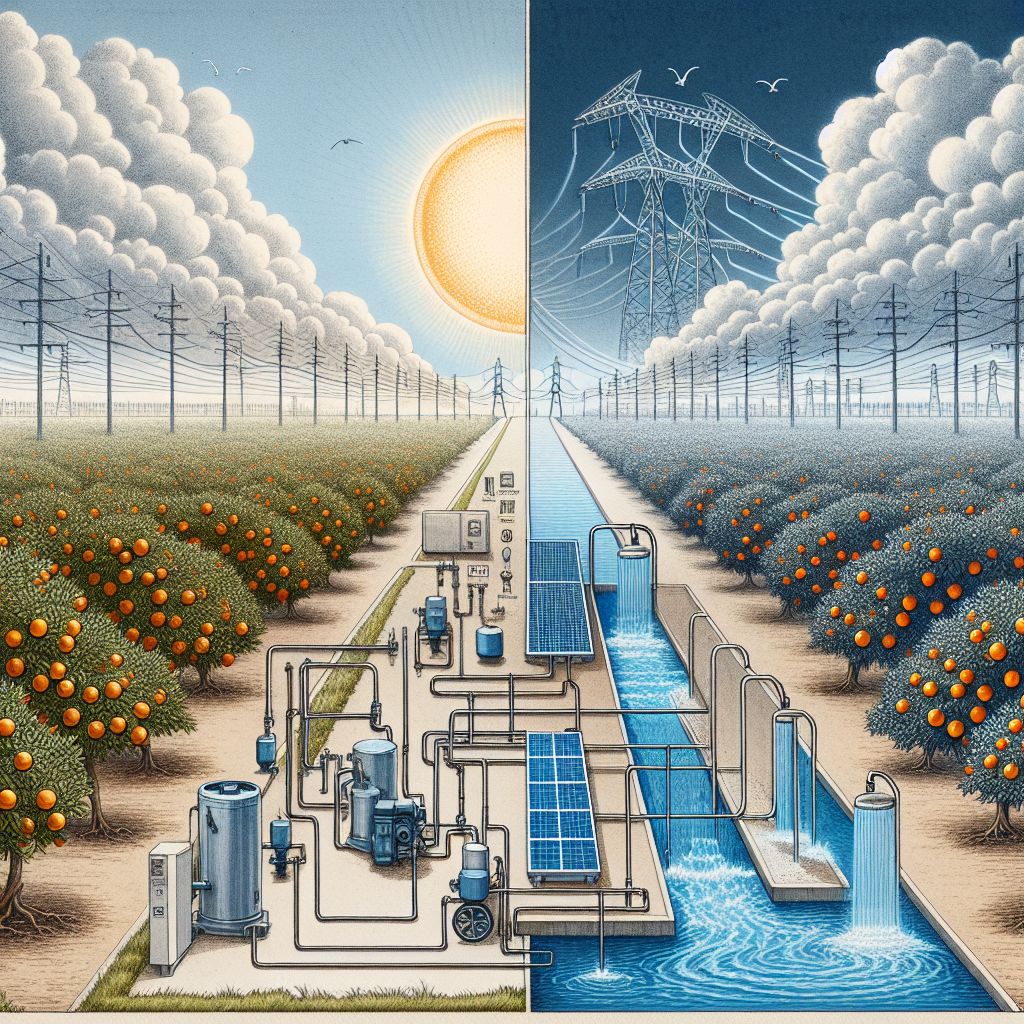
Comparing the Cost and Efficiency of Solar and Traditional Irrigation Systems for Growing Oranges
In a side-by-side comparison of traditional and solar-powered irrigation systems, the benefits of going solar are undeniable. Traditional systems typically run on grid electricity or diesel generators, which can be expensive and harmful to the environment. Solar irrigation systems harness the sun’s energy, which is not only free, but also a much greener solution. This results in a drastic reduction in operating costs and a boost in overall efficiency.
This table compare the pros and cons of solar-powered irrigation systems and conventional irrigation systems:
|
Aspect |
Conventional Irrigation System |
Solar-Powered Irrigation System |
|---|---|---|
|
Pros |
No ongoing energy costs, uses free solar power. 5 | |
|
Simple installation and maintenance. 1 |
Environmentally friendly, reduces carbon footprint. 3 | |
|
Reliable water supply even during power outages. 5 | ||
|
Long lifespan of solar panels (25-30 years). 5 | ||
|
Cons | ||
|
Susceptible to power outages. 5 |
Requires some technical knowledge for installation/maintenance. 3, 4 | |
|
Environmental impact from energy use. 3 |
Risk of over-abstraction of groundwater if not managed properly. 3, 4 | |
|
Potential for water waste/inefficiency. 1 |
Operating Costs Comparison
Let’s dissect the operating costs. You could be paying hundreds of dollars a month just for the fuel to run a diesel generator, not to mention what you’ll pay to maintain and repair it. The cost of grid electricity can also pile up fast, especially when you’re watering the most and the rates are at their highest.
Although there is an initial cost for the panels and their installation, once solar irrigation systems are operational, the ongoing costs are minimal. Since the sun doesn’t charge you for the energy it provides, the energy your panels produce is virtually free. Solar panels also require very little maintenance, usually just a regular cleaning and inspection.
Over time, the money put into solar can result in major savings. A lot of farmers discover that their solar irrigation systems cover their own costs within a couple of years, due to the decrease in energy and water expenses.
Assessing the Role of Solar Irrigation in the Longevity of Orange Farms
When we talk about sustainability, we’re referring to the long-term viability of our farming methods and their minimal environmental impact. Solar irrigation systems play a role in this by drastically reducing the carbon footprint associated with pumping irrigation water. In addition, they help save water, a resource that becomes more valuable with each passing year.
Using a solar irrigation system, farmers can provide a steady and dependable water supply for their orange trees. This dependability means healthier trees and more consistent yields. In the face of climate change and the increasing occurrence of droughts, solar irrigation systems provide a safeguard that can help guarantee the longevity of orange farms for future generations.
Conclusion: Is It a good Investment to Switch to a Solar Irrigation System for Growing Oranges
For citrus growers, the quest for sustainable and cost-effective irrigation is a constant battle. Rising water costs, energy prices, and the unpredictable climate make traditional systems a risky proposition. Enter solar irrigation: a game-changer that could revolutionize how we grow oranges.
While the initial investment may seem daunting, the long-term benefits of solar irrigation outweigh the drawbacks for many citrus growers. The potential for cost savings, environmental sustainability, and increased crop yield make it a compelling investment.
Ultimately, the decision to go solar is a personal one. By carefully evaluating your needs and weighing the pros and cons, you can determine if solar irrigation is the right solution for your orange grove. Just remember, the future of orange farming is bright, and solar irrigation can help you grow a profitable and sustainable future.
Questions You May Have
When it comes to solar irrigation systems for growing oranges, you may have a few questions. We’ve answered some of the most common ones to help you better understand this efficient watering solution.
What Should You Think About When Deciding Between Traditional and Solar Irrigation Systems?
There are several things you should consider when deciding between traditional and solar irrigation systems:
Price: Consider the initial costs as well as the ongoing costs of running each system.
Availability of energy source: Evaluate the reliability and availability of grid electricity compared to the viability of solar energy in your area.
Water efficiency requirements: Think about the water-saving benefits of each system, particularly in regions where water is scarce.
Sustainability objectives: Choose a system that aligns with your commitment to reducing carbon emissions and supporting renewable energy.
Size and topography of the farm: Consider the scalability of the system and its suitability for your farm’s landscape.
How Do Solar Irrigation Systems Affect the Quality and Quantity of Orange Production?
Solar irrigation systems can positively affect both the quality and quantity of orange production. By providing a steady and controlled water supply, these systems help to reduce stress on the trees, leading to better fruit development and potentially increased yields. Also, the accuracy of drip irrigation helps to improve nutrient uptake, contributing to the overall health of the trees and the quality of the fruit they produce.
Is it Possible for Solar Panels to Power a Whole Farm’s Irrigation System?
Yes, it is certainly possible for solar panels to power a whole farm’s irrigation system. The trick is to create a solar array that has enough capacity to satisfy the energy needs of your pumps and other irrigation equipment. This could require a substantial initial investment, but with the correct configuration, a solar array can supply all the power necessary to keep your orange trees healthy and growing.
For instance, a medium-sized California farm made the successful switch to a completely solar-powered irrigation system. Now, all of their drip irrigation pumps are powered by solar energy, saving them thousands in annual energy expenses.
What Are the Startup Costs for a Solar Irrigation System?
The startup costs for a solar irrigation system can greatly differ depending on the farm’s size, the irrigation system type, and the selected solar equipment. Here are some average costs:
Smaller systems can range from $1,000 to $5,000 in cost.
Medium-sized systems can cost anywhere from $5,000 to $20,000.
Large-scale systems can cost upwards of $20,000.
These prices include the solar panels, batteries (if needed for storage), controllers, and the labor for installation. While the initial cost can be high, there are often government incentives and tax breaks, as well as long-term savings on water and energy bills, that can help offset these initial costs.
Do I Need Special Training to Use a Solar-Powered Irrigation System?
You don’t need special training to use a solar-powered irrigation system, but it’s helpful to have a basic understanding of how the system works. Most modern systems are user-friendly and make it easy to set up watering schedules and keep an eye on how the system is performing. However, if your setup is more complicated, or if you want to get the most out of your system, you might find it useful to get some training or advice from a specialist.







Leave a Reply