

Key Takeaways
Solar power irrigation can significantly reduce energy costs for hemp farmers.
Monocrystalline solar panels are the most efficient but also the most expensive option.
Drip irrigation is highly efficient for water usage and ideal for hemp cultivation.
Combining solar panels with efficient irrigation systems promotes sustainable farming.
Initial costs may be high, but long-term savings and environmental benefits are substantial.
Why You Should Use Solar Panels with an Irrigation System for Growing Hemp
Using solar panels to power irrigation systems for growing hemp is a smart and sustainable choice. It helps cut down on energy expenses and promotes environmentally friendly farming practices. Hemp, being a water-intensive crop, requires efficient irrigation systems to ensure optimal growth. Solar power can provide the energy needed to run these systems without relying on traditional electricity sources.
Most importantly, integrating solar power with irrigation systems can make a farm more self-sufficient. Farmers can avoid the unpredictability of electricity prices and reduce their carbon footprint. Besides that, solar-powered irrigation systems can be tailored to fit various types of irrigation methods, ensuring that farmers can choose the best setup for their specific needs.
Benefits of Solar-Powered Irrigation
Solar-powered irrigation offers numerous benefits that can enhance the efficiency and sustainability of hemp farming. Here are some key advantages:
Cost Savings: Solar energy is free once the initial investment in panels and installation is made. This can lead to significant savings on energy bills.
Environmental Impact: Solar power is a clean energy source that reduces greenhouse gas emissions and dependence on fossil fuels.
Reliability: Solar panels can provide a consistent power source, especially in remote areas where electricity supply may be unreliable.
Scalability: Solar-powered systems can be scaled up or down based on the size of the farm and the specific irrigation needs.
Environmental Impact and Sustainability
Solar power is a renewable energy source that has a minimal environmental impact compared to traditional energy sources. By using solar panels to power irrigation systems, farmers can reduce their carbon footprint and contribute to a more sustainable future. This is especially important for hemp farming, which often requires large amounts of water and energy.
Furthermore, solar-powered irrigation systems can help conserve water. Efficient irrigation methods, such as drip or subsurface irrigation, can be powered by solar energy to deliver water directly to the plant roots, reducing water waste and ensuring that the plants receive the optimal amount of moisture.
Cost Savings and Long-Term Investment
Although the initial cost of installing solar panels and setting up a solar-powered irrigation system can be high, the long-term savings are significant. Traditional irrigation systems rely on electricity from the grid, which can be expensive and subject to price fluctuations. Solar power, on the other hand, is free once the system is in place.
Over time, the savings on energy bills can offset the initial investment. Additionally, many governments offer incentives and subsidies for renewable energy projects, which can help reduce the upfront costs. Investing in solar power for irrigation is not only a financially sound decision but also a step towards sustainable farming practices.
Energy Independence and Reliability
One of the major advantages of solar-powered irrigation systems is energy independence. Farmers are no longer reliant on the grid for their energy needs, which can be especially beneficial in remote areas where electricity supply is unreliable. Solar panels can provide a consistent and reliable power source, ensuring that irrigation systems run smoothly without interruptions.
Moreover, solar-powered systems are low maintenance. Once installed, they require minimal upkeep, making them a hassle-free option for farmers. Regular cleaning and occasional checks are usually sufficient to keep the system running efficiently.
Now that we finished looking at what irrigation system you should use to grow hemp, let’s take a look at the the solar panel that would power them.

Top Irrigation Methods Used by Hemp Farmers
Choosing the right irrigation method is crucial for the successful cultivation of hemp. Different methods offer varying levels of efficiency and suitability for different farm sizes and layouts. Let’s explore some of the top irrigation methods used by hemp farmers.
Drip Irrigation
Drip irrigation is one of the most efficient methods for watering hemp. It involves delivering water directly to the plant roots through a network of tubes and emitters. This method minimizes water waste and ensures that the plants receive the exact amount of water they need. For more information on setting up an efficient irrigation system, check out this guide on solar panels for farm irrigation systems.
Drip irrigation is particularly beneficial for hemp farming because it reduces the risk of overwatering and water runoff, which can lead to soil erosion and nutrient loss. By using solar power to run drip irrigation systems, farmers can further enhance the sustainability and efficiency of their operations.
Subsurface Irrigation
Subsurface irrigation is similar to drip irrigation but involves burying the irrigation tubes below the soil surface. This method delivers water directly to the plant roots, reducing evaporation and water loss. Solar-powered irrigation systems are ideal for hemp farming as they ensure that the plants receive a consistent supply of moisture without wetting the foliage, which can reduce the risk of fungal diseases.
Micro-Sprinkler Irrigation
Micro-sprinkler irrigation uses small sprinklers to deliver water to the plants in a fine mist. This method is suitable for areas with sandy soil where water infiltration is high. Micro-sprinklers can be powered by solar energy, making them a sustainable option for hemp farmers.
Sprinkler Irrigation
Sprinkler irrigation involves using overhead sprinklers to water the plants. This method is less efficient than drip or subsurface irrigation but can be useful for larger fields. Solar-powered sprinkler systems can help reduce energy costs and make the irrigation process more sustainable.
Center Pivot Irrigation
Center pivot irrigation is a method commonly used for large-scale farming. It involves a rotating sprinkler system that moves in a circular pattern, watering the crops evenly. While this method can be water-intensive, it can be made more sustainable by using solar power to run the system.
What is the Best Irrigation System to Use to Grow Hemp
The best irrigation system for growing hemp depends on various factors, including the size of the farm, soil type, and water availability. Drip irrigation is often considered the most efficient and effective method for hemp farming due to its precise water delivery and minimal waste.
However, subsurface irrigation and micro-sprinkler irrigation are also excellent options, particularly for farms with specific soil conditions or water requirements. Ultimately, the choice of irrigation system should be based on a careful evaluation of the farm’s needs and the sustainability goals of the farmer. For more information on efficient irrigation systems, visit our guide to solar panels for farms.
Choosing the right irrigation system for your hemp farm can make a significant difference in water usage efficiency and crop yield. While drip irrigation is highly recommended, other methods also have their advantages depending on specific farm conditions.

Top Solar Panels for Your Hemp Farmers Irrigation System
When it comes to selecting solar panels for your irrigation system, it’s essential to consider efficiency, cost, and suitability for your farm’s layout. The three most common types of solar panels are monocrystalline, polycrystalline, and thin-film. Each type has unique features and benefits.
Monocrystalline Solar Panels: High Efficiency in Limited Spaces
Monocrystalline solar panels are known for their high efficiency and long lifespan. These panels can convert a higher percentage of sunlight into electricity compared to other types, making them ideal for farms with limited space. Although they are more expensive, their efficiency can lead to greater energy savings in the long run.
Monocrystalline panels typically have an efficiency rate of 15-22%, meaning they can produce more power per square foot. This makes them a great choice for hemp farms that need a reliable and powerful energy source for their irrigation systems.
Polycrystalline Solar Panels: Cost-Effective Energy Solution
Polycrystalline solar panels are a more affordable option compared to monocrystalline panels. They have a slightly lower efficiency rate, usually around 13-16%, but they are still a viable option for powering irrigation systems. These panels are made from silicon crystals and are less expensive to produce.
While polycrystalline panels may require more space to generate the same amount of power as monocrystalline panels, their lower cost makes them an attractive option for farmers looking to save on initial investment costs.
Thin-Film Solar Panels: Flexibility and Versatility
Thin-film solar panels are known for their flexibility and versatility. They are lightweight and can be installed on various surfaces, including curved or irregularly shaped areas. However, their efficiency rate is lower, typically around 10-12%, which means they may not be the best choice for farms with limited space.
Despite their lower efficiency, thin-film panels can be a good option for farmers who need a flexible and adaptable solar power solution. They are also less affected by high temperatures, making them suitable for hot climates.
Here is a table showing the pros and cons of using different types of solar panels with an irrigation system on a farm:
|
Panel Type |
Pros |
Cons |
|---|---|---|
|
Monocrystalline Panels |
– High efficiency (15-22%), producing more power per square foot. 1, 2, 4 | |
|
Polycrystalline Panels |
– Lower upfront cost than monocrystalline. 1, 2 |
– Lower efficiency and shorter lifespan than monocrystalline. 2, 4 |
|
Thin-Film Solar Panels |
– Lowest upfront cost. 1, 2 |
– Lowest efficiency (7-13%). 2, 4 |
What is the Best Solar Panel to Use for Growing Hemp
The best solar panel for your hemp farm depends on your specific needs and budget. Monocrystalline panels offer the highest efficiency and are ideal for farms with limited space. Polycrystalline panels provide a cost-effective solution, while thin-film panels offer flexibility and versatility.
Consider the layout of your farm, the amount of sunlight your location receives, and your budget when choosing the right solar panel. By carefully evaluating these factors, you can select a solar panel that will provide reliable and efficient power for your irrigation system.
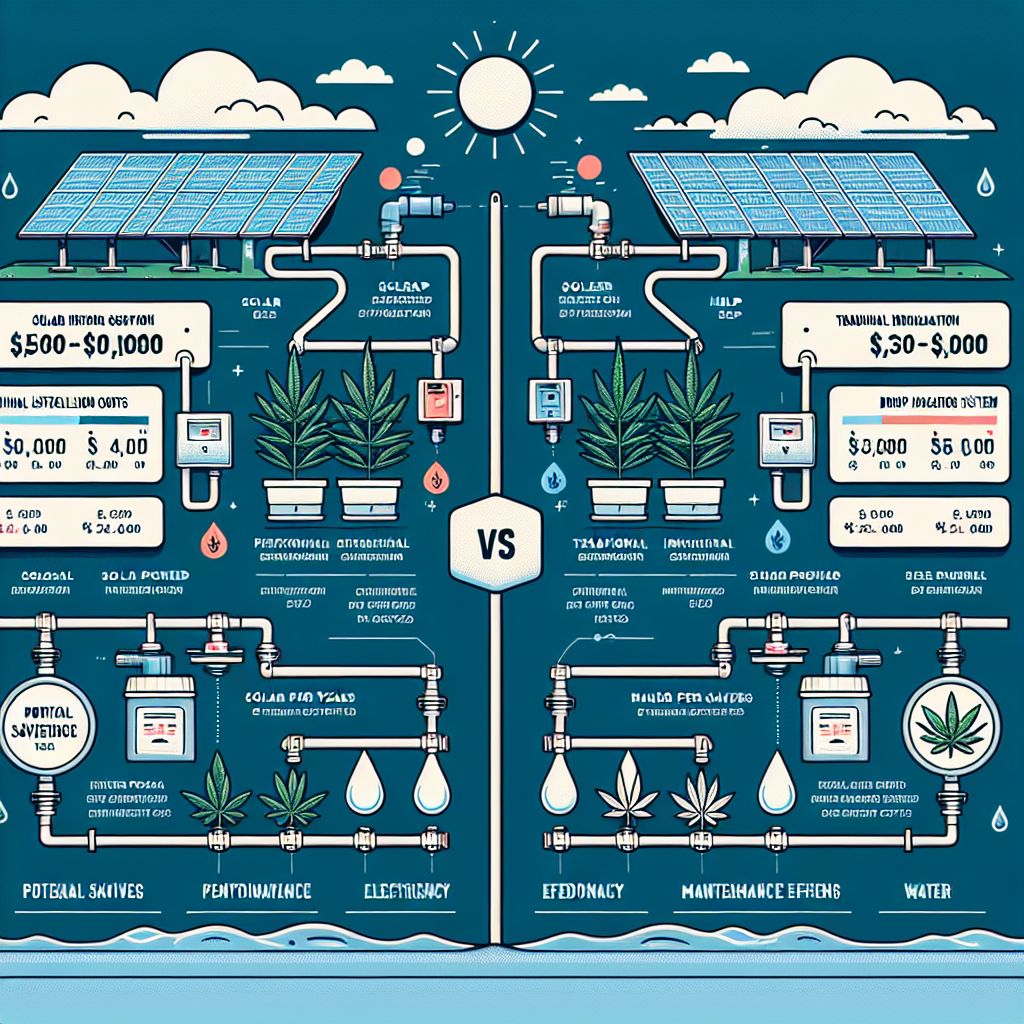
Cost and Efficiency Comparison: Solar Irrigation Systems Versus Traditional Irrigation Systems for Growing Hemp
When comparing solar irrigation systems to traditional irrigation systems, it’s important to consider both the initial installation costs and the long-term savings. Solar-powered systems may have higher upfront costs, but they can lead to significant savings over time.
Initial Installation Costs Comparison
The initial cost of installing a solar-powered irrigation system can be high due to the expense of solar panels and installation. However, many governments offer incentives and subsidies for renewable energy projects, which can help offset these costs.
|
System Type |
Initial Cost |
Potential Savings |
|---|---|---|
|
Solar-Powered Drip Irrigation |
$5,000 – $10,000 |
$1,000 – $2,000 per year |
|
Traditional Electric Drip Irrigation |
$3,000 – $7,000 |
$500 – $1,000 per year |
Maintenance and Upkeep Expenses Differences
Solar-powered irrigation systems generally require less maintenance than traditional systems. Solar panels have a long lifespan and need minimal upkeep, such as regular cleaning and occasional checks. Traditional systems, on the other hand, may require more frequent maintenance and repairs, leading to higher long-term costs.
Water Usage Efficiency Comparison
Solar-powered irrigation systems can enhance water usage efficiency by powering advanced irrigation methods such as drip or subsurface irrigation. These methods deliver water directly to the plant roots, reducing waste and ensuring that the plants receive the optimal amount of moisture. Traditional systems may not offer the same level of precision, leading to potential water waste and overwatering.
Energy Consumption and Savings Differences
Solar-powered irrigation systems offer significant energy savings compared to traditional systems. Once installed, solar panels provide free energy, reducing or eliminating electricity costs. Traditional systems rely on grid electricity, which can be expensive and subject to price fluctuations.
By using solar power, farmers can achieve energy independence and avoid the unpredictability of electricity prices. This can lead to substantial long-term savings and a more sustainable farming operation. For more information, check out this guide on solar panels for farms.
Here is a table comparing the cost and efficiency of an irrigation system with and without solar panels:
|
Aspect |
Without Solar Panels |
With Solar Panels |
|---|---|---|
|
Initial Cost | ||
|
Operating Cost |
Very low or zero fuel/electricity costs after installation. 1, 4 | |
|
Efficiency |
Depends on energy source efficiency. 4 |
Depends on solar radiation, temperature, system design. 1, 4 |
|
Environmental Impact |
Higher carbon footprint. 1 |
Lower carbon footprint, renewable energy. 1 |
|
Location Flexibility |
Limited to grid-connected or fuel access areas. 3 |
Can be used in remote off-grid areas. 3 |
|
Maintenance | ||
|
Lifespan |
Shorter for fuel-based systems. 1 | |
|
Long-term Costs |
Higher due to recurring fuel/electricity bills. 1 |
Lower total 20-year costs by 50-60% compared to traditional systems. 1 |
|
Government Incentives |
Generally none |
Many governments provide tax credits, subsidies for solar irrigation. 1 |
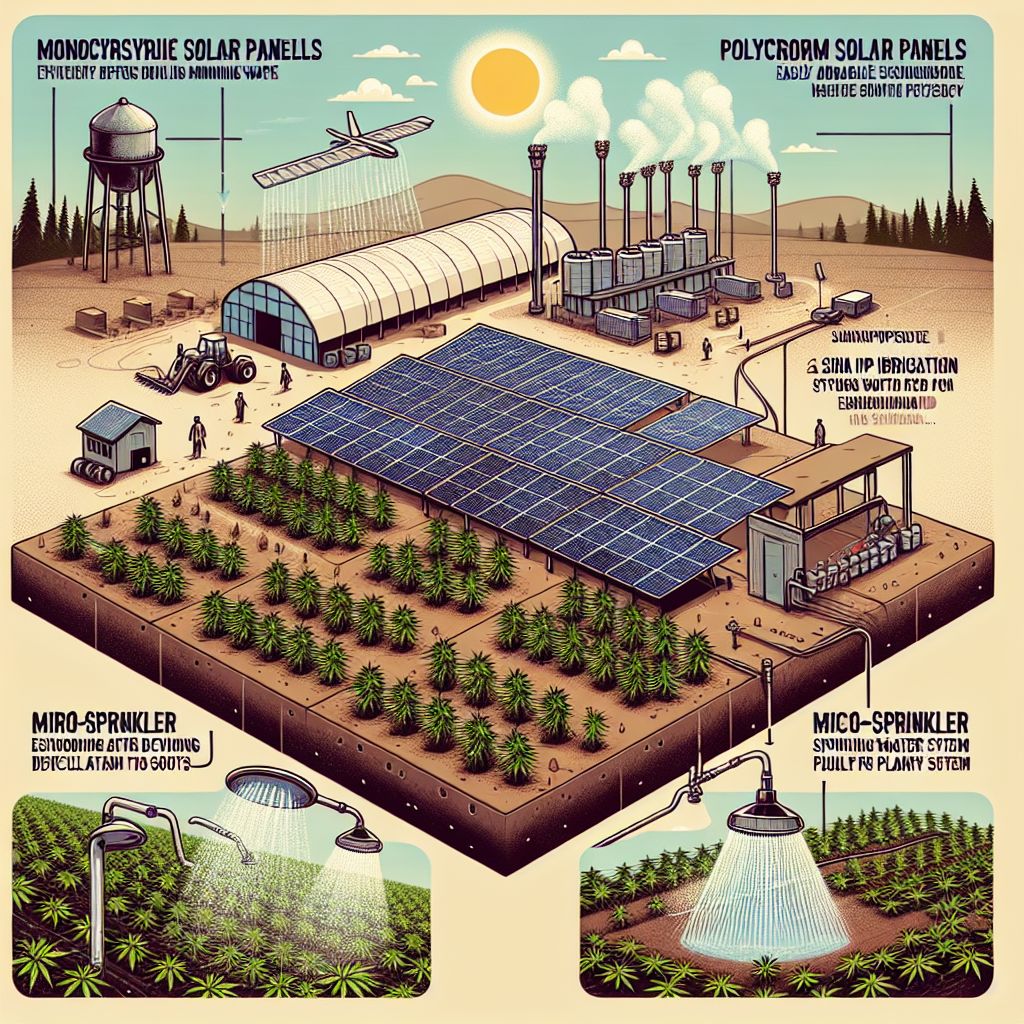
Which Combination of Solar Panels and Irrigation Systems make the Most Efficient System for Your Hemp Farm
Combining the right solar panels with the most suitable irrigation system can create an efficient and sustainable setup for your hemp farm. The ideal combination depends on your farm’s specific needs, layout, and budget. For more information on solar-powered irrigation, check out this guide on irrigation systems you can connect to solar panels.
Ideal Pairings: Drip Irrigation and Monocrystalline Solar Panels
Drip irrigation combined with monocrystalline solar panels is an excellent choice for hemp farming. This pairing offers high efficiency in both water usage and energy production. Monocrystalline panels provide reliable and powerful energy, while drip irrigation ensures precise water delivery to the plants. For more information on efficient irrigation systems, check out irrigation systems you can connect to solar panels.
Other good combinations include polycrystalline panels with subsurface irrigation for cost-effective and efficient water usage, and thin-film panels with micro-sprinkler irrigation for flexibility and adaptability in various farm layouts.
Ideal Pairings: Drip Irrigation and Monocrystalline Solar Panels:
Drip irrigation combined with monocrystalline solar panels is an excellent choice for hemp farming. This pairing offers high efficiency in both water usage and energy production. Monocrystalline panels provide reliable and powerful energy, while drip irrigation ensures precise water delivery to the plants. This combination minimizes water waste and maximizes energy efficiency, making it a sustainable and cost-effective solution for hemp farmers.
Other Good Combinations
Other effective combinations include:
Polycrystalline Panels with Subsurface Irrigation: This combination is cost-effective and efficient. Subsurface irrigation delivers water directly to the roots, reducing evaporation and water loss, while polycrystalline panels provide a budget-friendly energy solution.
Thin-Film Panels with Micro-Sprinkler Irrigation: Thin-film panels are flexible and can be installed on various surfaces, making them ideal for farms with irregular layouts. Micro-sprinkler irrigation provides a fine mist of water, suitable for sandy soils with high infiltration rates.
Conclusion: Is it a Smart Decision to Add Solar-Power to an Irrigation System for Your Hemp Farm?
Adding solar power to an irrigation system for your hemp farm is a smart decision that offers numerous benefits. It promotes sustainability, reduces energy costs, and enhances water usage efficiency. Although the initial investment may be high, the long-term savings and environmental benefits make it a worthwhile investment. By carefully selecting the right combination of solar panels and irrigation systems, you can create a highly efficient and sustainable farming operation.
Key Takeaways for Hemp Farmers
Solar power irrigation can significantly reduce energy costs for hemp farmers.
Monocrystalline solar panels are the most efficient but also the most expensive option.
Drip irrigation is highly efficient for water usage and ideal for hemp cultivation.
Combining solar panels with efficient irrigation systems promotes sustainable farming.
Initial costs may be high, but long-term savings and environmental benefits are substantial.
Pros and Cons Summarized
When considering solar-powered irrigation for your hemp farm, it’s important to weigh the pros and cons:
Pros:
- Energy independence and reliability
- Significant energy cost savings
- Reduced environmental impact
- Increased water usage efficiency
Cons:
- High initial installation costs
- Requires careful planning and evaluation
- Dependent on sunlight availability
Future Trends in Solar-Powered Irrigation
The future of solar-powered irrigation looks promising, with advancements in solar technology and irrigation methods continually improving efficiency and affordability. Innovations such as solar tracking systems, which adjust the angle of the panels to maximize sunlight exposure, and smart irrigation systems, which use sensors and data analytics to optimize water usage, are set to revolutionize the industry.
As more farmers adopt solar-powered irrigation, economies of scale will likely reduce costs, making it an even more attractive option for sustainable farming. Additionally, government incentives and subsidies for renewable energy projects are expected to continue, further supporting the growth of solar-powered irrigation systems.
Frequently Asked Questions (FAQs)
Here are some common questions about solar-powered irrigation systems for hemp farming:
How much can I save using solar power for irrigation?
The savings from using solar power for irrigation can vary depending on factors such as the size of the farm, the type of irrigation system, and local electricity rates. On average, farmers can save between $1,000 and $2,000 per year on energy costs by switching to solar-powered irrigation.
What are the maintenance requirements for solar irrigation systems?
Solar irrigation systems require minimal maintenance. Regular cleaning of the solar panels to remove dust and debris is essential to ensure optimal performance. Additionally, periodic checks of the irrigation system components, such as pumps and emitters, are necessary to prevent clogs and ensure efficient water delivery.
Can solar panels power large-scale irrigation systems efficiently?
Yes, solar panels can efficiently power large-scale irrigation systems. By carefully selecting the right type and number of panels, farmers can generate sufficient energy to meet the demands of extensive irrigation systems. Monocrystalline panels are particularly suitable for large-scale operations due to their high efficiency.
How do I choose the right solar panel for my hemp farm?
Choosing the right solar panel for your hemp farm involves considering factors such as efficiency, cost, and space availability. Monocrystalline panels offer the highest efficiency but come at a higher cost. Polycrystalline panels are more affordable but slightly less efficient. Thin-film panels provide flexibility and versatility but have a lower efficiency rate. Evaluate your farm’s specific needs and budget to make an informed decision.
Assess the energy requirements of your irrigation system.
Consider the available space for installing solar panels.
Evaluate the budget and potential savings from energy costs.
Is government funding available for solar-powered irrigation systems?
Yes, many governments offer incentives and subsidies for renewable energy projects, including solar-powered irrigation systems. These incentives can help reduce the initial installation costs and make solar power more accessible to farmers. Check with local and national government agencies for available funding programs and eligibility criteria.
Solar power irrigation for growing hemp is an innovative method that combines renewable energy with efficient watering techniques. This system ensures that hemp plants receive the right amount of water without wasting resources. By using solar power, farmers can reduce their carbon footprint and save on energy costs. Additionally, solar-powered irrigation systems can be automated to provide consistent watering schedules, which is crucial for the optimal growth of hemp plants.







Leave a Reply