
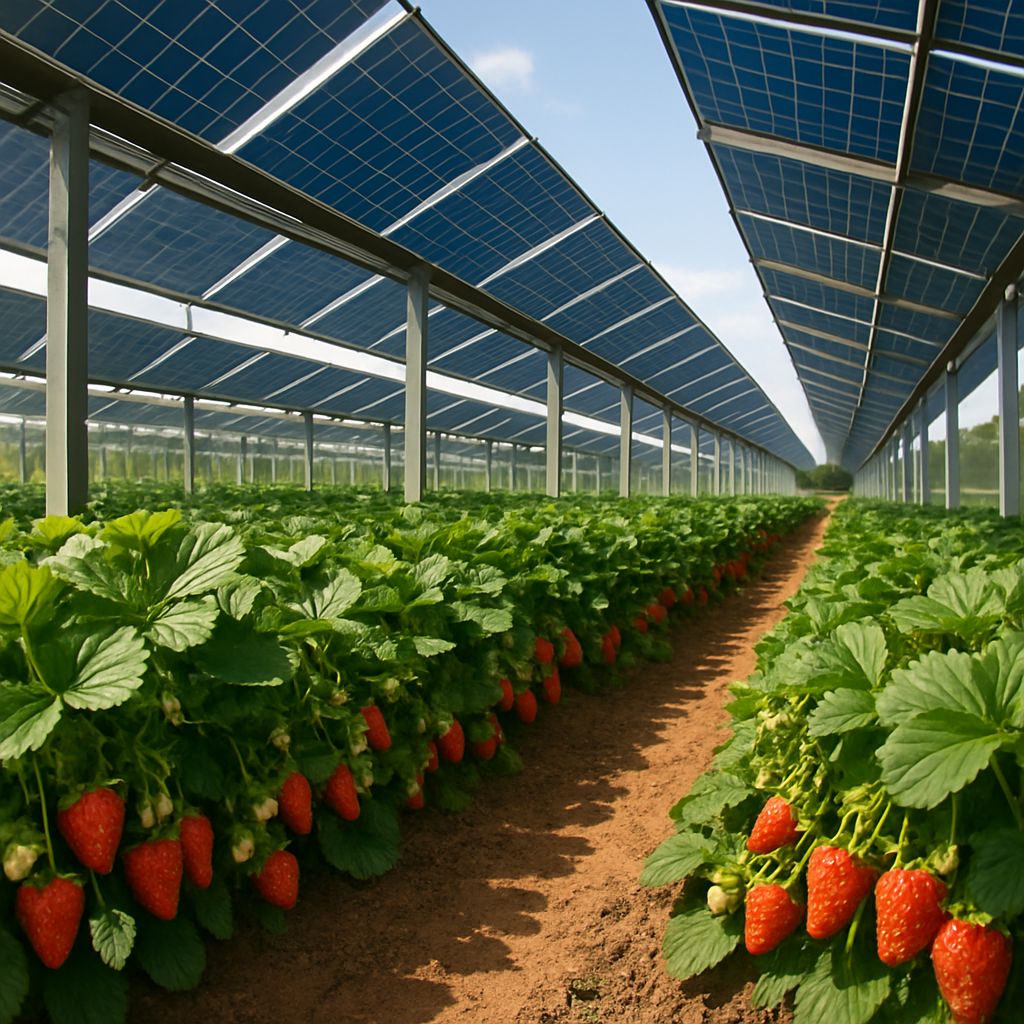
- Strawberries grown under 70% transparent solar panels produced 40.6% more fresh weight than control plants grown in full sun — a finding that flips conventional farming wisdom on its head.
- Agrivoltaic systems let farmers grow crops and generate clean electricity on the same land, with strawberry farms potentially producing between 595 and 1,786 GWh of electricity annually in Canada alone.
- Farmers who combine strawberry production with solar energy income could earn 2–3x more revenue per acre, while also reducing retail strawberry prices by up to 25%.
- Not all solar panels work equally well — panel transparency level is the critical variable that determines whether your strawberry yield goes up or crashes, and the sweet spot may surprise you.
- Agrivoltaics has already proven effective for dozens of crops worldwide, from basil to grapes — but new research from Ontario, Canada proves it works even in northern climates with shorter growing seasons.
Growing strawberries under solar panels isn’t just possible — in some cases, it outperforms traditional open-field farming entirely.
A landmark study conducted in Ilderton, Ontario tested how strawberry plants responded to varying levels of shading from semi-transparent solar panels. The results were hard to ignore. Not only did some plants produce more fruit than those grown in full sun, but the same system also generated clean electricity — turning a single plot of farmland into a dual-income operation. For farmers feeling the squeeze of rising input costs and unpredictable weather, this kind of system offers a genuinely different path forward.
Agritecture, a leader in urban and controlled environment agriculture strategy, has covered the growing momentum of agrivoltaic research globally. The Ontario study adds critical data for northern climate farmers who previously had little evidence that agrivoltaics could work in their conditions.
Strawberries Grow Better Under Solar Panels (Here’s the Proof)
The idea that partial shade could help strawberries outperform full-sun plants challenges decades of conventional growing advice. But the data from Ontario is specific and hard to argue with. For farmers interested in sustainable practices, the benefits of solar panels extend beyond energy savings, potentially enhancing crop yield as well.
The 18% Yield Increase That Changed the Game
In a separate but complementary agrivoltaic trial, strawberries grown under striped crystalline silicon solar panels produced 18% more fruit by weight than those grown in open field conditions. The panels created a microclimate beneath them — moderating temperature extremes, reducing water evaporation, and filtering light in a way that actually benefited the plants rather than harming them. This kind of yield bump has now been documented across dozens of crop types worldwide, but seeing it replicated with strawberries in a northern climate is what makes this research particularly significant for Canadian and northern U.S. farmers.
Why Full Sun Is Not Always Best for Strawberries
Strawberries are often categorized as full-sun crops, requiring at least 6–8 hours of direct sunlight daily. That’s true — but there’s a ceiling. Excessive heat and intense solar radiation during peak summer hours can cause heat stress, reduced fruit quality, and accelerated water loss in strawberry plants. Solar panels intercept that excess radiation and convert it to electricity, while the filtered light that reaches the plants sits closer to the optimal photosynthetically active radiation (PAR) range the crop actually needs. It’s not about giving plants less light — it’s about giving them the right light.
What Is Agrivoltaics?
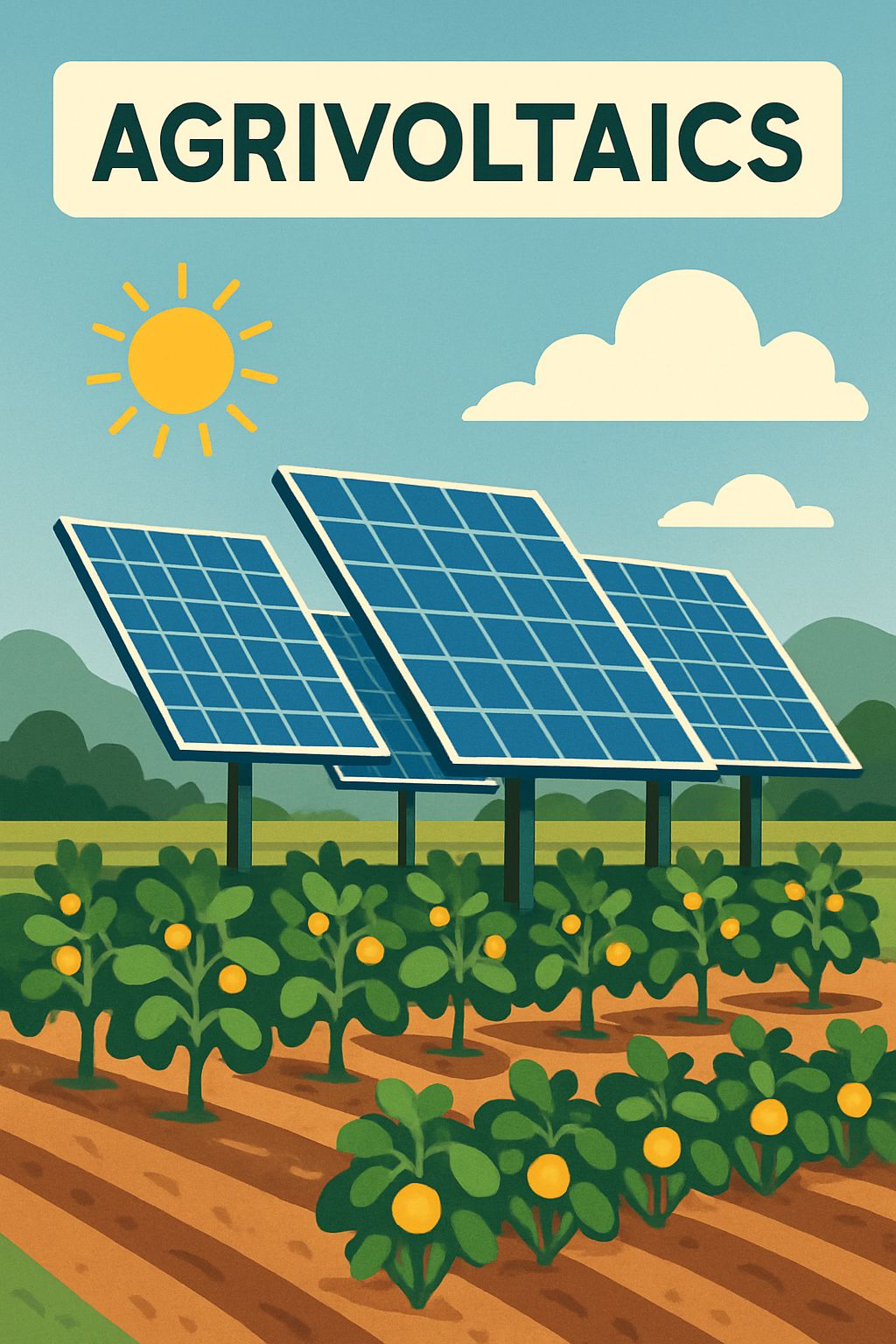
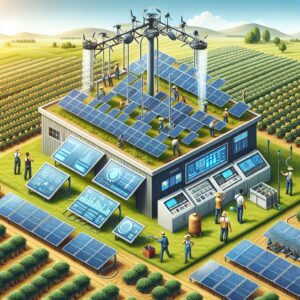
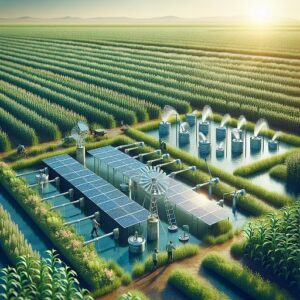
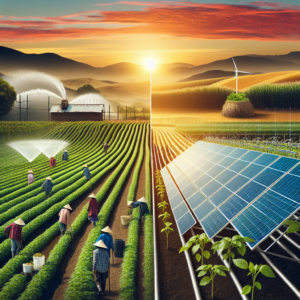
Agrivoltaics — sometimes called agrophotovoltaics or dual-use solar — is the practice of growing crops and generating solar electricity on the same land simultaneously. The panels are elevated and spaced to allow farming equipment, sunlight, and rain to pass through, while the crops below benefit from the modified growing conditions the panels create. Learn more about how solar panels on farms can help increase crop yields.
How Solar Panels and Crops Share the Same Land
In a traditional solar farm, panels are mounted low and close together, maximizing electricity generation but making the land below unusable for food production. Agrivoltaic systems flip that model. Panels are mounted higher — typically 2 to 4 meters above the ground — and spaced further apart or made semi-transparent so crops can still receive meaningful sunlight. The result is a system where land does two jobs at once: feeding people and powering communities. Rainfall still reaches the soil, farm machinery can often still operate underneath, and the panels provide a degree of climate buffering that benefits sensitive crops like strawberries.
Which Crops Benefit From Agrivoltaic Systems
Strawberries are far from the only crop showing positive results under solar panels. Research from around the world has documented yield improvements in a wide range of crops when grown in agrivoltaic systems, including:
- Basil
- Broccoli
- Celery
- Corn
- Grapes
- Kale
- Lettuce
- Strawberries
The crops that benefit most tend to be those that naturally tolerate or even prefer partial shade during the hottest parts of the day. Leafy greens and soft fruits like strawberries are particularly well-suited because they’re vulnerable to heat stress — the same stress that solar panels help mitigate.
The Solar Panel Transparency Sweet Spot for Strawberries
Not all semi-transparent solar panels perform the same way for strawberry production. The Ontario study tested thin-film cadmium telluride (Cd-Te) photovoltaic modules at seven different transparency levels — 10%, 30%, 40%, 50%, 60%, 70%, and 80% — to find the ideal balance between light transmission and electricity generation.
How Photosynthetically Active Radiation (PAR) Affects Plant Growth
PAR refers to the wavelengths of light — roughly 400 to 700 nanometers — that plants actually use for photosynthesis. Too little PAR and plants can’t produce enough energy to grow and fruit properly. Too much, especially combined with high heat, and plants divert resources to stress responses instead of fruit production. Semi-transparent solar panels act as a natural PAR filter, allowing farmers to tune the light environment beneath the panels by choosing the right transparency level for their specific crop and climate. For more insights, explore the benefits of solar panels for farmers.
Why 70% Transparent Panels Produced 40.6% More Fresh Weight
At 70% transparency, the Cd-Te panels transmitted enough PAR to keep plants in their optimal growth zone while cutting the harshest high-intensity radiation. Strawberries grown under these panels produced a fresh weight equal to 140.6% of the control group — meaning they outperformed open-field plants by 40.6%. The microclimate created beneath the panels reduced thermal stress during peak afternoon hours, allowing the plants to redirect energy toward fruit development rather than heat management. This transparency level appears to hit the sweet spot where light reduction is beneficial rather than limiting.
What Happens to Yield at 40% Panel Transparency
Even at 40% transparency — where significantly less light reaches the plants — strawberry yields remained above 80% of the open-field control. This is a critical finding because it means farmers using panels optimized more heavily for electricity generation (which tend to be less transparent) can still maintain commercially viable strawberry yields. It also suggests that the minimum transparency threshold for compliant agrivoltaic strawberry production sits around the 40% mark, giving system designers a meaningful range to work within depending on their energy and yield priorities.
How Transparency Levels Affect Leaf Count, Height, and Flowers
Yield isn’t the only metric that shifted under the panels. The Ontario study tracked plant morphology across all transparency levels, and the differences were measurable. Strawberry plants grown under the 70% transparent panels showed stronger vegetative development — more leaves, better canopy coverage, and healthy flower counts. As transparency dropped toward 10% and 30%, plants became visibly stressed: fewer leaves, reduced height, and lower flower counts that directly predicted weaker fruit sets. The data makes clear that light quality and quantity beneath the panels shapes the entire plant, not just the final harvest weight. For farmers looking to optimize their setups, understanding the benefits of solar panels is crucial.
The Financial Case for Strawberry Agrivoltaics
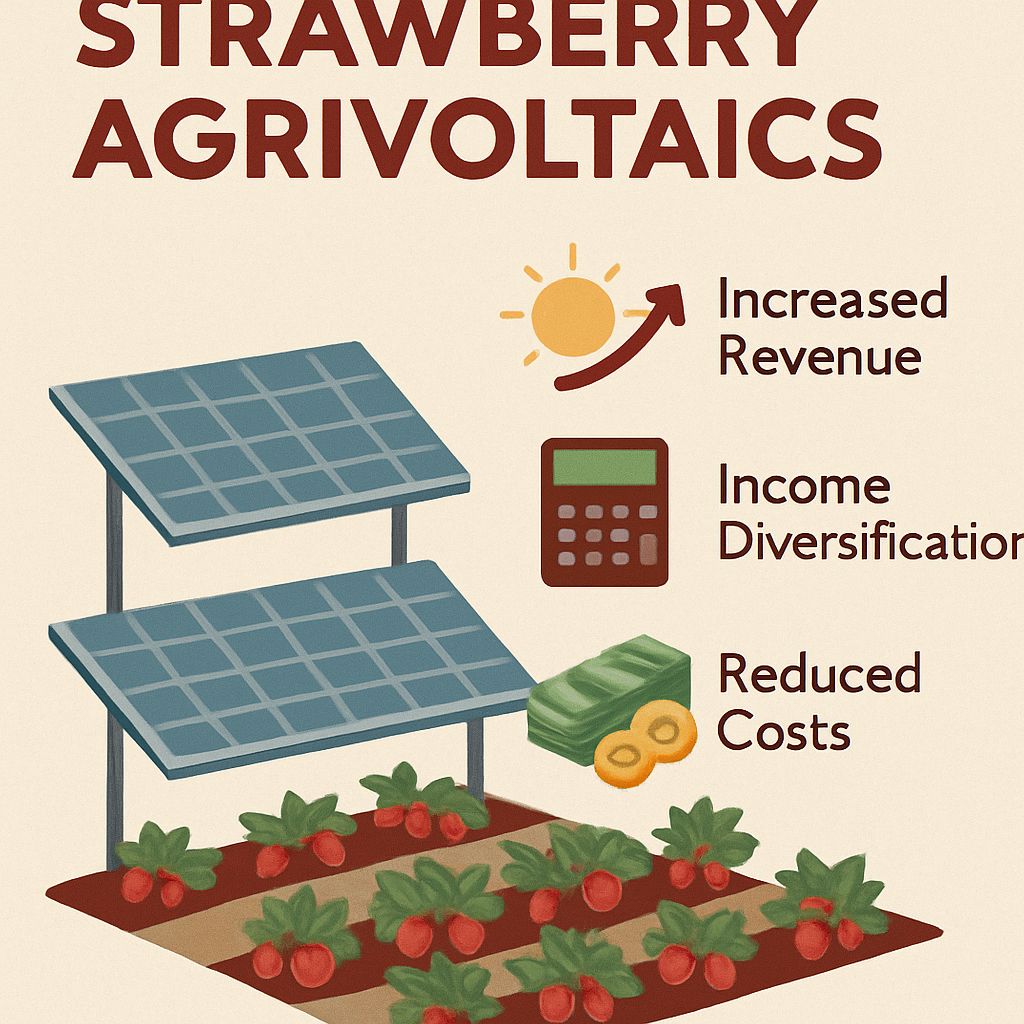
Beyond the agronomic results, the economic case for agrivoltaic strawberry farming is where this research becomes truly compelling for working farmers. Combining two revenue streams on a single piece of land fundamentally changes the math of farm profitability — especially as input costs continue to climb and commodity prices remain volatile.
How Farmers Can Earn 2-3x More Revenue
Traditional strawberry farming generates revenue from one source: fruit sales. An agrivoltaic system adds a second income stream — electricity — without requiring additional land. Depending on local energy pricing, feed-in tariffs, or net metering agreements, the solar component of an agrivoltaic strawberry operation can generate revenue that doubles or triples the total income per acre compared to strawberry production alone.
This isn’t theoretical upside. Researchers modeled the combined revenue potential of strawberry sales alongside electricity generation from semi-transparent panels across Canadian strawberry farm acreage. The findings consistently pointed to a 2–3x revenue multiplier when solar income was factored in alongside crop sales. For a sector where margins are often thin and weather risk is high, that kind of financial buffer is transformational.
How Solar Income Could Cut Strawberry Retail Prices by 25%
Here’s an angle that matters beyond the farm gate. When farmers earn supplemental income from solar electricity, they have more flexibility in how they price their fruit. The Ontario research estimated that solar revenue from agrivoltaic strawberry systems could allow farmers to reduce the retail price of strawberries by up to 25% while maintaining or improving their overall profit margins. For consumers dealing with rising grocery costs, and for farmers trying to compete with imported berries, that kind of structural price reduction could reshape local strawberry markets in meaningful ways.
Energy and Emissions: The Bigger Picture
The benefits of agrivoltaic strawberry farming extend well beyond individual farm economics. At a national and global scale, the electricity generation and emissions reduction potential of converting existing strawberry farmland to agrivoltaic systems represents a significant climate opportunity.
Canada alone has substantial strawberry acreage that could, in theory, host semi-transparent solar panels with transparency levels above 40% — the threshold the research identifies as commercially viable for both crop yield and electricity output. When researchers modeled this scenario, the numbers were substantial. For more information on how solar panels can benefit agriculture, explore the benefits of solar panels for farmers.
595 to 1,786 GWh of Annual Electricity From Canadian Strawberry Farms
Using a solar modeling tool, researchers calculated the electricity generation potential of Canadian strawberry farms if they installed semi-transparent panels at transparency levels above 40%. The range reflects the variation between panel types and transparency configurations:
At 40% panel transparency: approximately 1,786 GWh of annual electricity generation potential from Canadian strawberry farmland.
At 70% panel transparency: approximately 595 GWh of annual electricity generation potential — still a significant contribution, with the trade-off being higher crop yields and lower electricity output.
Source: Agrivoltaic study, Ilderton, Ontario — modeled using solar generation tools applied to Canadian strawberry farm acreage.
To put those numbers in context, 1,786 GWh is enough electricity to power hundreds of thousands of Canadian homes for a year. And this is from farmland that is already in production — no new land clearing, no dedicated solar farm development, no displacement of food production.
The lower end of the range — 595 GWh from 70% transparent panels — still represents a meaningful grid contribution, and it comes paired with the highest strawberry yield outcomes in the study. Farmers who prioritize crop performance over maximum electricity output can choose higher transparency panels and still contribute significantly to regional energy supply.
Up to 82 Million Metric Tons of Global Emissions Reduced Per Year
Scaling the agrivoltaic model beyond Canada, researchers estimated that if strawberry farmland worldwide adopted compatible solar panel systems, the resulting clean energy generation could displace fossil fuel electricity and reduce global greenhouse gas emissions by up to 82 million metric tons per year. That figure positions agrivoltaic strawberry farming not just as a smart farm business decision, but as a meaningful lever in the global transition away from carbon-intensive energy systems.
How to Set Up a Strawberry Agrivoltaic System on Your Farm
The research is compelling, but how do you actually move from open-field strawberry production to an agrivoltaic system? The process involves several interconnected decisions — about your land, your panels, your crop layout, and your local regulatory environment. Getting these right from the start will determine whether your system delivers on the yield and revenue potential the research demonstrates. For instance, understanding solar panel power solutions for farms can be crucial in maximizing the efficiency of your agrivoltaic system.
This isn’t a one-size-fits-all installation. The right configuration depends heavily on your specific climate, your existing farming infrastructure, and what balance of crop yield versus electricity generation you want to optimize for. Here’s how to approach each stage systematically.
1. Assess Your Local Climate and Sunlight Conditions
Before choosing any panel type or layout, you need a clear picture of your farm’s solar resource. Commission a site-specific solar irradiance assessment using tools like PVWatts (available through the U.S. National Renewable Energy Laboratory) or equivalent Canadian tools like RETScreen. Pay particular attention to peak sun hours, seasonal variation, and any shading from surrounding trees or structures. Strawberries in northern climates already face compressed growing seasons — your agrivoltaic system needs to be designed around your actual sun hours, not averages from sunnier regions.
2. Choose the Right Panel Transparency Level
This is the most consequential technical decision in the entire setup. Based on the Ontario research, your target transparency range should sit between 40% and 70%, depending on your priorities:
|
Transparency Level |
Strawberry Yield vs. Control |
Electricity Output |
Best For |
|---|---|---|---|
|
70% |
140.6% (40.6% above control) |
Lower (595 GWh range) |
Maximizing crop yield |
|
50–60% |
Near or above control |
Moderate |
Balanced yield and energy |
|
40% |
~80% of control |
Higher (1,786 GWh range) |
Maximizing electricity revenue |
|
Below 40% |
Below commercial viability threshold |
Highest |
Not recommended for strawberries |
For most strawberry farmers entering agrivoltaics for the first time, starting at 60–70% transparency is the lower-risk approach. You preserve most of your existing yield performance, you still generate meaningful solar revenue, and you give yourself a baseline season of data before making further infrastructure commitments.
The panel type also matters. The Ontario study used thin-film cadmium telluride (Cd-Te) photovoltaic modules, which offer uniform semi-transparency across the panel surface. Striped crystalline silicon panels — which alternate opaque and transparent strips — showed the strongest yield results in related research, producing that 18% yield increase over open-field controls. Both are worth evaluating with your solar installer, specifically in the context of strawberry production rather than standard rooftop or ground-mount applications.
3. Plan Your Crop Layout Beneath the Panels
Row orientation matters more in an agrivoltaic system than in open-field production. Orient your strawberry rows perpendicular to the panel rows where possible, so that as the sun moves across the sky, light gaps between panels sweep across your crop rather than leaving permanent shade strips on specific rows. This moving light pattern more closely mimics natural dappled light conditions and prevents any single row from being chronically underlit throughout the day.
Panel height above the crop is another variable that directly affects both your yield outcomes and your operational flexibility. Most commercial agrivoltaic installations mount panels at a minimum clearance of 2 meters above the crop canopy — enough to allow hand-picking operations and low-profile machinery to pass underneath without obstruction. If you’re running mechanical harvesting equipment, work with your structural engineer to determine the clearance height before any posts are set.
Spacing between panel rows creates the light corridors your plants depend on. A common starting configuration places panel rows far enough apart that at least 40–50% of the ground surface receives direct sunlight during peak hours, with the remainder receiving diffused or filtered light from the semi-transparent panel surface overhead. Monitor soil moisture carefully in the early seasons — the panels reduce rainfall interception on the covered areas, which changes your irrigation requirements compared to open-field production.
4. Connect to the Grid or Plan for Energy Storage
Most agrivoltaic strawberry operations will generate more electricity than the farm consumes on-site, making grid connection the most financially logical option for the majority of setups. Work with your local utility provider early in the planning process to understand net metering rates, feed-in tariff structures, and any interconnection requirements specific to agricultural solar installations. In some jurisdictions, agricultural land carries preferential connection terms — your utility provider or a local agricultural energy consultant can clarify what applies in your region. If grid connection isn’t viable or financially attractive in your area, battery storage systems can capture excess generation for farm use, reducing your purchased electricity costs and providing backup power during outages — a real operational advantage during critical harvest periods. For more insights on agrivoltaic setups, explore strawberries under solar panels.
5. Check Local Agrivoltaic Policy and Minimum Yield Mandates
Agrivoltaic policy is evolving rapidly, and where you farm determines a significant portion of your financial and regulatory landscape. Several countries and states have introduced minimum crop yield mandates for agrivoltaic installations — requirements that a defined percentage of the reference yield must be maintained for the land to qualify as agricultural under zoning law and to remain eligible for agricultural tax classifications. In Germany, for example, the DIN SPEC 91434 standard requires agrivoltaic systems to achieve at least 66% of the reference yield of the crop compared to conventional production. The Ontario research specifically notes that transparency levels above 40% keep strawberry yields above 80% of the control — comfortably within most existing mandate thresholds.
In North America, federal and provincial or state-level programs increasingly support agrivoltaic development through grants, accelerated depreciation on solar infrastructure, and low-interest financing for farm energy projects. In the U.S., the USDA Rural Energy for America Program (REAP) provides grants and loan guarantees for agricultural renewable energy systems. In Canada, programs through Natural Resources Canada and provincial agricultural ministries offer parallel support. Engage an agricultural energy consultant or your local farm bureau before finalizing any system design — the incentive landscape changes frequently and the right timing can significantly improve your project economics.
Agrivoltaics Is the Future of Sustainable Strawberry Farming
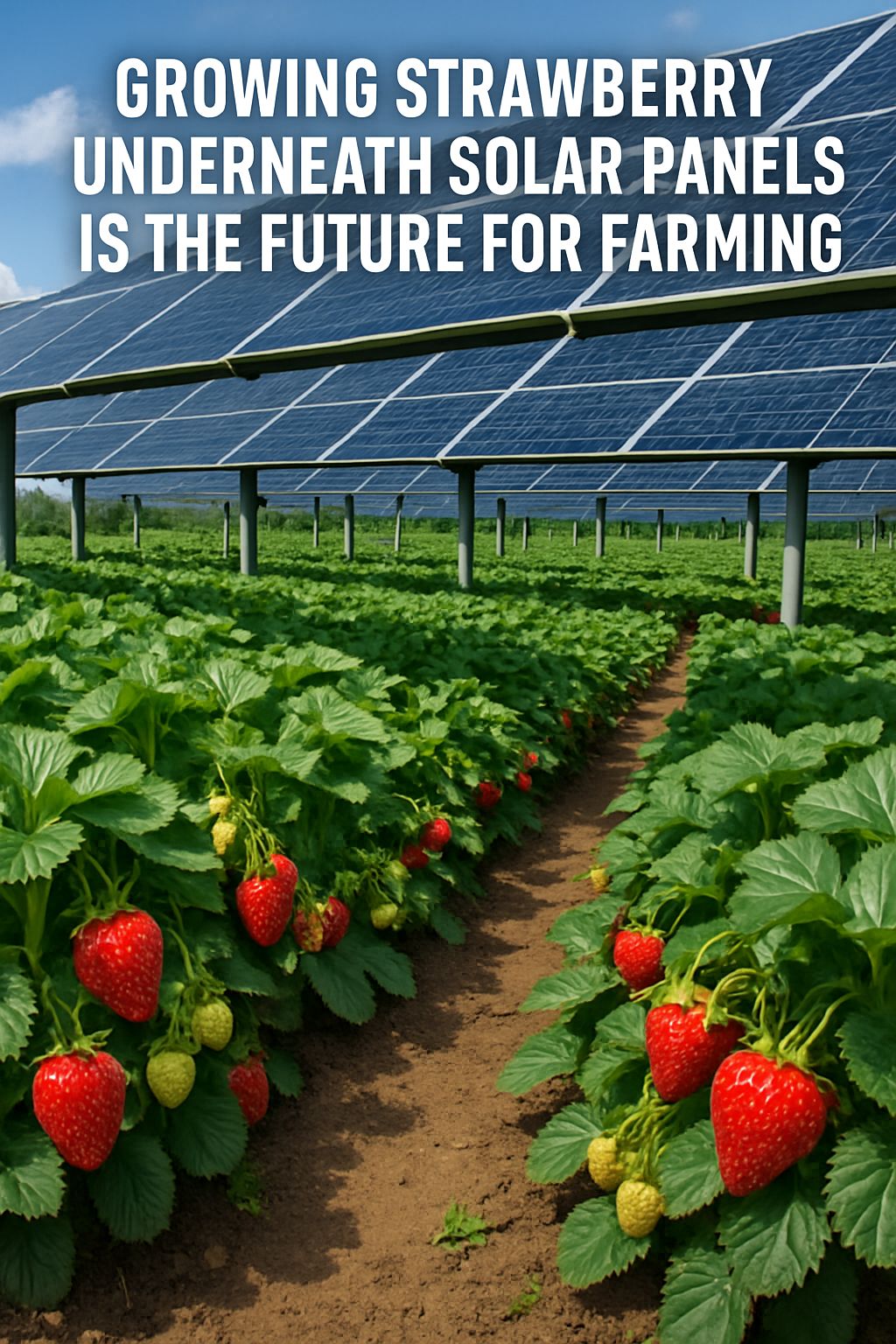
The Ontario study didn’t just confirm that strawberries can survive under solar panels — it showed they can thrive, outperform, and generate wealth in ways that open-field production simply cannot match on its own. A 40.6% yield increase under 70% transparent panels, combined with the potential for 2–3x revenue through solar income, and the documented ability to reduce retail strawberry prices by up to 25% — these aren’t incremental improvements. They represent a structural shift in what a strawberry farm can be.
Agrivoltaics won’t replace sound agronomy, careful variety selection, or experienced farm management. But it adds a powerful new dimension to what’s possible on existing farmland — turning sunlight into both food and energy simultaneously, on land that’s already in production, without sacrificing the crop that anchors the operation. For strawberry farmers navigating rising costs, climate pressure, and market volatility, that combination is worth taking seriously.
Frequently Asked Questions
Agrivoltaic strawberry farming raises practical questions for growers considering the transition from conventional open-field production. The research from Ontario and related global studies answer most of the key ones directly. For those interested in the integration of technology, exploring solar panel power solutions for farms can provide additional insights.
Do strawberries actually grow better under solar panels?
Yes — under the right panel configuration, strawberries can significantly outperform open-field plants. Here’s what the research shows:
- Strawberries under 70% transparent Cd-Te panels produced 140.6% of the control group’s fresh weight — a 40.6% yield increase over open-field plants.
- Strawberries under striped crystalline silicon panels produced 18% more fruit by weight than open-field controls in a separate agrivoltaic trial.
- Even at 40% panel transparency, yields remained above 80% of the open-field control — still commercially viable by most market standards.
- Panel-induced microclimates reduce heat stress during peak summer hours, allowing plants to direct more energy toward fruit development rather than thermal regulation.
The yield improvement isn’t guaranteed at every transparency level. Panels below 40% transparency suppressed yields significantly in the Ontario study, with plants showing reduced leaf counts, lower height, and fewer flowers — all leading indicators of weaker fruit production. The relationship between light transmission and yield is non-linear, which is why panel selection is the most critical variable in the entire system design.
It’s also worth noting that yield improvements have been documented across dozens of crop types in agrivoltaic systems globally — strawberries are not an anomaly. The mechanism is well understood: solar panels reduce peak thermal load, cut evapotranspiration rates, and filter excess radiation into a PAR range closer to what many crops actually need for optimal photosynthesis. Strawberries, as a soft fruit sensitive to heat stress and water loss, respond particularly well to these modified conditions.
What transparency level of solar panel is best for growing strawberries?
Based on the Ontario research, 70% transparent semi-transparent panels deliver the best strawberry yield outcomes, producing 40.6% more fresh weight than open-field controls. For farmers who want to balance crop yield and electricity generation, a transparency range of 50–70% represents the practical sweet spot — maintaining yields at or above the open-field reference while still generating meaningful solar revenue. Avoid transparency levels below 40% for strawberry production; the Ontario data shows yield performance drops below commercially viable thresholds at those light restriction levels. For more information on solar panel benefits for farmers, explore the advantages of integrating solar power in agriculture.
Can small-scale farmers benefit from agrivoltaic strawberry systems?
Yes, though the economics scale differently at smaller acreages. The upfront infrastructure cost of agrivoltaic panel mounting systems is higher per acre than conventional open-field production, which means smaller operations need to carefully model their payback period against their specific energy rates and solar incentives before committing. Community solar programs and shared agrivoltaic infrastructure models — where multiple smaller farms collectively invest in and benefit from a larger system — are emerging as viable pathways for operations that can’t absorb solo infrastructure costs.
The revenue diversification argument is actually stronger for small-scale farmers in many respects. A small strawberry operation with thin margins is more vulnerable to a single bad season than a large diversified farm. Adding a solar income stream that generates revenue regardless of crop performance — during drought years, pest pressure events, or late frosts — provides a financial cushion that can mean the difference between surviving a bad year and exiting the operation entirely.
What type of solar panels are used in strawberry agrivoltaic research?
The Ontario study used thin-film cadmium telluride (Cd-Te) photovoltaic modules tested across seven transparency levels from 10% to 80%. Related agrivoltaic strawberry research has also tested striped crystalline silicon panels — panels with alternating opaque and transparent strips — which produced an 18% yield increase over open-field controls in a separate trial. Both panel types are commercially available, though thin-film Cd-Te panels offer more uniform light distribution across the panel surface, while striped crystalline silicon panels create alternating light and shade bands that move across the crop as the sun tracks through the day. Each has agronomic implications worth discussing with both your solar installer and an agronomist familiar with agrivoltaic systems before you commit to a configuration.
Are there government policies that support agrivoltaic farming?
Government support for agrivoltaic farming is growing, but it varies significantly by country, province, and state. In the United States, the USDA Rural Energy for America Program (REAP) offers grants covering up to 50% of eligible project costs and loan guarantees for agricultural renewable energy installations — agrivoltaic systems qualify under this program where they meet the agricultural use criteria.
In Canada, Natural Resources Canada’s Clean Energy for Rural and Remote Communities program and provincial agricultural development funds offer financing options for farm-based renewable energy projects. Ontario, where the landmark strawberry agrivoltaic study was conducted, has active agricultural energy programs through the Ontario Ministry of Agriculture, Food and Rural Affairs (OMAFRA). For more insights on integrating renewable energy in agriculture, explore solar panel power solutions for farms.
In Europe, agrivoltaic policy is the most developed globally. Germany’s EEG renewable energy law includes specific provisions for agrivoltaic installations, and the DIN SPEC 91434 standard establishes technical and yield requirements that installations must meet to qualify. France’s agricultural agency has introduced dedicated agrivoltaic tender programs that provide fixed electricity purchase rates for qualifying farm solar installations. Learn more about the solar panel power solutions for farms.
Most jurisdictions with active agrivoltaic policy require that installations maintain a minimum percentage of the reference crop yield — typically between 66% and 80% depending on the region — to retain agricultural land classification and associated tax benefits. The Ontario research data showing yields above 80% of the control at transparency levels of 40% and above means that a well-designed strawberry agrivoltaic system should comfortably meet these thresholds in most regulatory environments.
The policy landscape is evolving fast. New agrivoltaic-specific incentive programs are being introduced regularly at the state, provincial, and federal level across North America. Engaging a farm energy consultant or your regional agricultural extension office at the start of your planning process — before you finalize any system design — ensures you capture every available incentive and structure your installation to remain compliant as regulations develop.



Leave a Reply