
Key Takeaways
- Solar panels can cut farm energy bills by generating electricity on-site, reducing dependence on the grid and protecting against rising utility costs over a 25-30 year panel lifespan.
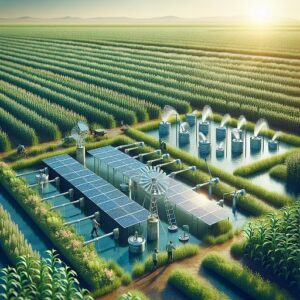
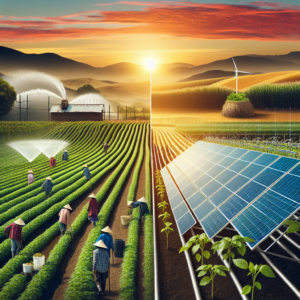
- Agrivoltaic systems let farmers grow crops and generate solar energy on the same land, with documented yield increases of up to 20% and irrigation water savings of up to 30%.
- The USDA’s Rural Energy for America Program (REAP) offers grants covering up to 25% of solar installation costs — one of several federal and state incentives that dramatically shorten payback periods.
- Not every farm is the right fit for solar — land orientation, shading, existing energy use, and available incentives all play a role in whether the numbers work in your favor.
- Net metering programs can turn your solar array into an income stream by crediting farmers for excess electricity sent back to the grid — keep reading to see how the math works.
Solar Panels Are Changing How Farmers Power Their Operations
Energy is one of the largest and least talked-about costs in modern farming — and solar panels are giving farmers a way to finally take control of it.
From irrigation pumps running through summer heat to grain dryers maxing out during harvest, farms consume electricity in ways most households never approach. That demand doesn’t shrink on its own. Utility rates have been climbing steadily, and for operations with thin margins, that’s a real problem. Solar panels address this head-on by generating electricity directly on the farm, often producing more than the operation needs during peak sunlight hours.
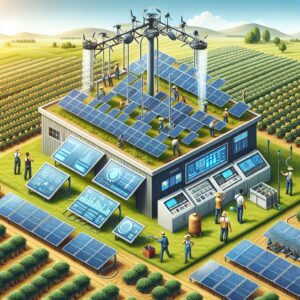
Growing Solar Mist specializes in helping agricultural operations navigate solar energy decisions, from panel selection to irrigation system integration — making them a useful starting point for farmers evaluating their options.
What makes solar particularly powerful for agriculture isn’t just the cost savings — it’s the flexibility. Whether you’re running a row crop operation, a livestock facility, or a small vegetable farm, there’s a solar configuration that fits. The technology has matured to the point where panels are more efficient, more durable, and more affordable than ever, and the financial case for farm solar has never been stronger.
How Solar Panels Cut Farm Energy Costs
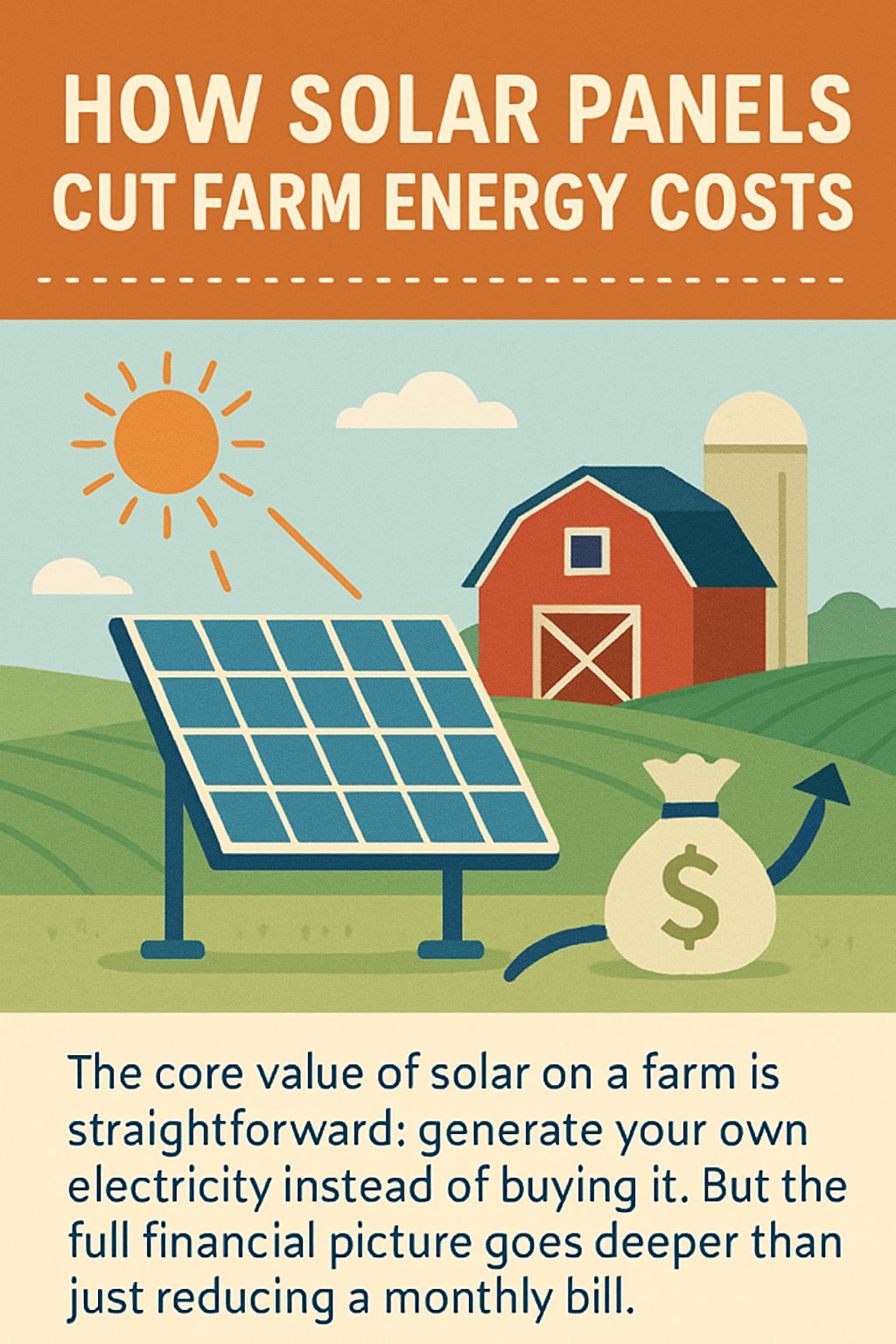
The core value of solar on a farm is straightforward: generate your own electricity instead of buying it. But the full financial picture goes deeper than just reducing a monthly bill.
Why Electricity Bills Are One of Farming’s Biggest Expenses
Modern farms rely on electricity for nearly every major function — irrigation systems, climate-controlled storage, ventilation for livestock barns, lighting, processing equipment, and more. Row crop operations face particularly sharp seasonal spikes. During harvest, grain dryers and irrigation pumps can run around the clock, sending electricity bills surging. Dairy and poultry operations face the opposite problem: consistently high baseline usage every single month with no off-season relief. To mitigate these costs, many farmers are exploring solar panels to power farm equipment with renewable energy.
These aren’t small numbers. Depending on the size and type of operation, farm electricity costs can run from several hundred to several thousand dollars per month. Solar panels attack that cost directly by generating electricity during daylight hours — right when many of those high-draw systems are running hardest.
How Net Metering Turns Excess Solar Power Into Farm Income
Net metering is a billing arrangement where your utility credits you for electricity your solar system produces but doesn’t immediately use. When your panels generate more power than your farm is consuming — common on sunny afternoons when loads are lower — that excess flows back to the grid, and your meter runs backward. This process can be further optimized by utilizing solar panels to power farm equipment and tools with renewable energy.
Those credits offset what you pull from the grid at night or during cloudy periods. In states with strong net metering policies, some farmers effectively zero out their electricity bills entirely. A few operations even generate small net credits. Availability and credit rates vary by state and utility, so checking your local policy before sizing a system is an important step. For more information on essential power solutions for farmers, explore solar panel backup batteries.
Solar Panels Last 25-30 Years: The Long-Term Math for Farmers
Most commercial-grade solar panels carry performance warranties guaranteeing at least 80% of original output after 25 years. In practice, many panels exceed that threshold. When you spread the installation cost across a 25-30 year operational lifespan, the per-kilowatt-hour cost of solar-generated electricity drops well below grid rates in most regions — and unlike utility rates, it doesn’t increase over time.
The compounding effect matters here. Every year utility rates rise, the value of your solar investment grows. Farmers who installed systems 10 years ago are now seeing even greater returns than their original projections showed, simply because grid electricity got more expensive while their solar cost stayed flat.
Agrivoltaics: Growing Crops and Energy on the Same Land
Agrivoltaics — the practice of co-locating solar panels and crop production on the same land — is one of the most exciting developments in agricultural solar. Rather than choosing between farming a plot or installing solar on it, agrivoltaic systems let you do both simultaneously.
How Shared Land Use Boosts Crop Yields by Up to 20%
This sounds counterintuitive at first. Less direct sunlight reaching plants should mean lower yields, right? Not necessarily. Many crops experience stress from excessive heat and direct sun exposure during peak summer hours. Solar panels mounted above crops provide partial shade that moderates temperature at the canopy level, reducing that stress. Farmers implementing agrivoltaic systems have documented yield increases of up to 20% for shade-tolerant crops compared to fully exposed plots — a finding that’s been repeated across diverse growing regions.
Solar Panels Reduce Water Evaporation by 30% for Crops Below
Water is the single most constrained resource in agriculture across much of the world, and agrivoltaics directly addresses that pressure. The shade cast by elevated solar panels significantly reduces soil surface temperature and slows evaporation. Documented field results show irrigation water requirements dropping by up to 30% in agrivoltaic plots compared to conventional open-field setups.
For farmers in arid or drought-prone regions, this isn’t a minor benefit — it can be the difference between a profitable season and a failed one. Reduced irrigation demand also means lower pump runtime, which compounds the energy savings solar is already delivering on the electricity generation side.
Which Crops Thrive Best Under Solar Panels
Not every crop responds equally well to the partial shade an agrivoltaic setup creates. The best results come from plants that naturally grow in dappled light conditions or that suffer yield and quality losses when exposed to intense midday sun. Leafy greens, herbs, and certain root vegetables consistently perform well in these setups, while crops that need maximum direct sunlight — like corn — are generally better suited to conventional open-field production.
The elevation and spacing of the solar array also matters. Panels mounted higher with wider spacing let more light through and allow farm equipment to operate beneath them, making the system practical for ongoing cultivation rather than just a passive setup.
Here’s a breakdown of how common crops perform under agrivoltaic conditions:
- Lettuce and leafy greens — Thrive under partial shade, with reduced bolting in summer heat and improved water retention in the soil
- Spinach — Benefits significantly from reduced heat stress, particularly in warmer growing zones
- Kale and Swiss chard — Perform well with filtered light and show strong yield consistency under panels
- Herbs (basil, cilantro, parsley) — Less prone to bolting under shade, producing higher-quality harvests for longer periods
- Strawberries — Show improved fruit quality with reduced sun scald in agrivoltaic systems
- Tomatoes and peppers — Mixed results depending on panel density; moderate shading can reduce heat stress without significantly cutting yields
- Root vegetables (carrots, beets, radishes) — Tolerate partial shade well and benefit from improved soil moisture retention
Solar-Powered Farm Equipment That Reduces Operating Costs
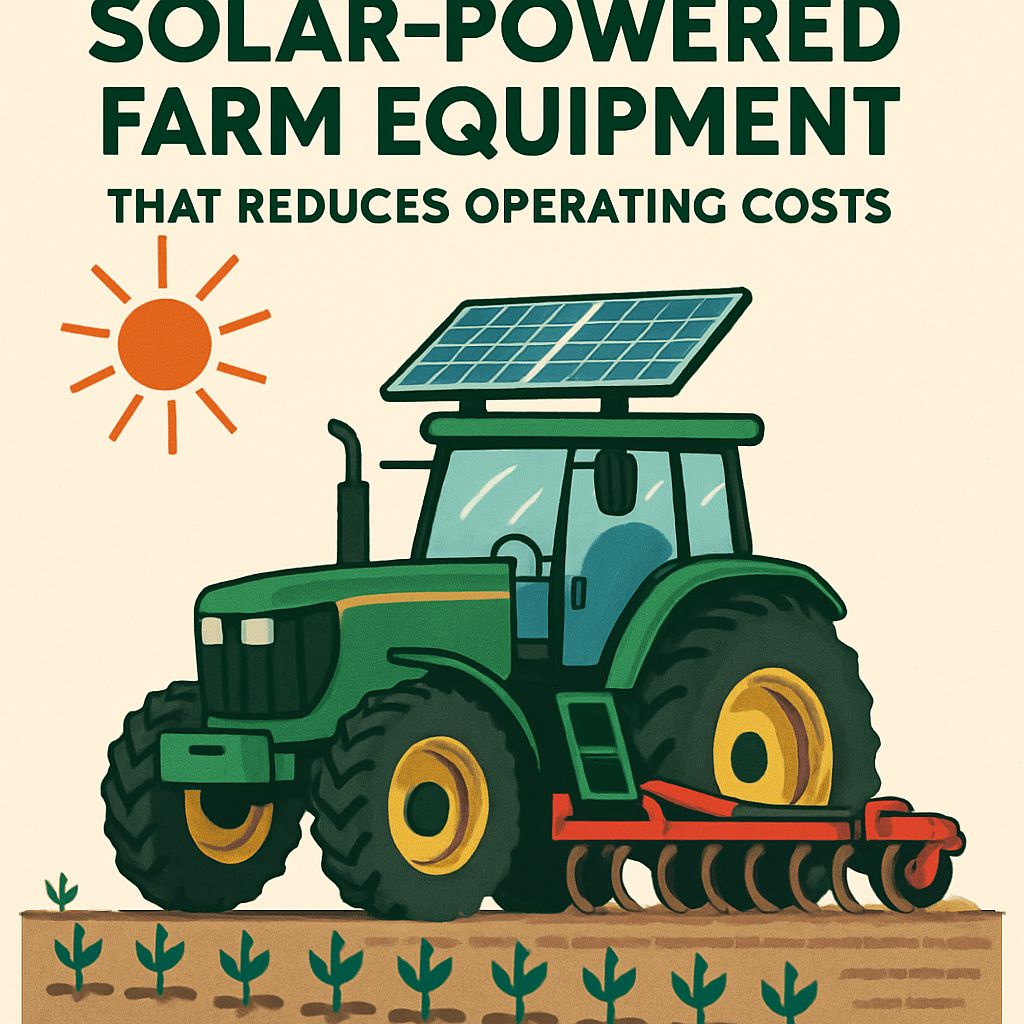
Beyond generating electricity for the grid or general farm use, solar power can be applied directly to specific pieces of farm equipment — cutting operating costs at the source rather than just offsetting them on a utility bill.
The two highest-impact applications for most farms are irrigation and ventilation. Both systems run frequently, consume significant electricity, and operate during daylight hours when solar generation is at its peak — making them ideal candidates for direct solar integration.
Solar Water Pumps for Irrigation
Solar-powered irrigation pumps eliminate the need to run electrical lines to remote field locations and remove the ongoing cost of powering pumps from the grid. These systems pair photovoltaic panels directly with pump motors, drawing water from wells, ponds, or reservoirs during daylight hours. For farms that irrigate during the day — which is most of them — the timing alignment between solar generation and pump operation is nearly perfect. Systems range from small single-panel setups for livestock water troughs to multi-panel arrays capable of driving high-volume center-pivot irrigation systems across hundreds of acres.
Solar Ventilation Systems for Livestock Barns and Greenhouses
Livestock barns and greenhouses share a common challenge: managing heat and air quality demands constant fan and ventilation system operation, often during the hottest parts of the day when electricity demand — and rates — are highest. Solar ventilation systems address this directly. Panels mounted on barn or greenhouse rooftops power fans and ventilation equipment during peak sunlight hours, which aligns almost exactly with peak heat and ventilation demand.
For poultry and hog operations in particular, where ventilation failures can result in significant animal losses, solar-backed systems with battery storage provide an added layer of reliability during grid outages. A properly sized solar ventilation setup can dramatically reduce the monthly electricity draw from climate management equipment while improving operational resilience.
Government Incentives That Make Farm Solar More Affordable
The upfront cost of a farm solar installation is the most common barrier farmers cite — and it’s a legitimate concern. A system sized for a mid-scale operation can run well into six figures before incentives. The good news is that between federal programs, state-level subsidies, and agricultural-specific grants, the effective out-of-pocket cost can be reduced substantially.
Understanding which programs you qualify for before signing any installation contract is critical. Incentives vary by state, utility territory, and farm type, and stacking multiple programs can make the difference between a 12-year payback period and a 6-year one. For more information on how to power farm equipment with renewable energy, explore our guide on farm solar panels.
Federal Tax Credits Available to Farmers
The federal Investment Tax Credit (ITC) allows farmers to deduct a significant percentage of their solar installation cost directly from their federal tax liability. Under current law, the ITC covers 30% of the total system cost for installations meeting domestic content and prevailing wage requirements. This applies to both purchased systems and certain financed arrangements, making it one of the most powerful tools available for reducing the net cost of going solar on a farm.
USDA Grants and Agricultural Solar Subsidies
Program
Type
Coverage
Who Qualifies
USDA REAP (Rural Energy for America Program)
Grant + Loan Guarantee
Grants up to 25% of project cost
Agricultural producers and rural small businesses
Federal Investment Tax Credit (ITC)
Tax Credit
30% of total installation cost
Any farm with federal tax liability
USDA Farm Service Agency (FSA) Loans
Low-Interest Loan
Financing for energy improvements
Eligible farm operations
State Agricultural Solar Incentives
Varies (rebates, credits, grants)
Up to 25% additional savings in some states
Varies by state and utility provider
The USDA’s Rural Energy for America Program (REAP) is the most impactful agricultural-specific solar incentive available at the federal level. It provides grants covering up to 25% of installation costs and loan guarantees for the remainder, specifically targeting agricultural producers and rural small businesses. Applications are accepted on a rolling basis, and priority is given to projects that demonstrate strong energy savings relative to cost, such as those utilizing farm solar panels.
Stacking REAP grants with the federal ITC is both legal and common practice among farmers who work with experienced solar and agricultural finance advisors. A farmer who qualifies for both programs could offset more than half the gross installation cost before factoring in any state-level incentives or net metering credits.
Long-term financial planning is essential when evaluating these combined incentive stacks. The benefits accumulate across the 25-30 year lifespan of solar equipment, and working with both agricultural and renewable energy financial specialists helps develop projections that capture every available value stream — from upfront grants to decades of reduced utility costs.
Environmental Benefits of Solar Power on Farms
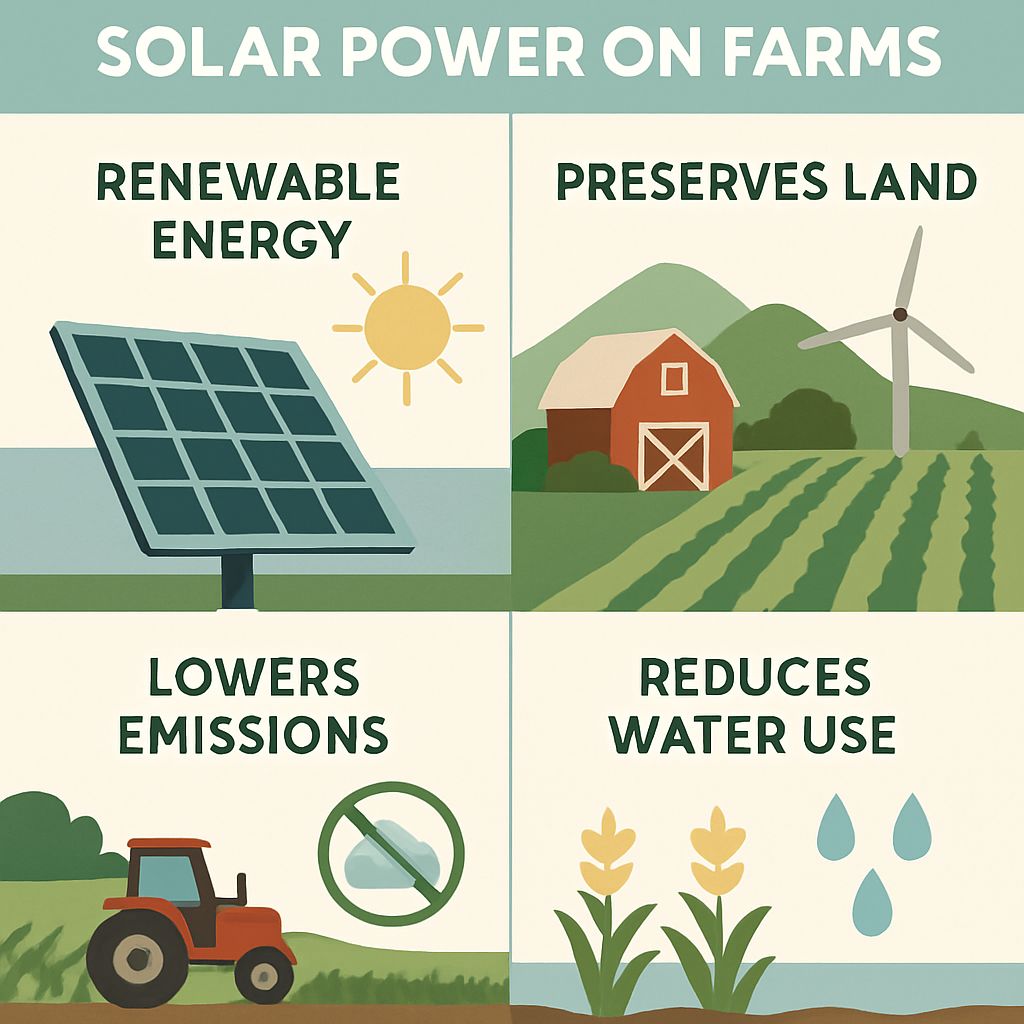
Solar panels dramatically reduce a farm’s carbon footprint by replacing grid electricity — which is often generated from fossil fuels — with clean, on-site renewable generation. Beyond emissions reduction, agrivoltaic systems actively improve local soil health by reducing erosion and moderating ground temperature, while solar-powered irrigation reduces groundwater draw through improved efficiency. Farms that adopt solar contribute to broader rural grid stability too, feeding excess generation back into local networks that serve surrounding communities.
Is Solar Power Right for Every Farmer?
Solar is a powerful tool — but it isn’t a universal fit. Whether it makes financial and practical sense for your operation depends on a combination of factors that vary significantly from one farm to the next. The good news is that most of these factors are easy to evaluate before committing to anything.
The most important variables are your current electricity costs, the solar resource at your location (how much sunlight your land receives annually), the orientation and shading of available roof or ground space, and which incentive programs you qualify for. Farms with high electricity consumption, south-facing unshaded roof or ground space, and access to REAP grants and the ITC tend to see the strongest returns. Operations with low electricity use, heavily shaded land, or limited tax liability may find the payback period extends beyond what makes practical sense.
Farm Conditions That Favor a Strong Solar Return
The strongest candidates for farm solar are operations with high and consistent electricity consumption, unobstructed south-facing roof or ground space, and access to favorable net metering policies. If your farm runs irrigation pumps, grain dryers, climate-controlled storage, or livestock ventilation systems regularly, you already have the energy demand profile that makes solar economics work. Add in REAP grant eligibility and the federal ITC, and payback periods in the 5-8 year range are realistic for many operations.
Location matters too, but perhaps less than most farmers assume. While peak sun hours vary across regions, solar panels generate meaningful electricity across most of the continental United States — including northern states and areas with significant cloud cover. What matters more than geographic location is the absence of shading from trees, buildings, or terrain features during peak daylight hours.
When Solar May Not Be the Best Investment
Solar isn’t the right call for every situation. If your farm has very low electricity consumption, the payback period stretches out to the point where the financial case weakens considerably. Similarly, if available roof or ground space is heavily shaded, panel output will be significantly reduced and may not justify the installation cost. Farms with limited federal tax liability may also find the ITC less useful — though REAP grants and accelerated depreciation options can partially compensate for that.
When evaluating whether solar makes sense, weigh what you’d earn by keeping that land in production versus what you’d save with panels on it. For highly productive cropland, the math sometimes favors farming over solar. Ground-mounted arrays require land, and that land has an opportunity cost that needs to be factored honestly into any financial projection.

Solar Energy Is One of the Smartest Long-Term Investments a Farmer Can Make
For the right operation, solar panels represent something rare in agriculture: a capital investment that actively reduces operating costs every single day for 25-30 years, with minimal maintenance required and strong government support behind it. The combination of on-site electricity generation, net metering income, agrivoltaic yield improvements, federal tax credits, and USDA grants creates a financial case that compounds in your favor year after year — especially as grid electricity prices continue to climb. If your farm has the energy demand, the land, and the sun exposure to support a well-sized system, the question isn’t really whether solar makes sense. It’s how quickly you want to start capturing those savings.
Frequently Asked Questions
Here are answers to the most common questions farmers have when evaluating solar energy for their operations.
How Much Do Solar Panels Cost for a Farm?
Farm solar installation costs vary widely based on system size, equipment selection, and installation complexity. Small systems designed to offset partial farm electricity use might run $15,000–$40,000 before incentives. Mid-scale systems for operations with significant electricity demand typically fall in the $50,000–$150,000 range. Large commercial farm installations can exceed $250,000 for full arrays. After applying the federal ITC (30%) and a REAP grant (up to 25%), the effective out-of-pocket cost can be reduced by more than half for qualifying operations. Always get multiple quotes from installers experienced in agricultural solar specifically, as farm installations have unique structural and electrical requirements compared to residential or commercial projects.
Can Solar Panels Power an Entire Farm?
Yes — with a properly sized system, solar panels can cover 100% of a farm’s electricity needs, and in some cases generate a surplus. The key is accurate load assessment before system design. A solar installer with agricultural experience will analyze 12 months of electricity bills, account for seasonal demand spikes like harvest-time grain drying, and size the array accordingly. Battery storage systems can extend solar coverage into nighttime hours and cloudy periods, though for most farms, a combination of solar generation and net metering credits provides effective full-coverage without the added cost of large-scale battery banks.
What Is the Payback Period for Farm Solar Panels?
The average payback period for farm solar installations ranges from 5 to 12 years, depending on system size, local electricity rates, available incentives, and how much of the generated power is used on-site versus exported. Farms that stack the federal ITC with USDA REAP grants and operate in states with strong net metering policies consistently land at the lower end of that range. Given that panels carry 25-year performance warranties and often operate well beyond that, even a 10-year payback period leaves 15 or more years of essentially free electricity generation — a compelling return on a capital investment by any agricultural standard.
Do Solar Panels Work in Cloudy or Cold Climates for Farming?
Solar panels work in cloudy and cold climates — often better than farmers expect. Panels generate electricity from daylight, not direct sunlight, which means they continue producing on overcast days, just at reduced output. Cold temperatures actually improve panel efficiency compared to hot summer conditions, as photovoltaic cells perform better in cooler environments. Germany, one of the world’s leading solar energy producers, has a climate comparable to the Pacific Northwest, demonstrating that high solar adoption is entirely viable in low-sun regions.
Snow is worth addressing specifically. Panels mounted at a tilt shed snow relatively quickly, and the reflective quality of snow cover on surrounding ground can actually boost panel output on clear winter days through increased light reflection. For farms in northern states, annual energy production projections should account for regional solar resource data — available through the National Renewable Energy Laboratory’s (NREL) PVWatts Calculator — rather than assumptions based on winter conditions alone.
Can Farmers Sell Solar Energy Back to the Grid?
Yes. Through net metering programs, farmers receive credits from their utility for excess electricity their solar system sends to the grid. When the system produces more than the farm is consuming — common during midday hours when sunlight is strongest — that surplus flows outward and credits accumulate on the account. Those credits are then applied against electricity pulled from the grid at night or during periods of low solar production.
Net metering policies vary significantly by state and utility. Some programs credit excess generation at the full retail electricity rate, maximizing the value of every kilowatt-hour exported. Others use a lower wholesale rate. A handful of states have moved toward virtual net metering arrangements or community solar programs that offer comparable value. Checking your specific utility’s interconnection and net metering policies before finalizing system size is an essential step in the planning process.
Some farmers go further by entering power purchase agreements (PPAs) or leasing portions of their land to solar developers for utility-scale installations. These arrangements provide steady lease income — often $500–$2,000 per acre annually depending on location — without requiring the farmer to own or operate the system. It’s a lower-risk entry point for operations that want solar income without the capital commitment of ownership.
Solar panels have become an essential tool for modern farmers, offering a sustainable way to power agricultural operations. The installation of solar panels not only reduces energy costs but also promotes environmental sustainability by reducing the carbon footprint. Farmers can significantly benefit from solar energy to power irrigation systems, greenhouses, and other farm equipment. For more detailed insights, consider exploring how solar power benefits agriculture.

Leave a Reply