
Key Takeaways:
- Farm solar panels can reduce energy costs by up to 70%, making them one of the most impactful investments a farmer can make for long-term operational savings.
- Solar power can run irrigation systems, lighting, grain dryers, electric tractors, and more — virtually every energy need on a modern farm has a solar-compatible solution.
- The federal Investment Tax Credit (ITC) covers 30% of installation costs, significantly shortening the payback period for agricultural solar systems.
- Agrivoltaics — pairing solar panels with active crop production — is one of the fastest-growing and most land-efficient solar strategies for working farms.
- There’s a key difference between grid-tied and off-grid solar systems that could determine how much independence your farm actually gains — and most farmers choose wrong.
Farm energy bills are quietly draining profits year after year — but solar panels are changing that equation for good. Solar power is no longer just for rooftops in suburban neighborhoods. Today, it’s one of the most practical and proven tools available to modern farmers. Whether you’re running a small family operation or managing thousands of acres, solar panels can power the equipment you depend on every single day — reducing your exposure to fuel price swings and grid outages in the process.
Why Farm Energy Costs Keep Rising
Farming has always been an energy-intensive business. Between pumping water, running grain dryers, powering barns, and fueling equipment, energy is one of the largest operating costs on any farm. And those costs are moving in one direction: up.
Fuel Price Volatility and Its Effect on Farm Budgets
Diesel and propane prices swing wildly based on global supply chains, geopolitical events, and seasonal demand — none of which farmers can control. A single drought season combined with a fuel price spike can turn a profitable year into a net loss. According to the U.S. Energy Information Administration, agricultural energy expenditures have climbed steadily over the past decade, and there’s no structural reason to expect that trend to reverse.
What makes this especially painful is that fuel costs hit farmers at the worst possible times. During planting and harvest — when equipment runs hardest — demand for diesel is at its peak, and so are prices. Solar power eliminates that variable entirely for the equipment it runs.
Grid Dependency Leaves Farmers Exposed
For farms connected to the utility grid, power outages aren’t just an inconvenience — they can destroy crops, kill livestock, and damage expensive equipment. Rural electrical infrastructure is often older and more vulnerable to weather events than urban grids, meaning farm outages can last for days.
Beyond outages, utility rate increases have consistently outpaced inflation. Farms relying heavily on grid electricity for irrigation, lighting, and climate control in livestock facilities are particularly exposed to these escalating costs.
Real-World Context: A mid-sized grain farm running electric irrigation pumps, barn lighting, and grain drying equipment can easily consume 50,000 to 150,000 kWh per year. At average commercial electricity rates, that translates to $6,000 to $18,000 annually — just in electricity costs, before a single drop of diesel is purchased.
How Farm Solar Panels Actually Work
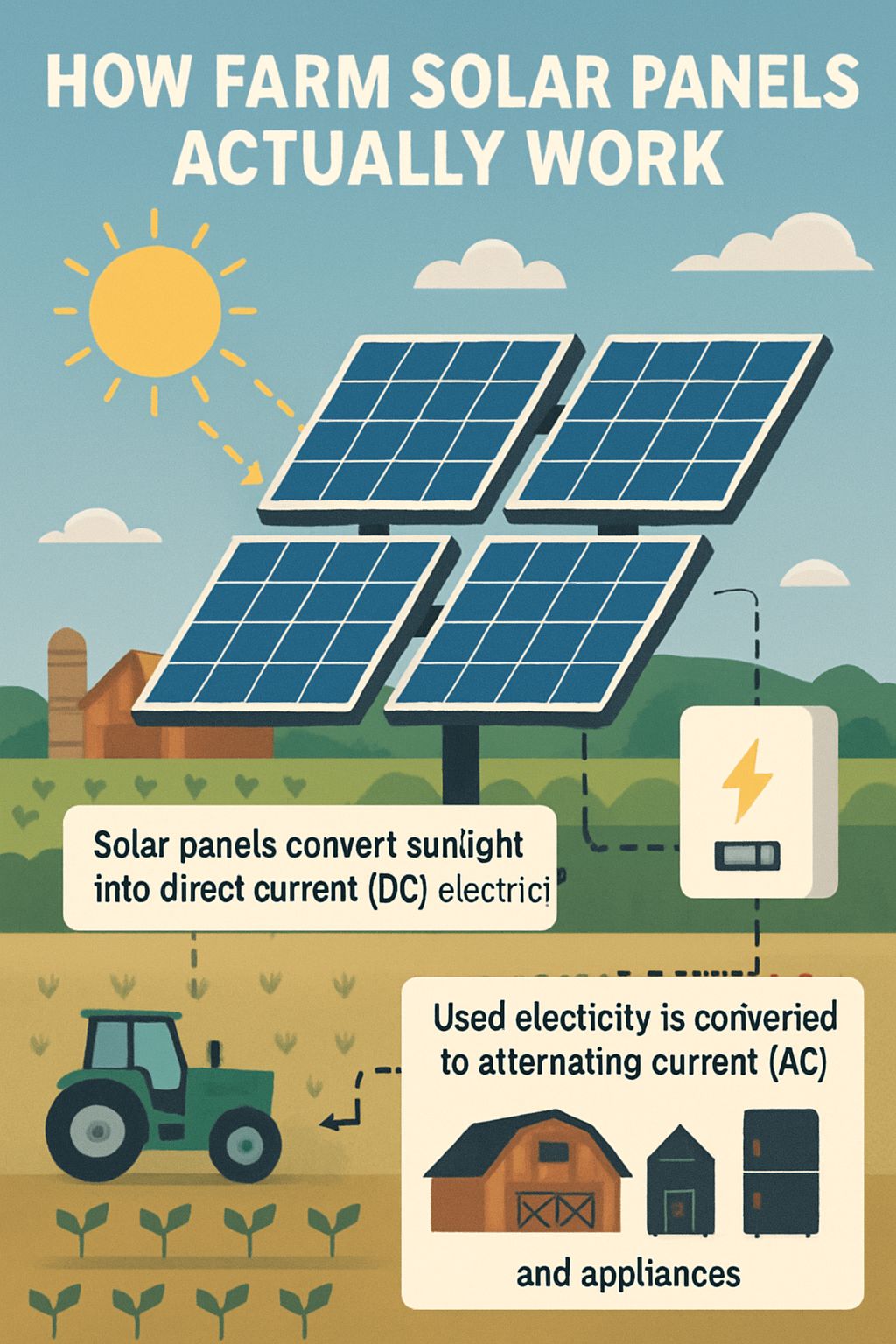
Solar panels work by converting sunlight into direct current (DC) electricity through photovoltaic (PV) cells. That electricity is then converted into alternating current (AC) by an inverter, making it compatible with standard farm equipment and appliances. The whole process is silent, requires no moving parts, and happens automatically every time the sun rises.
Converting Sunlight Into Usable Farm Power
Modern monocrystalline solar panels — the most efficient type widely available — convert between 20% and 23% of available sunlight into electricity. For a farm in a region with 5 peak sun hours per day, a 50-kilowatt (kW) solar array can generate roughly 250 kWh of electricity daily. That’s enough to run a substantial irrigation pump, power all barn lighting, and charge a fleet of electric fencing units simultaneously.
The key components of any farm solar system include:
- Solar panels — Capture sunlight and generate DC electricity; monocrystalline panels offer the best efficiency per square foot
- Inverter — Converts DC electricity into AC power compatible with farm equipment; string inverters and microinverters are the two most common types
- Charge controller — Regulates the flow of electricity into battery storage systems to prevent overcharging
- Battery bank — Stores excess solar energy for use at night or during cloudy periods
- Monitoring system — Tracks energy production and consumption in real time, often accessible via smartphone app
Once installed, the system operates with minimal intervention. Routine maintenance typically involves cleaning panels a few times per year and occasionally inspecting connections — a task most farmers can handle without outside help.
Battery Storage Keeps Equipment Running After Dark
One of the biggest misconceptions about farm solar is that it only works while the sun is shining. Battery storage technology has advanced dramatically in recent years, and modern lithium iron phosphate (LiFePO4) battery systems can store enough energy to run critical farm equipment through the night and into cloudy days. Systems like the Tesla Powerwall or purpose-built agricultural storage units from companies like Sonnen allow farms to build substantial energy reserves that deploy automatically when solar generation drops.
Grid-Tied vs. Off-Grid Solar Systems for Farms
Choosing between a grid-tied and off-grid system is one of the most consequential decisions in any farm solar installation. Each approach has distinct advantages depending on your farm’s location, energy consumption patterns, and operational priorities. For those considering energy storage options, understanding the benefits of backup batteries can be crucial in making the right choice.
- Grid-Tied Systems: Connected to the utility grid; excess solar power is sold back through net metering programs; lower upfront cost since large battery banks aren’t required; vulnerable to grid outages unless paired with a battery backup
- Off-Grid Systems: Fully independent of the utility grid; requires substantial battery storage and a properly sized solar array; ideal for remote pastures, irrigation stations, and farms in areas with unreliable grid service; higher upfront cost but complete energy independence
- Hybrid Systems: Connected to the grid but also equipped with battery storage; provides the cost benefits of net metering along with backup power capability during outages; increasingly popular for main farm facilities
Most large working farms benefit most from a hybrid approach — keeping grid connectivity for cost management while building enough battery storage to protect critical operations during outages.
9 Farm Tools and Equipment You Can Run on Solar Power
Solar power isn’t limited to lighting a barn or charging a phone. Today’s agricultural solar systems are capable of running some of the most energy-demanding equipment on a working farm. Here are nine real applications already in use across farms worldwide.
1. Solar-Powered Irrigation Systems
Irrigation is often the single largest energy expense on a farm. Solar-powered irrigation systems eliminate that cost entirely by pairing submersible or surface pumps directly with dedicated solar arrays. A properly sized solar irrigation setup can move thousands of gallons of water per hour without drawing a single watt from the grid or burning any diesel.
Modern solar irrigation systems can effectively water up to 5 acres on a single sunny day without grid electricity. Systems like the Grundfos SQFlex pump series are specifically engineered for solar-direct operation, adjusting their pumping rate automatically based on available sunlight — pumping faster on bright days and slower on overcast ones, always maximizing efficiency.
Example Setup: A 3 kW solar array paired with a Grundfos SQFlex 11SQF-2 submersible pump can lift water from depths of up to 230 feet and deliver approximately 13,000 gallons per day under full sun conditions — sufficient for irrigating several acres of row crops or maintaining a full livestock water system.
2. Livestock Fence Chargers
Keeping livestock contained in remote pastures is one of the most persistent challenges in farming — and running electrical lines to distant fence lines is expensive and often impractical. Solar-powered fence chargers solve this completely. Units like the Parmak DF-SP-LI Solar-Pak 6 deliver reliable, high-voltage pulses to miles of fencing without any grid connection, powered entirely by a small integrated solar panel and sealed lead-acid battery. For those interested in optimizing solar energy usage, exploring smart controllers and sensors can further enhance efficiency.
Most quality solar fence chargers can maintain effective charge through several consecutive cloudy days on a full battery. For rotational grazing operations where fence lines shift frequently, portable solar chargers are particularly valuable — they move with the fence and never require an extension cord or generator.
3. Electric Tractors Charged by Solar
Electric tractors are no longer a concept — they’re working machines already operating on farms across Europe and North America. The Solectrac e25 and the Monarch Tractor MK-V are two production-ready electric tractors currently available to farmers, offering comparable performance to their diesel counterparts for light to medium field tasks. When charged from an on-farm solar array, their operating cost per hour drops to a fraction of what diesel demands.
The efficiency gains are substantial. A diesel tractor burns roughly $15 to $25 worth of fuel per hour of operation. An equivalent electric tractor charged from solar panels operates at near-zero marginal energy cost once the system is installed. Over a full growing season, that difference adds up to thousands of dollars per machine.
Cost Comparison: Diesel vs. Solar-Charged Electric Tractor
Factor
Diesel Tractor
Solar-Charged Electric Tractor
Fuel/Energy Cost per Hour
$15 – $25
~$0 (solar charged)
Annual Maintenance Cost
$2,000 – $5,000+
$300 – $800
Emissions
High (CO₂, particulates)
Zero operational emissions
Engine Service Intervals
Every 250 – 500 hours
Minimal; no oil changes required
Payback Period (with solar)
N/A
4 – 7 years
The maintenance advantage is just as significant as the fuel savings. Electric drivetrains have far fewer moving parts than diesel engines — no oil changes, no fuel filters, no injector cleaning. Farmers who have made the switch consistently report dramatically lower service costs over the life of the machine.
Charging infrastructure is straightforward. A dedicated 10 kW to 20 kW solar array with battery storage can fully recharge most electric tractors overnight, ready for a full day of field work by sunrise. As solar panel costs continue to fall, the economics of this combination only improve.
4. Grain Dryers
Grain drying is one of the most energy-intensive processes in crop farming, traditionally powered by propane or natural gas at significant seasonal cost. Solar thermal systems can preheat the air fed into grain dryers, meaningfully reducing fuel consumption during harvest. Some newer hybrid systems combine solar thermal collectors with electric heating elements powered by PV panels, cutting propane use by 30% to 60% depending on ambient conditions and system sizing.
5. Farm Lighting and Security Systems
Barn lighting, yard lights, and security cameras are ideal candidates for solar power because they operate on relatively modest energy demands and run daily without exception. Solar LED barn lighting systems like those offered by Sunco Lighting can illuminate large interior spaces at a fraction of the energy draw of older fluorescent or incandescent setups. Paired with motion-activated solar security cameras and perimeter lighting, a farm can maintain full nighttime visibility and surveillance with zero ongoing electricity cost for those systems.
6. Ventilation Systems for Barns and Greenhouses
Proper ventilation in poultry houses, hog barns, and greenhouses is critical to animal health and crop productivity — and the fans that provide it run constantly. Solar-powered ventilation systems connect DC exhaust fans and circulation fans directly to dedicated solar panels, running at maximum speed during the hottest, sunniest parts of the day when ventilation demand is also at its peak. This natural alignment between solar generation and ventilation need makes it one of the most efficient solar applications on any farm.
7. Water Pumps for Remote Pastures
Hauling water to remote grazing areas is one of the most time-consuming and fuel-wasting tasks in livestock management. A standalone solar water pumping station changes that entirely. A small 400W to 800W solar panel array paired with a DC surface pump and a gravity-fed storage tank can deliver continuous fresh water to livestock in pastures miles from the nearest power line.
Systems like the Shurflo 9300 Solar Submersible Pump are designed specifically for this kind of remote deployment. They require no electrical infrastructure, operate automatically during daylight hours, and fill a storage tank that supplies animals around the clock. The result is less trucking, less labor, and healthier livestock with constant access to clean water. For farmers interested in optimizing their solar setups, understanding the benefits of backup batteries can further enhance the efficiency and reliability of solar-powered systems.
8. Solar-Powered Drones for Crop Monitoring
Precision agriculture has found a powerful ally in solar-powered drones. Unmanned aerial vehicles equipped with multispectral cameras can survey hundreds of acres in a single flight, identifying irrigation problems, pest pressure, nutrient deficiencies, and crop stress weeks before they become visible at ground level. When charged from on-farm solar systems, the ongoing operational cost of running these drone programs is essentially zero beyond the initial hardware investment.
Companies like DJI with their Agras series and Trimble with their UX5 fixed-wing drone are producing agricultural UAVs that deliver actionable field data with each flight. Farmers using drone monitoring programs consistently report catching problems early enough to intervene effectively — saving far more in prevented crop loss than the entire drone system costs.
9. Cold Storage Units for Produce
For vegetable, fruit, and specialty crop farmers, cold storage is not optional — it’s the difference between selling a product and losing it. Refrigeration is also one of the heaviest continuous electrical loads on a farm. Solar-powered cold storage solutions, including walk-in coolers powered by dedicated PV arrays with battery backup, allow small and mid-scale produce farmers to maintain proper storage temperatures without the constant utility bill that conventional refrigeration demands.
Pre-engineered solar cold storage systems are now available as complete packages sized for farm-scale use. A well-designed system maintains temperatures between 34°F and 40°F around the clock, using thermal mass and high-efficiency insulation to minimize energy draw during non-solar hours, with battery storage covering overnight cooling loads.
Where to Install Solar Panels on a Farm
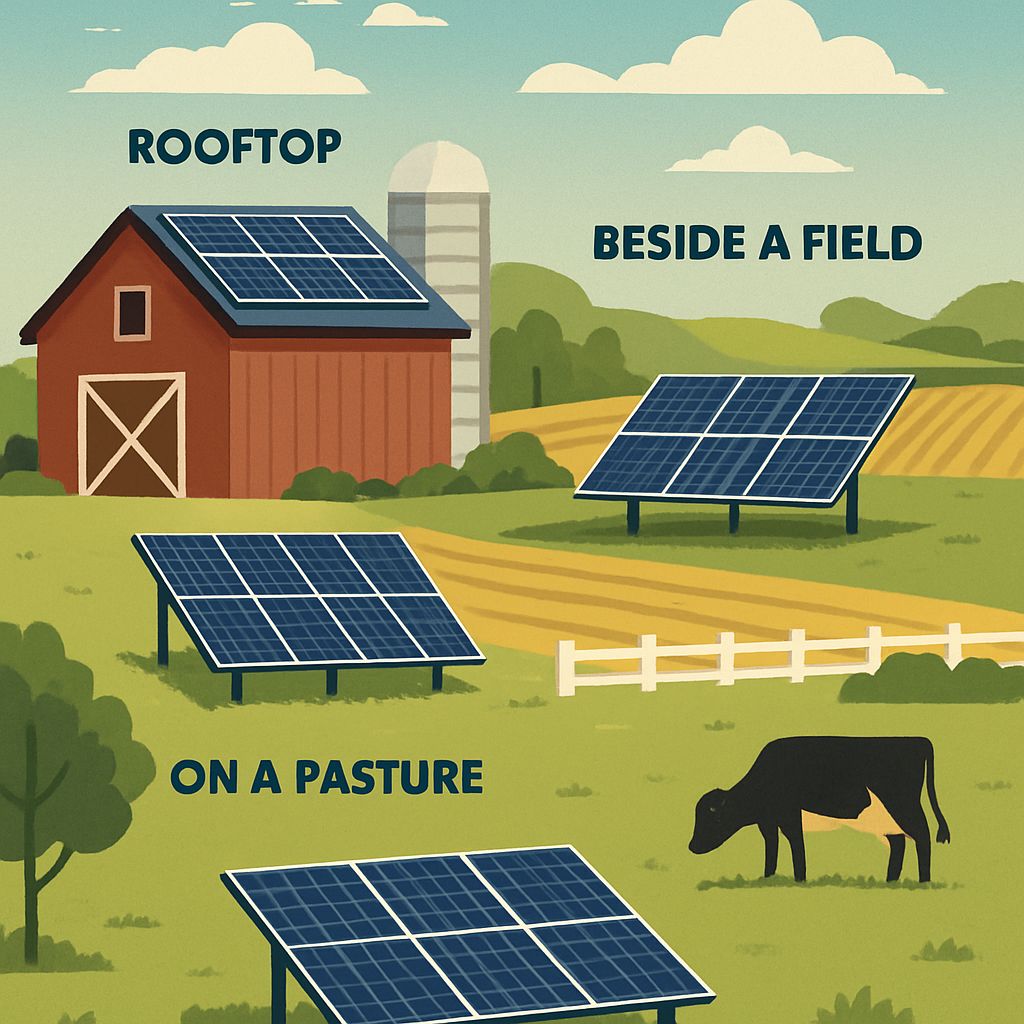
Placement strategy matters as much as panel quality. The right installation location on your farm determines how much energy your system produces, how long it lasts, and how well it integrates with your daily operations. Most farms have multiple viable installation zones, and the best approach often combines two or more of them.
Before committing to any installation location, a professional solar site assessment should evaluate shading from trees and structures throughout the day, roof structural capacity for rooftop installations, soil conditions for ground-mounted systems, and the distance from panels to the equipment they’ll power — since longer wire runs increase resistance and reduce efficiency. For enhanced efficiency, consider using dual-axis trackers which can adjust the panel’s position to follow the sun.
Rooftop Installations on Barns and Outbuildings
Barn rooftops are prime solar real estate. A standard 40-foot by 100-foot barn roof facing south at the correct tilt angle can accommodate 60 to 80 solar panels, generating 20 kW to 28 kW of capacity — enough to power significant farm operations. Rooftop installations use existing structure rather than consuming additional land, making them the most space-efficient option available. Metal roofing common on agricultural buildings is particularly well-suited to solar mounting systems, with brackets designed specifically for standing seam and corrugated metal profiles.
Ground-Mounted Systems for Open Fields
When roof space is insufficient or roof orientation isn’t ideal, ground-mounted solar arrays deliver maximum flexibility. Panels can be positioned at the precise angle and orientation that maximizes annual energy production — typically facing true south at a tilt angle equal to the local latitude. Ground-mounted systems are also easier to clean and maintain than rooftop installations, and they can be equipped with single-axis or dual-axis tracking systems that follow the sun throughout the day, increasing energy output by 15% to 25% compared to fixed-tilt arrays.
The primary trade-off is land use. A 100 kW ground-mounted array requires roughly half an acre of dedicated space. For farms with marginal or unproductive land — rocky hillsides, flood-prone corners, or steep grades unsuitable for cultivation — these areas become ideal candidates for solar installations that generate revenue from otherwise unproductive ground.
Agrivoltaics: Growing Crops Under Solar Panels
Agrivoltaics is one of the most exciting developments in modern farming — and it solves two problems at once. By mounting solar panels several feet above the ground on elevated racking systems, farmers can simultaneously generate electricity and continue growing crops in the space below. The panels provide partial shade that actually benefits certain crops during peak summer heat, while the farming activity beneath helps cool the panels and improve their efficiency.
Research from the University of Arizona found that crops like lettuce, chilies, and tomatoes grown under agrivoltaic installations showed comparable or improved yields compared to crops grown in full sun, while the solar panels above generated clean electricity at full capacity. The shade reduces water evaporation from the soil, meaning those crops also required significantly less irrigation — a double efficiency gain. For farms in hot, arid regions, this dual-use approach can be genuinely transformative.
Agrivoltaic installations are particularly well-suited to:
- Leafy greens and herbs — benefit from reduced direct sun exposure during summer heat peaks
- Berry crops — raspberries and blackberries thrive in partial shade conditions
- Pollinator habitats — native wildflower plantings beneath panels support bee populations critical to farm productivity
- Sheep and goat grazing — livestock graze naturally beneath elevated panel arrays while the panels remain accessible for maintenance
The Real Cost of Farm Solar Panels
Solar is an investment, not an expense — and understanding the real numbers makes that distinction clear. The upfront cost of a farm solar installation varies significantly based on system size, installation type, and location, but the long-term financial picture consistently favors farmers who make the switch. Additionally, utilizing solar trackers can further enhance the efficiency of your solar setup, making the investment even more worthwhile.
Typical Farm Solar System Cost Ranges (Before Incentives)
System Size
Estimated Cost
Best Suited For
Est. Annual Energy Output
10 kW
$25,000 – $35,000
Small farms, single irrigation pump, barn lighting
12,000 – 15,000 kWh
25 kW
$55,000 – $75,000
Mid-size operations, multiple loads, cold storage
30,000 – 38,000 kWh
50 kW
$100,000 – $140,000
Large farms, grain drying assist, EV tractor charging
60,000 – 76,000 kWh
100 kW+
$180,000 – $250,000+
Commercial operations, full energy independence
120,000+ kWh
These figures represent installed system costs including panels, inverters, racking, wiring, and labor. Battery storage adds to the total — a quality lithium iron phosphate battery bank sized for farm backup typically adds $15,000 to $50,000 depending on capacity. That said, these numbers look very different after federal incentives are applied.
The most important thing to understand about farm solar costs is that the upfront number is not the real cost. The real cost is the net expense after incentives, minus the energy savings generated over the system’s lifetime. When that math is done correctly, most farm solar installations return significantly more than they cost over their operational lifespan.
Average Payback Period: 3 to 7 Years
Most agricultural solar implementations reach their financial breakeven point within 4 to 7 years — and that timeline represents less than half the expected operational lifetime of the equipment. Quality solar panels carry performance warranties of 25 years, meaning farmers who hit payback at year 5 are looking at 20 or more years of essentially free electricity production from that point forward.
The payback period depends heavily on how much energy the farm currently consumes and what it pays for that energy. Farms with high electricity and fuel costs in states with strong net metering programs often see payback periods as short as 3 to 4 years. Farms in lower-rate utility territories with smaller energy loads will land closer to the 6 to 7 year range.
What accelerates payback most dramatically is putting solar to work on the farm’s heaviest energy loads. A farmer who installs solar and uses it primarily for irrigation pumping — replacing diesel-powered pumps — will see far faster payback than one who only uses it for incidental barn lighting. Strategic load matching between solar capacity and high-cost energy uses is the single most important factor in maximizing return on investment.
Operating cost savings compound over time in ways that make the long-term value extraordinary. As utility rates increase each year, a farm with solar locks in a fixed energy cost at effectively zero per kilowatt-hour for self-generated power. Every utility rate increase after installation makes the solar system more valuable, not less.
25-Year Solar Value Projection (50 kW System Example)
Metric
Value
System Cost (before incentives)
$120,000
Federal ITC (30%)
−$36,000
Net System Cost
$84,000
Annual Energy Savings (est.)
$12,000 – $18,000
Estimated Payback Period
5 – 7 years
25-Year Total Energy Savings
$300,000 – $450,000+
Net 25-Year Gain
$216,000 – $366,000+
Federal Tax Incentives Cover Up to 30% of Costs
The federal Investment Tax Credit (ITC), established under the Inflation Reduction Act, allows farmers to deduct 30% of their total solar installation cost directly from their federal tax liability. This is a dollar-for-dollar credit, not a deduction — meaning a $120,000 solar installation generates a $36,000 reduction in taxes owed. For farms structured as pass-through entities like LLCs or S-Corps, this credit flows directly to the owner’s personal tax return.
Beyond the federal ITC, the USDA Rural Energy for America Program (REAP) provides grants covering up to 25% of solar project costs for agricultural producers and rural small businesses. REAP grants can be stacked with the federal ITC, meaning eligible farms can receive up to 55% of their project cost covered through combined federal programs. Applications are accepted on a rolling basis and are evaluated competitively, so working with an experienced agricultural energy consultant to prepare a strong application is well worth the effort.
Solar Delivers Long-Term Energy Independence for Farms
Energy independence is about more than just saving money — it’s about building a farm operation that isn’t held hostage by forces outside your control. When your irrigation system runs on solar, a fuel price spike doesn’t threaten your crop. When your barn lighting and cold storage are powered by panels on your own roof, a grid outage doesn’t risk your livestock or your harvest. That kind of operational resilience has a real value that doesn’t always show up in a simple cost-benefit spreadsheet, but every experienced farmer understands it instinctively.
Solar panel technology continues to improve while costs continue to fall. Installations today offer significantly better returns than identical systems from just five years ago, and that trajectory is expected to continue. Farmers who invest in solar now are locking in energy security at historically favorable economics — and building an asset that increases farm value, reduces operating risk, and supports the long-term viability of their operation for the next generation.
Frequently Asked Questions
Below are the most common questions farmers ask when evaluating solar for their operations. These answers reflect current technology, verified program details, and real-world implementation experience across diverse agricultural settings.
Can solar panels fully power a working farm?
Yes — with a properly sized system, solar panels can cover 100% of a farm’s electrical energy needs. The key variables are total energy consumption, available installation area, local solar resource (average peak sun hours), and whether battery storage or grid connection provides backup during low-generation periods. Many farms achieve full solar coverage for electricity while also using solar thermal systems to offset propane and natural gas use for heating and grain drying. Farms with very high diesel consumption for heavy field equipment are the exception, though electric tractors charged by solar are increasingly closing that gap as well.
What size solar system does a farm need?
System sizing starts with a thorough energy audit — cataloging every electrical load on the farm, its wattage, and its daily runtime. From there, a solar designer calculates the total daily kilowatt-hour demand and works backward to determine the panel capacity and battery storage required to meet it reliably. A small diversified farm might need 10 kW to 20 kW, while a large grain or livestock operation could require 100 kW or more.
The best approach is to start with your most recent 12 months of utility bills and fuel receipts, which gives a solar designer the consumption data needed to size a system accurately. Oversizing slightly — by 10% to 15% — is generally recommended to account for future equipment additions and to maximize net metering revenue from excess production.
How long do farm solar panels last?
Quality solar panels from reputable manufacturers like LG, SunPower, or Canadian Solar carry 25-year linear performance warranties guaranteeing that panels will still produce at least 80% to 87% of their original rated output at the end of that period. In practice, many panels continue producing meaningful electricity well beyond 30 years. The components most likely to require replacement before panels are inverters — which typically carry 10 to 12 year warranties and are straightforward to replace when needed — and battery systems, which have a lifespan of 10 to 15 years depending on usage patterns and chemistry. For more on how solar energy is transforming agriculture, explore renewable energy farming.
Do farm solar panels work on cloudy days?
Solar panels continue generating electricity on cloudy days — just at reduced output. Depending on cloud density, panels typically produce between 10% and 25% of their rated capacity under overcast conditions. Diffuse light still contains photons that PV cells convert to electricity; it’s just less concentrated than direct sunlight.
This is precisely why battery storage and grid connectivity matter so much in farm solar design. A well-designed system accounts for multiple consecutive cloudy days in its battery sizing, ensuring that critical farm loads remain powered even during extended low-generation periods. Farms in regions with frequent cloud cover should size their battery banks more conservatively and consider grid-tied hybrid configurations to ensure reliability year-round.
What government incentives are available for farm solar installations?
The primary federal incentive is the Investment Tax Credit (ITC) at 30% of total system cost, available through at least 2032 under the Inflation Reduction Act. This applies to both purchased systems and certain financed installations, though the credit goes to the system owner — so lease arrangements typically don’t qualify for the farmer’s direct benefit.
The USDA Rural Energy for America Program (REAP) is the other major federal resource, offering grants of up to 25% of project costs and guaranteed loans for the remainder. REAP is specifically designed for agricultural producers and rural businesses, making most working farms eligible. The application process requires an energy audit, project proposal, and financial documentation, but the potential return — up to 25% of project cost as a non-repayable grant — makes it worth pursuing for any installation above $10,000.

Leave a Reply