
Key Takeaways
- Proper maintenance can increase solar panel efficiency by up to 25%, directly impacting your farm’s irrigation system performance and overall energy costs
- Cleaning solar panels 2-4 times annually can restore up to 21% of lost efficiency, with early morning or evening being optimal cleaning times
- Agricultural environments present unique challenges for solar panels including dust from field operations, crop shading, and seasonal weather patterns
- Implementing a seasonal maintenance schedule aligned with your farming calendar maximizes solar system performance year-round
20% More Power: Why Farm Solar Panels Need Regular Care
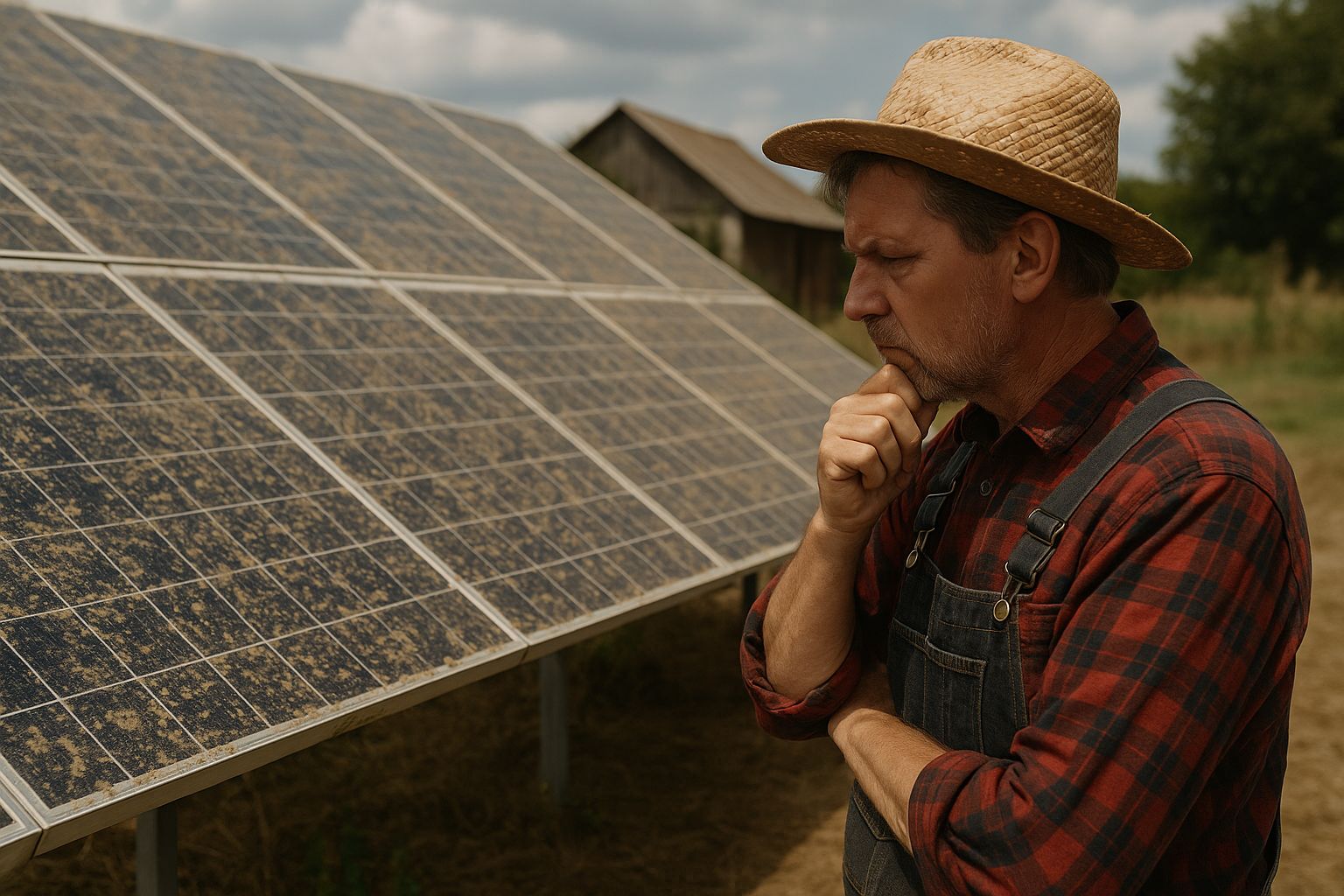
That layer of dust on your solar panels isn’t just unsightly – it’s costing you money. Solar panels on farms face unique challenges that can significantly reduce their efficiency over time. According to recent studies, poorly maintained panels can lose 15-25% of their power generation capacity, directly affecting your irrigation capabilities and overall farm productivity. Growing Solar Mist research shows that simply implementing proper maintenance routines can recover most of that lost energy, effectively giving your farm a free power upgrade without installing a single new panel.
Farm solar systems differ from residential installations in critical ways. They’re typically ground-mounted in open fields, exposed to agricultural dust, pollen, and debris that residential systems rarely encounter. The ROI on maintenance is particularly impressive for agricultural operations where energy demands fluctuate seasonally. When your irrigation system demands peak performance during growing seasons, every percentage point of solar efficiency translates directly to your bottom line.
Common Efficiency Killers on Farm Solar Systems
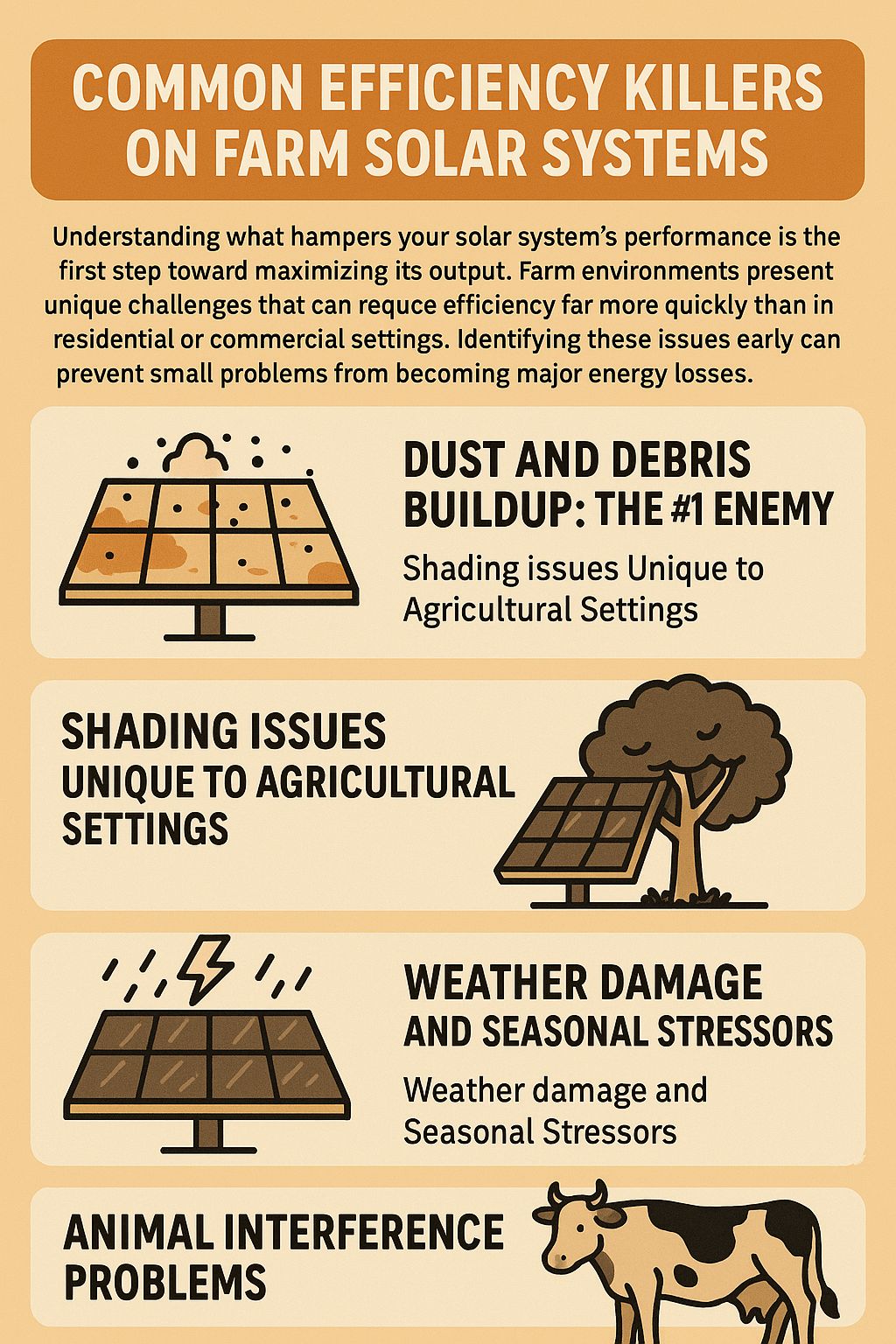
Understanding what hampers your solar system’s performance is the first step toward maximizing its output. Farm environments present unique challenges that can reduce efficiency far more quickly than in residential or commercial settings. Identifying these issues early can prevent small problems from becoming major energy losses.
Dust and Debris Buildup: The #1 Enemy
Agricultural operations generate considerably more airborne particles than typical environments. Tilling, harvesting, and even daily vehicle traffic kick up substantial dust that settles on panel surfaces. Field studies demonstrate that a mere 1mm layer of dust can decrease solar efficiency by 10%, while heavier soiling from pollen, bird droppings, and plant debris can reduce output by up to 25% within weeks. Unlike urban settings where rain might provide natural cleaning, farm dust often contains organic materials that can become stubbornly cemented to panels when wet, creating a persistent film that standard rainfall cannot remove.
The impact varies significantly by region and farming activity. Livestock operations might experience ammonia-laden dust that creates a sticky film requiring specialized cleaning solutions. Crop farms often face seasonal challenges – like cotton harvest creating particularly problematic fibrous debris or grain operations producing fine dust that infiltrates panel edges. The financial impact is straightforward: for every 1% reduction in efficiency, you lose 1% of potential energy production and the corresponding financial benefits.
Shading Issues Unique to Agricultural Settings
Farms present distinctive shading problems that residential solar rarely faces. Growing crops can cast seasonal shadows as they mature, particularly with tall varieties like corn or orchard trees. Even partial shading is disproportionately harmful – when just 10% of a panel is shaded, power output can drop by up to 80% due to how cells are connected in series. This “string effect” means one small shadow impacts entire panel sections. For more insights on optimizing solar energy in agriculture, check out these solar solutions for farming.
Farm equipment storage, silos, windbreaks, and seasonal structures often create unexpected shading as the sun’s position changes throughout the year. Unlike permanent buildings considered during initial installation, mobile farm equipment and temporary structures frequently create overlooked shading problems. Seasonal growth around ground-mounted arrays is particularly problematic in fertile farm soil, where even modest vegetation can cast significant shadows if not regularly managed. For farmers looking to optimize their solar panel efficiency, exploring solar panel systems for irrigation can be a beneficial solution.
Case Study: Johnson Family Farm, Iowa
After noticing irrigation problems during peak summer, the Johnsons discovered their three-year-old solar array was operating at just 78% capacity. Professional inspection revealed a combination of dust buildup from nearby field operations and partial shading from maturing windbreak trees. After implementing a monthly cleaning schedule and selective pruning, system performance improved by 19.4%, providing adequate power for their irrigation needs without adding additional panels.
Weather Damage and Seasonal Stressors
Agricultural solar installations face extreme weather conditions that accelerate wear and reduce efficiency. Seasonal temperature swings on farms can be dramatic, with panels experiencing 100°F+ summer days followed by sub-freezing winter conditions. This thermal cycling stresses connections and can cause microscopic cell fractures that progressively reduce output. Hail events, particularly common in agricultural regions, may cause invisible microcracking that doesn’t show obvious physical damage but nevertheless degrades performance over time.
Animal Interference Problems
Wildlife and livestock pose unique challenges to farm solar installations that residential systems rarely encounter. Birds nesting under panels deposit droppings that both block sunlight and contain acidic compounds that can gradually erode protective panel coatings. Rodents frequently chew through wiring insulation, causing system failures that are difficult to diagnose without specialized equipment. Larger livestock like cattle or goats can damage ground-mounted arrays if fencing is inadequate, particularly when seeking shade during hot weather.
Prevention is far more cost-effective than repairs. Installing critter guards around the perimeter of ground-mounted arrays deters burrowing animals that might damage underground wiring. Bird deterrents like visual reflectors or physical barriers prevent nesting under panels without harming wildlife. For farms with grazing animals, sturdy fencing with sufficient clearance from arrays is essential – remember that curious livestock can reach surprisingly far over standard fencing. For more insights on sustainable farming practices, explore our solar panels for farming solutions.
Here is a comparative table of common efficiency killers affecting farm solar systems.
| Efficiency Killer | Description | Impact on Solar Performance | Mitigation Strategies |
|---|---|---|---|
| Dust and Debris Buildup | Accumulation of dust, pollen, bird droppings, leaves, and grime on panel surfaces. | Reduces sunlight reaching cells; can decrease output by 5–25% in dusty regions; increases panel temperature, possibly causing overheating and faster degradation. 1, 2 | Regular cleaning, use of angled panels, self-cleaning coatings, installing windbreakers, and site selection away from dust sources. 1, 3 |
| Shading Issues | Shadows from nearby trees, buildings, crops, dust, and debris; includes “soft shading” (reduced sunlight) and “hard shading” (complete blockage). 4, 5 | Causes partial or total loss of current in shaded cells; may create “hot spots” that further degrade panels; loss is proportional to shading extent. 4, 6 | Strategic site placement, trimming vegetation, array spacing, bypass diodes, and regular inspections. 4, 5 |
| Weather Damage & Seasonal Stressors | Effects of heavy rain, snow, hail, wind, temperature extremes. Soiling may cement after dew, frost, or precipitation. 7 | Mechanical damage (cracks, corrosion, delamination), reduced output during storms/low sunlight, freeze/thaw cycles worsen soiling and weathering. 7 | Install durable panels, seasonal maintenance (e.g., snow removal, checks after storms), climate-appropriate mounting/tilt angles, monitoring systems. 7 |
These issues are persistent for farm solar installations, and addressing them is essential for maintaining optimal performance and minimizing long-term maintenance costs.
7 Essential Maintenance Tasks Every Farmer Should Know
Developing a systematic approach to solar maintenance ensures you capture every kilowatt-hour your system can produce. These seven critical tasks form the backbone of any effective solar maintenance program for agricultural settings. Each addresses specific efficiency challenges common to farm environments while fitting naturally into seasonal farm operations. Incorporating these practices into your regular routine protects your investment and maximizes energy production when your irrigation systems need it most.
1. Panel Cleaning: The Right Way to Do It
Proper cleaning technique matters as much as frequency. Start by inspecting panels early morning when dew often highlights problem areas like bird droppings or stuck debris. For routine dust removal, a soft brush with an extension handle and plain water is typically sufficient – specialized solar panel cleaning solutions are rarely necessary and may leave residue that attracts dust. Never use abrasive materials, standard household cleaners, or high-pressure water systems that can damage anti-reflective coatings or create microscopic scratches that accelerate degradation.
Timing matters significantly – cleaning early morning or evening prevents rapid evaporation that leaves streak marks and avoids thermal shock from cold water hitting hot panels. For larger installations, consider sectional cleaning on a rotation basis rather than attempting to clean the entire array at once. This methodical approach ensures thorough cleaning and allows you to measure performance improvements more accurately. Document your cleaning activities and corresponding energy production to establish the optimal cleaning frequency for your specific farm environment. For more detailed information, check out this solar panel maintenance guide.
2. Checking for Hot Spots and Bypass Diode Failures
Hot spots develop when cells within a panel generate heat rather than electricity, often due to partial shading, manufacturing defects, or cell damage. These areas not only reduce efficiency but can permanently damage panels if left unaddressed. Thermal imaging cameras, even inexpensive models that attach to smartphones, can identify hot spots that aren’t visible to the naked eye. Schedule thermal imaging during peak sunlight hours when temperature differentials are most pronounced – spots more than 20°F hotter than surrounding areas warrant immediate investigation. For more information on optimizing solar panel efficiency, check out these solar panels for farming tips.
Bypass diode failures often manifest as dramatic production drops in specific panels. These small components allow electricity to flow around damaged or shaded cells but can fail over time. Visual inspection may show discoloration or bulging on the back of affected panels. Testing suspected panels with a multimeter during daylight hours can confirm diode functionality – readings significantly below specification suggest diode issues. Most bypass diode replacements require professional service, but identifying the problem early prevents cascade failures that affect entire strings of panels.
3. Connection and Wiring Inspections
Electrical connections in farm environments face extreme conditions that accelerate degradation. Temperature fluctuations cause expansion and contraction that gradually loosen connections, while moisture intrusion and corrosion are particularly prevalent in agricultural settings. Quarterly visual inspections should focus on junction boxes, inverter connections, and combiner boxes – look for discoloration, corrosion, burnt smells, or loose components. Using an infrared thermometer during operation helps identify connections running hotter than surrounding components, often indicating high resistance points that waste energy as heat.
Wildlife damage to wiring is especially common on farms. Inspect wire runs for chew marks, nesting materials, or discoloration that might indicate rodent activity. Pay particular attention to areas where wiring enters conduit or buildings, as these transition points often provide access for pests. Addressing small issues before they cause system failures saves significant repair costs and prevents production losses during critical irrigation periods. Document all connection issues – patterns may emerge that suggest systemic problems requiring broader solutions.
4. Inverter Maintenance Essentials
Inverters represent the heart of your solar system but remain the most vulnerable component. Dust accumulation on cooling fins can cause overheating that triggers protective shutdowns or reduces conversion efficiency. Monthly inspection of inverter cooling systems should include gentle cleaning of vents and fins using compressed air or a soft brush. Check that airflow remains unobstructed by vegetation, stored equipment, or debris that might have accumulated since your last inspection.
Performance monitoring is equally important as physical maintenance. Modern inverters provide detailed operational data that signals potential issues before complete failure occurs. Learn to interpret basic error codes and efficiency metrics specific to your inverter model. Efficiency ratios consistently below 95% may indicate internal issues requiring professional assessment. Maintain detailed records of inverter performance alongside weather conditions to establish baseline performance patterns for your specific installation. For more information on solar efficiency, check out this guide on solar panels powering a farm’s irrigation system.
5. Monitoring System Performance Data
Regular performance analysis helps identify efficiency problems before they significantly impact production. Most modern systems include monitoring capabilities that track daily, monthly, and annual production metrics. Establish baseline performance expectations for each season, accounting for normal weather patterns in your region. Deviations of more than 10% from expected production warrant investigation, even when systems appear physically intact. Simple spreadsheet tracking can reveal gradual efficiency declines that might otherwise go unnoticed until significant production is lost.
Performance data becomes particularly valuable when correlated with maintenance activities and weather conditions. Note production metrics immediately before and after panel cleaning to quantify the impact of soiling on your specific installation. This data-driven approach allows you to optimize maintenance scheduling based on actual performance impacts rather than generic recommendations. For farms with seasonal operations, historical performance data helps predict energy availability for irrigation planning and other energy-intensive activities.
6. Vegetation Management Around Arrays
Uncontrolled plant growth around solar arrays creates multiple efficiency challenges beyond simple shading. Tall vegetation restricts cooling airflow beneath panels, increasing operating temperatures that reduce conversion efficiency – every 1°C increase above rated temperature typically reduces panel efficiency by 0.5%. Plants also harbor insects and provide pathways for rodents to access wiring and panel undersides. Regular mowing or selective application of landscape fabric and gravel around array footings prevents these issues while maintaining soil stability.
Seasonal considerations should guide your vegetation management approach. Spring often brings rapid growth requiring more frequent attention, while summer drought periods may require less intervention. Consider low-growing, drought-resistant ground covers specifically selected to minimize maintenance requirements while preventing erosion around ground-mounted systems. Document vegetation management activities alongside performance metrics to identify optimal maintenance intervals for your specific installation and surrounding ecosystem.
7. Structural Support Checks
Farm solar arrays face structural stresses that urban installations rarely encounter. High winds across open fields can exceed 70mph in many agricultural regions, placing enormous pressure on mounting systems. Quarterly inspections should include checking all mounting hardware for tightness and signs of movement. Pay particular attention to ground anchors in areas with seasonal soil moisture changes – frost heave during winter can gradually loosen even properly installed foundations.
Racking systems require regular assessment, especially in areas with significant snowfall or ice formation. The additional weight can bend supports or create dangerous loading conditions. Check for any visible deflection in supporting structures, rust at connection points, or shifting of ballast materials. Document any repairs or adjustments made to mounting systems – patterns may indicate design weaknesses that require more permanent solutions.
Animal interactions with mounting systems present another common issue on farms. Livestock rubbing against supports can gradually loosen connections, while burrowing animals may undermine ground-mounted foundations. Installing physical barriers or modified fencing at appropriate distances helps maintain structural integrity without impacting panel efficiency.
Seasonal Maintenance Calendar for Farm Solar
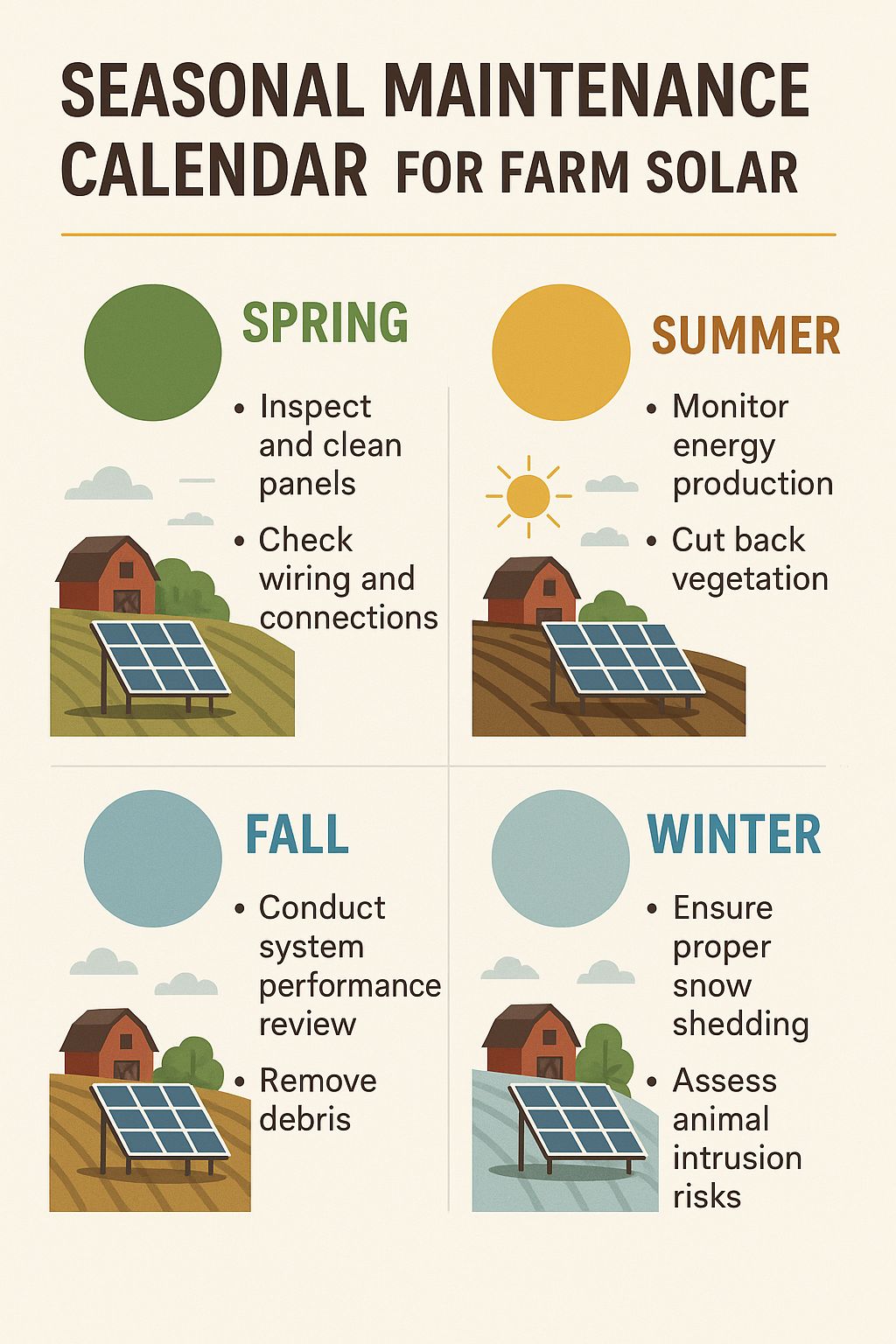
Aligning solar maintenance with your existing agricultural calendar ensures critical tasks happen at optimal times without disrupting farm operations. A thoughtful schedule recognizes both the seasonal needs of your solar system and the practical realities of farm life during planting, harvest, and other intensive periods. For more insights, consider exploring solar panels for farming solutions to maximize system performance while minimizing additional workload during your busiest seasons.
Spring Tasks: Post-Winter Recovery
Early spring represents a critical maintenance window as your solar system emerges from winter conditions. Conduct thorough cleaning once frost danger passes but before irrigation demands increase – removing winter grime can instantly restore 10-15% of lost production capacity. Inspect for any panel damage from winter ice, snow loads, or debris blown during winter storms. Check all racking systems for signs of movement from frost heave or ground settling that occurred during freeze-thaw cycles.
Electrical connections deserve special attention after winter exposure. Cold temperatures and moisture fluctuations often loosen connections or compromise seals. Inspect junction boxes, inverter connections, and combiner boxes for water intrusion, corrosion, or rodent damage that may have occurred when pests sought winter shelter. Test ground fault protection systems before spring thunderstorm season arrives with its increased lightning risk.
Spring also provides an ideal opportunity to prune trees or vegetation that may have grown during the previous season and now threatens to shade panels as the sun’s path changes. Remember that summer sun angles differ significantly from winter – areas fully exposed during winter months may experience unexpected shading as the sun rises higher in the sky. For more tips on maximizing solar efficiency, check out our solar panels for farming guide.
Summer Maintenance: Heat Management
Summer maintenance focuses primarily on heat management and vegetation control during peak production season. Panel efficiency typically decreases 0.4-0.5% for each degree Celsius above rated temperature, making cooling crucial during hot months. Ensure adequate airflow beneath panels by removing any vegetation blocking air circulation – ground-mounted systems particularly benefit from proper clearance that allows natural convection cooling. For more information on optimizing solar panels for farming, check out our solar panels for farming guide.
Adjust cleaning schedules based on local conditions – dusty regions or areas with frequent irrigation sprinkler drift may require monthly cleaning during summer, while other locations might maintain efficiency with less frequent attention. Morning cleaning before 9am or evening cleaning after 6pm prevents thermal shock to hot panels while ensuring cleaning solution doesn’t evaporate too quickly and leave residue.
Summer is also ideal for performance monitoring and baseline establishment. Record production metrics during clear sky conditions at consistent times to establish maximum performance benchmarks. These measurements provide valuable comparison data for future troubleshooting and efficiency assessments. Consider investing in a portable irradiance meter to correlate sunlight intensity with actual panel output – this relationship helps identify performance issues separate from natural weather variations. For more tips, check out this solar panel maintenance guide for maximum efficiency.
Fall Preparation: Getting Ready for Winter
Fall maintenance sets the stage for continued performance through challenging winter conditions. Thorough panel cleaning before winter arrives removes stubborn summer accumulations and maximizes energy production during shorter daylight hours. Pay special attention to sealing systems and water drainage paths – small cracks or blocked drainage can become significant problems when exposed to freeze-thaw cycles.
Ground-mounted systems benefit from soil stabilization before winter. Address any erosion around footings or support poles, particularly in areas subject to heavy rainfall or snowmelt. Consider adding protective ground cover or erosion control materials in vulnerable areas. For areas with significant snowfall, verify that snow-shedding angles are maintained and that nothing will prevent snow from sliding off panels naturally.
Review historical production data to establish realistic winter performance expectations based on previous years. This baseline helps identify abnormal production drops that might indicate developing problems rather than normal seasonal variations. Fall is also the ideal time to schedule professional thermographic imaging to identify any hot spots or connection issues before they’re covered by winter snow. For more tips on maintaining solar panels, check out our solar panels for farming guide.
Winter Care: Snow Removal and Cold Weather Protection
Winter maintenance balances snow management against safety concerns. Contrary to popular belief, light snow coverage often clears naturally as dark panels absorb sunlight and warm slightly – unnecessary clearing risks panel damage. However, heavy accumulation or icy buildup may require careful intervention. Use only soft-bristled snow removal tools designed specifically for solar panels, working from the bottom edge upward to allow snow to slide off naturally.
Monitor for unusual snow distribution patterns that might indicate structural issues or panel displacement. Uneven snow melting often reveals hot spots or failing cells that warrant further investigation when safer conditions permit. Document winter performance carefully, noting production impacts from various snow coverage levels to inform future winter management decisions. For more on optimizing your solar setup, explore these solar panels for farming tips.
Winter also presents the opportunity to review and organize maintenance records from the previous seasons. Identify recurring issues or maintenance patterns that might inform system improvements during the coming year. Use this quieter farm period to research emerging maintenance techniques or technology upgrades that might enhance system performance in the upcoming growing season.
Tools and Equipment for Effective Solar Maintenance
Having the right tools readily available makes regular maintenance significantly more efficient and effective. A thoughtful solar maintenance toolkit represents a small investment that pays substantial dividends in system performance and longevity. Store these items together in a dedicated location where they remain clean and accessible when needed.
Basic Cleaning Supplies
Quality cleaning tools make routine maintenance more effective while protecting expensive panel surfaces. The foundation of any solar cleaning kit is a soft-bristled brush with telescoping handle that allows safe cleaning from ground level – specialized solar brushes have bristles specifically designed to remove grit without scratching delicate surfaces. Pair this with a squeegee attachment for final water removal that prevents mineral spotting on panels. Microfiber cloths provide safe spot-cleaning for stubborn deposits without abrasive risk. For more detailed guidance, check out this solar panel maintenance guide.
Water quality significantly impacts cleaning effectiveness. Standard tap water often leaves mineral deposits that can gradually accumulate and reduce efficiency. Simple deionized water systems are worth considering for larger installations, while smaller operations might use rainwater collected on-site which typically contains fewer dissolved minerals. Avoid commercial cleaning chemicals unless specifically formulated for photovoltaic applications – many common cleaners leave residues that attract dust or degrade anti-reflective coatings.
Safety equipment matters even for seemingly simple cleaning tasks. Non-slip footwear, fall protection for elevated work, and appropriate sun protection should be standard practice. Early morning cleaning often provides the best combination of panel accessibility and comfortable working conditions while avoiding peak electricity production hours.
Monitoring Equipment Worth Investing In
Basic monitoring tools provide immediate efficiency feedback that guides maintenance decisions. A handheld solar irradiance meter (starting around $150) measures actual sunlight intensity, allowing you to calculate real-time conversion efficiency independent of weather variations. This simple device quickly identifies underperforming panels or array sections that warrant closer inspection. Multimeters with DC current capability provide immediate verification of panel output and help troubleshoot connection issues.
Thermal imaging has become increasingly affordable and accessible for farm applications. Entry-level thermal cameras that attach to smartphones (starting around $200) can identify hot spots, bypass diode failures, and connection issues invisible to the naked eye. These devices serve multiple farm purposes beyond solar maintenance, including equipment monitoring and livestock health assessment, making them particularly cost-effective for agricultural operations.
Data logging systems represent a more significant investment but provide tremendous maintenance value through continuous performance monitoring. Simple systems track overall production, while more advanced options monitor individual panel strings or even single panels. Many modern systems include smartphone alerts when production falls below expected parameters, allowing immediate investigation before small issues become major problems.
Safety Gear for Solar Panel Maintenance
Working with solar equipment presents unique safety considerations that require specific protective equipment. Electrical safety gear including insulated gloves, tools, and appropriate footwear is essential when working with connection points or troubleshooting live components. Remember that solar panels continue producing electricity whenever exposed to light – they cannot be “turned off” like conventional electrical systems. Even disconnected panels can present shock hazards in bright conditions.
Fall protection becomes critical for roof-mounted systems or when accessing elevated ground mounts. OSHA standards require fall protection for work above 6 feet in agricultural settings – ensure your equipment meets or exceeds these requirements with proper harnesses, anchors and lanyards rated for the specific application. Establish clear protocols for when and how protective equipment must be used, particularly when training farm staff who may not regularly work with electrical systems.
Weather protective gear appropriate for your climate completes the safety toolkit. Wide-brimmed hats, cooling vests, and adequate hydration systems protect workers during summer maintenance, while appropriate cold-weather gear enables safe winter inspection and snow management. Schedule maintenance activities during moderate temperature periods when possible, to reduce both worker strain and the risk of panel damage from thermal shock.
Efficiency-Boosting Upgrades for Existing Farm Systems
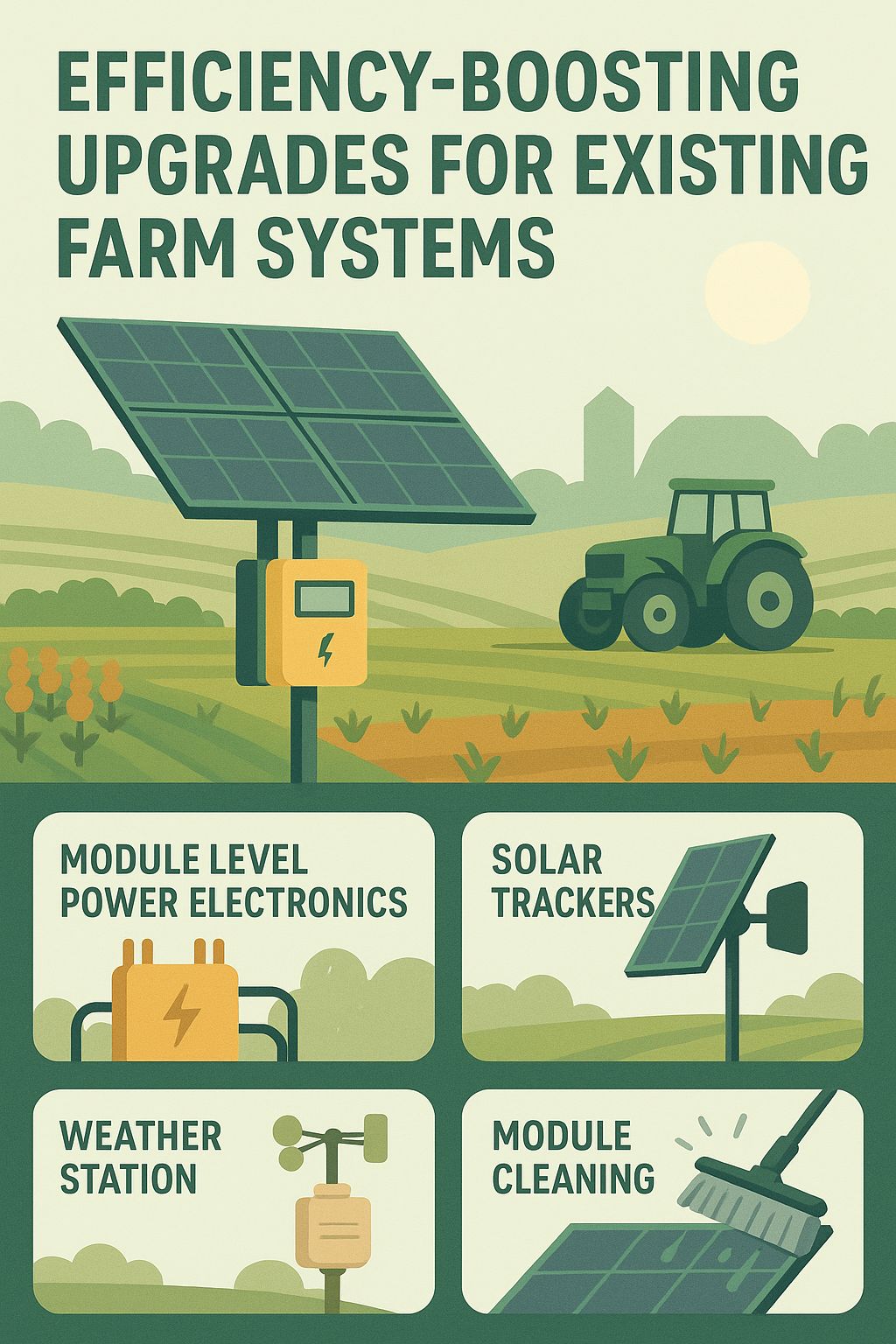
Beyond basic maintenance, several strategic upgrades can significantly improve the performance of existing farm solar installations. These enhancements typically offer shorter payback periods than installing additional panels, making them attractive options for maximizing return on your original investment. Consider these upgrades as part of a comprehensive efficiency strategy, implementing them strategically as budget allows. For more insights, explore our solar panels for farming solutions.
Micro-Inverter and Optimizer Options
Traditional string inverter systems suffer disproportionately from partial shading issues common in farm environments. When several panels connect to a single inverter, shade on even one panel reduces output across the entire string. Micro-inverters or power optimizers address this limitation by allowing each panel to operate independently at its maximum potential. This technology typically recovers 15-25% of energy that would otherwise be lost when partial shading occurs from equipment, structures, or seasonal vegetation.
Retrofitting existing systems with these technologies has become increasingly cost-effective. Power optimizers often integrate with existing string inverters, requiring minimal rewiring while still providing panel-level performance optimization. Beyond efficiency improvements, these systems provide detailed panel-level monitoring that transforms maintenance from reactive to predictive – performance anomalies become immediately visible, allowing targeted intervention before significant production is lost. For more information on solar solutions, check out this guide for farmers.
The payback period varies based on your specific installation, but farms with intermittent shading issues often recover costs within 3-5 years. Consider starting with optimizers on panels most affected by seasonal shading or those consistently underperforming before expanding to the entire array. This phased approach provides measurable performance data that justifies further investment.
Reflector and Concentrator Solutions
Simple reflector systems can increase panel energy capture by 15-30% with minimal investment. These solutions direct additional sunlight onto existing panels, effectively increasing their exposure without adding to panel count. Basic designs use UV-resistant reflective materials positioned to redirect light that would otherwise miss your panels entirely. For ground-mounted systems, light-colored gravel or concrete pathways between panel rows serves as passive reflection surfaces that incrementally boost production.
Advanced concentrator systems use carefully designed reflective geometry to focus additional light onto panels. Unlike simple reflectors, these systems require precise positioning and adjustment to prevent damaging hot spots from concentrated light. Professional installation is recommended for advanced concentrators to ensure both maximum effectiveness and panel safety. For those interested in solar applications in agriculture, exploring solar panels powering a farm’s irrigation system might provide additional insights.
Consider your local climate carefully before implementing reflector solutions. In hot regions, the additional heat from concentrated light may actually reduce efficiency if panels regularly exceed temperature ratings. Reflectors show best results in moderate climates or during cooler seasons when panels operate well below their maximum temperature threshold.
- Simple bifacial reflectors (white painted surfaces below panels) can increase production 5-10%
- Inter-row reflectors for ground mounts typically boost output 10-20%
- Advanced concentrator systems may achieve 25-35% gains but require precision installation
- Seasonal adjustable reflectors can optimize for changing sun angles throughout the year
Battery Storage Integration Benefits
Battery storage systems transform solar from intermittent power to reliable farm infrastructure. Beyond allowing energy use during nighttime hours, modern storage systems provide critical power quality improvements that extend equipment life and improve overall efficiency. Batteries buffer voltage fluctuations common in rural power grids, protecting sensitive irrigation controls and monitoring equipment from damage while ensuring consistent operation of variable frequency pump drives that might otherwise struggle with power quality issues.
The economics of battery storage have fundamentally changed in recent years. Declining battery costs combined with intelligent energy management software now deliver positive ROI for many agricultural applications, particularly for irrigation operations that can shift pumping to match solar production. Modern systems intelligently prioritize immediate use, battery charging, or grid export based on real-time conditions and programmed preferences, maximizing the financial value of every kilowatt-hour produced.
Making Solar Maintenance Part of Your Farm Routine
Successful solar maintenance requires integration into existing farm operations rather than treatment as a separate system. The most effective maintenance programs align solar care with established agricultural rhythms, sharing equipment, personnel and scheduling systems. This integrated approach ensures maintenance actually happens consistently without creating administrative burden or competing with critical farming operations for time and attention. For more detailed strategies, check out this solar panel maintenance guide.
Record-Keeping Systems That Work
Effective documentation transforms maintenance from guesswork to precision agriculture. Simple but consistent record-keeping establishes performance baselines, identifies gradual efficiency declines, and quantifies the impact of various maintenance activities. Begin with a basic maintenance log that records cleaning dates, visual observations, and any repairs alongside corresponding production metrics. These records quickly reveal the real-world value of maintenance activities specific to your installation and environment.
Digital monitoring systems significantly streamline record-keeping when properly implemented. Many modern inverters and monitoring platforms offer automated performance logging, alert systems, and production analytics that integrate with farm management software. These systems can automatically flag performance anomalies and maintenance needs based on actual production patterns rather than arbitrary schedules. For more insights on optimizing solar on agricultural properties, check out this helpful guide.
Include solar maintenance records in your broader farm management system rather than keeping them separate. This integration allows correlation with irrigation schedules, equipment usage, and crop rotation patterns that might impact solar performance. Many farmers discover surprising connections between operational decisions and solar output when comprehensive records enable data-driven analysis.
Training Farm Staff for Basic Solar Care
Developing in-house expertise for routine solar maintenance saves considerable time and expense over system lifetime. Create clear, illustrated maintenance procedures specific to your installation that allow any staff member to perform basic cleaning and inspection tasks correctly. Focus training on proper techniques, safety protocols, and recognizing issues that require professional attention. Laminated quick-reference guides kept with maintenance equipment ensure consistent procedures regardless of who performs the work. For more comprehensive tips, explore our guide on solar panels for farming.
Incorporating Maintenance into Seasonal Farm Planning
Schedule solar maintenance activities alongside compatible farm operations to maximize efficiency and ensure consistent completion. For example, align panel cleaning with equipment washing days when water systems and cleaning supplies are already deployed. Similarly, incorporate electrical inspections with other preventive maintenance activities requiring similar skills or safety protocols. This integration minimizes setup time while ensuring critical maintenance tasks receive appropriate priority within the broader farm operation.
Your Solar Efficiency Action Plan
Translating knowledge into action requires a structured implementation strategy. Begin by establishing your current performance baseline through production monitoring and professional inspection if necessary. This assessment identifies your system’s specific efficiency challenges and establishes measurable goals for improvement. Remember that even small efficiency gains compound over system lifetime – a 10% improvement represents substantial financial returns across 25+ years of operation.
Prioritize maintenance activities based on both impact and implementation difficulty. Panel cleaning typically offers the most immediate production improvement with minimal investment, making it a logical starting point. Develop a maintenance calendar specific to your farm that balances solar care requirements against other operational demands, ensuring critical tasks occur when they’ll provide maximum benefit without disrupting essential farm activities. For more insights, explore solar panels for farming solutions to enhance your agricultural operations.
- Start with thorough system inspection and performance baseline establishment
- Implement regular cleaning schedule aligned with farm operations
- Develop simple record-keeping system to track maintenance and performance
- Address vegetation management and shading issues
- Consider strategic upgrades starting with most cost-effective options
Remember that consistency matters more than perfection. A simple maintenance program reliably implemented will outperform an elaborate plan that proves impractical amid farm realities.
Frequently Asked Questions
Based on hundreds of conversations with farmers utilizing solar for irrigation and other agricultural applications, these questions represent the most common concerns about maintaining farm solar systems for maximum efficiency. Practical answers reflect both technical best practices and the practical realities of busy farm operations.
How often should I clean my farm’s solar panels?
Cleaning frequency depends significantly on your local environment and farming activities. As a general guideline, quarterly cleaning provides reasonable results in most agricultural settings, with additional cleaning following specific events like nearby harvesting operations, extended drought periods with high dust, or pollen season. Production monitoring provides the best guidance – when you notice 5-7% output reduction following initial cleaning, it’s typically time for maintenance. Many farmers find that 2-4 annual cleanings strike the optimal balance between maintenance costs and energy production benefits.
Can I use pressure washers on solar panels?
Standard pressure washers should never be used on solar panels as they can damage anti-reflective coatings, break seals, and force water into electrical components. The high-pressure stream can also cause microscopic surface scratches that accelerate degradation and reduce light transmission. Even low-pressure settings typically exceed manufacturer recommendations for maximum water pressure.
If manual cleaning seems impractical for large installations, consider specialized solar cleaning systems that use deionized water with soft brushes and controlled pressure specifically designed for photovoltaic applications. These systems typically operate below 100 PSI with appropriate nozzle design to prevent damage while effectively removing agricultural soiling.
What’s the average efficiency loss from poor maintenance?
Research across hundreds of agricultural installations shows that poorly maintained solar systems typically operate at 15-25% below their potential output, with some extreme cases exceeding 30% losses. Soiling accounts for 5-15% of this reduction, while unaddressed electrical issues, inverter inefficiency, and shading contribute the remainder. The financial impact compounds over time – reduced output not only affects immediate energy availability but also accelerates component degradation through increased operating temperatures and electrical stress, potentially shortening system lifespan by 5-10 years.
Are there tax benefits for maintaining solar equipment on farms?
While maintenance itself isn’t directly tax-deductible beyond standard business expense treatment, properly documented maintenance costs factor into depreciation calculations and may qualify for agricultural equipment maintenance deductions depending on how your system is classified. More importantly, maintenance expenses that restore or maintain original efficiency help preserve system value for continued tax benefits from initial installation incentives. For further insights on solar applications in agriculture, explore solar panels for farming.
Consider consulting with an agricultural tax specialist familiar with renewable energy systems. Many farmers successfully classify solar maintenance within their broader agricultural equipment maintenance program for favorable tax treatment. Proper documentation remains essential – maintain detailed records of all maintenance activities, expenses, and corresponding performance improvements to support both tax filings and warranty claims if needed.
How do I know if my panels are performing at full capacity?
Performance monitoring requires comparing actual production against expected output based on current conditions. Modern monitoring systems calculate performance ratios that factor in actual sunlight availability, temperature, and system specifications. A properly functioning system typically maintains performance ratios between 0.75-0.85, with values below 0.7 indicating efficiency issues requiring investigation.
Without advanced monitoring, compare current production to historical performance during similar weather conditions and seasonal position. Significant deviation (>10%) from previous years’ output during comparable conditions often indicates maintenance issues. For precise assessment, professional testing services can measure actual panel output against factory specifications to quantify efficiency losses and identify specific underperforming components.
Remember that some efficiency decline is normal – most panels lose approximately 0.5-0.7% capacity annually even with perfect maintenance. However, proper care ensures your system operates at its maximum potential throughout its lifespan, delivering reliable power for irrigation and other critical farm operations year after year.

Leave a Reply