

Key Takeaways
- Solar-powered center pivot irrigation systems can reduce operational costs by up to 70% compared to traditional electricity or diesel-powered systems.
- Integrating solar panels with irrigation infrastructure provides farmers with energy independence, protecting against utility price fluctuations.
- Modern solar solutions now include battery storage options, ensuring irrigation continues even during cloudy periods or at night.
- Federal and state incentives can offset up to 50% of solar installation costs, dramatically improving ROI timelines for farmers.
- Growing Solar Mist specializes in custom solar solutions designed specifically for agricultural irrigation needs, helping farmers maximize efficiency and sustainability.
Solar-Powered Center Pivot Irrigation: A Game-Changer for Modern Farming
Water and energy costs are squeezing farm profits tighter every year. Combining center pivot irrigation with solar power offers a powerful solution that addresses both challenges simultaneously. This integration represents one of agriculture’s most promising innovations, delivering reliable water distribution while slashing energy expenses. Growing Solar Mist has been at the forefront of helping farmers transition to solar-powered irrigation systems that provide both environmental and economic benefits.
The marriage between solar energy and center pivot technology creates a perfect synergy for modern farming operations. Solar panels generate peak power during summer months when irrigation needs are highest, creating a natural alignment between energy production and consumption. What’s more, this technology eliminates the need for expensive power line extensions to remote fields, making previously difficult-to-irrigate land newly productive.
Perhaps most compelling is how this combination addresses the unpredictability of agricultural economics. With energy costs representing up to 30% of irrigation expenses, switching to solar provides a fixed, predictable energy solution that farmers can budget around for decades. The technology has matured beyond experimental status and now represents a mainstream option for forward-thinking agricultural operations.
How Solar Integration Cuts Irrigation Costs by Up to 70%
Traditional center pivot irrigation systems typically rely on grid electricity or diesel generators, both subject to volatile price fluctuations that can devastate farm budgets. By contrast, solar-powered systems convert free sunlight into operational energy, immediately eliminating monthly utility bills. Most farmers see operational cost reductions between 40-70% in the first year alone, depending on previous energy sources and system design. These savings accelerate after the system reaches payback, typically within 5-7 years with available incentives.
Beyond eliminating direct energy purchases, solar integration reduces maintenance expenses commonly associated with diesel pumps and generators. Electric motors powered by solar are inherently more reliable, with fewer moving parts and no fuel system complications. Many farmers report maintenance cost reductions of 30-50% after transitioning to solar power, further enhancing the economic proposition. The absence of fuel deliveries also eliminates supply chain vulnerabilities that have become increasingly problematic in recent years.
Case Study: Anderson Family Farms
The Anderson operation in Nebraska transitioned their 160-acre pivot to solar power in 2020. Their annual irrigation energy costs dropped from $8,200 to $1,450 (82% reduction). The system is projected to pay for itself in 5.3 years, after which they’ll enjoy nearly free irrigation energy for the 25+ year lifespan of the solar array.
Why This Technology Matters for Farm Sustainability
Beyond immediate financial benefits, solar-powered irrigation represents a critical step toward true agricultural sustainability. Modern farming faces increasing pressure to reduce carbon footprints while maintaining productivity – a challenge solar irrigation directly addresses. Each solar-powered center pivot can eliminate approximately 20-30 tons of CO₂ emissions annually compared to grid-powered alternatives, helping farms meet sustainability goals without sacrificing operational capacity.
Water conservation also improves with solar integration. The consistent, reliable power supply enables more precise irrigation scheduling and better integration with soil moisture monitoring systems. This leads to water usage reductions of 15-25% compared to traditional systems that might skip cycles due to energy cost concerns. For farms in water-restricted regions, this efficiency gain can mean the difference between thriving and merely surviving during drought conditions. Learn more about solar panels powering a farm’s irrigation system.
Perhaps most important for long-term sustainability is how solar irrigation insulates farms from future energy price uncertainty. While conventional energy costs continue their upward trajectory, solar-powered systems lock in predictable operational expenses for decades. This stability allows for more confident crop planning, equipment investments, and overall business strategy development – critical advantages in an industry where margins continue to tighten.

Center Pivot Irrigation Basics Every Farmer Should Know
Before diving into solar integration, understanding the fundamentals of center pivot irrigation provides essential context. These systems revolutionized agricultural water distribution after their introduction in the 1940s and continue to evolve with new technology. At its core, a center pivot consists of a series of connected spans supporting sprinklers, all rotating around a fixed central pivot point. Modern systems can efficiently irrigate circular fields ranging from 5 to 500 acres with minimal labor requirements.
How These Systems Revolutionize Water Distribution
Center pivot irrigation transforms water distribution through its precise, uniform application across large acreages. Unlike flood irrigation that wastes significant water through runoff and evaporation, center pivots deliver water directly to the crop canopy or soil surface exactly where needed. The rotating movement creates even distribution patterns that ensure all plants receive consistent moisture, eliminating the dry or oversaturated zones common with other irrigation methods. To explore more about sustainable irrigation solutions, check out this guide on solar-powered irrigation systems.
- Water efficiency improvements of 85-95% compared to flood irrigation
- Reduced labor requirements – one person can manage multiple pivot systems
- Precision application of water, fertilizers, and crop protection products
- Ability to irrigate varying terrain with specialized nozzle packages
- Remote monitoring and control capabilities for optimized management
The advent of variable rate irrigation (VRI) technology further enhances center pivot capabilities by allowing different application rates across the field based on soil type, crop needs, and topography. This precision approach maximizes yield potential while minimizing water usage, representing another leap forward in irrigation efficiency. When combined with soil moisture sensors and weather forecasting, these systems can automatically adjust to changing field conditions.
Key Components and How They Work Together
Understanding the essential components of center pivot systems helps farmers make informed decisions when integrating solar power. The central pivot point houses the main control panel and water supply connection, serving as the hub for both mechanical operation and electrical systems. From there, multiple spans (typically 100-200 feet each) extend outward, supported by A-frame towers with drive motors that create the circular movement. These motors represent the primary electrical load when converting to solar power, consuming 0.5-1.5 kW each depending on size and terrain.
The water distribution system consists of the main pipeline running the length of the pivot arm, along with drops and sprinklers positioned at regular intervals. Modern systems incorporate pressure regulators and flow control nozzles that maintain consistent application rates regardless of field position or topography. Advanced pivots may include end guns or corner arm extensions that increase coverage beyond the primary circle, though these features increase both water and energy requirements.
- Central pivot point with control panel and water connection
- Multiple spans supported by A-frame towers with drive motors
- Main pipeline with drops and sprinklers for water distribution
- Pressure regulators and variable flow nozzles for consistent application
- Optional end guns or corner systems for extended coverage
The control system represents the brain of modern pivot operations, ranging from basic timers to sophisticated touchscreen interfaces with remote management capabilities. These systems monitor speed, pressure, and position while controlling water application rates. When integrating solar power, this control infrastructure requires consistent electrical supply to maintain programming and communication functions, making proper power system design crucial for reliable operation.
Water Efficiency Advantages Over Traditional Methods
Center pivot irrigation dramatically outperforms traditional water delivery methods in both efficiency and uniformity. While flood irrigation typically achieves only 40-50% efficiency (meaning half the water never reaches crop roots), modern pivot systems routinely deliver 85-95% efficiency. This translates directly to water conservation – a critical advantage in regions facing aquifer depletion or usage restrictions. For the average 120-acre pivot, this efficiency difference can save 25-50 million gallons annually compared to flood irrigation methods.
Solar Panel Technology: The Perfect Farm Energy Solution
Solar photovoltaic (PV) technology has evolved dramatically over the past decade, making it increasingly practical for agricultural applications. Modern solar panels convert 18-22% of available sunlight into electricity, a significant improvement over earlier generations. This efficiency gain, combined with falling prices (down over 70% since 2010), has transformed the economic equation for farm energy projects. Agricultural operations with high daytime energy demands like irrigation represent ideal candidates for solar adoption, with payback periods now competitive with other farm infrastructure investments.
The alignment between solar energy production and irrigation needs creates a natural synergy that benefits farmers. Both reach peak capacity during summer months and daylight hours, creating a perfect match between energy generation and consumption patterns. This natural alignment reduces or eliminates the need for extensive battery storage in many installations, simplifying system design and reducing costs. With proper sizing, a solar array can deliver reliable power precisely when irrigation demands are highest.
Types of Solar Panels Best Suited for Agricultural Applications
Not all solar panels perform equally in agricultural settings, where dust, exposure, and temperature fluctuations create challenging conditions. Monocrystalline panels typically offer the highest efficiency (19-22%) and smallest footprint, making them ideal for limited space installations. Their superior performance in high-temperature conditions also proves advantageous during peak summer irrigation seasons when ambient temperatures regularly exceed 90°F. Though commanding a premium price, their durability and performance advantages often justify the investment for irrigation applications.
Polycrystalline panels present a cost-effective alternative with slightly lower efficiency (15-17%). Their blue appearance and larger size requirements may influence aesthetic and space considerations, but their reliable performance and lower initial investment make them suitable for many farm installations. Some agricultural operations choose polycrystalline for larger ground-mounted arrays where space constraints are minimal, allowing them to achieve equivalent output with more panels at a lower total cost.
Thin-film solar technologies, while less common in agricultural settings, offer unique advantages for specific applications. Their lightweight, flexible nature makes them suitable for mounting on existing structures or integration with certain irrigation components. Though less efficient (10-13%) than crystalline options, their superior performance in low-light and high-temperature conditions can prove advantageous in certain regions. Their lower cost per panel (though higher cost per watt) sometimes makes them appropriate for specialized agricultural applications.
Here’s a table comparing the different solar panel you can use with a Center Pivot Irrigation system:
|
Solar Panel Type |
Efficiency |
Cost per Watt |
Pros |
Cons |
|---|---|---|---|---|
|
Monocrystalline |
17-22% |
$1.00 – $1.50 |
– Highest efficiency. 1, 3 |
– Most expensive option. 1, 3 |
|
Polycrystalline |
13-17% |
$0.90 – $1.20 |
– Lower cost than monocrystalline. 1, 3 |
– Slightly lower efficiency. 1, 3 |
|
Thin-Film |
10-13% |
$0.70 – $1.00 |
– Lowest cost. 1, 3 |
– Lowest efficiency. 1, 3 |
Monocrystalline panels are highly efficient and durable, making them ideal for high-performance irrigation systems that require consistent power output. Their higher cost is often offset by their superior performance in the long run 3.
Polycrystalline panels offer a good balance between cost and efficiency, making them suitable for medium-scale irrigation projects. They perform well in most conditions and are a popular choice for many agricultural applications 3.
Thin-film panels, while less efficient, are more affordable and flexible. They can be a good option for portable irrigation systems or installations where weight is a concern. Their lower efficiency means you may need more panels to achieve the same power output as crystalline options 3.
Energy Output Requirements for Different Pivot Sizes
Calculating the energy requirements for center pivot irrigation systems involves analyzing multiple factors including pump size, water lift requirements, pivot length, and operational hours. A typical quarter-section pivot (125-130 acres) with standard water pressure requires approximately 20-25 kWh per hour of operation. For a system running 12 hours daily during peak season, this translates to 240-300 kWh daily or 7,200-9,000 kWh monthly. Accurately sizing a solar system to meet these demands requires professional assessment of both irrigation needs and solar potential at the specific location.
|
Pivot Size |
Typical Power Requirement |
Daily Operation (12 hrs) |
Approximate Solar Array Size |
|---|---|---|---|
|
Small (40 acres) |
7-10 kWh/hour |
84-120 kWh/day |
20-25 kW |
|
Medium (80 acres) |
12-18 kWh/hour |
144-216 kWh/day |
35-45 kW |
|
Standard (125 acres) |
20-25 kWh/hour |
240-300 kWh/day |
50-65 kW |
|
Large (160+ acres) |
25-40 kWh/hour |
300-480 kWh/day |
65-100 kW |
Battery Storage Options for Continuous Operation
Battery storage systems transform solar-powered irrigation from daylight-dependent to 24/7 operations, a critical advantage for optimal crop management. Modern lithium-ion battery technologies now offer agricultural-scale storage with 80-90% round-trip efficiency and 10+ year lifespans. A properly sized battery system enables nighttime irrigation scheduling, critical during heat waves when evening watering minimizes evaporation losses. Though adding 20-30% to initial project costs, battery storage often delivers superior long-term economics by enabling more efficient water usage and protection against power interruptions.
- Lithium iron phosphate (LFP) batteries – offer longer cycle life and enhanced safety for agricultural applications
- Lead-acid options – lower initial cost but require replacement every 3-5 years
- Flow batteries – emerging technology with promising longevity for stationary applications
- Second-life EV batteries – increasingly available cost-effective option for agricultural storage
- Modular systems allowing incremental capacity expansion as needs grow
Determining appropriate battery capacity requires analyzing irrigation schedules, pump specifications, and critical operational periods. Most agricultural installations size batteries to provide 4-12 hours of continuous operation, with specific capacity determined by peak load requirements. For example, a center pivot system drawing 25kW would require a 100-300kWh battery bank for 4-12 hours of nighttime operation. Advanced battery management systems protect this investment by preventing harmful discharge levels and optimizing charging cycles based on usage patterns and weather forecasts.
Beyond enabling nighttime operation, battery systems provide valuable protection against intermittent cloud cover that might otherwise interrupt irrigation cycles. This operational continuity ensures consistent soil moisture levels critical for optimal crop development, particularly during sensitive growth phases. Some farmers report yield improvements of 5-12% simply from maintaining more consistent irrigation schedules made possible through battery-backed solar systems.

5 Ways to Integrate Solar Panels with Center Pivot Systems
Integrating solar power with center pivot irrigation requires thoughtful planning and design to ensure optimal performance. Farmers have multiple configuration options, each with distinct advantages based on specific operational needs and site conditions. The right approach depends on factors including land availability, budget constraints, and whether the system will operate independently or connect to the utility grid.
Working with specialists who understand both irrigation and solar technologies ensures proper system design and seamless integration. An experienced provider will analyze your specific water requirements, available solar resources, and existing infrastructure to recommend the most efficient configuration for your operation.
1. Direct Drive Connection
Direct drive systems create the simplest configuration, connecting solar panels directly to the irrigation pumps through appropriate inverters and controllers. This arrangement works well for daytime-only irrigation schedules and systems with consistent daily water requirements. The absence of batteries or grid connections reduces initial costs and maintenance requirements while providing immediate energy independence. However, operation is limited to sunny daylight hours, making this option best suited for regions with predictable weather patterns and crops that tolerate flexible irrigation scheduling.
2. Grid-Tied Systems with Net Metering
Grid-tied configurations connect solar arrays to both irrigation equipment and the utility grid, enabling two-way electricity flow. During peak production periods, excess solar energy feeds back into the grid, generating credits that offset electricity purchases during nighttime operation or cloudy days. This approach maximizes financial benefits in areas with favorable net metering policies while maintaining operational flexibility. Many farmers find this balanced approach offers the best economics while avoiding the complexity and cost of battery storage, though it does maintain dependence on grid reliability.
3. Battery Storage Solutions
Battery-backed systems incorporate energy storage components that capture excess solar production for use during non-daylight hours or cloudy periods. This configuration provides true energy independence and operational flexibility, allowing irrigation scheduling based on agronomic needs rather than sunlight availability. Modern lithium-ion battery technologies now offer agricultural-scale storage options with 10+ year lifespans, though they add significant upfront costs. For operations requiring precise irrigation timing or facing unreliable grid service, battery storage often justifies the additional investment through improved crop performance and reliability.
4. Hybrid Power Setups
Hybrid configurations combine solar generation with conventional power sources such as diesel generators or grid connections to ensure continuous operation regardless of weather conditions. This approach provides redundancy and reliability while still reducing conventional energy consumption by 60-80% annually. Control systems automatically switch between power sources based on availability and demand, prioritizing solar whenever possible. Many farmers start with hybrid systems during their transition to renewable energy, gradually expanding solar capacity and potentially adding batteries as budgets allow.
5. Mobile Solar Arrays
For operations with multiple irrigation points or seasonal water needs across different fields, mobile solar arrays mounted on trailers provide a flexible solution. These systems can move between irrigation locations as needed, maximizing the utility of the solar investment across various water sources. Though offering less total capacity than fixed installations, their mobility makes them ideal for smaller pivots or supplemental water sources. Some innovative designs incorporate automated tracking to follow the sun throughout the day, increasing energy production by 25-30% compared to fixed-position panels.
Cost Breakdown and ROI Analysis
Understanding the financial implications of solar-powered irrigation requires examining both initial investments and long-term returns. Current installation costs typically range from $1.50-$2.50 per watt before incentives, translating to approximately $75,000-$125,000 for a system powering a standard quarter-section pivot. This investment covers solar panels, mounting hardware, inverters, control systems, and installation labor. Battery storage, if included, adds $0.50-$0.70 per watt to these figures.
While these numbers may seem substantial, agricultural solar systems typically deliver 15-25 year payback guarantees and operational lifespans exceeding 30 years. When factoring in available tax incentives, grants, and accelerated depreciation schedules, many farmers achieve positive cash flow within the first year and complete payback within 5-8 years. The remaining decades represent essentially free irrigation energy, providing a significant competitive advantage in an industry with tight margins.
Initial Investment Requirements
The upfront costs for solar-powered irrigation systems vary significantly based on system size, configuration, and geographical location. Beyond the core components, farmers should budget for site preparation, electrical infrastructure upgrades, and permitting fees. Professional system design typically adds 3-5% to project costs but proves essential for maximizing performance and incentive qualification. Many agricultural lenders now offer specialized financing packages for renewable energy projects, recognizing their strong return profiles and positive impact on farm operations.
Operational Cost Savings Year-by-Year
Annual energy savings represent the primary financial benefit of solar irrigation, with most systems reducing conventional energy expenses by 70-100% depending on configuration and local utility rates. For a typical quarter-section pivot operating 1,000 hours annually, this translates to $5,000-$12,000 in first-year savings alone. Unlike many farm investments that depreciate over time, solar systems often increase in value as conventional energy prices rise, amplifying annual returns throughout their operational life.
Maintenance costs remain minimal compared to conventional energy alternatives, averaging 0.5-1% of system cost annually. Most maintenance involves simple panel cleaning and occasional electrical inspections, with inverter replacement typically required only once during the system’s 25+ year lifespan. This predictable cost structure allows for accurate long-term financial planning, unlike volatile fuel or electricity expenses that complicate budgeting with conventional irrigation power sources.
Typical Payback Periods Based on Farm Size
System scale significantly impacts economic performance, with larger installations typically achieving faster payback due to economies of scale in both equipment and installation costs. Small systems under 25kW may require 8-10 years for payback, while commercial-scale installations of 100kW or more often achieve breakeven in 5-7 years when utilizing all available incentives. Regional factors including sunlight availability, electricity rates, and state-specific incentives create significant variation in these timelines, making location-specific analysis essential for accurate projections.
|
System Size |
Typical Investment |
Annual Savings |
Estimated Payback |
|---|---|---|---|
|
25kW (40-acre pivot) |
$45,000-$60,000 |
$3,500-$5,000 |
8-10 years |
|
50kW (125-acre pivot) |
$85,000-$110,000 |
$7,000-$10,000 |
6-8 years |
|
100kW+ (multiple pivots) |
$160,000-$200,000 |
$14,000-$20,000 |
5-7 years |
Maintenance Costs You Need to Budget For
Proper maintenance ensures optimal system performance and longevity, though requirements remain minimal compared to conventional power sources. Annual panel cleaning improves efficiency by 3-5% and typically costs $0.10-$0.15 per watt depending on system configuration and accessibility. Inverter replacement represents the largest recurring expense, typically required once during years 12-15 at a cost of approximately 10% of initial system investment. Monitoring services range from basic free options to comprehensive packages costing $200-$500 annually, with the latter providing performance alerts, production analysis, and preventive maintenance recommendations.
Available Grants and Tax Incentives for Solar Irrigation
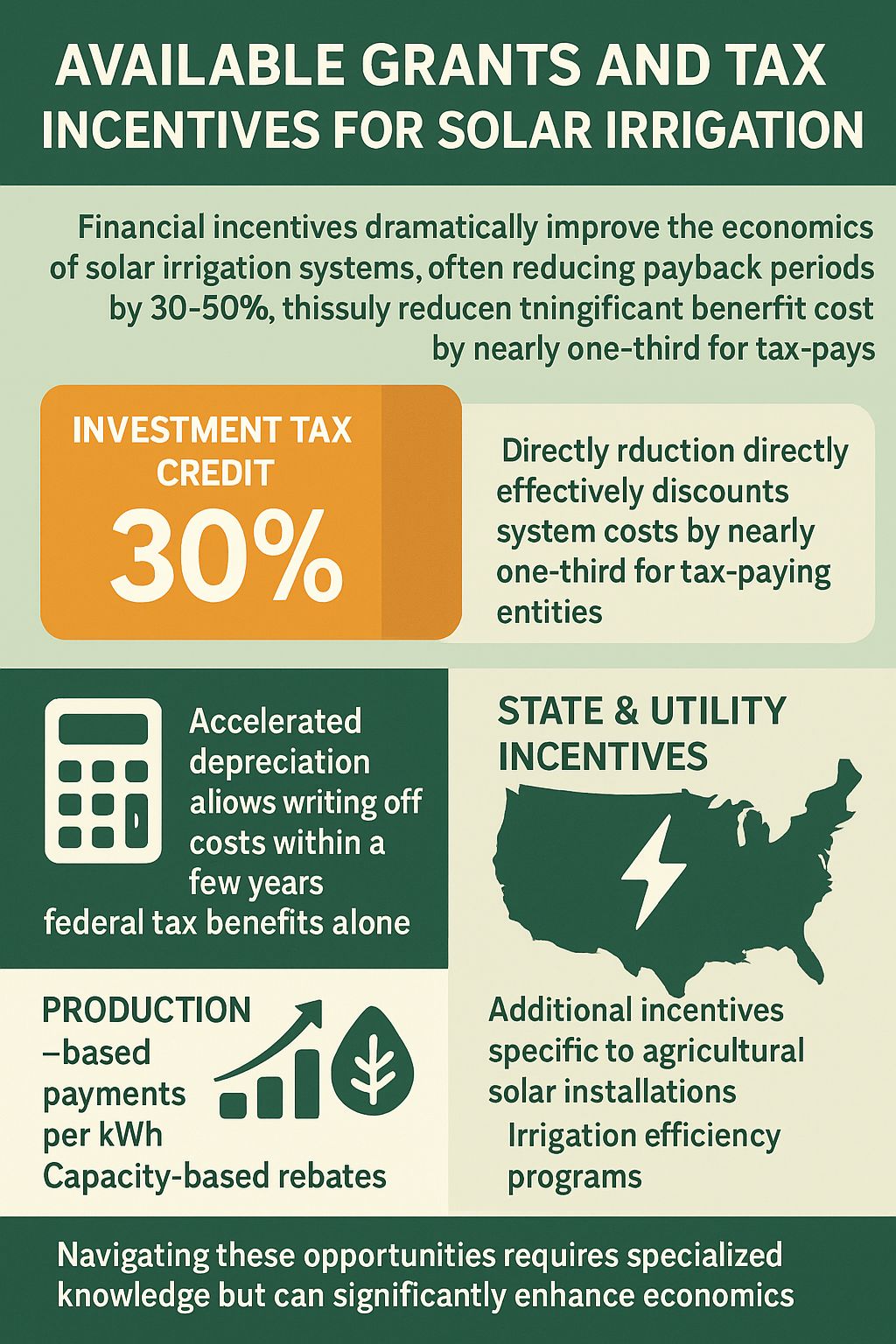
Financial incentives dramatically improve the economics of solar irrigation systems, often reducing payback periods by 30-50%. The federal Investment Tax Credit (ITC) remains the most significant benefit, currently offering a 30% tax credit on qualified solar expenses through 2032. This direct reduction in tax liability effectively discounts system costs by nearly one-third for tax-paying entities. Combined with accelerated depreciation schedules that allow writing off the entire system cost within the first few years, federal tax benefits alone can offset nearly half of the initial investment for qualifying operations.
Beyond federal programs, most states and many utilities offer additional incentives specific to agricultural solar installations. These range from production-based incentives that pay for each kilowatt-hour generated to capacity-based rebates providing upfront cost reductions. Some programs specifically target irrigation efficiency, offering enhanced benefits for projects that combine solar power with water conservation technologies. Navigating these opportunities requires specialized knowledge but can significantly enhance project economics.
Federal Programs That Cut Installation Costs
The Rural Energy for America Program (REAP) offers both grants and loan guarantees specifically designed for agricultural producers implementing renewable energy systems. REAP grants can cover up to 25% of eligible project costs, with maximum awards typically ranging from $250,000 to $500,000 depending on funding availability. These grants can be combined with tax credits and accelerated depreciation, potentially reducing out-of-pocket expenses by 60-75% for qualifying projects. Application processes require detailed energy audits and project plans, but the financial benefits justify the preparation effort for most substantial installations. For more insights, explore the integration of irrigation systems and solar panels.
State-Specific Agricultural Solar Incentives
State-level programs vary dramatically in structure and value but often provide critical supplemental incentives that enhance project economics. California’s Net Energy Metering Aggregation (NEMA) program allows farmers to offset electricity used for irrigation with solar production at any metered location on their property, maximizing financial benefits. Colorado offers sales tax exemptions and property tax incentives specifically for agricultural solar installations. New York’s NY-Sun program provides performance-based incentives that can exceed $0.40/watt for farm-based systems. Researching state-specific opportunities early in the planning process ensures maximum incentive capture.
USDA Programs Supporting Renewable Energy on Farms
Beyond REAP, the USDA offers several programs supporting agricultural energy projects through various agencies and initiatives. The Environmental Quality Incentives Program (EQIP) provides financial assistance for conservation practices including renewable energy systems that deliver environmental benefits such as reduced emissions or water conservation. The Conservation Stewardship Program (CSP) offers payments for operations implementing advanced conservation activities, potentially including solar irrigation when tied to water efficiency improvements. Regional conservation partnership programs frequently include energy components, creating additional funding pathways for innovative irrigation projects.
Technical assistance grants through USDA Rural Development help farmers with feasibility studies, energy audits, and system design planning – critical pre-development steps that improve project outcomes. Many of these programs receive enhanced funding through climate-focused initiatives, creating unprecedented opportunity for agricultural solar adoption. Working with agricultural extension services or experienced grant writers significantly increases success rates for these competitive funding opportunities.
Real-World Success Stories from Solar-Powered Farms
Examining successful implementations provides valuable insights for farmers considering their own solar irrigation projects. These case studies demonstrate proven approaches across diverse geographic regions, crop types, and system scales. While specific results vary based on local conditions, the consistent pattern of reduced operating costs, improved reliability, and enhanced sustainability emerges across virtually all documented installations.
Beyond the quantifiable benefits, many farmers report unexpected advantages after implementation. These include simplified management through automation, improved community relations through visible sustainability commitments, and marketing advantages with buyers increasingly focused on carbon footprints. Many operations also find that their solar investments serve as gateways to broader technology adoption, creating cascading benefits throughout their farming systems.
Drought-Resilient Operations in the Midwest
The Wilson family farm in central Nebraska installed a 65kW solar array powering two center pivot systems covering 180 acres of corn and soybeans. During the severe drought of 2022, when many neighbors faced prohibitive energy costs for irrigation, their solar system allowed them to maintain optimal soil moisture without budgetary constraints. The consistent irrigation enabled by their energy independence resulted in yields 22% above county averages despite challenging conditions. Their system, installed in 2019 with REAP grant assistance, achieved payback in just over four years due to exceptional performance during high electricity price periods.
Off-Grid Irrigation Solutions in Remote Locations
Montana’s Highline Ranch faced prohibitive costs exceeding $175,000 to extend utility lines to their remote pasture irrigation system. Instead, they invested $120,000 in a comprehensive solar solution with battery backup, creating a completely independent power system for their 80-acre pivot. Beyond the initial savings, they eliminated approximately $12,000 in annual utility costs while gaining operational flexibility previously impossible with diesel generators. The battery system allows nighttime irrigation during summer heat waves, significantly improving water efficiency and forage production. Their innovative approach has become a regional demonstration site, with neighboring ranches implementing similar systems after witnessing the results. For those interested in learning more about integrating solar panels with irrigation systems, visit this comprehensive guide.
Common Challenges and Practical Solutions
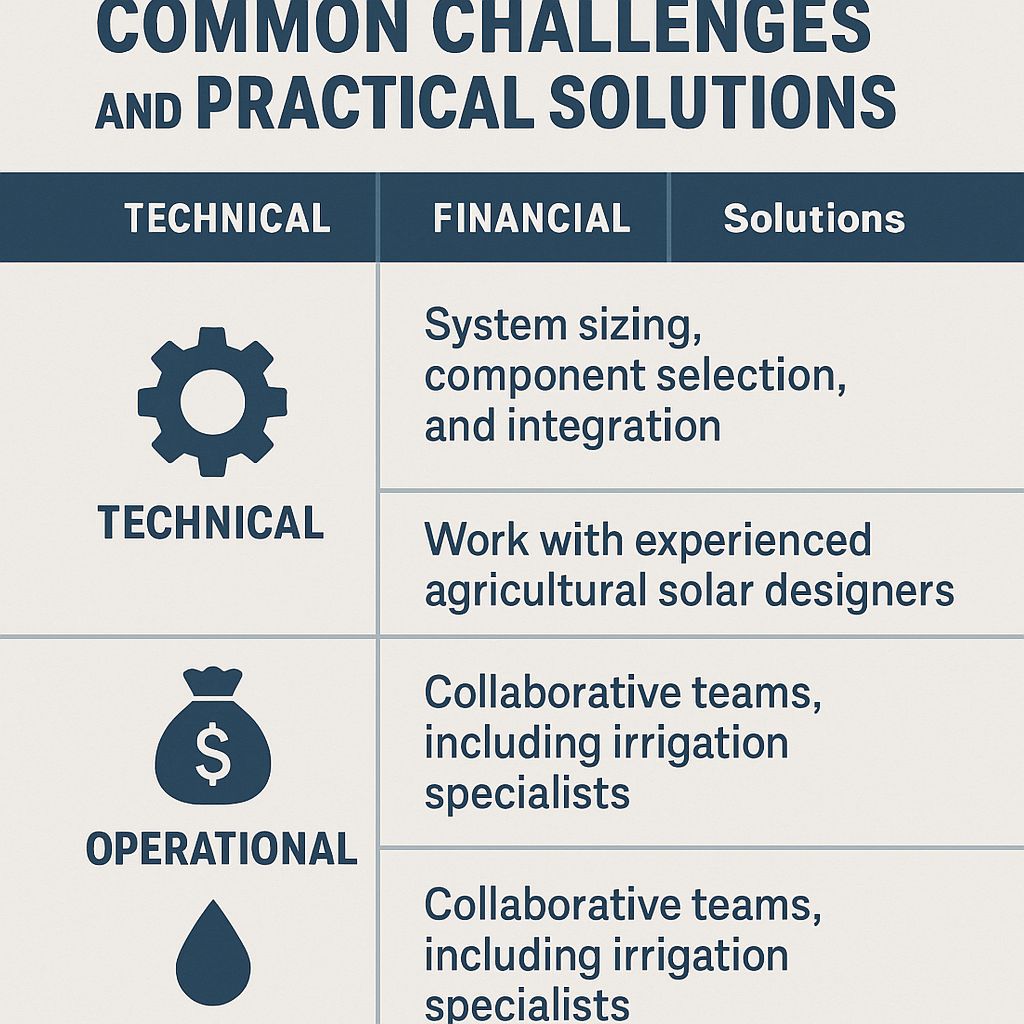
While solar-powered irrigation offers tremendous benefits, successful implementation requires addressing several common challenges. Understanding these potential obstacles and their proven solutions helps farmers develop realistic expectations and effective implementation strategies. Most difficulties fall into technical, financial, or operational categories, each with established mitigation approaches based on industry experience.
Technical challenges typically involve system sizing, component selection, and integration with existing irrigation infrastructure. Working with experienced agricultural solar designers rather than general solar contractors ensures these issues receive appropriate attention during planning. The most successful installations involve collaborative teams including irrigation specialists, solar experts, and agricultural production advisors who collectively understand all system aspects.
Operational adjustments represent another challenge category, as solar-powered systems may require modifications to established irrigation schedules and practices. Most farmers develop new management approaches during their first growing season with solar power, optimizing around energy availability while maintaining crop water requirements. These adaptations typically become routine after the initial learning period, often leading to improved overall irrigation practices.
Dealing with Inconsistent Sunlight
Weather variability presents an inevitable challenge for solar-dependent systems, requiring thoughtful design to maintain reliable operation during cloudy periods. For grid-connected systems, net metering provides the simplest solution, allowing farmers to “bank” excess production during sunny periods to offset consumption during cloudy weather. Battery storage offers another effective approach, capturing surplus energy for use when production falls below demand. Hybrid systems incorporating conventional power sources provide the highest reliability level, automatically switching to backup power when solar production proves insufficient.
Protecting Equipment from Extreme Weather
Agricultural solar installations must withstand challenging environmental conditions including high winds, hail, dust storms, and temperature extremes. Quality mounting systems designed specifically for agricultural settings typically withstand winds up to 120 mph when properly installed, protecting the substantial panel investment. Impact-resistant panel options, though slightly more expensive, offer excellent protection against hail damage in vulnerable regions. Regular maintenance including dust removal becomes particularly important in agricultural settings where field operations can generate significant airborne particulates that reduce panel efficiency. For more insights, explore solar panels for farming solutions and tips.
Troubleshooting Electrical Issues
Even well-designed systems occasionally experience electrical challenges requiring prompt diagnosis and resolution to avoid irrigation interruptions. Common issues include inverter faults, connection problems, or controller malfunctions, typically indicated through monitoring system alerts. Establishing relationships with qualified service providers before problems arise ensures rapid response when needed. Many agricultural solar companies now offer remote monitoring and diagnostics, often identifying and resolving issues before they impact irrigation operations. Maintaining basic replacement components on-farm (fuses, disconnects, control boards) helps minimize downtime for simple repairs.
Future-Proof Your Farm with Solar Irrigation
Agricultural operations face accelerating challenges from climate variability, input cost inflation, and market volatility. Solar-powered irrigation provides a strategic hedge against many of these uncertainties while positioning farms for long-term sustainability. Beyond immediate economic benefits, these systems create operational resilience through energy independence and adaptability to changing conditions.
Forward-thinking farmers increasingly view solar infrastructure as essential modernization rather than optional technology. The combination of mature equipment, proven economics, and unprecedented incentives creates a compelling case for implementation during this optimal window. Those who establish renewable energy capabilities now gain significant advantages as agriculture continues its inevitable transition toward more sustainable and efficient production methods.
Why This Investment Protects Against Rising Energy Costs
Agricultural energy expenses have historically outpaced inflation, with electricity rates increasing approximately 3-5% annually in most rural areas. Solar investments effectively lock in irrigation energy costs at current levels for 25+ years, creating predictable expenses in an otherwise volatile category. This cost certainty allows for more accurate long-term planning and budgeting, critical advantages in narrow-margin agricultural enterprises.
The protection extends beyond direct cost savings to include operational stability during energy disruptions or shortages. Recent experiences with grid reliability challenges in various agricultural regions demonstrate the vulnerability of conventional power-dependent operations. Solar-powered systems, particularly those with battery backup, maintain functionality during these events, protecting crops during critical growth periods when irrigation interruptions could cause significant yield losses.
Energy Independence Perspective
“Converting our irrigation systems to solar power five years ago was the best business decision we’ve made. While our neighbors face irrigation costs that have increased 37% since then, our energy expenses remain fixed. During last summer’s rolling blackouts, we maintained full irrigation capability while grid-dependent operations faced disruptions during critical flowering stages.” – James Rodriguez, California specialty crop producer
Beyond energy cost protection, solar irrigation systems often qualify for emerging carbon credit programs that provide additional revenue streams. As agricultural carbon markets mature, operations with documented emissions reductions through renewable energy adoption position themselves to capitalize on these developing opportunities. Some farmers already receive $15-$25 per acre annually through various carbon programs, with values projected to increase substantially as markets develop.
Environmental Benefits That Strengthen Your Farm’s Legacy
Solar-powered irrigation significantly reduces the environmental footprint of agricultural operations, supporting both marketing advantages and multigenerational sustainability. Each 50kW system typically eliminates 40-60 tons of CO₂ emissions annually compared to grid electricity, equivalent to removing 8-12 passenger vehicles from the road. This quantifiable impact supports environmental stewardship goals while potentially qualifying for additional incentive programs targeting emissions reduction.
Conclusion
Solar-powered center pivot irrigation represents a transformative approach to modern agricultural water management. By combining proven irrigation technology with renewable energy, farmers gain both immediate economic advantages and long-term sustainability benefits. The current alignment of mature technology, strong incentives, and rising conventional energy costs creates an optimal implementation window for forward-thinking operations.
Is It a Good Investment for a Farmer to Pair Up a Center Pivot Irrigation & Solar Panel Systems
For most agricultural operations with significant irrigation requirements, solar integration represents an exceptional investment opportunity with both short and long-term benefits. Systems designed to modern standards typically deliver returns exceeding most alternative farm investments while providing operational advantages beyond direct financial returns. The combination of 25+ year equipment lifespans, significant tax advantages, and protection against future energy cost increases creates compelling economics that continue improving over time.
The decision ultimately depends on specific farm circumstances including current energy costs, available solar resources, applicable incentives, and operational priorities. Most operations consuming more than $5,000 annually in irrigation energy find compelling cases for at least partial solar adoption. The modular nature of solar technology allows starting with smaller systems addressing highest-priority irrigation points, then expanding as experience and capital allow. For more information on solar-powered irrigation systems, consider exploring different types and methods available.
Return on Investment Analysis
A typical 50kW solar array powering a quarter-section pivot costs approximately $100,000 before incentives. With federal tax credits (30%), accelerated depreciation, and potential REAP grant funding (25%), net costs often reduce to $30,000-$40,000. Against annual savings of $7,000-$10,000, these systems achieve full payback in 3-5 years while providing 25+ years of virtually free irrigation energy.
Beyond purely financial considerations, solar irrigation delivers significant operational and sustainability benefits that should factor into investment decisions. Energy independence, reduced carbon footprint, potential water savings, and simplified management all contribute to comprehensive return on investment that exceeds purely financial calculations. For operations concerned with long-term sustainability and resilience, these systems represent infrastructure investments that will deliver value for decades.
Frequently Asked Questions
As farmers consider solar-powered irrigation, several common questions arise regarding implementation, operation, and economics. Addressing these concerns helps create realistic expectations and supports informed decision-making. While specific answers vary based on individual circumstances, these general responses provide useful starting points for further exploration.
Most farmers find that consulting with agricultural solar specialists provides the detailed analysis needed for their specific situation. Free assessments typically include site evaluation, energy usage analysis, incentive qualification review, and preliminary system design. This information allows for accurate economic projections and implementation planning tailored to individual farm needs.
How much land do I need to dedicate to solar panels for my center pivot?
Land requirements for solar arrays depend on system size, panel efficiency, and mounting configuration. A general rule of thumb is 3-4 acres per megawatt of capacity, translating to approximately 0.15-0.2 acres for a typical 50kW system powering a quarter-section pivot. Ground-mounted systems allow for continued agricultural use between rows, with many farmers implementing complementary enterprises such as sheep grazing or pollinator habitat in these spaces. Alternatives including rooftop installations on existing farm buildings or elevated “agrivoltaic” systems that permit cultivation beneath panels can minimize dedicated land requirements when space constraints exist.
Can I still operate my irrigation system on cloudy days?
Operational capacity during cloudy periods depends on system configuration and design. Grid-tied systems without batteries maintain full functionality regardless of weather, drawing from the utility grid when solar production falls short. Battery-backed systems provide energy storage that bridges cloudy periods, typically sized to maintain operation for 1-3 days depending on budget and reliability requirements. Even during heavy cloud cover, solar panels still generate 10-25% of their rated capacity, often sufficient for reduced operation when combined with appropriate storage or backup systems. Advanced weather forecasting integration can optimize irrigation scheduling around expected solar production, maximizing system efficiency during variable conditions.
What happens to excess energy my solar system produces?
Management of excess production depends on system configuration and local utility policies. Grid-connected systems with net metering send surplus electricity to the utility grid, earning credits that offset future consumption. These credits prove particularly valuable during nighttime operation or seasonal periods with lower solar production. Off-grid systems typically store excess energy in batteries for later use, with advanced controllers automatically managing this process to maximize battery life and system efficiency.
Some agricultural operations implement load-shifting strategies that utilize excess production for secondary purposes such as water pumping to storage reservoirs, heating/cooling agricultural buildings, or powering processing equipment. This approach maximizes on-site energy utilization without requiring expensive storage systems. Advanced energy management systems can automatically prioritize loads based on production availability, ensuring critical systems receive priority during limited production periods.
For systems consistently producing significant excess energy beyond irrigation requirements, some utilities offer feed-in tariffs that purchase this electricity at predetermined rates. While typically lower than retail electricity prices, these programs provide additional revenue streams that improve overall project economics. The availability and terms of such programs vary significantly by location, making local research essential when considering oversized systems. For more information on integrating solar panels with irrigation systems, you can explore this guide on irrigation systems and solar panels.
- Net metering: Credits for future use (most common)
- Battery storage: Capture for nighttime or cloudy day use
- Secondary applications: Water pumping, building climate control, processing
- Feed-in tariffs: Direct sale to utility (where available)
- Time-of-use optimization: Strategic generation during high-value periods
How does snow affect solar panel performance for irrigation?
Snow accumulation temporarily reduces panel output until cleared naturally or manually, though this rarely impacts irrigation operations since most systems operate primarily during snow-free growing seasons. Modern panels typically installed at angles of 20-40 degrees shed snow relatively quickly through natural warming and gravity, particularly in agricultural settings with minimal obstructions. Some installations in heavy snow regions incorporate specific design elements including steeper tilt angles, specialized frames, or even automated clearing systems to minimize production losses during winter months. For systems intended to maintain year-round production for other farm operations, proper snow management planning becomes more critical to performance.
Can I retrofit an existing center pivot system with solar power?
Most existing center pivot systems can be successfully retrofitted with solar power, typically requiring minimal modifications to the irrigation equipment itself. The process primarily involves installing the solar generation system and connecting it to the existing electrical infrastructure that powers the pivot. Control system upgrades may be recommended to optimize integration and enable advanced features such as variable frequency drives that improve efficiency. Pumping systems sometimes require modifications to operate efficiently with the DC power initially generated by solar panels, though modern inverters can typically accommodate existing AC motors without replacement. For more information, you can explore solar panels powering a farm’s irrigation system.
The retrofit process typically begins with a comprehensive energy audit to determine exact power requirements and identify potential efficiency improvements that might reduce the required solar capacity. This analysis often reveals opportunities to upgrade sprinkler packages, pressure regulators, or pumping components that further enhance system performance while reducing energy needs. Many farmers find that combining solar installation with irrigation efficiency upgrades delivers synergistic benefits that improve overall economics.
Working with specialists familiar with both solar energy and irrigation technology ensures proper integration that maintains or enhances existing system performance. An experienced agricultural solar provider will coordinate with your irrigation dealer to ensure all components work together seamlessly while preserving warranty coverage and support relationships. Growing Solar Mist specializes in these integrated solutions, offering turnkey installations that transform existing irrigation systems into renewable-powered assets with minimal disruption to farming operations.







Leave a Reply