
Key Takeaways
- Smart irrigation controllers can reduce water consumption by 20–50% compared to conventional systems, while improving crop yields by up to 25%.
- Pairing solar panels with smart controllers can cut electricity costs by 40–60% versus grid-powered irrigation alternatives.
- Soil moisture and weather-based sensors are the backbone of precision irrigation — delivering water only when and where crops actually need it.
- Remote monitoring capabilities reduce irrigation management time by 50–75%, freeing up farm labor for higher-value tasks.
- Keep reading to find out whether the investment in smart controllers and sensors actually pays off — and how fast farmers are seeing returns.
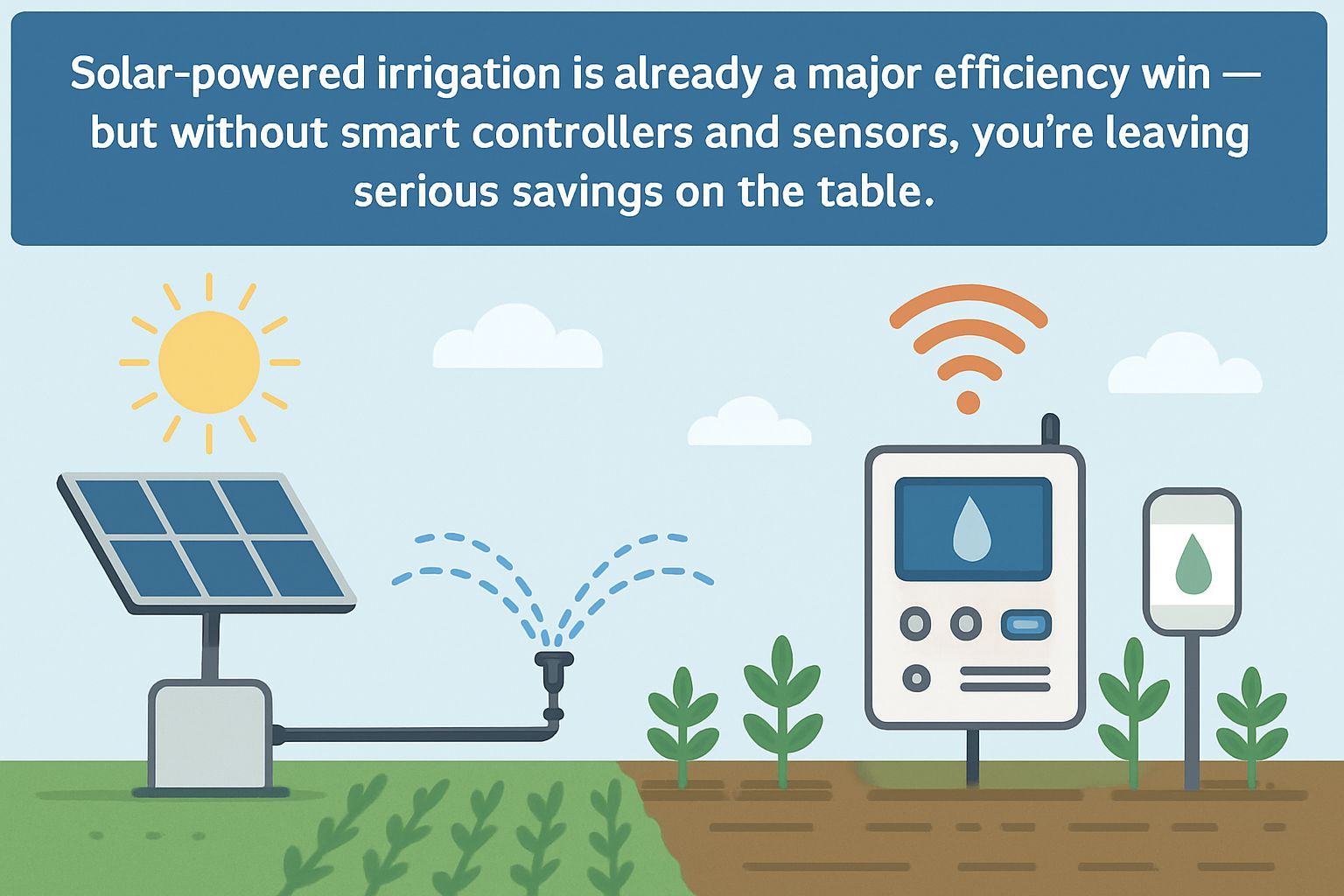
Solar-powered irrigation is already a major efficiency win — but without smart controllers and sensors, you’re leaving serious savings on the table.
Most farmers making the switch to solar irrigation focus almost entirely on the panels and the pump. That’s understandable, but the real performance gains come from what controls when and how that energy gets used. Growing Solar Mist covers this intersection of solar technology and agricultural efficiency in depth, and the data is hard to ignore: integrating advanced controllers and sensors into solar irrigation systems consistently produces compounding benefits across water use, energy costs, and crop output.
Smart Controllers and Solar Irrigation Can Cut Water Use by Up to 50%
Traditional irrigation systems operate on fixed schedules. They water at the same time, for the same duration, regardless of whether the soil is already saturated or a rainstorm just rolled through. Smart controllers eliminate that waste entirely by replacing fixed schedules with data-driven decisions.
The most capable systems reduce water consumption by 20–50% compared to conventional setups. That’s not a marginal improvement — on a mid-sized farm, that difference can translate to millions of gallons saved annually and a meaningful drop in pumping costs.
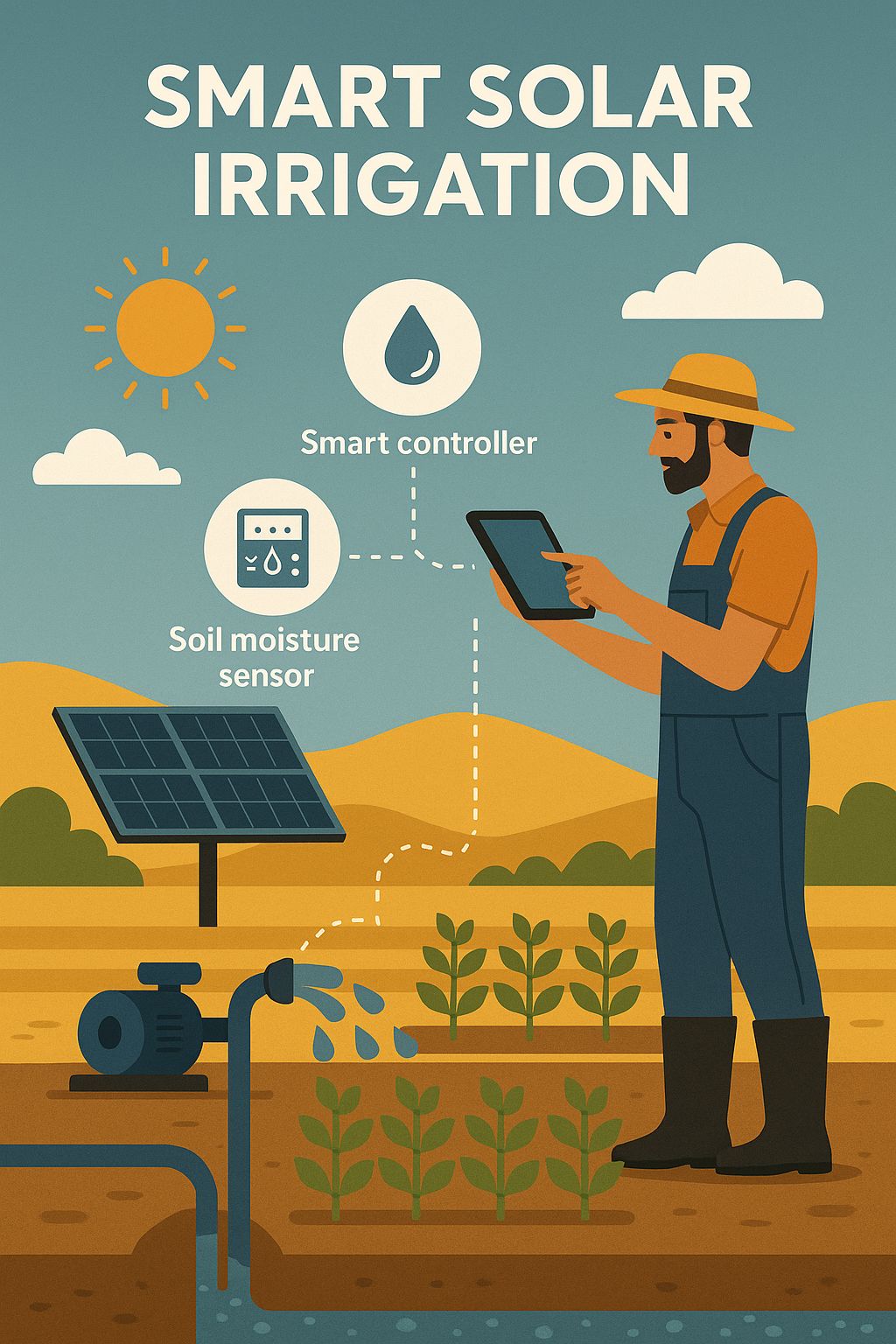
“Sensors Boost Solar Irrigation System …” from growingsolarmist.com and used with no modifications.
How Smart Controllers Work in Solar Irrigation Systems
At their core, smart controllers are decision-making hubs. They take inputs from multiple sources — sensors in the soil, weather data feeds, solar output readings — and use that information to determine exactly when to run the irrigation system and for how long.
What a Smart Controller Actually Does
A smart irrigation controller continuously monitors conditions and adjusts irrigation schedules in real time. Rather than operating on a timer, it responds to actual conditions on the ground. If soil moisture sensors detect adequate hydration, the controller delays watering. If a weather forecast shows incoming rain, it skips the next scheduled cycle entirely.
The most advanced controllers incorporate machine learning algorithms that refine irrigation schedules over time based on historical data from your specific fields. This means the system gets measurably smarter with each growing season, optimizing for your soil type, crop variety, and local climate patterns.
How Controllers Sync with Solar Power Output
One of the most powerful features of solar-integrated smart controllers is their ability to align irrigation activity with solar energy production. Pumps are typically the largest energy draw in any irrigation system, so running them during peak solar output hours — rather than at arbitrary times — directly maximizes the value of your solar investment. Controllers monitor real-time panel output and schedule pump operation accordingly, ensuring the system runs hardest when free solar energy is most abundant.
Energy-Aware Scheduling and Battery Storage Management
When battery storage is part of the system, smart controllers take on an additional layer of management. They track battery charge levels alongside solar output and irrigation demand, deciding when to draw from storage versus when to let batteries replenish. This prevents the common problem of depleting battery reserves during cloudy stretches, keeping irrigation capacity available even when solar generation temporarily dips.
The Sensors That Make Precision Irrigation Possible
Controllers are only as good as the data they receive. Sensors are what transform a smart controller from a scheduling tool into a genuine precision irrigation system.
Soil Moisture Sensors: Delivering Water Only When Crops Need It
Soil moisture sensors are installed directly in the root zones of crops to measure volumetric water content in real time. When readings fall below a defined threshold, the controller triggers irrigation. When readings are sufficient, watering is held — regardless of what the clock says. This prevents both overwatering and underwatering, the two most common causes of reduced crop yield and wasted water in traditional systems.
Using soil moisture sensors ensures crops receive the precise amount of water needed to support healthy growth without excess. Studies have shown this approach directly improves yield quality and consistency, not just water efficiency.
Weather-Based Sensors and Real-Time Schedule Adjustments
Weather-based controllers — sometimes called ET (evapotranspiration) controllers — factor in temperature, humidity, wind speed, and solar radiation to calculate how much water the crop is losing to the atmosphere. The system then matches irrigation output to replace only what’s been lost. According to the Smart Farming Journal, climate-based controllers alone can reduce water usage by up to 15% simply by adjusting schedules to reflect real-time weather data.
When soil moisture sensors and weather-based inputs are combined, the efficiency gains stack. The system cross-references atmospheric demand with actual ground-level moisture to make irrigation decisions that a human scheduler simply couldn’t match for precision or consistency.
How Modern Sensors Have Improved in Accuracy and Connectivity
Early soil moisture sensors were limited by short transmission ranges and frequent calibration needs. Modern sensors have solved both problems. Today’s units use wireless protocols like Zigbee, LoRaWAN, and cellular connectivity to transmit readings directly to cloud-based controller platforms — no manual data collection required. Installation has also become significantly simpler, with many sensors designed for direct soil insertion without specialized equipment.
Accuracy has improved just as dramatically. Current-generation capacitance-based soil moisture sensors measure volumetric water content with precision levels that older resistive sensors couldn’t approach. Combined with multi-depth sensor arrays that capture moisture data at different root zone levels, farmers now have a genuinely complete picture of soil hydration rather than a single surface-level reading. For those interested in integrating solar technology with agriculture, exploring HPBC solar panels for farms can offer additional benefits.
How Data from Smart Controllers & Sensors Ends Up Saving on Power Consumption
Every unnecessary pump cycle costs energy. When a smart controller eliminates redundant watering events — because a sensor confirmed adequate soil moisture or a weather feed flagged incoming rain — it also eliminates the solar energy or battery reserves that cycle would have consumed. Across hundreds of irrigation events per growing season, these small per-cycle savings accumulate into a substantial reduction in total energy demand. This is precisely why solar-powered systems with smart controllers can achieve electricity cost reductions of 40–60% compared to grid-powered alternatives: they’re not just using cheaper energy, they’re using significantly less of it overall.

“AI & IoT Sensors Boost Solar Irrigation …” from growingsolarmist.com and used with no modifications.
The Real Efficiency Gains Farmers See with These Systems
The performance numbers for smart controller and sensor integration aren’t theoretical projections — they’re outcomes documented across real agricultural operations. The gains show up across three distinct categories: water consumption, energy costs, and crop production.
What makes these results particularly compelling is that they compound. Saving water reduces pumping demand, which reduces energy use, which extends battery life, which makes the solar system more resilient. Each efficiency gain reinforces the others.
Water Savings: Up to 50% Less Consumption
Smart controllers with sensor integration consistently deliver water savings in the 20–50% range compared to fixed-schedule conventional systems. A farm in California documented a 25% reduction in water usage after deploying soil moisture sensors and weather-based controllers, while simultaneously increasing crop yield by 15%. At scale, these aren’t just environmental wins — they translate directly to reduced pumping costs and lower operational overhead. Learn more about how drones can boost solar panel efficiency and productivity for farms.
Electricity Cost Reductions of 40–60% Compared to Grid Power
Solar-powered smart irrigation systems slash electricity costs by 40–60% versus grid-powered alternatives. The combination of free solar generation and demand reduction from intelligent scheduling is what drives numbers that high. Systems without smart controllers still benefit from solar, but they miss the compounding savings that come from eliminating unnecessary pump cycles and aligning operation with peak solar output.
Crop Yield Improvements of Up to 25%
“Smart controllers and sensors working together don’t just conserve resources — they actively improve growing conditions by delivering water with a consistency and precision that manual or timer-based systems simply cannot match.”
Yield improvements of up to 25% have been documented in operations using integrated smart irrigation systems. The mechanism is straightforward: crops receiving precisely calibrated water at the right intervals experience less stress, develop stronger root systems, and produce more consistent output. Learn more about how drones can boost solar panel efficiency and productivity in agriculture.
Overwatering is just as damaging to yield as underwatering. Waterlogged soil restricts oxygen to roots, promotes fungal disease, and leaches nutrients beyond the root zone. Smart controllers prevent both extremes, keeping crops in the optimal moisture range throughout the growing cycle.
The combined effect of better water management and reduced plant stress also improves produce quality — not just quantity. For commercial operations where grade and consistency affect pricing, this is a meaningful revenue factor that goes beyond simple yield numbers.
Remote Monitoring and Precision Agriculture Benefits
One of the most underappreciated advantages of smart irrigation systems is what they do for farm labor efficiency. Managing irrigation across large acreage with traditional systems requires physical inspection, manual adjustments, and constant oversight. Smart systems replace that labor burden with data.
Real-time dashboards give operators a complete view of soil moisture levels, pump status, energy consumption, battery reserves, and weather conditions — all from a single interface accessible via smartphone or desktop. Alerts notify farm personnel immediately when anomalies occur, from pressure drops indicating a line break to battery levels falling below operational thresholds. For more insights on optimizing energy consumption, explore the benefits of HPBC solar panels for farms.
These labor efficiencies reduce irrigation management time by 50–75%, according to available data. That’s not a minor convenience — it represents a significant reallocation of skilled labor toward higher-value farming activities.
Managing Irrigation from Anywhere with Remote Access
Remote access capability means irrigation decisions no longer require physical presence in the field. A farmer can check real-time soil moisture readings, adjust zone schedules, override automated decisions, or shut down the entire system from anywhere with a cellular connection. This is particularly valuable during unpredictable weather events, where the ability to intervene immediately — without driving out to a control panel — can prevent both crop damage and energy waste.
Remote monitoring also enables multi-site management from a single platform. Operations running irrigation across several fields or separate properties can consolidate oversight into one dashboard, eliminating the coordination overhead that traditionally required dedicated irrigation staff at each location. For those interested in enhancing their agricultural operations, exploring HPBC solar panels can be a beneficial addition.
How Data from Sensors Drives Smarter Farming Decisions
- Soil moisture trends reveal which zones consistently over- or under-perform, allowing targeted adjustments to irrigation volume and frequency
- Energy consumption logs identify inefficiencies in pump scheduling that aren’t visible without data — like excessive run times during low solar output windows
- Weather correlation data helps refine ET calculations over time, making evapotranspiration estimates increasingly accurate for your specific microclimate
- Yield mapping tied to irrigation records lets farmers directly connect water management decisions to harvest outcomes
- Alert histories flag recurring system issues before they become failures, shifting maintenance from reactive to predictive
The shift from gut-feel irrigation scheduling to data-driven decision making is one of the most significant changes smart systems bring to farm operations. When every watering event is logged and linked to soil conditions, weather data, and energy consumption, patterns emerge that simply aren’t visible to the naked eye. A zone that seems to perform normally might be quietly consuming 30% more water than neighboring zones for the same output — something only sensor data reveals.
Over multiple growing seasons, this accumulated data becomes a competitive asset. Farms running smart irrigation systems build detailed historical profiles of how their specific soil types, crops, and microclimates interact with water and energy inputs. These profiles feed back into the machine learning algorithms embedded in advanced controllers, progressively tightening the system’s optimization. The result is an irrigation program that becomes measurably more efficient year after year without requiring additional manual input. For more information on how solar technology can enhance farm operations, check out the benefits of TOPCon solar panels for farms.
Precision agriculture at this level also strengthens farm resilience during resource constraints. During drought conditions or water restriction periods, sensor data allows operators to prioritize irrigation to the highest-value crops and most water-stressed zones first — making difficult resource allocation decisions with evidence rather than estimation. For more on how technology aids farming, check out how drones boost solar panel efficiency and productivity.
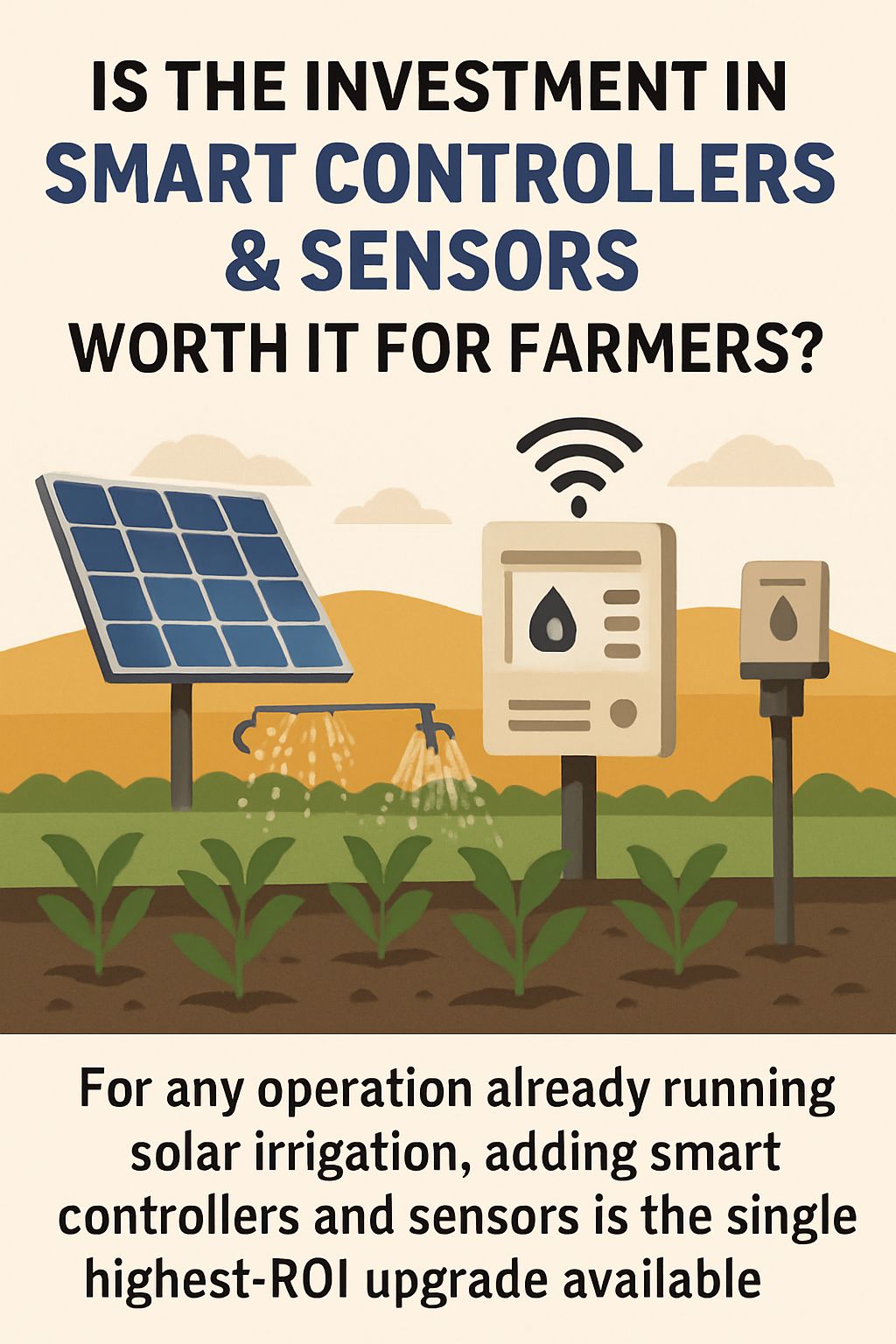
Is the Investment in Smart Controllers & Sensors Worth It for Farmers?
The upfront cost of smart controllers and sensors is real, but the payback math is straightforward for most operations. Water savings of 20–50%, electricity cost reductions of 40–60%, crop yield improvements of up to 25%, and labor time reductions of 50–75% don’t just offset the investment — they stack into returns that typically deliver full payback within one to three growing seasons for mid-sized to large operations. Smaller farms may see longer payback windows, but the compounding nature of the efficiency gains means the long-term financial advantage continues to grow well beyond the break-even point. For any operation already running solar irrigation, adding smart controllers and sensors is the single highest-ROI upgrade available.
Frequently Asked Questions
Below are the most common questions farmers and agricultural operators ask when evaluating smart controllers and sensors for solar irrigation systems.
How Much Can Smart Controllers Reduce Water Usage in Solar Irrigation Systems?
Smart controllers integrated with soil moisture and weather-based sensors can reduce water consumption by 20–50% compared to conventional fixed-schedule irrigation systems. The exact reduction depends on how inefficient the baseline system was and how comprehensively the sensors are deployed across irrigation zones. For a deeper understanding of solar technologies used in agriculture, consider exploring the comparison of solar technologies.
Operations that combine soil moisture sensors, ET-based weather controllers, and machine learning scheduling algorithms consistently land at the higher end of that range. A farm with previously unmonitored, timer-based irrigation has the most to gain and often sees the fastest and most dramatic water savings after transitioning to a smart system.
Do Smart Controllers Work with Existing Solar Irrigation Setups?
In most cases, yes. Many smart controller systems are designed with compatibility in mind and can integrate with existing pump infrastructure, solar panel arrays, and battery storage setups without requiring a complete system overhaul. The integration process typically involves connecting the controller to the existing pump controls and adding sensors to the irrigation zones. That said, older systems with non-standard components may require additional interface hardware or professional installation to ensure full functionality.
What Types of Sensors Are Most Important for Solar Irrigation Efficiency?
Soil moisture sensors and weather-based ET sensors are the two most impactful sensor types for solar irrigation efficiency. Soil moisture sensors deliver real-time root zone hydration data that prevents both overwatering and underwatering, while ET sensors factor in atmospheric conditions to calculate actual crop water demand. For operations prioritizing energy efficiency alongside water savings, solar output sensors that feed into the controller’s scheduling logic are equally critical — they’re what enables the system to align pump operation with peak solar generation windows.
How Do Smart Controllers Manage Energy When Solar Output Is Low?
When solar generation drops due to cloud cover, shorter daylight hours, or seasonal changes, smart controllers shift into a conservation mode that prioritizes available energy for the most critical irrigation needs. Controllers monitor battery state of charge in real time and adjust pump scheduling to avoid depleting reserves below operational thresholds.
Systems with battery storage integration handle low-output periods most effectively. The controller balances drawing from stored energy against forecasted solar recovery, using weather data to anticipate when generation will resume. In extended low-output scenarios, the system applies sensor data to triage irrigation — prioritizing zones with the most moisture-stressed crops and deferring lower-priority areas until energy reserves recover.
What Is the Typical Payback Period for Installing Smart Controllers and Sensors?
Payback periods vary based on farm size, baseline system inefficiency, crop type, and local water and energy costs. Mid-sized to large operations typically recover their investment within one to three growing seasons through combined savings on water, electricity, and labor. For those interested in enhancing their energy savings, exploring PERC solar panels for agriculture can be a beneficial option.
Smaller operations or farms already running reasonably efficient irrigation may see longer payback timelines — closer to three to five years — but the ongoing annual savings continue well beyond the break-even point. Water cost savings alone often represent the largest single component of ROI calculation, particularly in regions with high water pricing or strict usage allocations.
The most accurate way to estimate payback for a specific operation is to baseline current water consumption, electricity costs, and irrigation labor hours, then model the projected reductions using the performance ranges documented for smart irrigation systems. Most smart controller vendors offer this analysis as part of the pre-sale consultation process, making it straightforward to build a site-specific ROI projection before committing to the investment. For more in-depth guidance on optimizing your solar irrigation setup, Growing Solar Mist provides practical resources to help farmers get the most out of every watt and every drop. Additionally, you can explore the benefits of PERC solar panels for agriculture to further enhance your farming operations.


Leave a Reply