
Key Takeaways
- HPBC solar panels deliver up to 30% higher energy efficiency than conventional panels, making them ideal for energy-intensive farm operations like irrigation, cold storage, and climate control.
- Farms installing HPBC solar systems typically see payback periods of 4–7 years, with panels continuing to generate clean power for 25+ years after that.
- Federal tax credits and USDA agricultural grant programs can significantly offset upfront installation costs — a critical detail most farmers overlook when budgeting.
- Not all solar panels perform equally in partial shade or extreme weather — HPBC technology holds a clear advantage in real-world agricultural conditions.
- Sizing your system correctly from the start determines whether your solar investment covers your actual energy load or leaves expensive gaps — learn how to calculate it right.
Most farmers installing solar are leaving serious energy production on the table by choosing the wrong panel technology.
Agriculture is one of the most energy-demanding industries in the world. Between pumping water for irrigation, maintaining controlled environments in greenhouses, running cold storage for perishables, and powering processing equipment, a working farm’s electricity bill tells a punishing story. Growing Solar Mist focuses specifically on helping agricultural producers navigate these decisions, and one of the clearest conclusions from real farm installations is this: panel technology choice matters enormously, and HPBC panels consistently outperform alternatives in agricultural settings.
HPBC Solar Panels Deliver More Power for Less Farm Space
Space on a farm sounds unlimited until you start mapping out where panels can actually go. Rooftops on barns and outbuildings have structural limits. Ground-mounted arrays compete with crop land. The more power you can extract per square meter of panel, the better — and that’s exactly where HPBC technology earns its place.
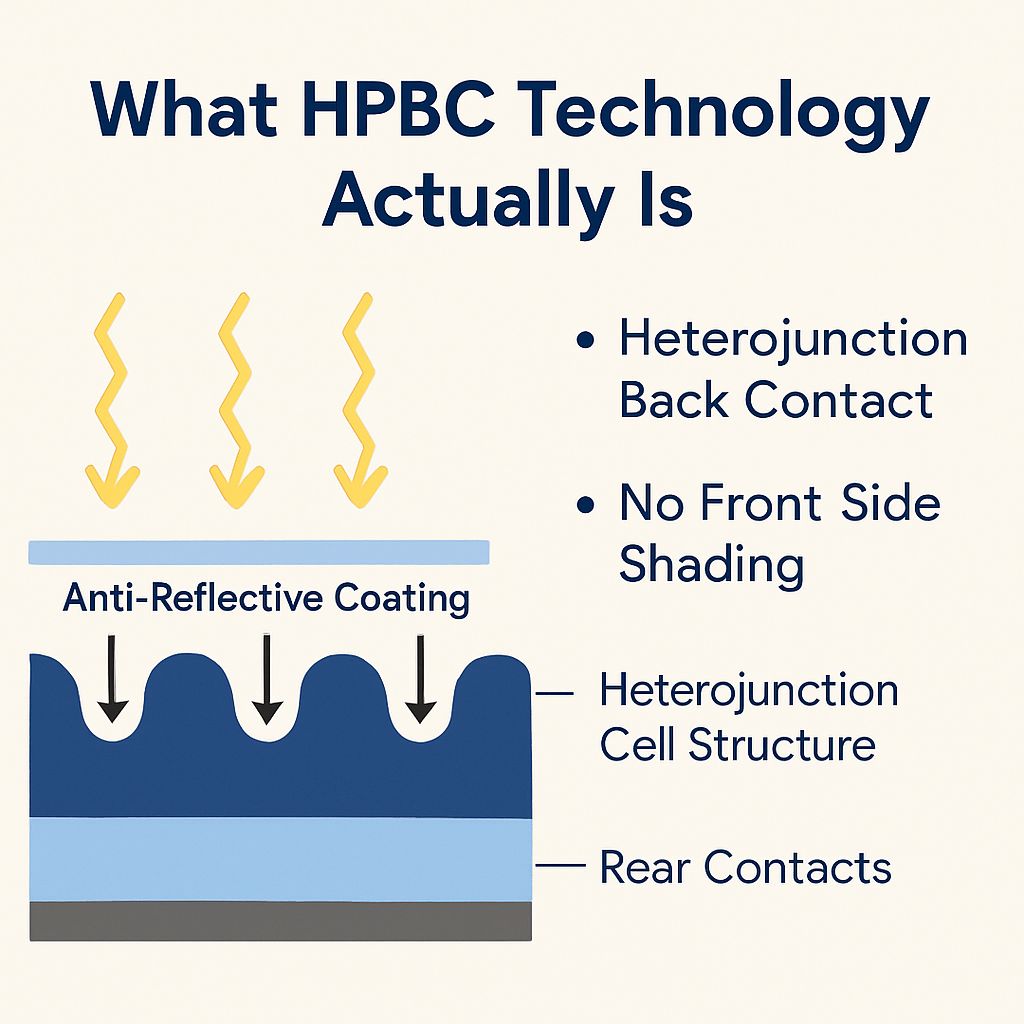
What HPBC Technology Actually Is
HPBC stands for Heterojunction Back Contact. It’s a solar cell architecture that combines two of the most effective innovations in modern panel design: heterojunction cell structure and rear-contact electrical layout. In a standard panel, metal contacts sit on the front surface of each cell, physically blocking a portion of incoming sunlight. HPBC moves all those contacts to the back of the cell, eliminating that shading loss entirely. The heterojunction layer adds a second performance boost by reducing electron recombination — essentially, more of the light that hits the panel gets converted to usable electricity instead of being lost as heat. For a deeper dive into solar panel materials, check out this article on polycrystalline solar panels.
How HPBC Differs From Standard Solar Panels
The practical gap between HPBC panels and conventional PERC panels — the most common type installed on farms over the last decade — is significant. Standard PERC panels typically achieve efficiencies between 19% and 21%. HPBC panels push that range to 23%–25%, and some premium configurations exceed that. That difference compounds quickly across a large array.
Temperature performance is another critical differentiator for outdoor agricultural installations. All solar panels lose efficiency as they heat up — this is measured as the temperature coefficient. HPBC panels carry a lower temperature coefficient than PERC panels, meaning on a hot summer afternoon when your irrigation system is running hardest, an HPBC array is producing measurably more power than a conventional array of the same physical size.
Why Farm Energy Demands Make HPBC the Right Fit
Farm energy loads are not like residential or commercial energy loads. They’re often seasonal, highly variable, and concentrated during peak sunlight hours — which actually aligns well with solar generation. Irrigation runs during the day. Grain drying runs during harvest season. Greenhouse cooling peaks on hot sunny afternoons. This natural overlap between solar production and farm energy demand is a genuine advantage, and HPBC panels maximize the electricity generated during those exact windows when the farm needs it most.

5 Agricultural Applications Where HPBC Solar Excels
Before choosing panel technology, it helps to see exactly where that power is going. These five applications represent the highest-impact areas where HPBC solar installations have delivered measurable results on working farms.
1. Irrigation Systems
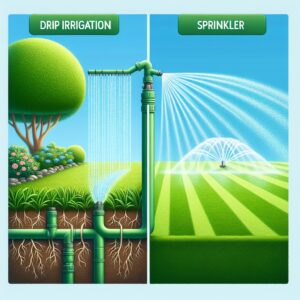
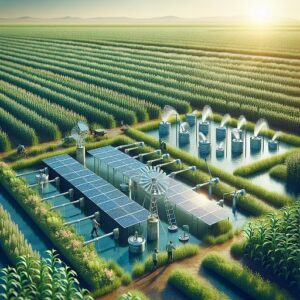
Irrigation is one of the single largest electricity expenses on any crop-producing farm. Electric submersible pumps, center pivot systems, and drip irrigation infrastructure can run for hours daily during growing season, and the costs stack up fast. HPBC solar is a natural match for irrigation because peak solar generation aligns almost perfectly with peak watering demand — sunny days are the days crops need water most.
Farmers who have transitioned irrigation systems to solar-direct or battery-assisted solar report energy cost reductions between 60% and 100% on that specific load. For operations running large center pivot systems covering hundreds of acres, that translates to tens of thousands of dollars annually.
2. Greenhouse Climate Control
Maintaining precise temperature and humidity inside a greenhouse demands constant energy input — ventilation fans, evaporative cooling systems, supplemental heating, and lighting all run simultaneously. The load is substantial, and it peaks during daylight hours when solar generation is at its highest. HPBC panels sized correctly for a greenhouse operation can offset between 40% and 80% of climate control costs, with the higher end of that range achievable in high-sunlight regions with well-designed battery backup systems.
3. Crop Drying and Processing
Grain dryers, conveyor systems, and processing equipment run intensively during harvest windows. While this creates a seasonal rather than year-round demand profile, the energy draw during those weeks is enormous. Pairing an HPBC solar array with a grid-tied net metering arrangement allows farms to bank solar credits during lower-demand months and draw heavily on the system during harvest without large utility spikes.
4. Cold Storage and Refrigeration
Cold storage is a 24-hour energy load, which makes it one of the more complex applications for solar. Daytime HPBC generation can cover a significant portion of refrigeration demand directly, but overnight loads require either battery storage or grid backup. The strategic approach most agricultural solar installers recommend is using solar to offset daytime refrigeration costs while maintaining grid connection for overnight coverage — reducing the overall storage investment while still achieving 40%–60% reductions in cold storage electricity costs.
5. Running Farm Equipment and Electric Vehicles
Electric utility vehicles, equipment battery charging stations, and automated machinery are becoming standard on modern farms. The shift toward electrified farm equipment is accelerating, and the farms best positioned to benefit are those with solar infrastructure already in place. HPBC panels provide the higher per-panel output needed to make on-farm EV charging practical without requiring a massive ground footprint.
A mid-sized operation running two or three electric utility vehicles alongside automated feeding or harvesting equipment can expect to need between 15kW and 40kW of dedicated solar capacity for that load alone. HPBC’s superior efficiency means achieving that output requires significantly fewer panels — and less structural mounting hardware — compared to conventional technology.
Real-World Example: A 500-acre grain operation in the Midwest installed a 75kW HPBC rooftop array across three barn structures. The system powers two electric tractors, a fleet of utility vehicles, and all grain auger equipment during harvest. First-year fuel and electricity savings came in at just over $31,000 — exceeding pre-installation projections by 14%.
The economics of powering farm equipment with solar become even more compelling when factoring in diesel price volatility. Farms that have locked in solar generation effectively insulate a portion of their operating costs from fuel market fluctuations — a risk management benefit that rarely gets highlighted but matters enormously to agricultural business planning.
As more equipment manufacturers release electric versions of traditionally diesel-powered machinery, having a robust HPBC solar infrastructure already producing power positions farms to adopt those technologies without adding significantly to their utility costs.
HPBC Panel Performance in Real Farm Conditions
Lab efficiency numbers are a starting point, not the full story. What matters for a working farm is how panels perform across seasons, in variable weather, and after years of outdoor exposure to dust, moisture, bird activity, and temperature swings. This is where HPBC technology demonstrates advantages that go well beyond the spec sheet.
Agricultural environments are genuinely demanding for solar equipment. Barn-mounted arrays accumulate dust and debris from grain handling. Ground-mounted systems near fields deal with seasonal flooding risks and soil particulate. Panels in livestock areas face ammonia exposure from animal waste. HPBC panels’ robust construction and tempered glass surfaces handle these conditions with lower performance degradation rates than most conventional panel types.
Output in Partial Shade and Overcast Weather
Shading is an unavoidable reality on most farm properties. Trees along fence lines, grain bins, silos, and neighboring structures all cast shadows that move across rooftop and ground arrays throughout the day. Conventional PERC panels suffer disproportionate output losses when even a small portion of a string is shaded — a characteristic that can dramatically undercut real-world performance. HPBC panels, particularly when paired with microinverters or DC power optimizers, handle partial shading with significantly less total output loss.
On overcast days, HPBC panels also maintain a higher percentage of their rated output compared to standard panels. This is due to their superior low-light response — a product of the heterojunction cell structure that captures a broader spectrum of diffuse light. For farms in the Pacific Northwest, Great Lakes region, or other areas with frequent cloud cover, this characteristic alone can justify the technology upgrade.
Long-Term Efficiency Retention vs. Conventional Panels
Solar panels degrade over time — that’s unavoidable. But the rate of degradation varies significantly by technology. Standard PERC panels typically degrade at roughly 0.5% to 0.7% per year. Quality HPBC panels from leading manufacturers hold degradation rates closer to 0.25% to 0.4% annually. Over a 25-year system lifespan, that difference accumulates to a meaningful gap in total energy production — and total financial return.
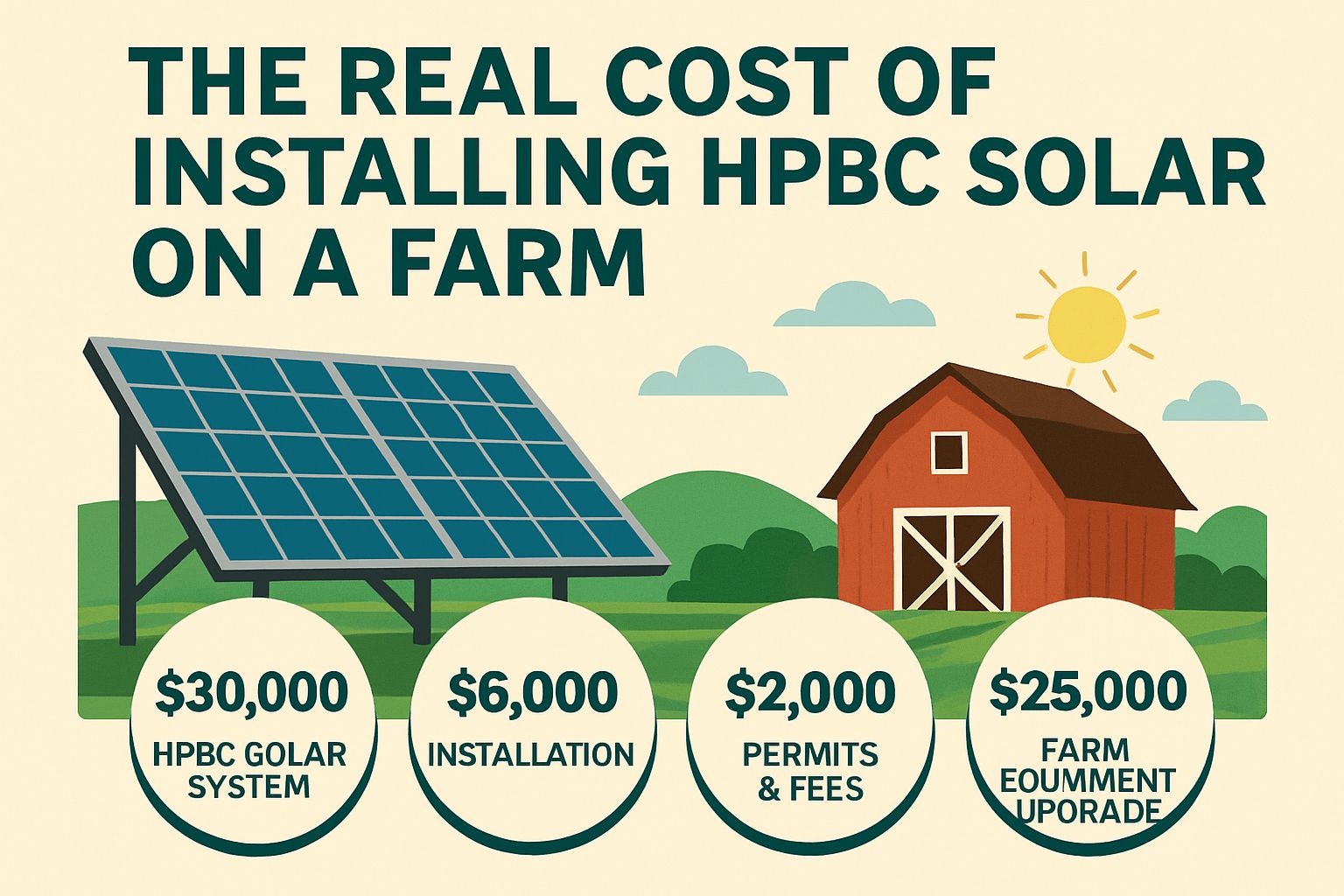
The Real Cost of Installing HPBC Solar on a Farm
Cost is where most farm solar conversations stall. HPBC panels carry a higher per-watt price than standard PERC panels, and that upfront difference can look significant when you’re budgeting a 50kW to 200kW agricultural system. But evaluating solar cost purely on panel price misses most of the actual financial picture.
Because HPBC panels produce more power per panel, a properly designed HPBC system requires fewer panels to meet the same energy target. Fewer panels means less racking hardware, fewer mounting penetrations on rooftops, reduced labor hours for installation, and a smaller inverter configuration in some cases. Those balance-of-system savings partially offset the higher panel cost before you even account for performance advantages over time.
Typical Payback Periods for Agricultural Installations
Agricultural solar installations using HPBC technology typically reach financial payback in 4 to 7 years, depending on system size, local utility rates, available incentives, and the specific energy loads being displaced. Operations in states with high electricity rates — California, Hawaii, New England — consistently hit the lower end of that range. Farms in regions with lower utility costs but strong sun exposure, such as the Southwest and Great Plains, typically land in the 5 to 7 year window. For more information on solar panel options, check out this comparison of monocrystalline vs polycrystalline solar panels.
After payback, the math becomes straightforward: the system continues generating power for another 18 to 21 years with minimal maintenance cost. For a farm that invested $180,000 in an HPBC solar system and reached payback in year 6, the remaining lifespan of the system represents well over $400,000 in avoided energy costs at current rates — and that figure grows if utility prices increase, which historically they do.
Federal Tax Credits and Agricultural Grant Programs
The federal Investment Tax Credit (ITC) currently allows agricultural businesses to deduct 30% of the total solar installation cost from their federal tax liability. For a $180,000 system, that’s a $54,000 direct reduction in tax owed — not a deduction from taxable income, but a dollar-for-dollar credit. This single incentive dramatically changes the payback calculation for most farm operations.
Beyond the ITC, the USDA’s Rural Energy for America Program (REAP) provides grants covering up to 50% of eligible project costs for agricultural producers and rural small businesses installing renewable energy systems. REAP applications are competitive, but farms that qualify can combine REAP grants with the federal ITC to reduce net system cost by 60% to 70% before accounting for energy savings. Working with an installer experienced in agricultural incentive programs is essential — the application process has specific documentation requirements that can disqualify projects if handled incorrectly.
Energy Cost Reductions by Farm Application
|
Farm Application |
Typical Energy Cost Reduction |
Notes |
|---|---|---|
|
Irrigation Systems |
60% – 100% |
Best alignment between solar production and demand |
|
Greenhouse Climate Control |
40% – 80% |
Higher end achievable with battery storage |
|
Crop Drying & Processing |
35% – 65% |
Seasonal demand; net metering maximizes value |
|
Cold Storage & Refrigeration |
40% – 60% |
Grid backup recommended for overnight loads |
|
Equipment & EV Charging |
50% – 90% |
Grows as fleet electrification expands |
How to Size and Plan an HPBC Solar System for Your Farm
Getting the system size right is the single most important planning decision you’ll make. An undersized system leaves energy costs on the table. An oversized system tied to unfavorable net metering policies generates credits you’ll never fully use. Neither outcome serves the farm’s financial interests, and both are common when farmers work with installers who lack agricultural-specific experience.
The planning process for a farm solar installation is more involved than a residential or commercial project. Agricultural energy loads vary by season, scale with production levels, and often include large motor-driven equipment that creates demand spikes requiring careful inverter and array sizing. A proper agricultural solar assessment takes all of these variables into account before a single panel location is finalized.
Calculating Your Farm’s Energy Load
Start with 24 months of utility bills to capture seasonal variation across full production cycles. Identify your five largest individual energy loads and note when during the day and year they run. For any diesel or propane-powered equipment you plan to electrify, get the kilowatt-hour equivalent from the manufacturer spec sheet — this becomes part of your future load projection, not just your current consumption. A qualified agricultural solar designer will use this data to build a load profile that drives accurate system sizing rather than relying on industry averages that rarely reflect any individual farm’s actual usage patterns.
Roof-Mounted vs. Ground-Mounted Arrays for Agricultural Properties
Farms have more mounting options than virtually any other property type, and the right choice depends on your roof condition, available land, and which energy loads you’re targeting. Barn rooftops and equipment shed roofs are the most common starting point — they put panels close to the loads they’re serving, minimize wiring runs, and don’t consume productive land. The key qualification is structural: agricultural rooftops need an engineer’s assessment before installation, as older timber-framed barns may require reinforcement to handle the added load of a full panel array.
Ground-mounted systems make sense when rooftop space is limited, roof condition is poor, or when the system needs to be large enough that rooftop площадь simply can’t accommodate it. Agrivoltaic installations — where ground-mounted panels are elevated to allow crops or livestock grazing underneath — are gaining significant traction as a way to generate solar power without sacrificing productive acreage. Research from the National Renewable Energy Laboratory has shown that certain shade-tolerant crops can actually benefit from the partial shading agrivoltaic arrays provide, reducing water stress during peak summer heat.
When to Add Battery Storage to Your Solar Setup
Battery storage is not a requirement for every farm solar installation, and adding it unnecessarily inflates upfront costs without proportional benefit. The decision comes down to three factors: whether your farm has critical loads that cannot tolerate grid outages, whether your utility offers unfavorable net metering rates that reduce the value of excess solar export, and whether you have significant overnight energy demands that solar alone cannot cover.
For farms with cold storage, livestock ventilation systems, or medical/safety equipment that must run continuously, battery backup is a clear justification. A properly sized lithium iron phosphate (LFP) battery bank — the chemistry most agricultural installers specify due to its thermal stability and cycle life — can carry critical loads through overnight hours and short-term grid outages without interrupting operations.
If your utility offers strong net metering at or near retail rate, exporting excess daytime solar production and drawing from the grid at night is often more cost-effective than investing in batteries. Run the numbers on your specific utility tariff before committing to storage — the financial case varies significantly by location and rate structure.
Choosing a Qualified Agricultural Solar Installer
Not every solar installer understands the specific demands of agricultural installations. Residential and commercial solar experience does not automatically translate to competence with farm-scale systems, three-phase power configurations, USDA REAP grant applications, or the structural considerations of agricultural buildings. Vetting your installer on agricultural-specific criteria is essential.
Ask prospective installers for references from farms of similar size and production type. Request documentation of their experience with USDA REAP applications and federal ITC compliance. Confirm that their electrical subcontractors are licensed for three-phase agricultural service work. A qualified agricultural solar installer will also perform a full shading analysis using tools like Aurora Solar or Helioscope rather than estimating production from satellite imagery alone.
Get at least three proposals and compare them on system production estimates, equipment specifications, warranty terms, and total cost of ownership — not just installed price per watt. The lowest bid rarely delivers the best 25-year outcome, particularly when it comes to panel quality, inverter brand, and workmanship warranty coverage on agricultural structures.
Installer Evaluation Checklist:
- Verified references from comparable farm installations
- Experience with USDA REAP grant applications
- Licensed for three-phase agricultural electrical work
- Professional shading analysis tools used (Aurora Solar, Helioscope)
- Clear documentation of ITC compliance and incentive capture
- Workmanship warranty of 10+ years on agricultural structures
- Detailed 25-year production and savings modeling provided
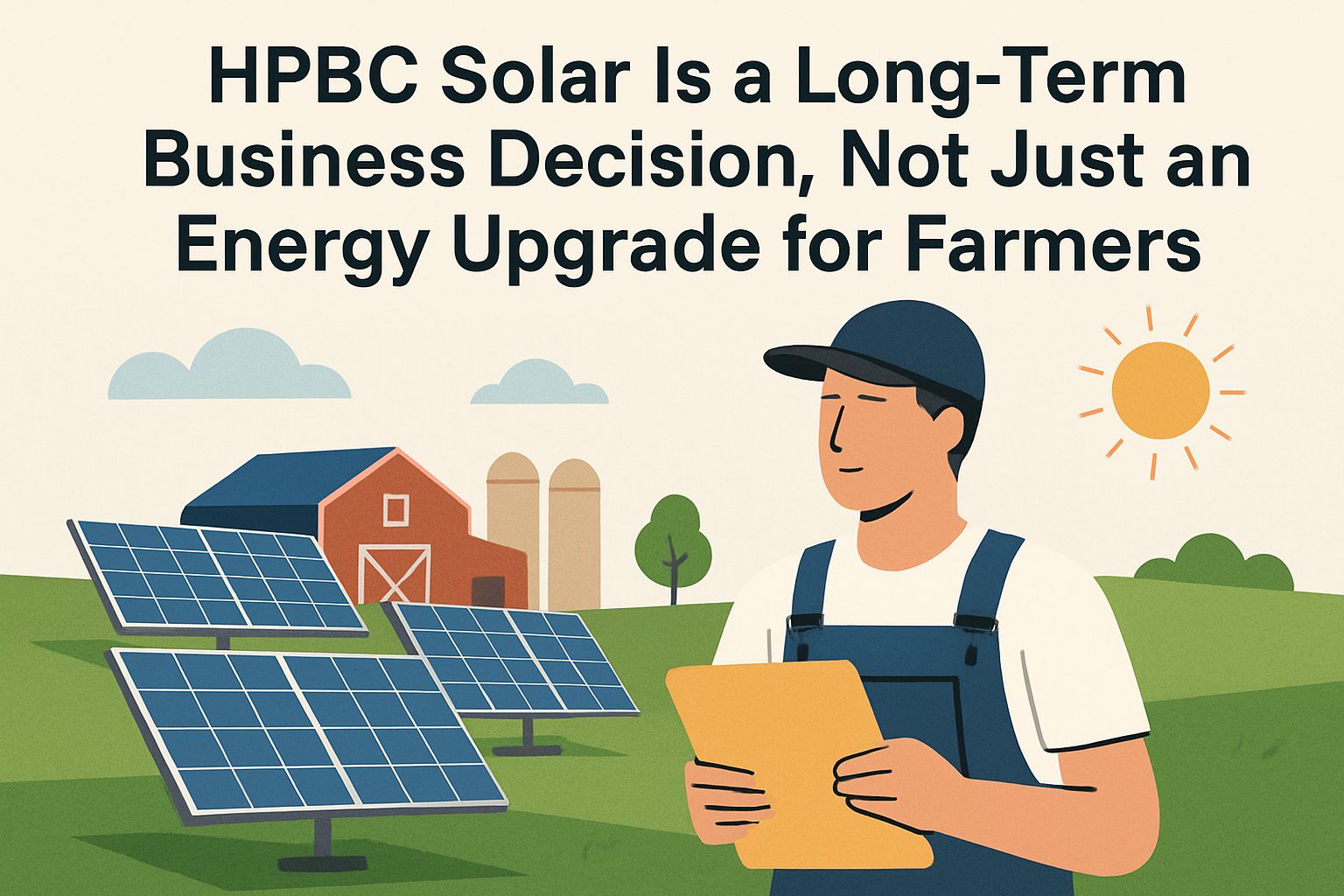
HPBC Solar Is a Long-Term Business Decision, Not Just an Energy Upgrade
Framing solar as an energy purchase misses what it actually is for a farm operation: a capital investment with a predictable return, a hedge against utility price increases, and a long-term reduction in operating cost exposure. The farms that have moved forward with HPBC solar installations consistently report that the financial discipline of analyzing it as a business investment — with IRR calculations, payback modeling, and incentive stacking — produced far better outcomes than approaching it as an equipment purchase driven by upfront price alone.
The 25-year production lifespan of a quality HPBC array, combined with the current federal ITC, available USDA REAP grants, and the compounding effect of utility rate increases on avoided costs, makes this one of the highest-confidence capital investments available to agricultural producers today. The technology is proven, the incentives are substantial, and the farms that act now lock in those advantages before policy windows change.
Frequently Asked Questions
Farmers considering HPBC solar installations consistently raise the same core questions around cost, performance, and practicality. The answers below are based on real installation data and current program parameters.
Are HPBC solar panels worth the higher upfront cost for small farms?
Yes — for most small farms, the higher per-panel efficiency of HPBC technology means achieving the needed energy output with fewer panels and less mounting infrastructure, which partially offsets the price premium. When USDA REAP grants and the federal ITC are factored in, the net cost difference between an HPBC system and a conventional PERC system narrows significantly, while the long-term production advantage of HPBC remains fully intact. Small farms with limited rooftop space particularly benefit from HPBC’s higher power density.
Can HPBC panels power an entire farm off-grid?
A fully off-grid farm solar system is technically achievable but requires a very large battery bank to cover overnight and low-production periods, which adds substantial cost. Most agricultural solar designers recommend a grid-tied or hybrid approach — using HPBC solar to cover the majority of daytime loads and either net metering or battery backup to handle the remainder. Fully off-grid configurations make the most sense for remote properties where grid connection costs are prohibitively high. For more on solar panel options, explore the differences and benefits of monocrystalline vs bifacial solar panels.
How long do HPBC solar panels last in outdoor agricultural environments?
Quality HPBC panels from established manufacturers carry 25-year linear power output warranties guaranteeing a minimum of 87%–92% of rated output at end of warranty period. In real-world agricultural environments — accounting for dust accumulation, temperature cycling, and occasional mechanical stress — properly installed HPBC panels regularly operate productively for 30 years or more. Annual degradation rates in the 0.25%–0.4% range mean meaningful power production well beyond the warranty term.
What government incentives are available for farmers installing solar?
The two primary incentives for agricultural solar installations in the United States are the Federal Investment Tax Credit (ITC), currently at 30% of total system cost, and the USDA Rural Energy for America Program (REAP), which provides grants of up to 50% of eligible project costs. These two programs can be combined, making it possible to offset 60%–70% of net system cost through incentives alone before accounting for energy savings.
Many states offer additional incentives including property tax exemptions on solar equipment, sales tax exemptions on panel purchases, and state-level renewable energy tax credits. Some utilities also offer agricultural-specific net metering programs or demand charge reduction incentives for farms that install solar with battery storage. A qualified agricultural solar installer familiar with your state’s incentive landscape should conduct a full incentive analysis as part of the proposal process.
Do HPBC panels require special maintenance on a working farm?
HPBC solar panels require minimal maintenance, which is one of their practical advantages for busy farm operations. The primary maintenance task is periodic cleaning — removing dust, grain chaff, bird droppings, and other debris that accumulates on panel surfaces and reduces output. In most agricultural settings, rainfall handles routine cleaning adequately, with manual cleaning recommended once or twice annually for arrays near grain handling facilities or livestock areas where debris accumulation is heavier.
Inverters and electrical connections should be inspected annually by a qualified technician. Most modern string inverters and microinverters used in agricultural installations include remote monitoring that alerts system owners to underperformance before it becomes a significant production loss. Setting up monitoring alerts from day one of system operation is a simple step that protects the investment over the long term.
Vegetation management matters for ground-mounted arrays. Keeping grass and weeds trimmed beneath panel rows prevents shading of lower panel edges and reduces moisture retention that can accelerate corrosion of mounting hardware. Most ground-mount installations specify a mowing or grazing management plan as part of the site design — integrating sheep grazing under elevated agrivoltaic arrays has become a particularly efficient approach on livestock operations.
In regions with heavy snowfall, snow accumulation on panels temporarily reduces output but rarely requires manual intervention — panel surface temperatures and tilt angles naturally shed snow within a day or two of accumulation. For operations where any production interruption during winter months is a concern, heated panel options exist but add cost that is rarely justified in standard agricultural applications.
Growing Solar Mist helps agricultural producers navigate every stage of the solar planning process — from load analysis and incentive identification to installer vetting and long-term system monitoring — so farms can make confident, well-informed energy investments that deliver for decades. For those interested in the best solar solutions, explore our comparison of monocrystalline vs. polycrystalline solar panels for farmers.


Leave a Reply