
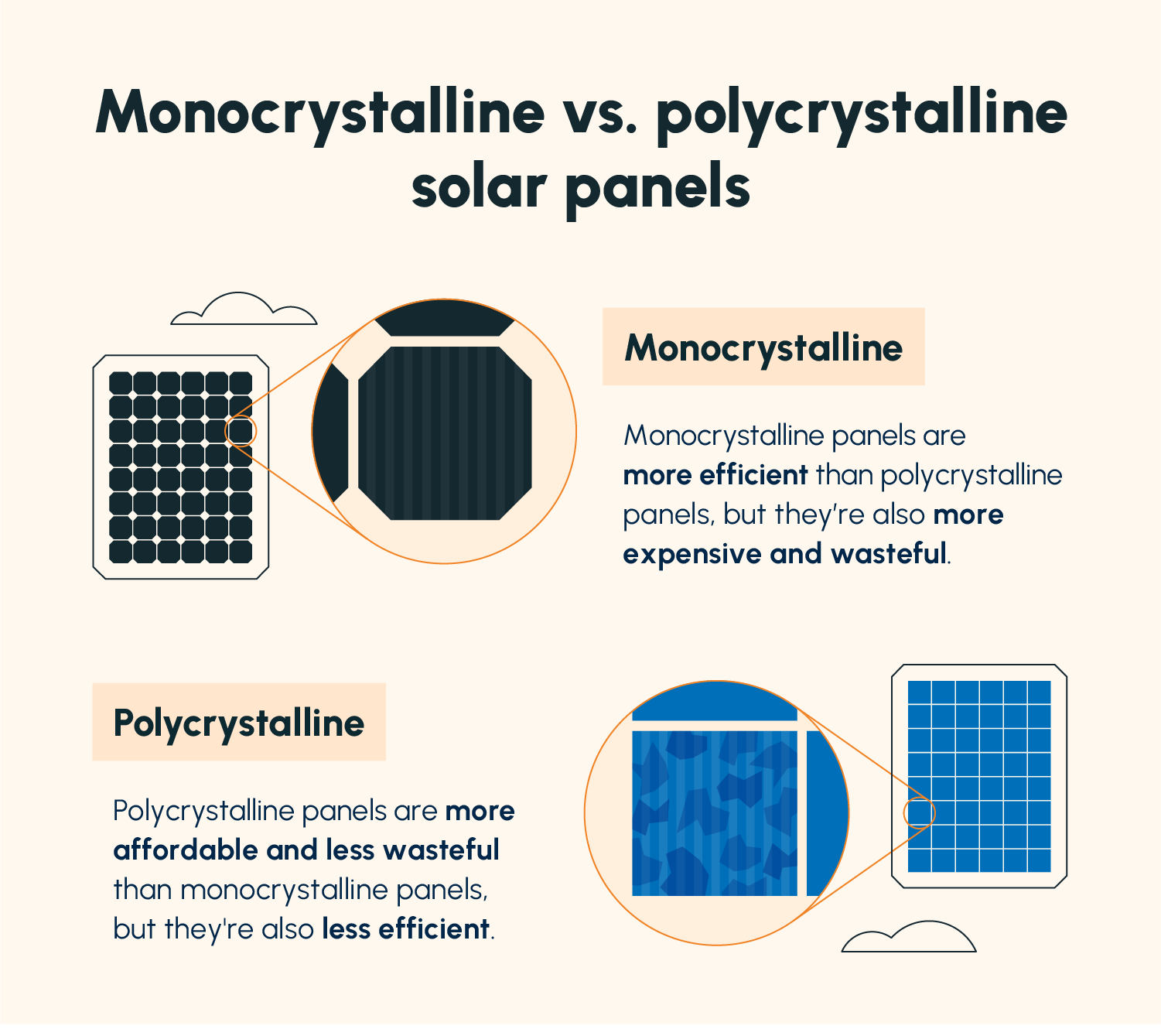
“Monocrystalline vs. Polycrystalline …” from www.solartap.com and used with no modifications.
Key Takeaways
- Monocrystalline solar panels offer efficiency rates of 17-22%, making them ideal for farms with limited roof or ground space.
- Polycrystalline panels cost less upfront and work well on farms with wide open land and high sunlight exposure.
- Solar-powered irrigation systems can dramatically reduce a farm’s electricity bills and dependence on the grid.
- The right panel type depends on your farm’s available space, budget, and local climate conditions — and the difference could mean thousands of dollars over the panel’s lifetime.
- Growing Solar Mist provides farmers with expert guidance on solar energy solutions tailored specifically for agricultural use.
Solar energy is quietly transforming the way farms operate — and the savings are too significant to ignore.
Energy costs are one of the biggest operational burdens for farmers today. Diesel pumps, electric irrigation systems, and climate control for livestock facilities add up fast. A well-designed solar installation doesn’t just trim those costs — it can eliminate them almost entirely over time.
Solar Panels Can Cut Farm Energy Costs Significantly
Farm energy consumption is no small number. Irrigation alone can account for a massive portion of a farm’s annual electricity spend, particularly in dry regions where pumping schedules run from sunrise to sunset. Solar panels convert sunlight directly into electricity, feeding that power straight into irrigation pumps, lighting, and equipment — with zero fuel cost once the system is installed.
Why Farmers Are Making the Switch to Solar
The economics are straightforward. After the upfront installation cost, solar panels generate free electricity for 25 to 30 years. Farms in sun-heavy states like California, Texas, and Arizona are seeing return on investment within 5 to 7 years on average. Beyond the numbers, energy independence is a powerful motivator — no more exposure to rising utility rates or fuel price volatility.
There’s also a growing push toward sustainable agriculture. Consumers, retailers, and regulatory bodies are increasingly rewarding farms that reduce their carbon output. Solar adoption is one of the most visible and impactful steps a farm can take in that direction.
How Solar Panels Power Farm Irrigation Systems
Solar-powered irrigation works by connecting photovoltaic (PV) panels to a pump controller, which then drives water pumps directly from solar-generated DC or AC power. In direct-coupled systems, the pump runs only when the sun is shining — ideal for daytime watering schedules. Battery-backed systems store excess energy for nighttime or cloudy-day operation, giving farmers more flexibility without relying on the grid.
The Two Main Types of Solar Panels Farmers Should Know
Not all solar panels are built the same, and choosing the wrong type for your farm’s conditions can mean underperformance, wasted space, or unnecessary cost. The two dominant technologies on the market are monocrystalline and polycrystalline solar panels. Each has distinct manufacturing processes, efficiency ratings, price points, and ideal use cases — all of which matter greatly in an agricultural setting.

“Monocrystalline Solar Panels …” from evoenergy.co.uk and used with no modifications.
What Are Monocrystalline Solar Panels?
Monocrystalline solar panels are widely considered the premium standard in residential and commercial solar installations — and for good reason. They deliver the highest efficiency ratings available in mainstream solar technology, making them particularly valuable when installation space is at a premium.
The name comes from the single-crystal silicon structure used in each cell. That uniformity is what drives their superior performance.
How Monocrystalline Panels Are Made
Each monocrystalline cell is cut from a single, continuous silicon crystal grown through a process called the Czochralski method. A silicon seed crystal is dipped into molten silicon and slowly pulled upward while rotating, forming a large cylindrical ingot. That ingot is then sliced into thin wafers, shaped into cells, and assembled into panels. The result is an extremely pure silicon structure with minimal electron flow disruption — which is exactly what drives higher efficiency.
Efficiency Rates and Energy Output
Monocrystalline panels typically achieve efficiency rates between 17% and 22%, with premium models from manufacturers like SunPower and LG pushing past 22% in ideal conditions. In practical terms, a standard 400W monocrystalline panel can produce around 1.2 to 1.6 kWh per day depending on sun hours. For a farm running a 5-horsepower irrigation pump, you’re looking at approximately 6 to 10 panels to sustain daily operation.
Their efficiency advantage means more power per square foot — a critical factor when rooftop space or designated ground area is limited on your farm.
Best Farm Conditions for Monocrystalline Panels
Monocrystalline panels perform best in areas with moderate to high sun exposure and are especially effective in regions with temperature fluctuations. They handle heat better than polycrystalline panels due to their lower temperature coefficient, meaning their efficiency drops less as temperatures climb — an important consideration for farms operating through hot summer months.
What Are Polycrystalline Solar Panels?
Polycrystalline solar panels are the more budget-accessible alternative, and they still deliver reliable performance across a wide range of farming environments. While they don’t match the efficiency ceiling of monocrystalline panels, their lower cost per watt makes them a practical choice for farms with plenty of available land.
How Polycrystalline Panels Differ in Construction
Instead of growing a single silicon crystal, polycrystalline panels are made by melting multiple silicon fragments together and pouring the mixture into square molds. As the silicon cools, it forms many smaller crystals rather than one uniform structure. This gives the panels their characteristic blue, speckled appearance. The multi-crystal structure creates more boundaries where electron flow can be disrupted, which is the primary reason for their lower efficiency compared to monocrystalline panels.
The simpler manufacturing process is also what makes them cheaper to produce — and that savings gets passed on to the buyer.
Efficiency Rates and Energy Output
Polycrystalline panels typically operate at efficiency rates between 15% and 17%. A standard 350W polycrystalline panel will produce slightly less power per square foot than its monocrystalline counterpart under identical conditions. For farms with wide-open field space, this difference is easily compensated by simply installing more panels — and the total system cost may still come in lower than a monocrystalline setup.
In high-sunlight regions, the performance gap between monocrystalline and polycrystalline narrows further, making polycrystalline panels an even more compelling value proposition for sun-drenched agricultural land.
That said, in low-light or diffuse-light conditions — think overcast mornings or partially shaded installations — polycrystalline panels do lose more ground relative to their monocrystalline counterparts. If your farm regularly deals with morning fog, tree shade, or cloud cover, this is a factor worth weighing carefully before committing to a system.
Best Farm Conditions for Polycrystalline Panels
Polycrystalline panels shine — literally — in wide-open farm environments with consistent, direct sunlight. Flat agricultural land in regions like the American Midwest, the Central Valley of California, or the Texas Panhandle gives these panels the ideal conditions to perform at their peak. If your farm has acres of unused south-facing land and your primary concern is keeping upfront installation costs down, polycrystalline is a strong contender.
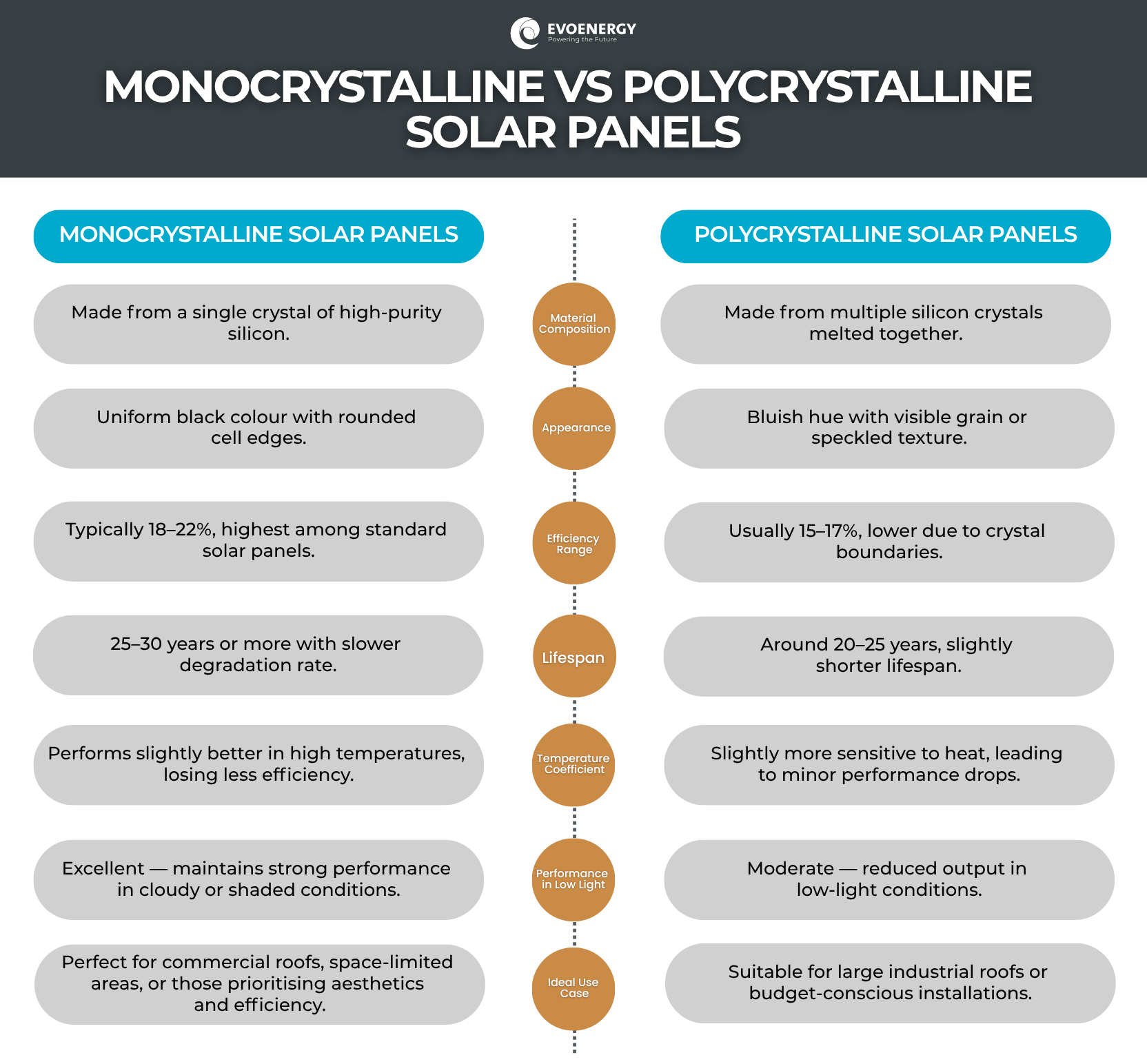
“Monocrystalline Solar Panels …” from evoenergy.co.uk and used with no modifications.
Monocrystalline vs Polycrystalline: Head-to-Head Comparison
Choosing between these two panel types isn’t just a technical decision — it’s a financial and logistical one that will affect your farm for the next 25 to 30 years. Understanding exactly where each panel type wins and loses makes the decision much clearer. For more insights on choosing the right panels, check out our guide on polycrystalline solar panels for large farm installations.
Here’s a detailed breakdown of how monocrystalline and polycrystalline panels compare across the factors that matter most to farmers.
|
Feature |
Monocrystalline |
Polycrystalline |
|---|---|---|
|
Efficiency Rate |
17% – 22% |
15% – 17% |
|
Cost Per Watt |
Higher |
Lower |
|
Space Required |
Less |
More |
|
Performance in Heat |
Better |
Moderate |
|
Low-Light Performance |
Better |
Lower |
|
Lifespan |
25 – 30+ years |
25 – 30 years |
|
Appearance |
Black cells |
Blue speckled cells |
Efficiency and Power Output
Monocrystalline panels consistently outperform polycrystalline panels in efficiency, converting more sunlight into usable electricity per square foot. This matters enormously when your installation area is restricted — such as on barn rooftops or designated solar zones with fixed dimensions.
Polycrystalline panels can close the gap when installed in large ground-mounted arrays on open farmland. If you have the space to accommodate 20% more panels, the overall system output can match or exceed a monocrystalline setup at a lower cost per watt. The key is doing the math for your specific acreage and energy demand before committing. Learn more about polycrystalline solar panels for large farm installations to make an informed decision.
For irrigation-heavy operations running high-horsepower pumps, monocrystalline panels‘ superior output per panel can mean fewer panels, fewer mounting structures, and a cleaner, more manageable installation overall.
Cost Differences and Long-Term Value
Upfront, polycrystalline panels cost less per watt to purchase and install. However, monocrystalline panels generate more electricity over their lifetime, which means the cost-per-kilowatt-hour produced often evens out — and in some cases, monocrystalline systems deliver better long-term value. When evaluating cost, always calculate the total lifetime energy output, not just the sticker price per panel.
Space Requirements on the Farm
Space is where the two panel types diverge most practically. A monocrystalline system producing 10kW might require roughly 600 to 650 square feet of installation space. The same output from polycrystalline panels could require 750 to 850 square feet — a significant difference when working within the confines of a barn roof or a specific ground-mount zone. For more insights on how solar panels work on farms, you can explore the benefits and installation considerations.
For farms with abundant open land, the extra space needed for polycrystalline panels is rarely a dealbreaker. But for operations where roof space is limited or zoning restricts solar footprint, monocrystalline’s compact efficiency wins outright.
Durability in Harsh Farming Climates
Both panel types are built to withstand outdoor exposure, but farming environments are particularly demanding. Dust, debris, hail, wind, and chemical exposure from nearby crop spraying can all affect panel longevity. Monocrystalline panels generally carry a slight edge in temperature resilience due to their lower temperature coefficient — typically around -0.3% to -0.4% per degree Celsius above 25°C, compared to polycrystalline’s -0.4% to -0.5%.
In practical terms, on a hot summer day when panel surface temperatures can reach 65°C or higher, monocrystalline panels will maintain a meaningfully higher output. For farms in the American South or Southwest where summer heat is intense and irrigation demand peaks simultaneously, this difference directly impacts crop watering reliability.
Lifespan and Warranty Considerations
Both monocrystalline and polycrystalline panels are rated for 25 to 30 years of operation. Most reputable manufacturers offer a 25-year performance warranty guaranteeing panels will still produce at least 80% of their original rated output at the end of that period. Monocrystalline panels from premium manufacturers like SunPower offer enhanced warranties that guarantee up to 92% output retention at 25 years.
When comparing warranties, look beyond the performance guarantee and check the product warranty as well — this covers defects and physical failures separately. A 12-year product warranty is considered standard, while leading manufacturers offer up to 25 years of product coverage.
Key Benefits of Solar Panels for Farmers
Beyond the panel-type debate, the broader case for solar on the farm is compelling across every metric that matters to agricultural operations — cost, sustainability, and operational resilience.
Lower Irrigation and Operational Costs
Irrigation is often the single largest electricity expense on a farm. Solar-powered pump systems can eliminate that cost almost entirely once the system is paid off. A mid-sized farm running a 10kW solar array can offset thousands of dollars in annual electricity costs, with full return on investment typically achieved within 5 to 8 years depending on system size, local utility rates, and available incentives.
Reduced Carbon Footprint on the Farm
Agricultural operations contribute meaningfully to greenhouse gas emissions — both directly through equipment fuel use and indirectly through grid electricity consumption. Installing solar panels reduces reliance on fossil-fuel-generated electricity, cutting the farm’s indirect carbon emissions substantially. A 10kW solar system can offset approximately 14,000 to 16,000 pounds of CO₂ per year, depending on the regional electricity grid’s carbon intensity.
For farms pursuing organic certification, sustainability branding, or participation in carbon credit programs, documented solar adoption adds measurable credibility and potential additional revenue streams.
Energy Independence From the Grid
Grid outages during peak growing season can be catastrophic — failed irrigation during a heat wave can wipe out an entire crop. A solar system with battery storage keeps pumps running regardless of what’s happening on the utility grid. Even a grid-tied system without storage reduces exposure to rate hikes and demand charges that utilities increasingly apply to high-consumption agricultural accounts. For more information on how solar panels work on farms, check out this agricultural insights article.

How to Choose the Right Solar Panel for Your Farm
The best solar panel for your farm isn’t the most expensive one — it’s the one that matches your specific energy demands, physical space, budget, and local climate. Getting this decision right upfront saves you from costly system redesigns down the road.
Assess Your Farm’s Energy Needs First
Start by calculating your farm’s total daily energy consumption in kilowatt-hours. Pull your last 12 months of utility bills and identify your peak usage months — for most farms, that’s summer when irrigation runs hardest. Your solar system needs to be sized to meet that peak demand, not just your average usage. A qualified solar installer can perform a formal energy audit, but a rough calculation using your pump horsepower ratings, daily run hours, and lighting loads will give you a solid starting point before any sales conversation begins.
Factor in Your Budget and Available Space
If your budget is tight and you have open land to work with, polycrystalline panels give you more installed capacity per dollar spent. If your roof space is limited or you’re working within a defined ground-mount footprint, monocrystalline’s higher efficiency per square foot justifies the premium cost.
Don’t evaluate price in isolation. A system that costs 15% more upfront but generates 20% more electricity over 25 years is the better financial decision. Run the numbers on total lifetime energy production, not just the installation quote, before making your final call. For more insights, explore why farms are ideal locations for solar panels.
Consider Your Local Climate and Sunlight Hours
Your average daily peak sun hours — the number of hours per day when sunlight intensity reaches 1,000 watts per square meter — directly determines how much electricity your panels will produce. Farms in Arizona or New Mexico average 6 to 7 peak sun hours daily, while farms in the Pacific Northwest or New England may average only 3.5 to 4.5. In lower sun-hour regions, monocrystalline panels’ superior low-light performance makes them the clear choice. In high sun-hour regions, polycrystalline panels close the performance gap significantly.
Monocrystalline Panels Are Best for Most Farmers, But Polycrystalline Has Its Place
For the majority of farm operations — especially those with limited installation space, high irrigation demands, or variable weather — monocrystalline solar panels are the stronger long-term investment. Their higher efficiency, better heat tolerance, and superior low-light performance translate directly into more reliable energy production when your crops need it most. That said, polycrystalline panels remain a genuinely smart choice for farms with wide-open sun-drenched land and a priority on minimizing upfront capital outlay. The right answer depends entirely on your farm’s specific conditions — and now you have the knowledge to make that call confidently.
Frequently Asked Questions
Quick Reference: Solar Panel FAQs for Farmers
For more information on the types of solar panels suitable for agricultural use, you can explore our detailed guide on the best solar panels for farmers.
- Are solar panels worth it for small farms? Yes — even small systems deliver measurable ROI within 5 to 8 years.
- How many panels does an irrigation system need? Typically 6 to 20+ panels depending on pump size and daily run hours.
- Do solar panels work on cloudy days? Yes, at reduced output — monocrystalline panels handle low light better.
- What is the lifespan of farm solar panels? 25 to 30 years with proper maintenance.
- Can farmers get government incentives? Yes — federal tax credits and USDA REAP grants are available.
Are solar panels worth it for small farms?
Solar panels are absolutely worth considering for small farms, particularly those with consistent irrigation needs or high electricity consumption from equipment like grain dryers, cold storage units, or poultry house ventilation systems. Even a modest 5kW to 10kW system can eliminate a substantial portion of monthly utility bills, and the return on investment timeline has shortened considerably as panel costs have dropped over the past decade.
Small farm operations may also qualify for the same federal and state incentive programs available to larger agricultural businesses, which can reduce net installation costs by 30% or more. The USDA’s Rural Energy for America Program (REAP) specifically targets small agricultural producers and rural small businesses, offering grants covering up to 25% of eligible project costs and loan guarantees for the remainder.
How many solar panels does a farm irrigation system need?
The number of panels required depends directly on your pump’s horsepower rating and how many hours per day it runs. As a general rule, a 1-horsepower pump requires approximately 1kW of solar capacity to run continuously. A 5-horsepower irrigation pump running 8 hours a day would require roughly a 5kW to 7kW solar array — accounting for system inefficiencies and inverter losses — which translates to approximately 12 to 18 standard 400W panels.
Larger center-pivot irrigation systems serving hundreds of acres can require 50kW to 100kW+ solar installations. For these scale systems, a professional energy assessment is essential to properly size the array, determine whether battery storage is needed, and evaluate grid-tied versus off-grid configurations based on your farm’s specific layout and usage patterns.
Do solar panels work on cloudy days for farm use?
Solar panels do continue generating electricity on cloudy days, though at reduced output — typically between 10% and 25% of their rated capacity under heavy overcast conditions. Monocrystalline panels consistently outperform polycrystalline panels in diffuse light conditions, making them the preferred choice for farms in regions with frequent cloud cover, morning fog, or seasonal overcast weather. Learn more about why farms are ideal locations for solar panels.
For farms that cannot tolerate interruptions to irrigation schedules — such as those growing high-value horticultural crops with precise watering needs — a battery storage system paired with your solar array ensures pumping capacity remains available regardless of daily cloud conditions. Grid-tied systems provide a reliable backup power source without the added cost of batteries, drawing from the utility grid only when solar output falls short.
What is the lifespan of solar panels used on farms?
Both monocrystalline and polycrystalline solar panels are designed and warranted for 25 to 30 years of operation in outdoor conditions. Most quality panels degrade at a rate of approximately 0.5% to 0.8% efficiency per year, meaning a panel installed today will still be operating at 80% to 87% of its original capacity after 25 years. With basic maintenance — primarily periodic cleaning to remove dust, bird droppings, and crop residue — farm solar panels reliably deliver their full projected lifespan.
Can farmers get government incentives for installing solar panels?
Yes — farmers have access to some of the most comprehensive solar incentive programs available to any energy consumer. At the federal level, the Investment Tax Credit (ITC) allows agricultural businesses to deduct 30% of their total solar installation cost from their federal tax liability under the Inflation Reduction Act’s current provisions. This alone can reduce a $50,000 solar installation to an effective net cost of $35,000.
The USDA’s Rural Energy for America Program (REAP) is specifically designed for agricultural producers and rural small businesses. REAP provides grants of up to 25% of eligible project costs and loan guarantees covering up to 75% of total project costs for renewable energy systems including solar installations. Applications are accepted on a rolling basis, and farms of all sizes are eligible to apply.
Many states offer additional incentives layered on top of federal programs, including property tax exemptions for solar installations, sales tax exemptions on solar equipment purchases, and net metering programs that credit farmers for excess electricity fed back into the grid. Some utility companies also offer agricultural-specific rebate programs that further reduce installation costs.







Leave a Reply