
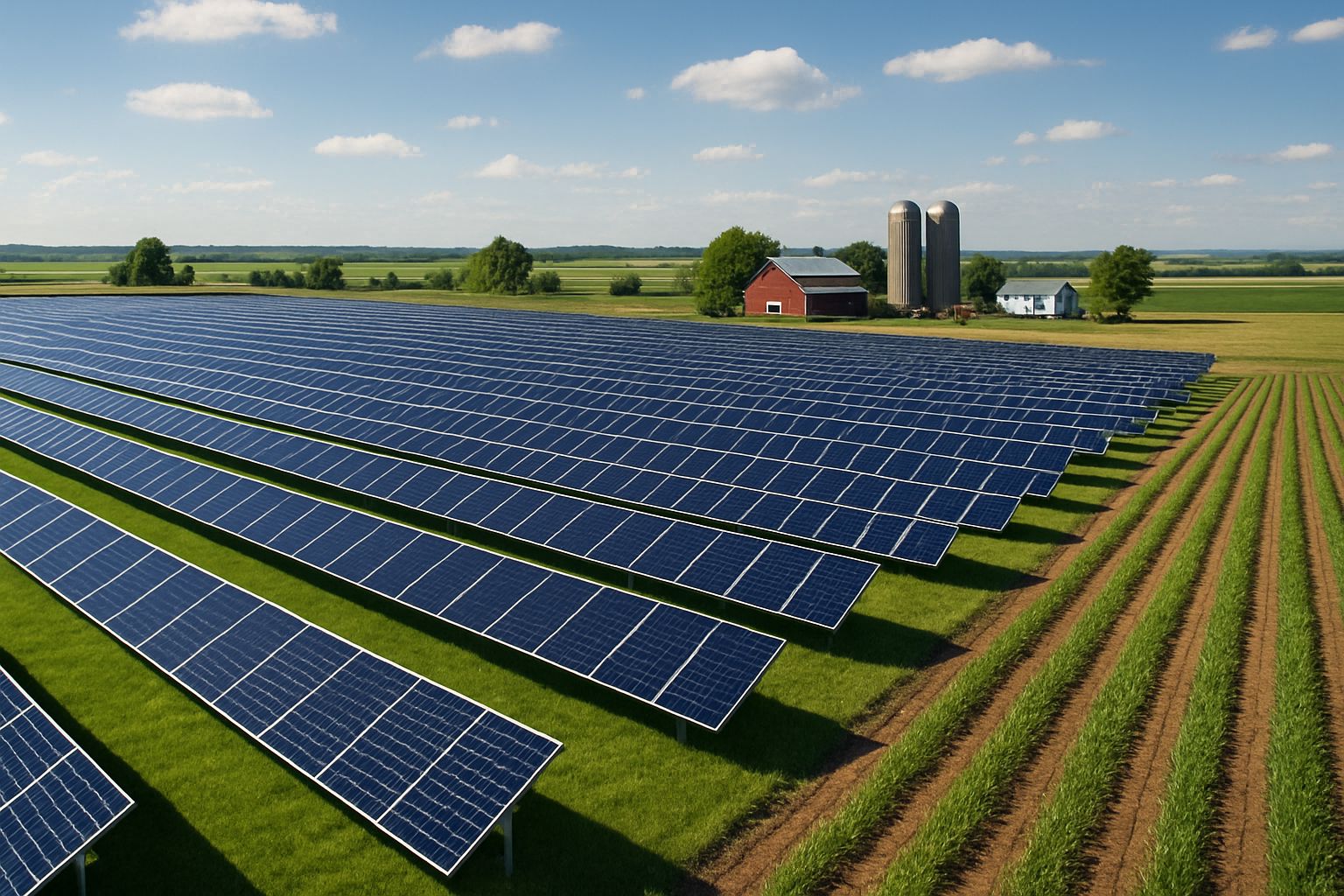
Solar Panels on Farms: What Every Renewable Energy Advocate Needs to Know
- 83% of projected solar development will occur on agricultural land, making farms the single most important frontier for renewable energy expansion in the U.S.
- Farmland’s flat terrain, low obstruction, and proximity to grid infrastructure make it one of the lowest-cost environments for utility-scale solar installation.
- Between 2009 and 2020, 43% of solar installations were built on land previously used for crop production — a trend that is accelerating rapidly.
- Solar leasing offers farmers a powerful income diversification tool, but it carries real risks for tenant farmers and the next generation of landowners.
- The most contested debate in agricultural solar isn’t whether farms should host panels — it’s which farmland should be used, and that answer matters more than most people realize.
Farms are already becoming the backbone of America’s solar energy future, and understanding why changes how you advocate for renewable energy.
The numbers alone tell a compelling story. Modeling by the American Farmland Trust (AFT) projects that 83% of all future solar development will occur on agricultural land. Of that, nearly half — 49% — will sit on land classified as nationally significant due to its productivity, versatility, and resilience. For renewable energy advocates, this intersection of food systems and energy systems is not a side issue. It is the central issue. Organizations like those working at the forefront of clean energy policy are already wrestling with how to expand solar capacity without permanently removing the most productive farmland from food production.
Farmland and Solar Panels Are a Natural Match
The pairing of solar panels and farmland is not accidental — it is the logical outcome of what solar developers need and what farms naturally offer. Solar installations require land that is clear, dry, relatively flat, and located close to existing grid infrastructure. Agricultural land, especially in the Midwest, Great Plains, and Sun Belt regions, checks every one of those boxes simultaneously.
Key Siting Requirements for Utility-Scale Solar:
Requirement
Why It Matters
Farmland Fit
Flat or gently sloping terrain
Simplifies installation and maintenance
✓ High
Clear of obstructions
Maximizes solar irradiance capture
✓ High
Dry, stable soil
Supports mounting infrastructure
✓ High
Proximity to grid
Reduces interconnection costs
✓ High
Large contiguous parcels
Enables utility-scale capacity
✓ High
What makes this match so significant is that the qualities farmers have cultivated for generations — cleared land, soil stability, open sky — are the exact qualities solar developers are willing to pay a premium to access. This creates a rare alignment of agricultural and energy interests that advocates can leverage.
83% of Projected Solar Development Will Land on Agricultural Land
The American Farmland Trust’s modeling is one of the most cited figures in agricultural solar policy — and for good reason. When 83% of projected solar sits on farmland, the future of solar energy and the future of American agriculture become inseparable conversations. The USDA’s Economic Research Service reinforced this by reporting that between 2009 and 2020, 43% of solar installations were on former cropland and another 21% on pasture or rangeland. Using AFT’s estimate that 83% of solar is on farmland, researchers roughly calculate that approximately 1.25 million acres of farmland have already been converted for solar production — representing about 0.14% of the 879 million acres of total U.S. farmland.
Why Flat, Clear, and Dry Land Wins for Solar Installation
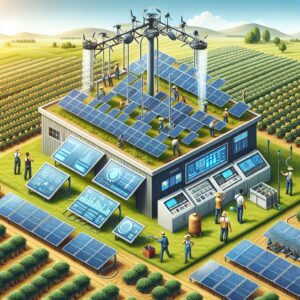
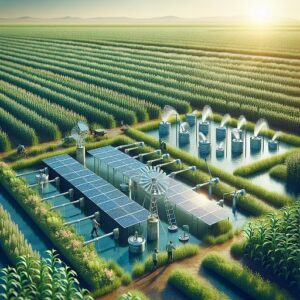
Steep slopes are a solar developer’s nightmare. They complicate panel mounting angles, create drainage issues, increase labor costs, and make long-term maintenance significantly harder. Flat or gently sloping terrain allows for standardized racking systems, predictable installation timelines, and straightforward access for inverter servicing and panel cleaning. Agricultural land — particularly row-crop farmland — was already graded and cleared for machinery, meaning the prep work solar developers would otherwise pay for has already been done over decades of farming. For farmers, integrating solar panels on center pivot irrigation can be a smart idea to maximize land use.
Dry land matters just as much. Moisture-prone soils can shift, heave, and corrode ground-mounted hardware over time. The well-drained soils common to productive agricultural regions provide the kind of stable foundation that keeps a 25-to-30-year solar investment secure. This is not a coincidence — it is why developers consistently target the same counties, the same soil classifications, and the same topographic profiles that farmers have worked for generations.
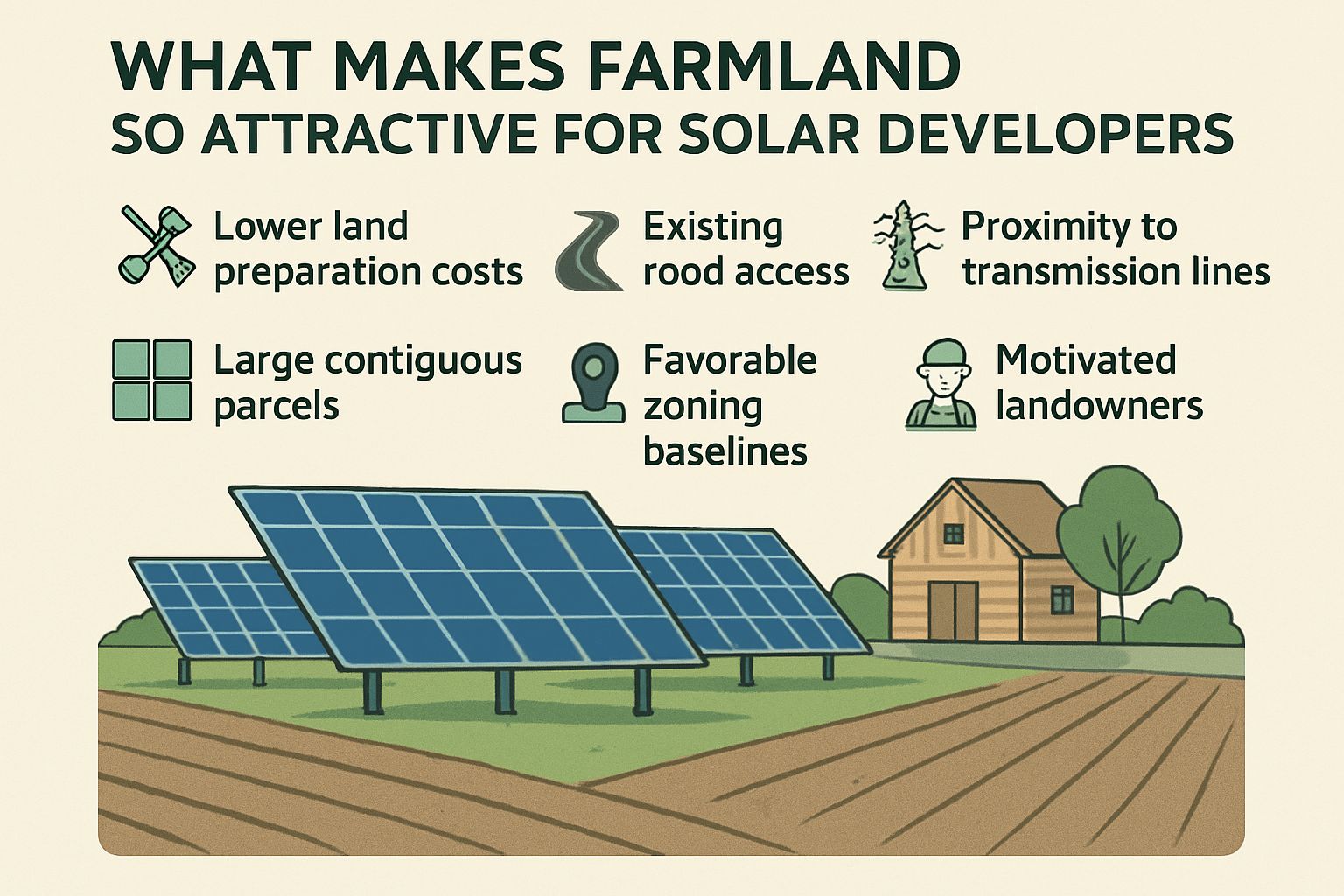
What Makes Farmland So Attractive for Solar Developers
Several factors combine to make agricultural land the preferred canvas for large-scale solar projects. Understanding each one helps advocates make the case for smarter, more targeted siting policy. For instance, integrating solar panels on center pivot irrigation systems is a smart idea for farmers looking to maximize land use efficiency.
- Lower land preparation costs — cleared, graded fields require minimal site work before installation begins
- Existing road access — farm roads and rural infrastructure support equipment delivery and ongoing maintenance
- Proximity to transmission lines — rural agricultural corridors often run parallel to utility infrastructure
- Large contiguous parcels — farms offer the acreage needed for utility-scale projects without complex land assembly
- Favorable zoning baselines — agricultural zoning in many states is more adaptable to solar siting than industrial or residential zones
- Motivated landowners — as commodity prices fluctuate, long-term solar lease income offers financial predictability that farming alone cannot guarantee
Lower Construction Costs Compared to Non-Agricultural Land
When a developer builds on previously forested, rocky, or uneven land, they absorb the cost of clearing, grading, and stabilizing the site before a single panel goes in the ground. Agricultural land eliminates most of that expense. The result is a lower per-watt installation cost that improves project economics and, in competitive energy markets, can mean the difference between a project getting financed or not. For advocates pushing for faster solar deployment, supporting smart agricultural siting is not a compromise — it is a strategy for getting more solar built, faster.
Proximity to Grid Infrastructure Reduces Development Costs
Interconnection costs are one of the most unpredictable and potentially expensive variables in any solar project. Building a solar farm miles from the nearest substation can add millions of dollars in transmission line construction to a project budget. Rural agricultural regions — particularly in the Midwest and Southeast — were built out with rural electric cooperatives and transmission corridors that run directly through or adjacent to working farmland. That proximity is a financial asset that solar developers price into their site selection models from day one.
Soil Stability and Topography Requirements for Solar Mounting
Ground-mounted solar arrays rely on driven or helical piles anchored directly into the soil. The load-bearing requirements for these systems depend heavily on soil composition and compaction. Well-structured agricultural soils — particularly those with consistent clay-loam or silt-loam profiles — provide reliable anchoring conditions across large areas. Developers use geotechnical assessments to confirm these conditions before committing to a site, and productive farmland consistently performs well in those evaluations.
Financial Opportunity for Farmers Who Lease Land for Solar
A June survey of farmers across the country found that 16% had discussed a solar leasing project with a company in the last six months — up from 12% in March, though down from a peak of 20% in May. That level of engagement signals how seriously landowners are taking solar as a financial option. For farmers who own their land outright, a long-term solar lease can provide annual income that competes with or exceeds crop revenue on a per-acre basis, without the input costs, weather risk, or market volatility that comes with commodity farming.
How Land Lease Agreements Work for Solar Projects
Typical Solar Land Lease Structure:
Lease Component
Typical Terms
Lease Duration
25 to 40 years, often with renewal options
Annual Payment
$700 to $2,000+ per acre depending on location and solar resource
Escalation Clause
1% to 2% annual increase built into most agreements
Development Period
3 to 5 years before panels are installed and payments begin
Decommissioning Terms
Developer typically responsible for removal and land restoration
Solar land leases are long-term contracts — typically running 25 to 40 years — that give developers the right to build and operate a solar facility on a landowner’s property in exchange for annual lease payments. Those payments are usually calculated on a per-acre basis and vary significantly based on geographic location, proximity to grid infrastructure, and the quality of the solar resource at that specific site.
Most agreements include an escalation clause that increases payments by 1% to 2% annually, providing some protection against inflation over the life of the lease. Before panels ever go in the ground, there is typically a development period of three to five years during which the developer conducts feasibility studies, secures permits, and arranges financing. Landowners should understand that income does not begin immediately upon signing — the timeline from agreement to first payment can be longer than expected.
Decommissioning provisions are one of the most important and often overlooked components of any solar lease. A well-negotiated agreement will require the developer to remove all equipment and restore the land to its previous agricultural condition at the end of the lease term. Advocates should push for these protections to be standard in every agreement, not an afterthought buried in fine print. For more insights, you can read about best locations for solar energy.
Risks for Tenant Farmers and the Next Generation of Landowners
Solar leasing looks straightforward from the landowner’s perspective, but the reality is more complicated for the farmers who actually work that land. In the U.S., more than half of all cropland is rented — meaning the person making farming decisions is often not the person who signs the solar lease. When a landowner converts rented cropland to solar, the tenant farmer loses their operating base, sometimes with limited notice and little legal recourse. For more insights on the impacts of solar energy expansion on rural communities, explore further resources.
As solar development expands into rural areas, it is driving up demand for agricultural land in ways that ripple through the entire rental market. Landowners who might have renewed a tenant’s lease for another five years are now weighing that against a 30-year solar contract offering guaranteed, inflation-adjusted income. That pressure is pushing cash rents higher in solar-competitive markets and pricing out smaller operations that cannot absorb the cost increase.
The generational dimension is equally serious. When a 35-year solar lease is signed today, it does not expire until the 2060s. Young farmers hoping to purchase or lease land from aging landowners may find those opportunities locked up for the entirety of their working careers. For renewable energy advocates who also care about the future of farming, this is not a hypothetical concern — it is an active tension that policy needs to address head-on.
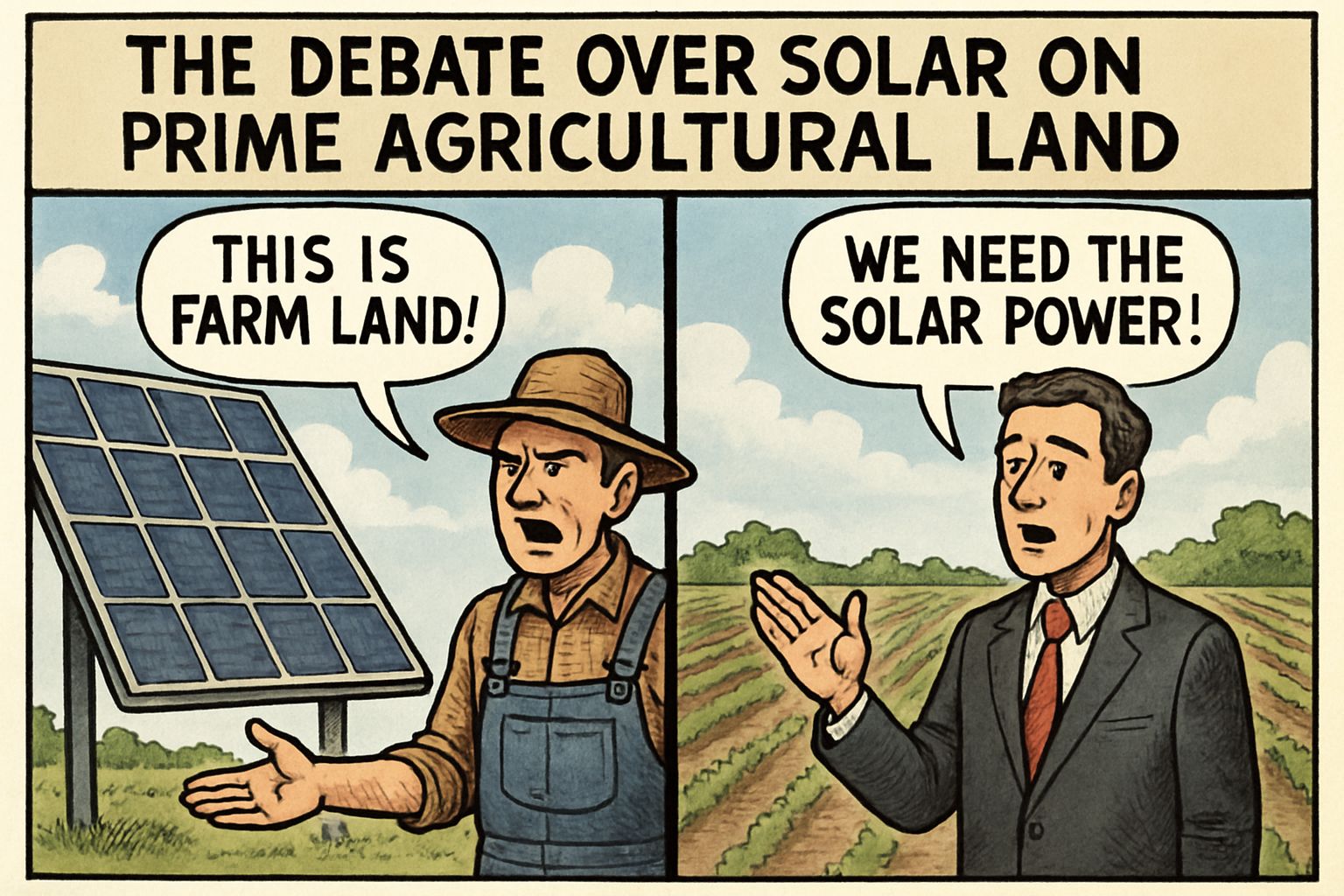
The Debate Over Solar on Prime Agricultural Land
Not all farmland is equal, and that distinction sits at the heart of one of the most important debates in energy and agriculture policy today. Some land is marginal — low productivity, prone to flooding, or already degraded by erosion or contamination. Other land is irreplaceable, producing high yields across diverse crops with minimal inputs. The challenge is that solar economics do not always distinguish between the two.
Developers follow the path of least resistance: flat, clear, grid-adjacent land. That description fits both marginal fields and some of the most productive soils in the country. Without deliberate siting policy, the market will continue placing panels wherever project economics work best — regardless of what that land could otherwise produce for the next century of food security.
49% of Projected Solar Will Sit on Nationally Significant Farmland
The American Farmland Trust’s classification of “nationally significant” farmland identifies soils with the highest levels of productivity, versatility, and resilience — the land most capable of feeding a growing population under changing climate conditions. AFT’s modeling projects that 49% of future solar development will occur on exactly this category of land. That is not land nobody wants. That is the agricultural equivalent of a first-round draft pick being used to run wind sprints.
In May 2024, the USDA’s Economic Research Service spotlighted this tension directly, reinforcing that the scale of agricultural land conversion for solar is not a distant projection — it is already underway. Between 2009 and 2020, nearly half of all solar installations were built on former cropland. The rate of conversion has only accelerated since then as utility-scale project pipelines have grown.
The concern is not that solar should not be built — it absolutely should. The concern is that once prime farmland is covered in panels and locked into a 35-year lease, it is functionally removed from food production for a generation. Soil compaction from construction activity, disruption of drainage tile systems, and changes to soil biology mean that restoration to full productivity, even after decommissioning, is not guaranteed. For more insights on solar energy expansion and its impacts, you can refer to this article on solar energy expansion.
Landowner Rights Versus Preservation of Productive Agricultural Land
Private landowners have the legal right to lease or sell their property for solar development, and that right deserves respect. At the same time, the cumulative effect of individual decisions made across thousands of farms adds up to a national-scale land use shift that no single landowner intended to create. This is the classic tension between individual property rights and collective resource stewardship — and it does not have an easy answer. For more insights, you can explore how solar siting impacts land use decisions.
What advocates can do is push for siting frameworks that prioritize degraded, marginal, or already-disturbed land for solar development before prime agricultural soils are committed. Dual-use agrivoltaic systems — where panels are elevated to allow crops or livestock to continue operating beneath them — represent one promising middle path, though they come with higher installation costs and are not suitable for all farm types. For more information, you can explore the solar siting frameworks that are being discussed in the industry.
What Federal Incentive Policy Should Actually Target
Federal solar incentives, including the Investment Tax Credit extended and expanded under the Inflation Reduction Act, currently do not distinguish between solar built on prime farmland and solar built on a brownfield or a parking lot. Redirecting or layering incentives to reward developers who site projects on marginal, contaminated, or previously disturbed land would shift market behavior without restricting anyone’s property rights — and it would be one of the most effective policy levers available to advocates right now.
Key Site Selection Factors for Solar Panel Placements on Farms
For developers, site selection is where project success is determined before a single dollar is spent on equipment. Five core variables drive every siting decision, and understanding them gives advocates the technical fluency to engage meaningfully in local planning and permitting processes.
Solar Irradiance and Panel Orientation
Solar irradiance — the amount of solar radiation hitting a given surface — varies significantly across the U.S. and even within individual counties. Developers use irradiance mapping tools to identify locations where annual sunlight exposure will support the energy yield projections needed to make a project financially viable. Higher irradiance means more kilowatt-hours produced per panel per year, which directly improves the project’s return on investment.
Panel orientation is the other side of that equation. In the Northern Hemisphere, south-facing panels at an angle roughly equal to the site’s latitude capture the most annual energy. Single-axis tracking systems — which slowly rotate panels to follow the sun from east to west throughout the day — can increase energy yield by 15% to 25% compared to fixed-tilt systems. The flat, open terrain of agricultural land makes tracker installation straightforward in ways that other site types simply do not allow.
Shading, Obstructions, and Proper Panel Spacing
Even partial shading on a solar array can have a disproportionate impact on total energy output. Modern string inverter and microinverter systems have reduced the cascading losses that older systems suffered when one panel was shaded, but shading avoidance remains a primary concern during site layout. Trees along field edges, grain bins, barns, and utility poles all factor into the shade analysis developers complete before finalizing panel placement.
Panel spacing — the distance between rows of panels — is determined by a balance between maximizing land use and avoiding inter-row shading as the sun moves across the sky at low angles in winter. Tighter spacing increases panel density but can reduce per-panel output; wider spacing does the opposite. On flat agricultural land, developers can optimize this spacing calculation with precision because terrain variability is minimal. For more information on integrating solar panels with agricultural systems, consider exploring solar panels on center pivot irrigation systems.
Access corridors between panel rows are not just a shading consideration — they are a maintenance necessity. Service vehicles need to reach inverters, junction boxes, and individual panels for cleaning and repair. Agricultural land’s existing infrastructure, including farm roads and turning radiuses designed for large equipment, makes this logistical requirement easier to meet than on most other land types.
Solar Site Selection Checklist for Farm Properties:
Factor
What Developers Assess
Impact on Project
Solar Irradiance
Annual kWh/m² at the site
Determines energy yield and revenue projections
Panel Orientation
South-facing angle, tracker feasibility
Optimizes daily and seasonal energy capture
Shading Sources
Trees, structures, topographic shadows
Directly reduces array output if unaddressed
Panel Spacing
Row-to-row distance at winter sun angles
Balances land efficiency with per-panel performance
Terrain Flatness
Slope percentage across the parcel
Affects racking cost, drainage, and tracker viability
Soil Bearing Capacity
Geotechnical pile resistance testing
Determines foundation type and installation cost
Grid Proximity
Distance to nearest substation or line
Controls interconnection cost and timeline
Zoning Regulations and Land Availability
Zoning is often the first regulatory hurdle a solar developer encounters, and agricultural zoning classifications vary dramatically from state to state and county to county. Some jurisdictions treat solar as a permitted use by right on agricultural land, while others require a conditional use permit, a special exception, or even a full rezoning process. Local planning boards increasingly face pressure from both solar developers eager to break ground and community members concerned about permanent agricultural land conversion. Understanding the zoning landscape in your region is essential for advocates who want to engage effectively in these decisions before they are made. For more information on integrating solar solutions in agriculture, explore solar panels integration with irrigation systems.
Land availability goes beyond just finding open fields. Developers assess parcel size, ownership structure, encumbrances like conservation easements, and whether the land can be assembled into a contiguous block large enough for a utility-scale project. A single 500-acre parcel is far more attractive than five adjacent 100-acre parcels with five different owners, five different titles to clear, and five separate lease negotiations to complete. Agricultural regions with larger average farm sizes and simpler ownership structures tend to attract more solar development interest for exactly this reason.
Are Farms Ideal Locations for Solar Panels
Yes — farms are among the most ideal locations for solar panels in the United States, and the evidence across terrain, economics, and grid logistics supports that conclusion clearly. The qualities that define productive agricultural land — open sky, flat ground, stable soil, and rural infrastructure — align almost perfectly with what utility-scale solar requires. That alignment is not a coincidence, and it is why developers consistently target agricultural regions when building out their project pipelines.
The Real Question Is Not Whether, But Where Solar Gets Built on the Farm
The debate has moved past whether solar belongs on farmland — it clearly does, and it already is there at scale. The real question now is which farmland. Advocates who frame the conversation around smart siting rather than solar opposition will be far more effective at shaping outcomes that serve both energy and food system goals. Marginal land, degraded soils, low-productivity fields, and already-disturbed agricultural parcels represent a massive, underutilized opportunity for solar development that does not require sacrificing the nation’s most productive soils. Pushing that distinction into local zoning codes, state permitting frameworks, and federal incentive structures is where the most important advocacy work is happening right now.
Frequently Asked Questions
Here are answers to the most common questions about solar panels on farms, covering land use data, farming compatibility, decommissioning, regional opportunities, and financial structures for landowners.
What Percentage of Solar Installations Have Been Built on Farmland?
According to the USDA’s Economic Research Service, between 2009 and 2020, 43% of solar installations were built on land previously used for crop production, and another 21% were built on land used as pasture or rangeland. Combined, that means nearly two-thirds of solar installations during that period were sited on agricultural land of some kind.
Using the American Farmland Trust’s broader estimate that 83% of solar installations are on farmland, researchers estimate that approximately 1.25 million acres of farmland have already been converted for solar production. While that figure sounds significant, it represents roughly 0.14% of the 879 million total acres of farmland in the United States — though the rate of conversion is accelerating as utility-scale project pipelines continue to grow.
Can Farmers Still Farm Land That Has Solar Panels on It?
It depends on the system design. Traditional ground-mounted solar arrays occupy the land beneath and between the panels, leaving limited room for conventional crop production. However, agrivoltaic systems — which elevate panels higher off the ground and space them wider apart — are specifically designed to allow farming activities to continue underneath. Sheep grazing beneath solar panels has become a particularly well-documented dual-use application, and certain shade-tolerant crops have shown promising results in agrivoltaic trials. The honest answer is that most utility-scale solar installations today are not designed for simultaneous farming, but the technology and interest in dual-use systems is advancing rapidly.
What Happens to Solar Panels When They Are Decommissioned?
At the end of a solar project’s operational life — typically 25 to 35 years — panels, racking, inverters, and underground wiring must be removed. A well-negotiated land lease will require the developer to cover all decommissioning costs and restore the land to its prior agricultural condition. In practice, the quality of land restoration after decommissioning varies. Construction activity can compact soils, disrupt subsurface drainage tile systems, and alter soil biology in ways that take years to reverse. Several states have begun requiring developers to post decommissioning bonds — financial guarantees held in escrow — to ensure the money exists to fund proper removal and restoration even if the project company no longer exists decades from now. Advocates should push for mandatory bonding requirements in every jurisdiction where solar siting policy is being written.
Which States Offer the Best Conditions for Solar Farm Development?
Solar resource quality — measured in annual kilowatt-hours of irradiance per square meter — is highest in the Southwest, making states like California, Arizona, New Mexico, and Nevada the most naturally advantaged for solar energy production. However, solar irradiance alone does not determine where development is most active. Grid capacity, land cost, state policy incentives, and permitting speed all factor into where developers actually build.
The Midwest and Southeast have emerged as high-growth solar markets precisely because they combine good-enough solar resources with large agricultural land bases, relatively low land costs, and existing rural grid infrastructure. States like Indiana, Ohio, Illinois, North Carolina, and Georgia have seen rapid utility-scale solar growth on agricultural land over the last five years, driven by favorable interconnection opportunities and motivated landowners in commodity farming regions where income volatility is high.
Texas deserves its own mention. It leads the nation in utility-scale solar capacity additions, and a significant portion of that development is occurring on agricultural land across the western and central parts of the state. The combination of exceptional solar irradiance, massive land availability, a deregulated energy market, and minimal permitting barriers has made Texas the most active solar development environment in the country.
How Do Farmers Benefit Financially from Leasing Land for Solar?
The core financial benefit is straightforward: a predictable, long-term income stream that does not depend on commodity prices, weather, or input cost inflation. Annual lease payments typically range from $700 to $2,000 or more per acre, depending on location, grid proximity, and the solar resource quality at that specific site. For a 100-acre parcel in a competitive solar market, that can translate to $70,000 to $200,000 in annual income — guaranteed for 25 to 40 years with annual escalation clauses built in.
For landowners who are approaching retirement age or who no longer actively farm their land themselves, a solar lease can fund retirement with a level of income certainty that farmland rental to a tenant farmer simply cannot match. It eliminates exposure to crop insurance complexity, eliminates the risk of a tenant defaulting on rent, and transfers all operational responsibility — and liability — to the solar developer.
The tax treatment of solar lease income is another consideration landowners should examine carefully with a qualified tax advisor. Lease payments are generally treated as ordinary income, but the interaction with self-employment tax, estate planning, and existing farm program payment eligibility can create complications that vary by individual situation. Some landowners have also explored solar easements as an alternative to traditional leases, which may offer different tax characterization depending on how they are structured.
For tenant farmers — those who rent land rather than own it — the financial picture is far less favorable. A landowner’s decision to convert rented farmland to solar typically means the loss of that operating ground, often with limited advance notice. As solar competition for agricultural land intensifies, cash rents in surrounding areas tend to rise as available parcels become scarcer. The financial benefit of solar leasing is real and meaningful for landowners, but the agricultural policy community is increasingly focused on ensuring that benefit does not come entirely at the expense of the farmers who were actually working that land. If you want to support both the clean energy transition and the farmers on the front lines of it, connecting with organizations advocating for smart solar siting policy is one of the most impactful steps you can take right now.


Leave a Reply