

Key Takeaways
- Solar panels can offset 70–100% of a farm’s electricity costs, making them one of the most powerful tools for long-term agricultural financial stability.
- Farms are naturally ideal solar sites — open land, unobstructed sunlight, and high daytime energy demand align perfectly with how solar systems generate peak power.
- Federal incentives like the Investment Tax Credit (ITC) and USDA REAP grants can cover a significant portion of installation costs, dramatically shortening payback periods.
- Agrivoltaics — the practice of growing crops beneath or alongside solar arrays — is showing real promise for water conservation and yield improvement in certain crops.
- Keep reading to find out which farm energy loads drain the most money and exactly how farmers are turning those costs into long-term solar returns.
Solar Panels on Farms: Here Is What You Need to Know
Solar energy is no longer a future concept for agriculture — it’s already reshaping how farmers manage costs, land, and long-term sustainability right now.
Modern farms consume enormous amounts of electricity. Irrigation systems, ventilation, refrigeration, lighting, and processing equipment all add up to energy bills that can cripple a farm’s margins during tough growing seasons. The volatility of utility rates makes planning even harder. Solar panels offer a way out — a predictable, stable energy source that farmers can own outright and depend on for decades.
Growing Solar Mist is a resource dedicated to helping farmers navigate the solar transition with clear, actionable guidance — from understanding system components to maximizing available incentives. Whether you manage a 20-acre vegetable operation or a 2,000-acre grain farm, the fundamentals of farm solar apply across the board.
This article breaks down exactly how solar panels work in an agricultural setting, why farms are uniquely suited for solar, where the biggest energy savings come from, and what the financial picture actually looks like when you run the numbers.

How Solar Panels Actually Generate Electricity on a Farm
Solar panels don’t store sunlight — they convert it directly into usable electricity through a well-understood physical process that happens silently, with no moving parts, every single day.
Photovoltaic Cells: The Core of Solar Power
Each solar panel is made up of dozens of photovoltaic (PV) cells, typically constructed from silicon — one of the most abundant materials on Earth. Silicon is a semiconductor, meaning it sits between a conductor (like copper wire) and an insulator (like rubber). When light hits a silicon cell, it triggers a physical reaction called the photovoltaic effect: photons from sunlight knock electrons loose from their atomic bonds, and those free-moving electrons create an electrical current. Farm-grade panels are engineered to maximize this effect even under variable light conditions, which matters enormously across different agricultural regions and seasons.
How Sunlight Becomes Usable Farm Electricity
The electricity produced at the cell level is direct current (DC) — the same type of current that flows from a battery. Most farm equipment and buildings, however, run on alternating current (AC), which is what the utility grid delivers. Before solar power can run your grain dryer, water pump, or barn lighting system, it needs to be converted.
That conversion happens through an inverter, and it’s one of the most critical components in any agricultural solar installation. The efficiency of your inverter directly affects how much of the energy your panels capture actually becomes usable electricity for your operation.
The Role of Inverters in Farm Solar Systems
Farm solar systems typically use one of two inverter configurations: string inverters or microinverters. String inverters connect a series of panels together and convert the combined DC output in one centralized unit — cost-effective for large open arrays with consistent sun exposure, which describes most agricultural land. Microinverters attach to each individual panel and optimize conversion independently, making them better suited for installations where shading from trees or structures may be an issue. For most large-scale farm installations, string inverters deliver the best balance of efficiency and cost.
Why Farms Are Ideal Locations for Solar Panels
Agriculture and solar energy are a natural match — and it goes beyond just having extra land available.
Open Land and Unobstructed Sun Exposure
Urban solar installations constantly battle shading from neighboring buildings, trees, and roofline angles. Farms rarely have these problems. Wide-open fields, south-facing rooflines on barns and machine sheds, and minimal overhead obstruction create near-ideal solar conditions. Even in northern states, agricultural land receives enough annual solar irradiance to make ground-mounted and rooftop systems financially viable. The more direct and uninterrupted the sunlight, the more electricity your system produces — and farms consistently deliver on that requirement.
High Daytime Energy Demand Matches Peak Solar Output
One of the biggest advantages farms have over residential solar users is when they consume energy. Residential electricity use peaks in the morning and evening — not when the sun is shining brightest. Farms are different. Irrigation runs during the day. Ventilation systems for poultry and livestock operate around the clock but are most critical during peak heat. Grain drying and refrigeration run continuously through harvest season. This daytime-heavy energy demand lines up almost perfectly with peak solar generation hours, meaning more of what your panels produce gets used directly — reducing waste and maximizing your return on every kilowatt generated.
The Biggest Energy Drains on Modern Farms
Understanding where your electricity actually goes is the first step to understanding how much solar can save you.
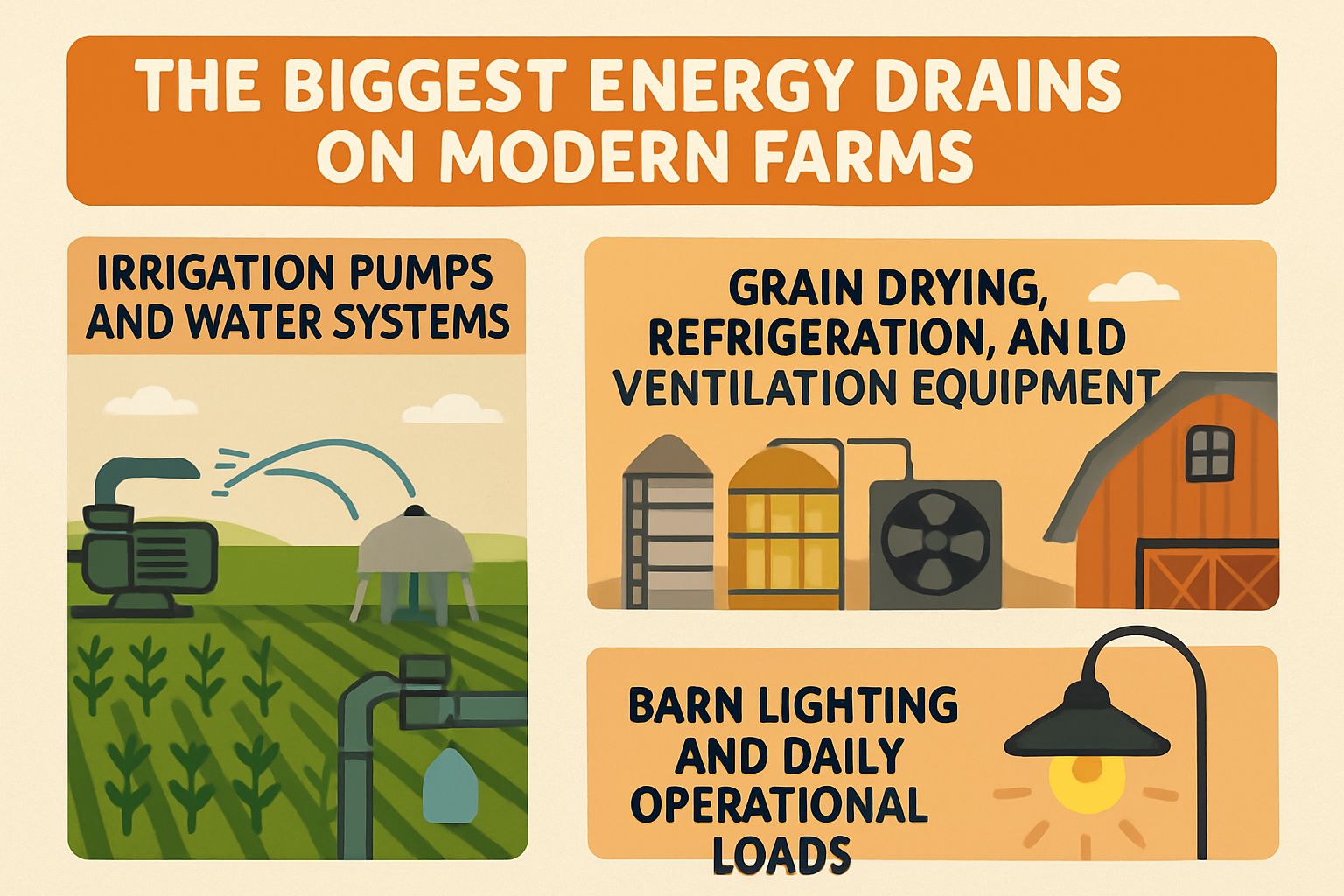
Farms are not one-size-fits-all operations, but certain energy loads show up consistently across nearly every type of agricultural business. Irrigation pumps are often the single largest electricity consumer on crop farms — high-horsepower motors running for extended hours during the growing season can push monthly bills into the thousands on their own. Grain drying equipment, walk-in refrigeration for produce, and climate-controlled storage add thousands more. On livestock and poultry operations, ventilation fans, water heating systems, and barn lighting run constantly, creating a baseline energy load that never fully turns off. These are exactly the loads that solar panels are best positioned to offset — large, predictable, and tied directly to the farm’s core productivity.
Irrigation Pumps and Water Systems
Irrigation is the single largest electricity expense on most crop farms. Center-pivot systems, drip irrigation networks, and submersible well pumps all rely on high-horsepower motors that run for hours — sometimes continuously — during peak growing season. A single center-pivot irrigator covering 130 acres can consume 50–75 kilowatt-hours per acre per season, and farms running multiple pivots can see irrigation alone account for 60–70% of their total annual electricity bill. Solar panels sized to match irrigation load can eliminate the majority of that cost, turning one of farming’s most unpredictable expenses into a fixed, manageable overhead.
Grain Drying, Refrigeration, and Ventilation Equipment
After irrigation, grain drying and cold storage are the next biggest energy consumers on most mixed or commodity crop operations. Natural air grain dryers, high-speed propane-assisted systems, and walk-in coolers for vegetable and fruit operations all demand significant, sustained electrical loads during the exact months when farm cash flow is most critical — harvest time.
- Grain dryers can consume 0.03–0.05 kWh per bushel per point of moisture removed, adding up fast during a wet harvest season
- Walk-in refrigeration units for produce farms run 24/7 and can draw 3–10 kW continuously depending on unit size and ambient temperature
- Bin aeration fans used in long-term grain storage add another consistent overnight load that solar-plus-battery systems can address
- Forced-air ventilation systems on swine and poultry operations run year-round, with summer peaks that align directly with maximum solar output
The overlap between high solar production months — late spring through early fall — and peak energy demand from drying, cooling, and ventilation equipment is not a coincidence. It’s one of the strongest arguments for agricultural solar investment. The sun produces the most electricity precisely when farms need it most, making it a smart idea for farmers.
Battery storage adds another layer of value for operations that need to run equipment overnight or through multi-day cloudy periods. Lithium iron phosphate (LiFePO4) battery banks are increasingly being paired with farm solar systems to bridge those gaps, particularly on poultry and swine operations where ventilation failure is not just a financial risk — it’s a biosecurity emergency.
For farms processing goods on-site — cheese production, wine making, seed cleaning — the electrical demand is even more complex. Solar electricity can power the entire production chain while also providing the reliability advantages that come with reduced grid dependence. A grid outage during cheese aging or wine fermentation can mean tens of thousands of dollars in lost product. Solar with battery backup addresses that vulnerability directly.
Barn Lighting and Daily Operational Loads
Barn lighting, water tank heaters, small motors, power tools, and office equipment may seem minor compared to irrigation and drying, but their cumulative load across a full year is significant. Poultry operations in particular use artificial lighting as a production management tool — carefully timed light cycles influence laying rates and broiler growth, meaning lights run on precise schedules regardless of natural daylight. LED barn lighting upgrades paired with solar generation can cut lighting costs by 60–80% while giving farmers tighter control over their production environment.
Agrivoltaics: Growing Crops and Energy at the Same Time
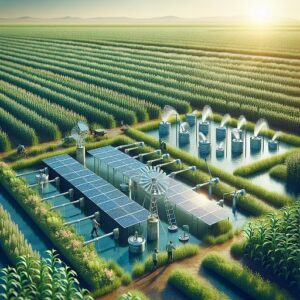
Agrivoltaics is one of the most exciting developments in sustainable agriculture — the practice of co-locating solar panels and crop production on the same land, generating electricity and food simultaneously. What started as a niche research concept has rapidly evolved into a legitimate dual-use land management strategy with documented benefits for both energy output and agricultural productivity in the right conditions.
How Partial Shade From Solar Panels Affects Crops
The relationship between solar panel shading and crop performance is more nuanced than most farmers initially expect. Full sun is not always optimal for every crop — many vegetables, herbs, and forage crops experience photosynthetic saturation, meaning they cannot productively use all the sunlight hitting them on a cloudless summer afternoon. Partial shade from elevated solar arrays can actually reduce heat stress on plants, lower soil surface temperatures, and decrease evapotranspiration rates. Studies conducted across agrivoltaic test sites have shown that certain crops planted beneath solar arrays can match or exceed yields compared to open-field controls.
The key is panel height and spacing. Agrivoltaic systems designed for crop integration typically elevate panels to 8–12 feet above ground level, allowing standard farm equipment to operate beneath them. The spacing between panel rows is also wider than conventional ground-mount configurations, creating alternating bands of direct sunlight and partial shade across the field. Careful crop selection and row orientation relative to panel direction determine whether the system enhances or hinders production. For more information on how solar panels can be integrated with irrigation systems, explore the pros and cons of sprinkler irrigation systems with solar panels.
Water Conservation Benefits Documented by NREL Research
The National Renewable Energy Laboratory (NREL) has documented measurable water conservation benefits in agrivoltaic systems. The shade provided by solar panels reduces soil moisture evaporation, which means irrigated crops grown beneath arrays require less water to achieve comparable growth outcomes. For farmers interested in sustainable practices, integrating irrigation systems with solar panels can be a beneficial approach.
Agrivoltaic Water Conservation Snapshot
Research on agrivoltaic systems has documented the following field-observed benefits compared to conventional open-field production:
Metric
Open Field
Agrivoltaic System
Soil moisture evaporation
Baseline
Measurably reduced
Irrigation demand
Baseline
Lower in documented trials
Panel operating temperature
N/A
Reduced by crop transpiration
Land use efficiency
Single use
Dual-use energy + food
The water savings benefit compounds in arid and semi-arid farming regions where irrigation costs are highest. In those environments, reducing water demand by even a modest percentage translates directly into lower pumping costs, less groundwater depletion, and stronger long-term farm viability.
An additional and often overlooked benefit: crop transpiration — the process by which plants release moisture through their leaves — actually cools the air around solar panels. Cooler panels operate more efficiently. Silicon PV cells lose approximately 0.3–0.5% of output efficiency for every degree Celsius above their rated operating temperature, so the natural cooling effect of growing vegetation beneath arrays produces a measurable boost in electricity generation during peak summer heat.
Which Crops Perform Best Under Solar Arrays
Shade-tolerant and cool-season crops consistently show the strongest performance in agrivoltaic configurations. Lettuce, spinach, kale, Swiss chard, and other leafy greens benefit from reduced heat stress under panels during summer months. Herbs like cilantro, parsley, and basil — which tend to bolt quickly in full summer sun — have shown extended productive seasons under partial shade. Pasture grasses used for livestock grazing have also performed well in elevated-panel agrivoltaic systems, and small fruit crops like strawberries and raspberries have shown promising results in early trials. Corn, soybeans, and other row crops that require maximum sun exposure are generally not suitable for agrivoltaic integration, but they represent only one part of the full agricultural picture.
The Financial Case for Farm Solar Installations
The numbers behind farm solar are compelling — and they’ve only gotten stronger as panel costs have dropped and federal incentive programs have expanded. For most farm operations, solar is not just an environmental choice. It’s one of the highest-return capital investments available in agriculture today.
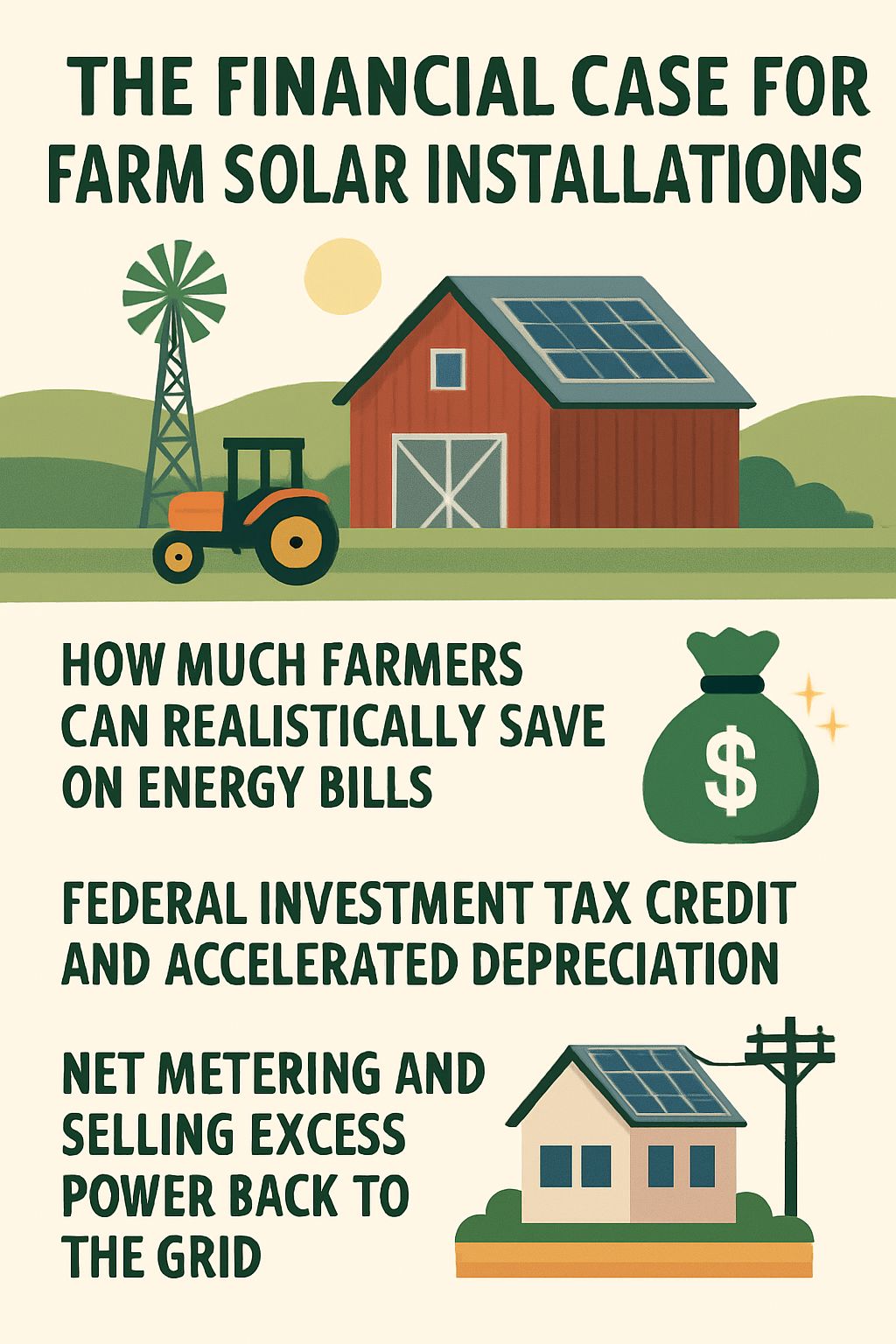
How Much Farmers Can Realistically Save on Energy Bills
Agricultural solar systems designed to match a farm’s actual load profile can offset between 70% and 100% of total electricity costs. The exact figure depends on system size, local utility rates, net metering availability, and seasonal energy patterns. Farms in states with higher utility rates — the Northeast, California, Hawaii — see faster payback periods and higher lifetime savings. Farms in lower-rate states benefit more from the federal incentives and accelerated depreciation advantages that reduce the net cost of the system itself. Either way, the direction of the math is consistent: solar reduces operating costs significantly and permanently over a 25–30 year system lifespan.
Federal Investment Tax Credit and Accelerated Depreciation
The Federal Investment Tax Credit (ITC) currently allows agricultural businesses to deduct 30% of the total solar installation cost directly from their federal tax liability. This is not a deduction — it’s a dollar-for-dollar credit, which makes it significantly more valuable. A farm installing a $200,000 solar system receives a $60,000 reduction in federal taxes owed. Additionally, integrating solar solutions, such as solar panels on center pivot irrigation, can further optimize farm operations.
Beyond the ITC, farm solar installations qualify for Modified Accelerated Cost Recovery System (MACRS) depreciation, which allows the system’s asset value to be depreciated over just 5 years. When combined with the ITC basis adjustment, the effective depreciation benefit on a commercial farm solar installation can reduce the net system cost by an additional 20–26% depending on the farm’s tax bracket and filing structure.
When you stack the ITC and MACRS depreciation together, many farm solar installations see their effective net cost reduced to 40–50% of the original installation price before any energy savings are even calculated. That fundamentally changes the payback period analysis — systems that might take 10–12 years to pay back at retail cost often reach breakeven in 5–7 years after incentives.
Federal Incentive Impact Example — $200,000 Farm Solar Installation
Discover how installing solar panels can significantly reduce energy costs on farms. For more information, check out this resource on farm solar and learn about the benefits of solar energy in agricultural operations.
|
Incentive |
Value |
Net Cost After Incentive |
|---|---|---|
|
Gross Installation Cost |
— |
$200,000 |
|
Federal ITC (30%) |
$60,000 |
$140,000 |
|
MACRS Depreciation Benefit (est. 26%) |
$52,000 |
$88,000 |
|
USDA REAP Grant (up to 25%) |
$50,000 |
$38,000 |
|
Note: MACRS benefit varies based on tax rate and filing structure. REAP grant amounts are subject to application approval and funding availability. |
USDA REAP Grants: Up to 25% of Project Costs Covered
The USDA Rural Energy for America Program (REAP) is one of the most powerful — and underutilized — financial tools available to American farmers considering solar. REAP provides grants covering up to 25% of eligible project costs for agricultural producers and rural small businesses installing renewable energy systems. In recent years, the Inflation Reduction Act expanded REAP funding significantly, with grant amounts up to 50% available under certain competitive application rounds. The program also offers loan guarantees for the remaining project balance, making it possible to finance a farm solar installation with minimal out-of-pocket capital at the outset.
REAP applications are accepted on a rolling basis through your local USDA Rural Development state office. The program evaluates applications based on energy savings, technical merit, financial need, and the applicant’s ability to complete the project. Farms that have completed an energy audit — which REAP also helps fund — tend to submit stronger applications because they can document existing energy use and projected savings with precision. Working with a solar developer experienced in REAP applications is strongly recommended, as the documentation requirements are detailed and errors in the application process can delay or disqualify an otherwise eligible project.
Net Metering and Selling Excess Power Back to the Grid
Net metering allows farm solar system owners to send excess electricity back to the utility grid in exchange for bill credits, effectively using the grid as a free battery. On days when your panels produce more than your farm consumes — common during shoulder seasons when irrigation systems are off and drying equipment isn’t running — that surplus energy flows outward and your meter runs backward. Those credits offset future electricity purchases when production dips below demand, such as during winter months or extended cloudy periods. Net metering policies vary significantly by state and utility provider, so understanding your local rules before system sizing is essential. Some utilities offer full retail rate credits; others provide wholesale rate compensation. The difference can substantially affect your system’s long-term financial performance.
How Long Do Farm Solar Panels Last and What Maintenance Is Required
Modern agricultural solar panels are engineered for decades of outdoor exposure under demanding conditions. Most commercial-grade panels carry 25–30 year performance warranties, guaranteeing that panels will still produce at least 80–87% of their original rated output at the end of that period. In practice, well-maintained farm solar systems routinely operate beyond their warranty period with continued — if gradually declining — energy production. The degradation rate for quality panels averages approximately 0.5% per year, meaning a system producing 100 kW today will still produce roughly 87 kW after 25 years of operation. That’s a remarkably durable asset for any capital investment in agriculture.
Maintenance requirements are minimal compared to virtually any other farm equipment. Solar panels have no moving parts, which eliminates the mechanical wear and failure modes that drive maintenance costs on conventional farm machinery. The primary maintenance tasks are straightforward, making them a smart idea for farmers considering solar panels on center pivot irrigation.
- Annual or biannual cleaning — dust, bird droppings, pollen, and debris accumulation reduce panel output; a basic rinse with low-pressure water is typically sufficient
- Inverter inspection — string inverters typically carry 10–15 year warranties and may require replacement once during a system’s lifetime; microinverters often carry 25-year warranties
- Monitoring system review — most modern farm solar installations include real-time production monitoring software that flags underperforming panels or system faults before they cause significant energy loss
- Structural inspection — racking and mounting hardware should be checked periodically for corrosion, especially in high-humidity or coastal agricultural environments
- Vegetation management — for ground-mount systems, keeping grass and vegetation trimmed beneath and around panel rows prevents shading and reduces pest habitat
The total annual maintenance cost for a well-designed farm solar system typically runs between $0.01 and $0.02 per watt of installed capacity, or roughly $1,000–$2,000 per year for a 100 kW system. Compared to the energy savings that same system generates, maintenance costs represent a small fraction of the net financial benefit — and far less than the ongoing maintenance burden of any combustion-based backup generator of equivalent capacity.
Solar Is a Long-Term Investment Every Farmer Should Seriously Consider
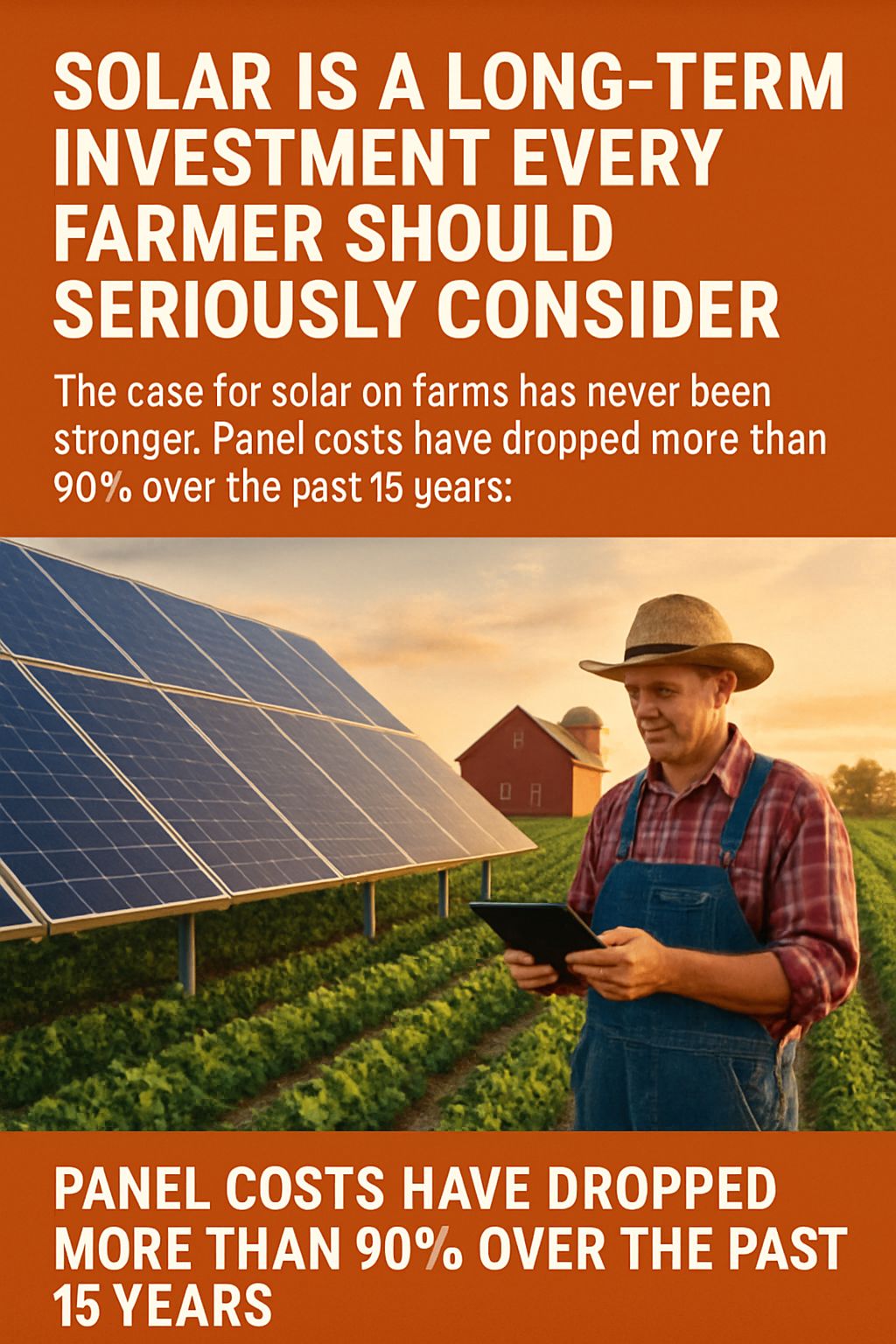
The case for solar on farms has never been stronger. Panel costs have dropped more than 90% over the past 15 years. Federal incentives have expanded. USDA funding is more accessible than at any previous point. And the underlying economics — stable, predictable energy costs over a 30-year horizon — align perfectly with the long-term planning mindset that successful farm management already demands. For farmers exploring different irrigation solutions, irrigation systems compatible with solar panels offer an innovative way to integrate sustainable energy into their operations.
What makes solar uniquely powerful in an agricultural context is that it addresses multiple problems at once. It reduces operating costs immediately after installation. It creates a hedge against utility rate volatility that has historically outpaced general inflation. It improves the overall energy resilience of the operation, reducing vulnerability to grid outages during critical production periods. And for farmers thinking about succession planning, a paid-off solar system that generates free electricity for the next generation is a meaningful asset — one that doesn’t depreciate the way equipment does and doesn’t require annual inputs the way land does.
The barriers to adoption are real but manageable. Upfront capital requirements are significant, though financing options — including REAP-guaranteed loans, agricultural lenders familiar with solar, and power purchase agreements — provide pathways for farms at every capital level. Permitting and interconnection timelines vary by region and can extend project timelines by months in some utility territories. And choosing the right solar developer — one with verified agricultural installation experience — matters enormously for system design, incentive navigation, and long-term performance. None of these challenges are insurmountable, and for the vast majority of farms that have made the investment, the long-term outcome has been exactly what the financial models projected: lower costs, greater independence, and a more resilient operation.
Frequently Asked Questions
Below are answers to the most common questions farmers ask when evaluating solar for their agricultural operation.
Can Solar Panels Power an Entire Farm Operation?
Yes — a properly sized solar system can offset 70–100% of a farm’s total electricity consumption. The key word is sized. A solar installer with agricultural experience will analyze 12–24 months of utility bills, map your seasonal energy demand patterns, and design a system that matches your actual load profile rather than a generic estimate. Farms with very high energy demands — large-scale grain operations, intensive poultry facilities — may find that a full-offset system requires significant acreage of ground-mount panels, which is usually available. Battery storage can extend solar coverage into nighttime hours and cloudy periods, further reducing grid dependence.
How Much Does a Farm Solar Installation Typically Cost?
Before incentives, commercial agricultural solar installations typically range from $2.50 to $3.50 per watt of installed capacity. A 100 kW system — appropriate for a medium-sized farm operation — would cost $250,000–$350,000 at the gross level. After applying the 30% federal ITC, MACRS depreciation benefits, and available USDA REAP grants, the effective net cost for many farm installations falls to $80,000–$150,000 for a system of that size.
Smaller farms with lower energy demands can install 20–50 kW systems at proportionally lower total costs, and the same incentive percentages apply regardless of system size. The most reliable way to get accurate cost figures for your specific operation is to request proposals from multiple NABCEP-certified solar installers with documented agricultural project experience. Compare proposals on a cost-per-watt basis and verify that each proposal accounts for your specific utility’s interconnection requirements and net metering policy.
Do Solar Panels Work in Cloudy or Cold Farm Regions?
Solar panels generate electricity from light, not heat — and they actually operate more efficiently in cold temperatures than in extreme summer heat. Farms in the upper Midwest, New England, and the Pacific Northwest all have viable solar resources, even accounting for cloudy periods and shorter winter days. Germany — one of the world’s leading solar markets — receives less annual sunlight than most of the continental United States, yet has built enormous solar infrastructure. The financial math works across virtually every U.S. agricultural region, though the system size required to meet a given energy target will be larger in lower-irradiance areas than in the Southwest.
Can I Still Farm the Land Where Solar Panels Are Installed?
It depends on the installation type. Rooftop systems on barns and machine sheds have zero impact on land use — the panels simply occupy otherwise unused roof space. Ground-mount systems do occupy land footprint, but agrivoltaic configurations — elevated arrays designed to allow equipment access and crop production beneath the panels — are specifically engineered to maintain dual-use land productivity. For farms that lease land to solar developers rather than owning the panels themselves, the lease area is typically fenced and removed from agricultural production, but the lease income often exceeds the crop revenue that same acreage would have generated — particularly on lower-productivity soils at the edges of fields.
How Do I Apply for USDA REAP Grants for Farm Solar?
The application process begins with your local USDA Rural Development state office, which manages REAP applications at the regional level. You can find your state office contact information at the USDA Rural Development website. Applications require documentation of your agricultural producer status, a detailed project description prepared by your solar installer, energy consumption records, a professional energy audit (for projects above certain cost thresholds), and financial statements demonstrating business viability.
REAP has two funding tiers: a simplified application process for projects under $200,000 in total eligible costs, and a standard application for larger projects that requires more comprehensive documentation. The simplified process is faster and accessible to more farmers who are navigating the grant process for the first time. For those interested in integrating renewable energy solutions, exploring solar-powered irrigation systems could be a viable option.
Application windows open multiple times per year, and funding is allocated competitively based on application scoring. Projects that demonstrate higher energy savings, serve historically underserved agricultural communities, or incorporate additional renewable energy components tend to score more favorably. Submitting a complete, well-documented application on time is more important than applying at any particular window — incomplete applications are a primary reason otherwise eligible projects don’t receive funding. For more insights on how to optimize energy savings, consider exploring solar solutions for farms.
Working with a solar developer who has successfully completed REAP-funded agricultural projects is the single most effective way to improve your application outcome. They will have experience with the documentation requirements, know what reviewers look for, and can help you present your project’s energy savings case in the most compelling way possible.
If you’re ready to take the next step toward energy independence on your farm, Growing Solar Mist provides farmers with the practical guidance, financial resources, and expert insights needed to make solar work for their specific agricultural operation. Additionally, explore how solar linear move irrigation systems can benefit your farming practices.

Leave a Reply