

Key Takeaways:
- Solar panel farms can offset 70–100% of a farm’s electricity costs, dramatically reducing one of agriculture’s fastest-growing operating expenses.
- Federal and state incentives — including the ITC and USDA REAP grants — can cover up to 50% or more of installation costs, making solar more accessible than most farmers realize.
- Agrivoltaics, the practice of combining crop production and solar generation on the same land, is quietly revolutionizing how farmers think about land use — and it’s a game-changer worth understanding.
- Not all farms are built the same — dairy, poultry, and crop operations each have unique energy demands that solar addresses differently, and knowing which applies to you can change your ROI calculation entirely.
- Growing Solar Mist offers expert guidance for farmers exploring solar energy solutions, helping agricultural operations understand the full picture before making any investment decisions.
Farmers are quietly becoming some of the most strategic solar adopters in the country — and for good reason.
Agriculture is energy-intensive. Irrigation pumps, grain dryers, refrigeration units, ventilation systems, and lighting all run continuously, and electricity bills reflect that. When energy costs spike — which they do regularly — there’s very little a farmer can do except absorb the hit. Solar changes that equation entirely by replacing a variable, unpredictable cost with a fixed, predictable one.
For farmers looking to understand the full financial picture before making any decisions, Growing Solar Mist breaks down the direct financial benefits and savings solar panel systems offer agricultural operations specifically.
Farms Are Paying Too Much for Energy — Solar Changes That
The average farm spends tens of thousands of dollars on electricity every year. For larger operations — commercial dairy farms, large-scale poultry houses, or irrigated crop farms — that number climbs into six figures. Unlike residential users who can simply adjust their habits to lower bills, farmers don’t have that flexibility. The cows still need milking. The grain still needs drying. The lights in the poultry house stay on.
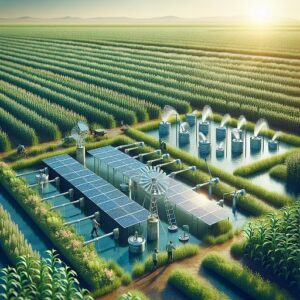
Solar energy addresses this at the source. Instead of purchasing electricity from a utility at whatever rate they charge, a solar-equipped farm generates its own power directly from sunlight. Once the system is paid off, that electricity is essentially free for the remaining 20+ years of the system’s life. For those interested in integrating solar technology, exploring irrigation systems a farmer can use with solar panels might be beneficial.
What makes this particularly powerful for agriculture is timing. Farms tend to use the most energy during daylight hours — exactly when solar panels produce at peak capacity. That alignment between production and consumption is one of the key reasons solar works so well in agricultural settings.

How Solar Panels Actually Work on a Farm
At the core of every solar installation — whether it’s on a barn roof or spread across an open field — is the same fundamental technology: photovoltaic (PV) cells that convert sunlight into electricity. Understanding how that process works, and how it connects to the rest of a farm’s infrastructure, is the foundation for evaluating whether solar makes sense for your operation.
From Sunlight to Electricity: The Photovoltaic Process
Each solar panel is made up of dozens of photovoltaic cells, typically constructed from silicon. When photons from sunlight strike these cells, they knock electrons loose, creating a flow of direct current (DC) electricity. That DC electricity travels to an inverter, which converts it into alternating current (AC) — the type of electricity used by virtually all farm equipment and appliances. From there, it flows directly into the farm’s electrical system, powering whatever is running at that moment.
How Excess Power Gets Stored or Sold Back to the Grid
Solar panels don’t always produce exactly what a farm needs in real time. On high-production days, there’s often more electricity generated than consumed. That surplus has two possible destinations: it can be stored in a battery system for later use, or it can be exported back to the utility grid in exchange for energy credits through a program called net metering.
Battery storage systems — like the Tesla Powerwall or similar commercial-grade options — allow farms to capture that surplus and draw on it at night or during cloudy periods. Grid-tied systems without batteries rely on net metering to handle the balance. Both approaches are valid depending on a farm’s location, utility policies, and operational priorities.
Why Farm Energy Demands Align Perfectly With Solar Production
This alignment is one of the most overlooked advantages of agricultural solar. Most high-energy farm tasks happen during daylight — irrigation runs during growing season days, grain drying peaks at harvest time, and ventilation systems in poultry houses work hardest when outside temperatures rise mid-day. Solar production peaks at exactly the same time.
- Irrigation pumps typically operate during morning to mid-afternoon hours, directly overlapping with peak solar output
- Grain dryers run intensively during fall harvest — often clear-sky days with strong solar generation
- Poultry ventilation demands increase with heat, which correlates directly with sunny, high-output solar days
- Refrigeration systems on dairy farms run around the clock but benefit from solar offsetting daytime draw
- Greenhouse lighting and climate control can be partially or fully solar-powered depending on system size
This natural synchronization means farms can often use solar power directly as it’s produced, rather than relying heavily on storage or grid interaction. That direct-use efficiency is what drives the highest possible return on a solar investment.
The Real Financial Benefits for Farmers
The financial case for farm solar is stronger than most farmers initially expect — especially once federal incentives, state programs, and long-term savings are factored in together.
Financial Benefit
Details
Potential Value
Federal Investment Tax Credit (ITC)
30% tax credit on total system cost
Significant upfront cost reduction
USDA REAP Grant
Covers up to 50% of project costs for eligible farmers
Up to 50% of installation cost
Net Metering
Sell excess electricity back to the grid
Ongoing revenue stream
Accelerated Depreciation (MACRS)
5-year depreciation schedule for solar assets
Substantial tax savings in early years
Electricity Cost Offset
Replace purchased power with self-generated solar
70–100% of electricity costs
These benefits don’t exist in isolation — they stack. A farmer who qualifies for a USDA REAP grant and claims the federal ITC could recover more than half the installation cost within the first year alone, dramatically shortening the payback period and improving the overall return on investment.
Beyond the immediate incentives, the long-term value of a solar system compounds over time. Most commercial solar panels carry performance warranties of 25 years, and many systems continue producing well beyond that. Every year of free or near-free electricity after the system is paid off goes directly to the farm’s bottom line. For those interested in integrating solar with their irrigation systems, solar panels integration with sprinkler irrigation systems can provide additional benefits.
How Much Farmers Can Offset With Solar (Up to 70–100% of Electricity Costs)
Agricultural solar systems are sized based on a farm’s actual historical energy consumption. When designed correctly, a system can offset between 70% and 100% of a farm’s total electricity usage. For operations spending $3,000 to $10,000 or more per month on electricity, that’s a transformative reduction in overhead.
Federal Investment Tax Credit (ITC) and What It Covers
The federal Investment Tax Credit currently allows farm businesses to deduct 30% of the total cost of a solar installation directly from their federal tax liability. This applies to both the equipment and the installation labor, making it one of the most valuable single incentives available to agricultural solar adopters. It’s a dollar-for-dollar reduction in taxes owed — not just a deduction from taxable income.
USDA REAP Grants: Up to 50% of Project Costs Covered
The USDA Rural Energy for America Program (REAP) is one of the most powerful — and underutilized — funding tools available to American farmers. REAP grants can cover up to 25% of a solar project’s cost, while REAP loan guarantees can cover an additional 75%, meaning eligible farmers can finance virtually the entire project through this single program. When combined with the federal ITC, the out-of-pocket cost of going solar drops dramatically. Applications are accepted on a rolling basis, and agricultural producers in rural areas are among the primary eligible recipients. For more information on how farmers can benefit from solar energy, explore the irrigation systems a farmer can use with solar panels.
Net Metering: Turning Surplus Energy Into Revenue
Net metering allows solar-equipped farms to send unused electricity back to the utility grid and receive credits on their energy bill in return. On high-production days — clear summer afternoons when panels are generating at full capacity but equipment isn’t running at peak — that surplus becomes a financial asset rather than wasted output.
The value of net metering varies by state and utility provider, but in states with strong net metering policies, farms can accumulate significant credits during spring and summer that offset winter electricity purchases. Over a full year, this can effectively reduce a farm’s net electricity cost to near zero even if the solar system doesn’t cover 100% of real-time consumption.
Long-Term ROI Over a 25+ Year System Lifespan
Most commercial solar panels — including widely used models from manufacturers like Canadian Solar and JinkoSolar — carry linear performance warranties guaranteeing at least 80% of rated output at the 25-year mark. In practice, many systems continue operating productively well into their 30th year with minimal maintenance costs.
The payback period for farm solar systems typically ranges from 5 to 9 years depending on system size, local electricity rates, incentives claimed, and financing structure. After payback, the electricity a farm generates is essentially free. For a 200-acre grain operation spending $8,000 a month on electricity, that means potentially $96,000 per year flowing back to the farm’s bottom line once the system is paid off. Learn more about solar-powered irrigation systems and how they can further enhance farm efficiency.
It’s also worth factoring in electricity rate inflation. Utility rates have historically increased year over year, which means the value of every kilowatt-hour a farm generates itself grows over time. A solar system locks in a fixed energy cost today, protecting against whatever rate increases come in year 10, 15, or 20 of the system’s life.
Example ROI Scenario: A Midwestern hog farm installs a 250 kW ground-mounted solar array at a total cost of $400,000. After a 25% REAP grant ($100,000) and the 30% federal ITC ($120,000 applied to remaining costs), the net out-of-pocket investment drops significantly. With $5,500 in monthly electricity savings and net metering credits, the system reaches payback in approximately 6–7 years — then generates over two decades of near-free electricity.

Which Farm Types Benefit Most from Solar
Solar works across virtually every agricultural category, but the degree of benefit varies based on how energy-intensive an operation is and when that energy is consumed. The farms that see the fastest payback and highest offset rates tend to be those with consistent, high daytime electricity demands — because they’re consuming solar power directly as it’s produced, with minimal reliance on storage or grid interaction. For instance, integrating solar panels on center pivot irrigation systems can be a smart idea for farmers looking to optimize energy use.
Three farm types consistently stand out as the strongest candidates for solar adoption: dairy, poultry, and crop production operations. Each has distinct energy profiles that align well with what solar delivers. For more information, consider exploring if solar energy is a good option for your farm.
Dairy Farms: Powering Refrigeration and Milking Equipment
Dairy farms are among the most energy-intensive agricultural operations in existence. Refrigeration for bulk milk tanks, vacuum pumps for milking systems, water heating, and ventilation all run continuously — often 24 hours a day, 7 days a week. A mid-sized dairy operation milking 500 cows can easily consume 30,000 to 50,000 kWh per month.
Solar handles the daytime load effectively, and when paired with battery storage or a grid-tied net metering arrangement, it can offset a significant portion of nighttime consumption as well. Many dairy farmers report electricity cost reductions of 60–80% after solar installation, with some achieving near-complete independence from grid power during peak production months.
Poultry Farms: Cutting Ventilation and Lighting Costs
Ventilation and lighting are the two largest electricity expenses in poultry production, and both are well-suited to solar offsetting. Broiler and layer houses require precisely controlled environments — temperature, airflow, and light cycles all directly impact bird health and production rates. Running that infrastructure on solar-generated electricity rather than purchased grid power can reduce a poultry farm’s energy costs by thousands of dollars per month. Ventilation demand also peaks on hot, sunny days — exactly when solar output is highest — making the production-to-consumption alignment particularly tight for poultry operations.
Crop Farms: Running Irrigation and Grain Dryers on Solar
For crop farmers, irrigation and grain drying represent the two biggest energy cost centers. Center-pivot irrigation systems can consume enormous amounts of electricity during the growing season, and propane or electric grain dryers running through harvest can spike energy bills dramatically in a short window of time.
Solar addresses both. Irrigation runs during daylight hours during the growing season — one of the best solar production periods of the year. Grain drying during fall harvest often coincides with clear autumn days that still generate strong solar output. Farmers who size their systems to accommodate peak harvest energy demand often find that solar handles the majority of those costs, with utility power serving only as a backup during extended cloudy stretches.
Agrivoltaics: Growing Crops and Generating Power on the Same Land
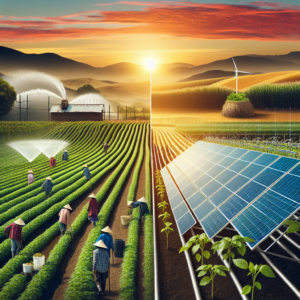
Agrivoltaics — the practice of co-locating solar panels and agricultural production on the same parcel of land — is one of the most exciting developments in both solar energy and modern farming. Rather than choosing between crop production and solar generation, agrivoltaic systems do both simultaneously. Panels are mounted higher than standard ground-mount systems, allowing farm equipment to pass underneath and crops to grow in the partial shade the panels create.
Research from the University of Arizona and other agricultural institutions has shown that certain crops — including tomatoes, peppers, and leafy greens — actually thrive under partial solar shading, showing improved yields and reduced water consumption compared to full-sun conditions. For farmers concerned about losing productive acreage to solar panels, agrivoltaics removes that tradeoff entirely and turns solar into an additive land-use strategy rather than a competing one.
What to Know Before Installing Solar on Your Farm
Going solar isn’t a one-size-fits-all decision, and the farms that get the best results are the ones that do their homework before signing any contracts. The key variables — system size, mounting type, financing structure, and local incentive availability — all interact with each other in ways that significantly affect the final return on investment. Before getting quotes, it’s worth understanding the fundamentals of how a system gets designed for an agricultural property specifically.
How System Size Is Determined by Your Energy Usage
System sizing starts with one thing: your actual electricity consumption. A solar installer will typically request 12 months of utility bills to establish a baseline average monthly usage in kilowatt-hours (kWh). That figure, combined with your location’s solar irradiance data — how much usable sunlight your area receives on average — determines how many panels are needed to hit your target offset percentage.
For most farm operations, the goal is to size the system to offset between 70% and 100% of annual consumption. Going above 100% rarely makes financial sense unless your utility offers strong net metering rates, since oversizing means you’re generating power you can’t use or monetize effectively. A 100 kW system, for example, is roughly appropriate for a farm consuming around 120,000 to 140,000 kWh per year depending on local sun hours — but every installation requires site-specific calculation, not estimates.
Roof-Mounted vs. Ground-Mounted Systems for Agricultural Properties
Farm buildings like barns, equipment sheds, and processing facilities are often well-suited for roof-mounted solar, provided the roof structure is sound and the orientation is favorable. South-facing roofs with a pitch between 15 and 40 degrees tend to capture the most annual solar energy in the northern hemisphere. Before mounting panels on any agricultural structure, a structural assessment is essential — older barns in particular may need reinforcement to handle the additional load.
Ground-mounted systems offer more flexibility in terms of positioning and panel angle optimization, and they’re often the preferred choice for farms with open acreage. Pole-mounted and ballasted ground systems can be oriented precisely for maximum output regardless of building placement. They’re also easier to clean and maintain than roof-mounted arrays. The tradeoff is land use — though as agrivoltaic systems demonstrate, that tradeoff is increasingly negotiable with the right setup design.

Solar Is One of the Smartest Long-Term Investments a Farmer Can Make
When you stack up the numbers — reduced electricity bills, federal tax credits, USDA REAP grants, net metering revenue, accelerated depreciation, and two-plus decades of near-free power generation — solar transitions from an expense into one of the highest-returning capital investments available to agricultural businesses today. The farms seeing the strongest results are those that treat solar not as a sustainability gesture, but as a strategic financial decision backed by data.
The energy landscape for farmers isn’t getting cheaper or more predictable. Utility rates continue to rise, grid reliability in rural areas remains a persistent concern, and input costs across agriculture show no signs of long-term decline. Solar addresses one of the largest and most controllable cost centers on a farm — and it does so with a technology that has 25+ years of proven performance data behind it. For farmers thinking about the next decade of their operation, the question isn’t really whether solar makes sense. It’s how quickly they can get it installed.
Frequently Asked Questions
Farmers considering solar often have very practical, operation-specific questions that general solar guides don’t fully address. The answers below focus specifically on agricultural applications and the real-world variables that affect farm solar performance and economics.
How Many Solar Panels Does a Farm Typically Need?
The number of panels depends entirely on your farm’s energy consumption and the wattage of the panels being installed. A farm using 10,000 kWh per month in a region averaging 5 peak sun hours per day would need approximately 250 to 300 panels rated at 400 watts each to achieve close to 100% offset. Larger operations with monthly usage of 50,000 kWh or more will require proportionally larger systems — often in the 500 kW to 1 MW range — which are typically configured as ground-mounted solar arrays across available acreage.
Can Solar Panels Power an Entire Farm Operation?
Yes — and many farms already do it. When a solar system is properly sized to match annual consumption and paired with either battery storage or a favorable net metering arrangement, farms can achieve near-complete energy independence. Dairy operations, poultry houses, and irrigated crop farms with consistent daytime energy loads are particularly well-positioned to run almost entirely on self-generated solar power. Backup grid connection is typically maintained for extended cloudy periods or unexpected demand spikes, but day-to-day reliance on purchased electricity can drop to near zero.
What Happens to Solar Production During Winter or Cloudy Days?
Solar panels still produce electricity on cloudy days and in winter — just at reduced output. A panel rated for 400 watts under standard test conditions might produce 100 to 200 watts on a heavily overcast day. Diffuse light still contains photons that PV cells can convert, just at lower intensity. In winter, shorter days and lower sun angles reduce daily production, but cold temperatures actually improve panel efficiency compared to peak summer heat.
For farms in northern climates, annual production modeling accounts for seasonal variation. The system is typically sized so that spring and summer surplus — captured through net metering credits or battery storage — offsets the reduced winter production. When the full year is balanced, well-designed agricultural solar systems still achieve their target offset percentages even in states like Minnesota, Wisconsin, or Michigan where winters are significant.
How Long Does It Take for a Farm Solar System to Pay for Itself?
Payback periods for farm solar systems typically range from 5 to 9 years, depending on system size, local electricity rates, available incentives, and financing structure. Farms that qualify for USDA REAP grants and claim the full 30% federal ITC tend to sit at the lower end of that range, sometimes achieving payback in as few as 4 to 6 years. After payback, the system continues generating electricity — and financial returns — for another 15 to 20+ years with minimal maintenance costs beyond occasional cleaning and inverter servicing.
It’s worth noting that payback calculations should also factor in electricity rate inflation. If utility rates increase by even 3% per year — a conservative historical average — the value of every kWh a farm self-generates grows each year. That compounding effect means the true long-term ROI of farm solar consistently outperforms what the initial payback calculation suggests.
Do Farmers Need to Own Their Land to Install Solar Panels?
Land ownership is not always a strict requirement, but it significantly simplifies the process. Farmers who own their land can install solar without navigating lease agreements or landlord approvals. For tenant farmers, solar installation typically requires written consent from the landowner and often involves a formal lease amendment or easement agreement. Some landowners are open to this arrangement — particularly if the system adds value to the property — while others are not.
An alternative model gaining traction in agriculture is the solar lease or power purchase agreement (PPA), where a solar developer installs and owns the system on a farmer’s land in exchange for lease payments to the landowner. The farmer — or the landowner — receives fixed income for the land use without bearing the installation cost or ownership responsibility. These arrangements are particularly common for large ground-mounted systems on agricultural land adjacent to utility infrastructure. For those interested in integrating solar with irrigation, irrigation systems a farmer can use with solar panels offer additional insights.
For farmers looking to explore solar options tailored to agricultural operations, Growing Solar Mist provides expert resources and guidance to help farm operations navigate the full process — from understanding incentives to evaluating the right system configuration for their specific needs.

Leave a Reply