
Key Takeaways
- Monocrystalline panels are the top choice for farms with limited roof or ground space, offering efficiency ratings between 17–22%.
- Bifacial panels can generate up to 30% more energy than standard panels by capturing sunlight from both sides — a game-changer for open farmland.
- The right solar panel type depends on your farm’s available space, energy load, and budget — not just efficiency ratings alone.
- Agrivoltaic systems, which combine crop production with solar energy generation, are gaining traction as a dual-income strategy for farmers.
- Keep reading to find out which panel placement strategy delivers the highest return for your specific farming operation.
Farmers who switch to solar aren’t just cutting energy bills — they’re turning their land and rooftops into long-term power assets.
Agricultural operations are among the highest energy consumers in any rural economy. Irrigation pumps, grain dryers, ventilation systems, refrigeration units, and lighting all run around the clock. That constant demand makes farms ideal candidates for solar energy, where the sun — not the utility company — covers the operating costs. Growing Solar Mist covers this intersection of farming and solar energy in depth, providing farmers with the practical guidance needed to make confident solar investments.
Solar Panels Are Changing How Farms Run
Energy is one of the largest and most unpredictable operating costs on any farm. Fuel prices fluctuate, utility rates climb, and seasonal demand spikes can push electricity bills into thousands of dollars per month. Solar panels change that equation by locking in a predictable, low-cost energy source for 25 to 30 years.
Beyond cost savings, solar gives farmers energy independence. Off-grid and hybrid systems mean that even during grid outages, essential systems like water pumps and refrigeration keep running. For remote farms far from reliable grid infrastructure, solar isn’t just convenient — it’s often the most practical solution available.
The agricultural sector is also uniquely positioned to benefit from solar because farms have something urban and suburban properties rarely have: space. Whether it’s a south-facing barn roof, unused low-productivity land, or open field corridors between crop rows, farms offer multiple high-value installation sites that can dramatically increase total energy output.
The 4 Best Solar Panel Types for Farms
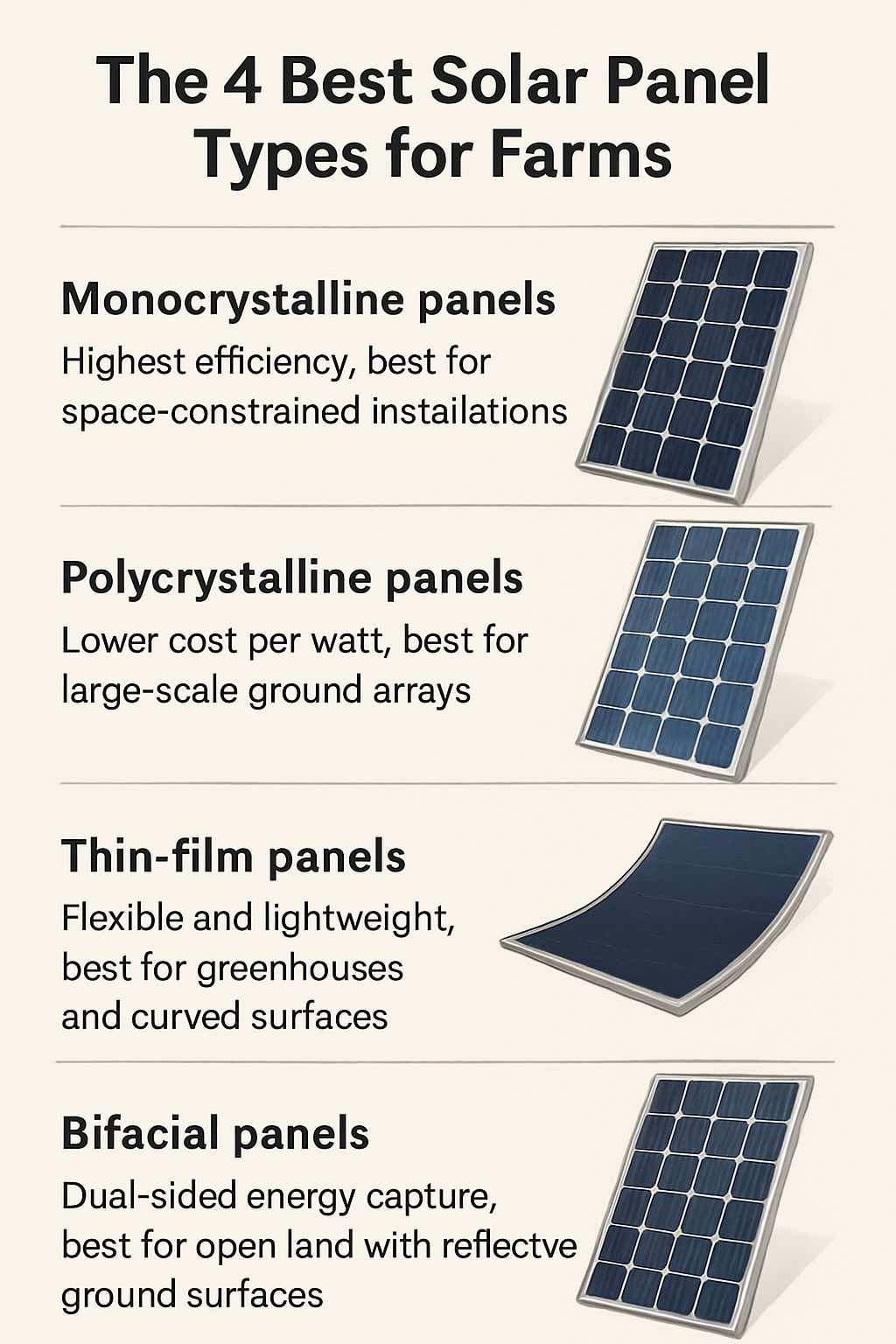
Not all solar panels are built the same, and the differences matter significantly when you’re powering a working farm. The four main types each bring a different combination of efficiency, cost, durability, and ideal application. For instance, integrating solar panels on center pivot irrigation systems can be a smart idea for farmers looking to optimize their energy use.
- Monocrystalline panels — Highest efficiency, best for space-constrained installations
- Polycrystalline panels — Lower cost per watt, best for large-scale ground arrays
- Thin-film panels — Flexible and lightweight, best for greenhouses and curved surfaces
- Bifacial panels — Dual-sided energy capture, best for open land with reflective ground surfaces
Each of these panel types is suited to a specific farm scenario. A barn roof with limited square footage calls for a completely different panel than an open pasture with acres of unused land. Understanding what each panel does — and where it excels — is the first step to making the right investment.
1. Monocrystalline Panels: Best for Limited Roof or Ground Space
Monocrystalline panels are made from a single continuous crystal structure, which gives them the highest efficiency of any commercially available panel type. Most monocrystalline panels on the market today operate at 17–22% efficiency, with premium models from manufacturers like SunPower and LG pushing into the 22–23% range. For a barn roof with a fixed footprint, that extra efficiency means more kilowatts from the same surface area.
These panels also perform well in low-light and overcast conditions, which matters for farms in northern climates or regions with frequent cloud cover. Their long lifespan — typically 25 to 30 years with less than 0.5% annual degradation on premium models — makes them a sound long-term investment despite their higher upfront cost, which typically runs $0.90 to $1.50 per watt before installation. For more information on how solar panels can be integrated into farming practices, consider exploring the benefits of solar linear move irrigation systems.
Best Use Case: A 10,000 sq ft dairy barn roof in a northern climate where maximizing output per square foot is the priority. A monocrystalline array here can realistically offset 60–80% of facility energy use depending on orientation and local sun hours.
2. Polycrystalline Panels: Best for Large Installations on a Budget
Polycrystalline panels are made by melting multiple silicon fragments together, a manufacturing process that’s less precise but significantly cheaper. Efficiency typically falls between 13–17%, slightly below monocrystalline, but the lower cost per watt — generally $0.70 to $1.10 per watt — makes them an attractive option when you have the land to spread out a larger array.
For farms running high-draw equipment like grain dryers, irrigation pumps, or large HVAC systems, polycrystalline panels allow farmers to install more total capacity for the same budget. The trade-off is that you’ll need roughly 10–15% more panel surface area to match the output of a monocrystalline system. On a farm with open acreage, that’s rarely a deal-breaker.
3. Thin-Film Panels: Best for Greenhouses and Curved Surfaces
Thin-film panels are produced by depositing photovoltaic material — typically cadmium telluride (CdTe) or amorphous silicon — onto a flexible substrate. The result is a lightweight, pliable panel that can conform to curved or irregular surfaces where rigid panels simply won’t work. Learn more about solar applications in agriculture.
Efficiency for thin-film panels is lower, typically ranging from 10–13%, and they require the most surface area per kilowatt of output. However, for greenhouse roofing applications, that lower efficiency is offset by a unique advantage: thin-film panels can be manufactured with partial transparency, allowing diffused light to pass through to crops below while still generating electricity.
They also handle high-temperature environments particularly well. Unlike crystalline panels, which lose efficiency as temperatures rise above 25°C (77°F), thin-film panels have a lower temperature coefficient, meaning their output drops less sharply in hot conditions. This makes them a practical option for sun-drenched climates.
4. Bifacial Panels: Best for Maximizing Energy from Open Land
Bifacial panels generate electricity from both their front and rear surfaces. The front side captures direct sunlight like any standard panel, while the rear captures reflected light — called albedo — bouncing off the ground, gravel, or light-colored soil below. In optimal conditions, bifacial panels can produce 10–30% more energy than their monofacial equivalents of the same rated wattage. Learn more about solar panel systems for farms and how they can be a smart investment for agriculture.
For farms with open land and light-colored or reflective ground cover — sandy soil, light gravel, snow cover in winter — bifacial panels are among the most cost-effective options available. They’re typically installed on elevated ground-mounted racking systems that allow reflected light to reach the rear cells. The higher upfront cost of $1.00 to $1.60 per watt is generally recovered faster due to the increased energy yield over the panel’s lifetime. For those interested in integrating solar technology into their irrigation systems, solar drip irrigation systems offer additional benefits and uses for farmers.
Here is a comparison table of the four best solar panel types for agricultural use — focusing on features, efficiency, and suitability for farms.
|
Solar Panel Type |
Efficiency Range |
Cost per Watt (Approx.) |
Key Advantages for Agriculture |
Limitations |
Best Farm Applications |
|---|---|---|---|---|---|
|
Monocrystalline Panels |
17–22% 1 |
$0.90–$1.50 2 |
High efficiency, compact design, long lifespan, performs well in all climates |
Higher upfront cost |
Space-limited farms, rooftops, and irrigation systems 1 |
|
Polycrystalline Panels |
13–17% 3 |
$0.70–$1.00 3 |
Lower cost, durable, long lifespan, strong in direct sunlight |
Requires more space, less efficient in cloudy conditions | |
|
Thin-Film Panels |
10–13% 5 |
$0.50–$0.90 2 |
Lightweight, flexible, better low-light/shaded performance |
Lower efficiency, shorter lifespan |
Greenhouses, barns, shaded or irregular terrain 5 |
|
Bifacial Panels |
18–22% 6 |
$1.00–$1.60 6 |
Captures light from both sides, high energy yield, great for reflective surfaces like grass or soil |
Higher cost, more complex installation |
Agrivoltaics (dual-use with crops), open-field installations 6 |
These four types of solar panels represent the most effective options for agricultural operations, allowing farmers to select between high efficiency (monocrystalline, bifacial) and lower-cost scalability (polycrystalline, thin-film) depending on land availability, sunlight exposure, and budget.
How Each Panel Type Performs in Real Farm Conditions
Manufacturer efficiency ratings are tested under Standard Test Conditions (STC) — 25°C, 1,000 W/m² irradiance, and a specific air mass value. Real farms don’t operate under those conditions. Dust, heat, humidity, partial shading from trees or structures, and seasonal sun angle changes all affect actual output. Understanding real-world performance is what separates a system that meets expectations from one that falls short.
Efficiency Ratings Compared Side by Side
When comparing panel types for agricultural use, efficiency ratings tell only part of the story. A monocrystalline panel rated at 20% efficiency will outperform a thin-film panel rated at 12% on a square-foot basis — but if that thin-film panel is installed across a 5,000 sq ft greenhouse roof that a rigid panel couldn’t cover, the total output comparison shifts entirely.
The more useful metric for farmers is energy yield per dollar invested, accounting for installation costs, available surface area, and local sun hours. A polycrystalline system covering 2 acres of unused low-productivity land may deliver a better return than a premium monocrystalline system half its size, depending on the farm’s specific energy load and grid connection status.
How Temperature and Weather Affect Output
Heat is one of the most underestimated performance factors in agricultural solar installations. Every panel type has a temperature coefficient — the rate at which output drops as panel surface temperature rises above 25°C. Monocrystalline panels typically carry a coefficient of around -0.35% to -0.45% per °C, while thin-film panels perform better in heat with coefficients closer to -0.20% per °C. On a summer afternoon where panel surface temperatures can reach 60–70°C in direct sun, that difference in coefficient translates to a measurable gap in actual output.
Wind, rain, and seasonal cloud cover also factor in heavily on working farms. Farms in the Midwest or Great Plains deal with significant temperature swings, dust accumulation from tillage operations, and seasonal shading changes. Panels installed near grain handling facilities may experience heavier soiling than those on a remote hillside. Regular cleaning — even a simple rinse twice per season — can recover 3–5% of lost output from dust and debris alone.
Lifespan and Durability on Working Farms
Agricultural environments are hard on equipment. Solar panels installed on a working farm face wind-driven debris, chemical exposure from fertilizer or pesticide drift, vibration from nearby machinery, and in some regions, hail. Premium monocrystalline and bifacial panels from manufacturers like Canadian Solar, Jinko Solar, and SunPower are rated to withstand hail impacts at 25mm diameter at 23 m/s under IEC 61215 testing standards. For farms in hail-prone regions, verifying this certification before purchasing is non-negotiable.
Most quality panels carry a 25-year linear power output warranty, guaranteeing no more than 0.5–0.7% annual degradation. That means a 400W panel should still be producing at least 320–330W after 25 years of operation. Thin-film panels tend to degrade slightly faster, with some manufacturers warranting a higher annual degradation rate of around 0.7–1.0% per year. Factor this into your long-term energy projections, especially for systems designed to cover a large percentage of farm load.
Best Solar Panel Placement for Different Farm Operations
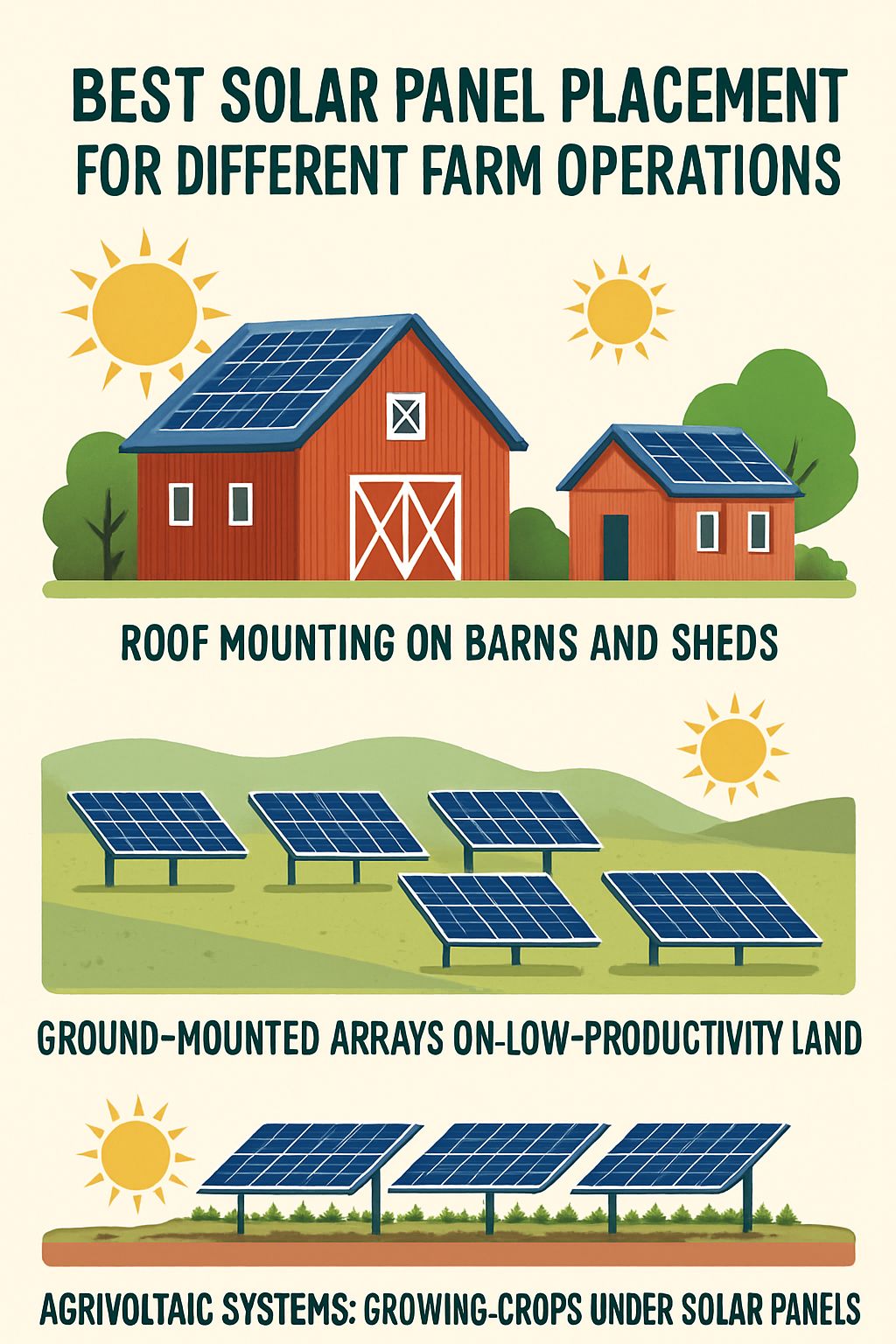
Where you put your panels matters just as much as which panels you choose. A farm has multiple potential installation sites — each with different structural considerations, shading profiles, orientation options, and land-use implications. Matching the right placement strategy to your farm’s layout can significantly increase total system output and return on investment.
Roof Mounting on Barns and Sheds
Barn and shed roofs are the most common starting point for farm solar installations, and for good reason. They use existing structure without consuming additional land, and large agricultural buildings often have substantial south-facing roof area that’s ideal for solar. A single 60 x 40 ft barn roof offers roughly 2,400 sq ft of potential panel space — enough for a 50–70 kW system depending on panel efficiency and racking configuration.
The key structural consideration is roof load capacity. Most modern agricultural steel buildings can support the added weight of a solar array — typically 2.5 to 4 lbs per square foot for standard panel and racking systems — but older timber-framed barns may require reinforcement before installation. Always have a structural assessment completed before signing an installation contract. Roof pitch and orientation also matter: a true south-facing roof at a 30–45 degree tilt will consistently outperform east or west-facing alternatives by 15–25% in annual output.
Ground-Mounted Arrays on Low-Productivity Land
For farms with land that’s too rocky, too wet, or simply too low-yield for reliable crop production, ground-mounted solar arrays offer a way to generate income from otherwise underperforming acreage. Ground-mounted systems allow for optimal tilt and orientation adjustments that rooftop installations can’t always achieve, and they’re easier to expand as energy needs grow. Learn more about solar systems for farmers and how they can benefit agricultural productivity.
Example: A 50-acre Midwest grain farm with 4 acres of low-productivity flood-prone land installs a 500 kW ground-mounted polycrystalline array. At an average of 4.5 peak sun hours per day, the system generates approximately 822,000 kWh annually — enough to power the entire grain drying and irrigation operation while selling excess power back to the grid under a net metering agreement.
Ground-mounted systems do require dedicated land, trenching for underground conduit runs, and concrete pier or ground-screw foundations. Installation costs run slightly higher than rooftop systems — typically 10–20% more per watt — but the flexibility in positioning usually results in higher annual energy yield that offsets the cost difference over time.
Single-axis tracking mounts, which rotate panels to follow the sun’s path from east to west throughout the day, can increase ground-mounted system output by 15–25% over fixed-tilt systems. For large arrays where the added mechanical complexity is manageable, tracking systems offer a compelling boost to energy production and overall system economics. Additionally, incorporating solar panels on center pivot irrigation can further enhance the efficiency and sustainability of agricultural operations.
Agrivoltaic Systems: Growing Crops Under Solar Panels
Agrivoltaics — the practice of co-locating solar panels and crop production on the same land — is one of the most promising developments in agricultural solar. Panels are elevated on taller racking structures, typically 8–14 feet off the ground, allowing farm equipment to operate underneath while crops grow in the partial shade created by the array. Research has shown that certain crops including lettuce, spinach, tomatoes, and various root vegetables can actually produce higher yields under agrivoltaic systems compared to full sun exposure, due to reduced heat stress and moisture retention in the shaded soil.
What Farmers Should Know Before Buying Solar Panels
Selecting the right panel type is only one piece of the decision. Before committing to a solar investment, farmers need to understand how their system will connect to — or operate independently from — the grid, and which technical specifications actually matter when comparing quotes from installers.
Grid-Tied vs. Off-Grid vs. Hybrid Systems
A grid-tied system connects directly to the utility grid and allows farmers to sell excess power back through net metering. When the solar array produces more than the farm needs, the surplus feeds into the grid and spins the electricity meter backward — effectively banking energy credits for nighttime or low-production periods. Grid-tied systems are the most cost-effective option for farms with reliable grid access, as they eliminate the need for expensive battery storage.
An off-grid system operates completely independently, relying on battery banks to store energy for use when the sun isn’t shining. These systems are best suited for remote farm buildings — water pump stations, outbuildings, or remote livestock facilities — where running utility lines would cost more than the solar and battery system itself. A hybrid system combines grid connection with battery backup, giving farmers the bill-reduction benefits of net metering alongside the energy security of stored power during outages. For farms where power interruptions can mean lost livestock or crop damage, the added cost of a hybrid setup is often justified. For more information on how solar panels can be beneficial for farmers, check out this article on solar panels on center pivot irrigation.
Key Specs to Check Before You Buy
When comparing solar panel quotes, the spec sheet can feel overwhelming. Focus on the numbers that actually affect farm performance and long-term value, especially when considering types of solar irrigation systems that could be integrated into your farming operations.
- Power Output (Watts): The rated wattage under Standard Test Conditions. Most quality agricultural panels range from 380W to 600W per panel. Higher wattage means fewer panels needed to hit your target system size.
- Efficiency (%): How much of the sunlight hitting the panel gets converted to electricity. For space-limited installations, prioritize panels above 19% efficiency.
- Temperature Coefficient (% per °C): How much output drops as panel temperature rises. Look for values closer to -0.30% — lower is better, especially in hot climates.
- Degradation Rate: The annual output loss over the panel’s life. Premium panels degrade at 0.5% or less per year. Avoid panels with degradation rates above 0.7%.
- Warranty Terms: Look for a 25-year linear power warranty and at least a 12-year product warranty covering manufacturing defects.
- Certifications: IEC 61215 (durability), IEC 61730 (safety), and UL 61730 (for U.S. installations) are the non-negotiables. For hail-prone regions, confirm Class 3 hail resistance certification.
Don’t let installers upsell you on brand name alone. A Tier 1 manufacturer classification — which indicates financial stability and consistent manufacturing quality — matters more than marketing claims. Tier 1 manufacturers include Canadian Solar, Jinko Solar, LONGi Solar, SunPower, and REC Group. These manufacturers have demonstrated consistent bankability and are backed by independent Bloomberg NEF assessments.
The Right Solar Panel Comes Down to Your Farm’s Needs
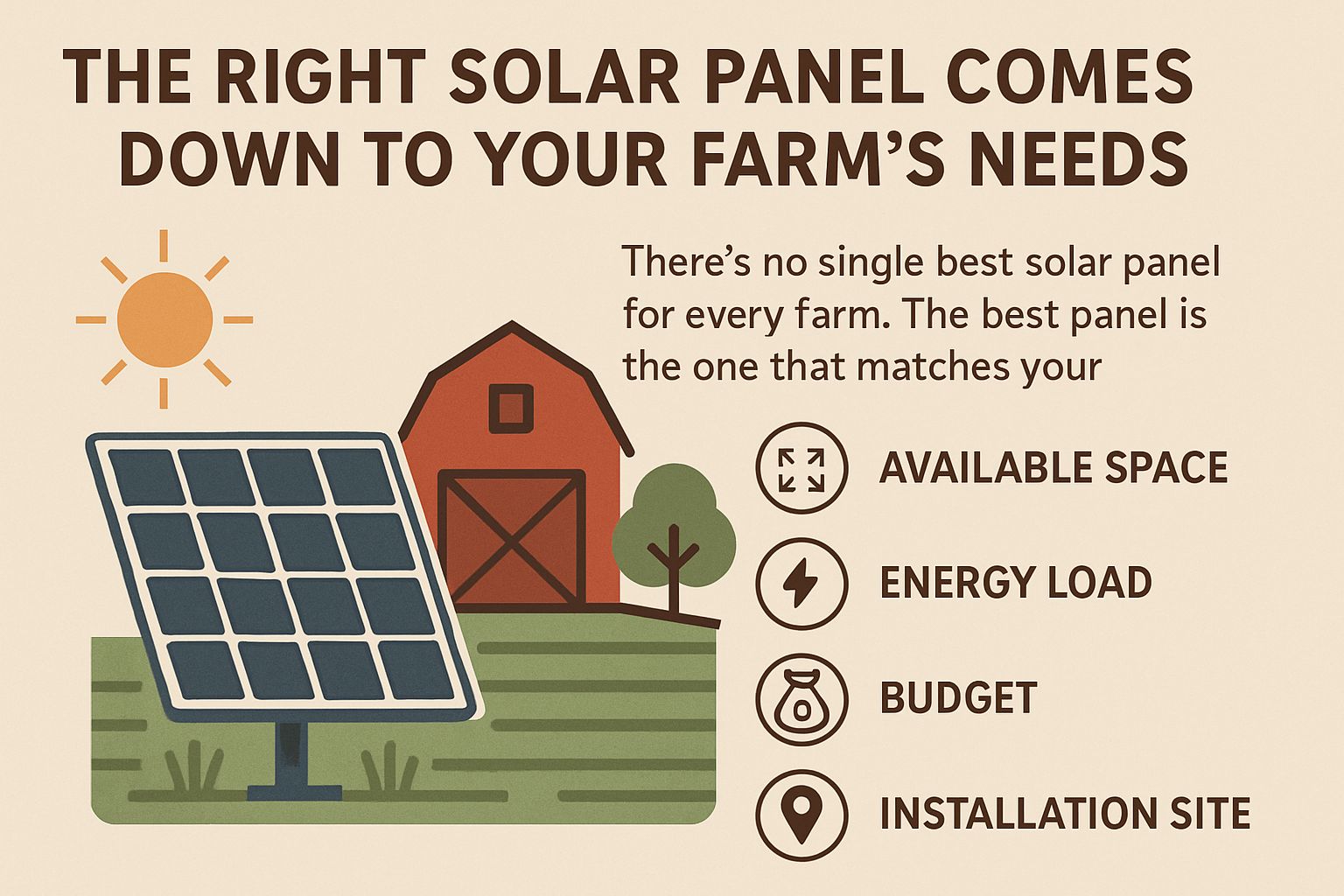
There’s no single best solar panel for every farm. A cattle operation in Texas with 10 acres of open sandy land has completely different requirements than a greenhouse operation in Oregon or a dairy farm in Vermont. The best panel is the one that matches your available space, energy load, budget, and installation site — in that order. Start with an honest energy audit, understand your peak demand periods, and let those numbers drive your panel selection rather than marketing materials or neighbor recommendations.
Frequently Asked Questions
Farmers considering solar often share the same core questions before committing to an installation. The answers below are drawn from real-world agricultural solar applications and are designed to give you straight, practical information.
What is the best type of solar panel for a farm?
The best solar panel for a farm depends on the specific installation scenario. Monocrystalline panels are the best all-around choice for barn roofs and space-constrained sites due to their high efficiency (17–22%) and long lifespan. Bifacial panels are the top pick for open land installations where reflected ground light can boost rear-side generation by 10–30%. Polycrystalline panels offer the best cost-per-watt value for large flat-ground arrays, and thin-film panels are the only practical option for greenhouses and curved agricultural structures.
Can solar panels power an entire farm?
Yes — and many farms already run entirely on solar. Whether a full solar offset is practical depends on your farm’s total energy consumption, available installation space, and whether you’re using a grid-tied, off-grid, or hybrid system. A mid-sized grain operation consuming 150,000 kWh annually would need approximately a 100–120 kW system to achieve full offset in a region receiving 4.5 peak sun hours per day. For those looking to integrate solar with irrigation, connecting a drip irrigation system to solar panels can be a win-win for farmers.
Large-scale operations with significant energy loads from grain drying, refrigeration, or irrigation may find that solar covers 60–80% of their consumption, with grid power filling seasonal gaps. Adding battery storage or a generator backup to a hybrid system can push operational independence even higher. The key is sizing the system to your actual load, not just your peak demand.
How many solar panels does a farm need?
The number of panels depends on three variables: your farm’s total annual energy consumption in kilowatt-hours, the average peak sun hours at your location, and the wattage rating of the panels you’re installing. For farms utilizing solar irrigation systems, understanding the types of solar sprinkler irrigation systems can also influence the number of panels needed. A straightforward formula is:
Number of Panels = Annual kWh Usage ÷ (Panel Wattage × Peak Sun Hours × 365)
Example: A farm using 80,000 kWh/year, located in a region with 5 peak sun hours/day, installing 400W panels:
80,000 ÷ (0.4 kW × 5 × 365) = approximately 110 panels
This is a baseline estimate. A qualified solar installer will refine this number based on system losses, inverter efficiency, shading analysis, and local utility interconnection requirements. Always get at least three installer quotes and request a detailed energy production estimate — not just a panel count — before committing. For more information on integrating solar energy into farming, consider exploring solar panels on center pivot irrigation systems.
Are there government grants for farmers to install solar panels?
Yes. In the United States, the most significant financial support for farm solar comes through the USDA Rural Energy for America Program (REAP), which provides grants covering up to 50% of eligible project costs for agricultural producers and rural small businesses installing renewable energy systems. Combined with the federal Investment Tax Credit (ITC) — currently at 30% of total system cost under the Inflation Reduction Act — farmers can offset the majority of their upfront solar investment. Many states offer additional incentives including property tax exemptions on installed solar systems, sales tax exemptions on solar equipment purchases, and state-level rebate programs. Consulting with a solar installer who specializes in agricultural projects is the fastest way to identify every incentive you qualify for.
What is an agrivoltaic system and is it worth it for farmers?
An agrivoltaic system is a dual-use land arrangement where solar panels and agricultural production operate on the same land simultaneously. Panels are elevated on taller racking — typically 8 to 14 feet high — allowing crops to grow beneath the array and farm equipment to operate underneath the panels. This approach effectively doubles the productive use of a single parcel of land, generating both energy revenue and crop yield from the same acreage.
|
Agrivoltaic Benefit |
Detail |
|---|---|
|
Dual Land Use |
Same acreage generates both crop yield and solar energy revenue |
|
Crop Yield Improvement |
Shade-tolerant crops like lettuce and spinach can produce higher yields under partial shade |
|
Soil Moisture Retention |
Panel shade reduces evaporation, lowering irrigation demand by up to 30% |
|
Panel Efficiency Boost |
Crop transpiration cools panels, improving electrical output in hot conditions |
|
Additional Revenue Stream |
Energy sales or reduced utility bills stack on top of existing farm income |
Research from the University of Massachusetts Amherst found that agrivoltaic systems can reduce irrigation water needs by up to 30% while maintaining or improving yields of shade-tolerant crops. That’s a compelling combination of water conservation and energy production that becomes increasingly valuable as water costs and availability become more constrained in agricultural regions.
The upfront cost of agrivoltaic installations runs higher than standard ground-mounted systems due to the taller racking structures required. Expect to pay 15–25% more per watt compared to a conventional ground mount. However, when the dual income streams — energy savings plus continued crop revenue — are factored into the financial model, agrivoltaic systems often deliver a stronger overall return than either solar or farming would generate on that land alone.
Agrivoltaics is not a one-size-fits-all solution. Row crops like corn or soybeans that require full sun will not thrive under solar arrays. The strongest agrivoltaic candidates are farms already growing shade-tolerant specialty crops, or those considering transitioning to high-value crops like herbs, leafy greens, or certain berry varieties that benefit from afternoon shade in warm climates.
If you’re evaluating whether an agrivoltaic system makes sense for your operation, start with a crop suitability assessment alongside your solar feasibility study. Growing Solar Mist provides farmers with the resources and expertise to evaluate both dimensions — helping you determine whether a traditional rooftop system, a ground-mounted array, or a full agrivoltaic setup best fits your land, crops, and financial goals.







Leave a Reply