
Article-At-A-Glance: Solar Panels for Agricultural Use
- Polycrystalline panels deliver 15–17% efficiency and are the go-to choice for large open fields and flat barn roofs where space isn’t a constraint.
- Thin-film panels are lightweight, flexible, and perform better in shade and high heat — making them ideal for curved roofs, greenhouses, and remote farm setups.
- The real cost difference between thin-film and polycrystalline isn’t just upfront — long-term ROI, installation complexity, and space requirements all play a major role.
- Farmers can combine either panel type with battery storage systems to run fully off-grid operations, powering irrigation, grain dryers, and livestock equipment around the clock.
- Government incentives like the USDA REAP grant can cover up to 50% of solar installation costs for eligible farmers — a detail most solar salespeople won’t lead with.
Choosing the wrong solar panel for your farm doesn’t just cost money — it costs years of underperformance. Growing Solar Mist covers the practical side of farm solar, cutting through the technical noise so farmers can make confident, informed decisions. Whether you’re powering an irrigation pump or electrifying an entire operation, the panel type you choose matters more than most people realize.
Thin-film and polycrystalline are the two most common solar panel types used in agriculture today. Both can power a farm effectively, but they work very differently — and the best choice comes down to your land, your roof, your climate, and your budget. This breakdown gives you exactly what you need to make the right call.
Thin-Film Solar Panels: Farmers Can Use These Flexible and Lightweight Panels
Thin-film solar panels are made by depositing one or more layers of photovoltaic material — such as cadmium telluride (CdTe) or copper indium gallium selenide (CIGS) — onto a surface like glass, plastic, or metal. The result is a panel that’s significantly lighter and more flexible than traditional crystalline silicon panels. For farmers, that flexibility opens up installation options that simply aren’t possible with rigid panels.
Why Thin-Film Panels Work Well on Curved and Weak Roof Structures
Many farm buildings weren’t built with solar in mind. Older barns, storage sheds, and outbuildings often have curved metal roofs or aging structures that can’t bear the weight of heavy rigid panels. Thin-film panels solve this directly. They weigh significantly less per square meter than polycrystalline alternatives, and their flexible form allows them to conform to non-flat surfaces without the need for bulky mounting hardware. Discover how solar panels can solve energy issues for farmers.
This makes thin-film a practical solution for corrugated iron roofs common on livestock shelters and hay storage buildings, where drilling and mounting heavy frames would risk structural damage or leaks. Installation is faster, less invasive, and often doesn’t require a structural engineer’s assessment.
How Thin-Film Panels Perform in Shade and High Temperatures
One of the most important advantages thin-film panels have over polycrystalline is their behavior under real-world conditions. All solar panels lose efficiency as temperature rises — this is called the temperature coefficient. Thin-film panels have a lower temperature coefficient than polycrystalline panels, meaning they lose less output on hot days. In regions where summer temperatures regularly exceed 35°C (95°F), this difference can be meaningful over the course of a year.
Shade tolerance is another area where thin-film pulls ahead. Polycrystalline panels use a series circuit design, meaning if one cell is shaded, the output of the entire string drops. Thin-film panels are less susceptible to this effect, making them better suited for farm rooftops where trees, silos, or neighboring structures cast partial shade at different times of day.
Best Farm Applications for Thin-Film Panels
Thin-film panels aren’t the right fit for every farm scenario, but there are specific use cases where they’re the clear winner:
- Greenhouse rooftops: Semi-transparent thin-film panels can be integrated into greenhouse glazing, allowing light diffusion while generating power — a genuine dual-use solution.
- Curved or corrugated metal barn roofs: Flexible panels conform to the surface without heavy mounting systems.
- Remote or off-grid water pumps: Lightweight panels are easier to transport and install in areas far from the main grid connection.
- Agrivoltaic setups: Thin-film’s adaptability makes it a natural fit for systems where panels are mounted above crops, since shading patterns can be more variable.
- Portable farm equipment charging: Flexible thin-film sheets can be deployed temporarily to charge batteries for electric fencing or monitoring equipment.
The Real Cost of Thin-Film: Cheaper to Install, But More Space Required
Thin-film panels typically cost less per panel than polycrystalline, and their easier installation reduces labor costs. However, their lower efficiency — generally ranging from 10–13% compared to polycrystalline’s 13–17% — means you need more surface area to generate the same amount of power. For a farmer with limited roof space or land, this trade-off can quickly erase the upfront savings.

“Polycrystalline Solar Panel Materials …” from growingsolarmist.com and used with no modifications.
Polycrystalline Panels: For Farmers with Large Installations but on a Budget
Polycrystalline solar panels are made by melting multiple silicon crystals together, which gives them their recognizable blue, speckled appearance. They sit between monocrystalline (highest efficiency, highest cost) and thin-film (lowest efficiency, lowest cost) in the solar panel hierarchy. For budget-conscious farmers with adequate space, they represent a strong balance of performance and affordability. If you’re interested in how solar panels can help with reducing overall costs, polycrystalline panels might be a suitable choice.
Why Polycrystalline Panels Suit Open Fields and Large Flat Roofs
With efficiency ratings of 13–17%, polycrystalline panels produce significantly more power per square meter than thin-film alternatives. On a large flat barn roof or an open ground-mounted array in a paddock, this efficiency advantage compounds quickly. A farmer installing a 20kW system will need fewer polycrystalline panels to reach that target than they would with thin-film — reducing the number of mounting points, wiring runs, and overall system complexity.
Ground-mounted polycrystalline arrays on open farmland are among the most cost-effective solar installations available. The land is already owned, the orientation and tilt can be optimized precisely, and there are no structural limitations to work around. For farms with grazing land adjacent to infrastructure, combining a ground-mounted polycrystalline array with continued sheep or cattle grazing beneath the panels is a well-established practice.
Durability in Harsh Weather: Hail, Wind, and Heavy Rain
Farm environments are hard on equipment. Polycrystalline panels are encased in tempered glass and aluminum frames, engineered to withstand impacts, wind loads, and prolonged moisture exposure. Most commercially available polycrystalline panels meet IEC 61215 certification standards, which includes hail impact testing at 25mm hailstones traveling at 23 m/s.
For farms in hail-prone regions — common across large parts of the US Midwest, Australian grain belt, and South African highveld — this level of certified durability matters. Thin-film panels on flexible substrates may not always meet the same impact resistance standards, particularly when installed on uneven surfaces where the panel can flex slightly under impact.
Wind resistance is another consideration. Framed polycrystalline panels mounted on engineered racking systems can be rated to withstand wind loads of up to 2400 Pa, making them suitable for exposed farm locations that experience regular high winds or occasional severe weather events.
Powering Irrigation Systems, Grain Dryers, and Machinery
Large polycrystalline arrays generate the kind of consistent, high-volume power output that energy-intensive farm equipment demands. A 10kW polycrystalline system running at full capacity for 5 peak sun hours per day generates approximately 50 kWh daily — enough to run a 5.5kW submersible irrigation pump for over 9 hours, or contribute significantly to the energy load of a grain dryer during harvest season.
How Battery Storage Pairs with Polycrystalline Panels for Consistent Power
- Tesla Powerwall 2: 13.5 kWh usable capacity, suitable for small to mid-size farm operations needing overnight backup power.
- BYD Battery-Box Premium HVS: Scalable up to 66.1 kWh, well-matched to larger polycrystalline arrays powering high-demand farm loads.
- Pylontech US5000: A cost-effective lithium iron phosphate (LFP) option frequently used in off-grid agricultural systems across developing regions.
Pairing battery storage with a polycrystalline array allows farms to store surplus daytime generation and deploy it during peak demand periods — typically early morning for irrigation startup or evening for livestock watering systems. This removes dependence on grid availability and protects against time-of-use tariff spikes.
The sizing relationship between the panel array and battery bank is critical. A general rule used by agricultural solar installers is to size battery storage at 1–1.5 times the daily kWh consumption of the loads you want to run off-grid overnight. Undersizing the battery bank is one of the most common and costly mistakes in farm solar installations.
Off-grid capability also has direct productivity value. Farms in areas with unreliable grid supply — common in rural regions across Africa, Southeast Asia, and parts of South America — can achieve energy independence with a correctly sized polycrystalline-plus-storage system, eliminating diesel generator costs that often run to thousands of dollars annually.
Importantly, polycrystalline panels maintain their output consistency well enough to make battery charging predictable. In climates with reliable sun, a well-designed system will fully recharge a battery bank daily, maintaining cycle health and extending battery lifespan beyond the manufacturer’s rated 3,000–6,000 cycles.
Thin-Film or Polycrystalline: Which Solar Panel Wins on the Farm?
|
Feature |
Thin-Film |
Polycrystalline |
|---|---|---|
|
Efficiency |
10–13% |
15–17% |
|
Cost per Watt |
Lower upfront |
Moderate, better long-term value |
|
Weight |
Lightweight |
Heavier |
|
Flexibility |
Flexible / conformable |
Rigid |
|
Shade Tolerance |
Better |
Moderate |
|
Heat Performance |
Better |
Moderate |
|
Space Requirement |
More space needed |
Less space for same output |
|
Durability (Impact) |
Varies by substrate |
High (tempered glass) |
|
Best For |
Curved roofs, greenhouses, shade |
Open fields, flat roofs, high output |
There’s no universal winner here — the right panel depends entirely on what your farm looks like and what you’re powering. A wheat farmer in Kansas with a large machine shed and open land is in a completely different situation than a greenhouse operator in humid coastal Queensland. The panel that wins on one farm can be the wrong call on another.
What the comparison table makes clear is that polycrystalline panels offer more power in less space, while thin-film offers more installation flexibility in challenging environments. Neither panel type is technically superior in every category — they’re optimized for different conditions.
The decision ultimately comes down to three practical questions: How much usable surface area do you have? How consistent is your sunlight? And what structures are you working with? Answer those three questions honestly, and the right panel type becomes obvious.
Polycrystalline Panels Deliver More Power Per Square Foot
- A standard 400W polycrystalline panel covers approximately 2 m² — delivering around 200W per m².
- A comparable thin-film panel of the same area generates roughly 120–150W per m² at peak efficiency.
- For a 50kW farm system, polycrystalline requires approximately 250 m² of panel surface; thin-film may require 330–400 m² for the same output.
- On rooftop installations with fixed dimensions, this difference directly limits how much power you can generate from a given structure.
When roof space is finite — and on most farm buildings it is — getting more watts per square meter has a direct impact on total system output. A shed roof that can physically fit 30 polycrystalline panels will only fit 30 thin-film panels in the same space, but the polycrystalline array will produce significantly more power from that identical footprint. For more insights on how solar power reduces farmers’ overall costs, explore our detailed guide.
This efficiency gap also affects the economics of grid-connected systems. Farmers selling surplus electricity back to the grid through net metering or feed-in tariff arrangements generate more revenue per square meter with polycrystalline panels, which can meaningfully shorten the payback period on the system investment.
Thin-Film Panels Thrive Where Traditional Panels Struggle
When conditions move away from ideal — partial shading from trees or nearby structures, consistently high ambient temperatures, or installation surfaces that aren’t flat and structurally robust — thin-film panels hold their performance better than polycrystalline alternatives. This isn’t a marginal difference. In a shaded environment, a polycrystalline string array can lose 30–40% of its rated output from a single shaded cell, while thin-film panels experience a much smaller proportional drop under the same conditions.
Space vs Flexibility: The Key Trade-Off Farmers Must Consider
Space and flexibility pull in opposite directions when it comes to farm solar, and understanding that tension is what separates a well-designed system from an expensive mistake. Polycrystalline panels give you more power from less surface area, but they demand flat, structurally sound mounting surfaces and work best when shade is minimal. Thin-film panels give you the freedom to work with what you have — curved roofs, partial shade, lightweight structures — but you’ll need more of them to hit the same kilowatt target.
For most farms, the honest answer is that both factors matter, just not equally. A cattle station with 500 square meters of flat shed roofing and reliable sun doesn’t need thin-film’s flexibility — it needs polycrystalline’s output density. A hillside vineyard operation with shaded greenhouse structures and uneven terrain is the opposite situation entirely. Map your farm’s physical constraints first, and the panel choice follows naturally.
Your Farm’s Layout and Climate Should Drive the Decision
If you’re in a high-irradiance region with consistent sun hours — such as the US Southwest, Australia’s inland regions, or Southern Europe’s agricultural zones — polycrystalline panels will deliver strong returns with minimal complexity. If your farm is in a more variable climate, experiences frequent overcast conditions, or sits in a valley where morning shade is common, thin-film’s performance stability under low-light conditions becomes a genuine asset rather than a technical footnote.

Efficiency Comparison: Power Output on Real Farm Conditions
Efficiency ratings on a specification sheet are measured under Standard Test Conditions — 25°C panel temperature, 1000 W/m² irradiance, and no shading. Real farms don’t operate under laboratory conditions. Panel temperature regularly exceeds 25°C on sunny days, cloud cover varies, and shade from infrastructure is almost always present to some degree. Understanding how each panel type performs under actual field conditions is far more useful than comparing spec sheet numbers alone. For more insights on how solar technology can benefit agriculture, explore the cost-saving advantages of solar power for farmers.
Polycrystalline Efficiency Rates in Direct Sunlight
Under direct, unobstructed sunlight in optimal temperature ranges (15–25°C), polycrystalline panels perform close to their rated efficiency of 13–17%. A quality 400W polycrystalline panel from manufacturers like Jinko Solar or Canadian Solar will produce reliably near its rated output during peak sun hours in these conditions. For large open-field installations where panels can be tilted to the optimal angle and shade is controlled, real-world output often tracks closely with the theoretical maximum.
The performance gap starts to appear as temperatures climb. Polycrystalline panels have a temperature coefficient of approximately -0.40% to -0.45% per degree Celsius above 25°C. On a hot summer day where panel surface temperature reaches 65°C — entirely normal on an exposed metal rack in full sun — a 400W panel loses roughly 16–18% of its rated output, effectively producing around 330–336W. Over a full summer season, this thermal derating accumulates into a measurable reduction in total annual generation.
How Thin-Film Performs in Shade, Heat, and Cloudy Weather
Thin-film panels, particularly cadmium telluride (CdTe) variants produced by manufacturers like First Solar, carry temperature coefficients in the range of -0.25% to -0.28% per degree Celsius — significantly better than polycrystalline. On that same 65°C panel surface temperature scenario, a thin-film panel loses only around 10–11% of its rated output. In consistently hot agricultural regions, this advantage results in meaningfully higher annual energy yields compared to what the efficiency gap on paper would suggest.
In diffuse light conditions — overcast skies, early morning, and late afternoon — thin-film panels also maintain a higher proportion of their rated output than polycrystalline panels. This is particularly relevant for farms in temperate climates where clear sunny days are the exception rather than the rule. A thin-film array in cloudy coastal farmland can outperform a similarly rated polycrystalline system on an annual generation basis, despite having lower peak efficiency on paper.
Which Panel Type Needs More Space for the Same Output
The space requirement difference between thin-film and polycrystalline is one of the most practically significant factors for farmers working with fixed roof dimensions or limited ground-mount areas. To generate 10 kW of installed capacity using standard 400W polycrystalline panels, you need 25 panels covering approximately 50 m². To achieve the same 10 kW using thin-film panels rated at around 150W per m², you’d need roughly 67 m² of panel surface — a 34% larger footprint for identical output.
On a rooftop where every square meter is accounted for, this matters enormously. A 200 m² barn roof fitted with polycrystalline panels can theoretically support a 40 kW system. The same roof fitted with thin-film panels for the same output would exceed the available surface area. Ground-mounted systems on large farms have more flexibility here, but thin-film’s space penalty still translates directly into higher material and racking costs per kilowatt installed.
Cost Breakdown for Farmers
Solar pricing has shifted significantly over the past decade, and the cost gap between panel types is narrower than it used to be. That said, the differences that remain are still meaningful at the scale most farms operate — and the upfront panel cost is only one component of a system’s total installed price. Labor, racking, inverters, wiring, and grid connection fees all factor in, and some of these costs favor one panel type over the other in ways that aren’t obvious at first glance. For instance, understanding how solar panels can solve energy costs is crucial for farmers.
Upfront Cost Per Watt for Each Panel Type
Polycrystalline panels currently price in the range of $0.25 to $0.35 USD per watt at wholesale for commercial agricultural quantities, with total installed system costs typically landing between $0.90 and $1.20 per watt for straightforward ground-mounted or large rooftop installations. Thin-film panels from established manufacturers like First Solar sit at a similar or slightly lower per-watt price point at the panel level, but the larger number of panels required to hit a given kilowatt target can offset those savings quickly.
For a practical example: a 50 kW polycrystalline system using 125 x 400W panels might carry a total installed cost of $50,000–$60,000 USD before incentives. An equivalent thin-film system of the same output capacity may require more racking, additional wiring runs, and more panels, pushing installed costs higher even if individual panel prices are comparable. The per-watt installed cost — not the panel purchase price alone — is the number that actually matters for budgeting.
How Installation Costs Differ Between the Two
- Racking and mounting: Polycrystalline panels use standardized aluminum racking systems widely available from suppliers like IronRidge and Unirac — competitive pricing and fast installation. Thin-film flexible panels on curved surfaces may require custom or adhesive-based mounting solutions that add labor time.
- Wiring and combiner boxes: More thin-film panels for the same output means more wiring connections, more string configurations, and potentially more combiner boxes — all of which add material and labor cost.
- Structural assessment: Lightweight thin-film panels may eliminate the need for a structural engineer’s report on older farm buildings, which can save $500–$2,000 USD depending on the jurisdiction.
- Installation time: Polycrystalline systems on standard racking are typically faster to install per kilowatt than thin-film systems requiring custom surface preparation.
Labor rates for agricultural solar installation vary significantly by region — from around $0.15 to $0.30 per watt in the US for straightforward commercial farm installs. The structural complexity of the installation surface has a direct impact on where within that range your project lands.
Thin-film installations on flexible substrates can reduce structural costs but introduce different labor requirements. Adhesive bonding of flexible panels to metal roofing, for instance, requires surface preparation, temperature-appropriate adhesive selection, and careful quality control to prevent delamination over time. A rushed or poorly executed flexible thin-film installation can fail within 5 years, voiding performance warranties and requiring costly re-installation. To explore how solar power can help in reducing overall costs, consider reading about how solar power reduces farmers’ expenses.
The total installed cost comparison between the two panel types is genuinely close enough that getting multiple quotes from installers experienced with both technologies is the right approach before committing to either. A $5,000 difference in quoted installation cost can easily swing the economic advantage from one panel type to the other on a mid-size farm system.
Long-Term Return on Investment for Each Option
Both panel types carry 25-year linear performance warranties from reputable manufacturers, guaranteeing output doesn’t fall below 80% of rated capacity at end of warranty period. Polycrystalline panels from established brands like Jinko Solar, LONGi, and Canadian Solar have extensive field data supporting their longevity claims. Thin-film panels from First Solar similarly have strong real-world performance records in utility-scale installations.
Payback periods for agricultural solar systems typically range from 5 to 9 years depending on system size, local electricity rates, available incentives, and how much of the generated power is self-consumed versus exported. Farms with high daytime energy consumption — running pumps, refrigeration, milking equipment, and processing machinery during solar generation hours — achieve the shortest payback periods because they’re displacing expensive grid electricity at full retail rate rather than exporting at lower feed-in rates. For more insights on how solar power reduces farmers’ overall costs, explore our detailed guide.

Best Agricultural Uses for Each Panel Type
Neither thin-film nor polycrystalline is a one-size-fits-all solution for agriculture, and the most effective farm solar installations are often those where the panel type was chosen specifically for the application rather than defaulting to whatever the installer had in stock. The use case drives the technology decision — not the other way around. For example, understanding types of solar sprinkler irrigation systems can guide you in selecting the right solar panels for your agricultural needs.
Understanding which panel type aligns with which farm application saves money, reduces installation complexity, and results in systems that actually perform as expected over their full 25-year lifespan. The following breakdowns reflect how each panel type performs across the most common agricultural energy applications, including thin-film vs polycrystalline solar panels.
Where Polycrystalline Panels Perform Best on a Farm
Open ground-mounted arrays for large-scale electricity generation are the strongest use case for polycrystalline panels. Farms with flat or gently sloping land adjacent to electrical infrastructure can install ground-mounted polycrystalline arrays sized to offset their entire annual electricity bill, with optimized tilt angles maximizing annual yield. Grazing integration — running sheep or cattle beneath the panels — is well-documented and adds dual land-use value without compromising panel performance.
Large flat-roofed farm structures, including machinery sheds, grain storage facilities, and dairy processing buildings, are equally well-suited to polycrystalline installations. The combination of structural integrity, consistent roof pitch, and large unshaded surface area makes these buildings ideal candidates. A 20m x 30m machinery shed roof provides 600 m² of potential panel surface — enough for a 240 kW polycrystalline system that could fully power a mid-size farm operation and generate surplus for export. For more insights, read about how solar power reduces farmers’ overall costs.
Ideal Thin-Film Applications: Barns, Greenhouses, and Remote Setups
Semi-transparent thin-film panels integrated into greenhouse glazing represent one of the most technically interesting applications in agricultural solar. Products like the thin-film BIPV (Building-Integrated Photovoltaics) panels allow controlled light transmission into the growing environment while generating electricity from the same surface. Research from Wageningen University has explored how optimized light filtering through semi-transparent solar panels can actually improve certain crop growth conditions compared to standard greenhouse glazing, making this a genuinely dual-benefit technology rather than a compromise.
Using Either Panel Type to Power Irrigation Systems
Solar-powered irrigation is one of the highest-value applications of farm solar, and both thin-film and polycrystalline panels can drive it effectively. The key variable is how the system is designed. Direct-coupled solar pump systems — where the pump runs only when the sun is shining — work well with either panel type, provided the array is sized to deliver adequate voltage and current to the pump motor during peak demand periods. AC pump systems running through an inverter give more flexibility and can be paired with battery storage for around-the-clock operation. Learn more about solar drip vs. micro-sprinklers as effective irrigation systems for farmers.
For submersible bore pumps in remote paddocks, thin-film’s lightweight and portable nature makes it easier to deploy a standalone solar pump system without heavy infrastructure. A flexible thin-film array mounted on a simple ground frame near the water source can power a DC submersible pump rated at 400–800W, sufficient for livestock watering points serving herds of up to several hundred animals. For larger center-pivot irrigation systems drawing 15–75 kW, a grid-connected polycrystalline array sized to offset peak irrigation energy costs is the more practical solution.
Combining Panels with Battery Storage for Off-Grid Farm Operations
Real-World Example: A mixed livestock and cropping farm in rural New South Wales, Australia running a 30 kW polycrystalline array paired with a 60 kWh BYD Battery-Box Premium HVS system eliminated $28,000 AUD in annual diesel generator costs within the first full year of operation. The system powered irrigation pumps, electric fencing energizers, workshop equipment, and farmhouse loads — fully off-grid. Payback period projected at 6.5 years before accounting for rising grid electricity tariffs.
Battery storage transforms a solar array from a daytime-only power source into a 24-hour farm energy solution. For off-grid farm operations, the battery bank bridges the gap between solar generation hours and the times when farm energy demand is highest — early morning livestock routines, evening refrigeration loads, and overnight irrigation cycles. Without storage, a solar array alone cannot serve these needs.
The chemistry of the battery system matters as much as its capacity. Lithium iron phosphate (LFP) batteries — used in products like the Pylontech US5000 and BYD Battery-Box series — offer superior cycle life, better thermal stability, and lower maintenance requirements compared to older lead-acid alternatives. In farm environments where battery enclosures may be exposed to temperature extremes, LFP chemistry’s wider safe operating temperature range is a meaningful practical advantage.
Hybrid inverter selection is the third component of a well-designed off-grid farm system. Inverters like the SMA Sunny Island, Victron MultiPlus-II, and Fronius Symo Hybrid are commonly specified for agricultural off-grid applications, offering generator integration inputs that allow a backup diesel generator to top up the battery bank during extended low-sun periods — such as extended rain events during harvest season when energy demand is simultaneously at its highest.
Correctly sizing the battery bank for your specific farm loads is non-negotiable. A farm energy audit — cataloguing every load, its wattage, and its daily run hours — should be completed before any battery storage system is sized or quoted. Undersizing the battery bank by even 20% results in daily depth-of-discharge levels that accelerate battery degradation, often halving the expected battery lifespan and creating a costly replacement cycle that destroys the system’s economics.
How to Choose the Right Panel for Your Farm
The best solar panel for your farm is the one that matches your physical infrastructure, your energy load profile, and your budget — not the one with the most impressive specification sheet. Too many farm solar installations are designed around what the installer has in stock or what’s easiest to quote, rather than what genuinely suits the property. Taking thirty minutes to assess your own farm against a few key criteria will put you in a far stronger position when comparing installer proposals.
Start with three practical questions. First, what surfaces do you have available — flat roofs, curved roofs, open ground, or greenhouse glazing? Second, are those surfaces shaded at any point during the day by trees, silos, or neighboring structures? Third, what is your single largest daily energy load, and does it run during daylight hours or after dark? The answers to these questions will point clearly toward one panel type over the other in most cases.
Farms With Large Open Land: Polycrystalline Is the Stronger Fit
If your farm has open, unshaded land adjacent to your main electrical infrastructure, ground-mounted polycrystalline panels are almost certainly your most cost-effective path to energy independence. You control the tilt angle, the orientation, and the shading environment — three variables that directly determine annual energy yield. Combine a polycrystalline ground array with a quality battery storage system and a grid connection for surplus export, and you have a system that can generate a measurable return on investment while fully powering your operation for 25 or more years.
Farms With Shaded, Uneven, or Structurally Limited Spaces: Go Thin-Film
When your available surfaces are curved, structurally marginal, or affected by partial shading for significant portions of the day, thin-film panels will consistently outperform polycrystalline in those conditions. The installation flexibility alone — the ability to mount directly onto corrugated metal roofing without heavy framing — can make thin-film viable on farm buildings where polycrystalline installation would either be structurally risky or prohibitively expensive. If greenhouse integration is on your agenda, thin-film BIPV panels are currently the only technology that genuinely delivers dual crop-and-power functionality from a single surface.
Budget-First Farmers: What the Numbers Actually Say
If upfront cost is your primary constraint, polycrystalline panels on a standard ground mount or flat roof installation will almost always deliver the lowest cost per kilowatt installed once you account for all system components — not just the panel price. The higher efficiency means fewer panels, less racking, less wiring, and faster installation. For a budget-constrained farmer trying to maximize kilowatts per dollar spent, this efficiency advantage typically outweighs thin-film’s slightly lower per-panel price.
The exception is when your installation surface genuinely requires thin-film — an older barn roof that can’t support rigid panel weight, for example. In that specific scenario, forcing polycrystalline panels onto an unsuitable structure creates structural risk and potential liability that no cost saving justifies. Thin-film’s installation compatibility can make it the financially responsible choice even when polycrystalline appears cheaper on paper.
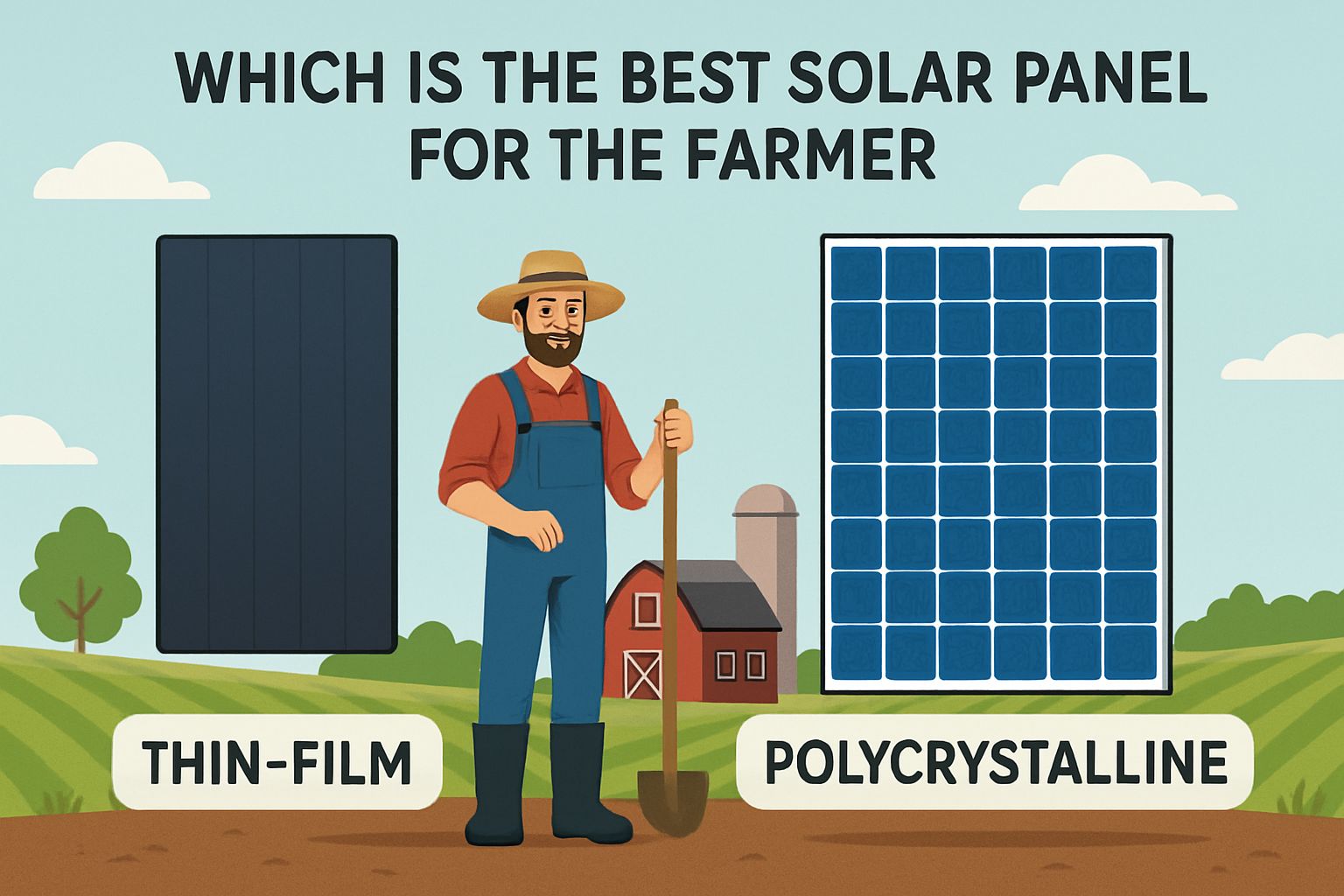
Conclusion: Which is the Best Solar Panel for the Farmer: Thin-Film or Polycrystalline
Polycrystalline panels win on output density, durability, and long-term value for farms with adequate space and structural integrity. Thin-film panels win on installation flexibility, shade tolerance, and heat performance for farms where conditions don’t suit rigid panel systems. The right answer is whichever one matches your farm’s actual physical reality — and now you have the technical foundation to make that call confidently and defend it when installers try to push you in the wrong direction.
Frequently Asked Questions
Farmers considering solar regularly encounter the same practical questions when comparing thin-film and polycrystalline panels. The following answers cut through the marketing language and give you the direct technical responses you need to make informed decisions.
What sets thin-film and polycrystalline panels apart?
Thin-film panels are made by depositing photovoltaic material in thin layers onto a flexible or rigid substrate — glass, metal, or plastic. Polycrystalline panels are made from multiple silicon crystals fused together and encased in tempered glass with an aluminum frame. The manufacturing difference produces panels with fundamentally different physical characteristics: thin-film is lightweight, flexible, and shade-tolerant; polycrystalline is rigid, heavy, and more efficient per square meter.
The practical difference on a farm comes down to where and how you can install them. Polycrystalline panels require structurally sound, predominantly flat surfaces and minimal shading for best performance. Thin-film panels tolerate curved surfaces, partial shade, and lighter mounting structures — making them viable in situations where polycrystalline installation would be impractical or structurally risky.
How do weather conditions impact thin-film vs polycrystalline panels?
Thin-film panels handle heat and shade significantly better than polycrystalline. With temperature coefficients of -0.25% to -0.28% per °C compared to polycrystalline’s -0.40% to -0.45% per °C, thin-film loses less output as panel temperatures rise on hot days. In diffuse light conditions — overcast skies, early morning, and late afternoon — thin-film also maintains a higher proportion of its rated output. Polycrystalline performs closer to its rated efficiency in cool, direct sunlight and open unshaded environments, which represent the best-case conditions for that technology.
Which panel type is more cost-efficient in the long term for farmers?
For most farm installations with adequate space and suitable surfaces, polycrystalline panels deliver better long-term cost efficiency. Their higher output per square meter means lower total system costs per kilowatt installed when all components are factored in. Both panel types carry 25-year linear performance warranties from reputable manufacturers, so lifespan is not a differentiating factor between them.
The calculation shifts when installation surface constraints make thin-film the only practical option. If using polycrystalline panels on a structurally limited roof would require $10,000 in structural reinforcement that thin-film avoids entirely, thin-film becomes the more economical choice regardless of panel-level pricing. Always evaluate total installed system cost — not panel price alone.
Cost Comparison at a Glance (50 kW Farm System, indicative USD figures before incentives):
Polycrystalline Ground Mount: ~$50,000–$60,000 installed | 125 x 400W panels | ~250 m² surface area
Thin-Film Equivalent Output: ~$55,000–$68,000 installed | More panels required | ~330–400 m² surface area
Typical Payback Period (Both): 5–9 years depending on local tariffs and self-consumption rate
25-Year Performance Warranty: Available from reputable manufacturers for both types
These figures assume a straightforward installation on suitable surfaces with no significant structural remediation required. Complex installations — curved roofs, remote off-grid sites, or buildings requiring structural upgrades — can shift the cost comparison substantially in either direction.
Incentive programs significantly affect the final economics for both panel types. The USDA Rural Energy for America Program (REAP) grant covers up to 25% of eligible project costs for agricultural producers, with loan guarantees available for an additional 75% — meaning some farmers can fund a solar installation with minimal upfront capital. The US federal Investment Tax Credit (ITC) provides a 30% tax credit on solar installation costs under current legislation. Farmers should consult a tax professional and a REAP-experienced solar installer before finalizing system design and financing, as incentive eligibility criteria affect both panel type selection and system sizing decisions.
Can thin-film panels be used on greenhouse roofs?
Yes — and greenhouse integration is actually one of the strongest use cases for thin-film solar technology in agriculture. Semi-transparent thin-film BIPV panels can be incorporated directly into greenhouse glazing systems, replacing standard glass or polycarbonate sections with panels that simultaneously transmit diffused light to crops and generate electricity from the same surface area. This dual-use functionality is something no rigid crystalline panel type can replicate. For more insights on how solar technology can benefit agriculture, explore the reduction of overall costs and expenses for farmers.
The critical design consideration is light transmission rate. Standard opaque thin-film panels block all light and are not suitable for crop-facing greenhouse surfaces. Semi-transparent thin-film panels are available with varying transparency levels — typically 10% to 40% light transmission — and the correct specification depends on the light requirements of the crops being grown. High-light crops like tomatoes and peppers require higher transmission rates than shade-tolerant crops like lettuce or herbs.
Thin-Film Greenhouse Integration — Key Specifications to Request from Suppliers:
• Light Transmission Rate: 10%–40% (match to crop light requirements)
• Power Output per m²: Typically 60–100W/m² for semi-transparent variants
• Temperature Coefficient: Confirm ≤ -0.30% /°C for greenhouse environments
• UV Stability Rating: Critical for long-term glazing performance
• Warranty: Minimum 10-year product warranty, 25-year linear performance guarantee
• Certifications: IEC 61646 (thin-film performance), IEC 61730 (safety)
Greenhouse thin-film installations require specialist design input — both for the electrical system and the structural integration into the glazing framework. Working with an installer who has documented greenhouse BIPV experience is essential. A poorly specified or installed greenhouse solar system can inadvertently reduce crop yields by over-shading sensitive plants, which eliminates any energy cost saving through reduced agricultural productivity.
Do farmers receive government incentives for installing solar panels?
Government incentive programs for agricultural solar exist across most major farming regions globally, and they can substantially reduce the net cost of a solar installation. In the United States, the two most significant programs are the USDA Rural Energy for America Program (REAP) and the federal Investment Tax Credit (ITC). REAP provides grants covering up to 25% of eligible project costs for agricultural producers and rural small businesses, with additional loan guarantees available. The ITC currently provides a 30% federal tax credit on the total installed cost of solar energy systems, applicable to both purchased and financed systems. For farmers interested in solar-powered irrigation, exploring solar drip irrigation systems can offer additional benefits and uses.
In Australia, the Small-scale Renewable Energy Scheme (SRES) provides Small-scale Technology Certificates (STCs) for eligible solar installations, effectively functioning as an upfront discount on system cost. State-based incentive programs vary significantly — some Australian states offer additional rebates or low-interest loan programs specifically targeting farm solar installations. The UK’s Smart Export Guarantee (SEG) requires licensed electricity suppliers to pay farmers for surplus solar electricity exported to the grid, providing an ongoing revenue stream on top of self-consumption savings.
Across the European Union, agricultural solar installations can access funding through the Common Agricultural Policy (CAP) rural development programs, with specific grant schemes varying by member state. Countries including Germany, France, and the Netherlands have established dedicated agrivoltaic incentive frameworks that provide premium support rates for solar installations that combine energy generation with active agricultural land use — a direct financial incentive for farmers exploring dual-use thin-film or elevated polycrystalline array designs.







Leave a Reply