
Key Takeaways
- Solar drip irrigation achieves up to 90% water efficiency — compared to 80% for micro-sprinklers — making it the top choice for water-scarce regions and high-value crops.
- Micro-sprinkler systems cost 15–25% less upfront than drip installations covering the same acreage, giving budget-conscious farmers a lower barrier to entry.
- Growing Solar Mist provides expert guidance on solar-powered irrigation solutions tailored to real farm conditions and crop types.
- Your soil type is the hidden deciding factor — sandy soils with poor lateral water movement often perform better with micro-sprinklers, while clay and loam soils favor drip systems.
- Keep reading to discover the exact decision framework farmers use to choose between these two systems based on crop type, climate, and long-term ROI.
Solar Drip vs Solar Micro-Sprinklers: What Farmers Need to Know First
Picking the wrong irrigation system doesn’t just waste water — it can quietly drain your profits season after season.
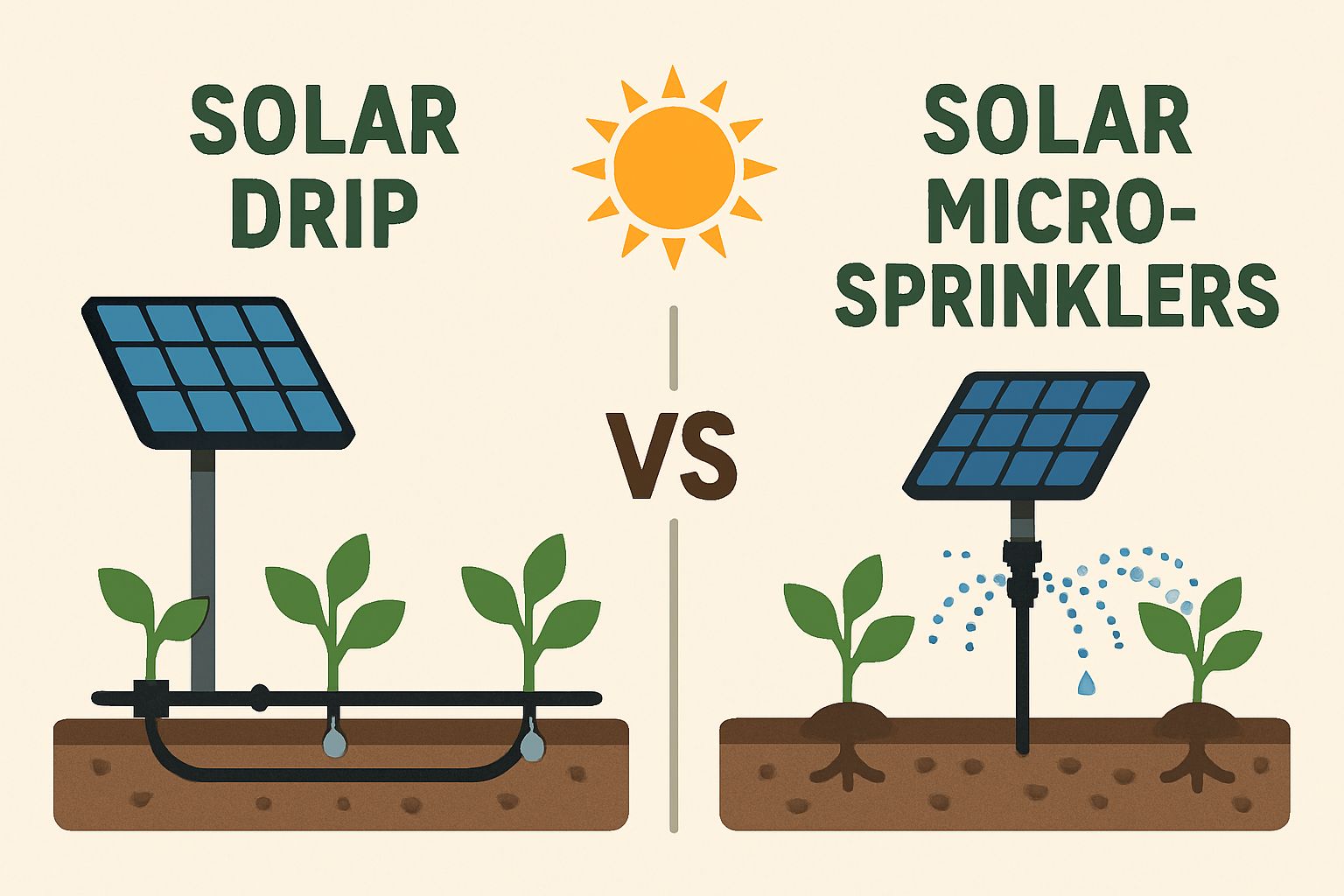
Both solar drip irrigation and solar micro-sprinkler systems are proven technologies, but they serve very different farming needs. One excels at pinpoint water delivery to individual plant roots. The other covers broader ground and offers unique benefits like frost protection and humidity regulation. The decision between them comes down to your specific crops, soil type, climate, and budget — not a one-size-fits-all recommendation.
The team at Growing Solar Mist has worked extensively with farmers navigating exactly this choice, and the variables that matter most are often the ones least discussed in product brochures. This guide cuts through the noise and gives you the technical detail and decision framework you need to get it right the first time.
How Solar Drip Irrigation Works on a Farm
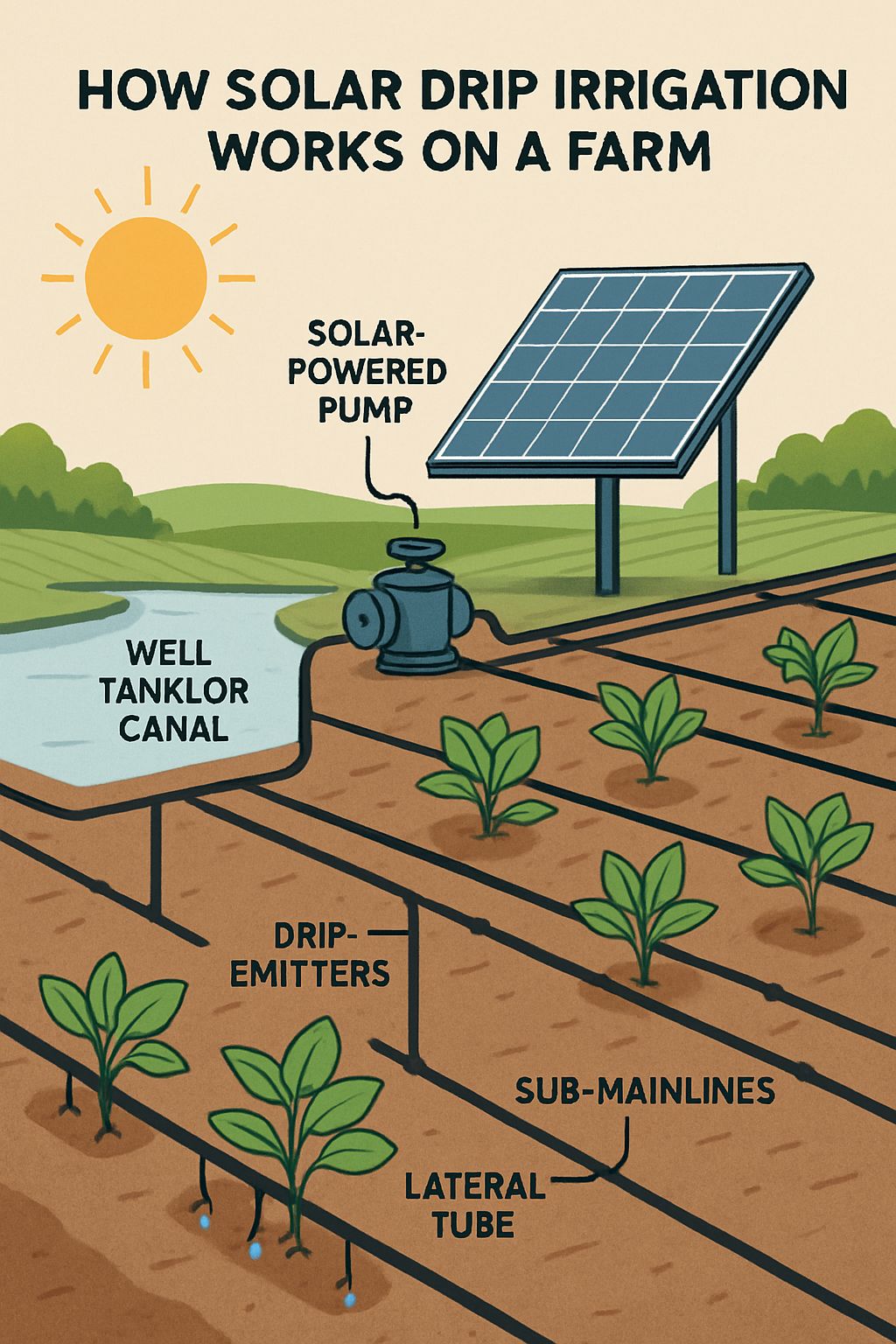
Solar drip irrigation is a closed-loop precision system. Water is pulled from a source — well, tank, or canal — by a solar-powered pump, then pushed through a network of mainlines, sub-mainlines, and lateral tubes fitted with drip emitters. Those emitters release water slowly and directly into the root zone of each plant, minimizing evaporation and surface runoff entirely.
Core Components of a Solar Drip System
Every functional solar drip setup relies on several key components working together. To explore the specific components and parts of solar irrigation systems, consider reviewing detailed guides that can provide more insight.
- Solar panels — typically monocrystalline, sized to match pump power draw
- DC or AC surface/submersible pump — selected based on water source depth and required flow rate
- Filtration system — usually a screen filter and sand separator to prevent emitter clogging
- Pressure regulator — maintains consistent low pressure (typically 10–30 PSI) across the drip lines
- Mainline and lateral tubing — polyethylene lines ranging from 16mm to 32mm diameter
- Drip emitters or inline drippers — rated at 0.5 to 4 liters per hour depending on crop water demand
- Fertigation injector (optional) — allows liquid fertilizers to be delivered directly through the system
How Solar Panels Power the Pump and Delivery System
The solar panels generate DC electricity that either powers a DC pump directly or feeds an inverter to run an AC pump. Direct DC pump systems are simpler and more efficient for smaller farms, while AC setups offer more flexibility for larger operations. The pump moves water through the filtration stage and into the pressurized mainline, from which laterals branch off to individual crop rows. Flow and pressure are regulated to ensure each emitter delivers a consistent, calibrated output regardless of where it sits in the system. For more information on how solar panels can be integrated with irrigation systems, check out this guide on solar irrigation systems for farmers.
Water Efficiency: Why Drip Systems Reach Up to 90% Efficiency
Drip systems achieve up to 90% water use efficiency because water is delivered directly to the root zone at low pressure, leaving almost nothing to evaporation, wind drift, or surface runoff. Traditional flood irrigation operates at around 40–50% efficiency by comparison. That gap translates directly into lower pumping costs, reduced solar panel sizing requirements, and significantly less strain on water sources — a critical advantage in drought-prone or water-restricted farming regions.
How Solar Micro-Sprinkler Systems Work
Solar micro-sprinkler systems use the same solar-powered pump infrastructure as drip systems, but instead of emitters at the root zone, they deploy small spinning or fixed sprinkler heads mounted above or near the soil surface. These heads throw water in a circular or semi-circular pattern, covering a radius of roughly 1 to 4 meters per head depending on the model and operating pressure.
Core Components of a Micro-Sprinkler Setup
The component list for a micro-sprinkler system overlaps heavily with drip, but with key differences in the delivery end:
- Solar panels and pump — same core setup, though micro-sprinklers typically require slightly higher operating pressure (15–45 PSI)
- Filtration system — still required, but emitter orifices are larger so clogging risk is lower than drip
- Stake-mounted micro-sprinkler heads — available in full-circle, half-circle, and quarter-circle patterns
- Distribution tubing — polyethylene supply lines feeding individual sprinkler stakes
- Pressure compensating devices — important for uneven terrain to maintain uniform distribution
How Water Coverage Differs From Drip Systems
The fundamental difference is coverage pattern. Drip systems deliver water to a single point or a narrow strip along a plant row. Micro-sprinklers throw water outward in a defined radius, wetting both the soil and often the lower canopy of the crop. This broader coverage is either an advantage or a liability depending on what you’re growing.
For crops that are sensitive to wet foliage — like tomatoes, grapes, and many berry varieties — overhead moisture increases disease pressure significantly. But for orchards with widely spaced trees, or for sandy soils where water needs to spread laterally, that same broad coverage becomes a major benefit. The soil and crop pairing is everything.
Solar Drip vs Solar Micro-Sprinklers: Head-to-Head Comparison
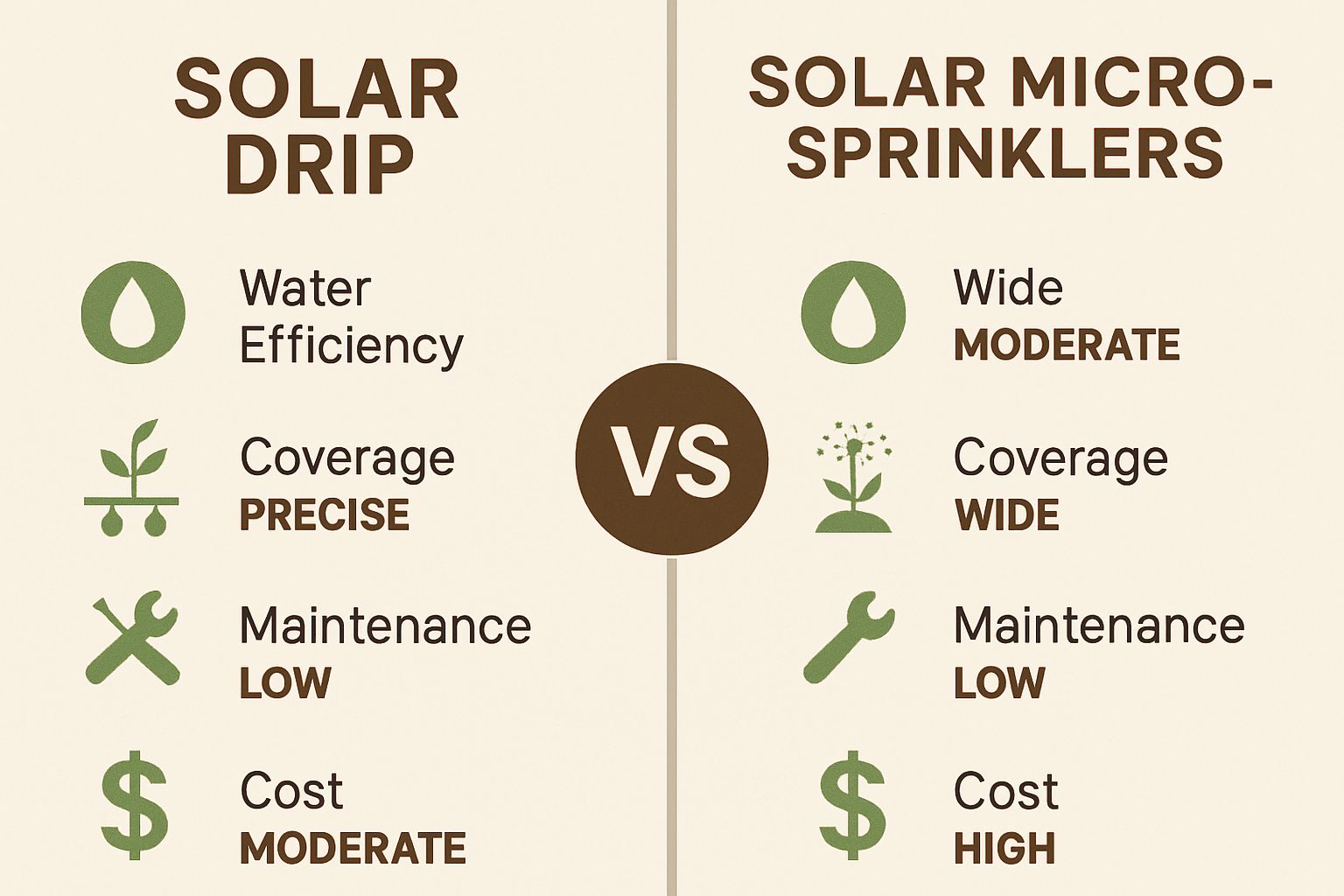
Let’s put both systems side by side across the metrics that matter most to a working farmer. For more in-depth analysis, check out this comparison of drip irrigation and sprinklers.
Water Efficiency Ratings for Each System
Solar drip irrigation systems achieve up to 90% water use efficiency, while solar micro-sprinkler systems come in at around 80% efficiency. That 10-percentage-point gap compounds over an entire growing season. On a farm using 500,000 liters of water per season, drip systems save an additional 50,000 liters compared to micro-sprinklers — reducing pump runtime, solar capacity needs, and stress on the water source simultaneously.
Energy Requirements and Solar Panel Sizing
Because drip systems operate at lower pressure (10–30 PSI vs. 15–45 PSI for micro-sprinklers), they demand less pump energy for the same volume of water delivered. This means a drip system can often be powered by a smaller solar array than an equivalent micro-sprinkler setup covering the same acreage.
For practical sizing, a small-scale drip system irrigating one acre of vegetables might require a 300–600W solar array paired with a 0.5 HP pump. A micro-sprinkler system covering the same area could push that requirement to 600–900W depending on head count and operating pressure. These aren’t dramatic differences on a small farm, but they scale significantly as acreage increases.
Battery storage adds another layer. Systems designed for early morning or evening irrigation need battery banks to store daytime solar generation. Direct solar operation — running the pump only when the sun shines — is simpler and cheaper to install but limits irrigation scheduling flexibility.
Installation Complexity and Maintenance Demands
Drip systems are more complex to install correctly. The emitter spacing must be calculated per crop, row spacing, and soil type. Filters require regular cleaning — typically every 1 to 4 weeks depending on water quality — and emitters can clog if filtration is insufficient. Flushing the lateral lines periodically is essential for long-term performance.
Upfront Costs vs Long-Term Savings
Initial costs for solar micro-sprinkler systems typically run 15–25% lower than comparable drip installations covering the same acreage. This cost advantage comes from fewer components at the delivery end — micro-sprinkler heads are simpler to install than precision drip emitter layouts, and the tubing network requires less exact placement. For a farmer working with tight startup capital, that difference can be meaningful.
Long-term, however, drip systems consistently outperform on operating costs. Lower water consumption means less pump runtime, which extends equipment life and reduces solar panel wear. Drip systems also reduce weed pressure between rows since only the root zone receives moisture — cutting labor costs over multiple seasons. Over a 5 to 10 year period, the higher upfront investment in drip infrastructure typically pays back through water savings, reduced pumping energy, and lower weed management expenses.
Which Crops Perform Better With Solar Drip Irrigation
Drip irrigation was essentially designed around the needs of high-value, water-sensitive crops. When water delivery is precise, targeted, and consistent at the root zone, certain crops respond with dramatically better yields, healthier root systems, and lower disease incidence. Understanding which crops belong in a drip system versus a sprinkler setup can be the difference between a profitable harvest and a frustrating one.
Row Vegetables and Root Crops
Row crops like tomatoes, peppers, eggplant, cucumbers, and zucchini are textbook drip irrigation candidates. Their root systems are relatively shallow and concentrated, meaning drip emitters placed 20–30cm from the plant stem deliver water exactly where uptake happens most efficiently. Consistent soil moisture in the root zone also reduces blossom end rot in tomatoes and tip burn in lettuce — both of which are moisture-stress disorders that spike under inconsistent watering.
Root vegetables including carrots, beets, onions, and potatoes benefit from drip systems for a different reason. Overhead watering on these crops increases surface soil compaction and raises the risk of fungal diseases at the crown. Drip keeps the soil surface drier while maintaining ideal subsurface moisture for tuber and root development — exactly the moisture profile these crops need.
The layout for row vegetable drip systems typically uses inline drip tape — thin-walled polyethylene tape with factory-installed emitters spaced at 20cm, 30cm, or 45cm intervals depending on crop spacing. Drip tape is cost-effective for annual row crops because it can be replaced each season without major infrastructure changes.
- Tomatoes — drip reduces blossom end rot and early blight pressure from wet foliage
- Peppers and eggplant — consistent root zone moisture improves fruit set and size uniformity
- Carrots and beets — subsurface moisture prevents crown rot and cracking from uneven watering
- Onions and garlic — dry foliage conditions reduce botrytis and downy mildew infection rates
- Potatoes — precise moisture control reduces common scab and hollow heart disorders
- Lettuce and leafy greens — root zone delivery prevents tip burn caused by calcium-deficient rapid growth under overhead irrigation
High-Value Specialty Crops
Strawberries, melons, and specialty herbs represent some of the highest per-acre returns in small-scale farming — and they’re also among the most responsive to drip irrigation. Strawberries irrigated with drip systems produce cleaner fruit with significantly lower botrytis (gray mold) incidence because the foliage and fruit stay dry throughout the season. Emitters are typically placed along the bed at 30cm spacing, delivering 1–2 liters per hour directly beneath the plant canopy.
Melons and watermelons need consistent deep moisture during fruit set and development — any irregular watering during this stage causes hollow centers, cracking, and flavor loss. A drip system running on a solar timer maintains that consistency automatically, even across large field areas, without requiring daily operator intervention.
Why Foliar-Sensitive Crops Need Drip Over Sprinklers
Foliar sensitivity is the single most decisive factor when drip is the clear winner. Crops like grapes, tomatoes, roses, and stone fruits are highly susceptible to fungal diseases — powdery mildew, downy mildew, botrytis, and anthracnose — all of which thrive when leaf surfaces stay wet for extended periods. Micro-sprinklers wet the canopy directly and create the humid microclimate these pathogens need to establish and spread.
A drip system eliminates that risk entirely. Water never contacts the foliage, the canopy stays dry, and the humidity around the plant remains at ambient levels rather than the artificially elevated conditions sprinklers create. For grape growers especially, switching from overhead irrigation to drip can reduce fungicide application frequency noticeably — directly cutting input costs per acre.
The financial math here is straightforward. If a foliar disease outbreak on a specialty crop costs more to treat — or results in yield loss — than the price difference between drip and micro-sprinkler installation, the choice is clear. For any crop with documented foliar disease susceptibility, drip is the lower-risk, lower-cost option over the full growing season.
When Solar Micro-Sprinklers Are the Smarter Choice
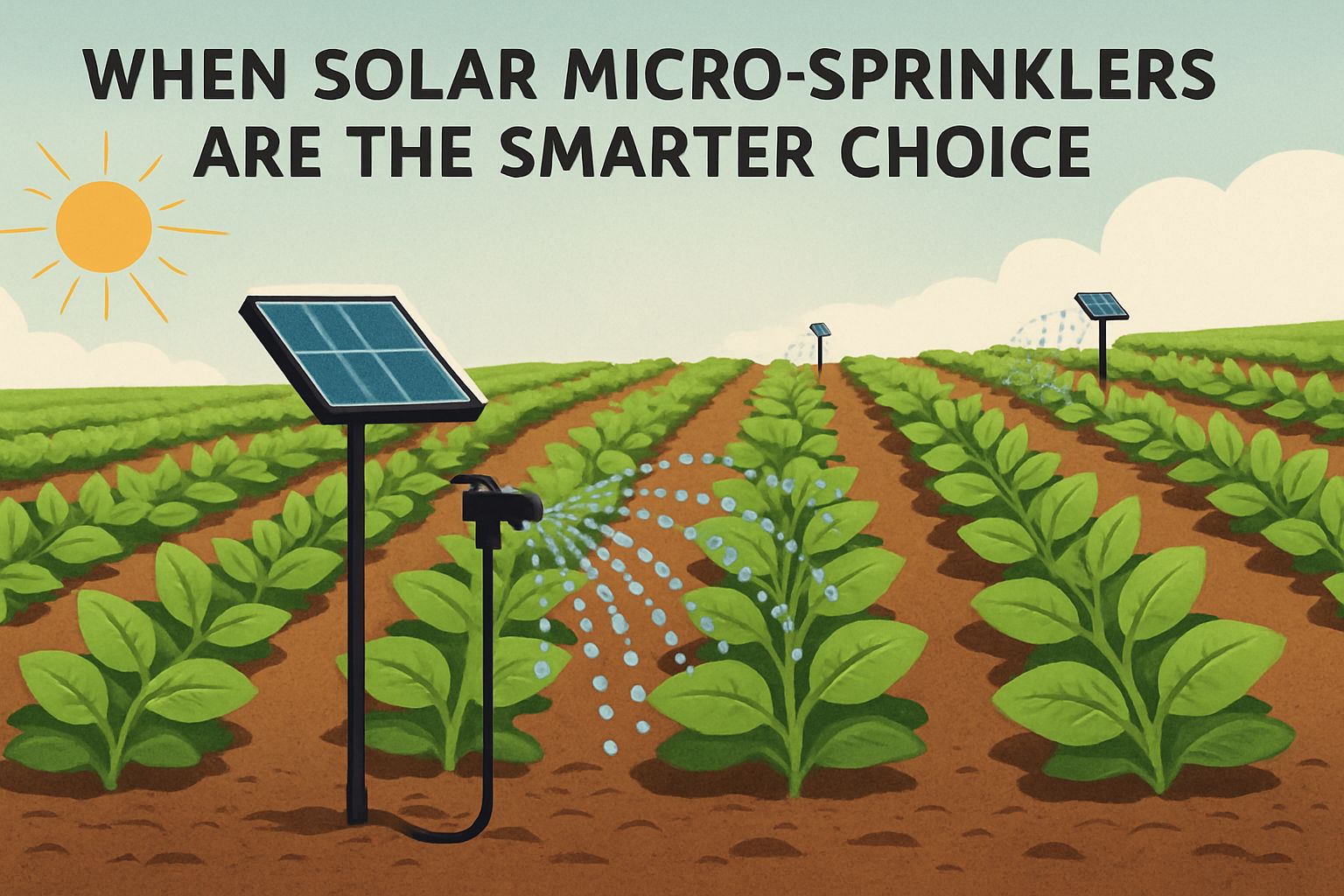
Micro-sprinklers aren’t the inferior option — they’re simply the right tool for a different set of conditions. There are specific scenarios where micro-sprinklers outperform drip systems so clearly that choosing drip would actually hurt productivity and increase operating complexity.
The key is recognizing when broad, overhead water distribution works in your favor rather than against you. Three conditions consistently favor micro-sprinklers: coarse sandy soils, widely spaced tree crops, and frost-risk environments. In any of these situations, the broader coverage pattern and humidity-generating characteristics of micro-sprinklers become genuine agronomic advantages.
Sandy Soils With Poor Lateral Water Movement
In sandy soils, water moves almost entirely downward with very little lateral spread — a property called low lateral hydraulic conductivity. A drip emitter in sandy soil creates a narrow, deep wetting front that may completely miss the majority of a tree or shrub’s root zone. Micro-sprinklers throw water across a 1–4 meter radius, compensating for poor lateral movement by delivering moisture across the full surface area where roots are actually distributed. For sandy-soil orchards and vineyards, this coverage difference can directly determine whether the plant is adequately hydrated or chronically water-stressed.
Orchards and Widely Spaced Crops
Mature fruit trees — citrus, avocado, mango, apple, peach — have large, spreading root systems that extend well beyond the canopy drip line. A single drip emitter or even two emitters per tree often can’t deliver adequate water volume across that entire root zone efficiently. A micro-sprinkler head positioned at the base of the tree, throwing water in a full-circle pattern across a 2–3 meter radius, matches the actual root distribution of a mature tree far more effectively. This is why micro-sprinklers dominate in established orchard irrigation globally.
Frost Protection and Humidity Benefits
One capability micro-sprinklers have that drip systems simply cannot replicate is frost protection. When water freezes on plant tissue, it releases latent heat that keeps the tissue temperature at 0°C rather than dropping below freezing — protecting buds, blossoms, and young fruit from frost kill. Running micro-sprinklers during a frost event is a recognized and effective crop protection strategy used by citrus, stone fruit, and berry growers in frost-prone regions. A drip system delivering water to the soil surface below the canopy offers no meaningful frost protection whatsoever. For farmers looking to integrate solar technology, solar irrigation systems can be a sustainable solution.
Soil Type and Climate: The Hidden Factors That Decide Your System
Most irrigation buying decisions focus on crop type — but soil texture and local climate often override crop preference when it comes to system performance. A farmer growing tomatoes (a textbook drip crop) in deep sandy soil may actually achieve better results with micro-sprinklers than with drip, simply because the soil physics work against drip’s narrow wetting pattern. Getting this analysis right before purchasing saves significant time, money, and frustration.
The three soil variables that matter most are texture, lateral conductivity, and water-holding capacity. Each one affects how water moves through the profile after it’s delivered — and that movement determines whether your chosen system is actually reaching the roots that need it.
- Clay soils — slow infiltration rate, high water-holding capacity, excellent lateral spread; drip systems perform very well
- Loam soils — balanced infiltration and lateral movement; both systems work effectively, crop type becomes the deciding factor
- Sandy soils — fast infiltration, poor lateral spread, low water retention; micro-sprinklers often outperform drip for tree and shrub crops
- Compacted soils — risk of surface ponding with micro-sprinklers; drip with subsurface emitters preferred
- Saline soils — drip strongly preferred as it keeps salts pushed away from the root zone through consistent low-volume application
Climate adds another dimension entirely. High evaporation environments amplify the water efficiency advantage of drip systems. Humid regions change the disease-pressure equation for micro-sprinklers. Wind-prone areas reduce micro-sprinkler distribution uniformity significantly. None of these factors appear in a product specification sheet — but every one of them affects real-world system performance on your farm.
How Clay, Loam, and Sandy Soils React Differently to Each System
Clay soils hold water well and spread it laterally, which means drip emitters create a wide, shallow wetting bulb that covers the root zone effectively even with low emitter counts. Loam soils behave predictably with both systems, making crop type the primary decision driver on these farms. Sandy soils, as discussed, create narrow vertical wetting fronts under drip emitters — sometimes wetting only a fraction of the available root zone and forcing roots to grow in artificially restricted patterns, which limits nutrient uptake and overall plant vigor.
Arid Climates vs High-Humidity Regions: What Changes
In arid, low-humidity climates, drip irrigation’s water efficiency advantage is amplified — evaporation losses from micro-sprinkler wetted surfaces increase dramatically when vapor pressure deficit is high and temperatures exceed 35°C. In high-humidity tropical or subtropical regions, the disease pressure created by micro-sprinkler canopy wetting becomes a much more serious concern, often tipping the decision firmly toward drip for any disease-susceptible crop. Wind speed above 15 km/h also significantly reduces micro-sprinkler distribution uniformity, causing uneven crop growth patterns that are difficult to diagnose and correct mid-season.
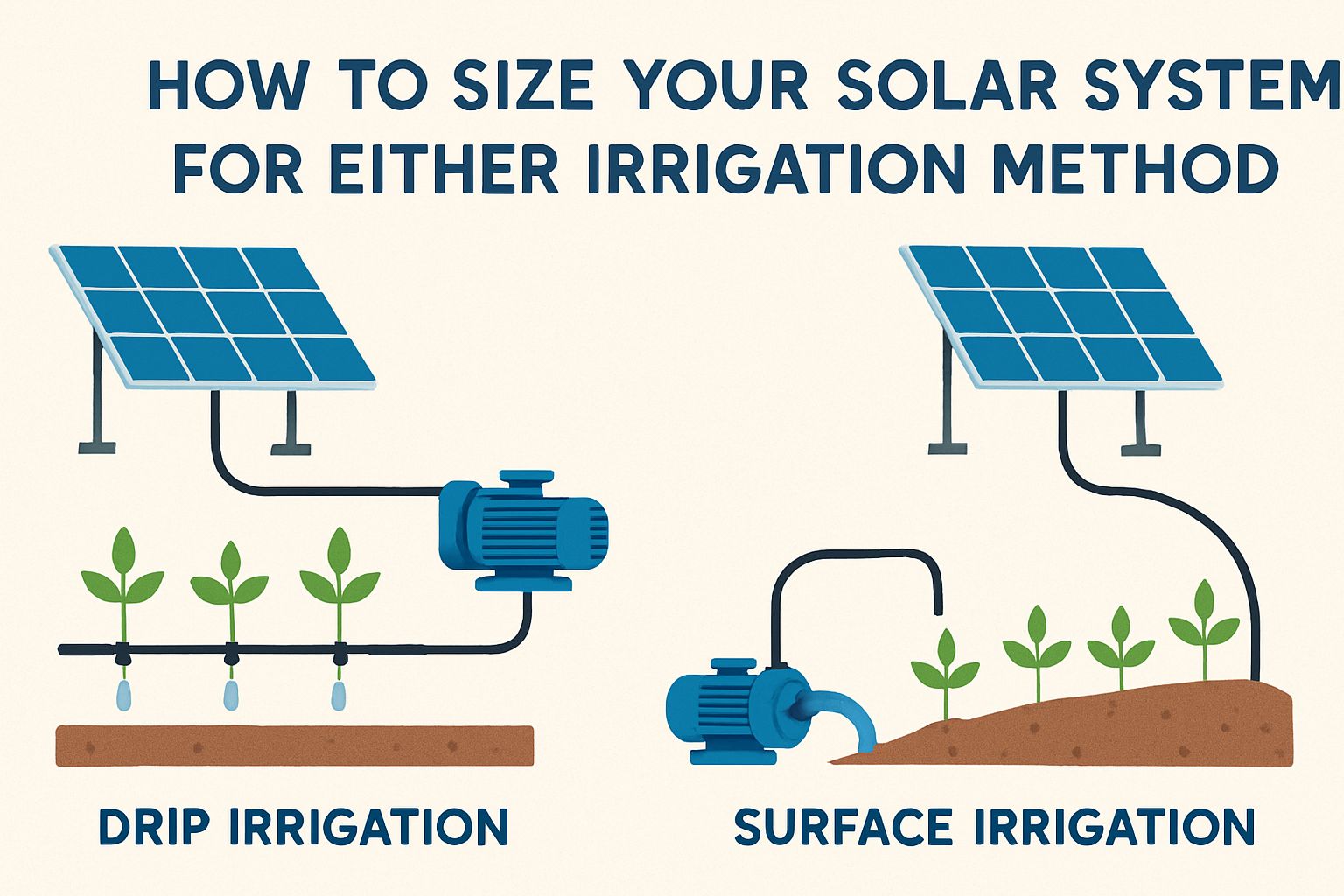
How to Size Your Solar System for Either Irrigation Method
Correct solar system sizing is the most technically demanding part of setting up any solar-powered irrigation system — and it’s also where the most expensive mistakes happen. Undersizing your solar array means the pump doesn’t run long enough to deliver full irrigation doses. Oversizing wastes capital that could go into better filtration, storage tanks, or field infrastructure. The sizing process follows a logical sequence: calculate total water demand, determine pump specifications, then size the solar array to match pump power draw and daily operating hours. For more details on solar irrigation systems, check out this guide on solar irrigation systems components and parts.
Calculating Water Volume and Pump Power Needs
Start with your crop’s daily water requirement — expressed in liters per plant per day or millimeters per day across the field area. For example, a one-acre tomato field in a hot climate may require 4–6mm of water per day during peak demand, which translates to roughly 16,000–24,000 liters per acre per day. That total water volume, combined with your available daily sunshine hours (typically 5–7 peak sun hours in most agricultural regions), determines how hard your pump needs to work and for how long each day.
Pump sizing follows directly from flow rate and head pressure requirements. Flow rate must match total daily water demand divided by intended daily operating hours. Head pressure accounts for the vertical lift from the water source plus friction losses through the pipe network. A pump operating at 0.5 HP can typically move 3,000–6,000 liters per hour at moderate head — sufficient for small to medium drip systems on one to three acres. Micro-sprinkler systems serving the same area need slightly higher pressure ratings, often pushing pump requirements up to 0.75–1 HP for equivalent coverage.
Once pump power draw (in watts) and daily operating hours are established, solar array sizing is straightforward. Multiply pump wattage by daily operating hours, then divide by local peak sun hours to get the minimum panel capacity required. Add a 20–25% buffer for real-world losses — panel soiling, wiring resistance, inverter inefficiency, and temperature derating on hot days. A 750W pump running 4 hours daily in a region with 6 peak sun hours needs a minimum array of around 600–700W, with a recommended installed capacity of 750–900W after applying the efficiency buffer.
Battery Storage vs Direct Solar Operation
Direct solar operation — running the pump only when sunlight is sufficient — is the simpler and cheaper approach, and it works well for daytime irrigation schedules with flexible timing. Battery storage systems add significant upfront cost but give you full control over irrigation timing, allowing early morning or evening runs when evaporation is lowest and crop uptake is highest. For most small farms with flexible scheduling, direct solar operation is the practical starting point. Battery storage makes more economic sense for operations with strict timing requirements, frost protection needs, or farms in regions with highly variable cloud cover that would otherwise cause inconsistent pump performance mid-irrigation cycle.
Common Installation Mistakes That Kill System Performance
The most damaging installation mistakes aren’t the obvious ones — they’re the small technical errors that reduce system performance gradually and invisibly until yields drop or equipment fails prematurely. Inadequate filtration is the single most common failure point in drip systems: installing a filter rated too coarsely for the water source allows particles to reach emitters, causing partial or full blockages that create uneven water distribution across the field. Running drip laterals on slopes without pressure-compensating emitters causes the downhill end of each line to over-irrigate while the uphill end under-irrigates — producing visibly uneven crop growth that’s often misdiagnosed as a soil or fertility problem. For micro-sprinkler systems, the most damaging error is incorrect head spacing — placing heads too far apart creates dry zones between coverage radii, while placing them too close wastes water and creates waterlogging near the heads. Solar panel angle and orientation errors are another category that compounds over time: panels installed at the wrong tilt angle for the farm’s latitude can lose 10–15% of potential energy generation annually, shrinking the operational window of the pump on marginal weather days precisely when reliable irrigation matters most.
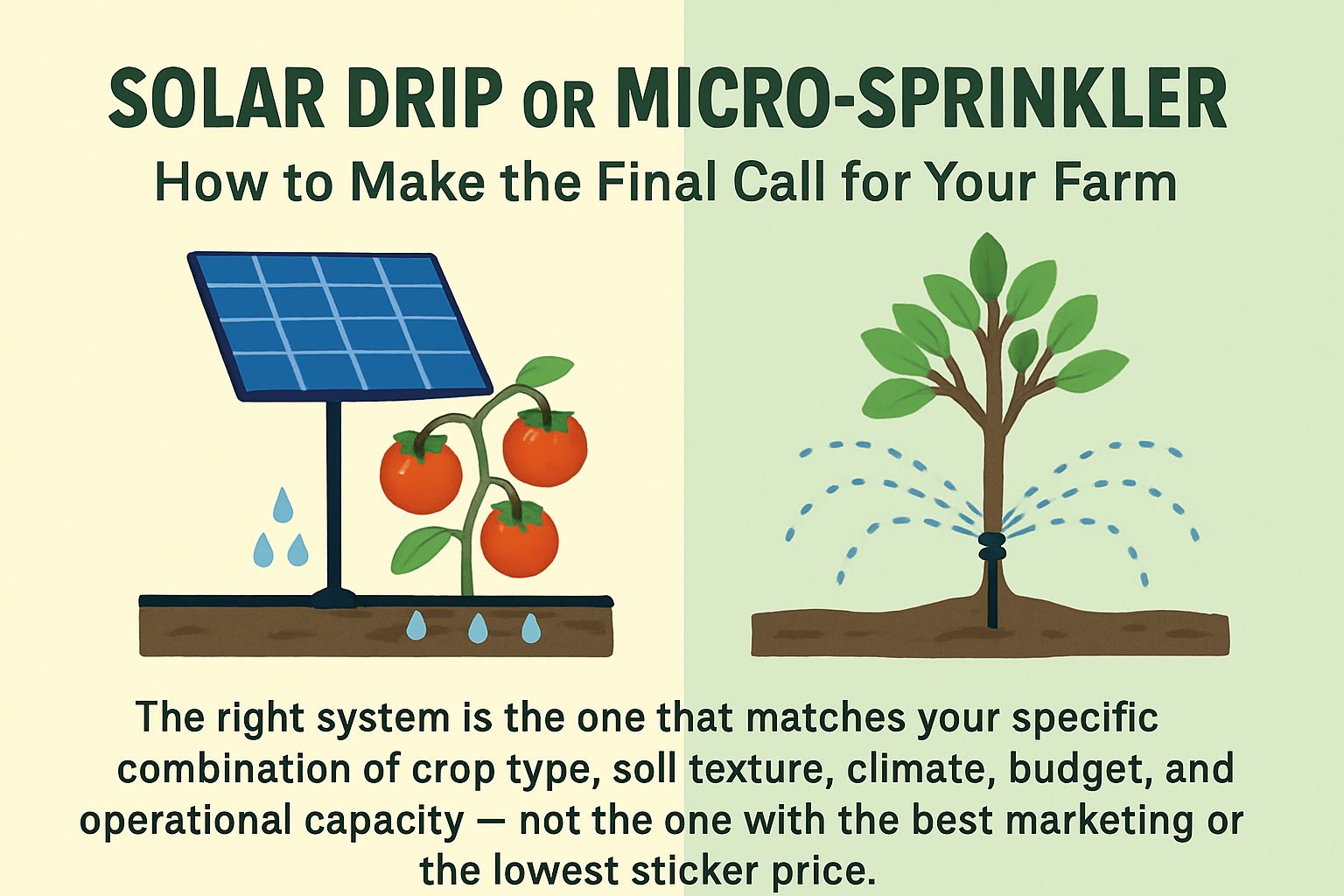
Solar Drip or Micro-Sprinkler: How to Make the Final Call for Your Farm
The right system is the one that matches your specific combination of crop type, soil texture, climate, budget, and operational capacity — not the one with the best marketing or the lowest sticker price. Farmers who approach this decision systematically, working through each variable methodically, consistently end up with systems that perform reliably for 10 to 15 years with minimal intervention. Those who choose based on price alone or neighbor recommendations often find themselves retrofitting expensive components within the first two to three seasons. For a deeper understanding of these systems, explore the types of solar sprinkler irrigation systems available for agricultural use.
Both systems have earned their place in modern solar-powered agriculture. Drip wins on water efficiency, disease management, energy demand, and long-term operating cost. Micro-sprinklers win on upfront cost, sandy-soil performance, frost protection, and orchard suitability. Neither is universally superior — the farm conditions make the decision, not personal preference.
Key Questions to Ask Before You Buy
Before committing to either system, work through these diagnostic questions honestly. What crops are you growing, and are any of them foliar-disease sensitive? What is your soil texture — have you done a basic jar test or soil analysis to confirm sand, silt, and clay percentages? What is your water source, and what is the realistic quality — hardness, sediment load, pH — that will affect filtration requirements? What is your available capital for upfront installation versus your tolerance for higher long-term operating costs?
Also consider your operational capacity. Drip systems require more attentive maintenance — filter cleaning, line flushing, emitter checks — than micro-sprinkler systems. If you’re managing a large operation with limited labor, the lower maintenance burden of micro-sprinklers may outweigh their lower efficiency rating in practical terms. The best system on paper is useless if it isn’t properly maintained in the field.
Decision Framework Based on Crop, Soil, and Budget
Use this as your starting point: if you’re growing foliar-sensitive row vegetables or high-value specialty crops in clay or loam soil with access to adequate startup capital, solar drip irrigation is your system. If you’re establishing or managing a mature orchard or widely spaced shrub crops in sandy soil, or if you face seasonal frost risk, solar micro-sprinklers are the more appropriate technology. If budget is the primary constraint and your crops aren’t highly foliar-sensitive, start with micro-sprinklers and plan a phased transition to drip as cash flow allows — many farms run both systems simultaneously across different blocks, a completely viable approach that lets you optimize each field independently.
Frequently Asked Questions
Here are direct answers to the questions farmers ask most when choosing between solar drip and micro-sprinkler systems.
Can I Run Both Solar Drip and Micro-Sprinkler Systems on the Same Farm?
Yes — and many productive farms do exactly this. Running both systems simultaneously across different crop blocks is a well-established practice that lets you optimize water delivery for each specific crop and soil zone independently. A farm might use drip tape on tomato and pepper rows, drip emitters in a strawberry block, and micro-sprinklers across a citrus orchard — all fed from the same solar pump system through separate zone valves and pressure regulators.
The key to making a hybrid setup work is proper hydraulic zoning. Each system type operates at different pressure requirements — drip at 10–30 PSI and micro-sprinklers at 15–45 PSI — so they should run as separate zones rather than simultaneously on a shared pressure line. A solar pump with sufficient flow capacity and a basic multi-zone valve manifold can manage both systems efficiently, with irrigation scheduling staggered so each zone runs at its correct operating pressure without interference.
How Many Solar Panels Do I Need to Power a Drip Irrigation System?
The number of solar panels depends on three variables: pump power draw in watts, daily operating hours required, and your location’s peak sun hours. A typical small farm drip system running a 0.5 HP (375W) pump for 4 hours per day in a region with 6 peak sun hours needs approximately 250–300W of installed panel capacity at minimum — that’s one to two standard 200W panels — before applying an efficiency buffer. With a recommended 20–25% buffer for real-world losses, a practical installation would use two 200W monocrystalline panels (400W total) for reliable daily performance.
Larger systems scale linearly. A 1 HP (750W) pump running 6 hours daily in the same location needs roughly 750–900W of installed solar capacity — three to four 200–250W panels configured in series or parallel depending on the pump’s voltage requirements. Always size for your peak-demand months, not average annual conditions, and confirm panel specifications match your pump controller’s input voltage range before purchasing.
Which System Has Lower Maintenance Costs Over 10 Years?
- Drip system maintenance requirements: filter cleaning every 1–4 weeks, annual lateral line flushing, emitter replacement as needed (typically every 3–5 years for inline drippers), drip tape replacement annually for seasonal row crops
- Micro-sprinkler maintenance requirements: periodic head cleaning, spinner replacement on rotating heads every 2–4 years, filter cleaning (less frequent than drip due to larger orifice sizes), stake and riser replacement as physical damage occurs
- Shared maintenance for both systems: solar panel cleaning every 1–3 months, pump service every 2–3 years, pipe joint inspection annually, pressure regulator calibration checks
Over a 10-year period, micro-sprinkler systems generally carry lower direct maintenance costs. The larger orifice size of sprinkler heads means significantly less clogging and far less frequent filter servicing compared to drip emitters, which are sensitive to even fine particle contamination. Drip tape used in annual row crop systems adds a recurring annual replacement cost — thin-wall drip tape rated for single-season use needs full replacement each growing season, which adds up substantially across multiple acres over a decade.
However, the maintenance cost comparison doesn’t tell the full financial story. Drip systems reduce other farm costs that don’t appear in the maintenance ledger — lower water consumption reduces pumping hours and extends pump life, drier inter-row conditions suppress weed growth and reduce herbicide and hand-weeding costs, and lower canopy humidity reduces fungicide application frequency on disease-susceptible crops. These indirect savings often exceed the direct maintenance cost difference between the two systems.
The practical recommendation is to factor total cost of ownership — not just maintenance line items — when comparing the two systems over a multi-year horizon. For a farmer growing high-value specialty crops where disease management costs are significant, drip’s higher maintenance demands are offset by lower crop protection input costs. For an orchard farmer with lower disease pressure and fewer emitter-per-plant requirements, micro-sprinklers deliver a straightforward maintenance cost advantage that’s harder to overcome.
Does Solar Drip Irrigation Work in Cloudy or Low-Sunlight Regions?
Solar drip irrigation works in low-sunlight regions, but system sizing must account for reduced panel output on overcast days. In regions with fewer than 4 peak sun hours daily, direct solar operation without battery storage becomes unreliable — the pump may not run long enough during cloudy periods to deliver complete irrigation doses. The solution is either installing a larger solar array to compensate for lower irradiance, adding battery storage to accumulate energy across multiple daylight hours, or incorporating a grid-backup or generator connection for days when solar generation falls below minimum pump operating thresholds. Farmers in temperate cloudy climates — Northern Europe, Pacific Northwest, highland tropical zones — routinely operate solar irrigation successfully using these approaches, typically with 20–40% more panel capacity than a comparable system in a high-sunlight region would require.
What Is the Average Payback Period for a Solar Irrigation System?
Payback periods for solar irrigation systems vary significantly based on what the system is replacing, local electricity or fuel costs, water savings achieved, and crop value. Systems replacing diesel-powered pumps in off-grid locations typically achieve the fastest payback — often 2 to 4 years — because diesel fuel costs are eliminated entirely from day one of operation. Systems replacing grid-connected electric pumps in areas with low electricity tariffs have longer payback periods, typically 5 to 8 years, because the cost differential being recovered is smaller. For more information on solar irrigation systems for farmers, you can explore various options and benefits.
Water savings contribute to payback acceleration in regions where water carries a cost — either through metered supply charges, water rights fees, or the indirect cost of water scarcity affecting yields. A drip system that reduces water consumption by 30–40% compared to a previous flood or sprinkler setup generates compounding savings on water, pumping energy, and crop inputs simultaneously, compressing the payback timeline.
When it comes to choosing the best irrigation systems for farmers, the decision often boils down to solar drip systems and solar micro-sprinklers. Both of these systems offer unique advantages that can significantly enhance agricultural productivity. For instance, solar drip systems are known for their efficiency in water usage, making them ideal for areas with limited water resources. On the other hand, solar micro-sprinklers provide uniform water distribution, which is crucial for certain crops. If you’re interested in exploring more about these systems, you might want to read about types of solar sprinkler irrigation systems that can be used in agriculture and farming.

Leave a Reply