

“Bifacial Solar Panels Benefits for …” from growingsolarmist.com and used with no modifications.
Key Takeaways
- Bifacial solar panels capture sunlight from both the front and rear surfaces, generating up to 30% more energy than traditional monofacial panels under the right conditions.
- The materials inside bifacial panels — from monocrystalline silicon cells to dual-glass encapsulation — are specifically engineered to maximize light absorption on both sides.
- Agricultural land is one of the best environments for bifacial panel installations, where reflected light from soil, crops, and irrigation water dramatically boosts rear-side energy capture.
- Agrivoltaic systems — where solar panels and crops share the same land — are proving to increase both energy output and crop yields simultaneously, a development worth watching closely.
- While upfront costs are higher, the long-term energy gains and dual land-use benefits make bifacial panels a compelling investment for large-scale agricultural operations.
Bifacial Solar Panels Capture Energy From Both Sides — Here’s Why That Matters
Most solar panels only work one way — sunlight hits the front, energy gets produced, and that’s the end of it. Bifacial solar panels break that rule entirely.
By capturing light on both the front and rear surfaces, bifacial panels tap into a source of energy that standard panels simply ignore: reflected light. Whether it’s bouncing off snow, sand, white gravel, or the moist soil of a working farm, that reflected light translates directly into additional electricity. The result is a solar technology that squeezes significantly more output from the same footprint of land — which is exactly why industries from large-scale solar farming to agriculture are paying close attention.
For anyone exploring renewable energy options, understanding how these panels are built and where they perform best is the foundation for making smarter energy decisions. Solar energy experts and educators at organizations like Afor Energy have been helping consumers and businesses navigate these decisions, offering clarity on the technologies driving the next generation of solar adoption.

“Bifacial Solar Panels …” from gycxsolar.com and used with no modifications.
What Bifacial Solar Panels Are Actually Made Of
The performance advantage of bifacial panels starts at the material level. Every component is selected to allow light to reach solar cells from two directions while maintaining structural durability over a 25–30 year lifespan. Understanding what’s inside these panels explains why they outperform conventional options in so many environments.
Monocrystalline vs. Polycrystalline Silicon Cells
The photovoltaic cells in bifacial panels are almost exclusively monocrystalline silicon. Monocrystalline cells are cut from a single continuous crystal structure, which gives electrons a cleaner, less obstructed path to travel. This translates to higher conversion efficiency — typically between 20% and 23% for monocrystalline bifacial cells — compared to polycrystalline cells, which are made from fragmented silicon and tend to cap out lower.
Polycrystalline cells are rarely used in bifacial configurations today. Their grain boundaries scatter electrons more aggressively, reducing efficiency gains on the rear side where light intensity is already lower than the front. For bifacial applications specifically, monocrystalline is the clear engineering choice.
Glass-Glass vs. Glass-Transparent Backsheet Configurations
Configuration
Front Layer
Rear Layer
Key Advantage
Best Use Case
Glass-Glass
Tempered glass
Tempered glass
Superior durability, longer lifespan
Ground-mount farms, agrivoltaic systems
Glass-Transparent Backsheet
Tempered glass
Transparent polymer
Lighter weight, lower cost
Rooftop installations, building facades
The glass-glass configuration is the dominant choice for agricultural and ground-mount bifacial installations. Both the front and rear surfaces use tempered, low-iron glass with a thickness typically ranging from 2mm to 3.2mm per side. Low-iron glass is critical here — standard glass has a greenish tint caused by iron content that absorbs a portion of incoming light before it even reaches the cells. Low-iron glass transmits over 91% of light, compared to roughly 86% for standard glass.
The glass-transparent backsheet configuration trades some durability for reduced weight. The rear polymer layer is lighter than glass but degrades faster under UV exposure and provides less mechanical protection. For installations expected to operate for 25+ years in outdoor agricultural environments, the glass-glass build is the more reliable long-term choice.
One additional practical benefit of the glass-glass design in farm settings: it resists moisture ingress far more effectively. Farms introduce humidity, irrigation spray, and temperature fluctuations that accelerate degradation in polymer backsheets. Dual-glass construction handles these conditions with significantly better long-term stability.
Anti-Reflective Coatings and Encapsulants
Both glass surfaces in a bifacial panel are treated with an anti-reflective (AR) coating, typically a nano-structured silicon dioxide or titanium dioxide layer. This coating reduces surface reflection from around 4% down to less than 1%, allowing more photons to pass through into the cell layer rather than bouncing away. On the rear glass, this matters especially in lower-light reflected conditions where every percentage point of transmission counts.
Between the glass layers and the silicon cells sit encapsulant films — most commonly EVA (ethylene vinyl acetate) or the newer POE (polyolefin elastomer). POE encapsulants are increasingly preferred for bifacial glass-glass panels because they show lower moisture absorption and better resistance to potential-induced degradation (PID), a failure mode where electrical leakage reduces panel output over time. POE also maintains higher optical clarity over the panel’s lifetime, keeping rear-side light transmission consistent.
How the Frame Design Affects Rear-Side Light Exposure
Many bifacial panels are sold as frameless, and this is a deliberate engineering decision. A traditional aluminum frame casts a shadow along the panel’s edges, partially blocking reflected light from reaching the rear cells near the perimeter. Frameless designs eliminate this shading entirely, improving rear-side energy capture by a measurable margin.
When frames are used, they are typically narrower and designed with angled or minimal profiles to reduce shadowing. In agricultural installations where panels are elevated and tilted, the mounting hardware itself must also be carefully positioned to avoid casting shadows across the rear surface — something that agrivoltaic engineers account for specifically during system design.
Why High-Reflectivity Surfaces Like Snow and Sand Boost Performance
The ground beneath a bifacial panel isn’t passive — it’s an active contributor to energy output. Surfaces with high albedo values reflect significantly more light back onto the rear cells, and the difference in energy production between a panel mounted over dark soil versus white gravel or snow can be substantial. Snow-covered ground has an albedo value of 0.65 to 0.90, meaning it reflects up to 90% of incoming sunlight — making winter installations in northern climates far more productive than most people expect.
Sand and light-colored desert surfaces typically carry albedo values between 0.30 and 0.45, which is still significantly higher than standard dark soil at around 0.10 to 0.15. This is why large-scale bifacial solar farms in desert regions like the Middle East and the American Southwest consistently report rear-side energy contributions of 10–20% above baseline. The surface under the panel isn’t an afterthought — it’s part of the system design.
Surface Type
Albedo Value
Estimated Rear-Side Energy Gain
Fresh Snow
0.65 – 0.90
Up to 25–30%
White Gravel / Crushed Stone
0.40 – 0.55
15–20%
Desert Sand
0.30 – 0.45
10–18%
Dry Grass / Crops
0.20 – 0.30
8–12%
Moist Agricultural Soil
0.10 – 0.15
3–7%
Dark Bare Soil
0.05 – 0.10
2–4%
What this means practically is that bifacial panel installations should be planned with ground surface in mind from the start. In agricultural settings, covering the ground beneath panels with white or light-colored mulch, reflective ground cover fabric, or even strategically selecting lighter-colored soil amendments can measurably increase annual energy yield without changing a single component of the panels themselves.
How Bifacial Panels Generate More Power Than Standard Panels
The core physics are straightforward: more light reaching active solar cells means more electrons displaced, more current generated, and more usable electricity produced. Bifacial panels achieve this not by being more efficient per cell, but by giving those cells a second source of photons to work with. The front side handles direct irradiance; the rear side handles reflected and diffuse light. Together, they consistently outperform monofacial panels across a wide range of real-world conditions.
The Role of Albedo (Ground Reflectivity) in Energy Output
Albedo is the measure of how much light a surface reflects rather than absorbs, expressed as a value between 0 (perfect absorption) and 1 (perfect reflection). For bifacial solar panels, albedo is one of the most critical site-selection variables — more so than for any other panel type. A bifacial panel installed over a high-albedo surface doesn’t just perform better; it performs in a fundamentally different energy category than the same panel over dark ground.
The relationship between albedo and bifacial gain isn’t linear in all conditions. Panel height above the ground also plays a role — lower-mounted panels capture reflected light from a smaller area directly beneath them, while elevated panels can intercept reflected light from a wider surrounding area. Most agrivoltaic and ground-mount installations aim for a panel clearance height of 1.5 to 2.5 meters above ground to optimize this capture angle.
Diffuse light also feeds the rear side of bifacial panels on overcast days. Even when direct sunlight is blocked by cloud cover, ambient sky radiation scatters in all directions, and a portion of this reaches the rear surface. This means bifacial panels maintain a performance edge over monofacial panels even in cloudy climates — not just in bright, high-irradiance environments. Learn more about agrivoltaics and their benefits for farmers.
In practical terms, site engineers use bifacial gain modeling tools — including software like PVsyst — to calculate expected rear-side contributions based on measured albedo values, panel tilt, row spacing, and mounting height. These calculations directly inform the financial projections for any bifacial solar project, and getting the albedo input right can make a significant difference in projected returns.
Variable
Low Setting
High Setting
Impact on Bifacial Gain
Ground Albedo
0.10 (dark soil)
0.80 (snow)
Up to 20% additional yield
Panel Height
0.5m above ground
2.5m above ground
Wider reflected light capture area
Row Spacing
Tight (high shading)
Wide (low shading)
Reduces inter-row rear shading losses
Tilt Angle
10°
30–40°
Affects both front irradiance and rear exposure
Why Farmland Is an Ideal Environment for Bifacial Panels
Farmland checks nearly every box for high-performing bifacial solar installations. The open sky exposure is excellent, panels can be elevated to practical heights for both agriculture and rear-light capture, and the ground surface — especially with crops or cover vegetation — provides consistent albedo throughout the growing season. Beyond the physics, farms offer something equally valuable: large, contiguous land areas where solar arrays can be scaled to meaningful generation capacity.
The land-use efficiency argument is particularly compelling. Solar farms on non-agricultural land consume that land entirely for energy production. Agrivoltaic bifacial installations, by contrast, allow the same land to produce both food and electricity simultaneously — a dual-purpose outcome that is increasingly attractive as both land costs and energy costs rise.
How Agrivoltaics Works: Solar and Crops on the Same Land
Agrivoltaics — sometimes written as agrophotovoltaics or APV — is the practice of co-locating solar panels and agricultural activity on the same piece of land. The concept isn’t new, but bifacial panel technology has made it significantly more productive. Because bifacial panels generate electricity from both sides, the elevated mounting heights required to allow farm machinery and crops to coexist beneath them actually benefit the rear-side energy capture rather than penalizing it.
The panels are typically installed on elevated racking structures at heights of 2 to 4 meters, depending on the crop type and equipment needs. Row spacing is widened compared to conventional ground-mount solar to allow adequate sunlight to reach the crops below. This wider spacing reduces the shading of crops while simultaneously reducing inter-row shading on the rear side of the panels — a dual benefit that makes careful row design one of the most important engineering decisions in any agrivoltaic project.
Shade tolerance of crops, seasonal sun angles, and irrigation requirements all factor into the system design. Research from agrivoltaic pilot projects in Europe and Japan has consistently shown that partial shading from elevated panels can actually reduce crop water stress during peak summer heat, improving yields for shade-tolerant species even as the panels generate clean electricity above.
- Reduced evapotranspiration: Panel shade lowers soil and plant surface temperatures, reducing water loss from crops by a measurable margin during hot months.
- Microclimate moderation: The area beneath bifacial panels maintains more stable temperature and humidity levels, buffering crops from extreme heat events.
- Dual revenue stream: Farmers earn income from both crop sales and electricity generation or sale back to the grid, improving overall land profitability.
- Pollinator habitat: Ground cover beneath panels can be planted with wildflowers and native grasses, supporting pollinator populations that benefit surrounding crops.
Crops That Thrive Beneath Bifacial Panel Installations
Not every crop is equally suited to growing under solar panels, but the list of well-performing species is longer than most people expect. Shade-tolerant and partial-shade crops are the most obvious candidates, but even some sun-demanding crops perform adequately under the intermittent, filtered sunlight typical of elevated bifacial panel arrays with wide row spacing.
Lettuce, spinach, kale, and other leafy greens consistently show strong results in agrivoltaic trials — their growth is largely unaffected or even improved under partial shade, which reduces bolting in warm climates. Berries, particularly raspberries and currants, also perform well. Lavender, herbs like basil and cilantro, and certain root vegetables have shown adaptability. Grapes grown under elevated panels in European trials have demonstrated improved fruit quality due to temperature moderation, and some pasture grasses used for livestock grazing maintain acceptable yields even under moderate shading.
How Elevated Panel Mounting Maximizes Rear-Side Light Capture on Farms
Mounting Height
Primary Agricultural Benefit
Bifacial Rear-Side Benefit
Typical Application
1.5 – 2.0m
Hand-harvested crops, foot traffic
Moderate rear light capture
Berry farms, herb gardens
2.0 – 3.0m
Small machinery access, tall crops
Good rear light capture zone
Vegetable farms, vineyards
3.0 – 4.5m
Full tractor and combine access
Maximum reflected light catchment area
Grain crops, livestock pasture
The relationship between mounting height and rear-side performance is direct: the higher the panel, the wider the cone of reflected light it can intercept from the ground surface below. At 1.5 meters, a panel primarily captures reflected light from the narrow strip of ground directly underneath. At 3.5 to 4.5 meters, that capture zone expands dramatically, pulling in reflected light from a much larger surrounding area.
For farms operating full-size agricultural machinery — tractors, combine harvesters, irrigation equipment — the minimum practical clearance height is generally around 3.5 to 4.5 meters. At these heights, bifacial panels actually achieve near-optimal rear-side light conditions, making the practical requirements of farming and the technical requirements of bifacial performance unusually well aligned.
Row spacing decisions also interact with mounting height. Wider rows allow more ground-level light to scatter and reflect back upward, benefiting rear cells. The standard approach in large agrivoltaic bifacial installations is to use row spacing ratios of 2:1 to 3:1 (spacing to panel width), which balances crop light availability, ground reflectivity contribution, and land use efficiency in a way that optimizes the whole system rather than any single variable.
Water Retention Benefits for Soil Beneath Solar Arrays
One of the less obvious but practically significant benefits of bifacial panel installations on farmland is their effect on soil moisture. The panels act as a partial rain shelter and shade canopy, reducing direct solar radiation hitting the soil. This reduces evaporation rates, keeping moisture in the root zone longer and lowering irrigation demand — a meaningful operational cost reduction for any farming operation.
Field measurements from agrivoltaic research sites in Germany and France have shown soil moisture levels beneath solar panels that are consistently higher than in unshaded control plots during dry periods. In some cases, irrigation water requirements were reduced without a corresponding reduction in crop yield — an outcome that improves both the economics and the sustainability profile of the combined solar-agriculture system.
Agrivoltaic Soil Moisture Finding: Research from agrivoltaic pilot sites in Germany found that soil beneath elevated solar panels retained measurably more moisture during dry periods compared to fully exposed control plots, leading to reduced irrigation needs while maintaining comparable crop productivity for shade-tolerant species.
For farmers in water-stressed regions, this moisture retention benefit can be as financially significant as the electricity generation itself. Combining reduced water costs with electricity revenue and maintained (or improved) crop yields shifts the economics of bifacial agrivoltaic installations from compelling to genuinely transformative for the right operation.
Real Efficiency Gains Bifacial Panels Deliver in Agricultural Settings
The efficiency numbers for bifacial panels in agricultural environments aren’t theoretical — they’re being measured in real installations across multiple continents, and the results consistently validate the technology’s advantages over standard monofacial panels in this context.
Up to 30% More Energy Output Compared to Monofacial Panels
Under optimal conditions — high-albedo ground surface, appropriate mounting height, correct tilt angle, and adequate row spacing — bifacial panels can deliver up to 30% more energy output than equivalent monofacial panels. In agricultural settings with vegetated ground cover, the typical real-world bifacial gain ranges from 10% to 20%, depending on the specific surface reflectivity of the crops and soil beneath the array.
This gain compounds over the life of the system. A bifacial array producing 15% more energy annually than a monofacial array of the same size accumulates a substantial additional kilowatt-hour total over a 25-year operational period — electricity that either reduces energy costs for the farming operation directly or generates revenue through grid export, depending on how the system is structured.
How Panel Tilt Angle and Row Spacing Affect Farm Energy Yields
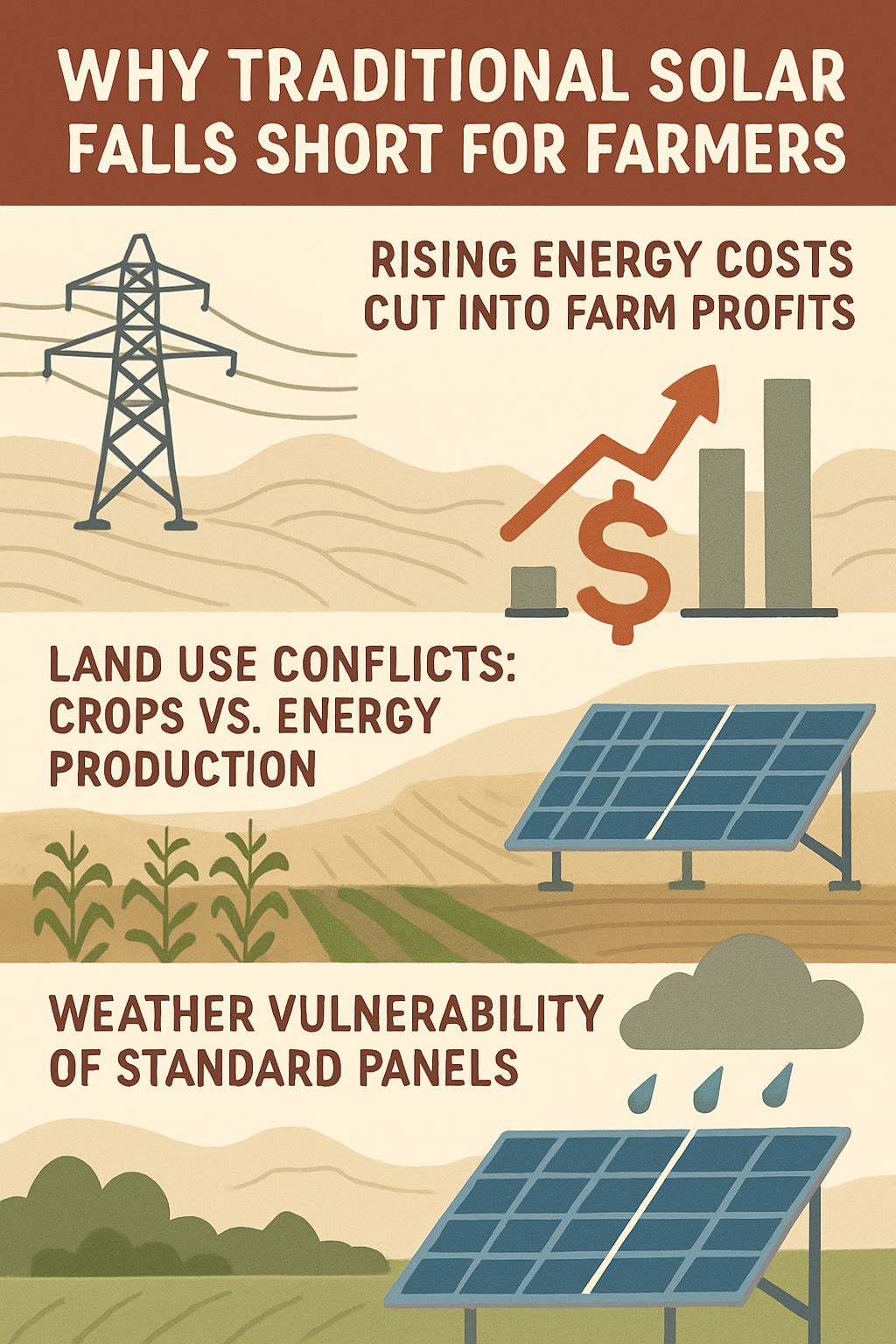
Tilt angle and row spacing are two of the most powerful levers available to agrivoltaic system designers, and getting them right for a specific farm’s latitude, crop type, and land geometry can meaningfully shift annual energy production. Tilt angle affects how much direct irradiance hits the front surface and simultaneously determines how the rear surface is angled relative to ground-reflected light. For most mid-latitude agricultural sites, tilt angles between 20° and 35° represent the practical optimum for combined front-and-rear bifacial performance. Row spacing must be wide enough to prevent inter-row rear shading — where the front of one row’s panels casts a shadow on the rear surface of the row behind it — which is one of the primary causes of underperformance in poorly designed bifacial arrays.
“Bifacial Solar Panels Benefits for …” from growingsolarmist.com and used with no modifications.
Cost vs. Long-Term Value for Farmers Adopting Bifacial Technology
Bifacial panels carry a higher upfront price tag than standard monofacial panels — typically 10% to 25% more per watt depending on the configuration and supplier. For a large agricultural installation, that cost difference is real and cannot be dismissed. But the financial analysis changes substantially when evaluated over the full operational life of the system rather than just the purchase price.
The additional energy output bifacial panels deliver — even at a conservative 10% gain over monofacial — accumulates year after year. When combined with the soil moisture retention benefits reducing irrigation costs and the potential for dual revenue from crop sales and electricity generation, the total return on investment for a well-designed agrivoltaic bifacial system frequently outpaces a comparable monofacial installation within 5 to 8 years, with the remaining 17 to 20 years of the panel’s operational life delivering pure additional return.
Durability is another financial factor that favors bifacial panels in farm environments. The glass-glass construction that dominates agricultural bifacial installations is significantly more resistant to mechanical stress, moisture ingress, and UV degradation than polymer-backsheet monofacial panels. Fewer failures, lower maintenance costs, and longer reliable operation all contribute to a total cost of ownership that makes bifacial technology the stronger long-term bet for farmers thinking beyond the initial purchase decision.
Other High-Performance Environments Beyond Agriculture
Agriculture is one of the most compelling use cases for bifacial panels, but it’s far from the only one. The same physics that make farmland productive for bifacial installations — elevated mounting, reflective ground surfaces, open sky exposure — apply in several other environments where bifacial technology consistently outperforms conventional panels.
Understanding where else bifacial panels excel helps clarify the broader picture of this technology’s role in the renewable energy transition — and why manufacturers, utilities, and project developers are deploying them at scale across a widening range of applications.
Ground-Mount Solar Farms
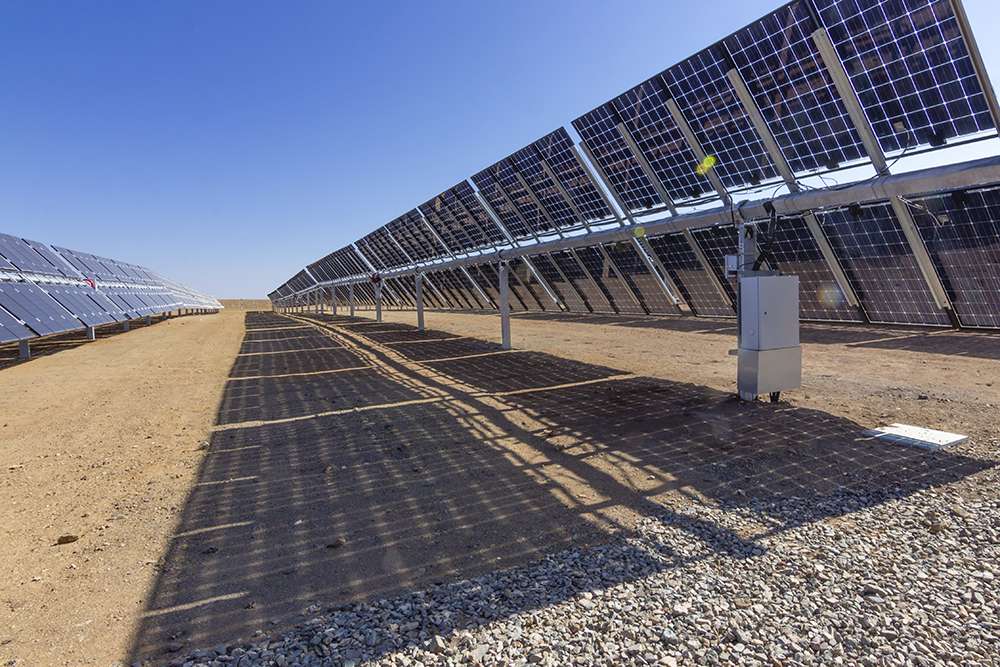
Large-scale ground-mount solar installations are currently the single largest deployment environment for bifacial panels globally. Utility-scale solar farms can precisely control ground surface conditions — installing white or light-colored gravel, reflective membranes, or maintained grass cover beneath the arrays — to maximize albedo and optimize rear-side energy capture across hundreds of acres.
The economics at utility scale amplify every percentage point of additional bifacial gain. A 100MW solar farm generating 12% more energy annually from bifacial panels compared to monofacial produces a meaningful increase in revenue over its operational life, and the per-unit cost premium of bifacial panels becomes increasingly negligible as project size grows. This is a key reason why bifacial panels now dominate new utility-scale procurement in major solar markets including the United States, China, and Europe.
Single-axis solar trackers — systems that rotate panel rows throughout the day to follow the sun’s movement — are particularly effective with bifacial panels in ground-mount applications. Trackers increase front-side energy capture by keeping panels perpendicular to direct sunlight, and simultaneously change the angle at which rear cells face the ground, dynamically shifting the reflected light capture zone. Studies have shown that bifacial panels paired with single-axis trackers can achieve total energy gains of 25% to 35% over fixed-tilt monofacial installations.
Building Facades and Solar Windows
Building-integrated photovoltaics (BIPV) represent a growing application for bifacial panels, particularly on commercial and institutional buildings where south-facing glass facades receive strong direct irradiance. In a vertical facade installation, the front side of the bifacial panel captures direct sunlight while the rear side captures light reflected from nearby surfaces — surrounding buildings, paved areas, or open sky at lower sun angles.
Transparent and semi-transparent bifacial panels are also being deployed as functional solar windows, generating electricity while still allowing visible light transmission into the building interior. These applications use modified cell spacing and lower cell coverage density to achieve dual functionality, trading some energy output for usability as architectural glass. While the efficiency numbers are lower than solid bifacial panels, the ability to generate energy from otherwise passive building surfaces represents a compelling value proposition for urban construction projects.
Snowy and Desert Regions
As noted in the albedo discussion earlier, snowy and desert environments both provide exceptionally high ground reflectivity that directly feeds bifacial rear-cell energy production. In snowy northern climates, bifacial panels mounted at elevated heights maintain productive energy generation through winter months when monofacial panels produce very little — the high albedo of snow-covered ground compensates significantly for lower sun angles and reduced direct irradiance intensity. In desert installations, the combination of high direct irradiance, high ambient albedo from sand, and minimal shading from vegetation creates near-ideal bifacial operating conditions, with some sites reporting sustained rear-side contributions exceeding 20% of total annual generation.
“5 Advantages of Bifacial Solar Panels …” from agsolarsolutions.com and used with no modifications.
Bifacial Panels Are Reshaping How Farmers Think About Land Use
The conversation around bifacial solar panels in agriculture is no longer a niche discussion — it’s becoming a mainstream consideration for forward-thinking farm operations worldwide. When a single piece of land can simultaneously produce food and clean electricity, reduce irrigation costs, support pollinator habitat, and generate a secondary revenue stream, the calculus around land use changes fundamentally. Bifacial technology isn’t asking farmers to choose between agriculture and energy — it’s showing that the choice is a false one. For the farms and communities that get this right, bifacial solar represents one of the most practical and high-impact applications of renewable energy technology available today.
Frequently Asked Questions
Here are answers to the most common questions people ask about bifacial solar panel materials, performance, and agricultural applications.
What materials are used in bifacial solar panels?
Bifacial solar panels are built from monocrystalline silicon cells, low-iron tempered glass on both front and rear surfaces, EVA or POE encapsulant films, and anti-reflective coatings applied to both glass layers. The glass-glass configuration is the most common in agricultural and ground-mount applications due to its superior durability and moisture resistance.
Component
Material
Function
Solar Cells
Monocrystalline Silicon
Convert photons to electricity on both sides
Front & Rear Cover
Low-Iron Tempered Glass (2–3.2mm)
Light transmission and structural protection
Encapsulant
EVA or POE Film
Bonds cells to glass, prevents moisture ingress
AR Coating
SiO₂ or TiO₂ nano-layer
Reduces surface reflection to under 1%
Frame (if used)
Anodized Aluminum or Frameless
Structural support with minimal rear shading
The choice between EVA and POE encapsulants matters more than it might seem. POE offers lower moisture vapor transmission and better resistance to potential-induced degradation, making it the preferred option for high-humidity agricultural environments where long-term reliability is critical.
Frameless designs are increasingly standard in bifacial panels because the aluminum frame of a conventional panel casts edge shadows on the rear cell surface, reducing rear-side generation. Going frameless eliminates this loss entirely, improving the rear-side contribution across the panel’s full operational life.
How much more efficient are bifacial panels compared to standard panels?
Bifacial solar panels are not more efficient per cell than monofacial panels — the cell efficiency is comparable. What bifacial panels deliver is greater total energy yield from the same installed capacity by capturing additional reflected and diffuse light on the rear surface. In real-world conditions, bifacial panels typically produce 10% to 30% more energy than monofacial panels of the same rated capacity, depending on ground albedo, mounting height, tilt angle, and row spacing.
In agricultural agrivoltaic installations specifically, the typical range is 10% to 20% additional annual yield, with the higher end of that range achieved on farms with reflective ground cover, appropriate mounting heights of 2 to 4.5 meters, and optimized row spacing. When paired with single-axis solar trackers in ground-mount utility applications, bifacial gains can reach 25 to 35% over fixed-tilt monofacial baselines.
Can bifacial solar panels be used on any farm?
Bifacial panels can be installed on most farm types, but they deliver the greatest benefit on farms with open, unobstructed sky exposure, relatively flat terrain, and crops or ground cover with moderate to high reflectivity. Farms in dense tree cover, heavily shaded valleys, or with very dark, moisture-saturated soil throughout the year will see lower bifacial gains. The ideal agrivoltaic bifacial farm has ample horizontal space for elevated racking, is located in a region with reasonable annual solar irradiance, and grows crops that tolerate or benefit from partial shading. A professional site assessment using bifacial energy modeling software like PVsyst is the most reliable way to determine whether a specific farm is a strong candidate.
What crops grow best under bifacial solar panel installations?
Shade-tolerant and partial-shade crops consistently perform best in agrivoltaic bifacial installations. The following crop categories have shown strong results in research trials and operational systems:
- Leafy greens: Lettuce, spinach, kale, Swiss chard — reduced bolting in warm climates, consistent yields
- Herbs: Basil, cilantro, mint, parsley — perform well under filtered light conditions
- Berries: Raspberries, currants, gooseberries — tolerate and often benefit from partial shade
- Root vegetables: Radishes, beets, and some carrot varieties maintain adequate yields
- Grapes: European agrivoltaic trials show improved fruit quality under temperature-moderating panel shade
- Pasture grasses: Support livestock grazing with minimal yield reduction under moderate shading
- Lavender and wildflowers: Thrive beneath panels and support pollinator populations
Sun-demanding crops like corn, sunflowers, and most large grain varieties are generally not ideal candidates for dense agrivoltaic bifacial arrays, though they can be viable beneath very wide-spaced, high-mounted panel rows where shading is minimal. The key is matching crop selection to the specific light environment that the panel installation creates at that site.
Are bifacial solar panels worth the higher upfront cost for agricultural use?
For most large-scale agricultural operations with suitable site conditions, yes — bifacial panels are worth the premium. The upfront cost difference of 10% to 25% per watt over monofacial panels is offset by higher annual energy yields, lower long-term maintenance costs from more durable glass-glass construction, and the compounding financial benefit of a dual-revenue land use model that generates income from both crops and electricity simultaneously.
The payback calculation depends heavily on local electricity prices, available incentives, farm size, and site-specific bifacial gain potential. In markets with strong net metering or feed-in tariff policies, the electricity revenue stream accelerates payback significantly. Farms that also benefit from reduced irrigation costs due to soil moisture retention beneath the panels see an additional financial offset that doesn’t appear in standard solar ROI calculations but can be meaningful in water-stressed regions.
The durability advantage of glass-glass bifacial construction deserves specific attention in the cost-value analysis. Agricultural environments are hard on equipment — humidity, temperature swings, irrigation spray, and mechanical activity all accelerate degradation. Standard monofacial panels with polymer backsheets show measurably higher failure rates in high-humidity farm environments over a 20 to 25-year horizon. Bifacial glass-glass panels are built to handle exactly these conditions, reducing the probability of mid-life failures that would require costly replacements and interrupt both energy generation and farm operations.
The bottom line: bifacial solar panels are not the right choice for every farm, but for operations with adequate land, suitable crops, and access to a professional agrivoltaic design, the long-term value case is strong. The combination of superior energy yield, enhanced durability, and dual land-use productivity makes bifacial technology one of the most financially sound renewable energy investments available to agricultural producers today. Afor Energy works with landowners and agricultural businesses to identify the right solar solutions for their specific needs, helping maximize the return on every installation.

Leave a Reply