

Key Takeaways:
- Agrivoltaics lets farmers grow crops and generate solar energy on the same land, turning a single acre into a dual-income, high-productivity asset.
- A 2020 German study found that combining potatoes and solar panels on the same land improved overall land productivity by up to 86% — a number that’s hard to ignore.
- Not every crop thrives under solar panels — keep reading to find out exactly which crops perform best and which ones struggle in agrivoltaic systems.
- Agrivoltaics reduces water consumption, supports pollinators, and creates shade that actually boosts the quality of certain vegetables — benefits that go far beyond extra income.
- Solar grazing with sheep is one of the fastest-growing agrivoltaic models in the U.S., offering low-maintenance land management and a new revenue stream for livestock farmers.
Farming has always been a balancing act, but now there’s a way to tip the scales in your favor — by adding solar power to the equation without giving up a single row of crops.
As solar energy demand surges and farmland becomes increasingly scarce, a growing number of farmers are discovering that the conflict between agriculture and energy production doesn’t have to exist. Agrivoltaics — the practice of co-locating solar panels and agricultural activity on the same land — is one of the most practical and promising tools available to modern sustainable farmers. Organizations like Statkraft, one of Europe’s leading renewable energy companies, have been actively highlighting how this dual-use approach creates value across the food-energy chain.
Solar Panels and Crops Can Share the Same Land
For decades, solar developers and farmers competed for the same resource: land. That tension is real, and it’s growing.
Why Farmers Are Running Out of Options
Agricultural land is under pressure from multiple directions at once. Urban expansion, climate volatility, and rising input costs are already squeezing farm margins. Now, add the demand for large-scale solar installations, and the competition for fertile, usable land becomes a genuine crisis. In many regions, solar developers offer lease rates that far exceed what crops can earn per acre — which creates a painful choice for farmers who need both income stability and productive land.
The core problem isn’t solar energy itself. It’s the assumption that solar and farming must be mutually exclusive. That assumption is outdated.
How Agrivoltaics Solves the Land vs. Energy Conflict
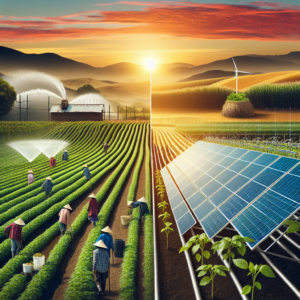
Agrivoltaics reframes the entire conversation. Instead of asking “solar or farming?” it asks “why not both?” By elevating solar panels above crop rows or grazing areas, the land beneath remains productive. Farmers keep growing food. Solar panels keep generating electricity. And the land itself becomes significantly more valuable — in terms of both output and income.
The dual-use model works because crops and solar panels have a surprisingly complementary relationship. Plants provide a natural cooling effect that improves panel efficiency in hot climates, while panels provide shade that reduces water stress on crops below. It’s not a compromise — it’s a genuine upgrade for both systems. Learn more about agrivoltaics and how it combines solar panels and agriculture.
- Land productivity: A single acre can now serve two economic purposes simultaneously
- Income diversification: Farmers gain a steady energy-lease income on top of crop revenue
- Climate resilience: Shade from panels reduces heat and drought stress on plants
- Energy independence: On-site solar can offset farm electricity costs directly
- Conservation synergy: Agrivoltaic setups can double as pollinator habitats

What Agrivoltaics Actually Is
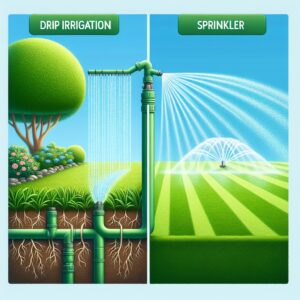
The concept sounds complex, but the core idea is straightforward: grow food and generate power in the same space at the same time. This innovative approach is akin to connecting a drip irrigation system to solar panels, creating a win-win for farmers.
The Meaning Behind the Word
“Agrivoltaics” is a compound of agriculture and photovoltaics (the technical term for solar power generation). It’s also called agrisolar, agri-PV, agrophotovoltaics, or dual-use solar depending on the region and context. All of these terms describe the same fundamental practice — solar panels installed in a way that allows agricultural activity to continue underneath or between them.
The concept isn’t new. It was first proposed by German researchers Adolf Goetzberger and A. Zastrow back in 1981. But it’s only in the last decade — as solar technology has become cheaper and climate pressure on farming has intensified — that agrivoltaics has scaled into a serious, commercially viable model.
How It Differs from Rooftop Farm Solar
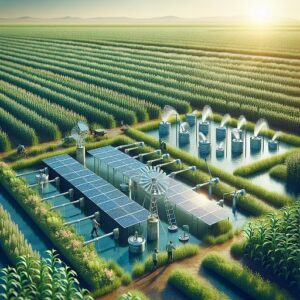
Rooftop solar on barns and farm buildings is valuable, but it’s a fundamentally different practice. Rooftop systems are limited by roof size and orientation, and they have zero interaction with crops or soil below. Agrivoltaics, by contrast, places panels directly in the fields — elevated on structures tall enough for farm equipment to pass beneath, and spaced to allow light penetration to the crops below. The scale is incomparably larger, and so is the potential impact on farm income and land productivity. For more on integrating solar with farming practices, explore the benefits of solar panels on center pivot irrigation.
The Three Main Agrivoltaic Setups
Not all agrivoltaic systems look the same. Depending on the farm type, climate, and crop selection, the physical setup can vary significantly. The three most common configurations are:
- Elevated fixed-tilt panels — Panels are raised on tall mounting structures (often 3 to 5 meters high) above crop rows, allowing tractors and harvesters to operate freely below. This is the most common setup for row crop farming.
- Interleaved or row-gap systems — Solar panels are installed in alternating strips with crop rows, creating a checkerboard pattern of shade and sunlight across the field. This works well for crops with moderate light requirements.
- Solar grazing systems — Standard ground-mounted panels at lower heights are used, with sheep or other small livestock grazing the vegetation beneath. This is one of the fastest-growing agrivoltaic models in the United States.
How Agrivoltaics Works in the Field
Understanding the mechanics of an agrivoltaic system helps farmers assess whether it’s a fit for their operation — and what kind of results they can realistically expect.
Panel Height and Spacing for Crop Access
Panel height is one of the most critical design decisions in any agrivoltaic installation. For crop-based systems, panels are typically elevated between 3 and 5 meters off the ground to allow standard farm machinery to operate freely. The horizontal spacing between panel rows is also carefully calculated to ensure that enough direct sunlight reaches the crops below throughout the growing season. In some advanced systems, panels are mounted on single-axis trackers that rotate to follow the sun, allowing farmers to dynamically control the amount of shade cast on crops at different times of day.
How Shade from Panels Affects Crop Growth
Shade is the most discussed variable in agrivoltaics — and for good reason. Too much shade suppresses photosynthesis and stunts growth. But the right amount of shade at the right time can actually improve crop quality and reduce heat stress. A study conducted in Kenya found that crops grown under solar panels suffered measurably less UV radiation damage. The 2020 German study noted that sun protection from panels improved the overall condition of shade-tolerant crops like potatoes. In hot, arid climates especially, the cooling effect of partial shade extends the growing window for crops that would otherwise bolt or wilt under direct sun.
The Cooling Effect: Why Plants Help Panels Perform Better
Solar panels actually perform better when they’re cooler — and crops provide exactly that. As plants transpire, they release moisture into the air, which naturally lowers the ambient temperature around the panels above them. In hot climates, this passive cooling effect can meaningfully improve panel efficiency. It’s a two-way relationship: the panels shade the crops, and the crops cool the panels. Both systems get a performance boost simply by sharing the same space.
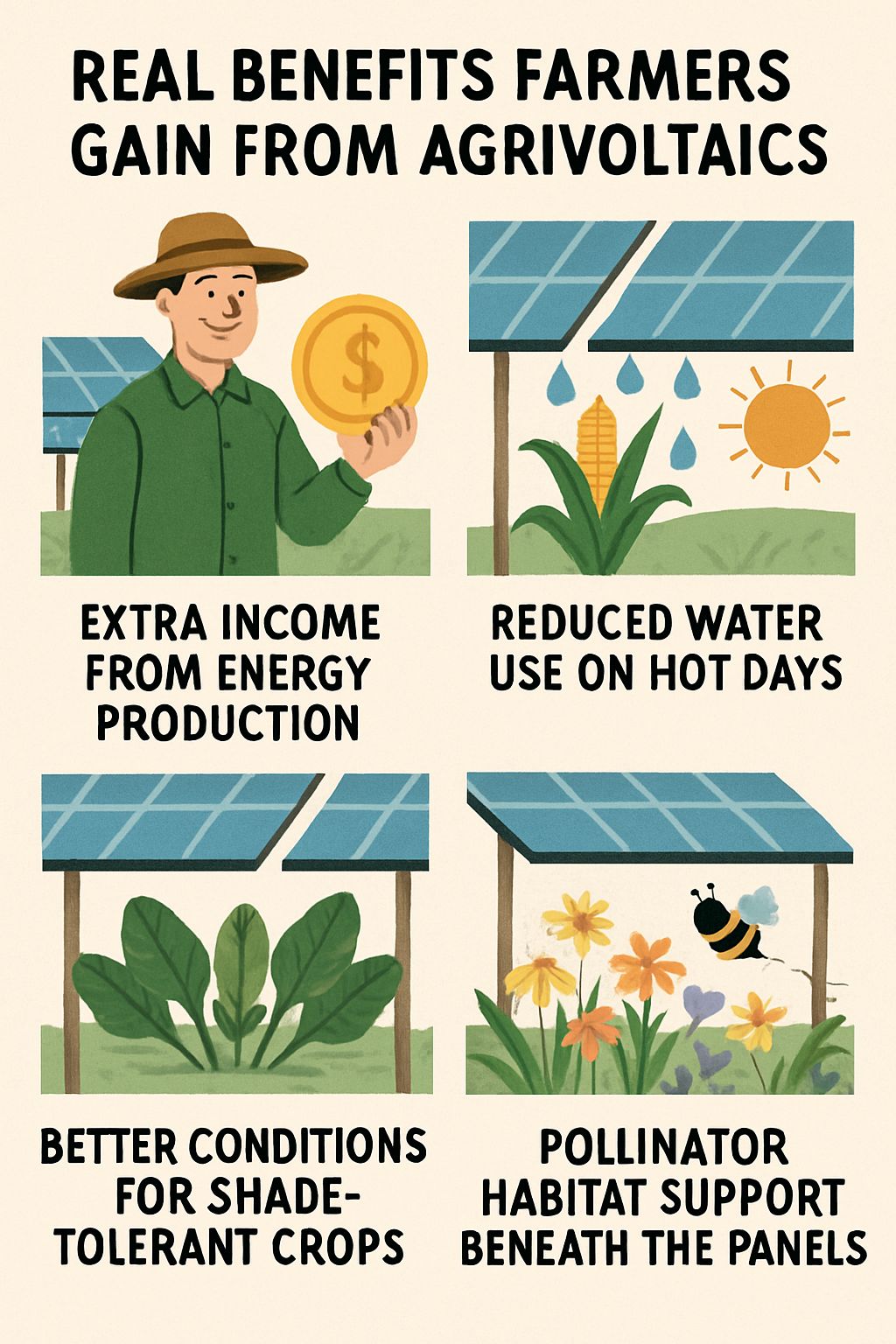
Real Benefits Farmers Gain from Agrivoltaics
The advantages of agrivoltaics go well beyond the novelty of combining two industries. For farmers operating on thin margins, these benefits translate directly into financial stability, reduced operating costs, and more resilient land over the long term.
Extra Income from Energy Production
Farming income is notoriously unpredictable. A single drought, pest outbreak, or market price drop can erase an entire season’s profit. Agrivoltaics introduces a second, far more stable income stream — energy production. Farmers can either lease their land to solar developers, who pay a fixed rate per acre regardless of weather or harvest outcomes, or they can own their solar infrastructure outright and sell electricity back to the grid. Either way, the financial floor under the farm operation gets significantly higher. For many small and mid-size farms, this steady energy income is the difference between staying viable and selling the land.
Reduced Water Use on Hot Days
Water is one of the most expensive inputs in modern farming, and in many regions it’s becoming genuinely scarce. Agrivoltaic systems naturally reduce crop water demand by casting shade over the soil and plants during the hottest parts of the day. That shade slows evaporation from the soil surface and reduces the heat stress on plants that drives transpiration rates up.
Research from the National Renewable Energy Laboratory (NREL) has highlighted water conservation as one of the key benefits of agrivoltaics across the food-energy-water nexus. In arid and semi-arid climates, this water savings can be substantial — reducing irrigation demand in ways that lower costs, reduce groundwater depletion, and make the farm more drought-resilient without any change to farming practices.
The water savings effect compounds over time. As soil moisture is retained more effectively under panel shade, soil health improves, reducing the need for irrigation even on days when panels aren’t actively shading. For water-stressed operations, this alone can justify exploring an agrivoltaic installation.
- Reduced evaporation: Panel shade slows soil moisture loss during peak heat hours
- Lower irrigation frequency: Crops under panels require less frequent watering cycles
- Improved drought resilience: Better soil moisture retention reduces vulnerability during dry spells
- Groundwater conservation: Less irrigation draw reduces pressure on local aquifers
- Long-term soil health gains: Consistent moisture levels support healthier microbial activity in the soil
For farms in regions already facing water restrictions or escalating water costs, agrivoltaics isn’t just an energy play — it’s a water management strategy.
Better Conditions for Shade-Tolerant Crops
Some crops don’t just tolerate shade — they actively perform better under it. Lettuces, spinach, kale, and many root vegetables like potatoes and onions can suffer in intense direct sunlight, producing lower-quality yields or bolting prematurely during heat spikes. Under agrivoltaic panels, these crops get the filtered light they thrive in. The 2020 German study specifically noted improved quality outcomes for potatoes grown under partial shade from solar panels, and researchers in Kenya observed reduced UV damage on crops grown beneath panel installations. For farmers already growing shade-tolerant varieties, an agrivoltaic setup can actually upgrade their crop quality without a single change to planting practices.
Pollinator Habitat Support Beneath the Panels
One of the most underappreciated benefits of agrivoltaics is what happens to the biodiversity of the land beneath the panels. When the ground under solar arrays is seeded with native flowering plants — which is common in habitat-focused agrivoltaic projects — it creates a protected, low-disturbance environment that pollinators like bees and butterflies actively colonize. Nationally, the majority of agrivoltaic projects in the U.S. integrate pollinator and habitat activities as a core component of the installation design, according to data from the solar grazing and agrivoltaics community.
For farmers who rely on pollinators for crop yield — which includes most fruit and vegetable operations — this is a direct productivity benefit. More pollinators in and around the farm means better fruit set, more consistent yields, and reduced dependence on managed pollination services. It also positions the farm favorably for conservation programs and sustainability certifications that increasingly recognize pollinator habitat as a measurable environmental asset.
Which Crops Work Best Under Solar Panels
Crop selection is arguably the most important practical decision in any agrivoltaic system. Not every plant responds the same way to reduced light levels, and getting this right is the difference between a system that boosts farm income and one that undermines it.
- Lettuce and leafy greens — Perform well under partial shade; reduced bolting in summer heat
- Spinach and kale — Shade extends the growing season and improves leaf quality
- Potatoes — Documented yield improvements in the 2020 German agrivoltaic study
- Onions and root vegetables — Recommended for agrivoltaic systems in Northern Europe by Statkraft researchers
- Small fruits and berries — Moderate shade tolerance with documented quality improvements in multiple studies
- Grains — Viable in certain configurations; noted as suitable in Northern European climates
- Herbs — Many culinary herbs tolerate and benefit from partial shade conditions
The right crop choice depends heavily on your climate zone, your existing farming operation, and the specific shading profile your panel layout creates. A farm in Arizona will have a very different agrivoltaic crop strategy than a farm in Germany or Kenya — and that’s entirely by design.
What the research consistently shows is that shade-tolerant and cool-season crops are the strongest performers. These are plants that already struggle with heat and high UV exposure, meaning the controlled microclimate created by solar panels is genuinely beneficial rather than merely neutral.
Farmers who are considering transitioning to agrivoltaics should start by auditing which crops in their current rotation are most heat-sensitive or water-intensive. Those are likely the best candidates for placement under panels in a new agrivoltaic system.
Leafy Greens and Root Vegetables
Leafy greens are the most consistently documented winners in agrivoltaic research. Lettuce, in particular, tends to bolt — or prematurely flower and turn bitter — when exposed to intense heat and long daylight hours. The partial shade from elevated solar panels delays bolting, extends harvest windows, and in many cases improves the flavor and texture of the leaves. Root vegetables like potatoes, onions, and carrots have also shown positive responses, with the German Fraunhofer Institute study reporting up to 86% improvement in land productivity when potatoes and solar panels were co-located on the same acreage.
Berries and Their Performance in Studies
Small fruits — including strawberries, raspberries, and currants — have shown promising results under agrivoltaic conditions in multiple research settings. Berries are naturally adapted to growing under forest canopy, which means partial shade from solar panels mimics their preferred light environment more closely than open-field exposure. For farmers interested in optimizing their crops, integrating drip irrigation systems with solar panels can be a beneficial approach.
Studies have noted that berry crops grown under panels in hot climates show reduced sun scald on fruit, better moisture retention in the soil, and in some cases, higher sugar content due to the more stable temperature environment. For premium berry producers, the quality improvement potential is commercially significant — higher-quality fruit commands better prices at market and reduces waste from cosmetic damage.
Crops That Struggle in Agrivoltaic Systems
- Corn (maize) — A high-light crop that needs full sun exposure throughout the growing season; significant yield losses expected under panel shade
- Sunflowers — As a phototropic plant that actively tracks sunlight, interference from panels disrupts growth patterns
- Soybeans — Yield-sensitive to light reduction; not recommended as a primary agrivoltaic crop
- Wheat and other full-sun grains — Can work in some configurations but carry yield risk in heavier shading setups
- Tomatoes — Light-demanding fruiting crops that require careful panel placement to avoid yield suppression
Choosing the wrong crops for an agrivoltaic system is one of the most common and costly mistakes early adopters make. If your entire operation is built around high-light row crops like corn or soybeans, a full agrivoltaic conversion is not the right move — at least not without a strategic crop rotation plan that incorporates shade-tolerant varieties into the mix.
That said, even on predominantly row-crop farms, there’s often an opportunity to test agrivoltaics on a portion of the land — particularly in areas where soil quality is marginal, water access is limited, or where field edges and buffer zones could host a solar installation without impacting core production areas.
The key is matching the shading profile of your specific panel configuration to the light requirements of your chosen crops. A well-designed agrivoltaic system accounts for this from the start, using spacing and tilt angle calculations to ensure the right light levels reach the right plants at the right times of day and season.
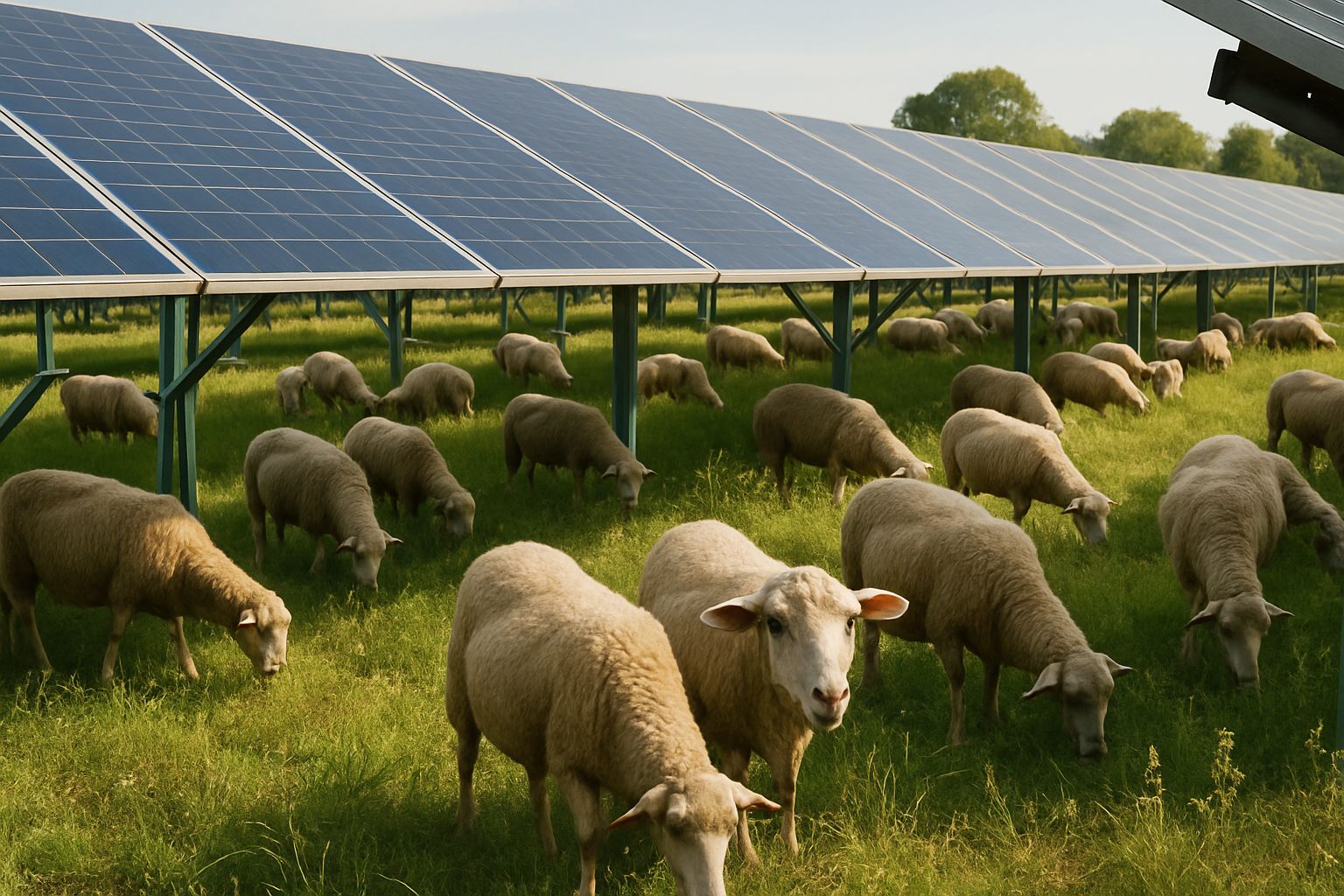
Solar Grazing: Sheep and Livestock Under Panels
Solar grazing is one of the most practical and rapidly expanding forms of agrivoltaics, particularly in the United States. In a solar grazing system, sheep — and occasionally goats or other small livestock — are introduced to graze the vegetation growing beneath standard ground-mounted solar arrays. The sheep manage the vegetation naturally, eliminating the need for mechanical mowing or herbicide application on the solar site. According to the American Solar Grazing Association, this arrangement benefits both the solar operator, who gets low-cost vegetation management, and the farmer, who gains access to grazing land they wouldn’t otherwise have. The solar panels also provide shade and shelter for the animals, reducing heat stress during summer grazing — a welfare benefit that many livestock farmers find genuinely valuable in hot-climate operations.
The Honest Drawbacks of Agrivoltaics
Agrivoltaics is genuinely promising — but it’s not a perfect solution for every farm, and glossing over the real limitations does farmers a disservice. Before committing to an installation, it’s worth understanding exactly where the model breaks down, including the pros and cons of integrating solar panels with existing irrigation systems.
Reduced Total Solar Output Per Acre
An agrivoltaic system will always produce less solar energy per acre than a dedicated solar farm. When panels are elevated, spaced out, and angled to allow light penetration to crops below, the total panel density per acre drops significantly compared to a conventional utility-scale solar installation. For solar developers, this means lower energy output per dollar invested. In regions where land is abundant and cheap, it often makes more financial sense for solar companies to build standard ground-mounted arrays rather than the more complex, elevated structures required for crop integration. Farmers negotiating land lease terms with solar developers should understand this trade-off, as it directly affects the lease rates they can command. For those interested in innovative irrigation solutions, exploring solar center pivot irrigation systems might offer additional benefits.
Yield Losses for Certain Crops
Even with careful crop selection, some yield reduction is possible — particularly in the first season while the system is being dialed in. High-light crops placed under panels with insufficient spacing can experience measurable yield suppression. Panel shade that works well in spring may become excessive during shorter autumn days when light is already limited. The initial investment in system design, agronomic consultation, and potentially switching to different crop varieties adds cost and complexity that not every farmer is positioned to absorb. The learning curve is real, and early adopters who rush the process without proper planning often report disappointing results that don’t reflect what a well-designed system can achieve.
When a Dedicated Solar Farm Makes More Sense
In areas where farmland is abundant and crop yields are already low due to poor soil quality or chronic water scarcity, leasing the entire acreage to a solar developer — rather than attempting an agrivoltaic integration — may deliver better financial returns with far less operational complexity. Similarly, farms heavily committed to high-light crops like corn or soybeans across their entire acreage may find agrivoltaics difficult to implement without a significant operational overhaul. The honest truth is that agrivoltaics works best when the farming operation already involves crops or livestock that are compatible with partial shade, and when the farmer has the capital or access to financing to absorb the upfront installation complexity. For those interested in exploring solar irrigation options, solar sprinkler irrigation systems can be a viable alternative.
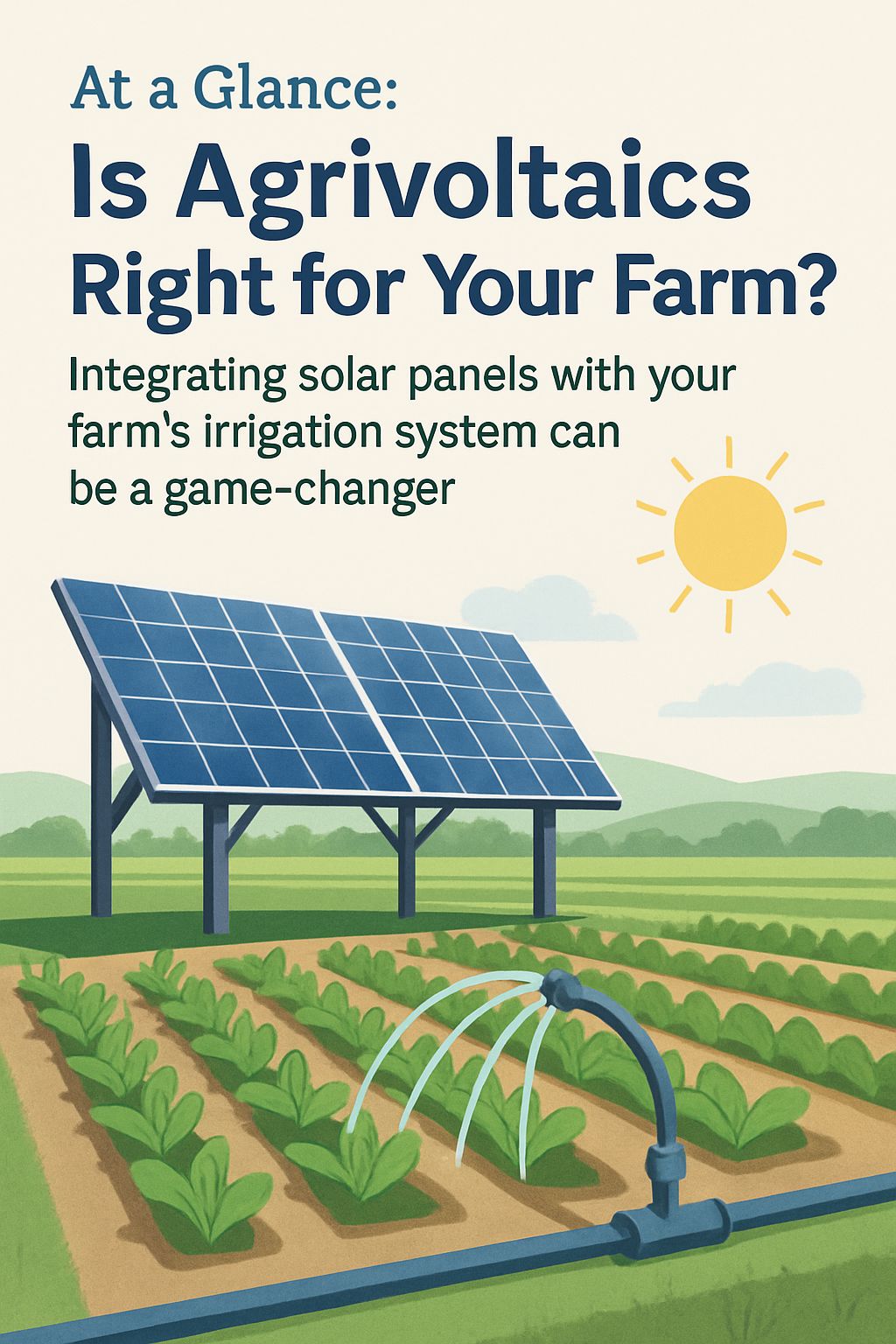
Agrivoltaics Is Not the Future for Every Farm, But It Could Be Yours
At a Glance: Is Agrivoltaics Right for Your Farm?
Integrating solar panels with your farm’s irrigation system can be a game-changer. Discover how solar panels integration with sprinkler irrigation systems offers numerous benefits and could be the right fit for your agricultural needs.
|
Farm Characteristic |
Agrivoltaics Fit |
|---|---|
|
Grows shade-tolerant crops (leafy greens, potatoes, berries) |
✓ Strong fit |
|
Located in hot, water-stressed climate |
✓ Strong fit |
|
Raises sheep or small livestock |
✓ Strong fit (solar grazing) |
|
Primarily grows corn, soybeans, or sunflowers |
✗ Poor fit without crop rotation |
|
Land is low-productivity or marginal |
△ Consider full solar lease instead |
|
Needs income diversification and stability |
✓ Strong fit |
The farms most likely to benefit from agrivoltaics share a few common traits: they’re already growing crops or raising livestock that are compatible with partial shade, they operate in climates where heat and water stress are ongoing challenges, and they’re actively looking for ways to stabilize income without abandoning food production entirely.
The Fraunhofer Institute’s research showing up to 86% improvement in land productivity for potato-solar co-location is not an outlier — it’s a preview of what thoughtful agrivoltaic design can achieve when the crop-panel pairing is right. That number doesn’t apply to every farm or every crop, but it illustrates the ceiling of what’s possible when the system is designed with precision rather than improvisation.
Agrivoltaics is also evolving fast. Panel technology is becoming cheaper, mounting systems are becoming more adaptable, and the body of agronomic research specific to different climate zones and crop types is growing every year. What’s difficult or expensive today will be more accessible and better understood within the next decade. Farmers who start exploring the model now — even at a small scale — will be significantly ahead of the curve when adoption accelerates.
The most important first step isn’t installing panels. It’s asking the right questions: Which crops in my rotation would benefit from shade? Where on my land is water stress the biggest yield limiter? What does my income stability look like if I add a reliable energy revenue stream? Those answers will tell you whether agrivoltaics is a genuine opportunity for your operation — or something better left for a neighbor down the road.
Frequently Asked Questions
Quick Reference: Agrivoltaics FAQs at a Glance
Question
Short Answer
Which farms benefit most?
Shade-tolerant crops, livestock grazing, hot/dry climates
How much extra income?
Varies by model — lease income or direct energy sales
Do panels damage soil?
No — they can actually improve soil health over time
Can small farms afford it?
Yes — especially through land leasing models
Does it support carbon sequestration?
Yes — through improved soil health and vegetation cover
What types of farms benefit most from agrivoltaics?
Farms that benefit most from agrivoltaics are those growing shade-tolerant crops like leafy greens, potatoes, root vegetables, and berries, or those running sheep and small livestock operations. Hot, arid, and semi-arid farming regions see the strongest combined benefits — where panel shade reduces heat stress, cuts water demand, and improves crop quality simultaneously. Farms facing income instability, high water costs, or pressure to transition toward sustainability also find agrivoltaics particularly well-suited to their needs. For instance, integrating solar panels on center pivot irrigation systems can be a smart idea for farmers in these regions.
How much extra income can a farmer earn from an agrivoltaic setup?
Income from agrivoltaics depends heavily on the model chosen. In a land lease arrangement with a solar developer, farmers receive a fixed payment per acre per year — typically far exceeding what most crop yields generate on a per-acre basis — regardless of weather, harvest outcomes, or energy market prices. In a farmer-owned solar system, income comes from selling electricity directly to the grid or offsetting farm energy costs. The specific figures vary widely by region, energy market rates, system size, and lease terms negotiated, but the consistent advantage across all models is income predictability — something traditional crop farming rarely offers.
Do solar panels damage soil or affect long-term crop health?
Solar panels themselves do not damage soil. In fact, research consistently shows that soil health under agrivoltaic installations tends to improve over time compared to fully exposed fields. The panel shade reduces soil temperature extremes, slows evaporation, and helps maintain more consistent moisture levels — all of which support healthy microbial activity in the soil profile. For additional benefits, consider connecting a drip irrigation system to solar panels as a win-win for farmers.
The main soil-related concern in agrivoltaic installations is compaction from the mounting structure foundations and any vehicle traffic patterns that change due to the panel layout. These risks are manageable with good installation planning and can be mitigated through thoughtful post placement and traffic routing that keeps heavy equipment away from active root zones.
Long-term crop health is also positively influenced by the reduction in UV radiation stress and heat exposure under panels — factors that contribute to better plant cell integrity, lower incidence of heat-related disease, and more consistent growing conditions season to season. Farmers who have operated agrivoltaic systems for multiple seasons generally report that the soil beneath their panels is in better condition than comparable open fields on the same property.
- No direct soil damage from panel installation or operation
- Improved moisture retention under panel shade reduces soil degradation
- Healthier microbial activity from more stable soil temperature and moisture
- Reduced UV stress on crops improves long-term plant health
- Compaction risk is manageable with proper installation planning
- Multi-season farmers report better soil condition under panels versus open fields
Can small-scale farmers afford agrivoltaic systems?
Small-scale farmers have multiple pathways into agrivoltaics without requiring significant upfront capital. The most accessible is the land lease model, where a solar developer funds, installs, and operates the entire solar system on the farmer’s land in exchange for a lease payment. The farmer bears zero installation cost and starts receiving income immediately. For farmers who want to own their solar infrastructure, financing options, federal tax incentives, and rural energy grant programs — including those available through the U.S. Department of Agriculture — can substantially reduce the net cost of installation. Community solar models and cooperative agrivoltaic projects are also emerging as options that spread infrastructure costs across multiple participating farmers.
How does agrivoltaics support carbon sequestration?
Agrivoltaics supports carbon sequestration through several overlapping mechanisms, starting with the solar panels themselves. By generating clean electricity, agrivoltaic systems displace fossil fuel-based power generation — directly reducing the carbon emissions associated with electricity production in the regions they serve.
Below the panels, the story continues at the soil level. Improved soil moisture retention under panel shade creates better conditions for organic matter accumulation. Healthy, biologically active soil sequesters more carbon than degraded or compacted soil — and the stable microclimate created by panel shade actively supports that biological activity.
When agrivoltaic installations incorporate pollinator meadows or native vegetation beneath the panels — which is common in habitat-focused projects — the above-ground plant biomass adds another layer of carbon capture. Dense, diverse plantings under panels accumulate organic matter both in the plant tissue itself and in the root systems below ground, feeding carbon back into the soil profile over time. For more information on integrating solar technology in agriculture, check out this article on solar panels on center pivot irrigation.
The combination of clean energy generation, improved soil organic matter, and habitat vegetation means that agrivoltaic farms are operating as carbon sinks in ways that conventional farms and conventional solar farms do not achieve independently. This positions agrivoltaic farmers favorably for carbon credit markets, sustainability certifications, and environmental stewardship programs that financially reward verified carbon sequestration on agricultural land.
As carbon markets mature and farm-level carbon accounting becomes more standardized, the carbon sequestration benefits of agrivoltaics are likely to become a standalone income stream in addition to energy and crop revenue — adding a third economic layer to land that was previously generating just one.
If you’re ready to explore how agrivoltaics could work on your land, Statkraft offers industry-leading expertise in renewable energy integration that sustainable farmers worldwide are already putting to work.
Agrivoltaics is an innovative approach that combines solar energy and agriculture to benefit farmers. By installing solar panels above crops, farmers can generate electricity while providing shade for their plants. This dual-use of land can lead to increased crop yields and reduced water usage. For those interested in exploring this technology further, integrating solar panels on center pivot irrigation systems is a smart idea for maximizing efficiency and sustainability on farms.

Leave a Reply