
Article-at-a-Glance
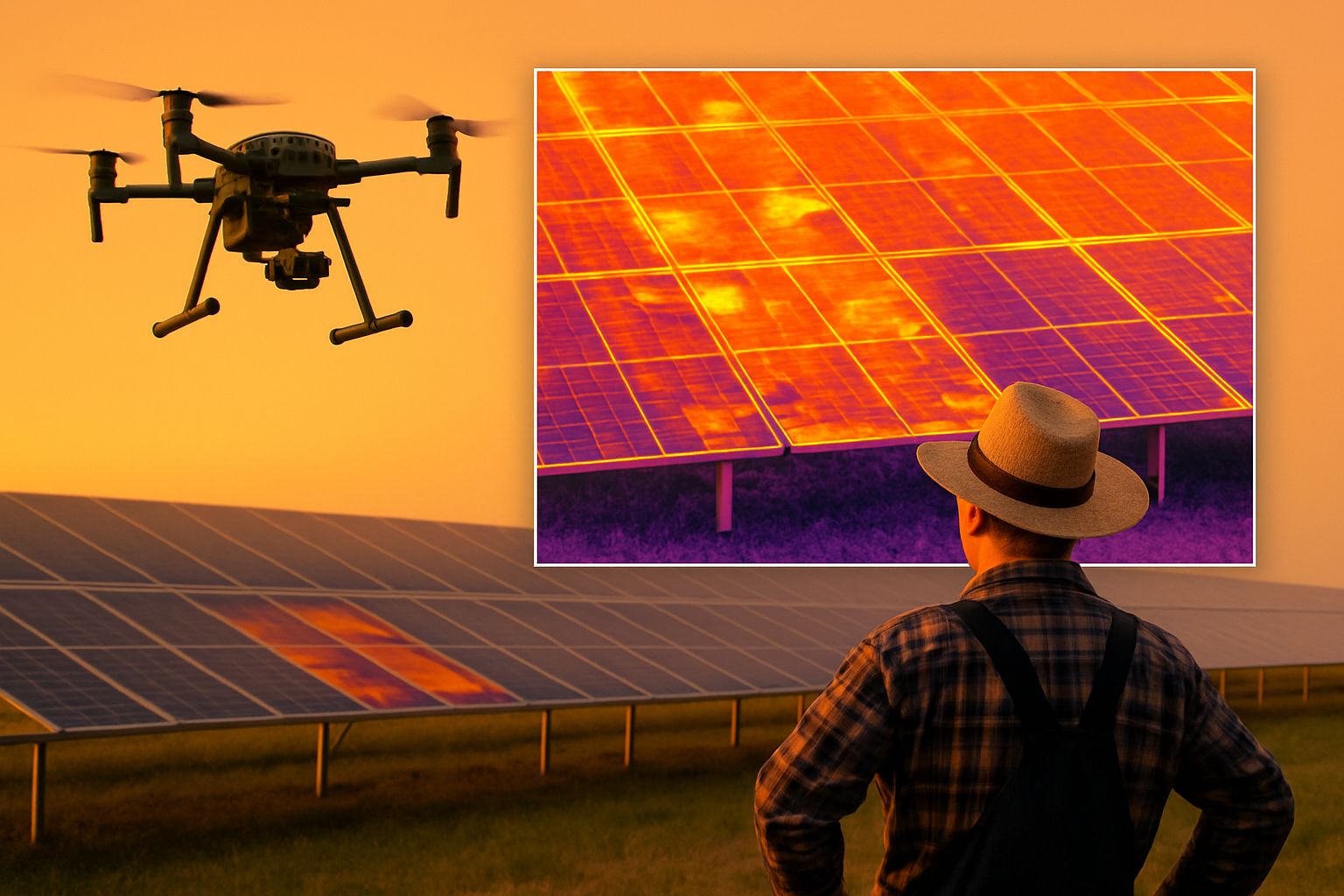
- Thermal imaging drones can detect hotspots, cell damage, and dirt accumulation on solar panels that are completely invisible to the naked eye — before they drain your energy output.
- Farmers who switch from manual to drone-based solar inspections save approximately 70% on inspection costs while gaining efficiency improvements of up to 15–30%.
- A 5-acre solar installation that takes a full day to inspect manually can be fully surveyed by a drone in under 30 minutes.
- Regular drone monitoring can extend the lifespan of your solar panels by up to 5 years through early preventative maintenance.
- Keep reading to find out which drones are best suited for farm solar inspections and how quickly a monitoring program pays for itself.
Solar panels quietly losing efficiency while powering your irrigation system or livestock barn isn’t just an inconvenience — it’s money walking out the door every single day.
For farm operations that depend on consistent solar energy output, small performance losses compound fast. A panel running at 80% capacity because of an undetected hotspot or debris buildup doesn’t announce itself. It just quietly underperforms, and manual inspections can’t keep pace with the scale of modern agricultural solar installations. That’s where drones change everything. Growing Solar Mist covers the intersection of agricultural technology and renewable energy, and drone-based solar monitoring is one of the most impactful developments reshaping how farms manage their energy infrastructure.
Drones Are Changing How Farmers Manage Solar Power
Modern farms have moved well beyond rooftop panels. Multi-acre solar installations now power everything from drip irrigation systems to climate-controlled livestock operations. Managing these installations with traditional walkthrough inspections is like checking a wheat field for disease one stalk at a time — technically possible, wildly inefficient.
Drone technology fills that gap with speed, precision, and data that manual methods simply can’t produce. Equipped with thermal imaging cameras and high-resolution sensors, agricultural drones can sweep an entire solar array, flag underperforming panels, identify physical damage, and generate detailed inspection reports — all in a single flight.
- Thermal cameras detect temperature anomalies across hundreds of panels simultaneously
- High-resolution visual sensors spot physical cracks, delamination, and surface soiling
- GPS-tagged data pinpoints the exact location of each identified problem
- Flight data integrates directly with farm energy management software
- Inspections that once took full days now complete in under an hour
The shift isn’t just about convenience. It’s about turning reactive maintenance into proactive energy management — and the financial difference is significant.
How Drones Detect Solar Panel Problems Faster Than Manual Checks
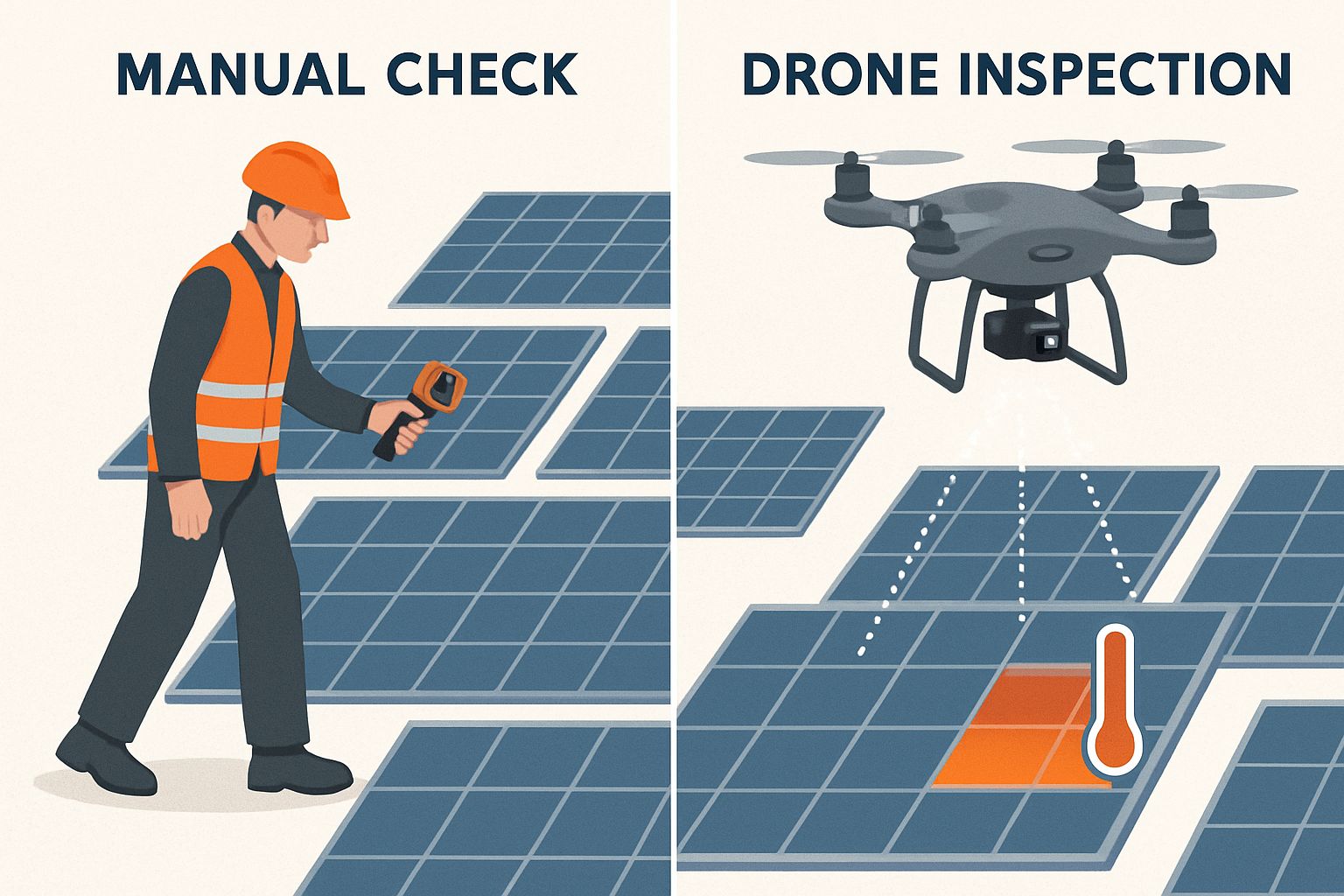
Manual solar inspections rely on a technician walking rows of panels, visually checking for obvious damage, and occasionally using handheld thermal tools on panels that already look problematic. That approach misses the vast majority of efficiency-draining issues because most defects don’t have visible surface signs until they’ve already caused measurable output loss.
Thermal Imaging Reveals Hidden Hotspots and Cell Damage
Thermal imaging is the core capability that makes drone solar inspection so powerful. When a solar cell develops a defect — whether from micro-cracking, delamination, or internal bypass diode failure — it generates excess heat. That heat signature shows up clearly in thermal imagery as a bright hotspot against the cooler background of functioning cells.
A drone equipped with a thermal camera like the FLIR Vue Pro R can capture radiometric thermal data across an entire panel array in a single pass. Every anomaly is recorded, GPS-tagged, and mapped. Technicians reviewing the data don’t need to be on-site during the inspection — they work from the flight report, prioritizing repairs based on severity before setting foot in the field.
This matters enormously on farms where solar arrays might span multiple acres and include hundreds of individual panels. Catching a hotspot cluster on panel row 47 before it cascades into a string-level failure can prevent days of energy loss and thousands of dollars in replacement costs.
Dirt and Debris Accumulation Caught Before Efficiency Drops
Farms are dusty environments. Pollen, soil particles, irrigation overspray, bird droppings, and seasonal debris accumulate on panels constantly. A panel with even moderate soiling can lose 5–10% of its output, and heavy contamination pushes that figure far higher. Drones conducting regular visual passes identify accumulation patterns early, allowing targeted cleaning rather than scheduling full-array washes on arbitrary timetables.
A 5-Acre Solar Installation Surveyed in Under 30 Minutes
A manual inspection of a 5-acre solar installation typically requires 6–8 hours of labor. A properly equipped drone completes the same survey in approximately 20–30 minutes. That speed advantage doesn’t just save labor costs — it makes frequent inspections economically viable for the first time. Instead of quarterly checkups, farms can run monthly or even bi-weekly monitoring passes without meaningful cost increases, catching problems at the earliest possible stage.
The Real Cost of Ignoring Solar Panel Maintenance on Farms
The financial argument for drone monitoring becomes even clearer when you look at what consistent underperformance actually costs. A solar installation that’s running at reduced efficiency isn’t a theoretical problem — it’s a measurable revenue and operational loss that compounds over time.
How Undetected Panel Defects Drain Farm Energy Output
Solar panel strings are wired in series, which means a single underperforming panel pulls down the output of every other panel in its string. One defective panel doesn’t just hurt itself — it degrades the entire string’s performance until the problem is identified and corrected.
- Hotspot failures can reduce individual panel output by 30–40% and damage surrounding cells
- Micro-cracks from hail, thermal cycling, or mechanical stress cause gradual but cumulative output loss
- Soiling losses on farm installations commonly run 5–15% depending on local conditions and cleaning frequency
- Bypass diode failures are nearly undetectable without thermal imaging and cause significant string-level losses
- Delamination allows moisture ingress that accelerates cell degradation over seasons
None of these issues announce themselves loudly. They accumulate quietly in the background while your energy bills edge upward and your solar ROI timeline stretches longer than projected.
For a 100kW farm installation, a 10% efficiency loss represents a meaningful gap between projected and actual energy production — energy that either needs to be purchased from the grid or results in reduced operational capacity for irrigation, refrigeration, or livestock systems. At scale, the numbers add up fast.
Impact on Irrigation Systems and Livestock Operations
Farm solar installations don’t operate in isolation. They directly power critical operational systems where performance gaps have immediate consequences. Irrigation systems running on undersupplied solar power may not deliver designed flow rates during peak growing periods. Climate control systems in poultry barns or dairy facilities are even less forgiving — consistent power delivery isn’t optional when livestock health depends on it.
Regular drone monitoring ensures the solar infrastructure supporting these systems performs at its designed capacity when the farm needs it most, not just when the next scheduled annual inspection rolls around.
Key Benefits of Drone-Based Solar Monitoring for Farmers
The efficiency and cost arguments for drone monitoring are compelling on their own, but the full picture of benefits reaches further than most farm operators initially expect. From direct energy gains to long-term infrastructure protection, drone-based monitoring delivers value across multiple dimensions of farm operations.
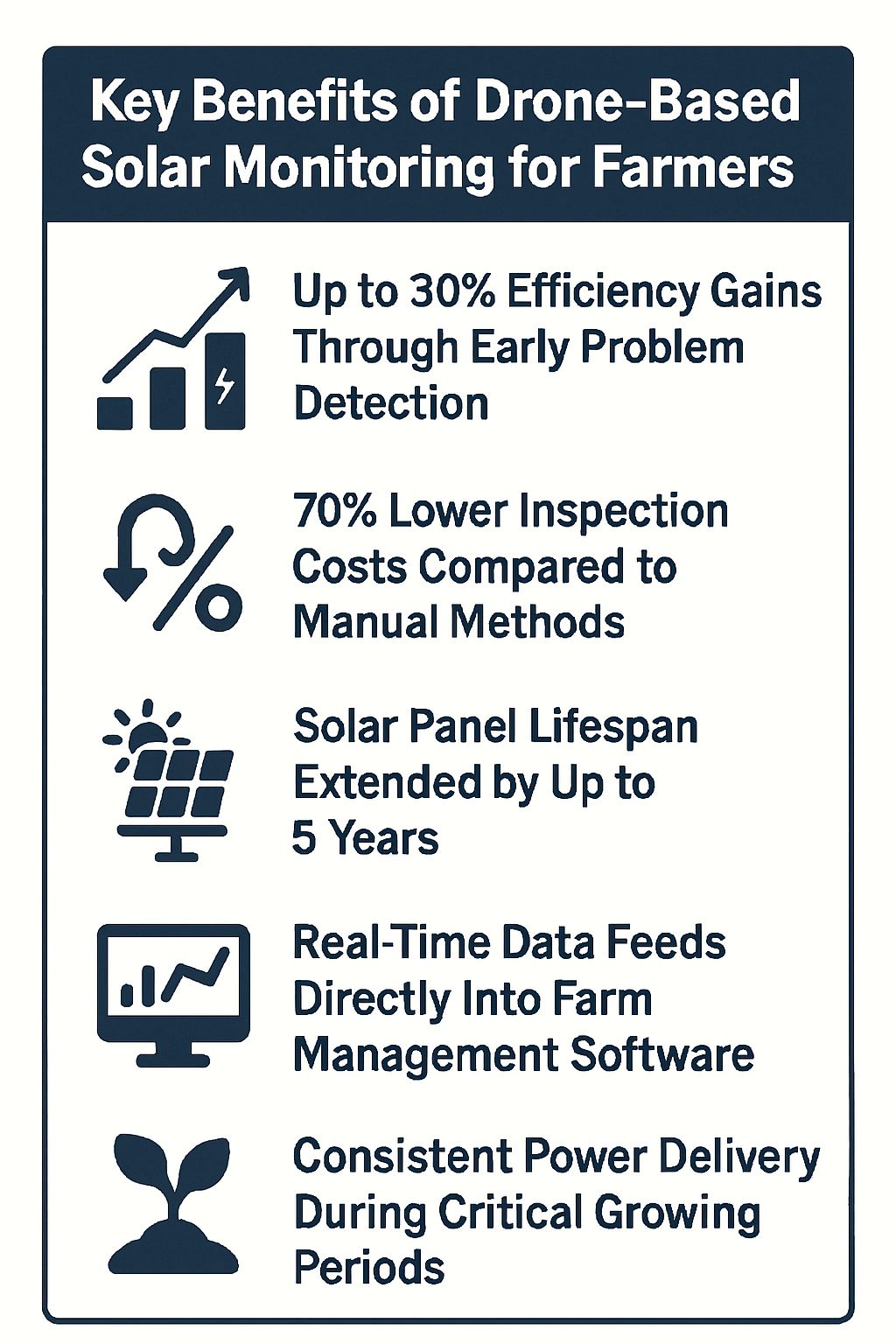
1. Up to 30% Efficiency Gains Through Early Problem Detection
Catching defects early is fundamentally different from catching them late. A hotspot identified in its first month causes minimal lasting damage and requires a straightforward repair. The same hotspot missed for a full year can permanently degrade surrounding cells, damage panel laminate, and require full panel replacement. Drone monitoring programs that run on regular schedules — monthly or bi-monthly — consistently deliver efficiency improvements in the 15–30% range by keeping arrays running at or near their designed output capacity rather than allowing slow degradation to go unchecked.
2. 70% Lower Inspection Costs Compared to Manual Methods
Manual solar inspections require skilled technicians, significant labor hours, specialized handheld equipment, and in many cases, safety equipment for working around large ground-mounted arrays. A drone inspection of the same installation needs one operator, one flight, and a fraction of the time. Farms switching from manual to drone-based inspection programs report cost reductions of approximately 70% on their total inspection spend — savings that compound annually and contribute directly to the overall ROI of the solar installation itself.
The cost equation also improves as inspection frequency increases. Because drone flights are so much cheaper per inspection than manual alternatives, farms can afford to inspect more often — which catches problems earlier, reduces repair costs, and keeps efficiency losses minimal throughout the year.
3. Solar Panel Lifespan Extended by Up to 5 Years
Solar panels are engineered for 25–30 year operational lifespans under ideal maintenance conditions. In practice, installations that receive infrequent or inadequate maintenance rarely achieve those numbers. Consistent drone monitoring, by catching small problems before they become large ones, directly protects panel longevity. Industry data from drone-monitored agricultural installations indicates lifespan extensions of up to 5 years compared to panels maintained through traditional inspection methods alone — a difference that dramatically improves the long-term economics of the solar investment.
4. Real-Time Data Feeds Directly Into Farm Management Software
Modern agricultural drone platforms don’t just collect data — they deliver it in formats that integrate with existing farm management systems. Flight data from a solar inspection can be processed through platforms like DroneDeploy or Pix4D and exported as structured reports that map directly to your panel layout, flag priority repairs, and track performance trends over time. For farm operators already using precision agriculture software, solar monitoring data becomes one more integrated data stream rather than a separate manual reporting process.
5. Consistent Power Delivery During Critical Growing Periods
Planting and harvest seasons place maximum demand on farm energy infrastructure. A solar array running at reduced capacity during these windows creates operational bottlenecks at exactly the wrong moment. Scheduling thorough drone inspections before peak energy demand periods — typically late winter before planting season and late summer before harvest — ensures arrays enter critical operational windows performing at full capacity.
Best Drones for Farm Solar Panel Inspections
Not every drone on the market is suited for agricultural solar monitoring. The right platform depends on your installation size, inspection frequency, and whether you’re running inspections in-house or contracting to a specialized service provider. Here’s what actually separates effective solar inspection drones from standard aerial platforms.
Thermal Imaging Drones vs. Standard Camera Drones
- Thermal imaging drones detect temperature differentials across panel surfaces, identifying hotspots, bypass diode failures, and cell-level defects invisible to optical cameras
- Standard RGB camera drones capture high-resolution visual imagery useful for identifying physical damage, soiling, debris accumulation, and structural issues
- Dual-sensor platforms combine both thermal and RGB imaging in a single flight, delivering complete inspection data without running separate passes
- Multispectral drones are primarily designed for crop monitoring and offer limited value for solar panel diagnostics specifically
For agricultural solar monitoring, dual-sensor platforms represent the clearest value. Running a single flight that simultaneously captures both thermal anomalies and visual surface conditions cuts flight time in half while delivering a more complete inspection dataset than either sensor type provides independently.
The thermal sensor specification that matters most is radiometric capability — the ability to record actual temperature values at each pixel rather than just relative temperature visualization. Radiometric data allows technicians to set specific temperature thresholds for flagging hotspots, making automated defect detection far more reliable than visual interpretation of thermal color gradients alone.
DJI Matrice 30T: Top Pick for Agricultural Solar Monitoring
The DJI Matrice 30T has become the dominant platform for professional agricultural solar inspections, and for good reason. It combines a 48MP visual camera, a 640×512 radiometric thermal sensor, a laser rangefinder, and a zoom camera in a single compact body rated IP55 for dust and water resistance — critical for farm environments. Its 41-minute maximum flight time covers large installations in a single battery cycle, and its wind resistance rating of 15 m/s handles typical open-field conditions without flight interruptions.
The Matrice 30T integrates with DJI’s FlightHub 2 enterprise software, which automates flight path planning over mapped solar installations and generates structured thermal inspection reports without requiring manual data processing. For farm operators running regular monitoring programs, automated flight paths mean consistent coverage on every inspection cycle with minimal operator input after the initial setup.
What Specs Actually Matter for Solar Farm Drone Inspections
When evaluating drones for solar monitoring, thermal sensor resolution and radiometric capability are non-negotiable for effective hotspot detection. A 160×120 thermal sensor — common on entry-level platforms — cannot resolve individual cell defects on standard 72-cell commercial panels at practical inspection altitudes. A minimum of 640×512 thermal resolution is the industry standard for reliable solar cell-level diagnostics.
Flight time directly determines how much of your installation you can cover in a single session. For installations larger than 2 acres, platforms with less than 30 minutes of flight time will require multiple battery swaps that interrupt the inspection and introduce positioning inconsistencies in the data.
IP rating for environmental protection matters more on farms than in most other inspection environments. Dust, irrigation overspray, and unpredictable weather conditions mean that a drone without meaningful ingress protection is a reliability risk. Look for a minimum IP43 rating, with IP55 preferred for year-round agricultural use.
How to Set Up a Drone Solar Monitoring Program on Your Farm
Getting a drone monitoring program running effectively doesn’t require a steep technical learning curve, but it does require upfront planning to ensure your inspection data is consistent, actionable, and properly integrated with your maintenance workflow. The difference between a monitoring program that generates useful results and one that generates large folders of unreviewed footage comes down almost entirely to how well the initial setup is structured.
Start by defining what you want the program to deliver — specific performance thresholds that trigger maintenance action, inspection frequency targets, and how findings will be handed off to whoever handles your panel repairs. A monitoring program without a clear action framework produces data that doesn’t drive decisions.
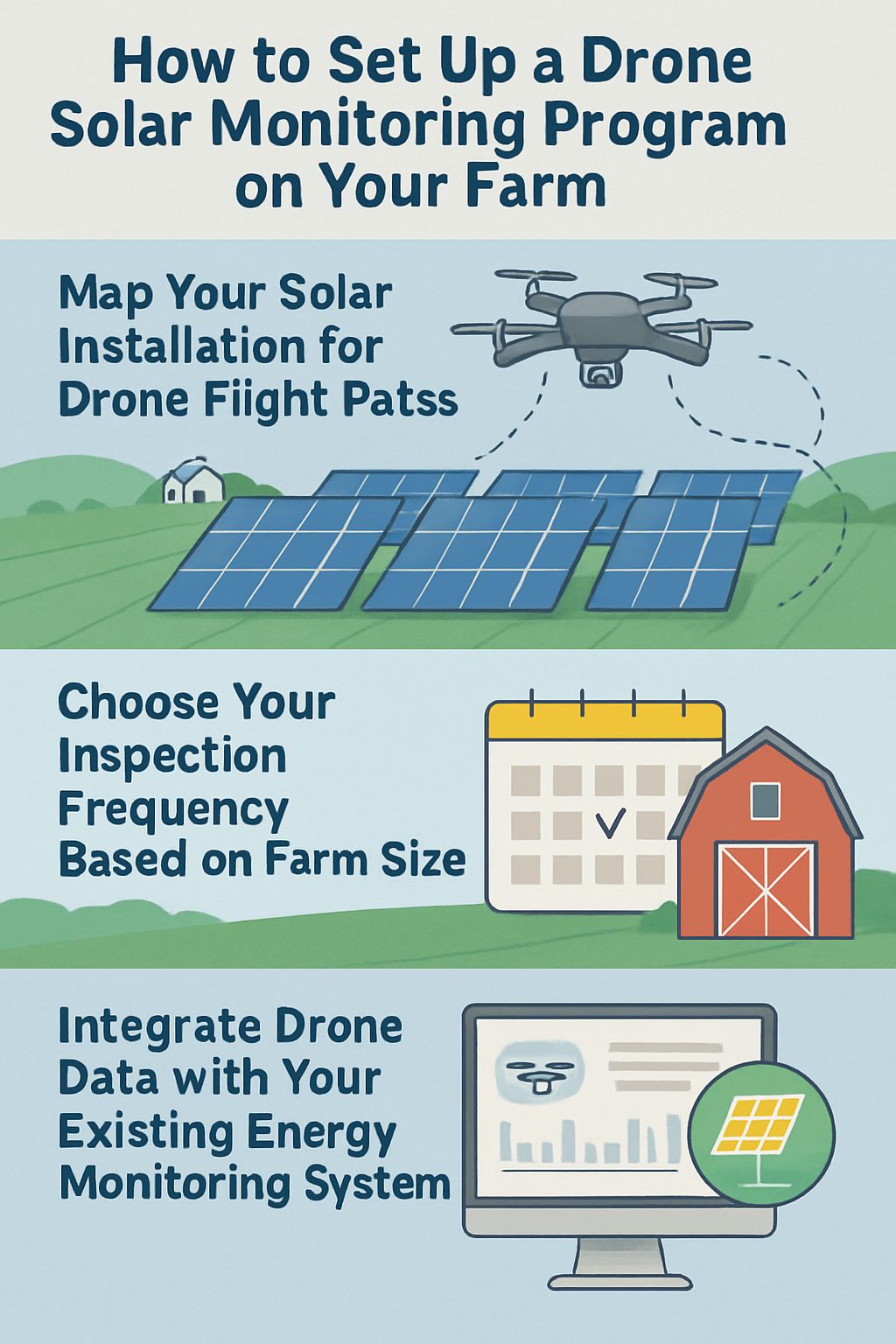
Step 1: Map Your Solar Installation for Drone Flight Paths
Before flying a single inspection, create a precise digital map of your entire solar installation including panel layout, string configurations, inverter locations, and any physical obstructions like trees, power lines, or outbuildings within the flight zone. Platforms like DroneDeploy allow you to import this layout and automatically generate optimized flight paths that provide consistent altitude, overlap, and coverage across every panel in the array. Consistent flight paths are critical — they ensure that thermal and visual data from each inspection cycle can be directly compared to previous flights to track performance trends over time. For farmers considering different types of solar panels, understanding the comparison between monocrystalline and thin-film panels can be beneficial.
Step 2: Choose Your Inspection Frequency Based on Farm Size
Inspection frequency should scale with installation size and operational criticality. For farm installations under 50kW, quarterly drone inspections combined with a single comprehensive annual thermal survey typically provides adequate coverage. Installations between 50kW and 200kW benefit from bi-monthly inspections, with additional passes scheduled before and after high-demand operational periods. Installations above 200kW — common on larger grain or livestock operations — warrant monthly monitoring to protect the energy volume at stake and justify the program investment through consistent efficiency maintenance.
Step 3: Integrate Drone Data with Your Existing Energy Monitoring System
Raw drone inspection data only becomes valuable when it connects to a decision-making workflow. Export thermal and visual inspection reports from your drone software platform and cross-reference them against your existing energy monitoring data — inverter output logs, string-level performance records, and historical production baselines. When a thermal anomaly on panel row 12 correlates with a subtle but consistent dip in string 3 inverter output over the past 60 days, you have both a confirmed diagnosis and a measurable performance cost to justify the repair prioritization.
Platforms like SolarEdge and Enphase both support third-party data integration, meaning GPS-tagged defect reports from drone flights can be mapped directly against real-time and historical panel performance data in a unified dashboard. This integration transforms drone monitoring from a standalone inspection tool into a continuous performance management system — one where every flight adds another layer of data to an increasingly accurate picture of your installation’s health over time.
What the ROI Looks Like for Drone Solar Monitoring
The return on investment calculation for drone solar monitoring comes down to three numbers: what your installation produces now, what it should be producing, and how much the gap costs you annually. For most farm installations that have been running without systematic drone monitoring, that gap is larger than expected.
Annual Energy Production Gains on a 100kW Farm Installation
A 100kW farm solar installation running at 10% below its designed output — a realistic figure for an installation without regular thermal inspection — loses a meaningful volume of energy production annually. Restoring that 10% through drone-identified repairs and targeted maintenance represents a direct operational gain, whether measured as reduced grid energy purchases or as restored capacity for farm systems that were running on insufficient supply. Farms implementing structured drone monitoring programs report efficiency improvements consistently in the 15–30% range as years of undetected minor issues are identified and corrected in the first monitoring cycle. For more information on solar panels suitable for farming, consider reading about the best solar panels for farmers.
How Quickly Drone Monitoring Programs Pay for Themselves
The upfront investment in a drone monitoring program — whether through equipment purchase or contracted inspection services — typically returns within 8–16 months for farm installations, depending on installation size and the baseline condition of the panels at program start. Installations with significant deferred maintenance tend to see faster payback because the efficiency gains from the first inspection cycle are larger.
Contracted drone inspection services for agricultural solar installations typically run between $200–$800 per inspection depending on array size, flight complexity, and reporting depth. For a 100kW installation inspected six times annually, total inspection costs sit well below the value of even a modest 5% efficiency recovery — which is why the ROI timeline for most farm operations falls well inside the first year of the program.
Owning your own inspection drone changes the economics further. A DJI Matrice 30T represents a significant upfront investment, but amortized across years of use on a large installation, the per-inspection cost drops to minimal levels — and the ability to run inspections on demand, rather than scheduling around a service provider’s calendar, adds operational flexibility that contracted services can’t match.
Installation Size
Manual Inspection Cost (Annual)
Drone Inspection Cost (Annual)
Estimated Efficiency Gain
Typical ROI Timeline
Under 50kW
$2,400–$4,000
$800–$1,200
10–15%
10–16 months
50kW–100kW
$5,000–$9,000
$1,500–$2,400
15–20%
8–14 months
100kW–200kW
$9,000–$16,000
$2,400–$4,800
20–30%
6–10 months
200kW+
$16,000+
$4,800–$8,000
20–30%
Under 8 months
Figures are representative estimates based on industry inspection data. Actual results vary by location, installation condition, and service provider.
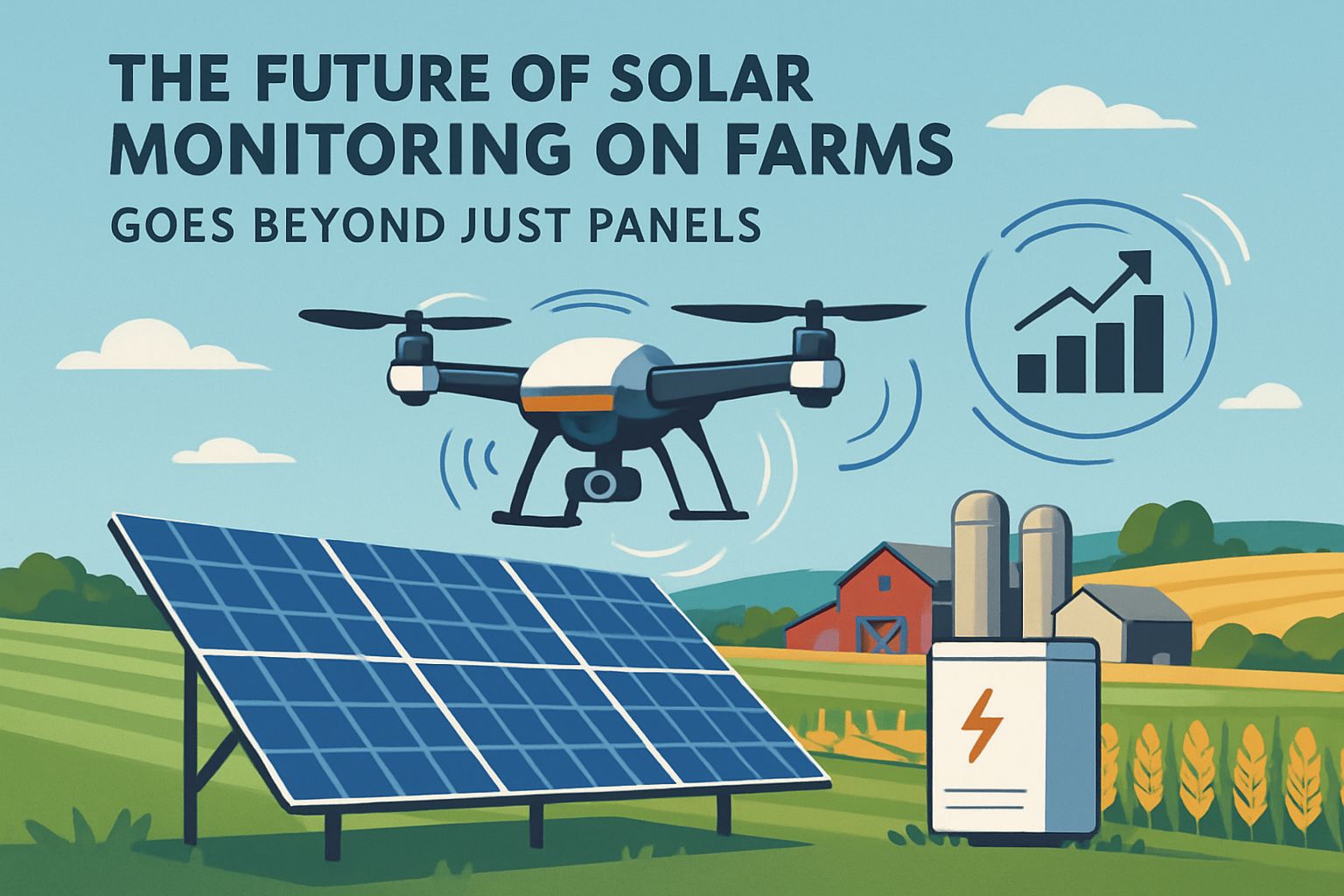
The Future of Solar Monitoring on Farms Goes Beyond Just Panels
The next evolution of drone-based solar monitoring on farms isn’t just about inspecting existing panels more efficiently — it’s about integrating aerial data into fully automated farm energy management systems. AI-powered defect detection algorithms are already being layered onto thermal inspection data, automatically classifying hotspot severity, predicting failure timelines, and generating prioritized maintenance schedules without requiring manual data review. As drone autonomy improves, fully automated inspection flights triggered by performance threshold alerts from inverter monitoring systems will move from pilot programs to standard practice on forward-thinking farm operations. The farms that establish structured drone monitoring programs today are building the data infrastructure and operational workflows that will integrate seamlessly with these next-generation systems — putting them years ahead of operations that wait for the technology to fully mature before engaging.
Frequently Asked Questions
Drone solar monitoring raises practical questions for farm operators who are weighing the investment and figuring out how the program fits their existing operations. The answers below address the most common concerns directly.
Whether you’re managing a small rooftop installation on a barn or a multi-acre ground-mounted array, the core principles of drone-based monitoring apply — though the specific approach, equipment, and inspection frequency shift based on your scale and operational context. For those exploring different solar technologies, understanding the differences between monocrystalline and bifacial solar panels can be beneficial.
Can small farms with limited solar installations benefit from drone monitoring?
Yes, even small installations benefit — though the economics work differently. For installations under 20kW, owning a dedicated inspection drone rarely makes financial sense. Contracting an annual or bi-annual drone inspection service delivers the core benefit of thermal defect detection at a cost that’s easy to justify against even modest efficiency recovery gains. A single inspection identifying one failing panel string on a small farm installation can pay for several years of contracted inspection costs through restored energy production alone.
Do you need a drone pilot license to inspect solar panels on your own farm?
In the United States, operating a drone commercially — including for your own farm business purposes — requires an FAA Part 107 Remote Pilot Certificate if the drone weighs more than 0.55 pounds. Most inspection-grade drones fall well above that threshold. The Part 107 certification involves a written knowledge test covering airspace regulations, weather interpretation, and drone operational procedures. Many farm operators pursuing in-house drone monitoring programs obtain the certification through dedicated online prep courses, with most candidates completing the preparation in 15–20 hours of study before scheduling the exam at an FAA-approved testing center.
How often should farmers conduct drone inspections of their solar panels?
Inspection frequency depends on installation size, local environmental conditions, and how critical consistent energy output is to daily farm operations. As a baseline, quarterly inspections provide adequate coverage for most small-to-medium farm installations. High-dust environments, farms near irrigation systems with mineral-heavy water, and installations in regions with significant seasonal weather variation — hail risk, heavy pollen seasons, or freeze-thaw cycles — benefit from monthly or bi-monthly monitoring passes.
The most effective approach for most farm operations combines frequent lightweight visual inspections — which can be conducted with standard camera drones quickly and inexpensively — with less frequent but more comprehensive thermal inspections timed to catch seasonal damage patterns. A bi-monthly visual pass combined with a full thermal survey twice per year covers the vast majority of detectable issues at a cost well below continuous full thermal monitoring.
What types of solar panel damage can thermal imaging drones detect?
Thermal imaging drones reliably detect hotspots caused by cell-level defects, bypass diode failures, micro-cracks from mechanical or thermal stress, delamination that creates thermal bridging within the panel laminate, soiling patterns that create localized shading and heat concentration, and string-level wiring faults that manifest as temperature differentials across connected panels. Physical damage including cracking, frame separation, and surface contamination is captured by the visual camera payload, while thermal imaging handles the electrical and performance-related defects that have no visible surface signature until late-stage degradation.
Is drone solar monitoring compatible with all types of farm solar installations?
Drone monitoring is effective across all standard agricultural solar installation types — ground-mounted fixed-tilt arrays, rooftop installations on barns and outbuildings, single-axis tracking systems, and carport-style agrivoltaic setups that combine solar generation with livestock shade or crop protection functions.
Tracking systems introduce one operational consideration: inspections should be scheduled when trackers are in their flat or minimum-tilt position to ensure consistent thermal data capture across the full panel surface. Rooftop installations on farm buildings require careful flight path planning to maintain safe clearances from structures and to ensure complete panel coverage without obstruction from roof features like ventilation stacks or guttering systems.
Agrivoltaic installations — where solar panels are integrated with active growing areas — are particularly well-served by drone monitoring because ground-level access for manual inspection is often constrained by crops or livestock. Aerial inspection completely bypasses that access limitation, making regular monitoring operationally practical in situations where manual inspection would require disrupting farm activity to gain panel access.

Leave a Reply