
Key Takeaways:
- Monocrystalline panels deliver 17–22% efficiency — the highest of any solar panel type — making them the go-to choice for farms with limited roof or ground space that need maximum power output.
- Thin-film panels are lighter, more flexible, and perform better in high heat and low-light conditions, but their 10–13% efficiency means you need significantly more surface area to generate the same power.
- For high-demand irrigation systems, monocrystalline wins on output and lifespan — but thin-film has a real role to play in off-grid, low-load, or unconventional farm setups where rigid panels simply won’t work.
- Upfront cost vs. long-term return is the deciding factor for most farmers — monocrystalline costs more initially but typically delivers better value over a 25+ year lifespan.
- The right panel depends on three things: your available space, your irrigation load, and your budget — and we break all three down in detail below.
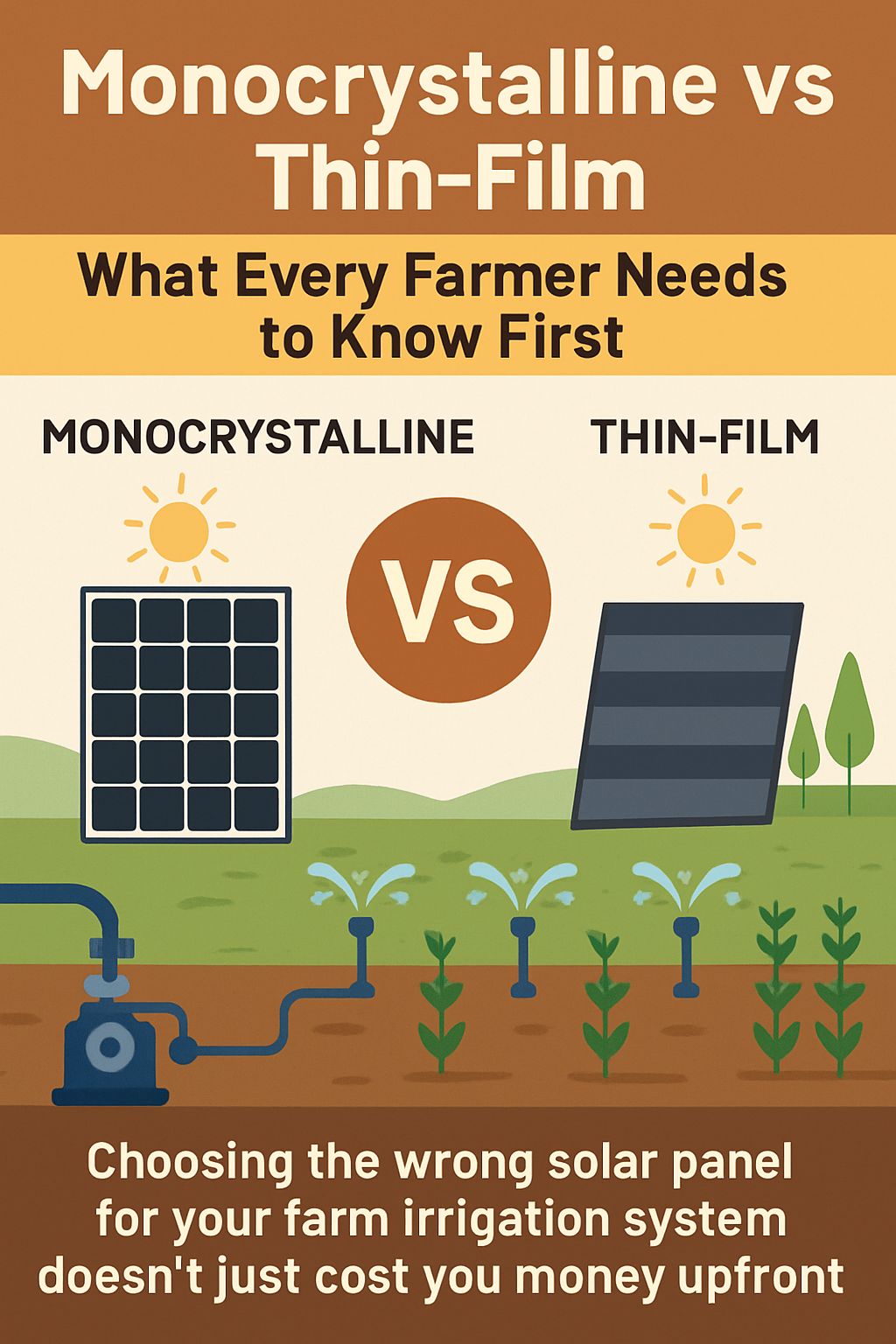
Monocrystalline vs Thin-Film: What Every Farmer Needs to Know First
Choosing the wrong solar panel for your farm irrigation system doesn’t just cost you money upfront — it can mean underpowered pumps, inconsistent water delivery, and a system that can’t keep up during peak growing season. The decision between monocrystalline and thin-film solar panels is one of the most important you’ll make when going solar on the farm.
For farmers, this isn’t just a tech comparison — it’s a practical question about what actually works in the field. Growing Solar Mist focuses specifically on helping agricultural operations navigate decisions like this one, cutting through the marketing noise to match panel technology to real farming needs. The difference between these two panel types goes deeper than price tags and brochure specs.
What Are Monocrystalline Solar Panels?
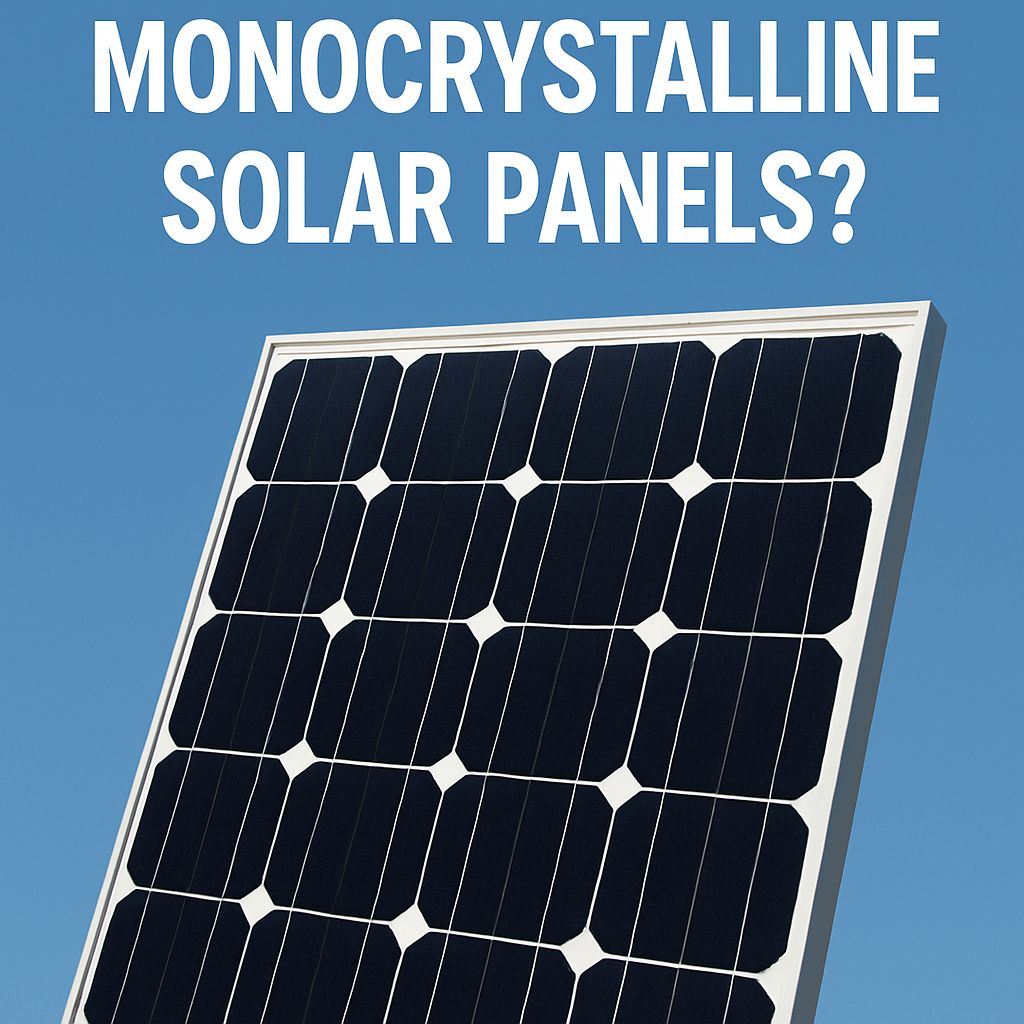
Monocrystalline solar panels are the most efficient and most widely used panel type in agricultural solar installations today. They’re built from a single continuous crystal structure of silicon, which is what gives them their characteristic dark black appearance and high performance. If you’ve seen solar panels on a barn roof or powering a pivot irrigation system, chances are they were monocrystalline.
How Monocrystalline Panels Are Made
The manufacturing process behind monocrystalline panels is what sets them apart. Silicon is grown into a single large crystal using the Czochralski method — a process where a silicon seed crystal is slowly pulled from molten silicon, forming a pure cylindrical ingot. That ingot is then sliced into thin wafers, each one cut into the familiar pseudo-square cell shape used in finished panels. For more information on different types of solar panels, you can explore best solar panels for farmers.
|
Feature |
Monocrystalline |
Thin-Film |
|---|---|---|
|
Efficiency |
17–22% |
10–13% |
|
Lifespan |
25+ years |
10–20 years |
|
Cost (upfront) |
Higher |
Lower |
|
Space Required |
Less |
More |
|
Weight |
Heavier |
Lightweight |
|
Flexibility |
Rigid |
Flexible options available |
|
Best For |
High-demand irrigation, limited space |
Off-grid, irregular surfaces |
Because the entire cell is one unbroken crystal lattice, electrons move through it with very little resistance. That’s the core reason monocrystalline panels convert sunlight to electricity more efficiently than any other mainstream panel type on the market today.
Efficiency Range: 17–22%
Monocrystalline panels consistently convert between 17% and 22% of incoming sunlight into usable electricity. Top-tier models from manufacturers like SunPower and LG push into the 22–23% range. For a farm irrigation system drawing significant wattage, that efficiency gap compared to thin-film translates directly into fewer panels needed and less structural load on your mounting surface.
Lifespan and Durability on the Farm
Most monocrystalline panels come with performance warranties of 25 years or more, guaranteeing at least 80% of their original output at the end of that period. On working farms — where panels face dust, wind, rain, and temperature swings daily — that long-term reliability is not a small thing. It means a system installed today can still be powering your irrigation in 2050.
What Are Thin-Film Solar Panels?
Thin-film panels take a completely different approach to converting sunlight into power. Instead of slicing silicon into rigid wafers, thin-film technology deposits one or more layers of photovoltaic material directly onto a substrate like glass, metal, or plastic. The result is a panel that can be made lightweight, semi-flexible, and adapted to surfaces where rigid monocrystalline panels simply can’t go. For a deeper dive into the best solar panels for agricultural use, explore our detailed comparison.
How Thin-Film Technology Works
The photovoltaic layer in a thin-film panel is just a few micrometers thick — sometimes as thin as 1 to 4 micrometers — compared to the 200-micrometer silicon wafers used in monocrystalline cells. The three most common thin-film materials are amorphous silicon (a-Si), cadmium telluride (CdTe), and copper indium gallium selenide (CIGS). Each has slightly different performance characteristics, but all share the same core advantage: they can be deposited over large, flexible surfaces at a lower manufacturing cost than crystalline silicon. Learn more about the best options for agricultural use.
Efficiency Range: 10–13%
The efficiency trade-off with thin-film is real and significant. Standard thin-film panels operate in the 10–13% efficiency range, though CIGS-based panels can push toward 15% in lab conditions. In practical farm terms, that means you’d need roughly 40–60% more surface area covered in thin-film panels to generate the same electricity as a monocrystalline array. For a large-scale irrigation system, that difference in space requirements can be a dealbreaker.
That said, thin-film panels handle heat better than monocrystalline. They have a lower temperature coefficient, meaning their efficiency drops less sharply when panel surface temperatures rise on hot summer days — exactly the kind of days when your irrigation system is working hardest. This is one area where thin-film genuinely pulls ahead in real-world farm conditions.
Thin-film also performs comparatively better in diffuse or low-light conditions. On overcast days or during early morning and late afternoon hours, thin-film panels can continue generating meaningful power while monocrystalline output has already started to taper. For farms in cloud-prone regions or with partially shaded installations, this matters more than the raw efficiency numbers suggest.
- Thin-film panels produce useful power even in indirect or diffuse sunlight
- Their temperature coefficient is lower, so hot summer days affect output less
- CIGS-based thin-film panels are the most efficient in the thin-film category
- Manufacturing cost is lower, which drives down the upfront purchase price
- Some thin-film products are semi-flexible, opening up curved and irregular mounting options
Flexibility and Weight Advantages
Where thin-film genuinely stands out for farm applications is in its physical versatility. A flexible thin-film panel can be mounted on a curved greenhouse roof, an aging barn with limited structural capacity, or even integrated directly into roofing membranes. For older farm structures that couldn’t support the weight of a traditional rigid panel array, thin-film opens up solar generation that would otherwise be off the table entirely.
Head-to-Head: Monocrystalline vs Thin-Film for Farm Use
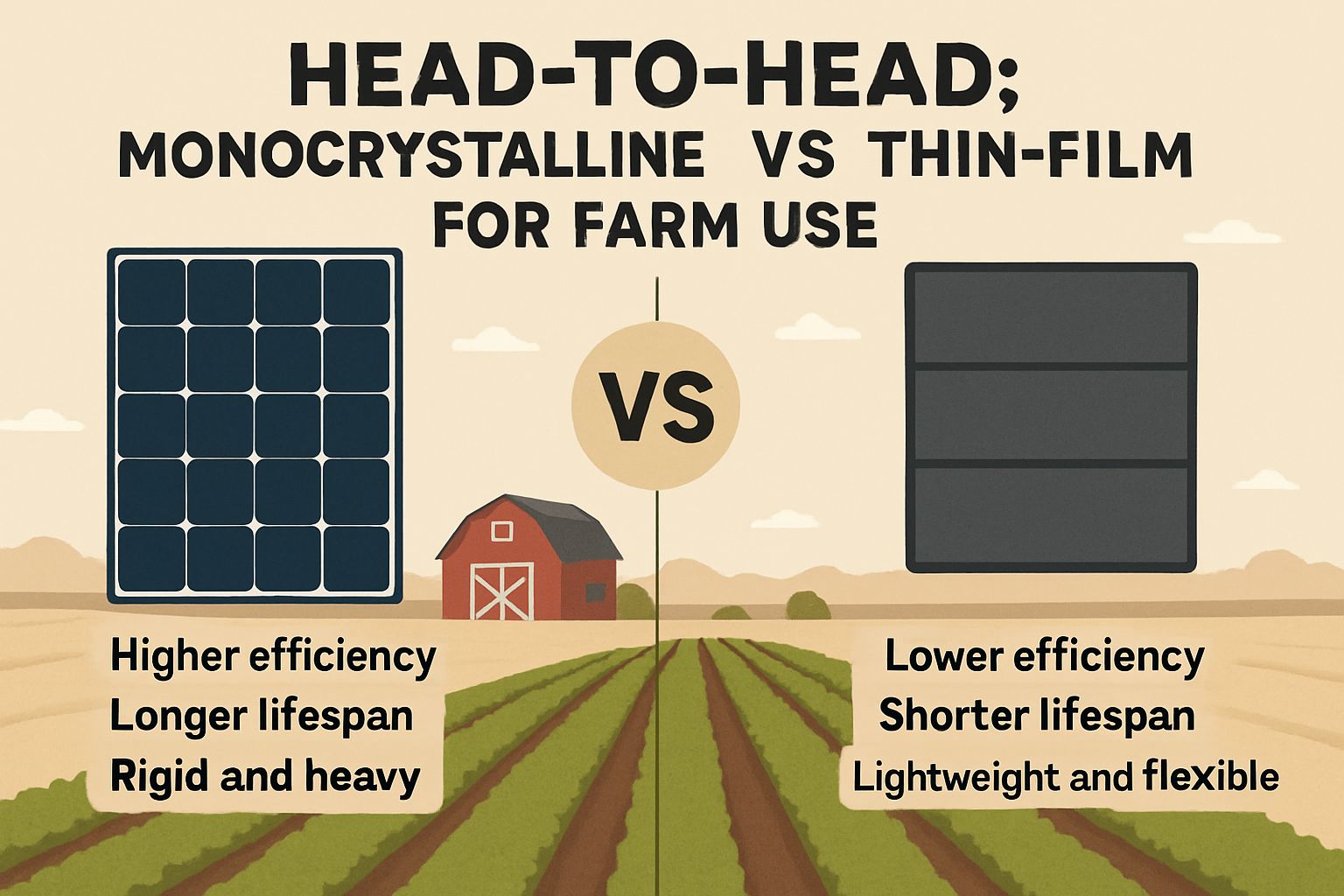
Side by side, these two panel types serve very different masters. Monocrystalline panels are built for maximum output in minimum space — a critical advantage when you’re trying to generate serious wattage from a fixed roof area or a defined ground-mount footprint. Thin-film panels trade raw efficiency for versatility, lower weight, and better performance under specific environmental conditions that farms actually encounter every day.
The comparison only gets useful when you ground it in real farm scenarios. A 50-acre operation running center-pivot irrigation has completely different power requirements than a small market garden using a submersible pump. Understanding where each panel type excels — and where it falls short — is what lets you build a system that actually keeps up with demand.
Power Output Per Square Foot
Monocrystalline panels generate significantly more power per square foot than thin-film. A standard 400W monocrystalline panel covers roughly 21 square feet. To match that same 400 watts using thin-film panels at 11% efficiency, you’d need closer to 36 square feet of panel surface. Over a full irrigation array sized at 10kW, that efficiency gap translates to needing approximately 200 extra square feet of mounting surface with thin-film — space that many farm structures simply don’t have available in a practical, unshaded configuration.
For ground-mount systems on open land, the extra space requirement of thin-film is more manageable. But every additional square foot of panel array also means more racking hardware, more wiring runs, and more labor during installation. The cost savings on thin-film panels themselves can quietly evaporate once you factor in those additional balance-of-system expenses.
Performance in Heat and Low-Light Conditions
This is where thin-film earns its place in the conversation. Monocrystalline panels typically carry a temperature coefficient of around -0.3% to -0.5% per degree Celsius above 25°C. On a 45°C summer day — not unusual in many major farming regions — that means a monocrystalline panel is already operating at 85–90% of its rated output. Thin-film panels, particularly CdTe and CIGS types, have lower temperature coefficients in the range of -0.2% to -0.25%, so they hold their output better when the thermometer climbs precisely when irrigation demand peaks.
Installation on Barns, Sheds, and Irregular Surfaces
Rigid monocrystalline panels need flat, structurally sound mounting surfaces. Most modern farm buildings can handle the load — a standard 400W monocrystalline panel weighs between 40 and 50 pounds — but older timber-framed barns, curved Quonset huts, and corrugated metal outbuildings often can’t. This is where thin-film’s flexibility becomes a genuine operational advantage, not just a marketing bullet point.
Flexible thin-film laminates can conform to curved rooflines and be bonded directly to metal roofing panels, eliminating the need for mounting rails or penetrations that could compromise a roof’s weather seal. For farm buildings where a conventional rack-mounted system would require significant structural reinforcement or roof replacement, thin-film can deliver solar generation at a fraction of the installation complexity.
Upfront Cost vs Long-Term Return
Thin-film panels typically cost less per panel at the point of purchase, but that upfront saving needs to be measured against a shorter operational lifespan. Most thin-film installations carry warranties in the 10–20 year range, compared to 25+ years for monocrystalline. Over a 25-year period, a farm that installs thin-film may face a partial or full system replacement midway through, effectively doubling some of the initial capital outlay.
Monocrystalline systems cost more upfront but deliver a lower levelized cost of energy (LCOE) over their full lifespan in most high-demand agricultural applications. For irrigation systems running hundreds of hours per growing season, that long-term cost efficiency is where the real financial case for monocrystalline gets made — not in the initial purchase price comparison.
Which Panel Works Best for Farm Irrigation Systems?
Farm irrigation is one of the most power-intensive applications in agriculture. Center-pivot systems can draw anywhere from 35kW to over 100kW depending on span length and pump depth. Drip irrigation systems are less demanding but still require consistent, reliable power delivery throughout the growing season. The panel technology you choose needs to match that load profile — not just on paper, but across real-world conditions including summer heat, variable cloud cover, and the physical realities of your farm infrastructure. For insights on selecting the best solar panels for farmers, consider the specific demands of your irrigation system.
Monocrystalline panels dominate commercial-scale irrigation installations for good reason. Their higher efficiency means a smaller array footprint for the same power output, their 25+ year lifespan aligns with typical farm infrastructure planning horizons, and their predictable performance degradation — typically 0.5% per year — makes system sizing and long-term yield forecasting straightforward.
Thin-film has a legitimate role in irrigation, but it’s a supporting role in most cases. Small submersible pumps, supplemental drip systems, and off-grid water delivery setups in remote paddocks are areas where thin-film’s lower cost and installation flexibility can make it the smarter choice. Trying to power a full center-pivot system with thin-film panels is technically possible but practically inefficient — you’d need a very large surface area and would likely face a system replacement before the irrigation infrastructure itself needs replacing.
The right answer also depends heavily on how your farm is structured. A concentrated operation with multiple buildings, limited open land, and high per-acre power needs points strongly toward monocrystalline. A diversified farm with large open sections, lower irrigation loads, and older structures that won’t support heavy panel arrays might find thin-film delivers better overall value.
Quick Decision Guide:
• Running center-pivot or large pump irrigation? → Monocrystalline
• Powering a remote drip system off-grid? → Thin-Film or Monocrystalline (small array)
• Mounting on an old barn with structural limits? → Thin-Film
• Maximizing ROI over 25 years? → Monocrystalline
• Need flexible installation on curved surfaces? → Thin-Film
High-Demand Irrigation: Why Monocrystalline Wins
A center-pivot irrigation system covering 130 acres typically requires a solar array in the 50–80kW range to operate independently of the grid. At 20% efficiency, a monocrystalline array of that size requires roughly 4,000–6,500 square feet of panel surface. The same system built with 11% efficient thin-film panels would need 7,000–11,500 square feet — a difference that makes ground-mount system design, land use, and installation cost substantially more complex and expensive. For operations where every kilowatt of irrigation power translates directly to crop yield, monocrystalline’s density advantage is not marginal — it’s fundamental.
Small-Scale or Off-Grid Irrigation: Where Thin-Film Fits
For a remote stock watering point, a small orchard drip system, or a supplemental garden irrigation setup operating entirely off-grid, thin-film panels can be the most practical and cost-effective solution. The lower upfront cost reduces the capital required for a system that may only run seasonally, and the ability to mount panels on existing structures without reinforcement simplifies installation significantly.
|
Irrigation Type |
Recommended Panel |
Why |
|---|---|---|
|
Center-Pivot (large-scale) |
Monocrystalline |
High wattage needed, limited footprint |
|
Submersible Pump (deep well) |
Monocrystalline |
Consistent high-draw power required |
|
Drip Irrigation (small farm) |
Either |
Lower load allows both options |
|
Off-Grid Stock Watering |
Thin-Film |
Low load, remote install, cost-sensitive |
|
Greenhouse Supplemental |
Thin-Film |
Curved/integrated mounting possible |
Thin-film also handles partial shading better than monocrystalline in many configurations. If your off-grid irrigation point is surrounded by trees or other obstructions that create intermittent shade across the panel surface, thin-film’s tolerance for non-uniform light exposure can maintain better output than a monocrystalline array suffering from the shading sensitivity typical of series-wired silicon cells.
The key is matching the technology to the task. Thin-film isn’t a budget compromise when used in the right application — it’s genuinely the better engineering choice for low-load, flexible-mount, or shading-affected installations. The mistake farmers make is applying one technology across every situation on the farm without accounting for the specific demands of each power load.
Durability in Harsh Farm Environments
Farms are not controlled environments. Solar panels installed on agricultural properties face a constant cycle of dust accumulation, chemical exposure from fertilizers and pesticides, mechanical vibration from nearby equipment, and weather extremes that would challenge any outdoor installation. Durability isn’t a secondary consideration for farm solar — it’s one of the primary ones, because a panel array that degrades faster than expected or requires early replacement erases the financial case for going solar in the first place.
Wind, Rain, and Hail Resistance
Most commercial monocrystalline panels are tested and certified to withstand hail up to 25mm in diameter at 23 meters per second — a standard set by IEC 61215. Rigid glass-fronted monocrystalline panels also carry wind load ratings typically up to 2,400 pascals, which covers wind speeds well above what most farms will experience outside of severe storm events. Their rigid aluminum frames and tempered glass construction give them a physical robustness that holds up well across decades of outdoor exposure.
Thin-film panels present a more varied durability picture depending on construction type. Rigid glass-substrate thin-film panels like First Solar’s CdTe modules are comparably robust to monocrystalline in wind and hail testing. Flexible thin-film laminates, however, are more vulnerable to puncture, edge delamination, and UV-driven material degradation over time. For farm rooftop applications where debris, foot traffic during maintenance, or hail is a realistic risk, flexible thin-film products require a more careful assessment of their specific durability ratings before installation. For more information on solar panel options, you can explore the best solar panels for farmers.
How Each Panel Ages Over 25+ Years
Monocrystalline panels degrade at approximately 0.5% per year under normal operating conditions — meaning a panel rated at 400W today will still produce around 350W after 25 years. That predictable, slow degradation curve is what makes long-term system planning straightforward for farm operators. You can size your array with confidence knowing the output floor 20 years from now.
Thin-film panels degrade faster, typically at 0.5–1% per year depending on the material type, with some amorphous silicon products showing higher initial degradation in their first year of operation — a phenomenon known as the Staebler-Wronski effect. Over a 25-year period, a thin-film panel degrading at 1% annually will retain only about 78% of its original output, compared to approximately 88% for a monocrystalline panel at 0.5% annual degradation. For an irrigation system sized precisely to meet peak seasonal demand, that output gap in year 20 can mean the difference between adequate water delivery and a system that’s falling short when your crops need it most.
The Real Cost Breakdown for Farmers
Monocrystalline panels typically run between $0.70 and $1.00 per watt at the panel level for commercial farm purchases, while thin-film panels come in lower at roughly $0.50 to $0.70 per watt. But panel cost is only one part of the total installed system price. When you factor in racking, wiring, inverters, labor, and the additional mounting infrastructure required to cover the larger footprint of a thin-film array, the total installed cost difference between the two technologies narrows considerably — and in many farm configurations, monocrystalline systems end up costing the same or less per kilowatt of installed capacity once balance-of-system expenses are accounted for. Add in the longer warranty period and slower degradation rate of monocrystalline, and the lifetime cost per kilowatt-hour generated almost always favors monocrystalline for any farm application drawing significant continuous load.
The Right Panel for Your Farm Comes Down to These 3 Factors
Every farm solar decision ultimately filters down to three variables: available mounting space, irrigation system power demand, and total budget across the system’s full operational life. If you have limited roof or ground space and need to generate serious wattage, monocrystalline is the only technology that delivers the output density required. If your irrigation load is modest, your structures are unconventional, and you need to minimize upfront capital, thin-film earns genuine consideration. And if you’re planning for a 25-year system life — which most agricultural solar installations should be — monocrystalline’s lower degradation rate and longer warranty make it the stronger financial choice in the overwhelming majority of farm irrigation scenarios. Know your load, know your space, and build your panel selection from those two anchors rather than starting with price.
Frequently Asked Questions
Farmers researching solar for irrigation consistently come back to the same practical questions. Here are direct answers to the ones that matter most.
Can thin-film solar panels power a full farm irrigation system?
Technically yes — thin-film panels can power a full farm irrigation system, but practically speaking, the space and infrastructure requirements make it inefficient for most commercial-scale operations. The core issue is output density: thin-film panels at 10–13% efficiency require 40–60% more surface area than monocrystalline panels to generate the same total wattage.
For a center-pivot irrigation system requiring 50kW of solar power, a thin-film array would need roughly 7,000–11,500 square feet of panel surface. Most farm structures can’t provide that kind of unshaded, structurally sound mounting area in a single location. You’d likely need a ground-mount system, which adds significant civil and racking costs that can offset the lower panel price entirely.
Thin-film is most practical for full irrigation system power in these specific scenarios:
- Small drip irrigation systems with total loads under 5kW
- Off-grid remote paddock setups where the pump draws minimal continuous power
- Farms with large open ground-mount areas and lower-than-average power density requirements
- Supplemental systems that work alongside a grid connection rather than replacing it entirely
For any irrigation system running high-draw pumps for extended periods across a full growing season, monocrystalline remains the more reliable and space-efficient choice for meeting that full load independently.
How long do monocrystalline panels last on a working farm?
Monocrystalline panels installed on farms typically carry performance warranties of 25 years, guaranteeing at least 80% of their original rated output at the end of that period. In real-world agricultural environments — accounting for dust, temperature cycling, and occasional mechanical stress from nearby equipment — well-installed monocrystalline systems regularly operate productively for 30 years or more.
The key to maximizing lifespan on a working farm is proper installation and basic maintenance: keeping panels clear of heavy dust and debris buildup, ensuring mounting hardware remains tight after high-wind events, and having the system’s electrical connections inspected every few years. A monocrystalline array installed today on a working farm is a legitimate 30-year infrastructure asset — comparable in lifespan planning terms to a new grain shed or irrigation mainline.
Are thin-film panels worth it if I have a limited budget?
If your budget is tight and your irrigation load is genuinely low — a small submersible pump, a seasonal drip system, or a remote stock watering point — thin-film panels can deliver real value at a lower entry cost. The mistake is assuming that lower panel cost automatically means a cheaper overall system. Once you account for the additional racking, wiring, and land or roof area required to compensate for thin-film’s lower efficiency, the total installed system cost often lands close to what a smaller, more efficient monocrystalline array would have cost. For budget-constrained farmers, getting a full system quote for both technologies — not just a panel price comparison — is the only way to know which option genuinely saves money in your specific situation.
Do monocrystalline panels perform better in cloudy or cold climates?
Monocrystalline panels do perform well in cold climates — cold temperatures actually improve silicon cell efficiency slightly, which is why solar works effectively in northern regions with harsh winters. In consistently overcast or diffuse-light conditions, thin-film panels narrow the performance gap because they handle indirect light comparatively better. However, monocrystalline panels still generate more total energy in cloudy climates on an annual basis due to their higher base efficiency rating. The advantage thin-film has in diffuse light doesn’t overcome the raw efficiency difference in most real-world conditions. For farms in cloud-prone regions, monocrystalline remains the stronger overall performer across full-year energy generation.
Can I mix monocrystalline and thin-film panels on the same farm?
Yes — and for many larger, diversified farms, a mixed approach actually makes a lot of sense. The key is to treat them as separate systems serving separate loads rather than combining them into a single array. Mixing panel types within the same inverter string creates compatibility issues because the different voltage and current characteristics of monocrystalline and thin-film panels don’t pair well electrically, which can reduce the output of the entire string.
A practical mixed approach might look like this: monocrystalline panels on the main farm building rooftop powering your primary irrigation pump system, and thin-film laminates on an older outbuilding or curved greenhouse structure powering supplemental loads like ventilation, lighting, or a small secondary drip system. Each sub-system is sized and wired independently, letting each panel type operate at its best.
The farms that get the most out of a mixed-panel approach are typically those with diverse infrastructure — a mix of new and old buildings, varied roof types, and multiple independent power loads across the property. Rather than forcing one technology to cover every need, you use each panel type where its specific strengths genuinely apply.
If you’re considering a mixed installation, work with a solar designer who has specific agricultural experience. The system architecture for a hybrid farm solar setup is more complex than a single-technology installation, and getting the electrical design right from the start is what prevents performance losses and compatibility headaches down the road. Growing Solar Mist specializes in exactly this kind of farm-specific solar guidance, helping agricultural operations build systems that work as hard as the farms they power.







Leave a Reply