
Key Takeaways
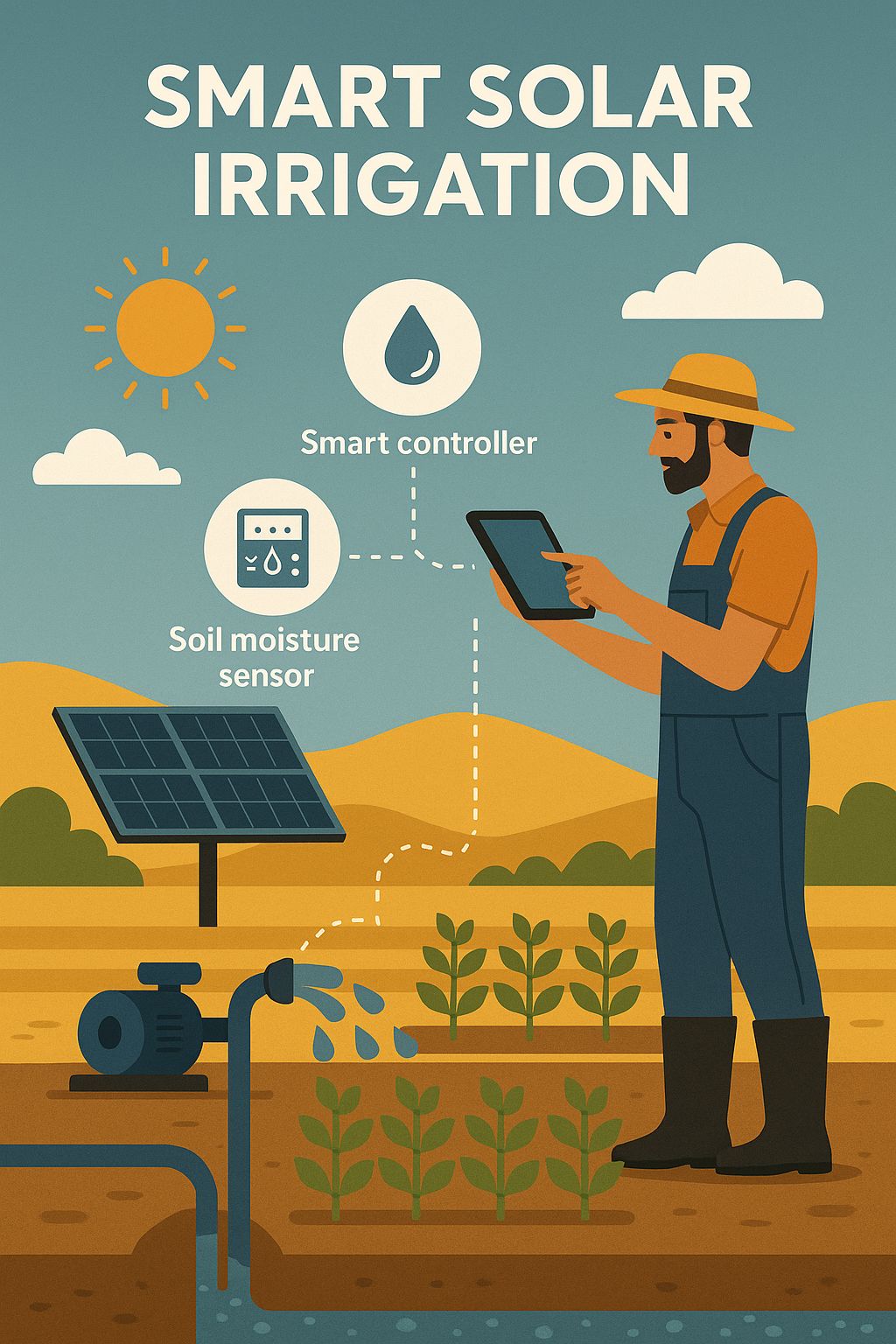
- Smart controllers in solar irrigation systems can reduce water consumption by 20-50% while increasing crop yields by up to 25%.
- Combining soil moisture sensors with weather-based controllers allows for precision irrigation that responds to real-time field conditions.
- Solar-powered smart irrigation systems can slash electricity costs by 40-60% compared to grid-powered alternatives.
- Remote monitoring capabilities enable farmers to manage irrigation from anywhere, saving time and labor costs.
- Modern sensor technology has advanced dramatically in recent years, with improvements in accuracy, durability, wireless connectivity, and energy efficiency.
Water is becoming increasingly scarce and expensive. For farmers, this reality presents a critical challenge that demands innovative solutions.
Smart controllers and sensors are revolutionizing solar irrigation systems, offering farmers unprecedented control over water usage while maximizing the benefits of solar energy. By integrating these technologies, agricultural operations can achieve significant improvements in efficiency, sustainability, and profitability. Growing Solar Mist has been at the forefront of developing these integrated solutions that help farmers navigate water management challenges while reducing operational costs.
Solar-Powered Irrigation: The Future of Water-Efficient Farming
Traditional irrigation methods waste substantial amounts of water through evaporation, runoff, and poor timing. Solar-powered smart irrigation systems address these inefficiencies by delivering precisely the right amount of water exactly when and where crops need it. These systems harness clean, renewable solar energy to power pumps, controllers, and sensors, creating a sustainable approach to modern agriculture that reduces both carbon footprint and operational costs.
The integration of solar energy with smart irrigation technology represents a perfect synergy – the sun provides both the energy to power the system and influences when crops need water most. During peak sunlight hours when evaporation rates are highest, solar panels generate maximum power to drive irrigation systems, ensuring optimal water delivery during critical growing periods.

How Smart Controllers Transform Traditional Irrigation Systems
At the heart of any efficient solar irrigation system lies the controller – the brain that processes data from various sources to make intelligent irrigation decisions. Unlike traditional timers that simply turn systems on and off at predetermined intervals regardless of conditions, smart controllers continuously analyze inputs from multiple sensors and adjust watering schedules accordingly.
These sophisticated devices can reduce water consumption by 20-50% compared to conventional systems while improving crop health and yields. The most advanced controllers incorporate machine learning algorithms that improve decision-making over time, learning from seasonal patterns and crop responses to create increasingly optimized irrigation schedules.
Automated Scheduling Based on Real-Time Data
“Smart controllers have transformed our almond operation. We’ve cut water usage by 32% while improving nut quality and yield. The system paid for itself in just 18 months through water savings alone.” – James Harvester, California Almond Grower
Smart controllers excel at creating dynamic watering schedules that adapt to changing conditions. Rather than relying on fixed timetables, these systems analyze data from soil moisture sensors, weather stations, and crop monitoring tools to determine precisely when irrigation should occur. This adaptive approach ensures crops receive optimal hydration without wasting resources.
Most advanced controllers allow for zone-specific programming, recognizing that different areas of a farm may have varying soil types, slopes, sun exposure, and crop varieties – each requiring customized irrigation approaches. Some systems can manage dozens or even hundreds of zones independently, bringing unprecedented precision to water management.
The automation capabilities extend beyond simple on/off functions. Today’s smart controllers can gradually ramp pumping speeds up and down, regulate pressure throughout the system, and sequence zone activations to maximize solar energy utilization and water distribution uniformity. This level of sophistication ensures every drop of water and watt of solar power is used efficiently.
For farms with variable water sources, smart controllers can prioritize and switch between options based on availability, quality, and cost – automatically selecting well water, surface water, or recycled water depending on current conditions and crop needs.
Remote Control Capabilities Through Mobile Apps
Modern smart controllers offer comprehensive remote management through dedicated mobile applications and web interfaces. These platforms allow farmers to monitor system status, adjust settings, and respond to alerts from anywhere with internet connectivity. The convenience of controlling irrigation systems remotely translates to significant labor savings and faster response times when conditions change unexpectedly. Some platforms even provide visual data representations through intuitive dashboards, making complex irrigation information easily digestible and actionable.
Integration With Weather Forecasts
Advanced smart controllers connect to real-time weather data services, allowing them to make proactive irrigation decisions based on upcoming conditions. When rain is forecasted, these systems can automatically postpone scheduled irrigation cycles, preventing water waste and avoiding potential issues like fungal diseases that thrive in overly wet conditions. This weather-responsive capability represents a significant improvement over traditional timers that continue watering regardless of environmental conditions.
The most sophisticated systems utilize hyperlocal weather data that accounts for microclimates within a specific farm, recognizing that weather can vary significantly even across relatively small geographical areas. These controllers can factor in not just precipitation, but also temperature, humidity, wind speed, and solar radiation levels to calculate evapotranspiration rates with remarkable accuracy, ensuring irrigation precisely matches plant water requirements.
Energy Management Features
Smart controllers optimize the interplay between solar energy production and irrigation system operation, maximizing efficiency by running pumps and other components when solar power is abundant. Some controllers incorporate battery storage management, intelligently deciding when to store excess solar energy and when to draw from batteries based on irrigation priorities and forecasted energy production. This energy-aware scheduling ensures the system operates at peak efficiency while minimizing reliance on backup power sources.
Essential Sensors That Maximize Water Conservation
While controllers serve as the brain of smart irrigation systems, sensors function as the critical sensory organs that gather real-time data about soil, weather, and plant conditions. The integration of diverse sensor types creates a comprehensive monitoring network that enables truly precision agriculture. These sensors communicate continuously with the controller, providing the crucial environmental feedback necessary for informed irrigation decisions. For more insights into different types of solar-powered systems, you can explore solar-powered irrigation systems that enhance water conservation.
Modern sensor technology has advanced dramatically in recent years, with improvements in accuracy, durability, wireless connectivity, and energy efficiency. Today’s agricultural sensors can operate for years on minimal power, often harvested from small solar cells, while transmitting data reliably across large farm operations. This technological evolution has made sophisticated sensing networks accessible to farms of all sizes. For more information on how these advancements integrate with solar technology, explore our guide on solar-powered drip irrigation systems.
Soil Moisture Sensors: Watering Only When Needed
Soil moisture sensors represent the foundation of precision irrigation, measuring the actual water content available to plant roots rather than relying on estimates or schedules. These sensors can be deployed at multiple depths throughout the root zone to create a complete moisture profile, ensuring water penetrates properly without wasteful deep percolation beyond root access. The most advanced soil sensors also measure temperature, electrical conductivity (as an indicator of nutrient availability), and soil compaction, providing a comprehensive view of root zone conditions.
For optimal coverage, soil moisture sensors should be strategically placed to represent different irrigation zones, soil types, and topographical features across a farm. Most agricultural operations benefit from deploying sensors in both the driest areas (which typically need water first) and wettest areas (to prevent overwatering) within each irrigation zone. This distributed sensing approach enables micro-zone management that maximizes both water efficiency and crop performance. Learn more about smart irrigation technology to enhance your farming practices.
Weather Stations: Adjusting to Environmental Conditions
On-farm weather stations provide hyperlocal atmospheric data that far exceeds the accuracy of regional weather forecasts for irrigation decision-making. These compact units typically measure temperature, humidity, wind speed, solar radiation, and rainfall – all factors that directly impact crop water requirements. The data collected enables calculation of evapotranspiration rates specific to the farm’s microclimate, allowing for irrigation scheduling based on actual water lost through evaporation and plant transpiration rather than generic estimates.
Many advanced solar irrigation systems incorporate multiple weather monitoring points across larger operations, recognizing that conditions can vary significantly within a single farm due to elevation changes, windbreaks, and other landscape features. This distributed weather monitoring enables zone-specific irrigation adjustments that further enhance water efficiency.
Flow Meters: Tracking Water Usage and Detecting Leaks
|
Sensor Type |
Primary Function |
Water Savings Potential |
Typical ROI Timeline |
|---|---|---|---|
|
Soil Moisture Sensors |
Measure available water in root zone |
15-30% |
6-18 months |
|
Weather Stations |
Calculate evapotranspiration rates |
10-25% |
12-24 months |
|
Flow Meters |
Monitor water usage and detect leaks |
5-15% |
12-36 months |
|
Pressure Sensors |
Maintain optimal system performance |
5-10% |
18-36 months |
Flow meters provide critical data on water volume delivered to crops, enabling precise tracking of irrigation efficiency and rapid detection of system problems. When integrated with smart controllers, flow meters can automatically identify leaks, broken lines, or clogged emitters by detecting discrepancies between expected and actual flow rates. This early warning system prevents both water waste and crop damage that might otherwise go unnoticed for days or weeks with traditional systems.
Beyond troubleshooting, flow measurement data creates valuable historical records that help farmers optimize water use over time, document compliance with water regulations, and make informed decisions about future irrigation investments. Many agricultural regions now require water usage reporting, making flow meters an increasingly essential component of modern irrigation systems.
Pressure Sensors: Maintaining Optimal System Performance
Pressure sensors monitor hydraulic conditions throughout the irrigation system, ensuring water is delivered at the ideal pressure for maximum distribution uniformity and application efficiency. These sensors can detect pressure fluctuations that might indicate problems like pipe restrictions, pump issues, or excessive elevation changes affecting water delivery. By maintaining optimal pressure ranges, smart irrigation systems achieve more consistent water application, eliminating both over-watered and under-watered areas that plague many traditional setups.
The most sophisticated systems incorporate multiple pressure monitoring points throughout the irrigation network, creating a comprehensive hydraulic profile that helps identify inefficiencies and optimization opportunities. This distributed pressure monitoring is especially valuable in large or topographically varied operations where maintaining consistent pressure presents significant challenges.

The Economic Benefits of Smart Solar Irrigation
The financial advantages of implementing smart solar irrigation extend far beyond simple water savings. These systems create comprehensive economic benefits that significantly improve farm profitability through multiple channels. The combination of reduced input costs, labor savings, improved crop quality, and potential regulatory compliance benefits creates a compelling return on investment case for farms of all sizes.
While the initial investment in smart solar irrigation technology can be substantial, ranging from $5,000 for small operations to $50,000+ for large farms, the payback period typically ranges from 2-5 years depending on water costs, crop value, and available incentives. This represents an attractive return compared to many other agricultural investments, particularly considering the long operational lifespan of quality components.
The most significant economic benefits often come from the second-order effects that aren’t immediately obvious – reduced fertilizer leaching, decreased disease pressure, more efficient harvesting due to uniform crop development, and the ability to optimize irrigation timing to maximize yield quality rather than just quantity. These advantages compound over time as farmers gain experience with their solar-powered drip irrigation systems.
Water Savings of 20-50% Compared to Traditional Methods
Water conservation represents the most direct and measurable economic benefit of smart irrigation systems. By applying water precisely when and where needed, these systems typically reduce consumption by 20-50% compared to conventional approaches. In regions with high water costs or allocation limits, these savings alone can justify the investment in smart technology. For example, in California’s Central Valley where water costs have exceeded $1,000 per acre-foot during drought years, a 30% reduction in water use can translate to savings of $300+ per acre annually.
Beyond direct cost savings, improved water efficiency provides strategic advantages in water-scarce regions by allowing farmers to irrigate more acreage with limited allocations or maintain production during drought restrictions. This water security represents a significant risk reduction benefit that enhances long-term farm viability and property values.
Reduction in Electricity Costs Through Solar Power
Energy represents one of the largest operational expenses for irrigated agriculture, particularly in regions relying on deep groundwater pumping. Solar-powered irrigation systems dramatically reduce or eliminate these energy costs, providing immediate operational savings. Depending on local electricity rates and pumping requirements, solar irrigation can reduce energy expenses by 40-90%, with many systems achieving complete energy independence during the primary growing season.
The economics of solar power continue to improve as panel efficiency increases and costs decrease. Modern solar irrigation systems can be designed with appropriate battery storage to ensure consistent operation even during periods of limited sunlight, providing reliable irrigation capacity while maintaining the economic benefits of renewable energy. For farms with net metering agreements, excess solar production during non-irrigation periods can be fed back into the grid, creating additional revenue streams that further enhance the system’s economic performance.
Labor Savings Through Automation
The automation capabilities of smart irrigation systems create substantial labor efficiencies that reduce operational costs while improving irrigation precision. Traditional irrigation often requires frequent manual adjustments, system checks, and time-consuming troubleshooting – all tasks that smart systems handle automatically. Remote monitoring and control features allow operators to manage irrigation from anywhere via smartphone applications, eliminating time-consuming field visits and enabling one person to effectively manage much larger irrigation operations. Learn more about solar-powered irrigation systems that offer similar automation benefits.
These labor efficiencies typically reduce irrigation management time by 50-75%, allowing farm personnel to focus on other productive activities. Additionally, the alert systems in smart controllers immediately notify operators about system issues, reducing costly downtime and preventing crop stress that might otherwise go unnoticed for days with traditional systems.
Return on Investment Timeline
“After installing our smart solar irrigation system, we documented a 42% reduction in water usage, 68% decrease in energy costs, and nearly eliminated irrigation-related labor. The entire system paid for itself in just 27 months.” – Maria Rodriguez, Texas Cotton Farmer
The return on investment timeline for smart solar irrigation systems varies based on several factors, including existing infrastructure, crop value, water costs, energy prices, and available incentives. However, most properly designed systems achieve full payback within 2-5 years through combined water, energy, and labor savings. For high-value specialty crops where improved irrigation precision also enhances quality and yield, the payback period can be even shorter – sometimes as little as a single growing season.
It’s worth noting that many agricultural lenders now offer favorable financing terms for irrigation efficiency projects, recognizing both their economic benefits and their contribution to farm sustainability. These financing options, combined with various incentive programs, can significantly improve cash flow during the initial implementation period.
Real-World Success Stories From Farmers
The practical benefits of smart solar irrigation are best illustrated through the experiences of farmers who have successfully implemented these systems. Across diverse agricultural regions, crops, and operation sizes, the consistent theme among adopters is that the technology delivers measurable improvements in efficiency, sustainability, and profitability. These case studies provide valuable insights into both the potential benefits and implementation considerations for farms considering similar investments.
While each operation faces unique challenges and opportunities, these success stories highlight common factors that contribute to successful implementation – including proper system sizing, strategic sensor placement, integration with existing farm management practices, and ongoing optimization based on performance data. The most successful adopters view smart irrigation not as a one-time installation but as an evolving system that improves over multiple growing seasons as they gain experience and refine their approach.
California Almond Grower Cuts Water Use by 30%
A 500-acre almond operation in California’s Central Valley implemented a comprehensive smart solar irrigation system featuring soil moisture sensors at multiple depths, on-farm weather stations, and variable-frequency drive pumps powered by a 75kW solar array. After the first full season with the new system, the operation documented a 30% reduction in water application while maintaining yield and improving nut quality metrics. The precision irrigation approach particularly benefited the operation during critical flowering and hull-split periods, when optimal moisture management directly impacts crop value.
Beyond water savings, the farm reported a 62% reduction in energy costs and significant improvements in field staff productivity. The system’s remote monitoring capabilities allowed the irrigation manager to reduce field visits while gaining more comprehensive insights into soil moisture conditions across the entire operation. The complete system achieved ROI within three seasons, primarily through water savings and improved crop quality premiums.
Texas Cotton Farmer Reduces Pumping Costs by 45%
A 1,200-acre cotton operation in the Texas High Plains replaced aging center pivot systems with smart solar-powered alternatives, incorporating soil moisture sensors, pressure monitoring, and variable-rate irrigation capabilities. The new system reduced groundwater pumping by 28% while improving yield uniformity across fields with variable soil types. The most significant economic benefit came from energy savings, with the solar component reducing electricity costs by 45% compared to the previous grid-powered system.
The operation utilized weather-based scheduling combined with soil moisture verification to optimize irrigation timing, particularly during the critical flowering and boll development stages. This precision approach not only conserved water but also reduced disease pressure and improved fiber quality metrics. The farmer reported that the system paid for itself within four years through combined energy savings, water conservation, and yield improvements.
Small-Scale Vegetable Farm Improves Crop Quality
A 15-acre diversified vegetable operation in New England implemented a zone-based smart drip irrigation system powered by a 12kW solar array with battery storage. The system incorporated soil moisture sensors for each crop type and utilized crop-specific irrigation programs to meet the diverse needs of multiple vegetable varieties. Despite the relatively small scale, the operation achieved impressive results, including a 40% reduction in water use and virtual elimination of irrigation-related energy costs.
The most significant benefit reported was improved crop quality and consistency, particularly for moisture-sensitive crops like tomatoes and leafy greens. The precision irrigation approach reduced splitting in tomatoes and improved shelf life for greens, allowing the farm to command premium prices at farmers’ markets and through restaurant sales. For this small-scale intensive operation, the quality improvements and labor savings provided even greater economic benefits than the direct water and energy cost reductions.

Step-by-Step Installation Guide
Implementing a smart solar irrigation system requires careful planning and execution to ensure optimal performance and maximum return on investment. While each farm has unique requirements, the following step-by-step approach provides a framework for successful implementation regardless of scale or crop type. This methodical process helps farmers avoid common pitfalls and create systems tailored to their specific needs.
Professional assistance is recommended for system design and installation, particularly for the electrical components connecting solar arrays to irrigation controllers and pumps. However, understanding the overall process empowers farmers to make informed decisions and effectively communicate their requirements to contractors and suppliers. For more insights, explore different solar-powered irrigation systems available for farmers.
1. Assess Your Current Irrigation System
Begin by thoroughly evaluating your existing irrigation infrastructure, documenting current water sources, distribution systems, application methods, and control capabilities. Identify components that can be integrated into the new smart system and those that should be upgraded or replaced. Pay particular attention to distribution uniformity, as even the most sophisticated controllers cannot compensate for poorly designed delivery systems. Measure current water use as a baseline for calculating future savings and performance improvements.
This assessment should include water quality testing, pressure measurements throughout the system, and evaluation of energy consumption patterns. For operations with multiple irrigation zones or blocks, document the specific requirements of each area, considering factors like crop type, soil variations, slope, and exposure. This comprehensive understanding of your current system provides the foundation for designing effective upgrades.
2. Calculate Your Water and Energy Requirements
Develop detailed estimates of your irrigation water requirements based on historical usage, crop needs, and climate conditions. Calculate peak demand periods to ensure your system can meet maximum requirements during critical growth stages. Similarly, determine energy requirements for pumping and system operation throughout the growing season, accounting for seasonal variations and potential future expansion.
This analysis should include consideration of water storage options that might allow you to optimize solar energy utilization by pumping during peak sunlight hours and storing water for later application. For operations in regions with seasonal water availability, calculate storage requirements that might allow capture of water during abundant periods for use during scarcity.
3. Select Compatible Controllers and Sensors
Choose smart controllers and sensors that meet your specific operational needs while ensuring compatibility between components. Consider factors like the number of zones required, communication protocols, wireless range needs, and integration capabilities with existing farm management software. Select sensors appropriate for your soil types, crops, and climate conditions, with particular attention to durability, accuracy, and power requirements.
When evaluating controllers, prioritize systems with intuitive user interfaces, comprehensive data reporting, and robust remote access capabilities. The most sophisticated technology provides limited benefits if it’s too complex for farm personnel to effectively utilize. Similarly, sensor selection should balance precision with practicality, focusing on measurements that directly inform irrigation decisions rather than collecting data for its own sake.
4. Position Solar Panels for Maximum Efficiency
Solar array placement significantly impacts system performance and return on investment. Work with solar specialists to identify optimal locations that maximize sun exposure throughout the day and year while minimizing shading and environmental risks. Consider factors like panel orientation, tilt angle, mounting height, and distance from pumps and controllers to minimize energy losses in transmission. For larger operations, multiple smaller arrays positioned near key irrigation components often prove more efficient than a single centralized system.
The solar component should be appropriately sized to meet peak energy demands with some margin for cloudy periods, degradation over time, and potential future expansion. For systems without battery storage, careful matching of solar production patterns with irrigation scheduling can maximize the direct utilization of solar energy without oversizing the array.
5. Connect and Program Your Smart System
The integration phase connects solar power generation with smart controllers, sensors, and irrigation components into a cohesive system. Establish reliable communication between all components, ensuring sensors correctly transmit data to controllers and controllers properly activate irrigation equipment. Program initial settings based on crop requirements, soil conditions, and climate patterns, creating zone-specific irrigation schedules that maximize efficiency while meeting plant needs.
This phase should include comprehensive testing under various conditions to verify system performance before relying on automation for critical irrigation decisions. Document baseline settings and performance metrics to serve as references for future optimization as you gain experience with the system’s capabilities and limitations.
Maintenance Tips to Keep Your System Running Efficiently
Proper maintenance ensures your smart solar irrigation system continues delivering optimal performance and maximum return on investment throughout its operational life. While these systems require significantly less day-to-day attention than traditional irrigation, they do need regular preventive maintenance to avoid costly failures and performance degradation. A structured maintenance program addresses all system components – from solar panels to sensors to delivery equipment.
The most successful maintenance approaches combine scheduled preventive activities with continuous monitoring that identifies potential issues before they impact performance. Smart controllers can facilitate this process by automatically flagging anomalies in system operation that might indicate developing problems requiring attention. This predictive maintenance capability represents a significant advantage over traditional systems that often fail without warning.
Documentation plays a crucial role in effective maintenance, creating records of system performance, component replacements, and operational adjustments that inform future decisions. These records prove particularly valuable when troubleshooting intermittent issues or planning system expansions and upgrades.
Seasonal Sensor Calibration Schedule
Sensors require regular calibration to maintain accuracy and reliability, with frequency depending on sensor type, environmental conditions, and manufacturer recommendations. Soil moisture sensors typically need calibration at the beginning of each growing season and verification checks monthly during active irrigation periods. Weather stations should be calibrated according to manufacturer specifications, typically twice yearly, with special attention to rain gauges and wind sensors that can be affected by debris accumulation.
Calibration procedures vary by sensor type but generally involve comparing sensor readings against known standards or alternative measurement methods and making appropriate adjustments. Many modern sensors incorporate self-calibration capabilities that simplify this process, but regular verification remains essential for critical measurements that directly influence irrigation decisions.
Solar Panel Cleaning and Inspection
Solar panels require periodic cleaning to remove dust, pollen, bird droppings, and other debris that can significantly reduce energy production. In most agricultural environments, quarterly cleaning is recommended, with additional cleaning following major dust events or prolonged dry periods. Simple water rinsing during early morning hours is typically sufficient, though stubborn deposits may require soft brushes and mild detergent solution.
Software Updates and Battery Replacement
The technological components of smart irrigation systems require regular software updates and battery maintenance to ensure reliable operation. Controller software should be updated whenever manufacturers release new versions that improve functionality or address security vulnerabilities. For wireless sensors operating on battery power, develop a staggered replacement schedule based on expected battery life rather than waiting for failures that could create data gaps during critical periods.
Battery systems associated with solar storage require specific maintenance according to battery type and manufacturer recommendations. Flooded lead-acid batteries typically need electrolyte level checks monthly, while sealed batteries and lithium systems require less frequent but still regular inspection of connections and operating conditions. For a comprehensive understanding of different solar-powered irrigation systems, exploring various types, examples, and methods can be beneficial.
Maintain detailed records of all software versions, update history, and battery replacements to facilitate troubleshooting and ensure timely preventive maintenance. Many smart controllers can automatically track battery status and alert operators when replacements are needed, but manual verification remains an important backup procedure.
- Check and clean filters weekly during peak irrigation season
- Inspect drip lines and emitters monthly for clogging or damage
- Test backup power systems quarterly
- Verify sensor readings against manual measurements monthly
- Update system maps whenever modifications are made
- Perform comprehensive system evaluation annually

Future-Proof Your Farm with Smart Irrigation Technology
Investing in smart solar irrigation represents more than an efficiency upgrade – it positions agricultural operations for long-term success in an increasingly water-constrained and climate-challenged world. As regulatory pressures increase, water availability decreases, and consumer demands for sustainable production grow, farms equipped with precision water management capabilities will maintain significant competitive advantages. By implementing these technologies today, farmers not only realize immediate operational benefits but also build resilience against future challenges while demonstrating environmental stewardship that increasingly influences market access and product valuation.
Frequently Asked Questions
As farmers consider implementing smart solar irrigation systems, several common questions arise regarding costs, performance, compatibility, and support. Addressing these concerns helps potential adopters make informed decisions based on realistic expectations and accurate information. While specific answers vary depending on individual farm conditions and selected technology, the following responses provide general guidance applicable across most agricultural contexts.
Beyond these frequently asked questions, farmers should consult with irrigation specialists, solar installers, and agricultural extension services familiar with local conditions and requirements. Many equipment manufacturers and system integrators also offer site assessments and customized recommendations based on specific farm characteristics and production goals. These personalized consultations often identify opportunities and considerations not addressed in general guidance.
Smart irrigation technology continues evolving rapidly, with new capabilities and improved components regularly entering the market. Staying informed through agricultural publications, manufacturer updates, and peer networks helps farmers identify innovations that might further enhance their irrigation efficiency and system performance.
- What size solar system do I need for my irrigation pumps?
- How reliable are wireless soil moisture sensors?
- Can smart controllers work with all types of irrigation systems?
- Do I need internet connectivity for smart irrigation systems?
- How do I protect outdoor electronic components from weather damage?
How much can I expect to save on water costs with smart solar irrigation?
Water savings typically range from 20-50% compared to conventional irrigation methods, with the exact amount depending on your current efficiency, crop type, soil conditions, and climate. For operations currently using basic timer-based systems without weather adjustment, savings tend toward the higher end of this range. Farms already employing some efficiency measures might see more modest percentage improvements but still achieve significant absolute water savings. These reductions translate directly to cost savings in regions with volumetric water pricing and provide strategic advantages where water allocations are limited or declining.
Beyond direct water cost savings, the precision application provided by smart systems often reduces energy costs for pumping, minimizes nutrient leaching (decreasing fertilizer requirements), and can improve crop quality and yield through optimal moisture management. When calculating return on investment, consider these secondary benefits alongside direct water savings for a complete economic assessment.
Will my smart irrigation system work during cloudy days?
Yes, properly designed solar irrigation systems continue functioning during cloudy conditions through several strategies. Most systems incorporate battery storage that accumulates excess energy during sunny periods for use when solar production decreases. System designers typically size solar arrays to generate sufficient power even under partial cloud cover, providing reliable operation under most conditions.
“Modern solar irrigation systems maintain 85-95% operational reliability even in regions with frequent cloud cover. The key is appropriate system design that accounts for local weather patterns and incorporates adequate storage capacity.” – Solar Irrigation Institute
For extended periods of limited sunlight, smart controllers can implement conservation modes that prioritize critical irrigation zones while temporarily reducing water delivery to more drought-tolerant areas. Some systems also include automatic switching to grid power when available, ensuring continuous operation regardless of weather conditions while still maximizing solar utilization when possible.
Weather-integrated smart controllers actually improve irrigation efficiency during cloudy periods by automatically adjusting water application based on reduced evapotranspiration rates. This weather-responsive capability ensures crops receive appropriate moisture without wasteful overwatering during periods of lower water stress.
Can I integrate smart controllers with my existing irrigation setup?
Most smart controllers can be retrofitted to existing irrigation infrastructure without complete system replacement. Modern controllers are designed to work with standard solenoid valves, pumps, and distribution systems found in conventional irrigation setups. The controller essentially replaces the timer or manual control system while adding intelligent management capabilities. This modular approach allows farms to implement smart technology incrementally, upgrading controllers and adding sensors while maintaining existing delivery infrastructure.
The compatibility assessment should consider electrical requirements, communication protocols, and physical connections between new smart components and existing equipment. Some older systems may require interface adaptors or valve replacements to ensure proper communication and control. A professional irrigation technician can evaluate your current setup and identify any compatibility issues before purchase, preventing costly surprises during installation. For maximum benefit, consider upgrading distribution components that limit uniformity or efficiency, as even the smartest controllers cannot overcome fundamental hydraulic limitations in water delivery systems.
What’s the average lifespan of soil moisture sensors?
Quality soil moisture sensors typically operate reliably for 3-7 years in agricultural applications, with specific lifespan depending on sensor type, installation method, soil conditions, and environmental factors. Capacitance-based sensors generally offer longer service life than gypsum block sensors but may provide less accuracy in certain soil types. Professional-grade sensors from reputable manufacturers consistently outperform budget options in both accuracy and durability, making them better long-term investments despite higher initial costs.
Proper installation significantly impacts sensor longevity. Sensors installed according to manufacturer specifications with appropriate protection from mechanical damage during field operations often exceed their expected service life. Conversely, improper installation can lead to premature failure or erratic readings that undermine the effectiveness of the entire irrigation management system.
Environmental factors affecting sensor lifespan include soil salinity, temperature extremes, freeze-thaw cycles, and moisture variability. Sensors in highly saline soils typically require more frequent replacement, while those in stable moisture environments often exceed warranty periods. Some sensors include replaceable elements that allow refurbishment rather than complete replacement when certain components degrade.
Modern smart irrigation systems often incorporate sensor health monitoring that alerts operators to potential sensor failures before they affect irrigation decisions. This predictive capability allows for planned replacements during convenient maintenance windows rather than emergency responses during critical irrigation periods.
|
Sensor Type |
Expected Lifespan |
Accuracy Characteristics |
Best Applications |
|---|---|---|---|
|
Capacitance |
5-7 years |
Excellent in most soils, affected by salinity |
Permanent crops, precision applications |
|
Tensiometer |
3-5 years with maintenance |
Very accurate, requires regular service |
Research, high-value specialty crops |
|
TDR (Time Domain Reflectometry) |
5-10 years |
Highest accuracy, minimal soil dependency |
Scientific applications, variable soils |
|
Gypsum Block |
1-3 years |
Less precise, good for trend monitoring |
Low-cost applications, drought monitoring |
Are there government rebates available for solar irrigation systems?
Yes, numerous government incentives exist for solar irrigation systems at federal, state, and local levels. The federal Investment Tax Credit (ITC) remains one of the most significant benefits, allowing agricultural operations to deduct a substantial percentage of solar system costs from federal taxes. Additionally, the USDA’s Rural Energy for America Program (REAP) provides grants and guaranteed loans specifically for renewable energy systems and energy efficiency improvements on agricultural operations. These federal programs combine with state-specific incentives that vary widely by location but often include additional tax credits, rebates, and accelerated depreciation allowances.
Beyond direct financial incentives, many agricultural water districts and conservation programs offer technical assistance, cost-sharing arrangements, and special financing for irrigation efficiency improvements. These programs frequently prioritize projects that combine renewable energy with water conservation, making smart solar irrigation systems particularly attractive candidates for support. Some utility companies also provide rebates or preferential rates for agricultural operations implementing energy-efficient irrigation technologies, especially in regions facing water scarcity or energy capacity constraints.
The available incentives change frequently as programs expire, and new initiatives emerge. Working with agricultural extension services, irrigation specialist’s familiar with local programs, or consultants specializing in agricultural energy projects can help identify all applicable incentives for your specific location and operation type. Many system providers also assist with incentive application processes as part of their service offerings, simplifying access to these valuable financial resources that can significantly improve project economics.


Leave a Reply