
Key Takeaways
- Solar trackers can boost energy capture by up to 40% compared to fixed systems, significantly reducing irrigation energy costs for farmers
- Regular maintenance and cleaning can prevent up to 25% power loss in solar panel systems, ensuring optimal efficiency for farm operations
- Upgrading to premium inverters and implementing battery storage solutions can enable 24/7 irrigation capabilities, even during nighttime hours
- Strategic panel placement based on geographic location and seasonal adjustments can maximize sunlight exposure and energy production
- Drone technology provides revolutionary shade analysis capabilities for agricultural solar planning. Equipped with specialized cameras and software, drones can map potential installation sites throughout the day.
Cut Farm Energy Costs by 40%: Solar Panel Efficiency Secrets
Irrigation costs are eating into your farm’s profits. With traditional systems consuming 30-50% of your total electricity usage, finding ways to optimize your solar panel efficiency isn’t just smart—it’s essential for survival. By implementing the right solar efficiency strategies, you can slash energy costs while ensuring your crops receive optimal irrigation.
Modern farming demands modern solutions, and solar-powered irrigation systems represent the intersection of agriculture and sustainable technology. The challenge isn’t just installing solar panels—it’s maximizing their efficiency to deliver consistent power for your irrigation needs. Growing Solar Mist specializes in helping farmers optimize their solar systems to achieve maximum output and significant cost savings.
The statistics speak for themselves: properly optimized solar panel systems can reduce farm energy costs by up to 40% annually while providing reliable power even during grid outages. This translates to thousands of dollars saved each year, particularly for operations with substantial irrigation requirements. But achieving these results requires strategic implementation of efficiency-boosting techniques tailored to your farm’s specific needs.
Why Traditional Irrigation Systems Drain Your Farm’s Budget
Conventional irrigation relies heavily on grid electricity or diesel generators, both of which come with significant drawbacks. Grid electricity prices continue to rise unpredictably, with agricultural rates increasing by an average of 5-7% annually in many regions. This creates a constant upward pressure on operating costs that cuts directly into your bottom line. To explore sustainable alternatives, consider solar-powered irrigation systems that can help mitigate these rising costs.
Diesel-powered pumps represent another costly alternative, requiring regular fuel purchases, maintenance, and eventual replacement. The environmental impact is substantial, with each gallon of diesel burned producing approximately 22 pounds of carbon dioxide. Beyond environmental concerns, diesel systems create noise pollution and require frequent attention, diverting precious time away from other essential farming activities. For more sustainable options, exploring solar panel battery technology can provide efficient energy solutions for agriculture.
Perhaps most critically, traditional systems lack the flexibility to adapt to changing conditions. They operate at full capacity regardless of actual water needs, wasting both energy and water resources. During peak demand periods or power outages, these systems often fail completely, leaving crops vulnerable precisely when they need water most.
How Optimized Solar Panels Save Water and Money
Solar-powered irrigation systems represent a fundamentally different approach to farm water management. By generating electricity directly from sunlight, these systems eliminate fuel costs and drastically reduce dependency on the grid. When properly optimized, they provide reliable power precisely when irrigation demands are typically highest—during sunny, dry periods. Learn more about solar-powered irrigation systems and their benefits.
Water conservation benefits emerge naturally from solar-powered systems. Since power generation correlates with sunlight intensity, these systems encourage irrigation during optimal daylight hours when evaporation losses are higher. This natural synchronization promotes more efficient water use compared to nighttime irrigation from traditional systems. Farmers implementing optimized solar irrigation systems report water savings of 15-20%, particularly in arid regions where every drop counts.
The financial advantages extend beyond simple energy cost reduction. Solar systems qualify for numerous incentives, including federal tax credits, accelerated depreciation, and agricultural-specific grants like the USDA’s Rural Energy for America Program (REAP). With potential funding covering up to 25% of project costs, the return on investment timeline shortens dramatically. Most optimized systems achieve complete payback within 4-7 years, followed by decades of nearly free energy production.
5 Proven Upgrades to Maximize Your Solar Panel Output
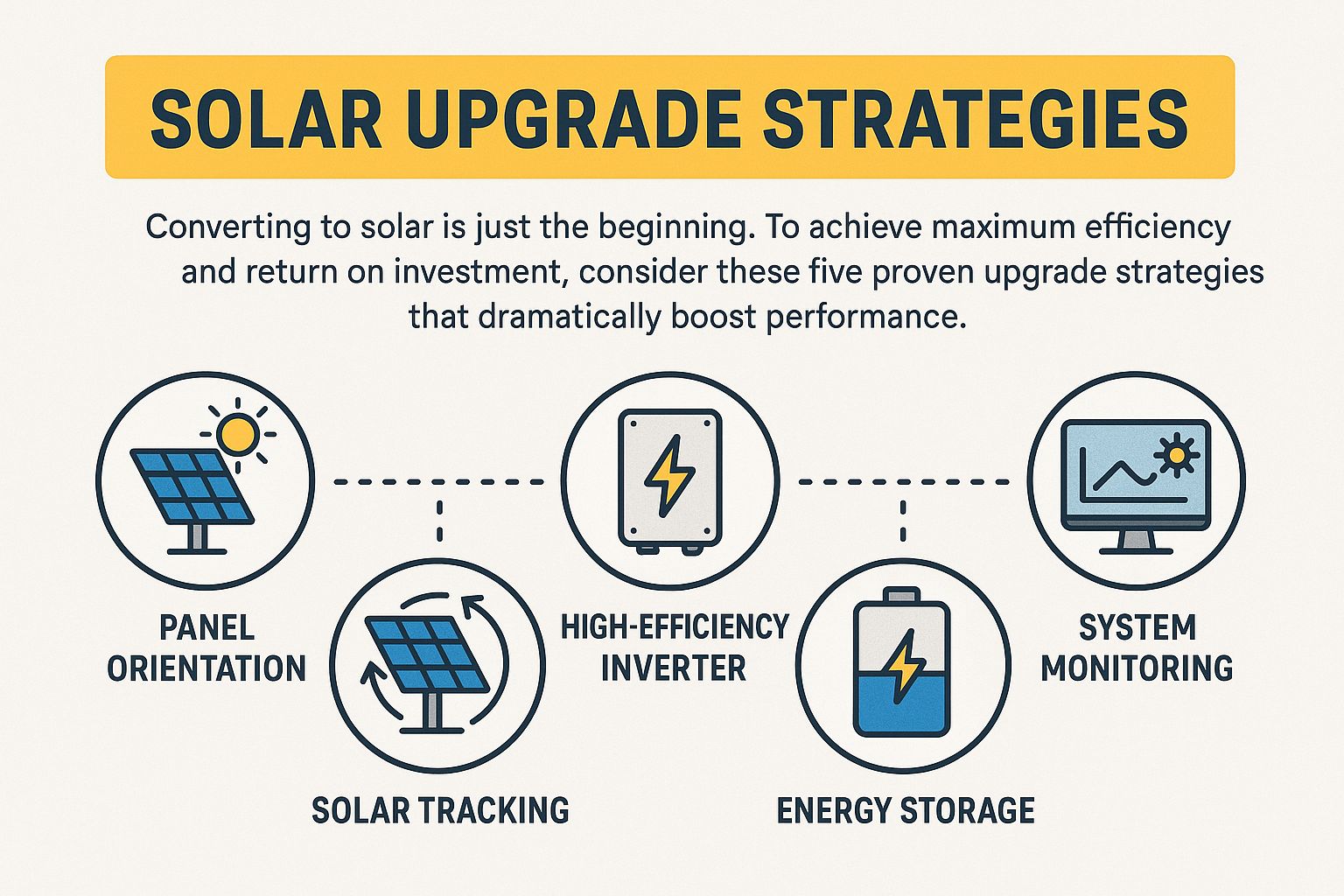
Converting to solar is just the beginning. To achieve maximum efficiency and return on investment, consider these five proven upgrade strategies that dramatically boost performance. Each improvement targets a specific aspect of system efficiency, combining to create a comprehensive approach to solar optimization.
1. Install Solar Tracking Systems for 25-40% More Energy
Fixed solar arrays remain stationary throughout the day, capturing optimal sunlight only during peak hours. Solar trackers fundamentally change this equation by continuously adjusting panel position to follow the sun’s path across the sky. Single-axis trackers move along one plane (typically east to west), while dual-axis systems adjust both horizontally and vertically to maintain perfect alignment with the sun regardless of season or time of day.
The efficiency gains are substantial: single-axis trackers typically increase energy production by 25-35%, while dual-axis systems can boost output by 35-45% compared to fixed installations. This translates directly to more available power for irrigation pumps, extending operating hours and increasing water delivery capacity without expanding the solar array size.
- Single-axis trackers: 25-35% increased production, lower cost, simpler maintenance
- Dual-axis trackers: 35-45% increased production, optimal for limited space installations
- Tracking controllers: Smart systems that adjust based on weather conditions and seasonal changes
- Mechanical vs. hydraulic systems: Different durability and maintenance requirements based on local conditions
While trackers require additional investment upfront, their performance advantages often justify the cost, particularly for irrigation-focused installations where water pumping needs align with daylight hours. The increased production means smaller array size requirements, partially offsetting the tracker expense through reduced panel and mounting hardware costs.
2. Clean Panels Regularly to Prevent 25% Performance Loss
Dirt, dust, pollen, bird droppings, and agricultural debris create a persistent challenge for farm-based solar installations. Even a thin layer of dust can reduce panel efficiency by 5-7%, while heavier soiling may decrease output by 20-25% or more. Agricultural environments present particular challenges, with activities like plowing, harvesting, and spraying creating substantial airborne particulates that settle on panel surfaces. To tackle these issues, some farmers are exploring drones to boost solar panel efficiency and maintain optimal performance.
Implementing a regular cleaning schedule based on local conditions proves essential for maintaining optimal performance. In dusty, low-rainfall regions, monthly cleaning may be necessary, while areas with frequent rain may require quarterly maintenance. The cleaning process itself requires careful attention—high-pressure water can damage panel seals and connections, while improper scrubbing risks scratching the protective glass surface.
Panel Cleaning Best Practices
• Clean during early morning or evening when panels are cool
• Use soft brushes, microfiber cloths, and proper solar panel cleaning solutions
• Avoid abrasive materials and harsh chemicals that can damage panel surfaces
• Consider automated cleaning systems for large installations
• Document cleaning to establish correlation between maintenance and performance
The return on investment for regular cleaning is among the highest of any efficiency improvement. With minimal equipment costs and straightforward procedures, even manual cleaning delivers immediate performance improvements. For larger installations, automated cleaning systems—including robotic cleaners and integrated spray systems—offer consistent maintenance with reduced labor requirements.
3. Upgrade to Premium Inverters for Better Power Conversion
Inverters serve as the heart of your solar irrigation system, converting DC electricity generated by solar panels into AC power for pumps and equipment. Standard inverters typically operate at 94-96% efficiency, meaning that up to 6% of your hard-earned solar power is lost during conversion. Premium models push this efficiency to 97-99%, immediately increasing available power without adding a single panel to your array.
|
Inverter Type |
Efficiency Range |
Best Application |
Approximate Cost Premium |
|---|---|---|---|
|
Standard String Inverter |
94-96% |
Small to medium systems with consistent sunlight |
Baseline |
|
Premium String Inverter |
96-97% |
Medium systems with minimal shading |
15-25% |
|
Microinverters |
95-98% |
Systems with partial shading issues |
40-60% |
|
Premium Hybrid Inverters |
97-99% |
Systems with battery storage |
30-50% |
Beyond efficiency ratings, modern inverters offer features specifically beneficial for irrigation applications. Advanced monitoring capabilities provide real-time performance data, allowing farmers to correlate energy production with water delivery. Smart inverters can prioritize critical loads during low-production periods, ensuring irrigation pumps receive available power before secondary systems.
When selecting an inverter upgrade, consider models designed specifically for agricultural applications. These units often feature enhanced dust protection, wider operating temperature ranges, and surge protection designed for rural power conditions. While premium inverters require additional investment, their efficiency gains and extended warranties (typically 10-12 years versus 5-7 for standard models) create compelling long-term value.
4. Add Battery Storage for Night Irrigation
Battery storage transforms an intermittent solar power system into a reliable 24/7 irrigation solution. By capturing excess daytime production for nighttime use, batteries enable irrigation scheduling based on crop needs rather than sunlight availability. This capability proves particularly valuable during critical growth stages when consistent moisture levels directly impact yield and quality.
Modern lithium iron phosphate (LiFePO4) batteries offer the ideal combination of cycle life, safety, and performance for agricultural applications. With expected lifespans of 3,000-4,000 cycles (approximately 10 years of regular use), these systems provide reliable storage without the maintenance requirements of older lead-acid technology. Smart battery management systems protect against overcharging and excessive discharge, maximizing both performance and lifespan. For more on solar-powered solutions, explore solar-powered irrigation systems and their benefits.
- Lithium iron phosphate batteries offer 10+ year lifespan with minimal maintenance
- System sizing should account for critical irrigation needs during 2-3 days of limited sunlight
- Integration with existing generators provides comprehensive backup during extended poor weather
- Battery systems qualify for the federal Investment Tax Credit when installed with new solar arrays
Strategic battery deployment allows for irrigation during optimal nighttime hours when evaporation losses are minimized. This capability alone can reduce water consumption by 15-20% compared to daytime irrigation, creating compound benefits for both water conservation and energy efficiency. For farms in regions with time-of-use electricity rates, batteries also enable complete disconnection from the grid during expensive peak periods.
5. Implement Smart Controllers and Sensors
Smart irrigation controllers bridge the gap between energy production and water application, creating a responsive system that maximizes efficiency across both domains. These systems integrate real-time data from multiple sources—soil moisture sensors, weather forecasts, solar production metrics, and crop growth stages—to make intelligent irrigation decisions. Rather than operating on rigid schedules, smart systems deliver precisely the right amount of water exactly when needed.
Soil moisture sensors placed at multiple depths provide critical feedback about actual root zone conditions, preventing both under and over-irrigation. When paired with flow meters and pressure sensors on delivery systems, these networks create comprehensive monitoring that identifies inefficiencies and mechanical problems before they impact crop health. Data integration with solar monitoring allows the system to adjust irrigation intensity based on available power, ensuring optimal use of available energy.
Advanced controllers incorporate machine learning algorithms that continually refine irrigation strategies based on historical performance and changing conditions. These systems become increasingly effective over time, learning the specific characteristics of your fields, crops, and climate patterns. The efficiency gains are substantial: farmers implementing comprehensive smart irrigation report water savings of 20-30% and energy reductions of 15-25% compared to traditional scheduled irrigation.
Perfect Panel Placement for Maximum Sun Exposure
Location and orientation fundamentally determine solar panel performance, yet many agricultural installations fail to optimize these critical factors. While conventional wisdom suggests south-facing fixed panels (in the Northern Hemisphere), irrigation-focused systems often benefit from alternative approaches. Understanding the specific relationship between your geographic position, seasonal sun paths, and irrigation requirements allows for strategic placement decisions that maximize production when water needs are highest. For more insights, explore our solar panels powering a farm’s irrigation system guide.
Elevation angle significantly impacts energy capture, with optimal tilt varying based on latitude and seasonal requirements. Traditional fixed systems typically set angles equal to latitude for year-round production, but irrigation-focused installations may benefit from steeper angles that maximize spring and fall production when temperatures are lower but water needs remain significant. Alternatively, shallower angles increase summer production when irrigation demands typically peak.
Best Angle and Orientation for Your Geographic Location with Solar Tracking
Geographic location determines both optimal fixed positioning and the potential benefits of tracking systems. Near the equator, the sun follows a relatively vertical path, making dual-axis tracking particularly valuable. In temperate regions, the sun’s seasonal path varies dramatically, with summer days featuring long east-to-west arcs that single-axis trackers capture effectively. Winter sun paths remain lower on the horizon, favoring steeper fixed angles when irrigation needs persist year-round.
Solar tracking systems eliminate many placement compromises by actively following the sun throughout the day. Single-axis trackers typically follow east-to-west movement, increasing daily production duration and smoothing the power curve for more consistent pump operation. Dual-axis systems add elevation adjustment, maintaining optimal angle regardless of season or time of day. This capability proves particularly valuable for irrigation systems that must operate consistently throughout the growing season despite changing sun positions.
Avoiding Shade from Buildings, Trees and Equipment with the Help of Drones
Shade represents the single greatest threat to solar panel efficiency, with even partial shading on a single panel potentially reducing output across entire strings by 25% or more. Agricultural environments present unique shading challenges from equipment, structures, seasonal vegetation changes, and even temporary obstructions during harvest or planting activities. Comprehensive shade analysis should consider both fixed obstacles and seasonal variations that may impact production during critical irrigation periods. For more information on solar-powered irrigation, explore solar-powered irrigation systems and how they can enhance agricultural productivity.
Modern drone technology provides revolutionary shade analysis capabilities for agricultural solar planning. Equipped with specialized cameras and software, drones can map potential installation sites throughout the day and across seasons, identifying optimal placement that minimizes shading impacts. This aerial perspective reveals patterns that ground-level assessments might miss, particularly for large installations where distant trees or structures cast long morning and evening shadows.
Beyond initial planning, drones offer ongoing monitoring to identify developing shade issues before they significantly impact performance. Regular aerial surveys can detect encroaching vegetation, newly constructed obstructions, or panel alignment issues that contribute to self-shading among rows. This proactive approach ensures that efficiency-robbing shade factors are addressed promptly, maintaining optimal system performance throughout its operational life.
Seasonal Adjustments to Capture Optimal Sunlight
The sun’s path changes dramatically between summer and winter, particularly at higher latitudes where agricultural production often occurs. Fixed-angle systems inevitably compromise between seasonal positions, optimizing for either year-round production or specific high-demand periods. While permanent installations typically maintain consistent positioning, adjustable mounting systems allow for seasonal angle modifications that maximize production when irrigation needs are highest.
Manual adjustment systems provide a cost-effective solution for smaller installations, allowing angle changes 2-4 times annually to track seasonal patterns. These adjustments typically require minimal time but deliver substantial efficiency improvements—often 15-25% increased seasonal production compared to fixed installations. For farms with distinct growing seasons and corresponding irrigation demands, focusing production during these critical periods through angle optimization can effectively increase system capacity without additional panels.
For larger installations where manual adjustments prove impractical, automated seasonal adjustment systems offer an intermediate solution between fixed mounts and full tracking. These systems make periodic adjustments based on preprogrammed seasonal positions, requiring minimal maintenance while capturing much of the benefit of manual optimization. The return on investment typically falls between fixed and tracking systems, providing a balanced approach for farms with moderate irrigation demands spread across multiple seasons.
5 Most Efficient Solar Panel Types for Farm Irrigation
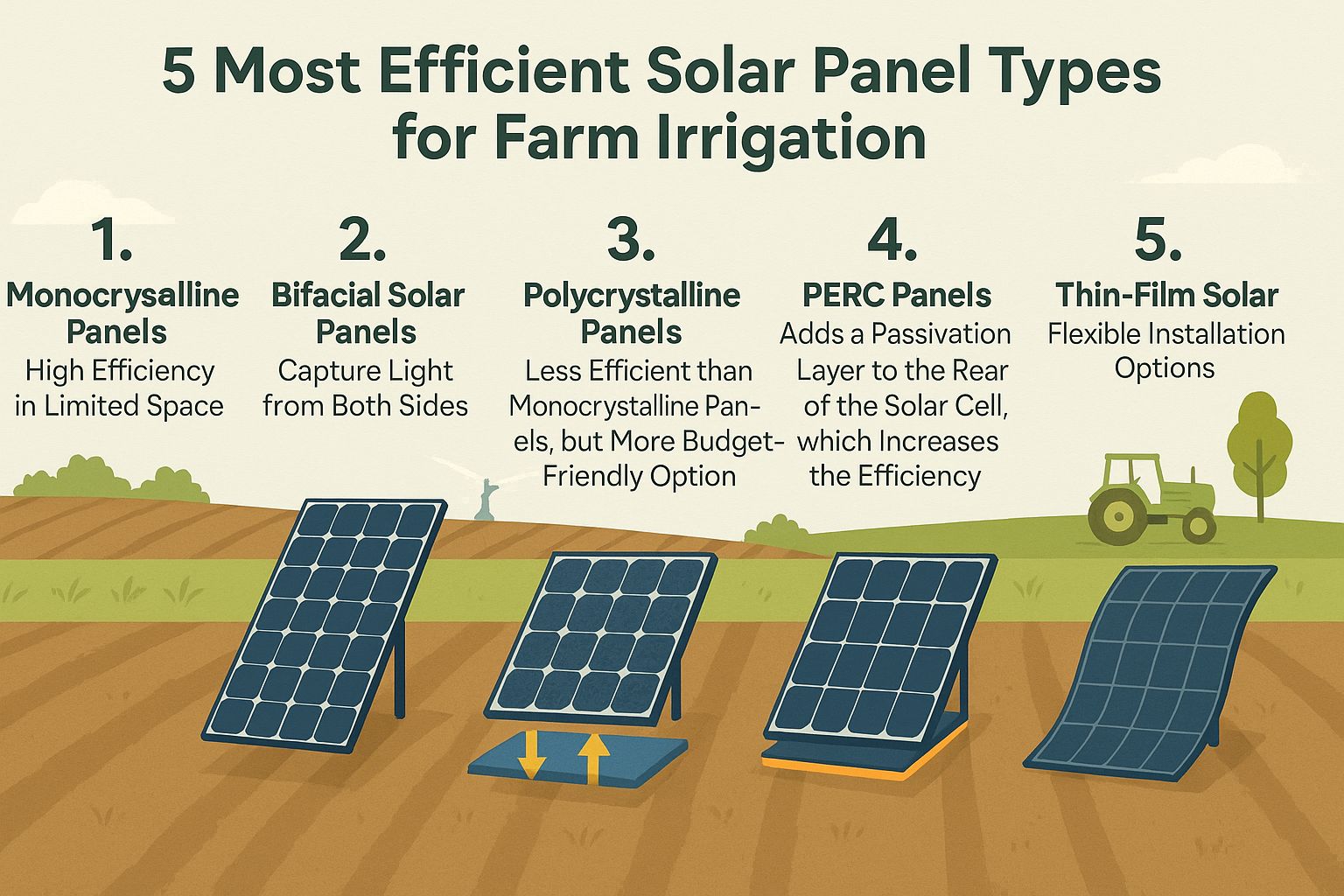
Panel technology significantly impacts system performance, with various options offering distinct advantages for agricultural applications. The ideal choice balances efficiency, durability, cost, and performance characteristics under farm conditions. While higher efficiency reduces space requirements and installation costs, durability considerations often prove equally important given the dust, equipment traffic, and weather extremes common to agricultural environments.
1. Monocrystalline Panels: High Efficiency in Limited Space
Monocrystalline panels deliver the highest efficiency commercially available, typically converting 18-22% of available sunlight into electricity. This superior performance comes from single-crystal silicon structures that minimize internal resistance and maximize electron flow. For agricultural installations with space limitations or high power requirements, these panels provide maximum production from available mounting areas, whether on dedicated ground mounts or existing structures like barn roofs or equipment sheds.
Beyond raw efficiency, monocrystalline panels typically offer superior performance in high-temperature conditions common during peak irrigation seasons. Their lower temperature coefficient means they maintain higher output as temperatures rise, delivering more consistent power during hot summer days when irrigation demands often peak. While these panels command premium pricing, their performance advantages and space efficiency often justify the investment for irrigation-focused installations where reliable operation directly impacts crop outcomes.
2. Bifacial Solar Panels: Capture Light from Both Sides
Bifacial panels introduce a revolutionary approach to solar generation by capturing light reflected onto their undersides, effectively increasing energy harvest without expanding panel dimensions. This technology proves particularly valuable in agricultural installations where reflective surfaces—including light-colored soils, concrete pads, or even water surfaces—can redirect significant light to panel undersides. Performance gains typically range from 5-30% depending on installation conditions, mounting height, and surrounding reflectivity.
For irrigation applications, bifacial panels offer compelling advantages beyond raw efficiency. Their dual-sided design eliminates the back sheet found on conventional panels, improving heat dissipation and reducing operating temperatures. This characteristic enhances performance during hot weather when irrigation demands typically peak. Additionally, the transparent backing allows some light transmission, reducing complete shading underneath and potentially allowing for compatible agricultural activities beneath elevated installations. Learn more about solar panels powering a farm’s irrigation system.
When mounting bifacial panels, elevation height significantly impacts performance gains. Higher mounting positions (typically 3-6 feet minimum) maximize ground reflection capture while allowing airflow that further improves thermal performance. While bifacial technology commands a price premium of approximately 10-15% over comparable monofacial panels, the production advantages often deliver superior lifetime value for agricultural applications, particularly in regions with high ambient light reflection.
3. Polycrystalline Panels: Less Efficient than Monocrystalline Panels, but More Budget-Friendly Option
Polycrystalline panels offer a compelling balance of performance and affordability, typically delivering 15-17% efficiency at costs 10-15% lower than comparable monocrystalline options. These panels feature silicon composed of multiple crystal fragments, creating a distinctive blue appearance and slightly lower efficiency due to increased internal resistance. For agricultural installations with adequate space and budget constraints, polycrystalline technology provides reliable performance at accessible price points.
The economic advantages extend beyond initial purchase price, as polycrystalline panels often demonstrate excellent longevity and durability in agricultural environments. Their manufacturing process creates inherently robust cells that withstand microcracks and physical stress, potentially reducing long-term degradation in farm settings where equipment vibration, dust accumulation, and extreme weather conditions pose ongoing challenges. This durability translates to consistent performance throughout the system’s operational life, often exceeding 25 years with proper maintenance.
4. PERC Panels: Adds a Passivation Layer to the Rear of the Solar Cell, which Increases the Efficiency
Passivated Emitter and Rear Cell (PERC) technology represents a significant advancement in solar efficiency, adding a specialized passivation layer to the rear surface of conventional cells. This additional layer reflects unabsorbed light back through the cell for a second absorption opportunity while reducing electron recombination at the back surface. The result is efficiency improvements of 1-2% absolute (representing 5-10% relative gains) without significant manufacturing cost increases, creating excellent value for agricultural applications where every efficiency percentage directly impacts irrigation capacity.
5. Thin-Film Solar for Flexible Installation Options
Thin-film solar technology offers unique advantages for specialized agricultural applications, particularly where weight restrictions, flexible mounting surfaces, or extreme environmental conditions challenge conventional panels. These lightweight, flexible panels can conform to curved surfaces, integrate with equipment, or deploy in temporary configurations that conventional rigid panels cannot accommodate. While their efficiency typically ranges from 10-13% (lower than crystalline alternatives), their versatility opens installation possibilities that might otherwise remain impractical.
One compelling agricultural application involves water conservation covers for irrigation ponds or reservoirs. Thin-film panels installed on floating platforms simultaneously generate electricity while reducing evaporation losses—a dual benefit for water-conscious operations. Similarly, thin-film installations on equipment storage structures, processing facilities, or even seasonal structures provide generation capacity without requiring dedicated mounting areas or substantial structural reinforcement. For more information on enhancing solar panel efficiency, consider exploring the advancements in drone technology for farmers.
Funding Your Solar Efficiency Upgrades
Financing represents the primary hurdle for many agricultural solar efficiency projects, but numerous programs specifically target farm operations transitioning to renewable energy. Understanding available incentives can dramatically improve project economics, often reducing payback periods by 30-50% compared to unsubsidized installations. A comprehensive funding approach typically combines federal programs, state/local incentives, and agricultural-specific opportunities to maximize financial support.
USDA REAP Grants Cover Up to 25% of Project Costs
The Rural Energy for America Program (REAP) stands as the premier funding source for agricultural solar projects, offering both grants and loan guarantees specifically for renewable energy improvements. Grant funding covers up to 25% of eligible project costs with maximum awards of $500,000, while loan guarantees can facilitate financing for up to 75% of project costs with favorable terms designed for agricultural operations. This program specifically prioritizes rural small businesses and agricultural producers, making it ideally suited for irrigation efficiency improvements.
REAP applications require detailed project planning, energy audits, and financial projections, but this preparation typically improves project outcomes while strengthening funding competitiveness. Application cycles occur twice annually, with simplified applications available for smaller projects under $80,000. Successful applications typically demonstrate clear energy savings, financial viability, and implementation readiness—all characteristics of well-designed solar irrigation efficiency projects.
Federal Tax Credits and Accelerated Depreciation
The federal Investment Tax Credit (ITC) provides substantial tax benefits for solar installations, currently offering a 30% credit against tax liability through 2032 before gradually stepping down in subsequent years. This direct reduction in tax obligations significantly improves project economics, particularly when combined with Modified Accelerated Cost Recovery System (MACRS) depreciation that allows for accelerated write-offs of the remaining system value. Together, these tax benefits can offset 45-55% of system costs for agricultural operations with sufficient tax appetite.
State-Specific Agricultural Solar Incentives
Beyond federal programs, many states offer agricultural-specific incentives targeting renewable energy adoption in farming operations. These programs include direct rebates, performance-based incentives, property tax exemptions, and specialized low-interest financing designed specifically for on-farm renewable energy. Programs vary significantly by location, with agricultural states typically offering the most robust support for irrigation efficiency improvements that simultaneously address energy and water conservation goals.
Many utilities serving agricultural areas have also developed specialized incentives for farm-based solar, particularly systems that reduce peak demand during summer months when both agricultural irrigation and overall grid demand typically peak. These programs often include additional incentives for battery storage components that enable load shifting away from high-demand periods, creating stackable benefits that significantly improve project economics while addressing grid stability concerns.
Maintain Your System Can Produce 20% More Power
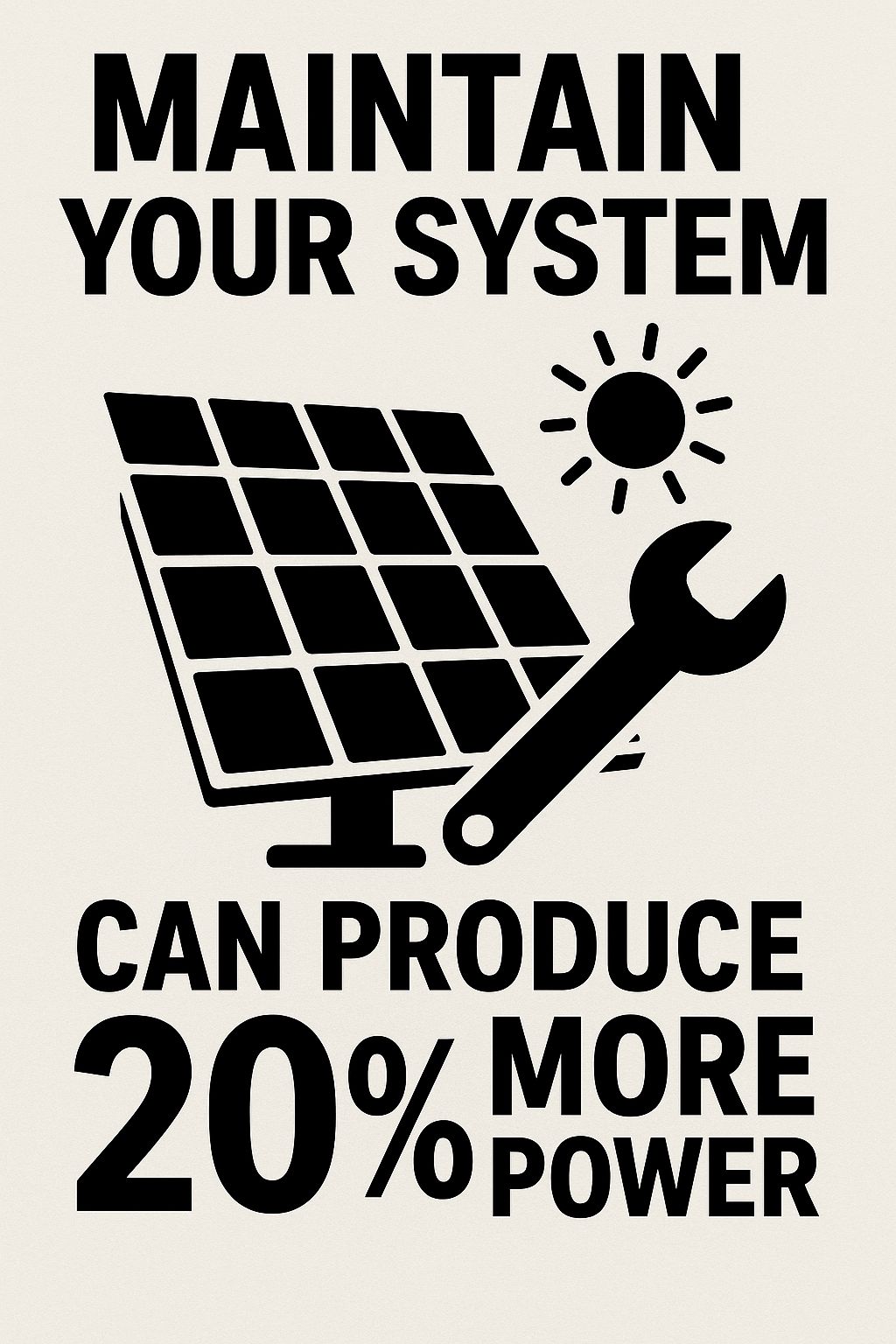
Proper maintenance represents the single most cost-effective strategy for maximizing solar irrigation efficiency. While well-designed systems operate reliably with minimal intervention, regular attention prevents cumulative degradation that gradually reduces performance. Studies consistently demonstrate that properly maintained systems produce 15-25% more energy over their operational lifespan compared to neglected installations, representing thousands of additional irrigation hours without any expansion of generation capacity. For more innovative solutions, explore how drones boost solar panel efficiency for farmers.
Comprehensive maintenance addresses both preventive needs and performance optimization, ensuring that each system component operates at peak efficiency. For irrigation-focused installations, maintenance scheduling should prioritize periods immediately preceding peak water demand seasons, ensuring maximum system performance when operational requirements are highest. This proactive approach prevents irrigation interruptions during critical growth stages while maximizing energy harvest during periods of greatest solar intensity.
Beyond performance benefits, regular maintenance significantly extends system lifespan, improving the long-term economics of your solar investment. Properly maintained components—particularly moving parts in tracking systems and electronic elements like inverters—typically achieve or exceed their rated operational life, while neglected components often require premature replacement. This lifecycle extension effectively reduces the annualized cost of your solar irrigation system while ensuring consistent performance throughout its operational span.
Essential Daily and Monthly Monitoring Practices
Daily monitoring provides the foundation for effective solar irrigation management, identifying potential issues before they impact crop water delivery. Modern monitoring systems provide real-time production data accessible via smartphone applications or web interfaces, allowing quick performance checks that take just moments to complete. These daily observations establish performance patterns that make anomalies immediately apparent, enabling rapid response to developing issues. For an in-depth understanding of solar-powered irrigation systems, explore this comprehensive guide.
Monthly physical inspections complement electronic monitoring, addressing aspects that remote systems might miss. These inspections include visual examination of panels for physical damage, connection integrity checks, mounting system stability assessment, and vegetation management around array perimeters. For tracking systems, monthly inspections should verify smooth operation through full range of motion and lubricate moving components according to manufacturer specifications.
- Review daily production data compared to weather conditions and historical performance
- Check for error codes or alerts from inverters and charge controllers
- Verify proper operation of irrigation pumps and controllers
- Inspect for signs of animal damage, particularly to wiring and connections
- Monitor battery system performance and state of charge (if applicable)
Developing a monitoring checklist specific to your system ensures consistent attention to critical components while simplifying record-keeping. These records prove invaluable for identifying seasonal patterns, tracking degradation rates, and substantiating warranty claims if component failures occur. Many monitoring platforms offer automated alert functions that notify operators when performance falls below expected parameters, providing an additional layer of protection for critical irrigation systems.
Seasonal Maintenance Schedule
Seasonal maintenance addresses deeper system needs beyond routine monitoring, focusing on activities that preserve long-term performance and reliability. Spring maintenance typically emphasizes thorough cleaning after winter accumulation, comprehensive system testing before peak irrigation season, and vegetation management to prevent summer shading. This preparation ensures maximum performance during the critical growing season when irrigation demands and solar production both typically peak.
Fall maintenance focuses on preparing systems for winter conditions, including drainage of water-sensitive components, tracking system winterization (where applicable), and structural inspection to identify any issues requiring attention before harsh weather arrives. For systems that operate year-round, fall maintenance should include comprehensive electrical testing to identify any components showing signs of degradation that might fail during winter months when replacement might be more challenging.
When to Call the Professionals
While many maintenance tasks can be performed by farm personnel with basic training, certain situations warrant professional intervention. Electrical issues—particularly those involving inverters, combiner boxes, or main system connections—should be addressed by qualified solar technicians with proper testing equipment and safety training. Similarly, tracking system mechanical failures often require specialized knowledge and tools that go beyond typical farm maintenance capabilities.
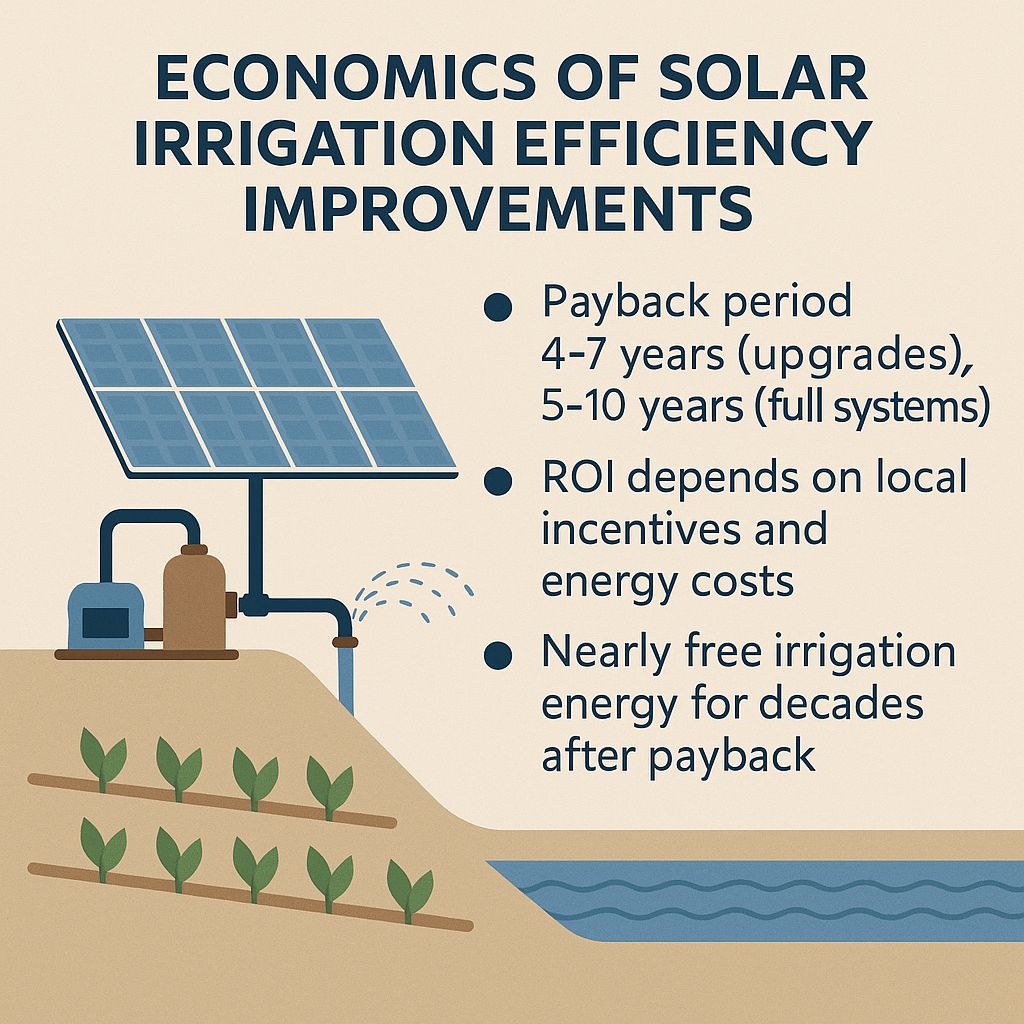
Implementing Solar Efficiency Today: Is it Worth the investment?
The economics of solar irrigation efficiency improvements present a compelling case for most agricultural operations, particularly those facing rising energy costs, water limitations, or both. Comprehensive analysis typically reveals payback periods of 4-7 years for efficiency upgrades to existing systems, with full system implementations achieving return on investment within 5-10 years depending on local incentives and energy costs. Beyond this payback threshold, systems continue producing nearly free irrigation energy for decades, with most modern components warranted for 25+ years of operation.
Beyond direct financial returns, solar irrigation efficiency improvements deliver secondary benefits that further strengthen their value proposition. These include enhanced water conservation, reduced carbon footprint, improved operational resilience during grid outages, and protection against future energy price increases. For operations seeking sustainable certification or participating in environmentally-focused marketing programs, renewable irrigation improvements often contribute toward qualification while simultaneously reducing operational costs.
Frequently Asked Questions
As farmers consider solar irrigation efficiency improvements, several common questions arise regarding performance, economics, and implementation. Understanding these key considerations helps develop realistic expectations and appropriate planning for successful system optimization. The following responses address the most frequent inquiries based on actual implementation experience across diverse agricultural operations.
These answers reflect current technology capabilities and market conditions, but solar technology continues advancing rapidly. Consulting with qualified agricultural solar specialists ensures that your specific situation receives customized analysis based on the latest available solutions and local conditions. This personalized approach delivers the most accurate projections and appropriate system recommendations.
How much can I realistically save by optimizing my farm’s solar irrigation system?
Savings vary based on current system efficiency, implemented improvements, and local conditions, but most farms achieve 20-40% energy cost reduction through comprehensive optimization. Operations previously relying on diesel irrigation typically see the highest savings, often exceeding 50% compared to fuel costs at current prices. Grid-connected farms in areas with high electricity rates or demand charges also realize substantial benefits, particularly when battery storage enables complete elimination of peak-period utility consumption.
The financial impact extends beyond direct energy savings to include reduced maintenance costs for conventional pumping equipment, decreased labor for system management, and potential water savings through improved application efficiency. Many farms report that enhanced irrigation reliability translates to yield improvements worth substantially more than the energy savings alone, particularly for high-value crops sensitive to irrigation timing and consistency.
For comprehensive economic analysis, consider both immediate operational savings and long-term benefits including insights from solar panels powering a farm’s irrigation system.
- Protection against future energy price increases
- Extended equipment lifespan through optimized operation
- Reduced downtime during critical irrigation periods
- Potential premium pricing for sustainably-produced crops
- Increased property value from permanent renewable infrastructure
What’s the typical payback period for solar panel efficiency upgrades?
Payback periods vary significantly based on current system condition, selected improvements, local incentives, and energy costs. Simple efficiency improvements like professional cleaning and minor maintenance typically pay for themselves within the first season through immediate production increases of 10-25%. More substantial upgrades like inverter replacements or tracking system additions generally achieve payback within 3-5 years while delivering 15-40% production improvements over the system’s remaining operational life.
Complete system replacements using current high-efficiency technology typically achieve payback within 5-10 years depending on available incentives and financing terms. When federal tax credits, USDA grants, accelerated depreciation, and state-specific incentives combine, many farmers report effective payback periods under 5 years for comprehensive system upgrades. This rapid return transforms irrigation from an ongoing expense to a largely fixed investment with predictable long-term costs.
- Maintenance and cleaning: Immediate to 1-year payback
- Inverter upgrades: 3-5 year payback
- Tracking system addition: 4-6 year payback
- Complete system replacement: 5-10 year payback
- Battery addition: 7-12 year payback (shorter with incentives)
For the most accurate payback analysis, comprehensive energy audits comparing current consumption patterns with projected post-improvement performance provide system-specific projections. These assessments typically identify the efficiency improvements offering the fastest return for your particular situation, allowing phased implementation prioritizing the most economically beneficial upgrades.
When evaluating payback periods, remember that solar components typically carry 25-30 year warranties with expected operational lives often exceeding these periods. This long productive lifespan means that systems continue delivering value long after achieving initial payback, effectively providing decades of nearly free irrigation energy that insulates farm operations from volatile energy markets.
Can I still irrigate at night with a solar-powered system?
Absolutely—modern solar irrigation systems incorporate battery storage specifically designed for nighttime and low-light operation. These storage systems capture excess daytime production for use during evening hours, early mornings, or cloudy periods when direct solar generation may be insufficient for pumping requirements. Contemporary lithium iron phosphate batteries provide 10+ year operational life with minimal maintenance requirements, creating reliable 24/7 irrigation capability regardless of immediate sunlight availability.
For operations requiring extensive nighttime irrigation, battery systems can be sized accordingly to store sufficient energy for overnight operations. Alternative approaches include hybrid systems that incorporate smaller battery banks for critical nighttime needs while maintaining grid connections for supplemental power during extended irrigation cycles. This balanced approach optimizes investment while ensuring irrigation flexibility regardless of sunlight conditions.
Do solar panels work efficiently in cloudy or rainy conditions?
Modern solar panels generate significant power even during cloudy conditions, typically producing 10-25% of their rated capacity depending on cloud density. This partial production often proves sufficient for reduced irrigation operation, particularly when combined with battery storage that accumulates energy during brighter periods. Additionally, contemporary high-efficiency panels perform better in diffuse light conditions than older technology, capturing energy across the light spectrum rather than requiring direct sunlight.
How do I know if my current solar setup is operating at peak efficiency?
Performance monitoring provides the clearest indication of system efficiency relative to potential. Modern monitoring platforms compare actual production against expected output based on local solar irradiance, identifying underperformance that might otherwise go unnoticed. These systems typically generate performance ratio metrics that indicate what percentage of theoretical maximum production your system currently achieves, with well-maintained installations typically operating at 80-90% of theoretical potential.
Physical inspections complement electronic monitoring by identifying visible issues affecting performance. Signs of potential efficiency loss include soiling or debris on panel surfaces, discoloration indicating potential internal damage, loose or corroded connections, and vegetation encroachment causing partial shading. For tracking systems, uneven movement or misalignment significantly impacts performance and typically requires adjustment to restore optimal operation.
Professional assessment offers the most comprehensive efficiency evaluation, combining performance data analysis with thermal imaging, electrical testing, and physical inspection. These assessments typically identify specific optimization opportunities ranked by potential impact and implementation cost, providing a clear roadmap for efficiency improvements. Many solar service providers offer annual performance evaluations that identify developing issues before they significantly impact irrigation capacity.
Remember that solar panel efficiency naturally decreases slightly over time—typically 0.5-0.7% annually for quality panels—so comparing current performance against initial benchmarks requires adjusting for this expected degradation. Systems underperforming beyond this natural decline likely have correctable issues that, when addressed, can restore substantial capacity for improved irrigation reliability.

Leave a Reply