
Article-At-A-Glance
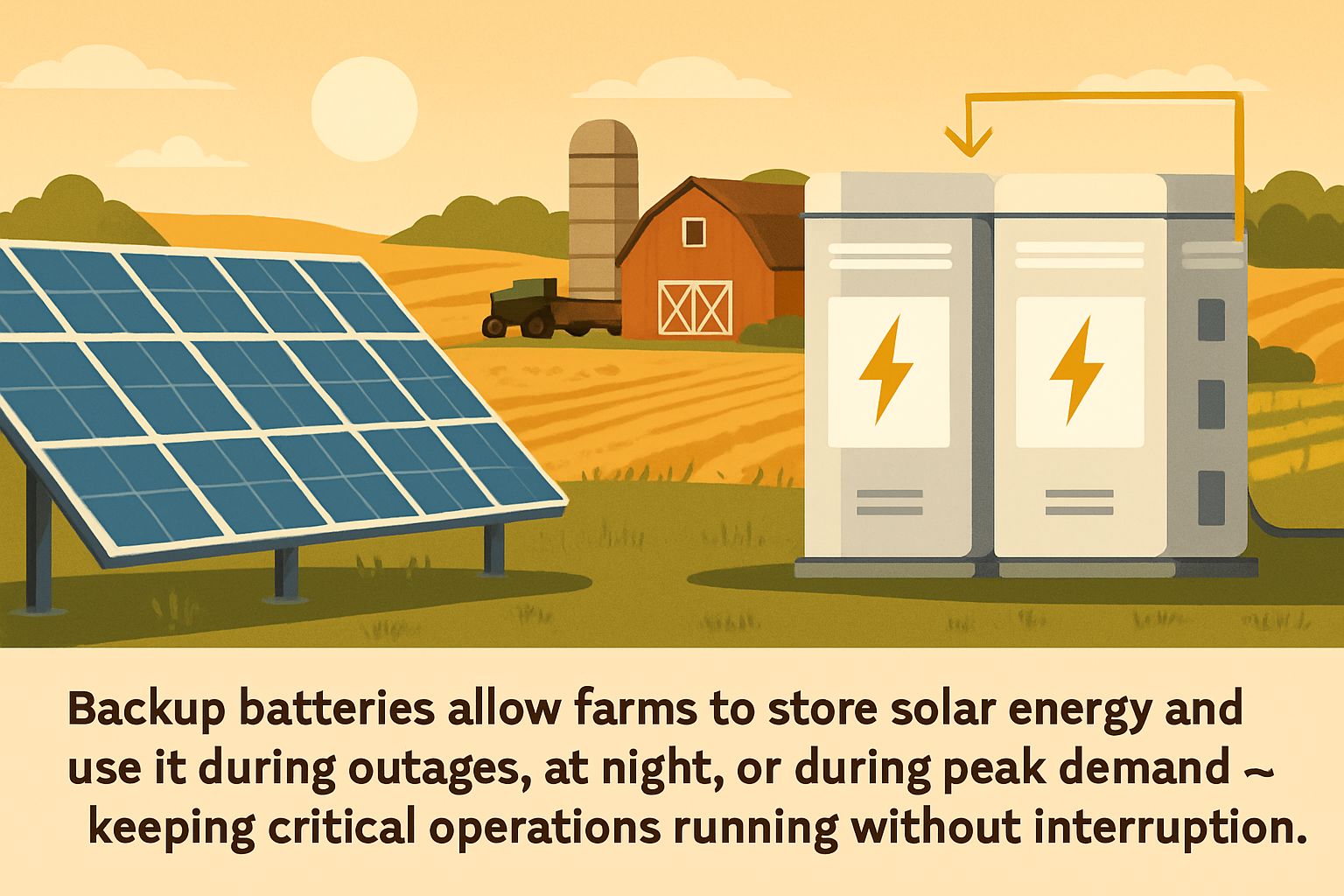
- Backup batteries allow farms to store solar energy and use it during outages, at night, or during peak demand — keeping critical operations running without interruption.
- Without battery storage, solar-powered farms lose unused daytime energy and remain vulnerable to costly grid failures.
- From irrigation pumps to cold storage, the farm systems that benefit most from battery backup are exactly the ones you can’t afford to lose power on.
- Battery storage systems pay for themselves over time by eliminating diesel generator costs and reducing peak-hour electricity bills.
- Sizing and scalability matter — the right battery system depends on your farm’s specific energy load, and modern systems can grow with your operation.
If your farm is running solar panels without a battery system, you’re generating power you can’t fully use — and paying for it every time the grid goes down.
Farmers across the country are discovering that solar alone isn’t enough. The sun doesn’t shine during a summer storm that knocks out power to your grain dryer at harvest time. It doesn’t help when your cold storage loses power at 2 AM. And it certainly doesn’t reduce your electricity bill when your utility charges peak rates in the evening, after your panels have already stopped producing. Battery storage is what closes that gap — and for farms running on tight margins, that gap is expensive. Voluntas Group works directly with agricultural operations to design solar and battery systems built around the real demands of farm life.
Solar Panels Without Batteries Are Leaving Farm Money on the Table
A solar system without storage is like a water tank with no lid — whatever you don’t use right away is lost. Most farms generate the bulk of their solar energy between 10 AM and 3 PM, but energy demand doesn’t follow a neat schedule. Irrigation runs early morning. Refrigeration runs around the clock. Processing equipment runs when the crop is ready, not when the sun cooperates.
Without a battery to capture that midday solar surplus, the excess energy either feeds back into the grid at a low feed-in tariff rate or simply goes to waste. Meanwhile, when demand spikes outside of peak solar hours, farmers are back to drawing expensive grid electricity. The financial logic for adding battery storage is straightforward — store what you generate, use it when you need it most, and stop paying premium rates for power your panels already produced.
How Backup Batteries Work with Solar Panels on Farms
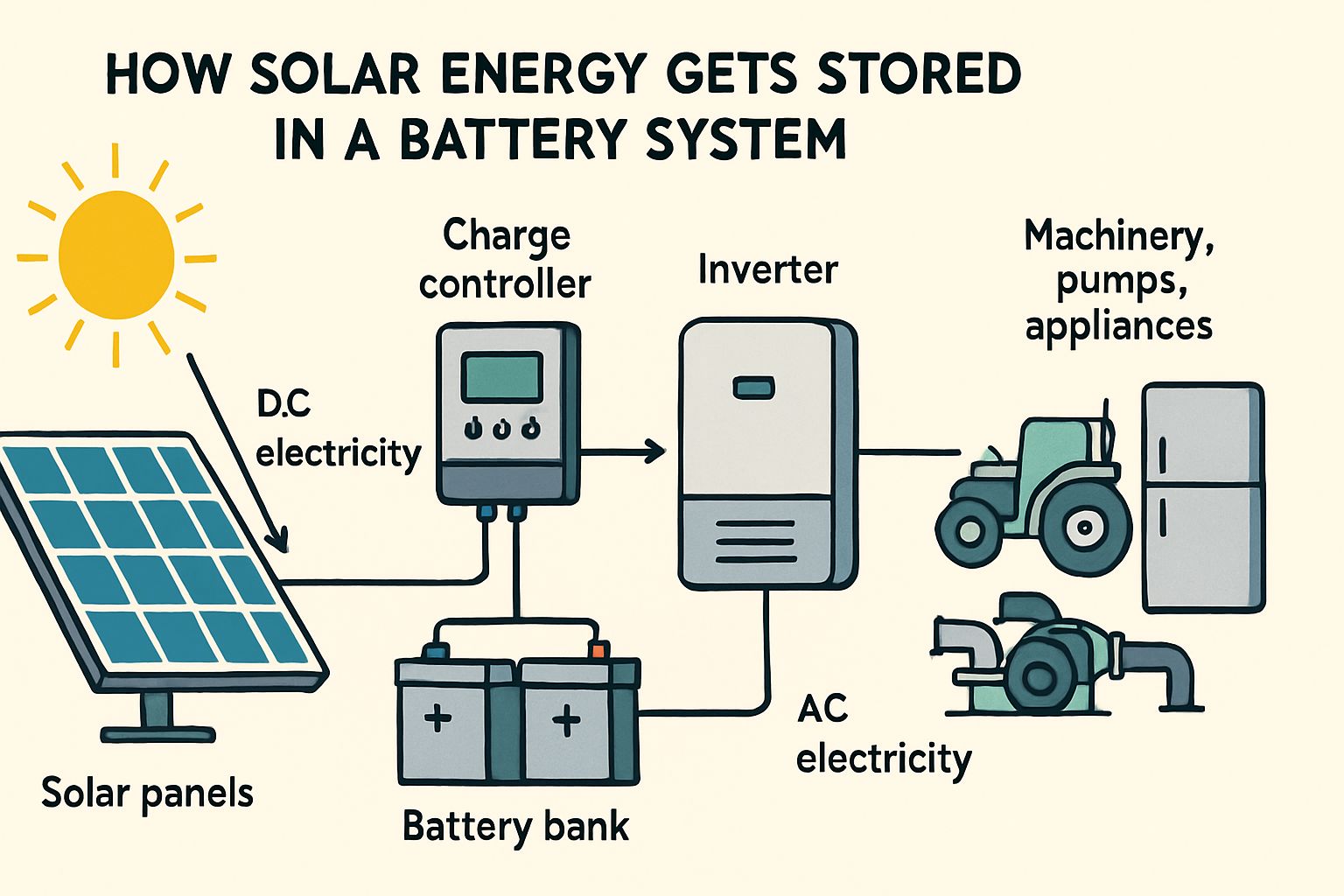
How Solar Energy Gets Stored in a Battery System
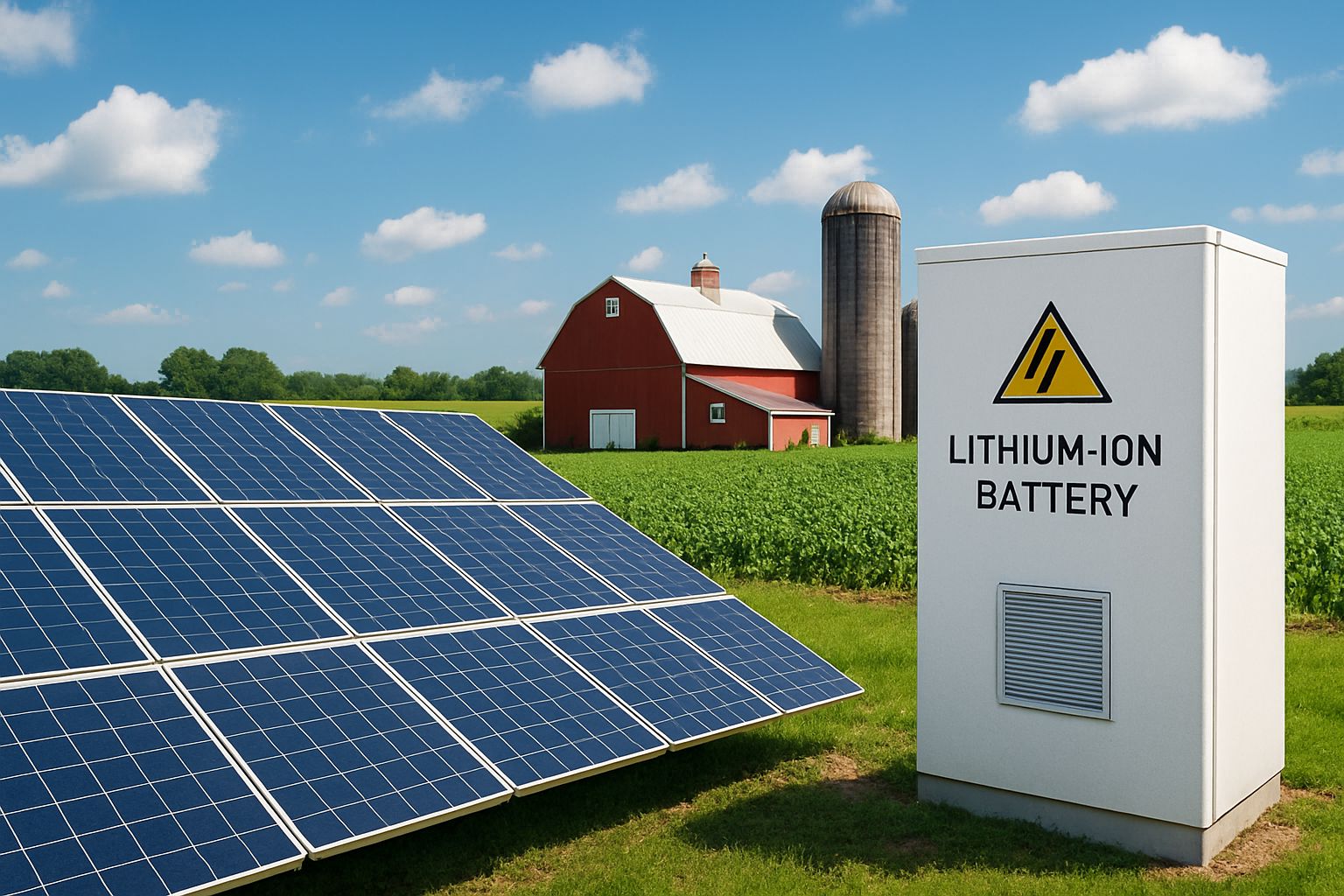
Solar panels convert sunlight into direct current (DC) electricity. A charge controller regulates that flow and sends it to the battery bank where it’s stored as chemical energy. When your farm needs power, an inverter converts the stored DC electricity back into alternating current (AC) — the same type your machinery, pumps, and appliances run on. Modern lithium iron phosphate (LiFePO4) batteries, like those used in the Tesla Powerwall 3 or BYD Battery-Box Premium HVS, can complete this cycle thousands of times with minimal degradation.
What Happens to Power During a Grid Outage
When the grid goes down, a battery-backed solar system with a hybrid inverter detects the outage within milliseconds and automatically switches to battery power. For your farm, this means refrigeration keeps running, water pumps stay online, and ventilation systems keep livestock safe — all without you touching a switch. This seamless transition is what separates a properly designed battery backup system from a diesel generator that takes minutes to start and requires fuel on hand.
The Role of Inverters and Charge Controllers
The inverter is the brain of the system. A standard string inverter only works when the grid is live, which means no backup power during outages. A hybrid inverter — like the SMA Sunny Boy Storage or Fronius Symo GEN24 — manages both solar input and battery storage simultaneously, enabling true backup capability. The charge controller protects the battery from overcharging and deep discharge, which directly affects how long your battery system lasts over its lifespan. For those interested in maximizing efficiency, drones can boost solar panel productivity on farms.
The Real Energy Challenges Farms Face Without Battery Backup
Grid reliability in rural areas is consistently worse than in urban centers. Longer transmission lines, aging infrastructure, and exposure to extreme weather events mean farmers experience more outages — and longer ones — than most other energy users. For farmers looking to mitigate these issues, exploring PERC solar panels might be a beneficial option.
Power Outages That Disrupt Irrigation and Machinery
A single unplanned outage during planting or harvest season can cost thousands of dollars in lost productivity, damaged crops, or spoiled goods. Irrigation systems that shut down mid-cycle can stress crops at critical growth stages. Grain dryers that cut out leave product vulnerable to mold and quality loss. These aren’t hypothetical risks — they’re recurring events for farms without reliable backup power.
Livestock operations face a different but equally serious risk. Ventilation fans, automatic feeders, and water delivery systems all depend on consistent power. In hot weather, a ventilation failure in a poultry or swine shed can cause significant animal losses within hours.
Wasted Solar Energy with No Storage System
Feed-in tariffs — the rate utilities pay for excess solar energy sent back to the grid — have dropped significantly in most regions. In many cases, farmers are exporting their surplus solar energy for just a few cents per kilowatt-hour, then buying it back in the evening at ten times that rate. A battery changes that equation entirely by letting you consume your own energy instead of selling it cheap and buying it back expensive. For those interested in different solar panel technologies that could enhance farm efficiency, exploring PERC solar panels for agriculture may be beneficial.
High Grid Electricity Bills During Peak Demand Hours
Time-of-use electricity tariffs mean the power you draw from the grid in the early morning or evening can cost significantly more than midday rates. For farms running irrigation at dawn or refrigeration overnight, this adds up fast. A battery charged during the day on solar energy can supply those peak-demand hours at zero additional cost, effectively flattening your electricity bill.
The Core Benefits of Backup Batteries for Solar Panels on Farms
Battery storage doesn’t just solve one problem — it stacks multiple financial and operational advantages that compound over time. The farms seeing the strongest return on investment are those treating battery storage not as an add-on, but as a core infrastructure decision.
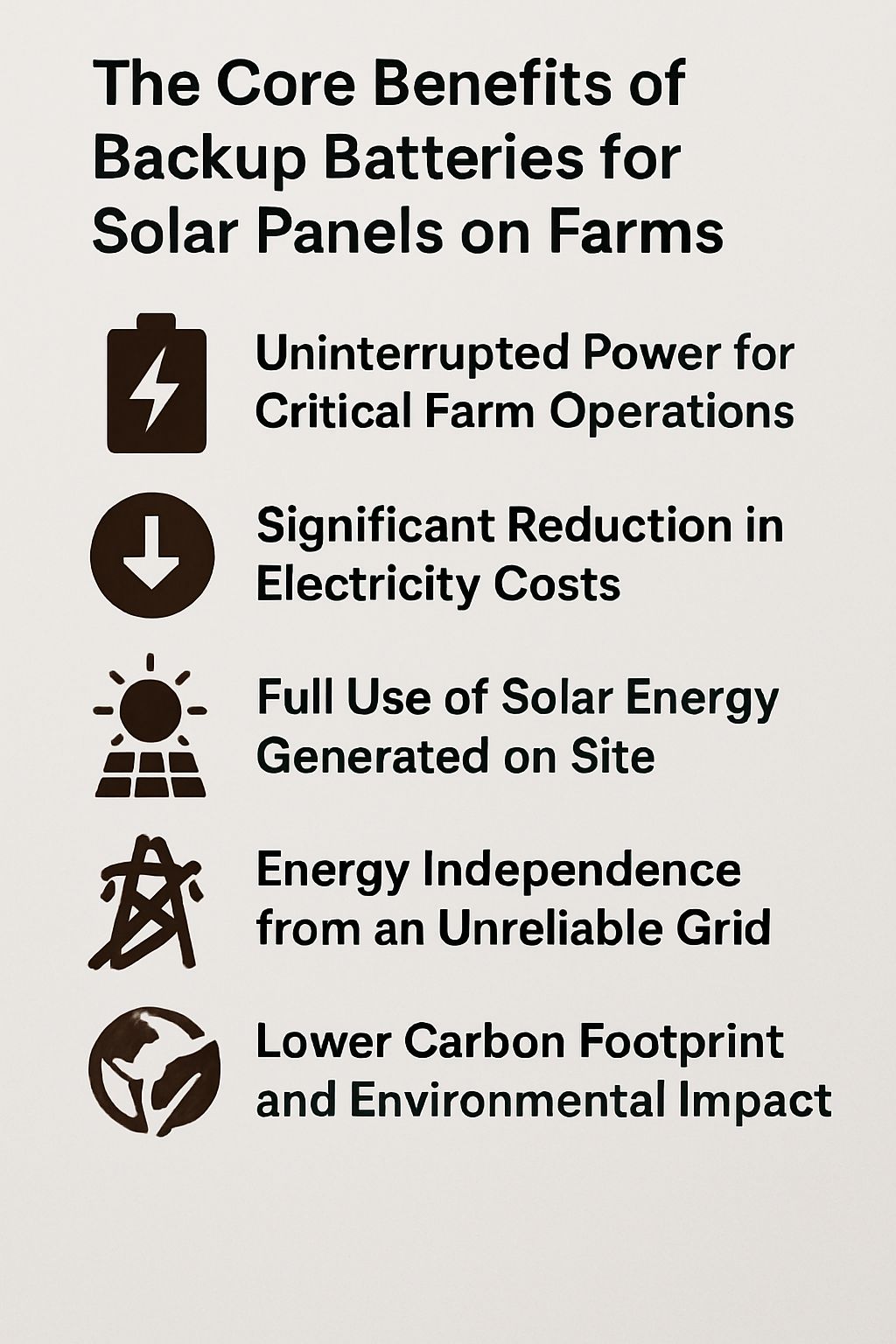
1. Uninterrupted Power for Critical Farm Operations
The most immediate benefit is reliability. With a properly sized battery system, critical loads — cold storage, water pumps, lighting, communications — stay powered regardless of what the grid is doing. This is especially valuable during storm season or in regions where outages are measured in hours rather than minutes.
Unlike diesel generators, battery systems kick in instantly, require no fuel delivery, and produce zero noise or emissions. For farms with food safety certifications or cold chain requirements, that automatic failover isn’t just convenient — it’s a compliance necessity.
2. Significant Reduction in Electricity Costs
Battery storage directly cuts the amount of grid electricity a farm purchases, particularly during expensive peak-rate periods. Farms running time-of-use tariffs can save substantially by charging their batteries from solar during the day and drawing from storage during evening and early morning hours when grid rates are highest. Over a full billing cycle, this shift in consumption patterns can reduce electricity costs by a meaningful margin — without changing a single farming practice.
3. Full Use of Solar Energy Generated on Site
A battery system transforms your solar investment from a partial solution into a complete one. Instead of exporting surplus midday generation at low feed-in rates, that energy gets stored and consumed on-site at full value. For a mid-sized farm generating 50–100 kWh of solar per day, capturing even an additional 30% of previously wasted output represents a significant annual saving — energy your panels already produced for free.
4. Energy Independence from an Unreliable Grid
Rural grid infrastructure is aging, and weather events are becoming more frequent and severe. For farms in remote or semi-remote locations, grid independence isn’t just a financial goal — it’s a practical necessity. A solar and battery system sized for full off-grid operation gives farmers complete control over their energy supply, eliminating exposure to utility price hikes, infrastructure failures, and supply disruptions.
Even farms that maintain a grid connection benefit from reduced dependence. A hybrid system — grid-connected but battery-backed — gives you the best of both worlds: the security of a backup connection combined with the savings and resilience of on-site storage.
5. Lower Carbon Footprint and Environmental Impact
Replacing diesel generator runtime with stored solar energy delivers immediate emissions reductions. A single diesel generator running 8 hours a day produces roughly 15–20 kg of CO₂ per hour depending on load — that’s a substantial carbon liability over a full growing season. Battery storage eliminates that entirely for backup applications, replacing combustion with clean, stored solar energy.
For farms marketing sustainably grown or certified organic produce, reducing on-farm emissions also supports brand positioning and can satisfy increasingly strict supply chain sustainability requirements from major retailers and export markets. Learn more about solar panel benefits for agricultural farms.
Which Farm Operations Benefit Most from Solar Battery Storage
Not every system on a farm carries the same risk profile when power fails. The operations below represent the highest-priority loads — the ones where a power interruption causes immediate, measurable damage to productivity, animal welfare, or product quality.
Cold Storage and Refrigeration for Perishable Goods
Cold storage is arguably the most critical power load on any farm handling perishable products. A temperature excursion of just a few degrees can render an entire batch of produce, dairy, or meat unsaleable — and potentially create a food safety liability. Battery backup ensures refrigeration compressors stay running through any outage, protecting both product value and compliance with food safety standards.
Irrigation Pumps and Water Management Systems
Irrigation systems are among the highest energy consumers on a farm, and they’re often needed most when solar production is lowest — early morning or late evening. Battery storage bridges that gap, allowing pumps to run on stored solar energy outside of peak generation hours without pulling from the grid at expensive rates.
For drip irrigation systems on horticulture farms, consistent pressure and timing is critical to crop health. Any interruption to an irrigation cycle during flowering or fruit set can directly reduce yield. Battery-backed systems eliminate that vulnerability entirely.
Water management in drought-prone regions adds another layer of importance. When surface water is scarce and bore pumps are the primary water source, reliable pump power isn’t optional — it’s existential for the operation. For farms looking to ensure consistent power supply, exploring HPBC solar panels can be a beneficial option.
Livestock Feeding, Ventilation, and Lighting
Automated feeding systems, ventilation fans, heat lamps, and water delivery all run continuously in intensive livestock operations. In poultry and pork production especially, ventilation failure during summer heat can cause significant stock losses within hours. Battery storage ensures these systems maintain power through any grid interruption, providing a level of animal welfare protection that no other backup solution matches for speed and reliability.
Greenhouse Climate Control
Greenhouses depend on precise temperature, humidity, and CO₂ management to maintain optimal growing conditions. Heating systems, evaporative coolers, circulation fans, and automated venting all draw continuous power. A battery system keeps climate control active through outages, protecting high-value crops like tomatoes, capsicums, and leafy greens that can suffer significant quality loss from even brief temperature spikes or drops.
For year-round greenhouse operations, the economics of battery storage are particularly compelling. With climate control running 24 hours a day, the ability to shift energy consumption away from peak-rate grid electricity — and maintain operation through outages — delivers both cost savings and production continuity simultaneously.
Security Systems and Electric Fences
Farm security cameras, alarm systems, and electric fencing are low-draw but continuously operating loads that must stay live around the clock. A battery system keeps these running through any outage or overnight — preventing the exact scenario where the opportunity for livestock theft or property damage happens.
Battery Storage Pays for Itself Over Time
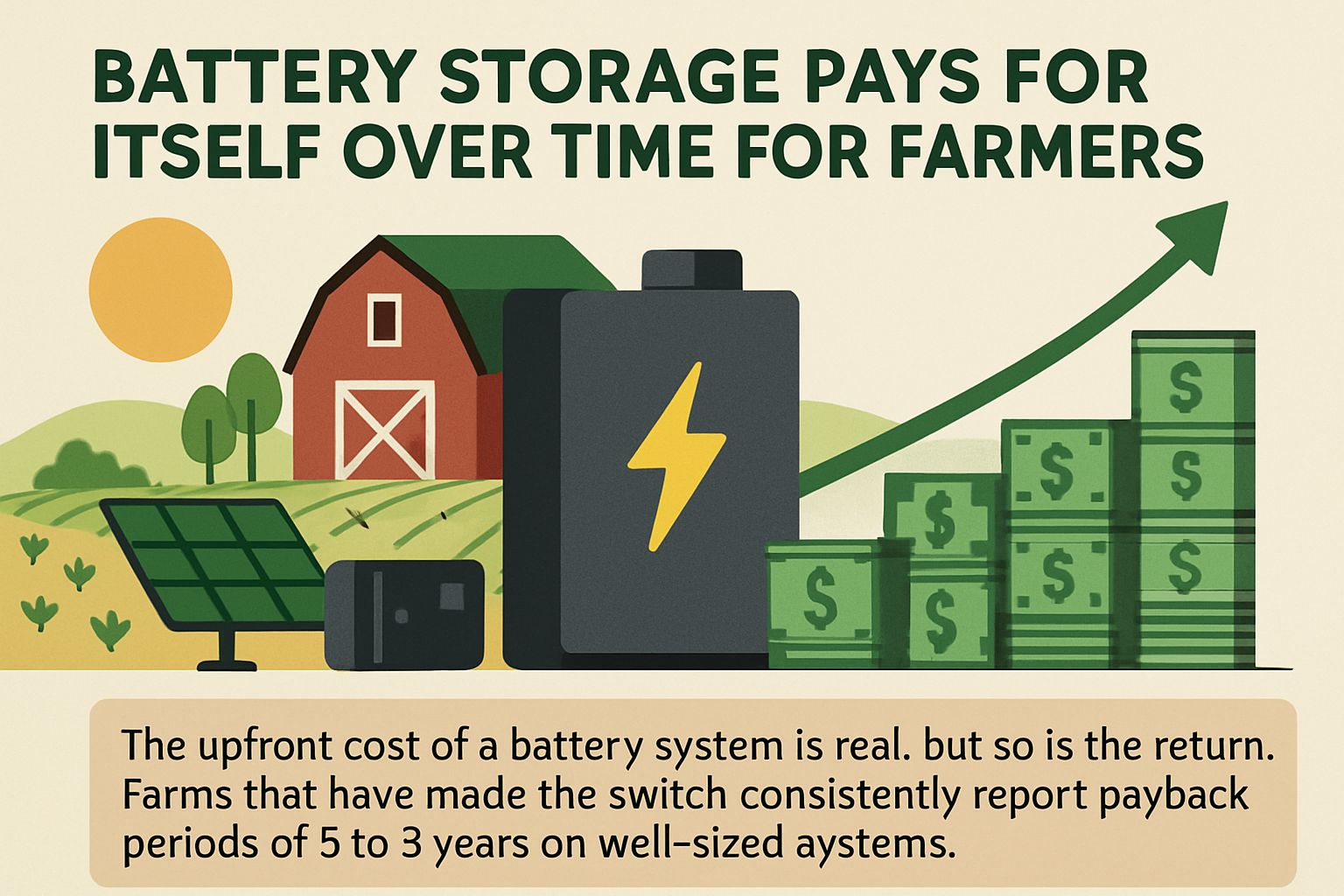
The upfront cost of a battery system is real, but so is the return. Farms that have made the switch consistently report payback periods of 5 to 8 years on well-sized systems — with battery lifespans of 10 to 15 years meaning years of net-positive returns after payback. The financial case strengthens further when diesel generator displacement and avoided crop loss are factored in.
Energy Arbitrage: Storing Cheap Power and Avoiding Peak Rates
Energy arbitrage is the strategy of charging your battery when electricity is cheap — either from solar or low off-peak grid rates — and discharging it when grid rates are high. For farms on time-of-use tariffs, this alone can justify a significant portion of the battery system cost.
The spread between off-peak and peak electricity rates varies by region and utility, but in many agricultural areas the difference between shoulder and peak rates can be substantial. Running high-energy equipment like grain augers, pumps, or processing machinery on stored battery power during peak windows directly converts that rate spread into cash savings.
Energy Source
Typical Cost per kWh
Use Case on Farm
Solar (on-site generation)
$0.04 – $0.08
Daytime operations, battery charging
Battery (stored solar)
$0.05 – $0.10
Evening, overnight, and peak-hour loads
Grid (off-peak)
$0.12 – $0.18
Supplemental top-up charging
Grid (peak rate)
$0.28 – $0.45
Avoided where possible with battery
Diesel Generator
$0.35 – $0.60
Emergency backup (being replaced)
The numbers above make the strategy clear. Every kilowatt-hour shifted from peak grid or diesel to stored solar represents real savings — and on a farm consuming tens of thousands of kilowatt-hours annually, those savings accumulate rapidly.
When you stack energy arbitrage savings on top of outage protection, reduced diesel dependency, and full solar utilisation, the total value of a battery system far exceeds what any single benefit suggests on its own. It’s not one payback stream — it’s four or five running simultaneously.
Reduced Diesel Generator Costs and Maintenance
Diesel generators are the traditional farm backup solution, but they come with a cost structure that compounds over time. Fuel, oil changes, filter replacements, and periodic engine overhauls add up to thousands of dollars annually for farms running generators regularly. A battery system, by contrast, has no moving parts, requires minimal maintenance, and runs on energy your solar panels already generated for free.
The operational comparison becomes even sharper when you factor in fuel logistics. Remote farms often need to store significant diesel reserves to ensure backup availability — adding storage costs, fire risk, and the logistical burden of regular fuel deliveries. Battery systems eliminate all of that. Once installed, they simply work, automatically, every time the grid goes down, with no action required from the farmer.
Choosing the Right Battery Storage System for Your Farm
Battery storage is not a one-size-fits-all solution. A small market garden operation has fundamentally different energy requirements than a large-scale poultry facility or a mixed cropping enterprise. Getting the sizing and configuration right from the start determines whether your system genuinely delivers on its promise — or falls short when you need it most. For more information on why farms are turning to battery storage, visit Hubble Energy.
The first step is an honest energy audit. Review 12 months of electricity bills to understand your actual consumption patterns — total kilowatt-hours used, peak demand periods, and seasonal variation. This data forms the foundation of any accurate battery sizing calculation. A system designed without this information is essentially a guess.
Chemistry matters too. Lithium iron phosphate (LiFePO4) batteries have become the dominant choice for farm applications due to their superior cycle life (3,000–6,000 cycles), thermal stability, and tolerance of partial state-of-charge operation — which is common on working farms. Lead-acid batteries cost less upfront but degrade faster under the irregular charge and discharge patterns typical of farm use, making them a poor long-term investment in most cases.
How to Size a Battery System Based on Farm Energy Needs
Start by identifying your critical loads — the systems that absolutely must stay running during an outage. List each one with its wattage and the number of hours per day it operates. Multiply those figures together to get daily kilowatt-hours for each load, then total them. That number represents your minimum viable battery capacity. For a practical example: a 500W irrigation pump running 6 hours, a 2 kW refrigeration unit running 24 hours, and basic lighting at 200W for 10 hours adds up to 53 kWh of daily critical load — requiring a battery bank of at least 60–70 kWh to cover one full day with a safe depth of discharge margin. For more insights, check out why farms are turning to battery storage for backup power.
A qualified solar and battery installer should perform load calculations that also account for your solar panel output, local peak sun hours, and seasonal generation variation. In southern Australia, for instance, winter solar generation can drop to 40–50% of summer output — a factor that dramatically affects how much battery storage is needed to maintain reliable overnight and cloudy-day coverage year-round.
Scalability: Start Small and Expand as Your Farm Grows
One of the practical advantages of modern battery systems is modularity. Products like the BYD Battery-Box Premium HVS and Pylontech Force H2 are designed to stack — you can start with a base capacity that covers your most critical loads and add modules as your budget allows or your operation expands. This makes battery storage accessible even for farms that can’t justify the full system cost upfront, while protecting the initial investment as needs scale over time. For more insights on solar technologies, check out this comparison of solar technologies for farmers.
Battery Backup Is No Longer Optional for Solar-Powered Farms
The farms running solar without battery storage are operating with one hand tied behind their back. They’re generating clean energy they can’t fully use, remaining exposed to every grid outage, and leaving significant savings on the table with every peak-rate electricity bill. Battery storage closes all three gaps simultaneously — and as battery prices continue to fall, the financial case grows stronger every year.
The question for most farmers today isn’t whether to add battery storage — it’s how to size it correctly and which system best fits their operation. The technology is proven, the economics are solid, and the farms that have made the transition are consistently reporting better energy resilience, lower costs, and less stress when storms roll in and the grid goes down. That’s not a future benefit — that’s happening right now on farms that made the switch.
Frequently Asked Questions
Below are the most common questions farmers ask when evaluating backup battery systems for their solar setup.
How long can a farm battery backup system run during a power outage?
Runtime depends entirely on battery capacity and the loads being powered. A 30 kWh battery system powering only critical loads — refrigeration, basic lighting, and communications — can typically run 12 to 24 hours. A larger 100 kWh system covering broader farm operations, combined with continued solar generation during daylight hours, can sustain operations through multi-day outages in many cases. Proper load analysis during system design determines exactly how long your specific system will last under your specific conditions.
Can I add battery storage to an existing solar panel system on my farm?
Yes — in most cases, battery storage can be retrofitted to an existing solar system, though the process depends on the type of inverter currently installed. If your system uses a standard string inverter, you’ll likely need to either replace it with a hybrid inverter or add an AC-coupled battery system that works alongside the existing setup.
The most common retrofit pathways are:
- AC-coupled battery systems — such as the Tesla Powerwall 3, which connects on the AC side and works with most existing inverters without requiring full system replacement
- Hybrid inverter replacement — swapping your existing inverter for a hybrid model like the Fronius Symo GEN24 or SMA Sunny Tripower Storage, then connecting a DC-coupled battery bank directly
- DC-coupled addition — adding a battery and charge controller to systems that have available DC capacity, common in larger commercial solar setups
A professional assessment of your existing system is the best first step. An experienced installer can identify which retrofit approach delivers the best performance and backup capability for your specific setup without unnecessary cost. For larger commercial solar setups, exploring options like bifacial vs. Topcon solar panels can also enhance efficiency and productivity.
What size battery system does a farm typically need?
Farm battery systems vary widely — from 20–30 kWh for a small mixed enterprise covering only critical loads, up to 200–500 kWh or more for large-scale operations requiring full energy independence. A useful starting benchmark is to size your battery bank to cover 1 to 2 days of critical load consumption without solar input. This provides genuine outage resilience while remaining financially practical for most operations. Your installer should run detailed load calculations using your actual energy data — not rules of thumb — to arrive at an accurate system size.
Are there government incentives for farm battery storage systems?
Incentives vary by country, state, and territory, and they change regularly as programs are updated or reach capacity. In Australia, several state governments have offered battery rebate programs — including the Victoria Battery Rebate and various programs through state energy authorities — and farms may also be eligible for the federal Small-scale Renewable Energy Scheme (SRES) credits when installing solar as part of a combined system. In the United States, the federal Investment Tax Credit (ITC) applies to battery storage systems installed alongside solar, currently offering a significant percentage-based credit on total system cost.
Beyond direct rebates, many agricultural finance programs and rural development grants include provisions for renewable energy infrastructure investment. It’s worth consulting both your solar installer and a rural business advisor to identify every incentive available in your specific location before purchasing — the combined effect of available rebates can meaningfully reduce payback periods.
How long do solar farm battery systems last before needing replacement?
Lithium iron phosphate (LiFePO4) battery systems — the current standard for agricultural applications — are rated for between 3,000 and 6,000 full charge-discharge cycles, which translates to roughly 10 to 15 years of real-world use at typical farm cycling rates. Most manufacturers back this with warranties of 10 years or more at a guaranteed minimum capacity retention, commonly 70–80% of original capacity at end of warranty.
Battery longevity is also influenced by operating conditions. Systems that regularly experience extreme heat, deep discharge below 10–20% state of charge, or aggressive charge rates will degrade faster than those operating within recommended parameters. A well-designed system with proper thermal management and a quality battery management system (BMS) will consistently reach or exceed its rated lifespan.
When a battery does reach end of useful life for primary farm storage, it isn’t necessarily worthless — batteries retaining 70–80% capacity can often be repurposed for lower-demand applications or sold into secondary markets. Replacement costs are also projected to continue declining as manufacturing scale increases, meaning the cost to replace a system in 10–15 years will likely be significantly lower than the original purchase price in today’s dollars.



Leave a Reply