

“Dual Axis Solar Panel Trackers for Farm …” from growingsolarmist.com and used with no modifications.
Farm Energy at a Glance: What You Need to Know About Dual Axis Solar Trackers
- Dual axis solar trackers can increase energy production by up to 40% compared to fixed solar panels by following the sun’s path across both horizontal and vertical axes throughout the day and across seasons.
- For farms running energy-intensive operations like irrigation, cold storage, and livestock systems, dual axis trackers provide more consistent, reliable power than any other solar configuration.
- While upfront costs are higher than fixed panel systems, the long-term return on investment makes dual axis trackers one of the smartest energy upgrades available to agricultural operations — keep reading to find out exactly why.
- Agrivoltaic farming — growing crops directly beneath solar tracker installations — is unlocking a powerful new way for farmers to double the productivity of a single piece of land.
- Growing Solar Mist provides farmers with expert guidance and renewable energy solutions tailored specifically to agricultural operations.
If your solar panels are sitting fixed on a mount, you’re already losing — and the gap between what you’re capturing and what you could be capturing is bigger than most farmers realize.
Farmers Are Leaving 40% of Their Solar Energy on the Table
Fixed solar panels only perform at their peak for a narrow window of the day — typically when the sun is positioned directly in front of them. Every hour before and after that window, energy output drops. Over the course of a full day, across all four seasons, that loss compounds into a significant energy deficit. Studies have confirmed that dual axis solar trackers can recover up to 40% of that lost production by continuously adjusting panel orientation to face the sun directly at all times.
For a farm that runs irrigation pumps, refrigeration units, or automated livestock systems, that 40% isn’t abstract — it’s the difference between running your operation on solar power alone or still depending on expensive grid electricity. The technology to close that gap exists, it’s proven, and it’s increasingly accessible to farms of all sizes.
What Is a Dual Axis Solar Tracker?
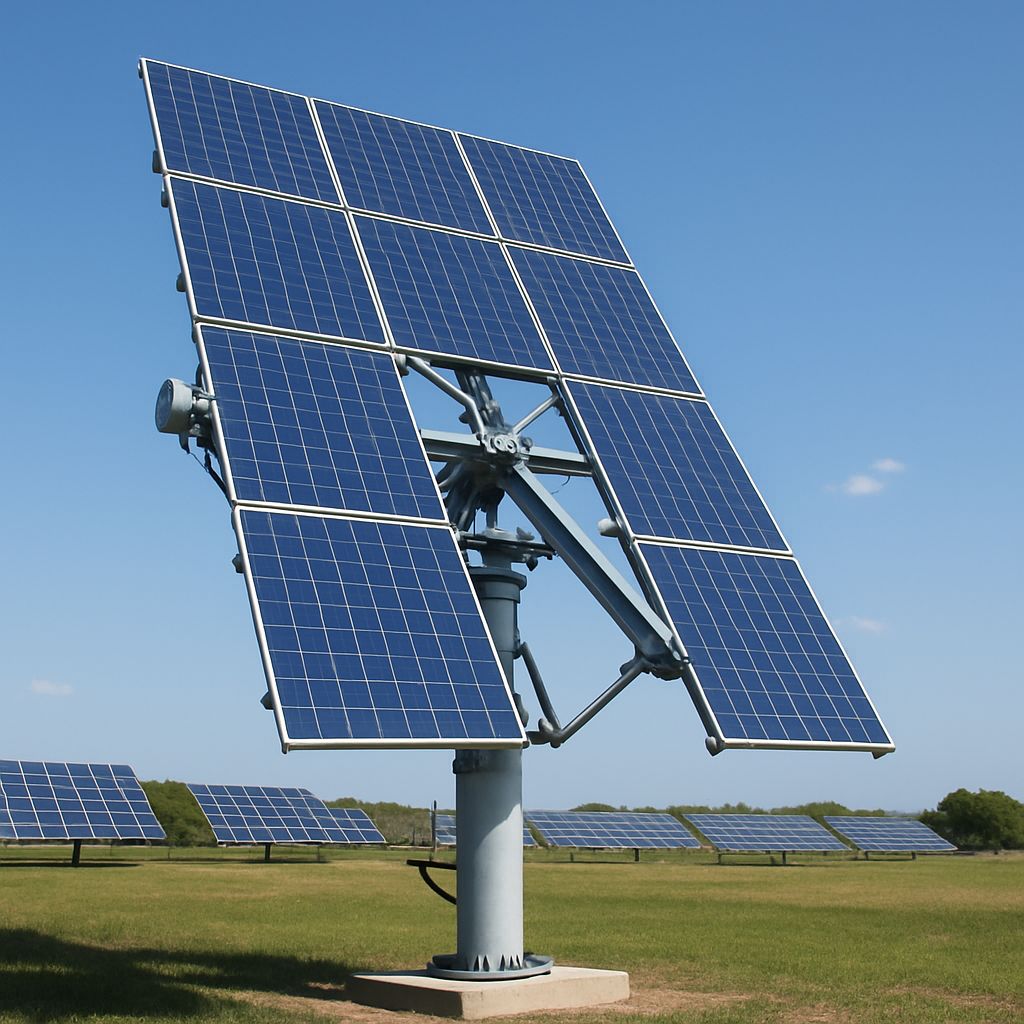
A dual axis solar tracker is a motorized mounting system that moves solar panels along two separate axes of rotation to follow the sun’s position throughout the day and across the changing seasons. Unlike a fixed panel that stays pointed in one static direction, a dual axis tracker continuously adjusts so the solar panels are always facing the sun as directly as possible — maximizing the angle of incidence and capturing the most available sunlight at every moment.
How the North-South and East-West Axes Work Together
The first axis — the East-West axis — handles the daily arc of the sun, rotating panels from east in the morning to west in the evening as the sun moves across the sky. The second axis — the North-South axis — adjusts for the sun’s changing elevation throughout the year, tilting panels higher in summer when the sun rides high and lower in winter when the sun sits closer to the horizon. Working together, these two movements ensure the panels maintain a near-perpendicular angle to direct sunlight at virtually all times, which is precisely where maximum energy output occurs.
This dual-movement capability is what separates these systems from their single-axis counterparts. A single axis tracker can follow the sun east to west but cannot compensate for seasonal elevation changes — meaning it still underperforms during winter months or in regions with significant seasonal sun angle variation. Dual axis systems eliminate that limitation entirely.
Dual Axis vs. Single Axis vs. Fixed Panel Systems
|
System Type |
Axes of Movement |
Estimated Energy Gain vs. Fixed |
Best For |
|---|---|---|---|
|
Fixed Panel |
None |
Baseline (0%) |
Low-budget installations, simple setups |
|
Single Axis Tracker |
East-West only |
Up to 25% more |
Flat terrain, moderate energy needs |
|
Dual Axis Tracker |
East-West + North-South |
Up to 40% more |
High-demand farms, variable terrain, year-round use |
The choice between these three systems ultimately comes down to energy goals and operational scale. For farms with high and consistent energy demands — which describes the majority of working agricultural operations — the dual axis tracker is the clear frontrunner in terms of total energy delivered per panel installed.
The Core Energy Benefits of Dual Axis Trackers
The performance advantages of dual axis trackers aren’t theoretical. They translate directly into measurable kilowatt-hours that power real farm equipment and reduce real utility bills.
Up to 40% More Energy Output Than Fixed Panels
The headline figure — up to 40% more energy production compared to fixed panels — is consistently supported across agricultural solar deployments. This gain comes from the tracker’s ability to eliminate the steep drop-off in panel efficiency that occurs when sunlight hits at an angle rather than head-on. In practical terms, a farm that would generate 100 kWh per day with fixed panels could generate up to 140 kWh per day with a dual axis system using the exact same number of panels.
That additional output has compounding value. More energy captured per panel means fewer panels needed to meet your farm’s energy demands, which directly affects your installation footprint and upfront hardware costs. It also means your system reaches its break-even point faster, accelerating the timeline to net profit from your solar investment.
Year-Round Performance Across All Seasons
One of the most underappreciated advantages of dual axis trackers is their seasonal consistency. Fixed panels are optimized for a specific angle that may perform well in summer but significantly underperforms in winter when the sun’s elevation drops. Dual axis trackers self-correct for this automatically, adjusting their tilt angle with the seasons so winter energy output stays strong rather than falling off the way fixed systems experience.
Consistent Power for High-Demand Farm Operations
Farms don’t operate on a schedule that conveniently matches peak solar hours. Irrigation may run early morning. Refrigeration runs continuously. Livestock watering systems operate around the clock. Because dual axis trackers extend the window of peak solar production — capturing strong output from early morning through late afternoon — they deliver more usable power during the hours farms actually need it most, reducing the gap that grid electricity or battery storage would otherwise need to fill.
How Dual Axis Trackers Cut Farm Energy Costs
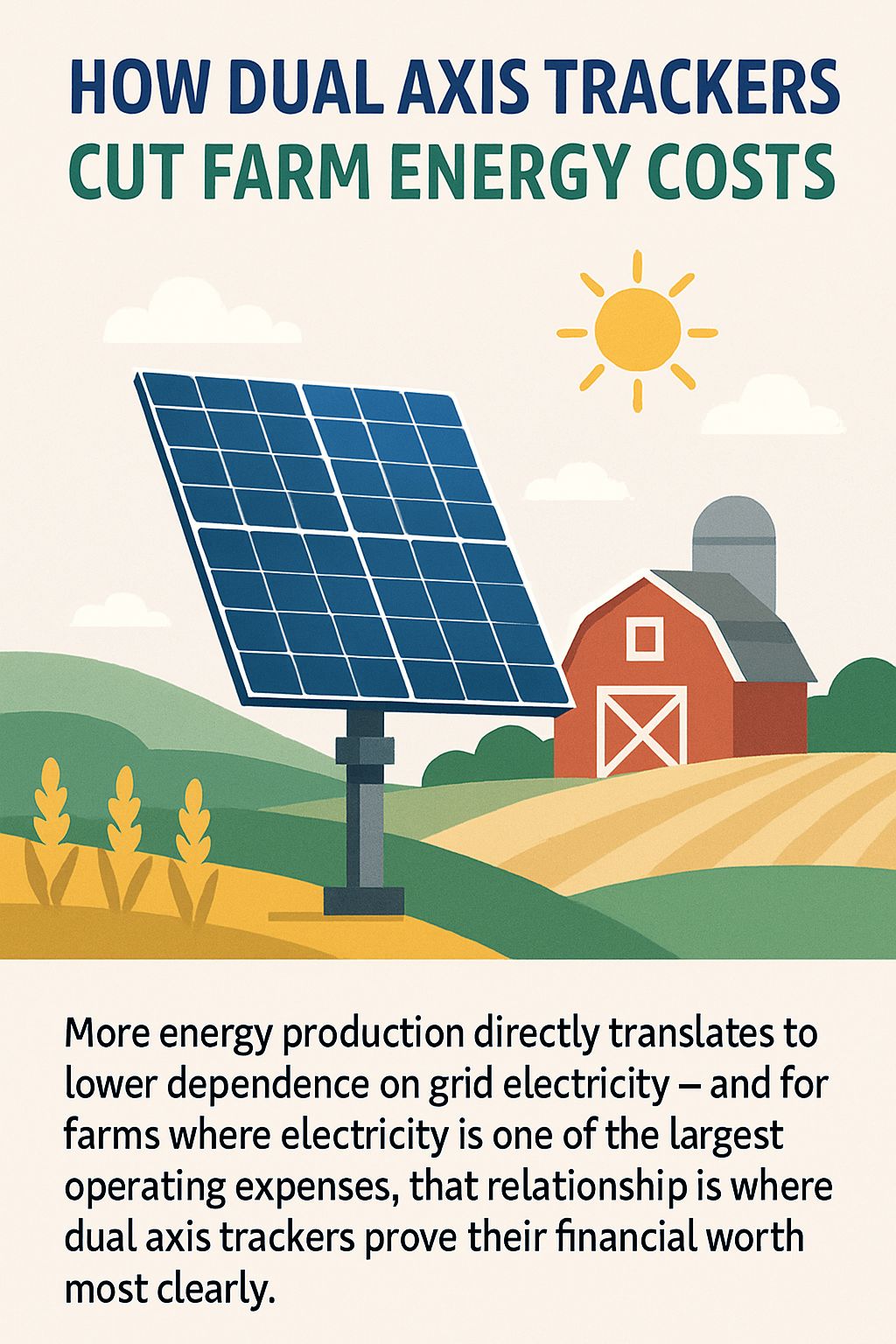
More energy production directly translates to lower dependence on grid electricity — and for farms where electricity is one of the largest operating expenses, that relationship is where dual axis trackers prove their financial worth most clearly.
Lower Electricity Bills Through Reduced Grid Dependency
Every kilowatt-hour your dual axis tracker system generates is a kilowatt-hour you don’t purchase from the grid. For farms running high-draw equipment — irrigation pumps, grain dryers, climate-controlled storage — grid electricity costs can represent tens of thousands of dollars annually. Dual axis trackers attack that expense directly by maximizing the share of your farm’s total energy consumption that comes from your own solar installation. Learn more about the best solar panels for farmers to further reduce energy costs.
The math compounds quickly when you factor in time-of-use electricity pricing, which many rural utility providers now apply. Peak grid rates typically hit hardest during mid-morning through late afternoon — precisely the hours when dual axis trackers are performing at their highest output. Running your equipment during those hours on solar rather than grid power creates savings that fixed panel systems simply can’t match because their output drops off during early morning and late afternoon when tracking would otherwise still be capturing strong sunlight.
Farms that fully offset their daytime electricity consumption with dual axis solar can also take advantage of net metering programs, where surplus energy generated gets credited back against future grid usage. This turns your solar installation into a rolling energy bank, further reducing the net cost of operating your farm year-round.
Renewable Energy Incentives and Tax Rebates Available to Farmers
The financial case for dual axis solar trackers gets even stronger when you factor in available government incentives. In the United States, the federal Investment Tax Credit (ITC) allows agricultural businesses to deduct a significant percentage of their solar installation costs directly from their federal tax liability. Farmers may also qualify for USDA Rural Energy for America Program (REAP) grants, which can cover up to 25% of eligible renewable energy project costs for agricultural producers.
Many state-level programs layer additional rebates and property tax exemptions on top of federal incentives, meaning the effective out-of-pocket cost of a dual axis tracker installation can be substantially lower than the sticker price suggests. Working with a solar provider experienced in agricultural installations — like the team at Growing Solar Mist — ensures you’re capturing every available incentive applicable to your specific operation and location. For more information on solar panel options, explore the best use of solar panels in agriculture.
Long-Term Return on Investment for Agricultural Operations
Dual axis solar trackers carry higher upfront costs than fixed systems, but their superior energy output shortens the payback period significantly. When you account for reduced electricity bills, available tax incentives, net metering credits, and the system’s operational lifespan — which commonly extends 20 to 25 years for quality installations — the total return on investment for dual axis trackers consistently outperforms fixed panel alternatives for farms with meaningful energy demands.
Land and Space Advantages for Agricultural Use
One of the most persistent concerns farmers raise about solar installations is land use. Dedicating acres to solar panels means taking that land out of crop production — or so the traditional thinking goes. Dual axis trackers challenge that assumption directly.
Because dual axis trackers extract significantly more energy per panel than fixed systems, fewer panels are needed to meet the same energy target. That means a smaller physical footprint for an equivalent amount of power generation. For farms where every acre has productive value, this efficiency advantage isn’t a minor detail — it’s a fundamental part of the economic calculation.
Agrivoltaic Farming: Growing Crops Beneath Solar Trackers
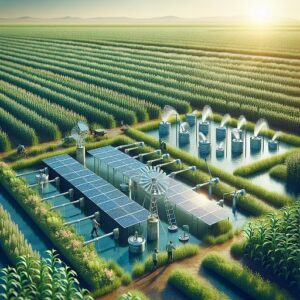
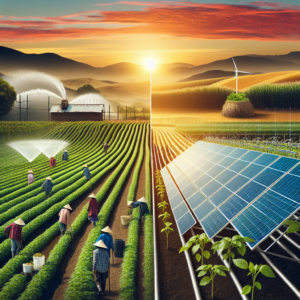
Agrivoltaics — the practice of simultaneously farming and generating solar energy on the same land — pairs exceptionally well with dual axis tracker installations. The elevated, adjustable mounting structures used for dual axis trackers create natural canopy space beneath the panels, which can shelter shade-tolerant crops, reduce soil moisture evaporation, and even improve yields for certain vegetables and herbs that benefit from partial sun protection during peak afternoon heat. For more insights, check out the benefits of TOPCon solar panels for agricultural farms.
A cooperative of farmers in Italy demonstrated this approach at scale, installing dual axis trackers across shared agricultural land and continuing crop production in the spaces between and beneath the tracker mounts. The result was a dual revenue stream from a single piece of land — energy production layered on top of continued agricultural output — a model that is gaining traction across European and North American farming operations alike.
Adapting Tracker Installations to Uneven or Hilly Terrain
A common misconception is that solar trackers require perfectly flat land to function correctly. Modern dual axis tracker systems are engineered with independent mounting systems that can be individually leveled and calibrated to accommodate slopes, gradients, and uneven terrain. Each tracker unit operates independently, so a hillside installation doesn’t require land grading or significant site preparation the way large fixed-array ground mounts often do.
This terrain flexibility makes dual axis trackers genuinely practical for the wide variety of land profiles found across real working farms — rolling pasture land, gently sloped fields, and mixed-terrain properties that would otherwise be considered poor candidates for solar development. The key is proper site assessment during the planning phase to ensure each unit is positioned and calibrated for its specific ground conditions.

“Dual Axis Solar Panel Trackers for Farm …” from growingsolarmist.com and used with no modifications.
Practical Farm Applications Powered by Dual Axis Trackers
The increased energy output from dual axis trackers isn’t just a number on a spec sheet — it powers specific, high-demand systems that are central to how modern farms operate. Understanding exactly where that additional energy goes helps farmers evaluate the real operational impact of upgrading to a tracking system.
The most energy-intensive farm systems fall into three clear categories, and dual axis trackers address each one with a consistent, renewable energy supply that fixed panels struggle to match across a full operating day.
Irrigation Systems
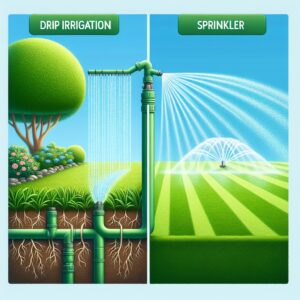
Irrigation pumps are among the heaviest electrical loads on any farm. Running center-pivot or drip irrigation systems during daylight hours — particularly during the high-demand summer growing season — aligns almost perfectly with the peak output window of a dual axis tracker system. Because trackers extend that peak window from early morning through late afternoon rather than limiting strong output to just the midday hours, irrigation systems can run longer on solar power before needing to draw from battery storage or the grid.
Livestock Operations
Livestock facilities require continuous power for ventilation fans, automatic waterers, lighting, and feeding systems. Dual axis trackers provide the extended daily output window that makes it realistic to run these systems predominantly on solar, reducing the depth of discharge on any battery backup systems and keeping operational costs predictable regardless of grid electricity price fluctuations.
Cold Storage and Processing Equipment
Refrigeration and cold storage are among the most power-hungry systems on diversified farms and market operations. These loads run continuously, making the consistency of dual axis tracker output — strong production from morning through late afternoon rather than a sharp midday spike — particularly valuable. A tracker system sized correctly for a farm’s cold storage load can dramatically reduce the grid electricity draw that refrigeration equipment would otherwise demand around the clock.
Processing equipment — grain augers, wash stations, packaging lines — typically operates in defined shifts that can be scheduled to align with peak solar production hours. When those operating windows are matched to the tracker’s strongest output periods, the result is a processing operation that runs almost entirely on self-generated renewable power, with grid electricity serving only as a backup rather than a primary source.
What Farmers Should Know Before Installing Dual Axis Trackers
Dual axis solar trackers are one of the most powerful energy investments a farm can make — but like any significant infrastructure decision, going in with clear expectations about costs, installation requirements, and ongoing maintenance sets you up for a successful outcome. The technology is proven and the returns are real, but understanding the full picture before you commit is what separates a smart investment from a costly surprise. For more insights, explore how dual axis solar trackers can offer more energy per square foot.
The two areas that generate the most questions from farmers considering dual axis trackers are upfront cost and mechanical maintenance. Both deserve straightforward answers rather than the vague reassurances that often pass for guidance in the solar sales process.
Upfront Costs Compared to Fixed Panel Systems
Dual axis trackers cost more upfront than fixed panel systems — that’s a straightforward fact worth acknowledging directly. The motorized mounting hardware, control systems, and more complex installation requirements all contribute to a higher initial price point compared to a static ground mount or rooftop array using the same number of panels. However, the relevant comparison isn’t the sticker price in isolation — it’s the cost per kilowatt-hour delivered over the system’s lifetime. On that metric, dual axis trackers consistently outperform fixed systems for farms with meaningful energy demands, because the same number of panels generates substantially more energy across the system’s 20-to-25-year operational life.
When federal ITC tax credits, USDA REAP grant funding, and state-level incentives are applied, the effective out-of-pocket cost gap between dual axis and fixed systems narrows considerably. For many agricultural operations, the payback period on a properly sized dual axis tracker installation — measured against electricity cost savings alone — falls within a range that makes the investment straightforward to justify on financial grounds.
Maintenance Requirements for Moving Mechanical Parts
Because dual axis trackers include motors, drive systems, and articulating joints that fixed panels simply don’t have, they do carry higher maintenance requirements. Routine servicing typically includes periodic lubrication of mechanical components, inspection of motor drive systems, checking electrical connections at pivot points, and software or firmware updates for the tracking control system. Most quality dual axis tracker manufacturers design their systems for low-intervention maintenance cycles, with annual or biannual service visits sufficient for well-installed systems operating in normal agricultural environments. Building a service agreement with your installation provider from day one is the simplest way to ensure maintenance never becomes an unplanned disruption to your farm’s energy supply. For more information on solar panel options for farms, explore the best solar panels for farmers.
“Solar Panel Efficiency for Farmers …” from growingsolarmist.com and used with no modifications.
Dual Axis Solar Trackers Are the Smartest Energy Upgrade a Farm Can Make
When you stack up every dimension of performance — energy output, land efficiency, seasonal consistency, application flexibility, and long-term financial return — dual axis solar trackers sit at the top of the hierarchy for agricultural solar installations. No other configuration delivers the same combination of maximum energy capture and operational versatility that working farms actually need.
The 40% energy output advantage over fixed panels isn’t a marginal gain. For a farm already running solar, it’s the difference between a system that offsets a portion of your electricity costs and one that fundamentally transforms your energy economics. For a farm making its first solar investment, it means fewer panels needed, a smaller physical footprint, and a faster path to energy independence.
Farmers who have made the switch consistently point to the same outcomes: lower electricity bills, more reliable power for critical systems, and the confidence of knowing their energy supply isn’t subject to grid price volatility or supply disruptions. Those outcomes are available to farms of all sizes — from small diversified operations to large-scale agricultural enterprises.
- Up to 40% more energy generated compared to fixed solar panels using the same number of panels
- Year-round output consistency through automatic seasonal elevation adjustment on the North-South axis
- Extended daily production window that matches irrigation, refrigeration, and livestock operation schedules
- Agrivoltaic compatibility allowing continued crop production beneath and between tracker installations
- Terrain flexibility with independently adjustable mounts that work across uneven and sloped farmland
- Access to federal and state incentives including ITC tax credits and USDA REAP grants that reduce effective installation costs
- 20-to-25-year operational lifespan that delivers compounding financial returns well beyond the initial payback period
The farms that will lead in energy efficiency and operational resilience over the next two decades are the ones making smart infrastructure investments today. Dual axis solar trackers are exactly that kind of investment — proven technology with a clear performance record and a financial return structure that rewards long-term thinking. Learn more about solar panel benefits for agricultural farms.
Frequently Asked Questions
Here are the questions farmers ask most often when evaluating dual axis solar trackers for their operations, answered directly and without the sales spin.
Quick Reference: Dual Axis Solar Tracker FAQ Summary
✅ Energy gain vs. fixed panels: Up to 40% more output
✅ Worth it for small farms? Yes, when energy demands are consistent and incentives are applied
✅ Works on hilly terrain? Yes, with independent leveling mounts
✅ Farm equipment it can power: Irrigation, refrigeration, livestock systems, processing equipment
✅ Maintenance intensity: Low with scheduled annual or biannual servicing
Each of these answers carries nuance worth understanding in full — particularly if you’re weighing dual axis trackers against other solar configurations for your specific farm setup.
How Much More Energy Do Dual Axis Trackers Produce Compared to Fixed Solar Panels?
Dual axis solar trackers produce up to 40% more energy than fixed solar panels using the same number of panels over the same time period. This gain comes from the tracker’s ability to maintain a near-perpendicular angle between the panel surface and direct sunlight throughout the entire day — from early morning through late afternoon — and across all seasons by adjusting for both the daily solar arc and seasonal sun elevation changes.
In practical terms, a fixed panel system producing 100 kWh per day could produce up to 140 kWh per day with dual axis trackers installed in its place. That additional 40 kWh represents real operational capacity — more irrigation runtime, more refrigeration coverage, more processing equipment hours — all powered by renewable energy rather than purchased from the grid.
Are Dual Axis Solar Trackers Worth the Extra Cost for Small Farms?
Small Farm Cost-Benefit Snapshot
⚡ Higher upfront cost than fixed panels → Offset significantly by ITC tax credits and USDA REAP grants
⚡ Fewer panels needed for same energy output → Smaller physical footprint, lower panel hardware cost
⚡ Stronger daily output → Reduced grid electricity purchases from day one
⚡ 20-to-25 year lifespan → Long return window that rewards the investment over time
The honest answer is: it depends on your farm’s energy consumption profile. For a small farm running consistent, energy-intensive operations — irrigation, cold storage, livestock systems — dual axis trackers deliver a compelling return even at smaller system sizes because the energy savings are real and recurring every single day the system operates.
For a very small operation with minimal electricity demands, the payback period may stretch longer, and a smaller fixed panel system could be the more appropriate starting point. The key variable is how much grid electricity your farm currently purchases and how consistently that demand runs throughout the day.
Small farms in Italy operating as part of a cooperative structure have demonstrated a practical path forward for operations where individual installation costs feel prohibitive — by sharing a dual axis tracker installation across adjacent properties, multiple small farms can access the energy output advantages of a larger system while splitting the infrastructure investment. It’s a model worth exploring with neighboring farms facing similar energy challenges.
When federal and state incentives are fully applied, the effective cost premium of dual axis over fixed systems shrinks substantially — often enough to make dual axis the financially sound choice even for smaller agricultural operations with limited capital budgets. Getting a detailed site assessment and incentive analysis specific to your location is the clearest way to answer this question for your farm’s specific situation.
Can Dual Axis Solar Trackers Be Used on Hilly or Uneven Farmland?
Yes — modern dual axis solar tracker systems are specifically engineered to accommodate uneven and sloped terrain through independently adjustable mounting structures that can be individually leveled and calibrated for their specific ground position. Unlike large fixed-array ground mounts that often require significant site grading to create a level installation surface, dual axis tracker units operate independently of one another, meaning a hillside installation can be deployed without moving earth or disrupting the existing landscape. A thorough site assessment during the planning phase ensures each unit is positioned and calibrated correctly for the terrain conditions at that specific location on your property.
What Farm Equipment Can Be Powered by Dual Axis Solar Tracker Systems?
Dual axis solar tracker systems can power virtually any electrically driven farm equipment, but they deliver the greatest operational impact when applied to the highest-draw, most consistently running systems on the farm. Irrigation pumps — including center-pivot systems and drip irrigation arrays — are a natural fit because their peak demand hours align directly with the tracker’s strongest output window. Livestock operation equipment including ventilation systems, automatic waterers, and lighting runs on the consistent daytime output dual axis systems provide. Cold storage and refrigeration units benefit from the extended daily production window that keeps solar coverage running well beyond the midday peak that fixed panels depend on.
Processing equipment — grain handling systems, wash stations, and packaging lines — can be scheduled to operate during peak solar production hours, effectively running those energy-intensive processes on self-generated renewable power. For farms that have already catalogued their electricity consumption by system, a dual axis tracker installation can be sized specifically to cover the highest-priority loads first, with the system designed to scale as energy needs grow.
Do Dual Axis Solar Trackers Require a Lot of Maintenance?
Dual axis trackers require more maintenance than fixed panel systems because they include moving mechanical components — motors, drive systems, pivot joints, and electronic control systems — that static installations simply don’t have. However, “more maintenance than fixed panels” shouldn’t be interpreted as high-maintenance. Quality dual axis tracker systems are engineered for low-intervention operation, with most installations requiring only annual or biannual service visits under normal agricultural operating conditions.
Routine maintenance tasks include lubricating mechanical joints and drive components, inspecting motor systems for wear, checking electrical connections at all pivot and articulation points, cleaning panel surfaces, and updating tracking control software where applicable. These are scheduled, predictable activities — not reactive repairs — which means they can be planned around your farm’s operational calendar without disrupting critical energy supply periods.
The most practical approach for any farm installing dual axis trackers is to establish a service agreement with the installation provider from the outset. This locks in scheduled maintenance visits, ensures access to manufacturer-trained technicians, and gives you a clear cost structure for ongoing system care — removing maintenance uncertainty from the investment equation entirely.


Leave a Reply