
Article-at-a-Glance
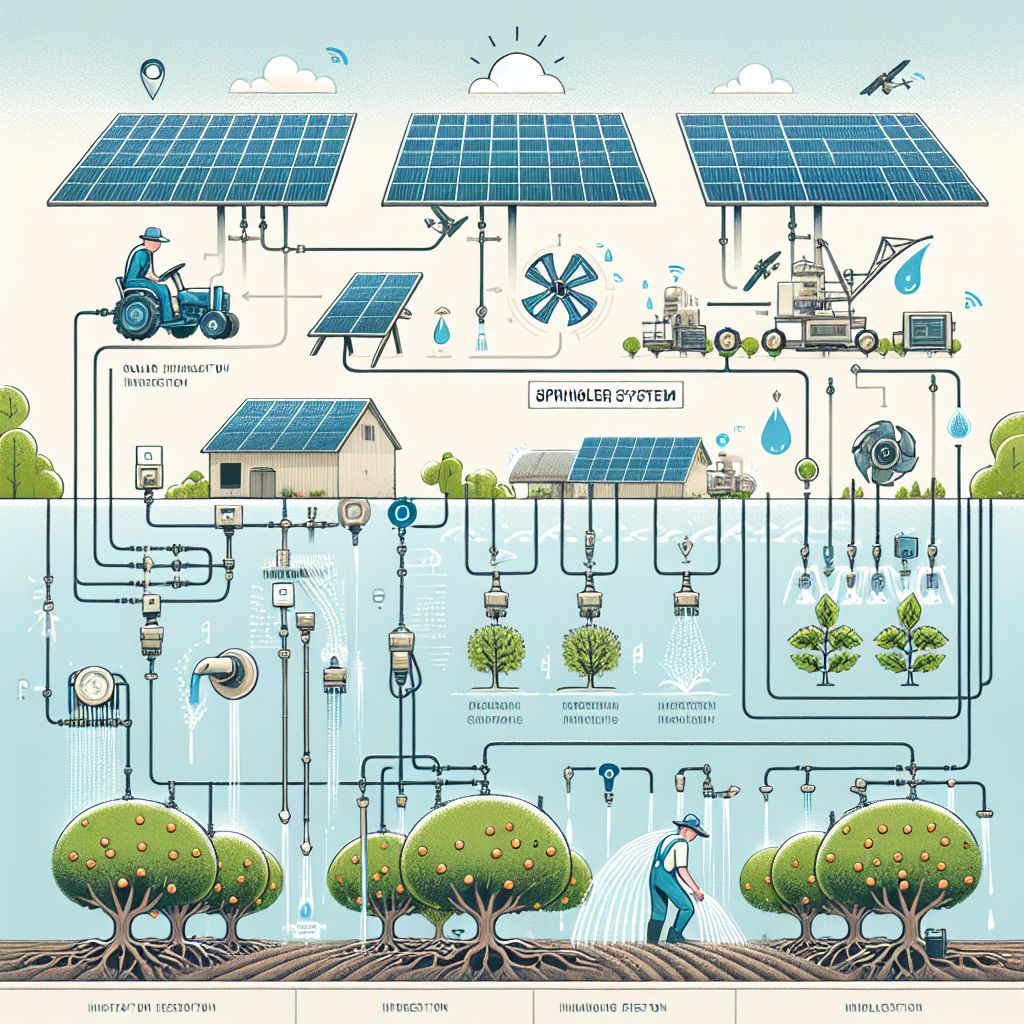
Orchards can substantially decrease their water and energy use by implementing solar irrigation systems.
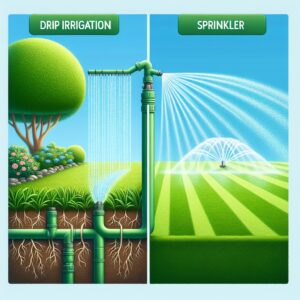
Drip irrigation is an effective method for delivering water straight to the roots, which helps reduce waste.
Although sprinkler systems offer wide coverage, they must be properly managed to minimize evaporation.
Micro-irrigation systems provide precise watering, which can be tailored to meet the specific needs of various orchards.
Selecting the right solar panel configuration for an irrigation system is key to maximizing efficiency and cost savings.
Optimizing Orchard Health through Intelligent Watering Techniques
Water is as valuable as the fruit it produces when it comes to maintaining an orchard. However, the way we deliver water to our trees is just as important as every drop of water. The goal is straightforward: reduce water and energy use while maintaining the health of our orchards. Let’s examine how contemporary solar irrigation systems can make this possible.
Comparing Top Irrigation Methods
Picture three friends – Drip, Sprinkler, and Micro – all with the same aim but using different approaches. Drip is the careful one, delivering water drop by drop exactly where it’s required. Sprinkler enjoys making it rain, sprinkling water over a large area. And Micro? He’s the exact one, customizing water delivery to the specific needs of each tree. Each method has its uses, but let’s see which one is the most suitable for you.
Right below is a table summarizing the best irrigation systems for an orchard:
|
Irrigation System |
Pros |
Cons |
|
Drip Irrigation |
– Most efficient, up to 100% water use efficiency. 3 |
– High initial investment. 4 |
|
Sprinkler Systems (Overhead and Under-Tree) |
– Overhead sprinklers can cover large areas. 2 |
– Less water efficient than drip irrigation, around 70% efficiency. 2 |
|
Micro-Irrigation (Micro-Sprinklers) |
– Provides uniform water coverage. 4 |
– Consumes more water and energy than drip irrigation. 4 |
Efficient Water Usage in Orchards
When it comes to managing an orchard in a sustainable manner, efficiency is key. It’s not just about the amount of water we conserve, but also the method of conservation. Solar-powered systems allow us to utilize the sun’s energy, reducing our dependence on traditional forms of energy. This results in not only lower utility bills, but also a smaller carbon footprint, making our orchard operations as environmentally friendly as possible.
Personalized Solutions for Every Orchard
Each orchard is different, with its own problems and needs. That’s why a one-size-fits-all irrigation method isn’t going to work. Whether you’re on a hill, have different types of soil, or have a mix of young and old trees, your irrigation system needs to be as flexible as you are. Let’s look at the systems that can be tailored to your particular needs.
Quenching Thirst at the Source: An Examination of Drip Irrigation
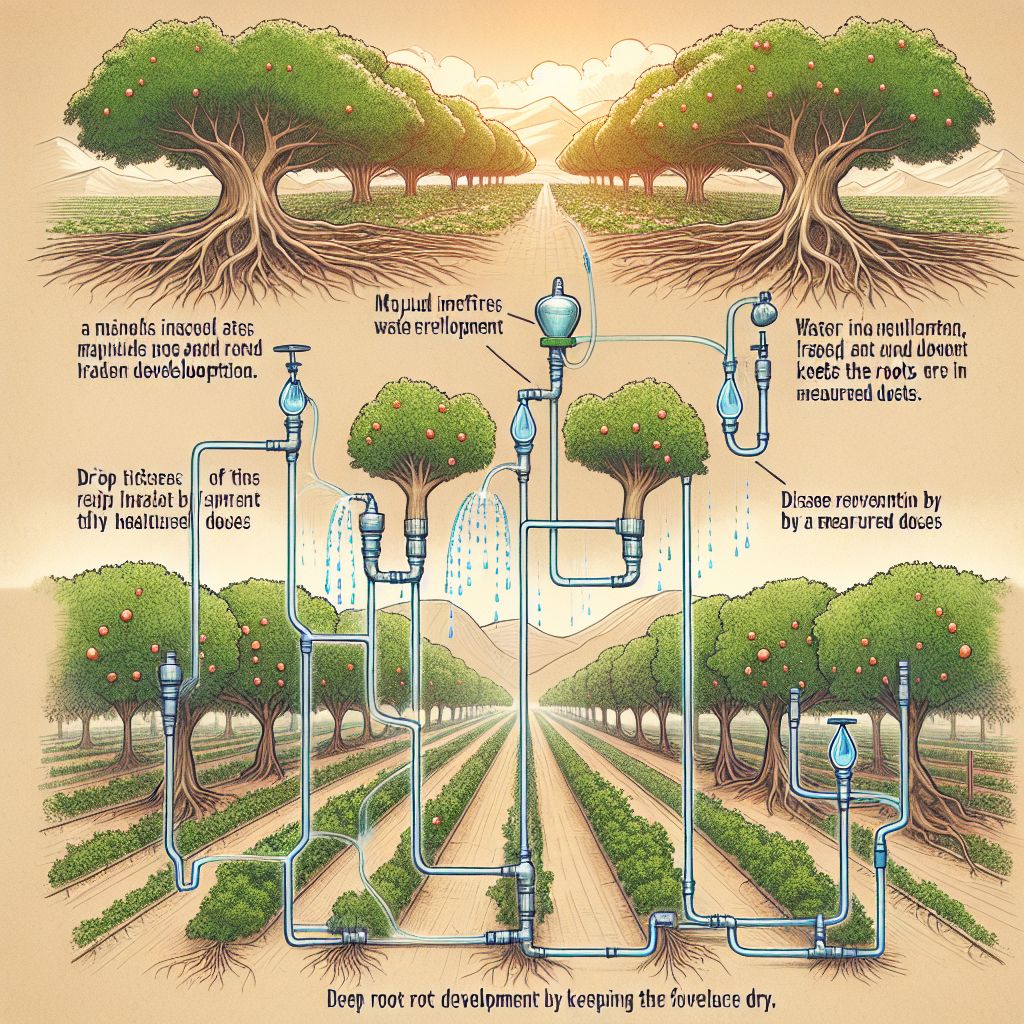
Drip irrigation can be likened to a life-sustaining system for trees, as it provides water and nutrients straight to their roots. This approach is not only water-efficient, but it also fosters deep root development, resulting in sturdier, more robust trees. Furthermore, it lessens the likelihood of disease transmission by keeping the foliage dry.
Understanding the Structure of a Drip System
Think of a drip system as the veins and arteries of your orchard, with the mainlines acting as the heart. These mainlines pump vital water through a system of smaller lines. Each of these smaller lines is fitted with emitters, which release water in carefully measured amounts. The idea is simple, but the execution is complex.
Best Practices for Installation
While setting up a drip system isn’t as complex as rocket science, it does necessitate some expertise. You should begin with a plan that takes into account the size and spacing of your trees in your orchard. After that, you’ll need to lay out your mainlines and laterals, and install emitters at the root zones of your trees. Keep in mind that the goal is to achieve uniformity – each tree should receive an equal amount of water.
How to Tell If Your Drip System is Working
Wondering if your drip system is doing its job? Your trees will let you know. If you prefer hard data, you can also measure the system’s efficiency by looking at the uniformity of water distribution and the amount of water you’re saving. A good drip system can cut your water use by up to 50% compared to traditional watering methods.
Upkeep and Solving Ordinary Problems
Even the most effective systems require a bit of upkeep from time to time. Routine maintenance, such as clearing out your lines and inspecting for blocked emitters, will ensure your system continues to function optimally. And if you encounter any issues, don’t worry. Ordinary problems like leaks or pressure changes can usually be resolved with a few easy tweaks.
Getting to Every Nook and Cranny: The Pros of Sprinkler Systems
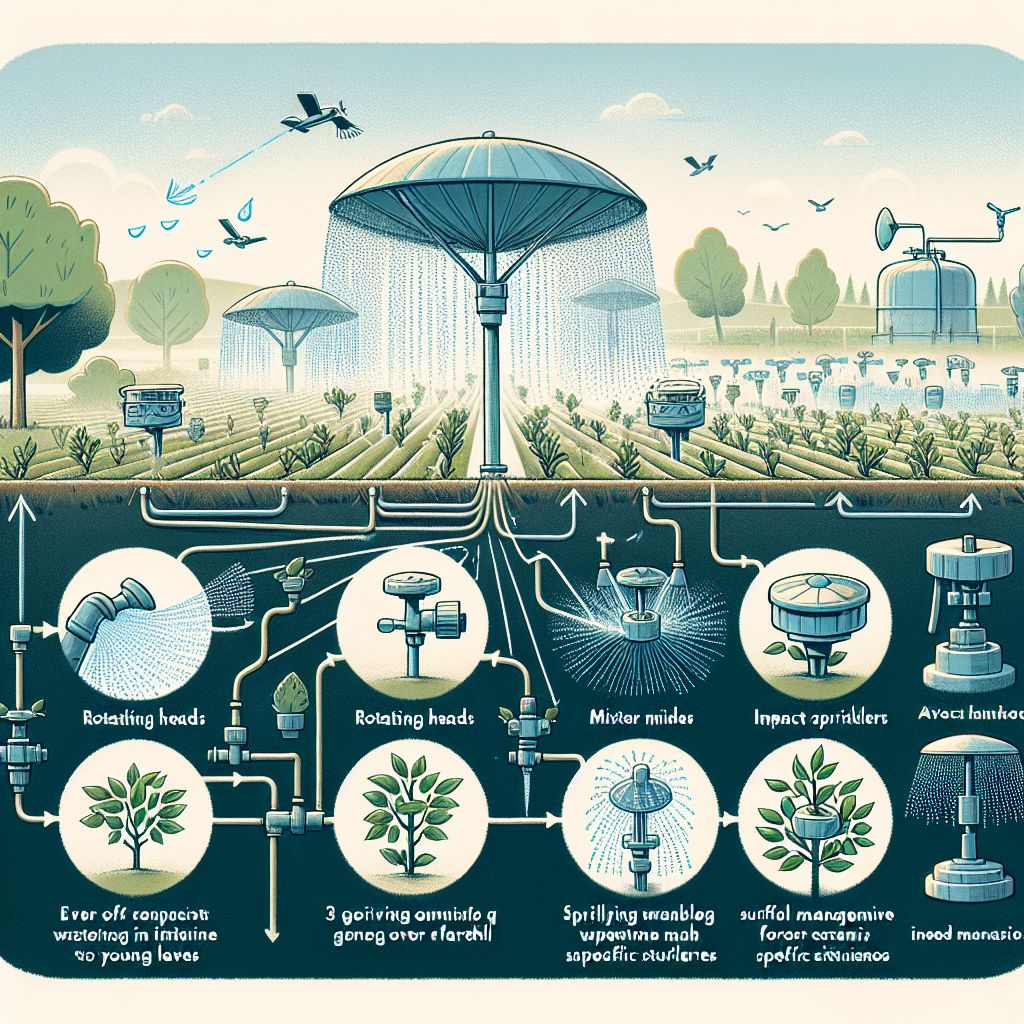
Unlike drip irrigation systems that aim for the roots, sprinkler systems imitate rainfall and cover a larger area. This can be particularly useful when saplings require a more general water supply. However, with this extensive coverage, it is important to manage these systems properly to avoid wasting water.
Planning for Placement: Sprinkler Head Options
The type of sprinkler head you select can have a significant impact on your orchard. Options include rotating heads, misters, and impact sprinklers, each of which is suited to a different situation. For instance, rotating heads provide even coverage, while misters are perfect for fragile leaves. The key is to choose a sprinkler head that meets the needs of your orchard.
Water Distribution and Pressure Considerations
Uniform distribution is the key, but to achieve it, you need to balance coverage with water pressure. Insufficient pressure and your trees won’t get enough water; excessive pressure and you risk runoff and erosion. It’s like tuning a guitar string – the right tension produces the perfect sound.
Examine your water supply and pressure capabilities.
Select sprinkler heads suitable for your particular water pressure range.
Ensure that your system provides uniform coverage across the orchard by testing it.
The most important thing is to ensure that the trees at the far end of the orchard are as well-watered as those near the water source.
Addressing Evaporation and Wind Drift
Sprinklers can be negatively affected by the weather, and the amount of water lost to evaporation and wind drift can be substantial. To counteract this, water during the cooler parts of the day, when there is little wind and the sun isn’t too strong. This timing ensures more water gets to the soil and roots, where it’s most needed.
Think about using sprinklers that have a lower trajectory and bigger droplets to reduce drift. Also, don’t forget that performing routine maintenance to prevent leaks and misdirected sprays will help maintain your system’s efficiency.
Don’t just take my word for it though. A study published in the Journal of Sustainable Agriculture found that by simply adjusting watering times and sprinkler settings, water usage could be reduced by up to 30% without any decrease in orchard yield.
Unpacking the Efficiency and Precision of Micro-Irrigation
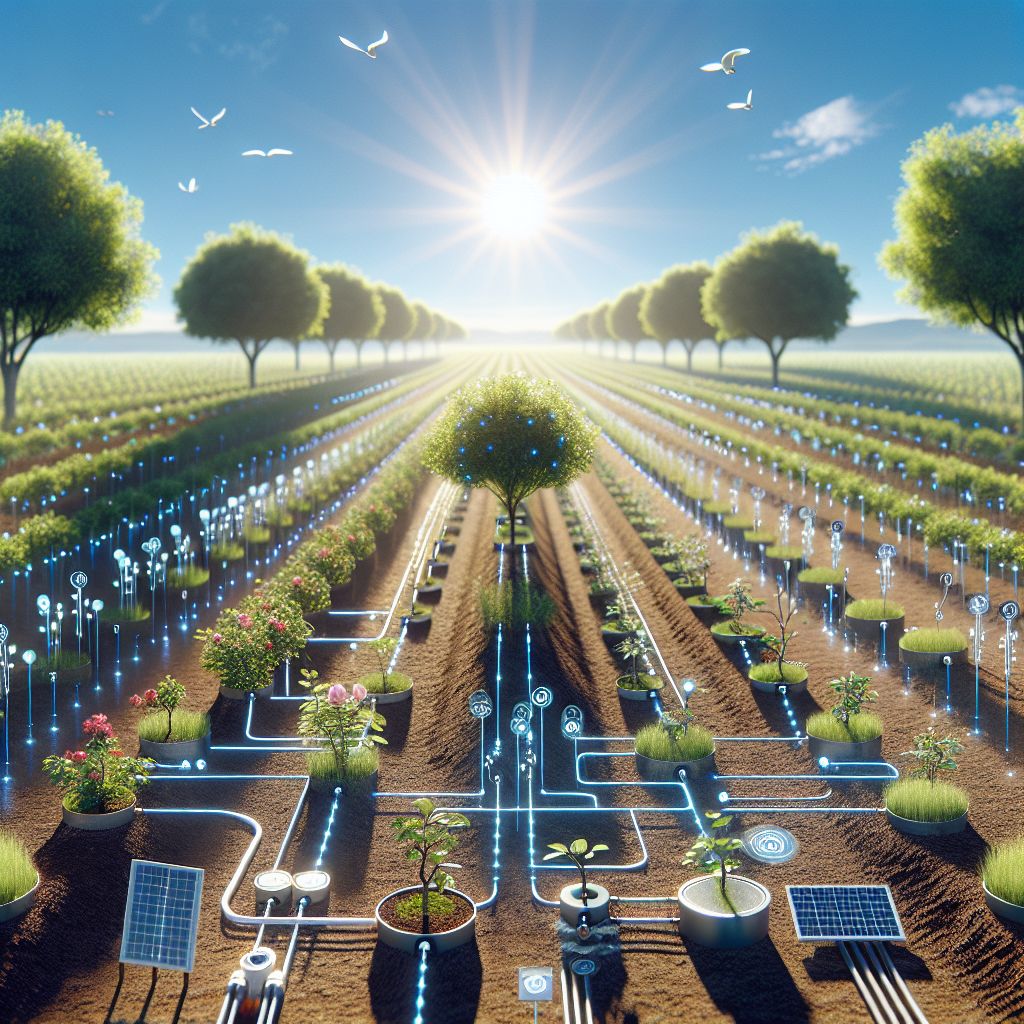
Micro-irrigation is the secret weapon of precision agriculture. It’s a method that delivers water and nutrients in small, precise amounts. It’s like giving your trees a custom hydration treatment – it’s that accurate. And because it’s so precise, it can be incredibly efficient, both in terms of water use and energy consumption when powered by solar energy.
Micro-irrigation allows you to cater to the unique needs of various sections of your orchard. This is particularly beneficial in areas with varied topographies or in orchards that have a mix of tree species and ages.
Customizing Micro-Irrigation for Your Orchard Design
Micro-irrigation systems can be tailored to fit the specific shape and conditions of your orchard. You can adjust the flow rate, the placement of emitters, and even the irrigation schedule to suit the requirements of each tree or row. It’s akin to assigning each tree its own personal water manager who knows exactly when it needs a drink.
Micro and Drip: How They Compare
Micro-irrigation and drip systems both aim to use water efficiently. However, while drip irrigation focuses on saturating the roots, micro-irrigation can also incorporate micro-sprayers and bubblers that can moisten a small area around the tree. This can be advantageous for young trees that benefit from having moist soil beyond just the root zone.
Both systems are great for saving water, but micro-irrigation has a little more versatility in how it’s used, which can make all the difference in some orchard configurations.
Modern Tools and Tech in Micro-Irrigation
Modern micro-irrigation systems are packed with impressive technology. Soil moisture sensors can initiate irrigation only when necessary, and intelligent controllers can modify the watering schedule based on weather predictions. These tools not only conserve water but also guarantee that your trees receive the correct quantity of moisture at the correct time.
Making the Right Choice: Picking the Perfect System for Your Orchard
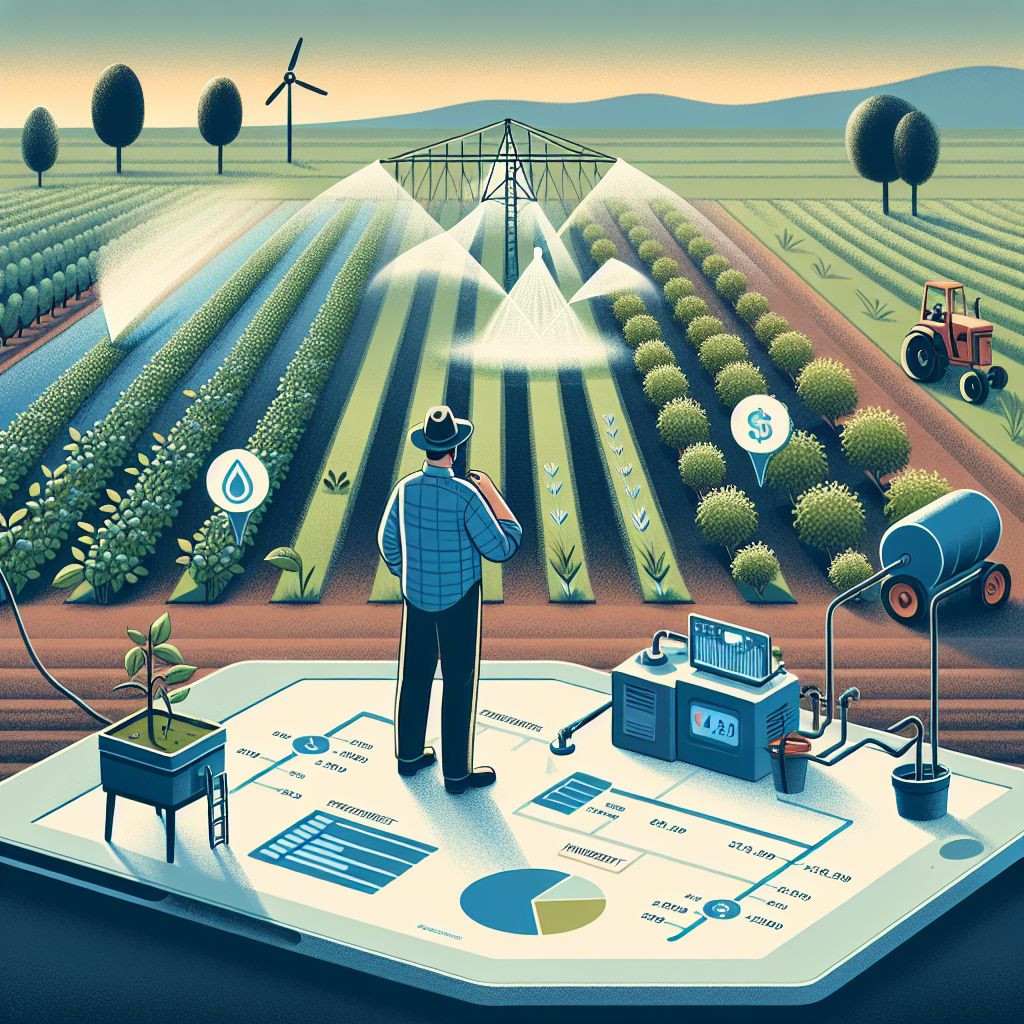
Choosing the right irrigation system for your orchard is a significant decision. It’s a choice that affects both the wellbeing of your trees and the viability of your business. Let’s look at the factors you need to consider when making this crucial decision.
Evaluating the Size and Shape of Your Orchard
The dimensions and the arrangement of your orchard are crucial in choosing an irrigation system. If your orchard is large, a sprinkler system that covers a wide area may be beneficial. On the other hand, if your orchard is small or has an irregular terrain, a drip or micro-irrigation system that allows for precise watering may be more appropriate.
Water Supply and Quality
The water resources in your area are another key factor. Solar irrigation systems have the ability to pump water from deep wells or nearby streams, but the quality and availability of that water will determine which system is the most suitable. Keep in mind that healthy trees require quality water, and your irrigation system should be able to provide it consistently.
Understanding the Financial Implications of Irrigation Investments
When you decide to invest in an irrigation system, it’s essential to consider the initial costs and the potential savings in water, energy, and labor. The right system will eventually pay for itself, not only in terms of money but also in the health and productivity of your orchard.

Enhance the Efficiency of Your Irrigation System with Solar Panels
By incorporating solar panels into your irrigation system, you are essentially putting your orchard on cruise control. Thanks to the sun’s energy, you can pump water without relying on the grid, which not only saves you money but also decreases your environmental impact. It’s a beneficial situation for both you and the Earth.
However, it’s not as simple as just sticking some panels up and being done with it. You need to think about the kind of panels you’re using, where you’re putting them, and how they work with your irrigation system to ensure you’re getting the best value for your money.
For example, a farmer in sunny California reported that installing solar panels cut their irrigation costs by more than 70%. Their trees are flourishing, and they’re saving a lot of money on energy bills.
Consider the Various Types of Solar Panels for your Irrigation System
It’s important to note that not all solar panels are the same. There are monocrystalline, polycrystalline, and thin-film panels, each with its own set of advantages and disadvantages. Monocrystalline panels are very efficient but can be pricier, while polycrystalline panels are more budget-friendly but a bit less efficient. Thin-film panels are flexible and light, but they usually need more space.
Choosing the Right Solar Panel to Pair with Your Irrigation System
When choosing the right solar panel, take into account your orchard’s geographic location, the amount of sunlight it gets, and the energy needs of your irrigation system. In the long run, a balanced approach that takes into account cost, efficiency, and durability is the best choice.
This table summarizes the best solar panels to use for a solar irrigation system in an orchard:
|
Solar Panel Type |
Key Features |
Advantages for Orchard Irrigation |
|---|---|---|
|
Monocrystalline Solar Panels |
– Made from single-crystal silicon |
– Able to generate more power per square foot, important for limited space in orchards. 3, 5 |
|
Polycrystalline Solar Panels |
– Made from multiple silicon crystals |
– Good balance of performance and cost for orchard irrigation systems. 1, 5 |
|
Thin-Film Solar Panels |
– Made from non-silicon materials like cadmium telluride |
– Suitable for orchards in hot climates where temperature impact on efficiency is a concern. 1, 3 |
Green Thumbs Up: Orchard Owners Share Their Watering Wisdom
There’s nothing like a success story to prove that a strategy is effective. And when it comes to solar irrigation systems, the proof is in the produce.
Orchard Irrigation Success Stories from the Real World
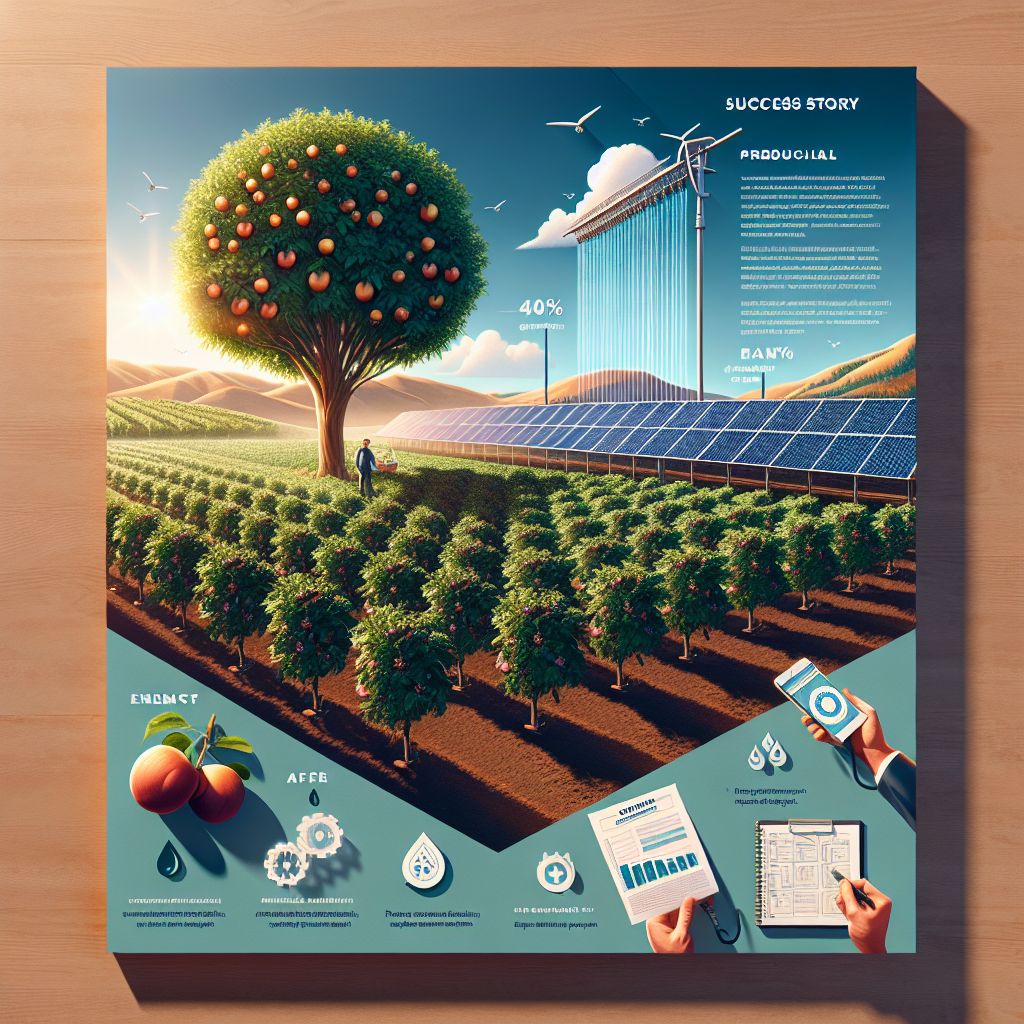
Consider the tale of a family-run orchard in Oregon. They saw a significant boost in tree health and fruit quality after transitioning to a solar-powered drip irrigation system. They not only reduced their water consumption by 40%, but their energy costs also plummeted, demonstrating the dual advantages of solar irrigation.
Advice from Professionals
Professionals in the field say that the most important thing about solar irrigation is good planning and implementation. They suggest that you first evaluate the layout and water needs of your orchard, then talk to a specialist in solar irrigation who can help you design a system that fits your unique circumstances.
Final Thoughts:
Wrapping up, solar irrigation systems provide a green and effective method to irrigate orchards. By leveraging solar power, orchard owners can lessen their carbon footprint while keeping their trees healthy and fruitful. Regardless of whether you opt for drip, sprinkler, or micro-irrigation, combining your system with solar technology is a wise decision that will yield benefits for many years.
FAQs: Understanding Your Orchard’s Irrigation Requirements
Before we conclude, let’s tackle some frequently asked questions you might be wondering about.
How often should I use drip irrigation in my orchard?
The watering frequency will vary based on a number of factors such as the type of soil, the type of tree, and the climate. A good rule of thumb is to water deeply and less often to promote strong root growth. However, using soil moisture sensors can give you a more precise watering schedule for your orchard.
Will utilizing smart technologies decrease the amount of water my orchard uses?
Definitely, smart technologies such as soil moisture sensors and weather-based controllers can drastically decrease water usage by providing data-driven insights for irrigation. These tools enable you to water only when it’s needed, avoiding both over and under-watering.
Consider an orchard in Arizona, for instance. They put in a smart irrigation controller that tweaks watering based on real-time weather data. The result? They cut their water usage by 25%.
Which solar irrigation system is the best for a hilly orchard?
When dealing with uneven ground, drip irrigation systems are often the best choice. They can be tailored to the different levels of the land and deliver water straight to the root zone, reducing runoff and soil erosion.
What can I do to stop my trees from getting too much water and experiencing water stress?
To stop your trees from getting too much water, you can use timers and moisture sensors to control your irrigation. Also, knowing how much water your specific type of tree needs is very important. To stop your trees from experiencing water stress, make sure your irrigation system is in good working order and change your watering schedule based on the time of year and the weather.
How often do I need to clean my solar irrigation system to keep it running at peak performance?
Keeping your solar irrigation system clean and well-maintained is key to its performance. You should clean the panels every few months to remove any dust and debris, and check the rest of the system for clogs or damage at least twice a year.
When you adopt solar irrigation systems and the methods described in this article, you’re not just contributing to your orchard’s long-term viability. You’re also helping to create a more environmentally friendly future for farming. Remember, every move towards more efficient water usage is a move towards a more bountiful crop.

Leave a Reply