

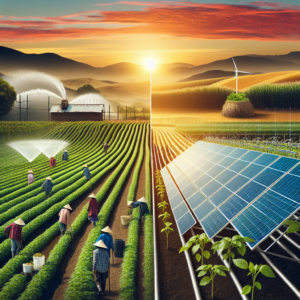
As a passionate advocate for sustainable farming, I aim to share knowledge that enlightens and encourages action. In apple cultivation, the proper irrigation system can significantly impact the outcome. Now, consider pairing that with solar energy – you’ve got a winning combination. It’s a fusion of the old and the new that harnesses the sun’s abundant energy, ensuring that your apple trees flourish while saving resources. Let’s delve into how solar-powered irrigation systems can transform your apple orchard.
Key Takeaways
Solar-powered irrigation systems provide a renewable method to water apple orchards, using the sun’s power to run pumps.
Drip irrigation is the most effective watering technique for apples, minimizing water loss and directly reaching root zones.
Selecting the appropriate solar panel, such as monocrystalline or polycrystalline, is vital for maximizing energy efficiency.
Although the initial cost of solar irrigation can be more, the long-term savings and environmental advantages are substantial.
Pairing solar power with the right irrigation technique can result in a highly efficient system designed for apple cultivation.

Why Solar Panels and an Irrigation System are Ideal for Apple Cultivation
The Eco-friendly Revolution: Tapping into the Sun for Sustainable Agriculture
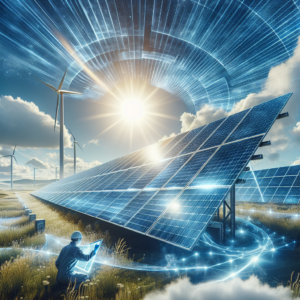
Employing solar panels for irrigation is a win-win situation – you cut down on electricity expenses and decrease your carbon emissions. Solar panels harness the sun’s power, transforming it into electricity to operate your irrigation system. This implies you’re not reliant on the grid, and you’re utilizing a renewable energy source that’s plentiful and free after the initial installation is done.
Reduced Costs and Freedom from the Grid
Everyone knows that farming can be an expensive endeavor, particularly when you consider the costs of water and power. By choosing to use a solar-powered irrigation system, you’re making an investment that will eventually pay for itself. Energy costs can eat up a significant portion of your income, but solar power is a cost-effective solution – after the initial installation, it costs practically nothing to run.
Improving Crop Production with Steady Water Supply
When it comes to farming, consistency is everything, and a steady water supply is a crucial part of consistent crop production. Solar-powered irrigation systems offer that steadiness, guaranteeing that your apples receive the right amount of water every time. This can result in healthier trees and, in the end, a larger yield.

Different Irrigation Methods for Apples Farming
All watering methods are not made equal, especially in the case of orchards. The aim is to deliver water in an efficient manner directly to the root zone, where it’s most needed. In this article, we’ll talk about the different watering methods that can be combined with solar power to create the perfect irrigation system for your apple trees.
Drip Irrigation: A Precise Way to Water for Better Efficiency
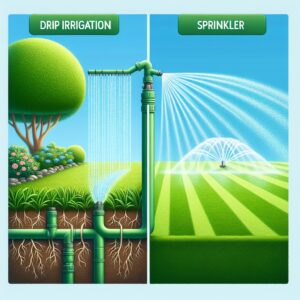
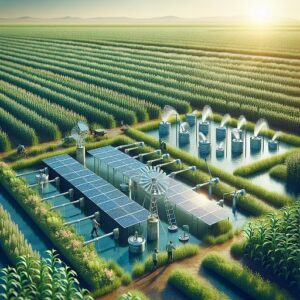
Drip irrigation is a method that provides water straight to the roots of each apple tree, one drop at a time. This precise method means less water is wasted due to evaporation and runoff, making it highly efficient. When drip irrigation is powered by solar panels, it becomes an eco-friendly powerhouse, ensuring that every drop of water is used to its maximum potential.
Micro-Sprinkler Systems: Maximizing Water Usage
Micro-sprinkler systems are another option that distribute water in a controlled way over the root zone. This is similar to drip irrigation, but it covers a larger area. These sprinklers can be powered by solar energy, which means they can continue to function during power outages or in remote areas that do not have access to the electrical grid.
Surface Irrigation Techniques: Old vs. New
Surface irrigation, one of the oldest methods, involves distributing water across the land by gravity. Although it’s not as efficient as drip or micro-sprinkler systems, its effectiveness has been improved by modern advancements. Surface irrigation, when paired with solar-powered pumps, can still be a good choice for some orchards.
Here’s a table comparing different irrigation methods for apple farming:
|
Irrigation Method |
Description |
Advantages |
Disadvantages |
|---|---|---|---|
|
Drip Irrigation |
Delivers water directly to the root zone through a network of pipes and emitters |
– High water efficiency (90-95%). 1, 2, 4 |
– Higher initial installation cost. 1, 4 |
|
Micro-Sprinkler Systems |
Uses small sprinklers to distribute water in a localized area around each tree |
– Good water efficiency (75-90%). 2, 3 |
– Higher water use compared to drip irrigation. 3 |
|
Surface Irrigation (Flood/Furrow) |
Water is distributed across the orchard surface through gravity flow |
– Low initial cost. 4 |
– Low water efficiency (40-60%). 2, 4 |
Having discussed the reasons and methods for using solar-powered irrigation for apple growing, it’s clear that this approach is not just a passing fad, it’s the way forward in agriculture. By capturing the energy of the sun and combining it with the most effective irrigation methods, we can ensure that apple orchards are productive, sustainable and robust. In the following section, we will delve deeper into the types of solar panels that are most suited to your orchard’s requirements.

Top Solar Panels for Your Apples Farm’s Irrigation System
Selecting the correct solar panel is essential for the effectiveness of your solar-powered irrigation system. Each panel type has its pros and cons, and knowing these can assist you in making the optimal choice for your apple orchard.
Monocrystalline Solar Panels: The Best Choice for Your Apple Orchard
Monocrystalline solar panels are renowned for their high efficiency and long-lasting durability. They are constructed from a single, pure crystal structure, which enables them to generate more power per square foot than other panel types. This means you’ll require fewer panels to satisfy your energy requirements, thereby conserving space in your apple orchard. They also perform better in low-light conditions and have a longer lifespan, often exceeding 25 years.
Polycrystalline Panels: A Cost-Effective and Efficient Solution
Polycrystalline panels are a more affordable option as they are made from multiple silicon crystals. Although their efficiency rate is slightly lower than monocrystalline panels, they still offer a dependable power source. If you have ample space in your orchard and want to cut down on initial costs, polycrystalline panels might be the best option.
Thin-Film Solar Panels: Adaptable Designs for Various Landscapes
Thin-film solar panels are light and bendable, making them perfect for orchards with irregular terrain or for farmers who like a more discreet look. While they have the lowest efficiency rates among the three types, they are also the least impacted by high temperatures and shading. If your orchard is in an especially hot climate or has spots that don’t get consistent sunlight, thin-film panels could be your best bet.
Here is a table showing the pros and cons of using different types of solar panels with an irrigation system on a farm:
|
Panel Type |
Pros |
Cons |
|---|---|---|
|
Monocrystalline Panels |
– High efficiency (15-22%), producing more power per square foot. 1, 2, 4 | |
|
Polycrystalline Panels |
– Lower upfront cost than monocrystalline. 1, 2 |
– Lower efficiency and shorter lifespan than monocrystalline. 2, 4 |
|
Thin-Film Solar Panels |
– Lowest upfront cost. 1, 2 |
– Lowest efficiency (7-13%). 2, 4 |
What Solar Panel Should Apple Farmers Consider?
The optimal solar panel for apple growers is determined by a variety of factors, such as the orchard’s location, weather conditions, and the farmer’s budget. Monocrystalline panels are the most efficient, making them the best choice if space is at a premium. However, if upfront costs are an issue, polycrystalline panels might be a better fit. For those with land that has difficult terrain, thin-film panels offer the required adaptability.
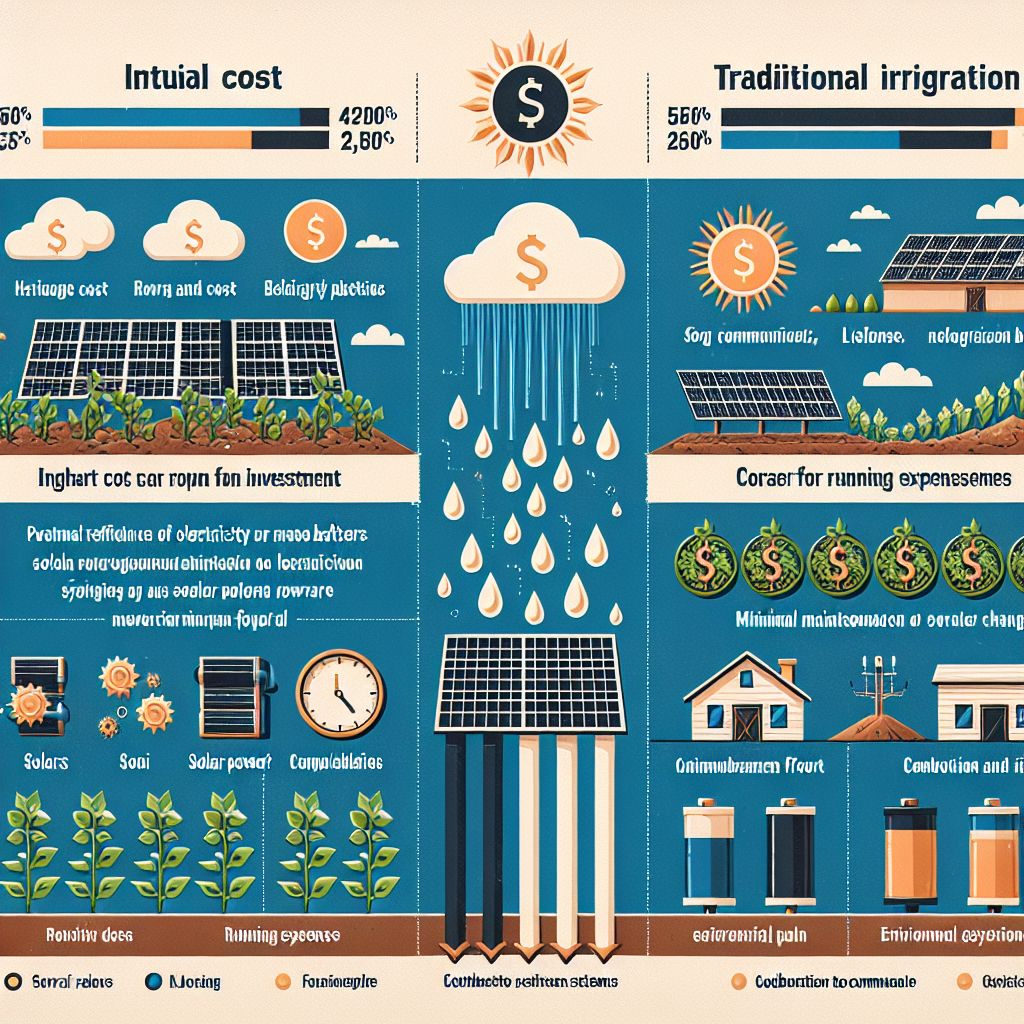
Price and Productivity: A Comparison of Solar and Traditional Irrigation Systems for Apple Cultivation
In the decision between solar and traditional irrigation systems, price and productivity are both key. Let’s take a closer look at these factors to help you make the best choice.
Examining the Initial Cost and ROI of Both Systems
While the initial cost of a solar irrigation system is higher than a traditional system due to the price of solar panels and batteries, the return on investment (ROI) can be very appealing. Solar panels often pay for themselves over time by reducing electricity bills. In some areas, you may even be eligible for government incentives that can help cover the upfront costs.
Contrasting the Lifespan and Running Expenses of Different Systems
When compared to traditional irrigation systems, the running costs for solar-powered irrigation systems are significantly lower. Solar panels, once installed, require very little upkeep and the energy they generate is free of charge. Furthermore, solar panels often last for more than 25 years, meaning you’ll be reaping the benefits of lower energy costs for many years to come.
Evaluating the Environmental Impact of Both Systems
Solar irrigation systems have a significantly smaller environmental impact than traditional systems. Solar panels create renewable, clean energy, which decreases your carbon footprint and aids in the fight against climate change. Traditional systems, in contrast, frequently use electricity generated by fossil fuels, which adds to greenhouse gas emissions.
Here is a table comparing the cost and efficiency of an irrigation system with and without solar panels:
|
Aspect |
Without Solar Panels |
With Solar Panels |
|---|---|---|
|
Initial Cost | ||
|
Operating Cost |
Very low or zero fuel/electricity costs after installation. 1, 4 | |
|
Efficiency |
Depends on energy source efficiency. 4 |
Depends on solar radiation, temperature, system design. 1, 4 |
|
Environmental Impact |
Higher carbon footprint. 1 |
Lower carbon footprint, renewable energy. 1 |
|
Location Flexibility |
Limited to grid-connected or fuel access areas. 3 |
Can be used in remote off-grid areas. 3 |
|
Maintenance | ||
|
Lifespan |
Shorter for fuel-based systems. 1 | |
|
Long-term Costs |
Higher due to recurring fuel/electricity bills. 1 |
Lower total 20-year costs by 50-60% compared to traditional systems. 1 |
|
Government Incentives |
Generally none |
Many governments provide tax credits, subsidies for solar irrigation. 1 |

What is the Best Combination of Solar Panels and Irrigation Systems for Apple Farmers?
Discovering the perfect mix of solar panels and irrigation systems can enhance efficiency and yield in your apple orchard. We’ll explore the various options to help you determine what’s most suitable for your farm.
Choosing the Best Combo: Pairing the Right Solar Panels with the Optimal Irrigation System for Maximum Efficiency
For the best return on your investment, pair top-performing solar panels with the most efficient irrigation system. Monocrystalline panels combined with drip irrigation can provide maximum efficiency, making sure your trees get precisely the water they need and you get the most out of the solar energy collected.
Comparing Solar-Powered Drip and Micro-Sprinkler Irrigation Systems
In regions where water is scarce, solar-powered drip irrigation systems are the most water-efficient. On the other hand, micro-sprinkler systems are more water-intensive and are best for larger orchards with a plentiful water supply.
Adapting to Seasonal Changes in Water Needs
Knowing how much water your apple trees need during different seasons is essential to make the most of your irrigation system. Your trees will need more water during the main growing season and less when they’re not growing. A solar-powered system can be adapted to these changing needs, making sure your trees get just the right amount of water throughout the year.
Conclusion: Is it a Smart Decision to Add Solar-Power to an Irrigation System for an Apples Farmer?
Wrapping up, solar-powered irrigation systems are a sustainable and economically smart choice for apple growers. Selecting the appropriate solar panel and pairing it with the most effective irrigation method ensures a plentiful yield and a healthier environment. Keep in mind, the best choice for your orchard depends on your unique situation, but investing in solar power is a decision that will pay off for many years.
A Quick Reminder: Why Solar Power is Good
Before we move on, let’s quickly remind ourselves why using solar power to irrigate apple orchards is a good idea. The most important reason is that these systems use the sun’s infinite energy, which means they don’t use up non-renewable resources and they save on energy costs. With the right system, you can make sure your apple trees get just the right amount of water, without wasting any. And in the long run, you can save money on your utility bills and possibly get money from the government, so solar power makes financial sense too.
However, the advantages don’t end with saving money. Solar irrigation systems are great for the environment. They don’t produce greenhouse gases, so your farm’s carbon footprint is greatly reduced. And don’t overlook the freedom that comes with generating your own power. It’s about taking charge, being self-reliant, and pledging to a sustainable future.
Lessens dependence on non-renewable energy resources
Conserves water through efficient irrigation techniques
Delivers substantial long-term cost benefits
Reduces environmental damage and carbon emissions
Ensures energy independence and self-reliance
Considering these benefits, it’s evident that solar-powered irrigation is not just a minor contribution. It’s a revolutionary method of farming that is in line with the concepts of sustainability and responsible management of our natural resources.
Surmounting Obstacles: The Right Time for Solar Irrigation
Switching to solar irrigation is not without its difficulties, but knowing when it’s the right move can make these obstacles easier to surmount. It’s an appropriate option for areas that get a lot of sun and for farmers who are focused on sustainability and cost-effectiveness over the long term. If you’re in a place where electricity is expensive or the power grid isn’t reliable, solar can provide a steady water supply and free you from dependence on the grid.
But there’s an important consideration: the upfront cost. It can be quite large, but there are different ways to finance it, and there are incentives to help, too. Plus, solar panels last a long time and are very efficient, so over time, they can pay for themselves. The trick is to look at your particular circumstances, like the size of your orchard, where it’s located, and how much water you need, and see if solar irrigation fits into your plans and your budget.
How to Get Started with Solar-Powered Irrigation for Your Apple Orchard
For apple farmers interested in switching to solar-powered irrigation, the first thing you need to do is evaluate the layout and sunlight exposure of your orchard. Then, reach out to solar installation professionals to help you decide on the best type of panel and system size for your specific needs. After that, look into various financing options and government incentives that could help offset the cost. Once you’ve got everything figured out, you can install your system and start enjoying the benefits of using clean, renewable energy for your irrigation needs.
Keep in mind, going solar isn’t simply about the setup. It’s about accepting a fresh perspective that prizes sustainability and effectiveness. Welcome the shift, learn about the new system alongside your employees, and get ready for a future where your farm contributes to solving our environmental issues.
Frequently Asked Questions
How do solar panels enhance water management in apple cultivation?
Solar panels enhance water management by providing power to irrigation systems that bring water straight to where it’s most needed – the roots of the apple trees. This accuracy prevents overwatering and runoff, saving water and making sure every drop is used efficiently. With solar panels, farmers can keep a steady water supply, which is crucial for the health and yield of apple crops.
What are the most common challenges when transitioning to solar-powered irrigation?
The most common challenges include the upfront cost of the solar panel system, identifying the right type of panels and irrigation technique for your particular orchard, and getting used to new technology. Additionally, some areas may have less sunlight, which can impact the effectiveness of solar panels. However, with careful planning and professional guidance, these obstacles can be surmounted, resulting in a successful solar irrigation setup.
Is solar irrigation beneficial for small-scale apple farms, and how?
Definitely! Solar irrigation can provide substantial benefits to small-scale apple farms. By lowering energy costs and enhancing water efficiency, even small apple orchards can become more sustainable and profitable. Solar panels can be scaled to accommodate any farm size, ensuring that all farmers can utilize this technology.
Furthermore, smaller farms usually have less money to work with, so the long-term cost savings from solar power can be especially appealing. Plus, the environmental advantages of lowering one’s carbon footprint apply to everyone, no matter how big their farm is.
Do apple farmers have access to government incentives for using solar irrigation systems?
Indeed, numerous governments provide incentives to farmers who adopt renewable energy solutions, such as solar irrigation. These incentives may take the form of tax credits, grants, or low-cost loans. It’s crucial to investigate the incentives available in your area because they can greatly lower the cost of switching to solar power.
What role does weather play in the effectiveness of solar-powered irrigation systems?
Weather can have a significant effect on the productivity of solar panels. Naturally, more energy is produced on sunny days, while the amount of electricity produced can be reduced in overcast conditions. However, today’s solar panels are becoming more and more efficient and can still produce electricity even in less than ideal weather conditions. In addition, battery storage systems can store excess energy to be used on cloudy days or at night, ensuring that your irrigation needs are consistently met.

Leave a Reply