
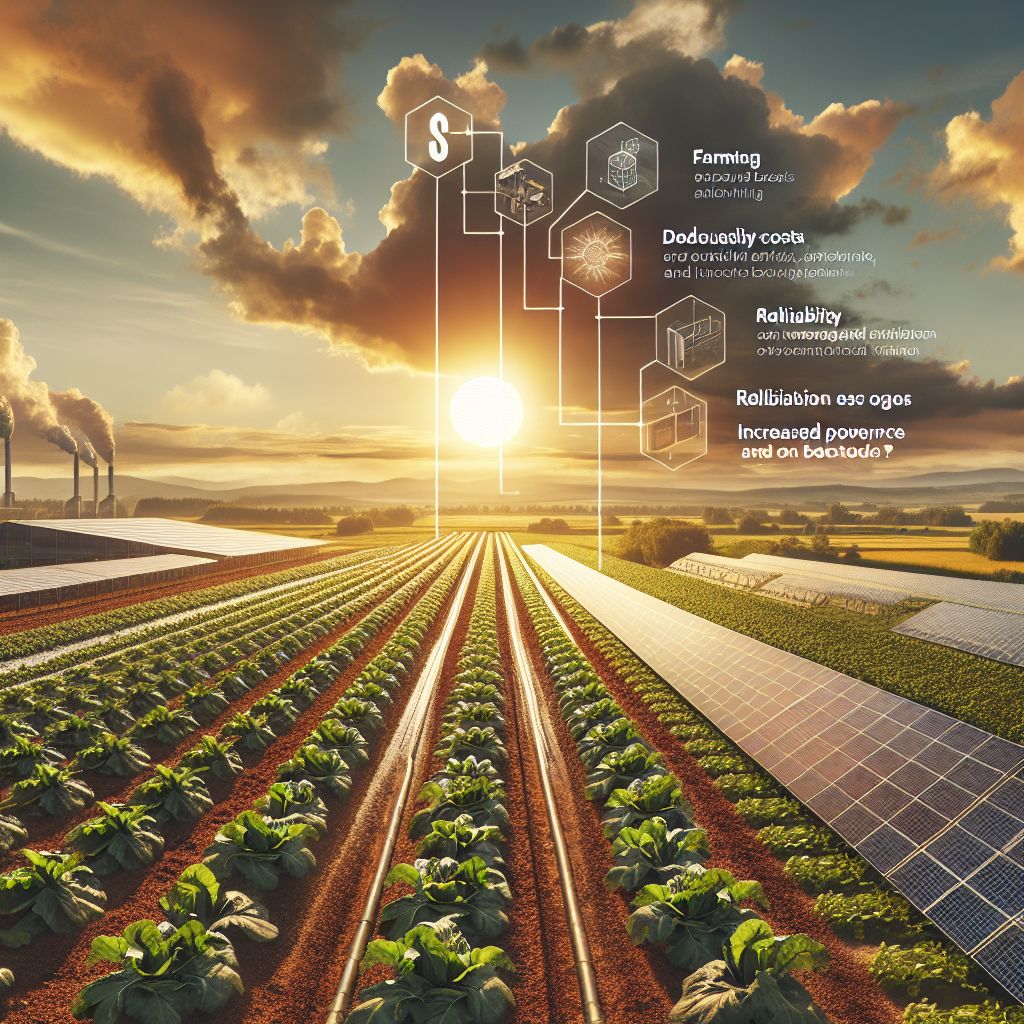
When we imagine agriculture, we often picture endless fields bathed in sunlight. But what about the unseen, yet crucial, process of irrigation? Let’s explore how solar energy can revolutionize the way we grow beets, a crop as resilient as it is necessary.
Let’s start with the basics. Why beets? Beets are not only good for you, but they’re also adaptable, growing in different climates and types of soil. They’re a common food for many people, so it’s important that we farm them efficiently. That’s where solar-powered irrigation comes in.
Key Takeaways:
Solar-powered irrigation systems can greatly decrease energy costs, often paying for themselves in just a few years.
Solar power for irrigation ensures a reliable water supply, even during power outages.
Drip irrigation combined with solar power is an effective method for beet farming, maximizing water use and increasing crop yield.
Monocrystalline solar panels, while pricier, provide high efficiency and long life, making them a wise investment for sustainable agriculture.
Government incentives can help cover the upfront costs of switching to solar-powered irrigation systems.

Why You Should Combine Solar Panels with an Irrigation System
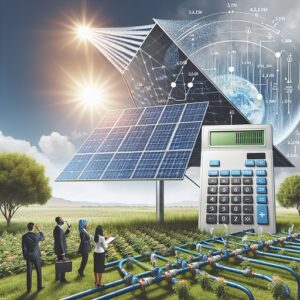
Let’s discuss the sun. It doesn’t just aid in growing our crops; it can also power the systems that water them. Solar panels transform sunlight into electricity, which can then operate irrigation systems—this means free energy from the sun and less dependency on the grid. This is critical for farmers who are dealing with rising electricity costs or who farm in remote areas where grid access is limited or inconsistent.
Improving Water Management with Solar Power
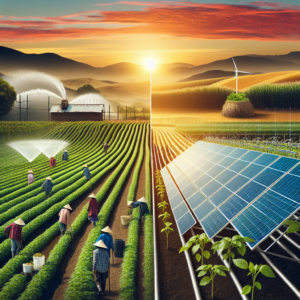
Picture a hot, arid day where your beets are in desperate need of water. With a solar-powered irrigation system, you can use the sun’s peak hours—when your crops are most in need of water. This direct connection between sunlight and water delivery creates a balance between the resources provided by nature and the needs of your farm.
The Financial Benefits of Solar Panels in the Long Run
It’s true that solar panels require an initial investment, but the long-term savings can be quite substantial. Consider this: once you’ve covered the cost of the solar panels, the energy they generate is basically free. Over the long term, this can lead to a significant decrease in your operating expenses.
Helping the Environment through Sustainable Farming
When you opt for solar, you’re making a choice that benefits the earth. Solar panels generate clean energy, which decreases your carbon footprint and helps create a healthier environment. This is particularly crucial in farming, where sustainability is essential for ensuring that our land is preserved for future generations.
Off-the-Grid Freedom: Guaranteed Water During Blackouts
Power blackouts can spell disaster for traditional irrigation systems. However, with solar power, you’re not beholden to the grid. Your irrigation system can continue to operate, ensuring that your beets receive the water they need, regardless of the circumstances.
Utilizing Smart Technology to Optimize Irrigation
Contemporary solar-powered systems can be paired with smart technology. Sensors can keep tabs on soil moisture levels and weather forecasts, which allows the system to only water when necessary, helping to cut back on water waste. This advanced approach to irrigation ensures your beets receive just the right amount of water every time.

Different Irrigation Methods for Beet Farming
Next, we’ll discuss how to get water to your beets. There are a number of methods, each with its own advantages. For those interested in sustainable agriculture, exploring solar-powered irrigation systems can be a particularly efficient way to ensure your crops receive the hydration they need.
Drip Irrigation: Making the Most of Your Water
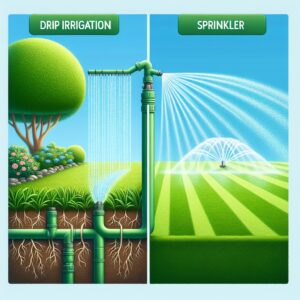
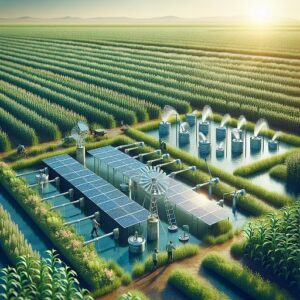
Think of drip irrigation as giving each of your beets its own water bottle. It slowly drips water to the roots of the plants, reducing evaporation and runoff. This water-saving method can be easily powered with solar panels.
Pros and Cons of Overhead Sprinklers
While overhead sprinklers can rapidly water a large area, they lack the precision of drip systems. They can be a suitable choice for some scenarios, but keep in mind the possibility of water loss from evaporation and wind.
When to Use Furrow and Flood Irrigation Practices: A Look at Traditional Methods
Traditional methods such as furrow and flood irrigation have stood the test of time. They can be effective, particularly in regions where water is plentiful, but they are not as efficient as contemporary systems. Nevertheless, when paired with solar power, they can continue to be a component of sustainable farming.
Here is a table showing the pros and cons of different irrigation systems a farmer can use on a farm:
|
Irrigation System |
Pros |
Cons |
|---|---|---|
|
Drip Irrigation |
– High water efficiency (90%+). 1 |
– High initial cost. 4 |
|
Sprinkler Irrigation |
– Relatively inexpensive to install. 5 |
– Lower efficiency than drip (60-80%). 1 |
|
Furrow/Surface Irrigation |
– Very low efficiency (50-60%). 1 |
Which Irrigation System is Most Effective for Beet Farming?
Beets need a steady supply of water, particularly in the initial growth phase. Drip irrigation is usually the preferred method due to its accuracy and minimal water wastage. When combined with solar power, it’s a green, highly efficient solution.

Different Solar Panel for Your Beet Farm’s Irrigation System
As a farmer, you know that water is essential for growing crops. And with the rising cost of energy, it’s more important than ever to find ways to reduce your irrigation costs. One way to do this is to install a solar-powered irrigation system.
There are a few different types of solar panels available, and each type has its own advantages and disadvantages. Here is a brief overview of the different types of solar panels that are available for beet farms.
Monocrystalline Panels: The Perfect Blend of Efficiency and Durability
Monocrystalline panels are the gold standard in solar panels. They are made from a single crystal structure, giving them an edge in efficiency, not only in converting sunlight into electricity, but also in terms of space. For beet farmers, this means less panels to worry about and more land to grow their crops.
Yet, efficiency isn’t the only thing that they have going for them. Monocrystalline panels are also known for their longevity. They have the ability to last for decades with very little degradation in performance. This means that you won’t have to worry about your power source for a very long time. And, because they perform better in low-light conditions, they are reliable even when it’s cloudy – a situation that is common on many farms.
They are excellent at turning sunlight into electricity
They don’t take up much space but produce a lot of power
They can last for more than 25 years
They work well even when it’s not very sunny
These panels might be more expensive, but they are worth the money in the long run. Farmers who want to get the most out of their solar panels and do the least harm to the environment often choose these panels.
When it comes to growing beets, where consistency and reliability are everything, monocrystalline panels provide the stable energy source needed to keep the irrigation schedule on track.
Polycrystalline Panels: Affordable and Reliable
Polycrystalline panels, though they have a slightly shorter lifespan and are a bit less efficient in low light, are still a good option for beet farmers who want to balance cost with performance. These panels can ensure that irrigation systems operate smoothly, keeping beet fields lush and productive without causing a financial strain.
Thin-Film Solar Panels: A Versatile Installation Option
Thin-film solar panels are the rebels of the solar panel family. They are created by applying thin layers of photovoltaic material to a substrate. Their design makes them light and flexible, which provides a range of installation possibilities. They can be installed on surfaces that may not be able to handle the weight of traditional panels, such as some agricultural buildings or structures.
Here is a table showing the pros and cons of using different types of solar panels with an irrigation system on a farm:
|
Panel Type |
Pros |
Cons |
|---|---|---|
|
Monocrystalline Panels |
– High efficiency (15-22%), producing more power per square foot. 1, 2, 4 | |
|
Polycrystalline Panels |
– Lower upfront cost than monocrystalline. 1, 2 |
– Lower efficiency and shorter lifespan than monocrystalline. 2, 4 |
|
Thin-Film Solar Panels |
– Lowest upfront cost. 1, 2 |
– Lowest efficiency (7-13%). 2, 4 |
The choice depends on factors like budget, space constraints, climate, and expected lifespan. Monocrystalline panels offer the best long-term performance but at a higher upfront cost. 1, 2, 4
What to Consider When Buying Solar Panels: Quality and Warranty
When purchasing solar panels, two factors to keep in mind are quality and warranty. You should opt for panels that have a proven history of performing well and come with a warranty that lasts a minimum of 25 years. A manufacturer that offers a robust warranty is demonstrating that they believe in the durability and dependability of their panels.
Which Solar Panel is Ideal for Beet Farming?
When it comes to beet farming, the competition for the best solar panel is a close one between monocrystalline and polycrystalline panels. Monocrystalline panels are more efficient and last longer, making them a sound investment if you can afford the initial cost. On the other hand, polycrystalline panels provide a more budget-friendly option for solar irrigation, offering dependable performance. The final decision will depend on your budget, the size of your farm, and your energy requirements.
However, keep in mind that the ideal solar panel is the one that fulfills your unique farming requirements and aligns with your sustainability objectives. Each beet farm is distinct, and its solar solution should be as well.
Essential Parts: Pumps and Controllers for Solar Irrigation
Maximizing the potential of your solar panels requires the correct parts. The solar pumps and controllers are the central nervous system of your irrigation setup. Solar pumps allow water to reach your crops without the use of grid electricity, and controllers regulate the water flow to ensure each beet is adequately watered.
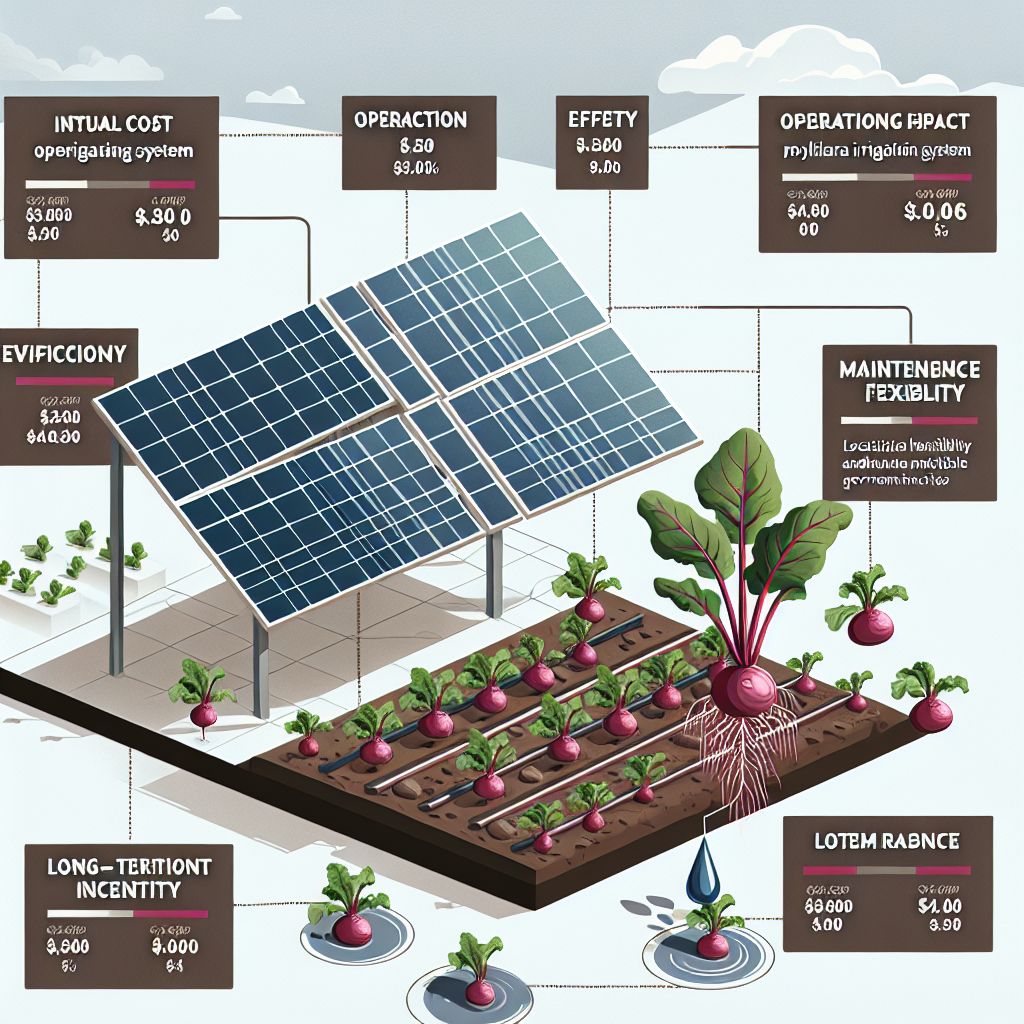
Cost and Effectiveness Analysis: Solar-Powered Irrigation Systems versus Traditional Irrigation Systems for Growing Beets on a Farm
When we discuss the expense of solar-powered irrigation systems compared to traditional systems, we’re not just considering the initial purchase cost. We’re also looking at effectiveness—how much water and energy you’re conserving—and how those results in long-term savings.
Traditional irrigation systems, which usually run on diesel generators or grid electricity, can be expensive to maintain. Although solar irrigation systems require an upfront cost, they use the sun’s free energy, resulting in substantial savings in the long run.
Understanding the Upfront Cost
Wondering how much this will cost you? Here’s a look at the upfront cost of solar-powered irrigation:
Monocrystalline panels: $1 to $1.50 for each watt
Polycrystalline panels: $0.70 to $1 for each watt
Thin-film panels: $1 to $1.50 for each watt
Solar pumps and controllers: Cost can vary based on the size and complexity of the system
While these costs may seem intimidating, the financial benefits from government incentives and long-term energy savings make solar irrigation a cost-effective choice for beet farmers.
Long-Term Savings: A Look at Operating Expenses
Once you’ve made the initial investment, the operating expenses of solar irrigation systems are almost nonexistent. The sun doesn’t charge you for its energy, so your energy costs are essentially zero. Maintenance costs are also low, mostly involving keeping the panels clean and the system functioning properly.
Examining Water Distribution Efficacy
Where solar irrigation systems truly excel is in their efficiency. They supply water right where it is required, which cuts down on waste. This is especially vital for beets, as they need steady moisture levels to grow at their best.
How Long It Takes for Solar Systems to Pay for Themselves
While the payback period for solar irrigation systems can differ, many farmers have found that they recoup their investment within a few years. From there, it’s all about enjoying the perks of costless solar energy.
Comparing Maintenance and Operating Costs: Solar and Conventional Systems
Since solar irrigation systems have fewer moving parts than conventional systems, there’s less that could break down. This results in lower maintenance costs. Additionally, there’s no need to buy fuel or pay for electricity. Therefore, solar systems are more cost-effective in the long term.
Here is a table comparing the cost and efficiency of an irrigation system with and without solar panels:
|
Aspect |
Without Solar Panels |
With Solar Panels |
|---|---|---|
|
Initial Cost | ||
|
Operating Cost |
Very low or zero fuel/electricity costs after installation. 1, 4 | |
|
Efficiency |
Depends on energy source efficiency. 4 |
Depends on solar radiation, temperature, system design. 1, 4 |
|
Environmental Impact |
Higher carbon footprint. 1 |
Lower carbon footprint, renewable energy. 1 |
|
Location Flexibility |
Limited to grid-connected or fuel access areas. 3 |
Can be used in remote off-grid areas. 3 |
|
Maintenance | ||
|
Lifespan |
Shorter for fuel-based systems. 1 | |
|
Long-term Costs |
Higher due to recurring fuel/electricity bills. 1 |
Lower total 20-year costs by 50-60% compared to traditional systems. 1 |
|
Government Incentives |
Generally none |
Many governments provide tax credits, subsidies for solar irrigation. 1 |
While solar irrigation systems have higher upfront costs, they can provide substantial long-term economic and environmental benefits over traditional irrigation systems powered by electricity grids or fossil fuels. 1, 3, 4

The Best Pairing of Solar Panels and Irrigation Systems for Beet Farmers
The best pairing for beet farmers is monocrystalline solar panels with a drip irrigation system. This setup offers the most water and energy efficiency, resulting in healthier crops and reduced costs.
Choosing the perfect solar panels and irrigation system is not just a matter of personal choice; it’s about using the most efficient methods to get the best beet harvest. So, let’s examine the combinations that offer the most advantages for your farm.
Using Monocrystalline Solar Panels and Drip Irrigation for Smart Farming
Think of pairing monocrystalline solar panels with a drip irrigation system as creating a custom suit for your beet crop. The high efficiency of monocrystalline panels guarantees that you’ll have enough energy to power your irrigation system even on days with limited sunlight. The precision of drip irrigation ensures that every drop of water is used effectively. This pairing is especially useful during the critical germination and early growth stages of beets, when consistent moisture is crucial.
Using Polycrystalline Solar Panels and Sprinklers for Affordable and Wide-Ranging Coverage
For those who need to cover a larger area without breaking the bank, polycrystalline solar panels combined with sprinkler systems offer a great solution. While sprinklers may not be as exact as drip systems, they still provide good coverage, especially when combined with solar panels that keep the costs down. This setup works well for young beet plants that benefit from a more generalized watering approach.
Polycrystalline panels are a great option because they are affordable and efficient.
Sprinkler systems cover a lot of ground, which is perfect for large beet fields.
Together, they provide a balance of cost and coverage, making it a good choice for many farmers.
But remember, you need to keep an eye on the weather to reduce water loss from evaporation. You also need to adjust your watering schedule to make sure you don’t overwater or underwater your beets.
Pairing Solar Panels with Furrow Irrigation Systems
Even though furrow irrigation is an older method, it can still be part of a modern, sustainable approach when paired with the right solar panels. Thin-film solar panels, with their flexible installation options, can be a good match for farms using furrow irrigation. They can be installed on various structures, ensuring that even farms with less traditional layouts can benefit from solar power. This combination can be especially useful in regions with abundant sunlight and water resources.
What’s the Most Efficient Choice for Farmers?
The most efficient choice for farmers ultimately depends on the specific conditions of their farm. If the initial investment isn’t a barrier, monocrystalline panels with drip irrigation will likely offer the best long-term savings and water efficiency. For those with budget constraints or larger areas to irrigate, polycrystalline panels with sprinkler systems might be the way to go. In the end, the goal is to create a system that meets your farm’s needs while maximizing the return on your investment in solar technology.
Keep in mind that the shift to solar-powered irrigation isn’t just about immediate benefits. It’s a commitment to the longevity of your farm and the health of the earth. By selecting the best combination of solar panels and irrigation systems, you’re laying the groundwork for a sustainable, profitable farming operation that can weather the storm of climate change.
Conclusion:
Overall, it is wise to use solar-powered irrigation for growing beets as it is both economically and environmentally friendly. By choosing the right solar panels and irrigation techniques, you can make sure your farm stays fruitful, robust, and progressive in the changing world of agriculture.
Frequently Asked Questions:
Let’s tackle some usual inquiries you might have about solar-powered irrigation systems for beet cultivation.
Is it possible to use solar irrigation on crops other than beets?
Indeed! Solar irrigation is adaptable and can be used for a variety of crops. Whether you’re growing beets, tomatoes, or any other crop, the principles of efficient water and energy use still apply. The trick is to adjust the system to the specific water needs of the crop you’re growing.
Are there any government incentives for solar farming?
Absolutely, numerous governments provide incentives to farmers to adopt renewable energy practices. These include tax credits, grants, and rebates that can substantially decrease the initial costs of setting up a solar irrigation system. It’s definitely worth looking into the incentives in your area and using these programs to make the switch more affordable.
What is the lifespan of a solar-powered irrigation system?
Solar panels are built to endure for many years, typically coming with guarantees of 25 years or longer. Other parts of the system, such as pumps and controllers, also have extended lifespans if they are well-maintained. If you regularly take care of your solar irrigation system, it can offer dependable service for a long time, making it a smart long-term investment for your farm.
When is the Optimal Time to Set Up a Solar-Powered Irrigation System?
It’s usually best to put in a solar irrigation system during the off-season when your fields aren’t in full swing. This gives you the chance to get the system up and running without getting in the way of your farming. Plus, if you install during the off-season, you’ll be all set to make the most of the solar system when it’s time to start growing.
Is it possible for solar panels to also power other farming operations?
Absolutely, solar panels are not just for irrigation, they can power a multitude of farm operations. They can power the lighting and ventilation systems in barns, electric fencing, and even farm machinery. Solar energy can be a flexible and cost-saving power source for many parts of farm management.

Leave a Reply