

Key Takeaways
Solar-powered irrigation systems can lower energy costs by up to 90% compared to traditional methods.
Monocrystalline solar panels are the most efficient for agricultural use, with an efficiency rate of 15-22%.
Drip irrigation systems can conserve up to 60% more water compared to sprinkler systems.
Initial setup costs for solar-powered systems are higher but provide long-term savings and a fast ROI.
Pairing solar panels with drip irrigation is the most efficient system for sesame cultivation.
Why You Should Combine Solar Panels with an Irrigation System for Growing Sesame
Adopting solar panels for irrigation is a wise choice for any farmer growing sesame. It not only reduces energy costs but also makes your farming practices more eco-friendly. Solar panels tap into the sun’s energy, turning it into electricity to operate your irrigation systems. This means you’re not dependent on the grid or fossil fuels, making your farm more self-reliant.
Primarily, solar-powered irrigation systems are especially advantageous for sesame farming. Sesame crops need regular watering, and solar power can offer that without the inconsistency and expenses linked with conventional energy sources.
Going Green with Solar Powered Irrigation
One of the best things about solar-powered irrigation is that it’s good for the planet. Traditional irrigation systems often use fossil fuels, which are a big source of greenhouse gases. By using solar power instead, you can cut down on your carbon emissions.
Moreover, solar-powered systems don’t emit air or noise pollution, making them a greener choice. This not only helps the environment, but also makes a healthier and more enjoyable workplace for you and your employees.
Saving Money on Operations
One of the most attractive reasons to switch to solar-powered irrigation is the money you’ll save on operational costs. Traditional irrigation systems can be costly to run, especially with the unpredictability of fuel prices. Solar energy, however, is free once you’ve set up the panels.
While the upfront cost of solar panels can be steep, the long-term savings are substantial. Research shows that farmers can cut their energy costs by as much as 90% by transitioning to solar-powered irrigation. This makes it a wise financial decision over time.
Self-Sufficient Farming
One of the major benefits of solar-powered irrigation for farmers is energy self-sufficiency. You’re not dependent on the grid or fuel deliveries, which is particularly valuable in remote areas where power supplies can be unpredictable.
Creating your own energy means you have total control over your watering timetable. This guarantees your sesame plants are watered exactly when they need it, with no disruptions.
Benefits for Sesame Farming
Sesame plants flourish in well-drained soil and need regular watering to yield high returns. Solar-powered irrigation systems can offer this regularity, guaranteeing that your sesame plants receive the correct amount of water at the correct time.
What’s more, solar-powered systems are easily automated, so you can set the watering schedule you want. This is especially helpful for growing sesame, as it cuts down on the need for manual watering and makes sure the plants have the best conditions for growth.

Top Irrigation Techniques Employed by Sesame Growers
Selecting the most suitable irrigation technique is vital for the prosperity of your sesame cultivation. Each technique has its own strengths and weaknesses, and the optimal selection is contingent on your unique requirements and circumstances.
The Efficiency and Advantages of Drip Irrigation
Drip irrigation stands as one of the top watering techniques for sesame crops. It works by supplying water straight to the roots of the plants through a system of pipes and emitters. This not only reduces water waste but also guarantees that every plant receives the necessary amount of water. Learn more about solar-powered irrigation for growing green beans and its benefits.
Compared to conventional sprinkler systems, drip irrigation systems can conserve up to 60% more water. They also minimize the likelihood of soil erosion and nutrient leaching, making them a perfect option for sesame cultivation.
Sprinkler Irrigation: Pros and Cons
Sprinkler irrigation is another method frequently used by sesame farmers. It works by spraying water over the crops through a network of pipes and sprinklers. This method is ideal for larger fields and can be easily automated. For example, solar-powered irrigation for growing lentils can also benefit from similar techniques.
On the other hand, sprinkler systems are not as efficient as drip systems because they can waste water through evaporation and runoff. They are also more likely to be affected by wind, which can disrupt the even distribution of water.
The Advantages and Disadvantages of Furrow Irrigation
Furrow irrigation is a time-honored technique that involves carving small trenches in the field and letting water run through them. This technique is straightforward and cost-effective to implement, making it a favorite among smallholder farmers. For those interested in modern irrigation methods, you might want to explore solar-powered irrigation for growing radishes.
Nevertheless, furrow irrigation does not match the efficiency of contemporary methods, as it can result in substantial water wastage through evaporation and deep percolation. It also necessitates more work for upkeep and operation.
Comparing Different Methods
When deciding on an irrigation method for your sesame farm, it’s crucial to take into account factors such as water efficiency, cost, and user-friendliness. Here’s a comparison of the three methods we’ve discussed: solar-powered irrigation systems.
|
Technique |
Water Conservation |
Price |
Usability |
|---|---|---|---|
|
Drip Irrigation |
High |
Medium |
Medium |
|
Sprinkler Irrigation |
Medium |
High |
Simple |
|
Furrow Irrigation |
Low |
Low |
Challenging |
Now that we looked at Irrigation systems, lets take a look at the solar panels tnat will power them.

Best Solar Panels for Your Sesame Farm’s Irrigation System
Picking the right solar panels for your irrigation system is key to maximizing efficiency and ensuring long-term dependability. There are several kinds of solar panels on the market, each with its own pros and cons.
We’re going to discuss the most popular solar panels and how they can help your sesame farm:
Solar panels made of monocrystalline silicon
Solar panels made of polycrystalline silicon
Thin-film solar panels
Knowing the pros and cons of each type can help you make a smart choice. For more information, check out this guide on solar panels for farms.
Monocrystalline Solar Panels: Superior Performance
Monocrystalline solar panels are recognized for their superior performance and longevity. These panels are constructed from a single crystal structure, enabling them to transform sunlight into electricity more effectively than other panel types.
Monocrystalline panels, with an efficiency of 15-22%, generate a greater amount of power per square foot, making them a great choice for farms with space constraints. They also excel in low-light conditions, guaranteeing a continuous power supply even when it’s overcast.
Polycrystalline Solar Panels: An Affordable Choice
While polycrystalline solar panels may not be as efficient as their monocrystalline counterparts due to their multi-crystal structure, their lower production cost makes them a budget-friendly choice for farmers.
Polycrystalline panels, despite having an efficiency rate of 13-16%, still offer a dependable source of power for your irrigation system. If you have plenty of space to install more panels, these would be a good option.
Thin-Film Solar Panels: The Flexible and Versatile Choice
Thin-film solar panels are created by adding one or more layers of photovoltaic material to a substrate. The result is a lightweight, flexible panel that can be installed in a range of different locations, including solar-powered irrigation systems.
Thin-film panels, despite their lower efficiency rate of 10-12%, are a great option for farms that have irregular shapes or limited space because of their adaptability. They can also be incorporated into construction materials, which provides more flexibility in the installation process. For more information on efficient watering techniques, check out our guide on solar-powered irrigation for growing lentils.
Here is a table showing the pros and cons of using different types of solar panels with an irrigation system on a farm:
|
Panel Type |
Pros |
Cons |
|---|---|---|
|
Monocrystalline Panels |
– High efficiency (15-22%), producing more power per square foot. 1, 2, 4 | |
|
Polycrystalline Panels |
– Lower upfront cost than monocrystalline. 1, 2 |
– Lower efficiency and shorter lifespan than monocrystalline. 2, 4 |
|
Thin-Film Solar Panels |
– Lowest upfront cost. 1, 2 |
– Lowest efficiency (7-13%). 2, 4 |
Which Solar Panel is Ideal for a Sesame Farmer?
The most suitable solar panel for your sesame farm hinges on your unique requirements and circumstances. Monocrystalline panels are the top pick if you have a small area and require high efficiency. Polycrystalline panels are a sound option if you’re on a budget and have plenty of space. Thin-film panels are the best choice for flexibility and versatility.

Comparing the Cost and Efficiency of Solar and Traditional Irrigation Systems for Sesame Cultivation
If you’re contemplating the transition to solar-powered irrigation, it’s crucial to compare the costs and effectiveness of solar systems to conventional irrigation methods. This will allow you to comprehend the potential savings and advantages of transitioning.
Let’s discuss the main points to consider when implementing solar-powered irrigation systems:
Comparing the Initial Setup Costs
Getting started with solar-powered irrigation systems can be more expensive than setting up traditional systems. This is because you’ll need to buy solar panels, inverters, batteries, and pay for installation. But, there are usually incentives and grants that can help you with these costs.
For instance, a solar-powered drip irrigation system can cost anywhere between $5,000 to $10,000, based on the size of your farm and the equipment you use. On the other hand, a traditional diesel-powered irrigation system can cost as little as $2,000 or as much as $5,000.
Costs of Running and Upkeeping the Systems
One of the main benefits of solar-powered irrigation systems is that they are inexpensive to maintain and operate. Solar panels require little maintenance, usually just occasional cleaning and checks. There are no costs for fuel, and the systems can function for 25 years or longer.
On the flip side, conventional irrigation methods can rack up the costs in maintenance and operation. Systems that run on diesel need frequent fuel refills, engine upkeep, and fixes. These expenses can accumulate over time, making solar-powered systems the more economical choice in the long haul.
Long-Term Savings and ROI for Each System
Although the initial setup costs for solar-powered irrigation systems are higher, the long-term savings can be significant. Farmers can save up to 90% on their energy costs by switching to solar power. This results in a quick return on investment (ROI), often within 5-7 years.
However, conventional irrigation systems have continuous fuel and maintenance expenses that can eat into profits over time. The long-term savings and return on investment for solar-powered systems make them a financially wise choice for sesame farmers.
Comparing the Efficiency and Water Usage of Different Systems
When comparing solar-powered irrigation systems to traditional ones, efficiency is a key factor to consider. Solar-powered systems can be automated with ease, offering a high level of control over water usage. This can lead to considerable water savings, especially when used in conjunction with efficient irrigation techniques such as drip irrigation.
Conventional irrigation methods like furrow or sprinkler systems aren’t always the most efficient when it comes to water usage. They frequently lead to more water being wasted through evaporation and runoff, which isn’t ideal for sustainable farming practices.
Here is a table comparing the cost and efficiency of an irrigation system with and without solar panels:
|
Aspect |
Without Solar Panels |
With Solar Panels |
|---|---|---|
|
Initial Cost | ||
|
Operating Cost |
Very low or zero fuel/electricity costs after installation. 1, 4 | |
|
Efficiency |
Depends on energy source efficiency. 4 |
Depends on solar radiation, temperature, system design. 1, 4 |
|
Environmental Impact |
Higher carbon footprint. 1 |
Lower carbon footprint, renewable energy. 1 |
|
Location Flexibility |
Limited to grid-connected or fuel access areas. 3 |
Can be used in remote off-grid areas. 3 |
|
Maintenance | ||
|
Lifespan |
Shorter for fuel-based systems. 1 | |
|
Long-term Costs |
Higher due to recurring fuel/electricity bills. 1 |
Lower total 20-year costs by 50-60% compared to traditional systems. 1 |
|
Government Incentives |
Generally none |
Many governments provide tax credits, subsidies for solar irrigation. 1 |
On balance, the benefits of solar-powered irrigation systems are substantial, in terms of cost, efficiency, and sustainability. By transitioning, sesame farmers can lessen their environmental footprint, save on expenses, and guarantee a consistent water supply for their crops.

Which Combination of Solar Panels and Irrigation Systems Make the Most Efficient System for Your Sesame Farm
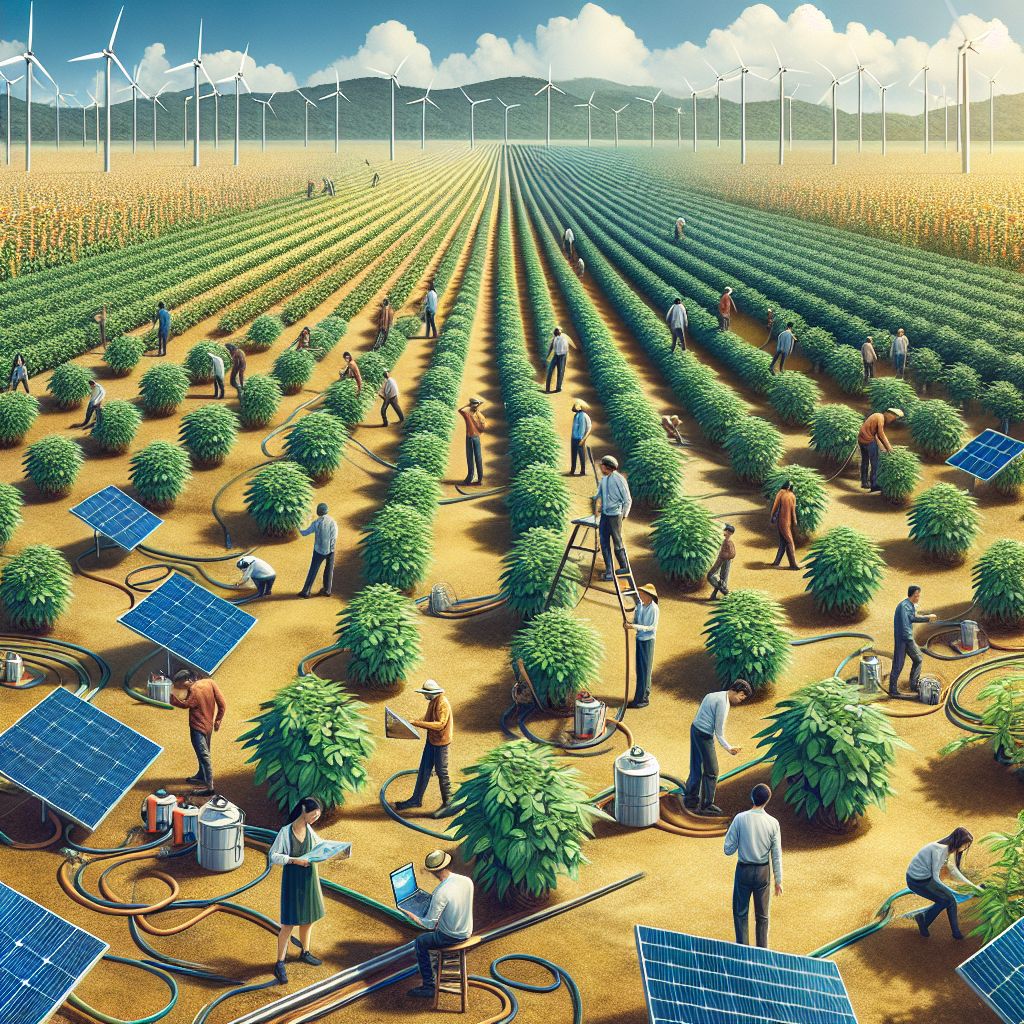
Pairing the right solar panels with an efficient irrigation system can make all the difference for your sesame farm. Here are some of the best combinations to consider.
Optimal Pairings for Maximum Efficiency: Drip Irrigation System powered by Monocrystalline Solar Panels
Monocrystalline solar panels and drip irrigation systems are a match made in heaven. The panels are highly efficient, guaranteeing a constant flow of power to your irrigation system. Meanwhile, drip irrigation delivers water straight to the roots of your plants, reducing waste and fostering robust growth.
This mix is perfect for sesame farms that are short on space and prioritize water conservation. It provides the best blend of energy efficiency and water use, leading to the best possible crop yields.
Using Simulation Models and Predictive Analytics
By using simulation models and predictive analytics, you can optimize your solar-powered irrigation system. Simulating different scenarios allows you to see how your system will perform under different conditions. This gives you the ability to make informed decisions on system design, placement, and operation.
For instance, simulation models can be used to figure out the optimal location for your solar panels to ensure they get the most sunlight. You can use predictive analytics to predict how much water you’ll need based on the weather, the stage of growth of your crops, and the moisture level in the soil. This makes sure that your sesame plants get the right amount of water at the right time, which can increase your yield and reduce waste.
Personalized Suggestions According to Farm Size and Location
No two farms are alike, and the most efficient solar-powered irrigation system for your sesame farm will be determined by a variety of elements, including the size of your farm, its location, and the climate. Personalized suggestions can assist you in creating a system that is tailored to your specific requirements and optimizes efficiency.
For small scale farms, a basic drip irrigation system powered by monocrystalline solar panels may be the most suitable option. For larger scale farms, a combination of drip and sprinkler systems powered by a combination of monocrystalline and polycrystalline panels may be more efficient. Factors specific to the location, such as average hours of sunlight and local weather conditions, should also be taken into account when planning your system.
Conclusion
There are many advantages to using solar-powered irrigation systems for sesame farming, such as lower energy costs, better efficiency, and enhanced sustainability. By selecting the appropriate solar panels and irrigation techniques, you can design a system that is tailored to your requirements and optimizes your farm’s yield.
Regardless of whether you choose monocrystalline, polycrystalline, or thin-film solar panels, the important thing is that your system is well-designed and properly maintained. If you do this, you can reap the long-term benefits of solar-powered irrigation and contribute to a more sustainable future for agriculture.
Frequently Asked Questions (FAQ)
What is the role of solar panels in irrigation?
Solar panels transform sunlight into electricity, which powers the water pumps in an irrigation system. This electricity can be saved in batteries for use when it’s cloudy or at night, providing a steady water supply for your plants.
How long do solar panels used in irrigation systems last?
Both monocrystalline and polycrystalline solar panels usually last 25 years or longer, while thin-film panels might only last 10-15 years. The lifespan of your solar panels can be extended with regular upkeep and correct installation.
Will solar-powered irrigation systems function in overcast conditions?
Absolutely, solar-powered irrigation systems can continue to operate under overcast conditions, but their performance might be somewhat diminished. To maintain a steady water supply, it’s crucial to have battery storage in your setup. This enables you to store surplus energy produced on bright days for use when it’s cloudy.
What does it take to maintain a solar-powered irrigation system?
Maintaining a solar-powered irrigation system doesn’t require much work. You’ll need to clean the solar panels regularly to keep dust and debris from blocking the sun and reducing their efficiency. You should also periodically check the system’s other parts, like the water pumps and batteries, to catch and fix any problems before they get out of hand.
What kind of savings can I expect if I switch to solar-powered irrigation from conventional methods?
If you opt for solar-powered irrigation, you can expect substantial cost savings. Farmers can cut their energy costs by up to 90% if they use solar power instead of conventional fuel-based systems. While the upfront costs of solar-powered systems are higher, the long-term savings and quick return on investment make them a smart financial decision.







Leave a Reply