

Imagine a farm where the sun does more than just nurture the crops – it powers the very system that waters them. In a world where sustainability is no longer a choice but a necessity, solar irrigation stands out as a beacon of innovation, especially for those cultivating mangoes. It’s a game-changer that promises to revolutionize how we grow our food. So, let’s dive into the world of solar irrigation for mangoes, shall we?
Key Takeaways
Solar irrigation systems can significantly reduce energy costs and increase sustainability in mango farming.
Drip irrigation, powered by solar energy, delivers water directly to the roots, enhancing water efficiency and crop yields.
Monocrystalline solar panels, though more expensive upfront, offer the best efficiency and longevity for farm use.
Investing in solar irrigation can yield a quick return on investment due to savings on water and energy bills.
The right combination of solar panels and irrigation methods depends on your specific orchard needs and can be tailored for maximum efficiency.
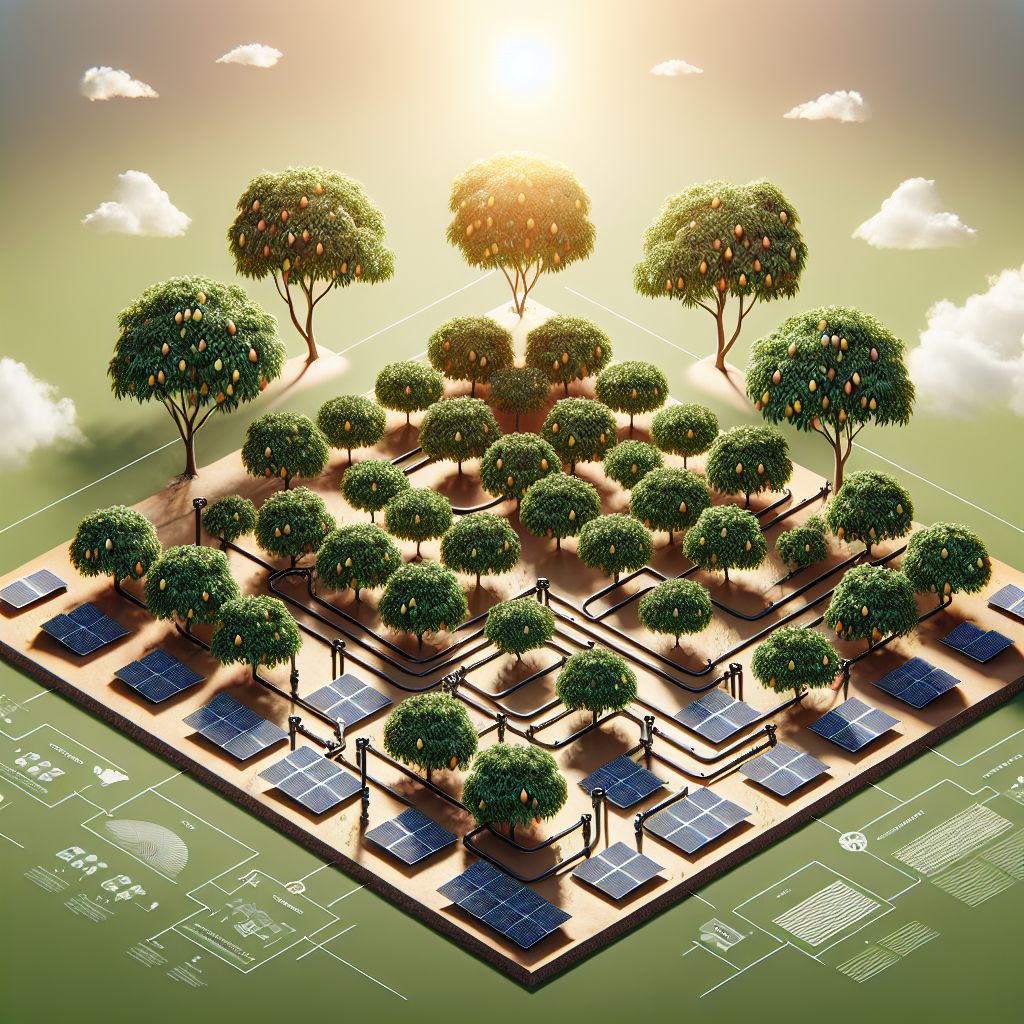
Why You Should Use Solar Panels with an Irrigation System for Growing Mangoes
Here’s the deal: growing mangoes requires a lot of water. But what if you could provide all that water without the hefty energy bill? That’s where solar panels come into play. By harnessing the power of the sun, you can operate your irrigation systems without relying on the grid. This not only cuts costs but also ensures that your farming practices are eco-friendly.
But why mangoes, specifically? Mango trees thrive in warm climates where sunshine is abundant, making them perfect candidates for solar irrigation systems. Plus, with the increasing demand for this juicy fruit, optimizing your orchard with solar power can give you the edge in a competitive market.
The Environmental Impact of Solar Irrigation
Let’s talk environment. Traditional irrigation methods are resource-intensive and can lead to groundwater depletion. Solar irrigation, on the other hand, uses renewable energy, which means it has a much smaller carbon footprint. It’s a win-win: you get to grow delicious mangoes while taking care of our planet.
Long-Term Savings on Water and Energy Bills
Think about the long game. Investing in solar panels for irrigation may have a higher upfront cost, but the savings on water and energy bills can be substantial. In the long run, solar irrigation systems can pay for themselves and continue to save you money for years to come.
Improved Water Management and Crop Yield
Efficient water management is crucial for healthy mangoes. Solar-powered irrigation systems, like drip irrigation, deliver water directly to the base of the plant, which reduces waste and ensures that every drop counts. This targeted watering can lead to a significant increase in crop yield because it gives the trees exactly what they need, when they need it.

Top Irrigation Methods Used by Mango Farmers
Now, let’s look at the irrigation methods mango farmers are using. It’s not just about quenching the trees’ thirst; it’s about doing it smartly.
Drip Irrigation: Tailored Water Delivery to Roots
Drip irrigation is like a personal butler for each of your mango trees – it delivers water directly to the roots, precisely where it’s needed. This method is incredibly water-efficient, reducing runoff and evaporation. And when powered by solar energy, it’s even better for the environment and your wallet.
Flood/Furrow Irrigation: A Traditional Approach
Some farmers stick to the old-school flood or furrow irrigation, which involves flooding the orchard. It’s simple and doesn’t require fancy equipment, but it’s not the most water-efficient method. In areas with water scarcity, this might not be the best choice.
Micro-Sprinkler Systems: Covering More Ground
Micro-sprinkler systems are another option. They spread water over a larger area and can be more efficient than traditional sprinklers. While they don’t target the roots as precisely as drip systems, they’re still a good middle ground.
Here’s a table comparing the top irrigation systems for growing mangoes in an orchard:
|
Irrigation System |
Advantages |
Disadvantages |
Water Efficiency |
Suitability for Mangoes |
|---|---|---|---|---|
|
Drip Irrigation |
– Highly water-efficient. 2, 6 |
– Higher initial cost. 5, 6 | ||
|
Flood/Furrow Irrigation |
– Low initial cost. 6 |
– Less water-efficient. 2 |
Moderate, better for mature trees in traditional orchards. 4 | |
|
Micro-Sprinkler Systems |
– Good coverage area. 1, 3, 7 |
– Higher water use than drip. 3, 7 |
Sustaining Orchard Health with the Right Irrigation
Choosing the right irrigation method is crucial for the health of your orchard. It’s about balancing water use with the needs of your mango trees. Get it right, and you’ll see your trees thrive.
For example, a mango farmer in India switched to a solar-powered drip irrigation system and saw a 40% increase in yield while cutting down water use by 30%. That’s the power of matching the right technique with renewable energy.
Now that we looked at All the top irrigation Systems, let’s look at the Solar panels that will power them.
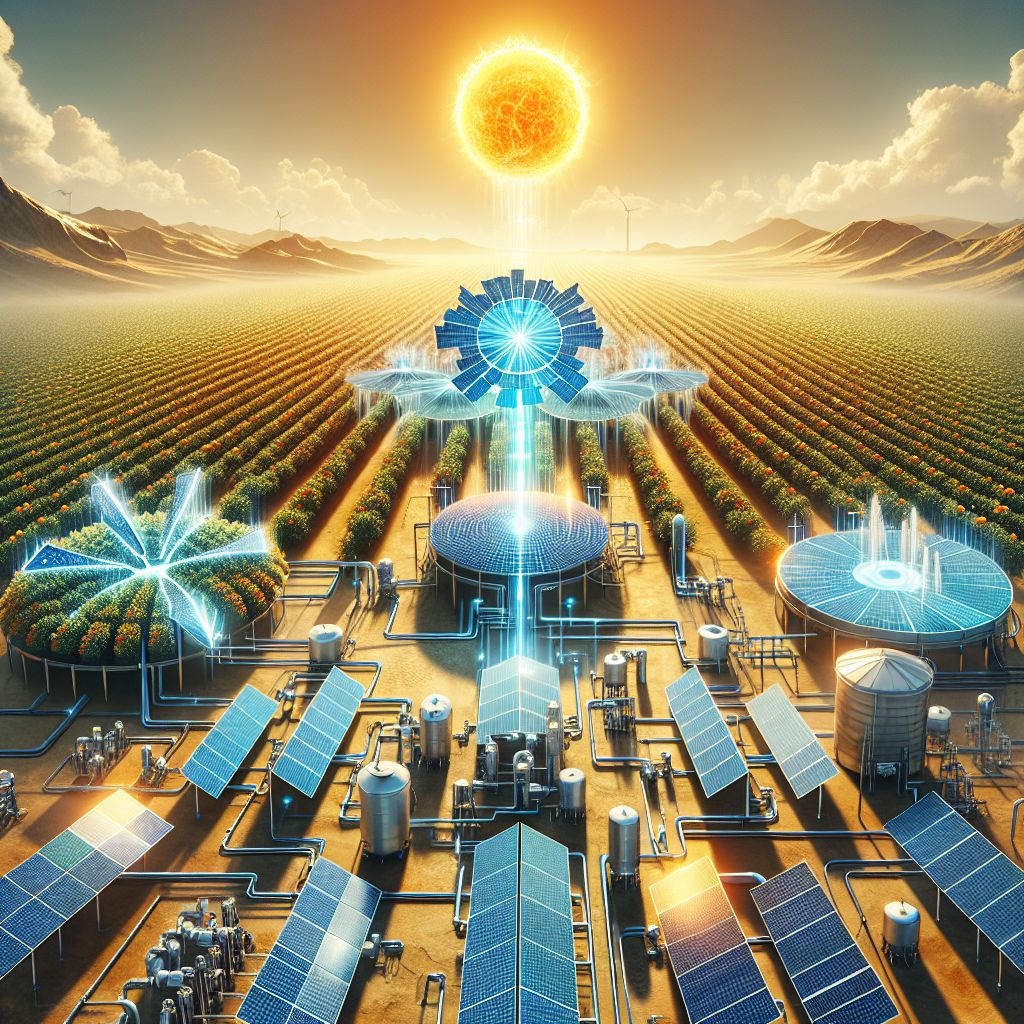
Top Solar Panels for Your Mango Farmers Irrigation System
When it comes to solar panels, not all are created equal, especially in the context of irrigating mango orchards. The efficiency, durability, and suitability of solar panels vary, which is why it’s crucial to choose the right type for your specific needs.
Monocrystalline Panels: Efficiency Meets Longevity
Monocrystalline solar panels are the go-to for farmers who are looking for top-notch efficiency and a long lifespan. They’re made from a single, pure crystal structure, which allows them to convert more sunlight into electricity than other types. That means you’ll need fewer panels to get the job done, saving space and resources in the long run.
Polycrystalline Panels: Affordable Quality
If you’re budget-conscious but still want quality, polycrystalline panels are your best bet. They’re made from multiple silicon crystals, making them less efficient than monocrystalline panels but also more affordable. They strike a balance between performance and cost, making them a popular choice for many farmers.
Though they might not be as efficient, solar-powered irrigation systems are still a reliable option for powering your irrigation system, and they have a commendable lifespan as well.
Thin-Film Solar Panels: Flexibility and Versatility
Thin-film solar panels are the mavericks of the solar panel world. They’re lightweight, flexible, and can be applied to a variety of surfaces. While they’re less efficient compared to crystalline panels, their versatility makes them suitable for large areas or unconventional spaces where traditional panels might not fit.
Plus, they tend to perform better in high temperatures and low light conditions, which can be particularly beneficial in the hot climates where mangoes flourish.
Comparing Panel Performance Under Matched Conditions
When choosing solar panels, consider your local climate and the layout of your land. Monocrystalline panels might be the most efficient, but if your farm is in a region with diffuse light, thin-film panels could perform better. It’s about finding the right tool for the job.
Here is a table showing the pros and cons of using different types of solar panels with an irrigation system on a farm:
|
Panel Type |
Pros |
Cons |
|---|---|---|
|
Monocrystalline Panels |
– High efficiency (15-22%), producing more power per square foot. 1, 2, 4 | |
|
Polycrystalline Panels |
– Lower upfront cost than monocrystalline. 1, 2 |
– Lower efficiency and shorter lifespan than monocrystalline. 2, 4 |
|
Thin-Film Solar Panels |
– Lowest upfront cost. 1, 2 |
– Lowest efficiency (7-13%). 2, 4 |
What is the Best Solar Panel for a Farm to Use on a Mango Orchard
Ultimately, the best solar panel for a mango orchard is one that provides enough power for your irrigation system while fitting into your budget and farm layout. For most, monocrystalline panels will be the best choice due to their efficiency and longevity, but don’t discount polycrystalline or thin-film options without considering your unique circumstances.

Cost and Efficiency Comparison: Solar Irrigation Systems Versus Traditional Irrigation Systems for Growing Mangoes
Let’s talk numbers. When comparing solar irrigation to traditional methods, we need to look at both the initial investment and the ongoing costs.
Initial Setup and Installation Costs for Both Systems
Setting up a solar irrigation system typically involves higher upfront costs than a traditional system. You’ll need to purchase solar panels, batteries, inverters, and possibly new pumps. However, prices for solar technology have been dropping, making it more accessible than ever.
On the flip side, traditional irrigation systems might seem cheaper at first glance, but they come with recurring energy costs that can add up quickly.
Operational Savings in the Long Run
Once your solar irrigation system is up and running, the operational costs are minimal. The sun’s energy is free, so you’re essentially eliminating the electricity costs associated with pumping water. Over time, these savings can be substantial, offsetting the initial investment.
Return on Investment: A Tangible Timeline
So, when do you start seeing a return on your investment? It varies, but many farmers report that solar irrigation systems pay for themselves within 3-5 years through savings on water and energy bills. After that, it’s pure savings, making it a smart financial move in the long run.
Here’s a breakdown to give you a clearer picture:
Solar panel setup (including installation): $10,000 – $20,000
Traditional irrigation system setup: $2,000 – $4,000
Annual savings on energy with solar: $1,000 – $2,000
Consider John’s story, a mango farmer from California. After installing a solar irrigation system, he saw his annual energy costs drop from $3,000 to virtually zero. That’s money he can now invest back into his farm or save for a rainy day.
Real-Life Farmer Experience: Case Studies
Real stories from real farmers can shine a light on the impact of solar irrigation. Take Maria, who owns a mango orchard in Brazil. After switching to solar-powered drip irrigation, her water usage dropped by 25%, and her yields increased by 30%. These are the kinds of results that can transform a farm’s profitability and sustainability.
Then there’s Alex, whose farm in Kenya was transformed by solar irrigation. He was able to triple his production of mangoes, which allowed him to hire more workers and support his local economy. It’s a ripple effect of benefits that starts with a single solar panel.
Here is a table comparing the cost and efficiency of an irrigation system with and without solar panels:
|
Aspect |
Without Solar Panels |
With Solar Panels |
|---|---|---|
|
Initial Cost | ||
|
Operating Cost |
Very low or zero fuel/electricity costs after installation. 1, 4 | |
|
Efficiency |
Depends on energy source efficiency. 4 |
Depends on solar radiation, temperature, system design. 1, 4 |
|
Environmental Impact |
Higher carbon footprint. 1 |
Lower carbon footprint, renewable energy. 1 |
|
Location Flexibility |
Limited to grid-connected or fuel access areas. 3 |
Can be used in remote off-grid areas. 3 |
|
Maintenance | ||
|
Lifespan |
Shorter for fuel-based systems. 1 | |
|
Long-term Costs |
Higher due to recurring fuel/electricity bills. 1 |
Lower total 20-year costs by 50-60% compared to traditional systems. 1 |
|
Government Incentives |
Generally none |
Many governments provide tax credits, subsidies for solar irrigation. 1 |

Which Combination of Solar Panels and Irrigation Systems make the Most Efficient System for Your Mango Orchard
Every mango orchard is unique, so there’s no one-size-fits-all solution. To find the most efficient system for your orchard, you’ll need to consider several factors. Understanding the efficiency of drip irrigation for mango trees can be a good starting point for optimizing water usage.
Assessing Your Mango Orchard’s Needs
First, assess your water needs based on your orchard’s size, the local climate, and your mango trees’ specific requirements. Then, consider the layout of your land to determine which type of solar panel would work best. Finally, look at your budget to decide how much you can invest upfront.
The goal is to match your orchard’s needs with the right combination of solar panels and irrigation methods to maximize efficiency and minimize waste. Whether it’s a solar-powered drip system or a combination of micro-sprinklers and thin-film panels, the perfect setup is out there for you.
Remember, the journey to a more sustainable farm doesn’t end with solar irrigation. It’s a continuous process of learning and adapting. But by taking this step, you’re not only investing in the future of your farm but also in the future of our planet. And that’s something worth growing for.
Determining the optimal solar panel configuration for your mango orchard is like piecing together a puzzle. The aim is to harness as much solar energy as possible without overshooting your budget or your orchard’s needs.
Determining the Optimal Solar Panel Configuration
To start, calculate the total wattage required by your irrigation system. This will give you an idea of how many panels you’ll need. Next, consider the space available for installing the panels. Do you have a large, open area, or will you need to place panels on existing structures? Lastly, factor in the amount of sunlight your location receives; this will influence the type of panel you choose.
With these considerations in mind, you can begin to compare the different solar panel types and their outputs. Monocrystalline panels might be more efficient, but if your space allows for a larger array, polycrystalline panels could provide the same output at a lower cost.
Take the case of a mango orchard in Florida, where abundant sunshine made it possible for a farm to use fewer high-efficiency monocrystalline panels to meet their energy needs, thereby saving space and reducing the impact on the landscape.
Remember, the best configuration is one that balances efficiency with practicality. It’s not just about the highest energy output; it’s about creating a sustainable and cost-effective system that aligns with your orchard’s specific requirements.
Choosing the Right Irrigation Method for Your Soil Type
When it comes to irrigation, one size does not fit all. The right method for your mango orchard will depend on the type of soil you have. Sandy soils, for instance, drain quickly and may benefit from frequent, low-volume drip irrigation. On the other hand, clay soils retain water longer and might be better suited to less frequent irrigation events.
Another factor to consider is the topography of your land. If your orchard is on a slope, drip irrigation can help prevent erosion by reducing the volume of water applied at any one time. Flat land may be more accommodating to micro-sprinklers, which can cover a larger area evenly.
It’s essential to get a soil test to understand your soil’s properties, such as texture, structure, and water-holding capacity. With this information, you can tailor your irrigation strategy to ensure water is delivered efficiently to your mango trees’ roots.
For example, a mango orchard in Arizona with sandy loam soil found that using a combination of drip irrigation and polycrystalline solar panels was the most cost-effective setup. The soil’s moderate drainage characteristics allowed for efficient water use, while the solar panels provided a reliable energy source.
What is the Best Combination
The best combination of solar panels and irrigation systems is the one that meets your orchard’s needs while being mindful of environmental impact and cost-effectiveness. For many, this will mean pairing high-efficiency monocrystalline solar panels with a precise drip irrigation system to minimize water use and maximize yield.
However, for larger orchards or those with unique layouts, a mix of polycrystalline panels and micro-sprinklers might make more sense. The key is to assess your conditions and make an informed decision based on your specific situation.
Frequently Asked Questions (FAQ)
Now, let’s tackle some common questions about solar irrigation for mangoes, to help clear up any lingering doubts.
What is the lifespan of a typical solar panel in an irrigation system?
Can solar irrigation systems be used in areas with inconsistent sun exposure?
How do solar irrigation systems impact the taste and quality of mangoes?
Are there government incentives for using solar irrigation in agriculture?
Can the same solar irrigation system be used for other crops besides mangoes?
What is the lifespan of a typical solar panel in an irrigation system?
Most solar panels come with a warranty of 25 to 30 years, and they can continue to operate efficiently long after that. Regular maintenance, such as cleaning and inspection, can help extend their lifespan even further.
Average lifespan: 25-30 years
Extended lifespan with maintenance: potentially 30+ years
Can solar irrigation systems be used in areas with inconsistent sun exposure?
Yes, they can. Solar panels can still generate electricity on cloudy days, albeit at a lower rate. Additionally, battery storage systems can store excess energy generated on sunny days for use when sunlight is limited.
How do solar irrigation systems impact the taste and quality of mangoes?
Properly irrigated mango trees are more likely to produce fruit that is sweet and full-flavored. Solar irrigation systems that provide consistent and adequate water can help ensure that mangoes develop the best taste and quality possible.
Are there government incentives for using solar irrigation in agriculture?
Many governments offer incentives for adopting renewable energy solutions, including solar irrigation. These can take the form of grants, tax credits, or rebates. Check with local agricultural extension services or renewable energy programs for specifics.
Can the same solar irrigation system be used for other crops besides mangoes?
Absolutely. Solar irrigation systems are versatile and can be adapted to a variety of crops by adjusting the water delivery method and the amount of water supplied. This makes solar irrigation a smart investment for farms with diverse agricultural practices.


Leave a Reply