

Key Takeaways
Solar irrigation is a sustainable method to water pineapples, using the sun’s energy to power the system.
Choosing the right type of irrigation, such as drip or micro-sprinkler systems, is crucial for the water needs of pineapples.
Monocrystalline solar panels are highly efficient and suitable for farms with limited space.
Understanding the costs involved shows that solar irrigation can lead to significant savings over time.
Pairing the correct type of solar panel with an efficient irrigation method maximizes water and energy use on pineapple farms.
Why You Should Use Solar Panels with an Irrigation System for Growing Pineapples
Let’s talk about growing pineapples—the juicy, tropical fruit we all love. But here’s the thing, pineapples, like any crop, need water, and plenty of it. Now, imagine if you could water your pineapples without ever worrying about rising energy bills or harming the planet. That’s where solar irrigation comes in. It’s like giving your pineapples a drink of water using a glass filled by the sun. And who doesn’t want a bit of sunshine in their life?
Eco-Friendly Farming: Harnessing the Sun’s Energy
First off, solar irrigation is about as green as it gets. By using solar panels, you’re tapping into one of the most abundant sources of energy out there—the sun. This means you’re not relying on electricity from the grid, which is often generated from fossil fuels. And because solar energy is renewable, you’re making a choice that’s good for the planet and sets a positive example for others to follow.
Water Conservation: Smart Usage for Thirsty Pineapples
Water is precious, and we need to use it wisely. Pineapples can be quite thirsty, but with solar irrigation, you can make every drop count. These systems can be incredibly precise, delivering water right where it’s needed—at the roots. So, you’re not just saving energy; you’re also conserving water. That’s a win-win for your farm and the environment.
Long-Term Cost Savings: Investing in Renewable Energy
Yes, there’s an upfront cost to setting up a solar irrigation system. But think about this—it’s an investment. In the long run, you’re looking at saving a hefty chunk of change. No more electric bills for watering your crops means the system will pay for itself over time, and then some. Plus, with the durability of solar panels, you’re setting up your farm for success for years to come.

Top Irrigation Methods Used by Pineapple Farmers
Drip Irrigation: Directing Water to the Roots
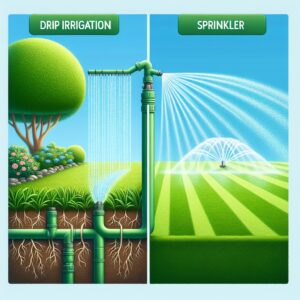
When it comes to irrigating pineapples, drip irrigation is like the secret sauce. It’s all about efficiency. By delivering water directly to the base of each pineapple plant, you minimize evaporation and runoff. It’s a system that not only saves water but ensures your pineapples get the hydration they need to grow plump and sweet.
Micro-Sprinkler Systems: Providing Even Coverage
Then there’s the micro-sprinkler system. It’s like a gentle rain shower for your pineapple field, providing even coverage without the water waste of traditional sprinklers. These little guys are perfect for keeping the soil moisture just right, which is exactly what pineapples need to thrive.
Furrow Irrigation: Traditional Techniques Meet Innovation
And don’t forget about furrow irrigation. It’s one of the oldest tricks in the book, but when you combine it with solar power, you’re making an old dog do new tricks. By creating small channels between the rows of pineapples, water flows by gravity, and the solar panels provide the energy to pump or distribute the water as needed.
Using a Hybrid System: Drip Irrigation combined with Micro-Sprinkler
Sometimes, the best approach is a mix of methods. That’s where a hybrid system comes in, blending drip irrigation’s pinpoint accuracy with the even distribution of micro-sprinklers. It’s like having the best of both worlds, ensuring your pineapples get the perfect amount of water every time.
For example, on my own farm, we’ve seen remarkable results by using a hybrid system. The pineapples are thriving, and the water savings have been substantial.
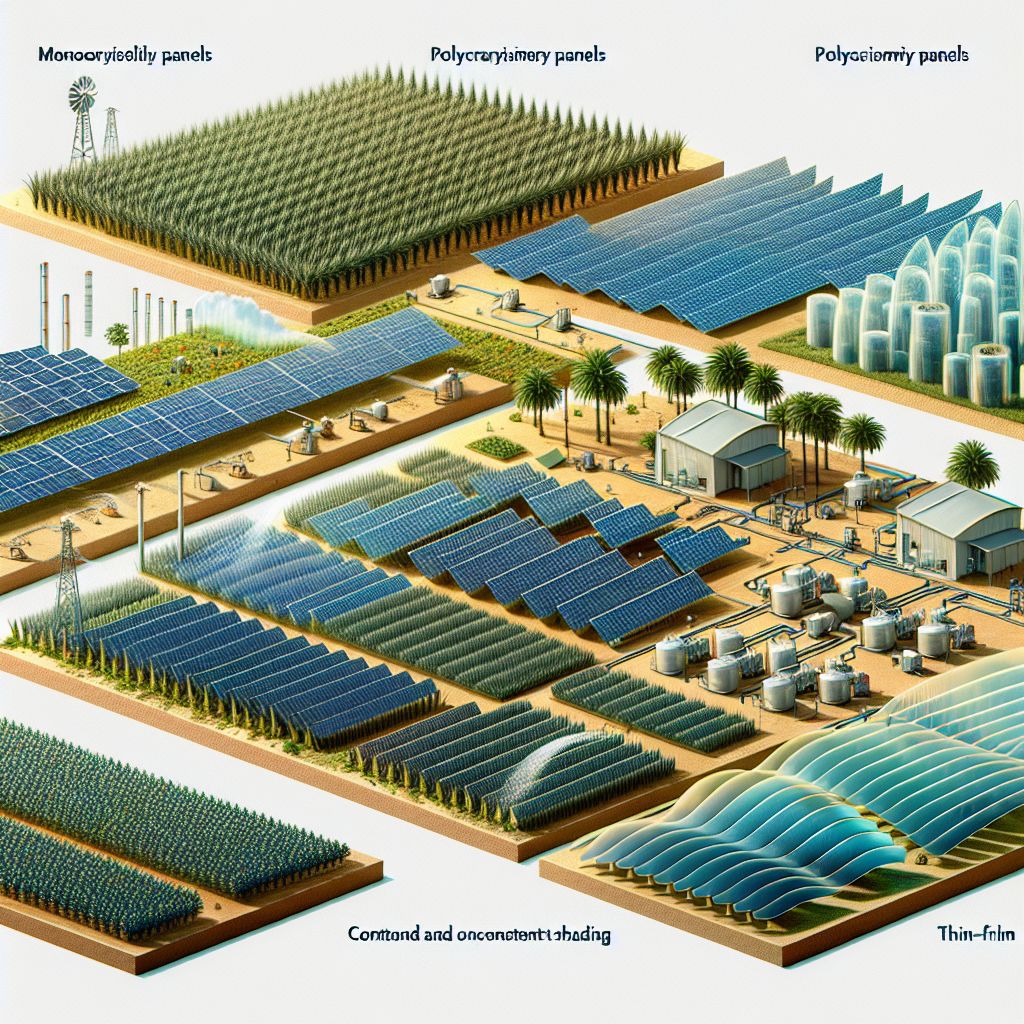
Top Solar Panels for Your Pineapple Farmers Irrigation System
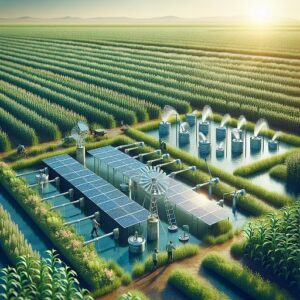
A bountiful pineapple harvest is dependent on consistent, reliable irrigation. But what if you could power your irrigation system with the very sun that ripens your fruit? Solar panels offer a sustainable and cost-effective solution for pineapple farmers, providing energy independence and a brighter future for your business.
Investing in a solar-powered irrigation system is not just a smart business decision; it’s a commitment to sustainability, ensuring a brighter future for your farm and the generations to come. With the right panel choice and expert guidance, you can harvest the power of the sun and cultivate a bountiful pineapple harvest for years to come. Let’s look at the top solar panels.
Monocrystalline Panels: High Efficiency on Limited Land
If you’re working with a smaller plot of land, monocrystalline panels are your best friend. These panels are top-notch, with efficiency ratings that can soar up to 22%. What does that mean for you? It means you can squeeze out more power from every square inch of solar panel. That’s crucial when space is at a premium, and you need to make every panel count. Think of it as packing a powerful punch in a small package, perfect for your pineapple paradise.
Polycrystalline Panels: Cost-Effective for Larger Farms
Now, if you’re blessed with a sprawling pineapple farm, polycrystalline panels might be the way to go. They’re a bit less efficient than their monocrystalline cousins, but they make up for it in cost-effectiveness. With a larger area to cover, you can afford to use more panels to get the job done. This can be a smart move for your wallet in the long run, especially when you’re looking to power a robust irrigation system that keeps those pineapples happy.
Polycrystalline panels are also a bit more shade-tolerant than monocrystalline panels. So if your farm has patches of shade throughout the day, these panels will keep chugging along, making sure your irrigation system doesn’t skip a beat.
Thin-Film Solar Panels: Flexible Solutions for Diverse Settings
Let’s not overlook thin-film solar panels. These are the contortionists of the solar panel world—they can bend and flex to fit on curved surfaces or wrap around structures. They’re not as efficient as mono or polycrystalline panels, but their versatility can be a game-changer. If your farm has unique structural challenges, thin-film panels can adapt to meet your needs, ensuring that your irrigation system always has the power it requires.
Here is a table showing the pros and cons of using different types of solar panels with an irrigation system on a farm:
|
Panel Type |
Pros |
Cons |
|---|---|---|
|
Monocrystalline Panels |
– High efficiency (15-22%), producing more power per square foot. 1, 2, 4 | |
|
Polycrystalline Panels |
– Lower upfront cost than monocrystalline. 1, 2 |
– Lower efficiency and shorter lifespan than monocrystalline. 2, 4 |
|
Thin-Film Solar Panels |
– Lowest upfront cost. 1, 2 |
– Lowest efficiency (7-13%). 2, 4 |
What is the Best Solar Panels for Pineapple Grower to Use
Choosing the best solar panels for your pineapple farm boils down to a few key factors: efficiency, cost, and land availability. Monocrystalline panels are the go-to for efficiency, especially on limited land. Polycrystalline panels offer a balance of cost and performance for larger areas. And thin-film panels bring flexibility to the table, ideal for unconventional spaces. Ultimately, the right choice aligns with your farm’s specific conditions and your long-term goals for sustainability and productivity.
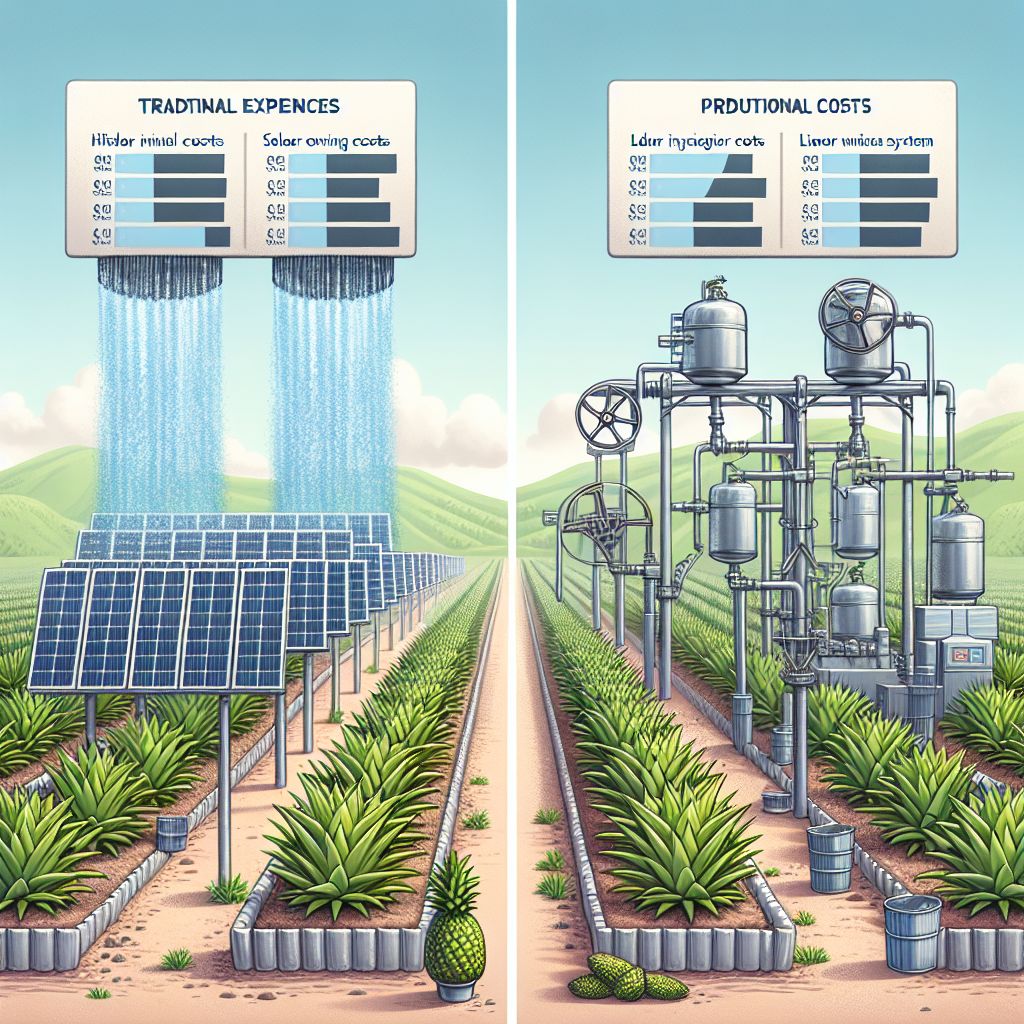
Cost and Efficiency Comparison: Solar Irrigation Systems Versus Traditional Irrigation Systems for Growing Pineapples
Initial Setup Costs: Understanding the Investment Between the 2 Systems
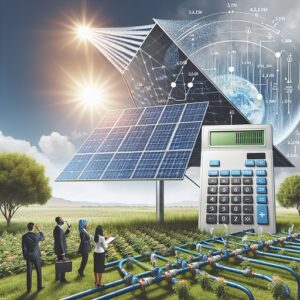
When weighing solar against traditional irrigation systems, it’s important to crunch the numbers. A solar irrigation system might have a higher upfront cost—think anywhere from a few thousand dollars to tens of thousands, depending on the size of your operation. But remember, traditional systems also come with hidden costs like monthly energy bills, which can add up quickly over time.
For instance, installing a solar irrigation system on my farm cost more initially, but the monthly savings on energy bills made it the smarter choice financially.
Therefore, when comparing the two, consider not just the initial price tag, but also the ongoing costs that will affect your farm’s bottom line.
Operational Costs: Calculating Energy and Water Savings Comparison
Once your system is up and running, the differences in operational costs become clear. Solar irrigation systems can lead to significant reductions in both energy and water use. With precise watering techniques like drip irrigation, you’re delivering the exact amount of water your pineapples need—no more, no less. And since the sun’s energy is free, you’re looking at zero costs for electricity to run your pumps and timers.
Traditional systems, on the other hand, can be quite thirsty and power-hungry. This means higher water bills and a steady drain on electricity or fuel to keep them going. Over time, these costs can really add up, making solar the savvy choice for both your wallet and the environment.
Return on Investment: Projecting Long-Term Benefits
So, what’s the bottom line? Investing in a solar irrigation system can deliver a return on investment (ROI) that’s hard to beat. While it’s true that the upfront costs can be substantial, the long-term savings on operational expenses make it a smart play. Most solar panels come with warranties of 25 years or more, which means you can expect your system to keep saving you money for decades.
And let’s not forget about the potential increase in crop yields. Healthier, better-watered pineapples can lead to a more abundant harvest, which translates to more income from your farm. When you add it all up, solar irrigation isn’t just an expense—it’s an investment in a more profitable, sustainable future for your farming operation.
Here is a table comparing the cost and efficiency of an irrigation system with and without solar panels:
|
Aspect |
Without Solar Panels |
With Solar Panels |
|---|---|---|
|
Initial Cost | ||
|
Operating Cost |
Very low or zero fuel/electricity costs after installation. 1, 4 | |
|
Efficiency |
Depends on energy source efficiency. 4 |
Depends on solar radiation, temperature, system design. 1, 4 |
|
Environmental Impact |
Higher carbon footprint. 1 |
Lower carbon footprint, renewable energy. 1 |
|
Location Flexibility |
Limited to grid-connected or fuel access areas. 3 |
Can be used in remote off-grid areas. 3 |
|
Maintenance | ||
|
Lifespan |
Shorter for fuel-based systems. 1 | |
|
Long-term Costs |
Higher due to recurring fuel/electricity bills. 1 |
Lower total 20-year costs by 50-60% compared to traditional systems. 1 |
|
Government Incentives |
Generally none |
Many governments provide tax credits, subsidies for solar irrigation. 1 |
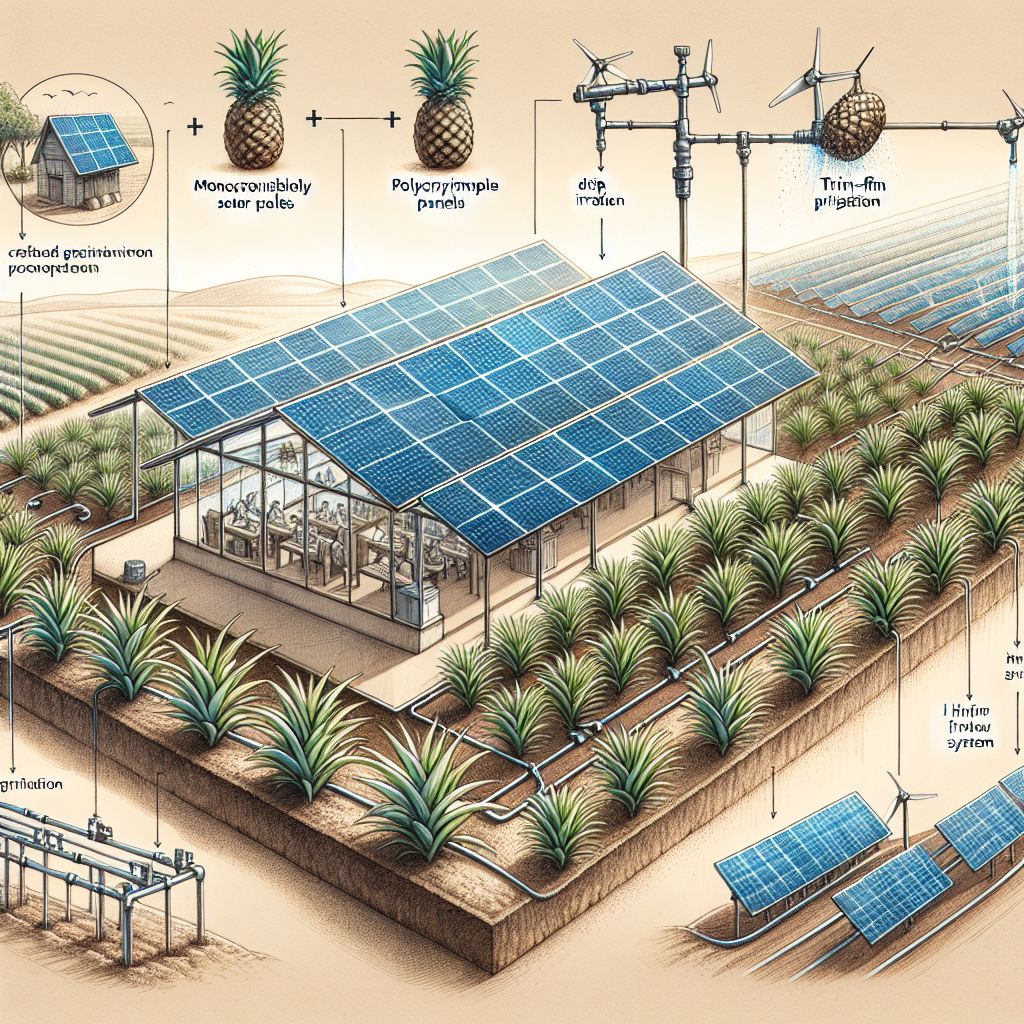
Which Combination of Solar Panels and Irrigation Systems make the Most Efficient System for Your Pineapple Farm
Pairing Monocrystalline Panels with Drip Irrigation
For top efficiency, consider pairing monocrystalline panels with a drip irrigation system. This dynamic duo offers the best of both worlds: maximum power generation and water delivery straight to the roots of your pineapples. It’s a setup that’s hard to beat for precision and performance, ensuring every drop of water and every ray of sunlight is used to its fullest potential.
Other Pairing Options: Customizing for Efficiency
But remember, your farm is unique, and there’s no one-size-fits-all solution. You might find that polycrystalline panels paired with micro-sprinklers are the perfect match for your larger farm. Or perhaps thin-film panels combined with a hybrid irrigation system will meet the specific challenges of your terrain.
The key is to tailor the system to your needs, balancing efficiency, cost, and the particular demands of your pineapple crop. By doing so, you’ll create a solar irrigation setup that not only saves resources but also boosts the health and yield of your pineapples, season after season.

Conclusion: Is it a Smart Decision to Add Solar-Power to an Irrigation System for Your Pineapples Farm
After delving into the specifics of solar-powered irrigation systems for pineapple farming, the verdict is clear. Embracing solar power for irrigation is not only a smart decision for the health of your crops but also for the sustainability of your farm and the environment. The initial costs may seem daunting, but the long-term benefits and savings can be substantial. By choosing the right combination of solar panels and irrigation methods, you can create a system that is both efficient and cost-effective.
Most importantly, by investing in solar irrigation, you’re taking a stand for eco-friendly farming practices. You’re reducing your carbon footprint, conserving water, and potentially increasing your crop yield. This forward-thinking approach can also set a precedent, inspiring others in the agricultural community to consider renewable energy options.
Besides that, the increasing availability of technology and the potential for government incentives make it an opportune time to invest in solar irrigation. As the technology continues to advance, it’s likely that we’ll see even more efficient and affordable solutions in the near future.
For example, a pineapple farm in Hawaii made the switch to solar irrigation and saw a 30% reduction in their water usage while maintaining their crop yield. This not only lowered their operational costs but also enhanced their reputation as a sustainable business.
Recap: The Advantages of Solar-Powered Irrigation
Solar-powered irrigation systems offer numerous advantages, especially for pineapple farming. They harness renewable energy, which leads to reduced greenhouse gas emissions and a smaller carbon footprint. They’re highly efficient, using precise irrigation methods like drip or micro-sprinkler systems that conserve water and reduce waste. Additionally, the cost savings on energy bills make these systems financially appealing in the long run.
Furthermore, solar irrigation systems can contribute to increased crop yields by providing consistent and adequate water to the plants. This is particularly important for water-intensive crops like pineapples. The improved crop health and yield can lead to higher profits for farmers.
Lastly, solar panels have a long lifespan, often with warranties of 25 years or more. This means that once the initial investment is recouped, the savings will continue for many years, making solar irrigation a wise financial decision for the future of any farm.
Renewable energy source reduces carbon footprint
Efficient water usage with precise irrigation methods
Long-term financial savings on energy costs
Potential for increased crop yields and profits
Long lifespan of solar panels ensures ongoing benefits
Final Thoughts: Balancing Costs, Benefits, and Sustainability
Ultimately, the decision to integrate solar power into your pineapple farm’s irrigation system comes down to a balance of costs, benefits, and sustainability. While the upfront investment may be significant, the reduction in ongoing operational costs and the positive environmental impact are compelling reasons to make the switch. As a farmer, you have the opportunity to lead the way in sustainable agriculture, contributing to a healthier planet and setting a standard for future generations.
Therefore, consider the specific needs of your pineapple farm, evaluate the available solar panel and irrigation options, and make an informed decision that aligns with your goals for sustainability and efficiency. With careful planning and a commitment to eco-friendly practices, adding solar power to your irrigation system can be a pivotal step in the success and sustainability of your pineapple farming venture.
Frequently Asked Questions (FAQ)
How Do Solar Panels for Irrigation Systems Work?
Solar panels for irrigation systems work by converting sunlight into electricity. This electricity is then used to power water pumps that distribute water throughout the irrigation system. The panels are typically installed in a sunny location and connected to a controller that manages the flow of electricity to the pumps.
The efficiency of the solar panels determines how much electricity can be generated and, consequently, how much water can be pumped. With advancements in solar technology, these systems have become more efficient and reliable, making them a viable option for farmers around the world.
What Are the Maintenance Requirements for Solar Irrigation Systems?
The maintenance requirements for solar irrigation systems are relatively low. The key components that need regular checks are the solar panels and the water pumps. Solar panels should be kept clean and free of debris to ensure maximum efficiency. Periodic inspections can help identify any potential issues, such as loose connections or damaged panels.
Water pumps also require occasional maintenance to ensure they are functioning correctly. This includes checking for leaks, monitoring the system’s pressure, and replacing any worn parts. With proper maintenance, a solar irrigation system can operate smoothly for many years.
Can Solar Irrigation Systems Be Used in Areas with Limited Sunlight?
Solar irrigation systems can be used in areas with limited sunlight, but their efficiency will be affected by the amount of sunlight available. To compensate for less sunny conditions, additional panels may be installed to capture as much sunlight as possible during the daylight hours. Battery storage systems can also be used to store excess energy generated during sunny periods for use during cloudy days or at night.
Are There Government Incentives for Using Solar Irrigation in Agriculture?
Many governments offer incentives for using solar energy in agriculture. These can include tax credits, rebates, grants, or subsidized loans. These incentives are designed to reduce the financial burden of installing solar systems and encourage farmers to adopt renewable energy solutions. It’s important to research the specific incentives available in your region, as they can significantly lower the initial investment cost of a solar irrigation system.

Leave a Reply