

Article-At-A-Glance
- Solar power can reduce farm energy costs by eliminating or drastically cutting monthly electricity bills and diesel fuel expenses.
- Solar panels last 25 to 30 years with minimal maintenance, making them one of the most cost-effective long-term investments in modern agriculture.
- Farmers can earn money back through net metering by selling surplus energy to the grid.
- Federal tax credits and state-level agricultural grants make the upfront cost of solar far more manageable than most farmers expect.
- The right solar setup depends on your farm type, energy demand, and available land — keep reading to find out which system fits your operation.
Farm energy costs are climbing every year, and solar power is one of the most effective tools available to stop the bleeding.
Across the country, farmers are switching to solar not because it’s trendy, but because the numbers make undeniable sense. Between grid electricity, diesel fuel for pumping water, and the unpredictability of energy pricing, running a modern farm has become a serious financial challenge. Solar directly attacks those costs at their root. For farmers looking to understand exactly how solar fits into an agricultural operation, Solar Empower breaks down the technology and financial case in plain terms built specifically for agricultural producers.
Why Farm Energy Costs Are Out of Control
Agriculture is one of the most energy-intensive industries in the United States. Irrigation pumps, grain dryers, climate-controlled storage, lighting, ventilation systems, and processing equipment all run on power that costs more every single year. Unlike most businesses, farms can’t easily pass those rising costs on to consumers without losing competitiveness in tight commodity markets.
Farm Energy Reality Check: According to the USDA, energy is one of the fastest-growing input costs for U.S. farm operations. For irrigated crop farms specifically, electricity for pumping water alone can represent a significant portion of total annual operating costs — costs that compound every time utility rates increase.
The problem isn’t just the dollar amount on the bill. It’s the unpredictability. Farmers plan budgets seasons in advance, and when energy costs spike mid-season — as they have repeatedly over the past decade — profit margins that were already razor-thin can vanish entirely.
The Real Price of Running Irrigation Pumps on Grid Power
Irrigation is where electricity costs hit hardest. A single large electric irrigation pump can consume tens of thousands of kilowatt-hours per season. In states like California, Texas, and Kansas where irrigated agriculture is essential, farmers running center-pivot systems on grid power face electricity bills that can reach tens of thousands of dollars annually just for water management. Solar-powered irrigation directly eliminates this recurring expense by generating the electricity needed to run pumps from sunlight at zero fuel cost.
Diesel Dependency and Its Hidden Costs
Many farms — particularly those in remote or rural areas without reliable grid access — rely on diesel generators to power irrigation pumps and other equipment. Diesel comes with costs that go far beyond what you pay at the pump. Fuel storage, equipment maintenance, engine repairs, and the logistical challenge of keeping fuel on hand all add up. When diesel prices spiked dramatically in recent years, farms running diesel-dependent systems felt it immediately in their operating budgets with no short-term escape route available. For those looking to reduce reliance on diesel, exploring solar irrigation systems can provide a sustainable alternative.
Solar-powered pump systems eliminate the diesel cost entirely. Once installed, they run on sunlight with no ongoing fuel expense. A solar irrigation pump system sized correctly for a farm’s water demands can replace a diesel pump completely, delivering the same output with a fraction of the lifetime cost.
How Energy Price Volatility Crushes Farm Profit Margins
The structural problem with grid electricity and diesel is that neither price is within a farmer’s control. Both are subject to market forces, geopolitical events, infrastructure decisions, and regulatory changes that have nothing to do with agriculture. When those prices jump, farm profit margins absorb the shock directly.
Solar power fundamentally changes this dynamic. Once panels are installed, the energy they produce costs nothing. The sun doesn’t raise its rates. There’s no utility company setting prices, no OPEC production decision affecting your pump costs. Farmers who have made the switch describe this price stability as one of the most underappreciated benefits of solar — it turns an unpredictable expense into a fixed, declining cost over time.
Here is a clear comparison of what farmers face with traditional energy versus solar:
- Grid electricity: Subject to annual rate increases, demand charges, and peak-hour pricing penalties
- Diesel generators: Vulnerable to global oil price swings, requires fuel storage and maintenance
- Solar power: Fixed installation cost, near-zero operating cost, predictable output for 25 to 30 years
- Solar + battery storage: Adds energy independence during grid outages or cloudy periods

How Solar Power Works on a Farm
At its most basic level, a farm solar system uses photovoltaic (PV) panels to convert sunlight into direct current (DC) electricity. An inverter then converts that DC electricity into alternating current (AC), which is what farm equipment, lighting, and other systems actually use. The whole system can be scaled from a few panels powering a single outbuilding to a full commercial installation powering an entire operation.
What makes solar particularly well-suited to farming is the alignment between when solar panels produce the most energy and when farms need it most. Peak solar production happens during daylight hours in summer months — the exact same window when irrigation demands are highest and energy prices are at their peak.
On-Grid vs. Off-Grid Solar Systems for Farms
Farmers generally choose between two primary solar configurations, and the right choice depends on the farm’s location, energy needs, and goals.
On-grid systems connect directly to the utility grid. When your panels produce more electricity than you’re using, the surplus flows back to the grid and you receive credit for it through net metering programs. On-grid systems are typically less expensive to install because they don’t require battery storage, and they ensure continuous power availability even when solar production is low.
Off-grid systems operate completely independently of the utility grid. They pair solar panels with battery storage systems to ensure power availability around the clock, regardless of grid connectivity. These are ideal for remote farm locations where grid connection is either unavailable or prohibitively expensive to establish. The tradeoff is higher upfront cost due to battery bank requirements, but for truly remote operations, off-grid solar is often far cheaper than the alternative of extending grid infrastructure or running diesel continuously.
What Happens to Excess Solar Energy
On days when your solar panels produce more electricity than your farm consumes — which happens regularly on sunny days with lower equipment demand — that surplus energy doesn’t go to waste. On-grid systems feed it back into the utility grid, and through net metering programs available in most states, you receive a credit on your utility bill for every kilowatt-hour you send back. Over a full year, this can result in significant bill reductions or even net payments from the utility to the farmer.
The Direct Cost Savings Solar Delivers to Farmers
The financial case for farm solar is built on multiple simultaneous savings streams, not just one. When you add them together across a 25-year panel lifespan, the total value becomes compelling enough that solar has shifted from a niche agricultural experiment to a mainstream farm investment strategy.
Understanding each savings category individually helps farmers calculate what solar could realistically deliver for their specific operation.
Monthly Electricity Bill Reductions
The most immediate and measurable benefit farmers see after switching to solar is the drop in their monthly electricity bill. Depending on system size and local utility rates, farms can eliminate 70% to 100% of their grid electricity costs. For operations running heavy loads like grain dryers, cold storage, or large-scale irrigation, those monthly savings can reach thousands of dollars during peak season.
The key is sizing the system correctly to match actual farm consumption patterns. A properly designed solar installation analyzes 12 months of historical electricity usage, identifies peak demand windows, and builds a panel array that offsets the most expensive portions of that usage first. Done right, the monthly bill reduction starts from day one of operation.
Elimination of Diesel Fuel Costs for Water Pumping
For farms running diesel-powered irrigation pumps, the switch to solar is one of the single highest-return investments available. Solar irrigation systems eliminate the need for diesel fuel entirely, converting a recurring and unpredictable operating cost into a one-time capital investment with decades of free operation ahead of it.
- No more fuel purchases: Solar-powered pumps run on sunlight, removing the need to budget for diesel every season
- Reduced equipment wear: Electric solar pump systems have fewer moving parts than diesel engines, meaning significantly lower maintenance costs
- Quieter operation: Solar pumps run silently compared to diesel generators, reducing noise pollution across the farm
- Remote operation capability: Many solar pump systems can be monitored and controlled remotely, saving labor time and improving efficiency
- Scalable output: Solar pump systems can be sized precisely to match water volume requirements for any irrigation configuration
The practical savings on a mid-size irrigated crop farm switching from diesel to solar water pumping can be dramatic. Diesel pump systems require not just fuel but regular oil changes, engine servicing, injector maintenance, and eventual engine rebuilds. A solar-powered pump system sidesteps virtually all of those recurring costs.
Beyond the direct cost elimination, there’s also a risk management dimension to consider. Diesel supply chains can be disrupted during natural disasters, regional emergencies, or extreme demand periods — exactly the conditions that often coincide with a farm’s peak irrigation season. Solar-powered irrigation systems are immune to fuel supply disruptions, providing water access reliability that diesel simply cannot guarantee.
25 to 30 Years of Low Maintenance Costs
One of the most underappreciated financial advantages of solar panels is how little they cost to maintain over their operational lifetime. Quality solar panels carry performance warranties of 25 years and regularly operate effectively for 30 years or more. During that entire period, maintenance requirements are minimal — occasional cleaning to remove dust and debris, periodic inverter inspections, and routine system monitoring. There are no fuel costs, no combustion components to service, and no annual tune-ups required. For a farmer already stretched thin managing equipment maintenance across an entire operation, a system that essentially runs itself for three decades is a significant practical advantage.
Net Metering Revenue From Surplus Energy
When a farm solar system produces more electricity than the operation consumes, net metering programs allow that surplus to be credited against future utility bills or, in some cases, paid out directly. For farms with large roof areas or open land available for ground-mounted panels, it’s entirely possible to generate enough excess electricity to create a measurable annual income stream on top of the direct savings. Some agricultural producers in states with favorable net metering policies have effectively turned their farms into small power producers, offsetting not just their own electricity costs but generating credits that reduce bills across multiple meters on the same property.
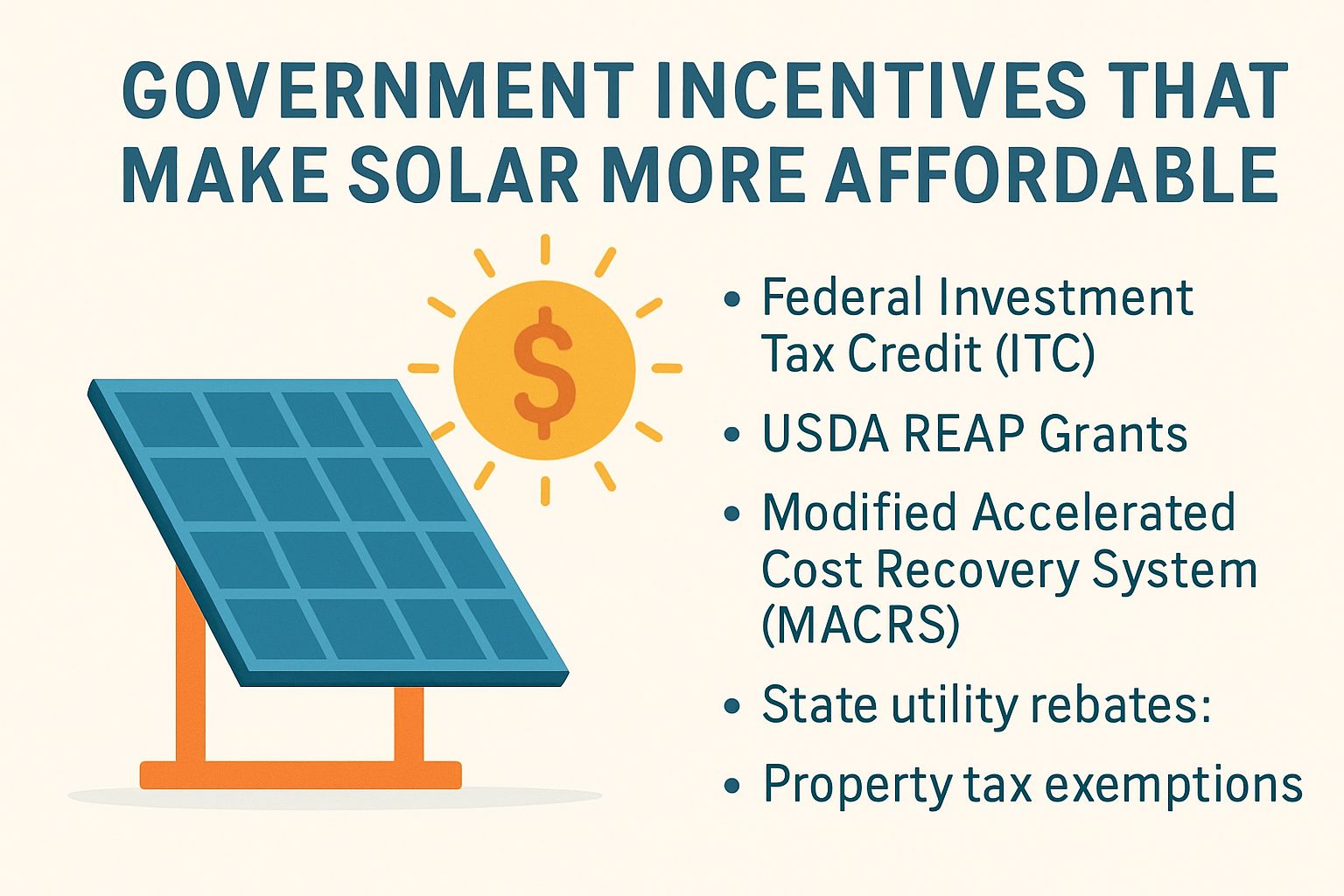
Government Incentives That Make Solar More Affordable
- Federal Investment Tax Credit (ITC): Allows farm businesses to deduct a significant percentage of solar installation costs directly from federal taxes owed
- USDA REAP Grants: The Rural Energy for America Program provides grants and guaranteed loans specifically for agricultural producers investing in renewable energy systems
- Modified Accelerated Cost Recovery System (MACRS): Allows farmers to depreciate solar equipment rapidly, reducing taxable income in the early years after installation
- State utility rebates: Many state utility commissions offer upfront rebates that reduce the net cost of solar installation at the point of purchase
- Property tax exemptions: Numerous states exempt solar energy systems from property tax assessments, preventing installation from increasing annual tax liability
The combination of federal and state incentives can substantially reduce the effective out-of-pocket cost of a farm solar installation. When stacked together — ITC, REAP grants, MACRS depreciation, and state rebates — the financial support available to agricultural producers can reduce net system costs by 50% or more in many cases, dramatically improving the payback timeline.
The USDA REAP program deserves particular attention because it was specifically designed with farmers and rural small businesses in mind. REAP grants can cover up to 50% of eligible project costs for renewable energy systems, and the program has been consistently funded and expanded in recent Farm Bill cycles. Applications are processed through USDA Rural Development state offices, and priority is given to smaller agricultural operations — making it especially valuable for family farms that might otherwise find solar financially out of reach.
Working with a tax professional who understands agricultural tax situations is strongly recommended before making a solar investment decision. The interaction between the ITC, MACRS depreciation, and REAP grants involves specific eligibility rules and timing considerations that can significantly affect the total financial benefit. Getting this right from the start ensures farmers capture the maximum available incentive value rather than leaving money on the table.
Federal Tax Credits Available to Farm Operations
Under the Investment Tax Credit, farm businesses that install solar energy systems can claim a federal tax credit equal to a percentage of total system cost. This is a direct credit against taxes owed — not a deduction — which makes it far more valuable dollar for dollar than a standard deduction. Combined with MACRS bonus depreciation, which allows accelerated write-offs on solar equipment in the first year, the federal tax benefits alone can recover a substantial portion of a farm’s solar investment within the first tax filing year after installation. For more information, you can explore how solar panels can reduce energy costs for farms.
State-Level Agricultural Solar Rebates and Grants
Beyond federal programs, individual states have developed their own incentive structures to accelerate solar adoption in agricultural communities. States like California, Iowa, Minnesota, and New York have robust agricultural solar incentive programs that include direct rebates, low-interest green energy loans, and property tax exclusions for solar installations on farm property. The availability and value of these programs varies significantly by state, so researching what’s specifically available in your location is a critical step before finalizing any solar investment plan.
Some states also offer additional incentives tied specifically to agrivoltaic installations — systems where solar panels are installed over or alongside active crop production areas. These dual-use configurations are gaining traction because they allow land to serve two purposes simultaneously, generating solar energy while maintaining agricultural production on the same footprint. State programs supporting agrivoltaic development often include enhanced grant amounts or preferential loan terms compared to standard ground-mount installations.
Best Places on a Farm to Install Solar Panels
Choosing where to install solar panels on a farm is a practical decision driven by available space, existing infrastructure, shading, and the type of energy loads being offset. Most farms actually have multiple viable installation locations, and the best approach often combines two or more placement strategies to maximize both total energy production and land use efficiency.
South-facing orientations with minimal shading from trees or structures are universally preferred. In the northern hemisphere, panels facing true south at an angle roughly equal to the site’s latitude capture the highest annual solar energy. But even east-west oriented roof installations or slightly suboptimal ground placements can still deliver strong financial returns — perfect siting matters less than actually getting the system built and producing.
The most common and financially efficient installation options for farm properties break down into two primary approaches: rooftop systems on existing farm buildings and open-land ground-mounted arrays. Each has distinct advantages depending on the farm’s specific geography, energy needs, and land use priorities.
Rooftop Installations on Barns and Farm Buildings
Barns, equipment storage buildings, processing facilities, and grain storage structures often have large, unobstructed roof surfaces that are ideal for solar panel installation. Rooftop installations use space that is already built and paid for, require no additional land clearing or grading, and typically connect efficiently to the electrical loads inside the building below. A large dairy barn roof, for example, can accommodate enough solar panels to power the barn’s entire lighting, ventilation, and milking equipment load — turning a fixed asset into an energy-producing installation without sacrificing a single acre of productive farmland.
Open Land Installations That Don’t Sacrifice Crop Space
Ground-mounted solar arrays on open land give farmers the flexibility to install larger systems than rooftops alone can accommodate. For farms with marginal land — areas that are too rocky, poorly drained, or otherwise unsuitable for reliable crop production — ground-mounted solar is an excellent way to put underperforming acreage to productive financial use. A field that generates minimal crop revenue can be transformed into a steady energy asset generating thousands of dollars in electricity savings annually.
The agrivoltaic approach takes this a step further by combining solar panel installation with active crop production on the same land. Research from the University of Massachusetts and other agricultural institutions has shown that certain crops — including leafy greens, herbs, and some root vegetables — can actually thrive under the partial shade created by elevated solar panels. The panels reduce water evaporation from soil, moderate temperature extremes, and protect sensitive crops from hail and wind damage, while simultaneously generating clean electricity. This dual-use model allows farmers to count the land as both an energy asset and a productive agricultural unit simultaneously.
For livestock operations, solar panels mounted on elevated racking structures over grazing paddocks serve triple duty — generating electricity, providing shade for animals during hot months, and reducing pasture water loss through evaporation. Sheep and other small livestock can graze freely underneath elevated panel arrays without any conflict between energy production and animal husbandry. This agrivoltaic grazing model is gaining significant traction across the western United States where heat stress in livestock is a serious production and welfare concern.
How Long Before Solar Pays for Itself on a Farm
The payback period for a farm solar installation — the point at which cumulative energy savings equal the original system cost — typically falls between 5 and 10 years depending on system size, local electricity rates, available incentives, and the farm’s energy consumption profile. Farms in states with high utility rates and strong net metering programs tend to reach payback faster, sometimes in as few as 4 to 6 years. After payback is reached, every kilowatt-hour the system produces is essentially free electricity for the remaining 15 to 20+ years of panel life.
Consider a mid-size corn and soybean operation in the Midwest spending $3,000 per month on electricity during peak irrigation season. A properly sized solar installation with federal ITC, MACRS depreciation, and a USDA REAP grant could reduce net system cost by more than half. At that reduced net cost, the annual electricity savings alone — before factoring in net metering credits — could deliver full payback within 6 to 8 years. From that point forward, the system generates what amounts to a six-figure contribution to farm profitability over its remaining operational life. Learn more about solar irrigation systems for farmers and how they can enhance agricultural efficiency.

Solar Is One of the Smartest Long-Term Investments a Farmer Can Make
When you stack up the electricity bill reductions, diesel fuel elimination, net metering revenue, government incentives, and the 25 to 30-year operational life of modern solar panels, the financial argument is hard to dispute. Solar doesn’t just reduce costs — it converts a farm’s biggest uncontrollable expense into a fixed, predictable, declining cost that improves the farm’s financial position every single year it operates. In an industry where margins are tight and input costs are relentless, that kind of long-term financial certainty is genuinely rare. For farmers who are planning for the next generation, installing solar today is one of the most tangible ways to hand off a more profitable, more resilient operation to whoever comes next. Discover how irrigation systems can be powered by solar panels to further enhance farm efficiency.
Frequently Asked Questions
- How much can a farm save annually by switching to solar power?
- Do solar panels work well in rural or remote farm locations?
- Can solar power run all farm equipment including large irrigation systems?
- What is net metering and how does it benefit farmers?
- How long does it take to install a solar system on a farm?
These are the questions farmers ask most often when evaluating solar for their operations. The answers cut through the noise and focus on what actually matters for agricultural decision-making.
Solar technology has matured significantly over the past decade. System reliability, efficiency ratings, and installation quality have all improved substantially, while costs have dropped. What was once a niche investment for well-capitalized operations is now a financially accessible choice for farms of many sizes and types.
Understanding the specifics — payback timelines, equipment compatibility, incentive eligibility — is what separates farmers who make confident solar decisions from those who stay on the fence indefinitely. The details below answer the most critical questions directly.
Every farm’s situation is unique, which is why general answers only go so far. But the fundamentals of solar economics in agriculture are consistent enough that these answers apply broadly across most farm types and regions in the United States.
How Much Can a Farm Save Annually by Switching to Solar Power?
Annual savings vary based on farm size, energy consumption, local utility rates, and system design — but farms that install solar systems sized to meet a significant portion of their electricity demand commonly report annual savings ranging from several thousand dollars for smaller operations to tens of thousands of dollars for large irrigated crop farms or intensive livestock facilities. The key variable is how much electricity the farm currently buys from the grid or generates with diesel, because solar savings are directly proportional to how much expensive conventional energy the solar system displaces. For more insights, consider how solar panels can reduce energy costs for farms.
Do Solar Panels Work Well in Rural or Remote Farm Locations?
Solar panels work extremely well in rural and remote locations — in many cases, they work better as an investment in those settings than in urban environments. Remote farms that currently rely on diesel generators or pay high connection fees to maintain grid access stand to gain the most from solar because their baseline energy costs are already elevated. The sun’s energy reaches rural farmland just as reliably as it reaches suburban rooftops, and the absence of shading from surrounding buildings often means rural installations capture more solar energy per panel than urban or suburban systems.
Off-grid solar systems with battery storage are specifically designed to serve locations without reliable grid access. These systems pair solar panels with a battery bank — such as lithium iron phosphate (LiFePO4) battery systems — that stores daytime solar production for use at night or during cloudy periods. For a remote farm currently running a diesel generator 8 to 12 hours per day, replacing that generator with an off-grid solar-plus-storage system can eliminate diesel costs entirely while providing more reliable and consistent power than a combustion engine ever could.
Grid connectivity in rural areas is also often less stable than urban infrastructure, meaning remote farms are more vulnerable to outages that can disrupt irrigation schedules, climate-controlled storage, and livestock operations. A solar system with battery backup provides resilience against grid outages that goes beyond simple cost savings — it protects against the kind of operational disruption that can cause real crop losses or animal welfare issues during extended power failures.
Remote Farm Solar Example: A cattle operation in a rural area running a 15kW diesel generator daily for water pumping and barn power could replace that system with a ground-mounted solar array paired with a battery storage bank. The result: zero daily diesel cost, reduced maintenance burden, consistent power availability, and a system that continues generating value for 25+ years with minimal ongoing expense.
Can Solar Power Run All Farm Equipment Including Large Irrigation Systems?
Yes — solar power can run virtually any farm equipment that operates on electricity, including large center-pivot irrigation systems, grain dryers, cold storage refrigeration, milking equipment, poultry house ventilation, and greenhouse climate control. The critical factor is proper system sizing. A solar installation needs to be designed with sufficient panel capacity and, where necessary, battery storage or grid backup to match the peak electrical demand of the equipment it’s powering. Large irrigation pumps drawing significant horsepower require larger solar arrays, but the technology to support that scale of agricultural load is well established and widely available through commercial solar installers who specialize in agricultural applications.
What Is Net Metering and How Does It Benefit Farmers?
Net metering is a utility billing arrangement that allows solar system owners to send surplus electricity back to the grid in exchange for credits on their electricity bill. When a farm’s solar panels produce more electricity than the farm is consuming at that moment — common during midday hours when sunlight is strongest but equipment demand may be lower — the excess flows to the grid and the utility company registers a credit. That credit offsets future electricity purchases, effectively using the grid as a virtual battery. For farms with large roof areas or ground-mounted systems generating substantial surplus, net metering can reduce annual electricity bills to near zero, and in some states, utilities are required to purchase surplus generation outright, creating an actual revenue stream for the farm.
How Long Does It Take to Install a Solar System on a Farm?
Typical Farm Solar Installation Timeline:
• Site assessment and system design: 1 to 3 weeks
• Permitting and utility interconnection approval: 2 to 8 weeks depending on jurisdiction
• Equipment procurement and delivery: 2 to 6 weeks
• Physical installation: 1 to 5 days for most farm systems
• Inspection and utility interconnection: 1 to 3 weeks
• Total timeline from first contact to full operation: Typically 2 to 5 months
The physical installation itself is often the shortest part of the entire process. A rooftop system on a large barn or a ground-mounted array can typically be fully installed by an experienced crew in one to five days. The longer timeline comes from permitting, utility interconnection approvals, and equipment lead times — all of which are administrative and logistical processes outside the installer’s direct control.
Planning ahead is the most important thing farmers can do to minimize the timeline impact. Starting the solar evaluation and design process during the off-season — fall or winter for most crop operations — means the system can be fully permitted, installed, and operational before the following spring and summer when energy demand peaks. Farmers who wait until peak season to begin the process often end up waiting an entire additional year before capturing the full benefit of their investment. For more information on how solar panels can reduce energy costs, read this article.
Utility interconnection approvals are the most variable part of the timeline. Rural electric cooperatives and smaller utility districts sometimes have longer processing timelines than major investor-owned utilities, so starting early and working with an installer who has an established relationship with the local utility can meaningfully accelerate the process. Some utilities have streamlined fast-track interconnection processes for agricultural solar systems below certain capacity thresholds, which is worth asking about during the planning phase.
For off-grid systems that don’t require utility interconnection — common for remote irrigation pump installations — the timeline is often significantly shorter. Without the interconnection approval process, a standalone solar pump system can go from design to full operation in as little as four to six weeks once equipment is on hand.
If you’re ready to explore how solar can work on your farm specifically, Solar Empower specializes in helping agricultural producers find the right solar solutions to cut costs, increase resilience, and build long-term energy independence.
Solar power is revolutionizing the agricultural industry by significantly reducing farmers’ overall costs and expenses. By utilizing solar panels, farmers can generate their own electricity, which can be used to power various systems on the farm. This not only cuts down on energy costs but also provides a sustainable and eco-friendly alternative to traditional energy sources. One of the most effective applications of solar power in agriculture is in irrigation systems. For instance, solar irrigation systems are becoming increasingly popular among farmers who wish to optimize water usage and reduce reliance on non-renewable energy sources.

Leave a Reply