
Key Takeaways:
- Dual-axis solar trackers can increase energy production by up to 45% compared to fixed systems — making them the highest-yield option available to farmers today.
- Single-axis trackers offer a practical middle ground, boosting output by 10–25% over fixed panels at a significantly lower cost than dual-axis systems.
- Fixed solar systems are the most affordable and lowest-maintenance option, but they sacrifice energy capture — which matters most in regions with variable sunlight.
- The right system depends on your farm size, energy demands, budget, and geographic location — and the difference in long-term ROI between systems can be substantial.
- Your geographic location — specifically how much direct sunlight you receive and how dramatically sun angles shift seasonally — plays a major role in which system delivers the best return.
Choosing the wrong solar system for your farm could cost you tens of thousands of dollars in lost energy production over 20 years.
Whether you’re powering irrigation pumps, grain dryers, livestock operations, or simply trying to cut utility bills, the solar system you install determines how much energy you actually capture — and how fast your investment pays back. Growing Solar Mist has been helping farmers navigate exactly these decisions, breaking down the real-world performance differences between dual-axis trackers, single-axis trackers, and fixed systems so you can make an informed choice before committing to a significant capital investment.
Dual Axis Trackers Produce Up to 45% More Energy Than Fixed Systems
The gap in performance between a dual-axis tracker and a static panel is not marginal — it’s transformational for high-energy farming operations. When your panels can follow the sun across both its daily east-to-west arc and its seasonal north-south elevation changes, you’re capturing peak solar intensity for a significantly longer window each day. That sustained alignment is where the 45% gain comes from.
What a Dual Axis Solar Tracker Actually Does
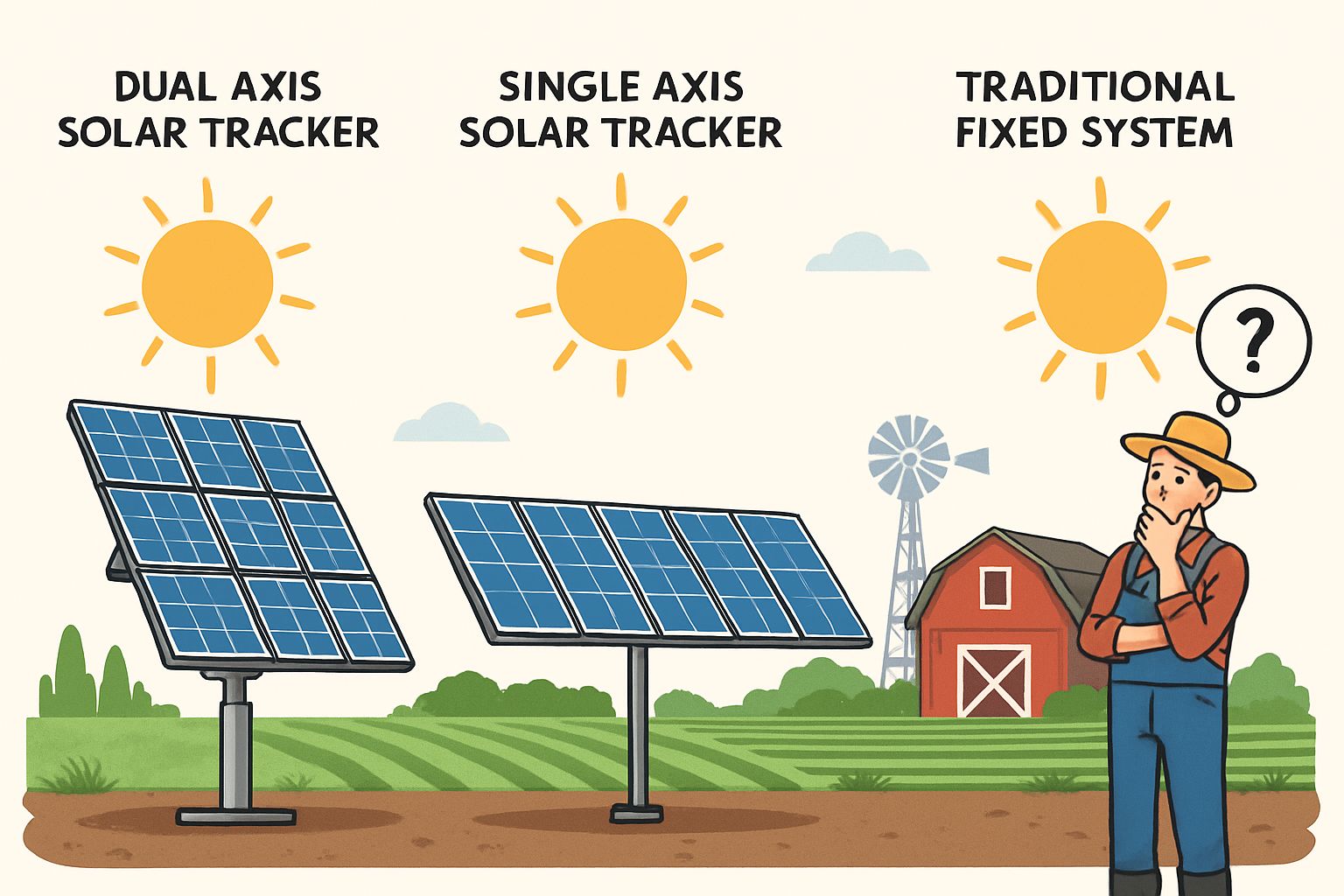
A dual-axis solar tracker moves solar panels along two independent axes simultaneously. The first axis handles the daily horizontal movement — tracking the sun as it rises in the east and sets in the west. The second axis adjusts for the sun’s vertical angle, which changes throughout the year as seasons shift. Together, these two movements keep panels pointed directly at the sun at all times.
This continuous alignment is what separates dual-axis systems from everything else. On a winter morning when the sun sits low on the horizon, a dual-axis tracker tilts and rotates to meet it — while a fixed panel or even a single-axis tracker misses a significant portion of that available energy. For farms in regions with pronounced seasonal sun angle variation, this matters enormously.
What a Single Axis Solar Tracker Does Differently
Single-axis trackers move along one axis only — typically rotating from east to west to follow the sun’s daily path. They do not adjust for the sun’s seasonal elevation changes. This makes them simpler and cheaper than dual-axis systems while still delivering a meaningful improvement over fixed panels. Most single-axis systems are installed with a fixed tilt angle that is optimized for the farm’s latitude, then left to rotate horizontally throughout the day.
How Traditional Fixed Solar Systems Work
Fixed solar systems are exactly what the name suggests — panels mounted at a static angle that never moves. The tilt is set at installation, typically calculated to match the average optimal angle for the farm’s geographic location. They generate power whenever sunlight hits the panels, but they never adjust to chase peak intensity. What you see at installation is what you get for the life of the system. For farmers exploring different solar technologies, understanding the comparison between bifacial and TopCon solar panels can be beneficial.
Fixed systems are the most widely installed type of solar globally, largely because of their lower cost, simpler installation, and near-zero mechanical maintenance requirements. For farms where budget is the primary driver and energy demands are modest, they remain a completely viable solution. Learn more about choosing PV structures for your farm.
Energy Output Numbers Farmers Need to Know
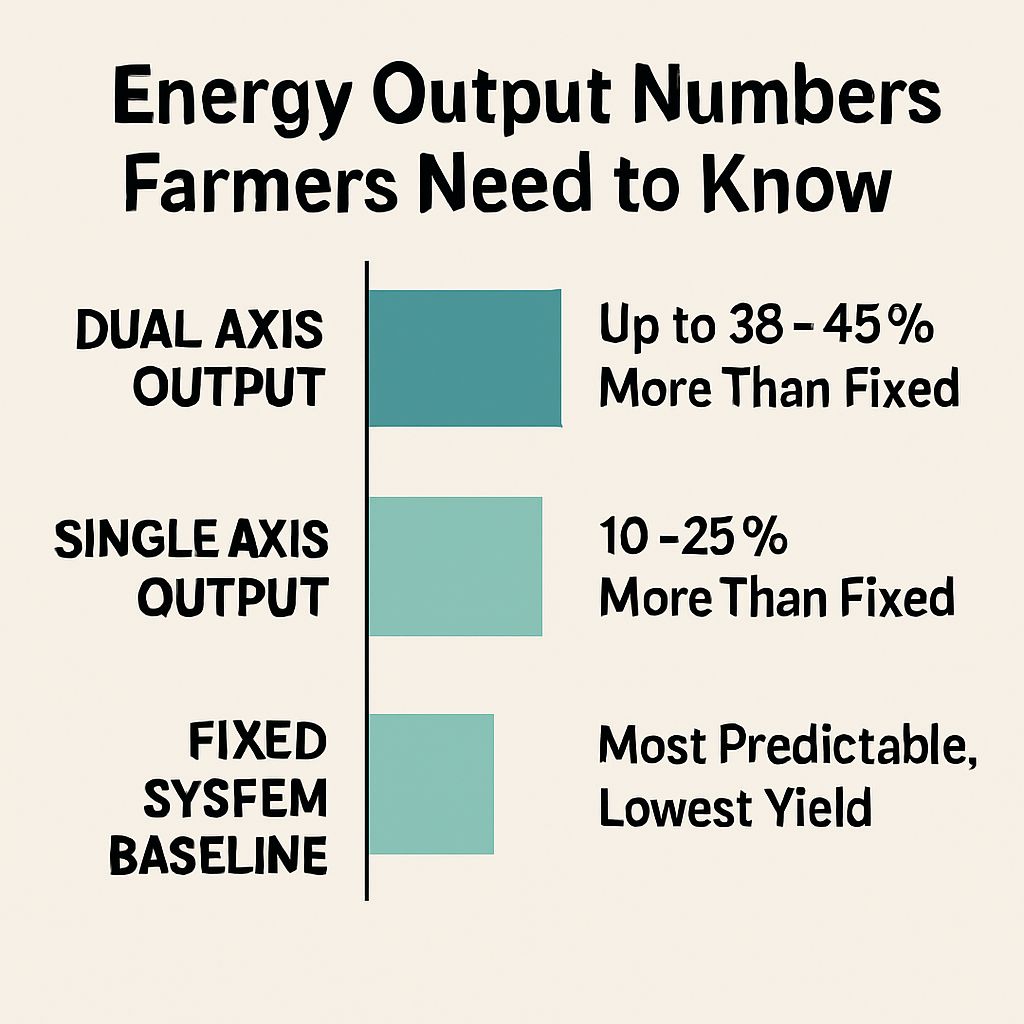
Raw performance numbers are the fastest way to understand what each system actually delivers. The table below puts all three side by side using realistic output comparisons based on a baseline fixed-system annual yield of 10,000 kWh. For more information on how different solar technologies compare, check out this solar technologies comparison for farmers.
|
System Type |
Energy Gain vs. Fixed |
Estimated Annual Output (baseline: 10,000 kWh fixed) |
|---|---|---|
|
Fixed (Traditional) |
Baseline (0%) |
10,000 kWh |
|
Single-Axis Tracker |
+10% to +25% |
11,000 – 12,500 kWh |
|
Dual-Axis Tracker |
+38% to +45% |
13,800 – 14,500 kWh |
These numbers represent averages across favorable conditions. Your actual yield will depend on your location, local weather patterns, panel quality, and installation precision. That said, these ranges are consistent with what farmers across utility-scale and commercial operations have reported in real deployments.
Dual Axis Output: Up to 38–45% More Than Fixed
Dual-axis trackers sit at the top of the performance chart for one reason: they eliminate almost all the angular loss that fixed and single-axis systems accept as a given. Every degree of misalignment between a solar panel and the sun reduces energy capture — and dual-axis systems minimize that misalignment across every hour of every day, across every season.
In practical terms, if a fixed system on your farm generates 10,000 kWh annually, a dual-axis tracker on the same site could push that figure to 13,800–14,500 kWh. Over a 25-year system lifespan, that’s a cumulative difference of nearly 100,000 kWh — enough to power significant portions of a large farming operation or sell back to the grid at meaningful volumes.
Single Axis Output: 10–25% More Than Fixed
Single-axis trackers reliably deliver between 10% and 25% more energy than fixed systems. The exact gain depends heavily on latitude — farms closer to the equator see smaller gains because the sun’s daily arc is more overhead and consistent, while farms at higher latitudes benefit more from east-to-west tracking. For most North American farm locations, a 20–25% gain is a realistic target with a well-installed single-axis system.
Fixed System Baseline: Most Predictable, Lowest Yield
Fixed systems offer the most predictable output — but also the lowest ceiling. Their energy generation curve is entirely dependent on the sun’s natural path relative to the panel’s static angle, which means performance drops are baked in at sunrise, sunset, and during winter months when sun angles are shallow. For farms that simply need a reliable, low-complexity power source without maximizing every kilowatt-hour, this trade-off can be acceptable. For a deeper understanding of solar technologies, you can explore solar technologies comparison for farmers.
Real Cost Differences Between All Three Systems
Performance gains only matter if the economics make sense for your operation. The cost differences between these three system types are significant — both at installation and over the life of the system — and understanding them is critical before you sign any contracts.
Dual-axis trackers carry the highest upfront cost due to their mechanical complexity, motorized components, and more involved installation process. Single-axis systems are moderately more expensive than fixed installations but far less than dual-axis. Fixed systems are the cheapest to install and the cheapest to maintain, with virtually no moving parts to service or replace over a 25-year lifespan. For a detailed comparison of solar technologies, you can explore the solar technologies comparison for farmers.
Upfront Installation Costs Compared
Dual-axis tracker systems consistently cost more per watt to install than either single-axis or fixed systems. The motorized mounts, control systems, and reinforced structural foundations required for dual-axis movement add significant material and labor costs. Single-axis systems are a meaningful step down in complexity — they use simpler rotating frames with fewer mechanical components, bringing installation costs closer to fixed systems while still delivering the east-to-west tracking benefit. Fixed systems remain the most straightforward installation of the three, with static racking that requires no motors, sensors, or programmable controllers.
Maintenance Costs Over Time
This is where the long-term cost picture really separates the three systems. Fixed solar arrays have almost no mechanical maintenance requirements — there are no moving parts, no motors to service, and no tracking software to update. Outside of routine panel cleaning and occasional inverter checks, a fixed system can run for 25 years with minimal hands-on attention. For farmers who are already stretched thin managing daily operations, that simplicity has real value.
Tracking systems, by contrast, introduce moving parts — and moving parts eventually need maintenance. Single-axis systems have one motor and one rotational mechanism per tracker unit, which keeps service needs manageable. Dual-axis systems double that mechanical complexity, with two motors, two axes of movement, and more sophisticated control electronics. Bearing replacements, motor servicing, and software calibration are recurring maintenance considerations that fixed systems simply don’t have.
- Fixed systems: Near-zero mechanical maintenance — panel cleaning and inverter checks are the primary ongoing tasks.
- Single-axis trackers: Annual motor and bearing inspections recommended; occasional lubrication and calibration required.
- Dual-axis trackers: More frequent servicing due to two-axis mechanical complexity — budget for semi-annual professional maintenance checks.
- Weather damage risk: Tracking systems, particularly dual-axis, have more exposure to wind and mechanical stress due to their moving components and elevated panel positions.
One often-overlooked factor is downtime. When a tracking motor fails on a dual-axis system, the entire tracker unit may default to a fixed position until repairs are made — meaning you lose the performance premium you paid for. Building a service contract into your system budget from day one is strongly recommended for any tracking installation.
When the Investment Actually Pays Off
Payback period — the point at which your energy savings offset your installation cost — varies significantly between the three system types. Fixed systems typically reach payback fastest because their lower upfront cost means there’s less ground to make up, even with lower annual energy production. Single-axis trackers generally take longer to pay back than fixed systems, but the additional energy they generate can close that gap in high-sunlight regions where the performance premium is most pronounced. For a deeper dive into solar panel options, check out this comparison of solar panels for farmers.
Dual-axis trackers present the most complex payback calculation. Their higher upfront and maintenance costs mean the payback period is the longest of the three — but for large-scale operations generating and potentially selling significant volumes of electricity, the cumulative energy advantage over 20–25 years can outweigh that slower start. The strongest financial case for dual-axis systems exists on utility-scale farms and operations in regions with significant seasonal sun angle variation, where the second axis delivers real, measurable yield gains rather than marginal improvements. For more details, explore the comparison between single-axis and dual-axis solar trackers.
Which System Handles Bad Weather and Seasonal Changes Best
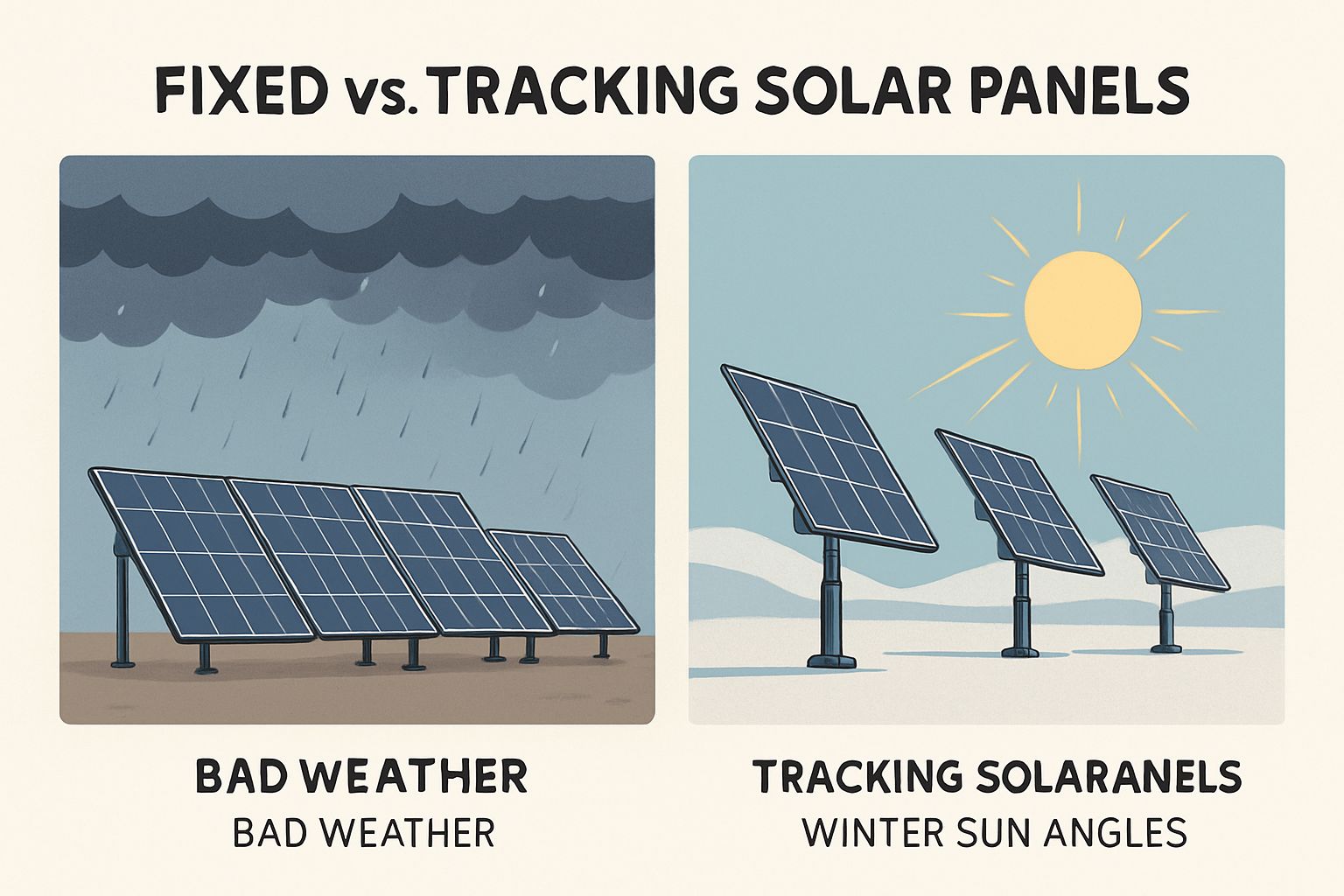
Energy production doesn’t happen in a vacuum — weather, cloud cover, and seasonal sun angle shifts all affect how much power your system actually generates. The way each system responds to these real-world conditions is a practical factor that output percentages alone don’t fully capture. For a deeper understanding of how different solar technologies compare in handling these conditions, explore further insights.
Fixed systems are inherently passive — they don’t respond to anything. Whatever the sky delivers, the panels capture at their static angle. Tracking systems, on the other hand, are actively optimizing panel position in real time, which means they can extract more value from partial sunlight conditions by ensuring panels are always as well-aligned as possible with whatever light is available.
How Dual Axis Trackers Respond to Winter Sun Angles
Winter is where dual-axis trackers earn their premium most clearly. As the sun drops lower on the horizon during winter months, fixed panels and single-axis systems experience a steep drop in efficiency — their static or horizontally-adjusted angles simply can’t compensate for how dramatically the sun’s elevation changes between June and December. A dual-axis tracker adjusts for exactly this, tilting panels to maintain optimal alignment with the low winter sun. For farms in northern latitudes where winter energy needs are high — think heating systems, livestock operations, and grain drying — this seasonal advantage can be a decisive factor.
Single Axis Performance in Cloudy or Variable Climates
Single-axis trackers perform well under partly cloudy conditions because their east-to-west rotation still optimizes panel angle relative to where the sun is positioned behind the clouds. However, in regions with consistently overcast skies, the performance gap between single-axis and fixed systems narrows considerably — if diffuse light is coming from all directions equally, precise panel orientation matters less.
For farms in the Pacific Northwest, Great Lakes region, or other areas with high cloud cover frequency, the ROI calculation for single-axis trackers needs careful scrutiny. In these climates, a well-designed fixed system with high-efficiency panels may deliver comparable real-world output at a lower total cost. Farms in the Southwest, Great Plains, and other high-direct-sunlight regions are where single-axis tracking delivers its strongest performance advantages.
Land Use and Space Requirements for Each System
Solar tracking systems require more land than fixed arrays for the same installed panel capacity. Because tracker-mounted panels move throughout the day, they need additional spacing between rows to prevent panels from shading each other at low sun angles — a phenomenon called inter-row shading. Fixed systems can be mounted in tighter rows with less spacing since their angle never changes. Dual-axis trackers typically require the most land per kilowatt of installed capacity, followed by single-axis systems, with fixed arrays being the most land-efficient of the three. For farms where arable land is at a premium or where agrivoltaic systems — combining crop production with solar generation — are a consideration, land use efficiency becomes a meaningful factor in system selection.

The Right System for Your Farm Size and Energy Needs
There is no single correct answer for every farm — but there are clear patterns that match system types to specific farming situations. Farm size, annual energy consumption, available land, budget, and geographic location all feed into the decision. Here’s how to think through it based on your specific operation.
Large Farms With High Energy Demands
Large-scale farming operations with high energy consumption — powering extensive irrigation systems, large grain drying facilities, cold storage, or multiple livestock buildings — are the strongest candidates for dual-axis tracking systems. At this scale, the 38–45% output premium over fixed systems translates directly into substantial energy cost savings and, in many cases, significant grid export revenue. The higher upfront investment is more easily absorbed across a large energy budget, and the long-term cumulative yield advantage compounds meaningfully over a 25-year system life.
Utility-scale solar farms operating on agricultural land follow the same logic. When maximizing kilowatt-hours per acre is the primary objective, dual-axis trackers are the benchmark system. Single-axis trackers are also widely used at utility scale as a cost-performance compromise — particularly when land availability is less of a constraint and the simpler maintenance profile of single-axis systems is operationally attractive.
Mid-Size Farms Balancing Budget and Output
For mid-size farming operations — say, 500 to 2,000 acres with moderate to significant energy demands — single-axis trackers typically represent the most financially sound choice. They deliver a genuine and measurable improvement over fixed systems, with a more manageable upfront investment and a simpler maintenance profile than dual-axis alternatives. In high-sunlight regions, the 20–25% output gain over fixed panels can meaningfully accelerate payback and improve the system’s overall economics without the full complexity of dual-axis installation.
Small Farms or Tight Budgets
For small farms or operations where capital is limited, fixed solar systems are almost always the right starting point. The lower upfront cost, minimal maintenance requirements, and straightforward installation make them accessible to farms that can’t absorb the financial risk of a more complex tracking system. A well-designed fixed array with quality panels will still meaningfully reduce your utility bills and provide a reliable, long-term energy source — without the mechanical complexity that can become a headache when you’re already managing a full farming operation.
That said, small farms shouldn’t automatically rule out single-axis trackers. In high-sunlight regions where a modest additional investment can deliver a 20–25% yield boost, the math can still work favorably even at smaller scale. The key is running a site-specific payback analysis rather than assuming tracking systems are only for large operations. If the numbers pencil out over a 10–15 year payback window, a single-axis system can be a smart upgrade even on a smaller property.
Farms in High-Sunlight vs. Low-Sunlight Regions
Geography is one of the most decisive variables in this entire decision. Farms in high-direct-sunlight regions — the American Southwest, Great Plains, and similar latitudes globally — extract maximum value from tracking systems because there are more hours of direct, intense sunlight available to capture. In these locations, the performance gap between a dual-axis tracker and a fixed system is at its widest, and the financial case for tracking is at its strongest. The sun is intense, the sky is clear, and every degree of panel alignment translates directly into kilowatt-hours.
Farms in consistently overcast or low-sunlight regions — the Pacific Northwest, Great Lakes, northern New England — face a different reality. When diffuse light dominates over direct sunlight for significant portions of the year, the advantage of precise panel tracking shrinks considerably. In these climates, high-efficiency fixed panels may deliver comparable real-world output to a tracking system at a fraction of the cost. Before investing in any tracking technology in a low-sunlight region, get a detailed solar irradiance analysis for your specific location — the data will tell you more than any general rule of thumb.
Side-by-Side Comparison: Dual Axis vs. Single Axis vs. Fixed
|
Feature |
Dual-Axis Tracker |
Single-Axis Tracker |
Fixed System |
|---|---|---|---|
|
Energy Gain vs. Fixed |
+38% to +45% |
+10% to +25% |
Baseline |
|
Upfront Cost |
Highest |
Moderate |
Lowest |
|
Maintenance Requirements |
High (two motors, two axes) |
Moderate (one motor, one axis) |
Minimal (no moving parts) |
|
Best For |
Large farms, utility-scale, high sunlight regions |
Mid-size farms, high-sunlight regions |
Small farms, low-sunlight regions, tight budgets |
|
Seasonal Adjustment |
Full (daily + seasonal) |
Partial (daily only) |
None |
|
Land Efficiency |
Lowest (most spacing required) |
Moderate |
Highest (tightest row spacing) |
|
Payback Period |
Longest |
Moderate |
Shortest |
|
Weather Resilience |
Moderate (more wind exposure) |
Good |
Best (static, no mechanical exposure) |
|
Complexity |
High |
Moderate |
Low |
Reading this table in isolation can make the choice feel obvious — but the right answer depends entirely on your specific farm’s energy demands, location, and budget. A dual-axis tracker that’s oversized for a small operation is a poor investment even if it produces more energy. A fixed system that leaves 40% of available solar energy uncaptured on a large farm is an equally poor choice in the other direction. For more information on solar panel options, consider reading about thin-film vs. polycrystalline solar panels.
The most common mistake farmers make when selecting a solar system is anchoring the decision on upfront cost alone. A fixed system that costs 30% less than a single-axis tracker might seem like the smart financial move — until you calculate the cumulative energy revenue gap over 20 years. Equally, a dual-axis tracker that looks impressive on a spec sheet may deliver diminishing returns if your farm is in a low-sunlight region where the second axis adds minimal real-world benefit.
Think of the table above as a decision filter, not a verdict. Use it to narrow your options based on farm size and sunlight region first, then bring in a qualified solar installer to run site-specific output and payback projections before making any final commitment. The numbers will tell you which column in that table actually makes financial sense for your operation.
It’s also worth noting that technology in this space continues to evolve. Solar tracker manufacturers have been steadily improving the reliability of tracking mechanisms, reducing mechanical failure rates, and bringing down the cost per watt of installed tracking systems. The economics of tracking versus fixed are more favorable today than they were a decade ago — and that trend is continuing in the direction of trackers becoming cost-competitive with fixed systems at smaller scales over time.

So, Which Solar System Should Farmers Choose?
Large farms with high energy demands in high-sunlight regions should take a hard look at dual-axis trackers — the yield premium is real and the long-term financials are compelling at scale. Mid-size farms in good sunlight regions will find single-axis trackers hit the best balance of output gain and investment risk. Small farms or operations in consistently cloudy climates are generally best served by a high-quality fixed system that delivers reliable, low-maintenance power without the complexity or cost of tracking technology. Whatever your situation, the single most important step before purchasing anything is a detailed solar assessment for your specific site — because geography, not marketing, determines which system actually performs for your farm.
Frequently Asked Questions
These are the questions farmers most commonly ask when working through the decision between dual-axis, single-axis, and fixed solar systems.
What is the main difference between single axis and dual axis solar trackers?
A single-axis solar tracker rotates along one axis — typically following the sun’s east-to-west daily path — while a dual-axis tracker moves along two axes, adjusting for both the daily horizontal movement and the seasonal vertical changes in the sun’s elevation. This second axis is what allows dual-axis systems to maintain near-perfect panel alignment year-round, including during winter months when the sun sits low on the horizon. The result is a higher energy yield, but also a higher cost and more complex maintenance profile.
Are dual axis solar trackers worth the extra cost for farmers?
For large farming operations in high-direct-sunlight regions, dual-axis trackers can absolutely justify their premium — the 38–45% output gain over fixed systems translates into significant cumulative energy revenue over a 25-year system lifespan. The financial case is strongest when farm energy demands are high enough to absorb the upfront investment across a large annual consumption base, or when excess generation can be sold back to the grid at favorable rates. To explore more about solar panel options for farms, consider reading this comparison of solar panels.
For smaller farms or operations in low-sunlight regions, the dual-axis premium is harder to justify. The maintenance costs, longer payback period, and added mechanical complexity make single-axis or fixed systems a more pragmatic choice. The honest answer is that dual-axis trackers are worth it for some farmers and genuinely not worth it for others — the only way to know for certain is to run a site-specific financial analysis using your actual solar irradiance data and energy consumption figures. To explore more about solar panel options, consider this comparison of thin-film vs. polycrystalline solar panels.
Do solar trackers work during cloudy or overcast weather?
Yes, solar trackers still generate electricity during cloudy or overcast weather — but the performance advantage over fixed systems narrows significantly under these conditions. When direct sunlight is replaced by diffuse light coming from all directions, the precision alignment that trackers provide matters less because there’s no concentrated light source to track. Panels generate power from diffuse light regardless of their angle.
The practical implication is that in consistently overcast climates, the ROI calculation for tracking systems is weaker. Here’s how each system type performs under different sky conditions:
- Direct sunlight (clear skies): Tracking systems deliver their full performance premium — dual-axis up to 45% more than fixed, single-axis up to 25% more.
- Partly cloudy conditions: Tracking still provides meaningful benefit as the sun periodically breaks through — systems maintain optimal alignment whenever direct light is available.
- Consistently overcast skies: The performance gap between tracking and fixed systems shrinks considerably — high-efficiency fixed panels may match or approach tracker output under these conditions.
- Heavy rain or storms: All three systems generate minimal power; trackers may reposition panels to a storm-safe angle to reduce wind load and mechanical stress.
If your farm location receives a high percentage of overcast days annually, this factor alone can shift the financial case away from tracking systems entirely. Always factor your local cloud cover frequency into any solar investment analysis.
How much land does a dual axis solar tracker need compared to a fixed system?
Dual-axis tracking systems require significantly more land per kilowatt of installed capacity than fixed systems. Because the panels move throughout the day — including tilting to steep angles at low sun positions in winter — they need generous spacing between tracker units to prevent inter-row shading when panels are at their most extreme tilt positions. This shading loss would directly undercut the efficiency gains that tracking provides, so the spacing requirement is non-negotiable for proper system performance.
Fixed systems can be installed in tighter row configurations because their panels never move and shading patterns are entirely predictable at installation. Single-axis trackers fall between the two — they require more spacing than fixed arrays but less than dual-axis systems since they only tilt along one axis. For farms where every acre of land has productive agricultural value, this land use trade-off is a genuine consideration — and in some cases, the economic value of keeping that land in crop production outweighs the energy gains from installing a tracking system on it.
Can a small farm benefit from a solar tracking system?
Small farms can benefit from solar tracking systems, but the bar for financial justification is higher than it is for large operations. The fixed costs of tracking technology — motors, control systems, reinforced mounts, installation labor — don’t scale down proportionally with system size, which means the cost-per-watt premium for tracking is felt more acutely on smaller installations.
The most realistic path to a tracking system making sense on a small farm is a combination of factors: a high-sunlight geographic location that maximizes the output premium, energy demands that make every additional kilowatt-hour genuinely valuable to the operation, and favorable financing or incentive programs that reduce the effective upfront cost. In some states and regions, agricultural solar incentives, USDA REAP grants, or accelerated depreciation programs can meaningfully shift the economics in favor of tracking systems even at smaller scales.
For most small farms, though, a high-quality fixed system remains the most financially sound choice — reliable, low-maintenance, and capable of meeting core energy needs without the added complexity or cost. As tracking technology continues to improve and costs continue to fall, that calculus may shift over the next decade, but for installations happening today, fixed systems offer small farms the best combination of simplicity, reliability, and return on investment.
For farmers ready to explore which solar system makes the most sense for their specific operation, Growing Solar Mist provides expert guidance and in-depth resources to help you make the most informed decision possible. Additionally, you can explore the benefits of different solar panel types in agriculture, such as thin-film vs. polycrystalline solar panels, to determine the best fit for your needs.


Leave a Reply