
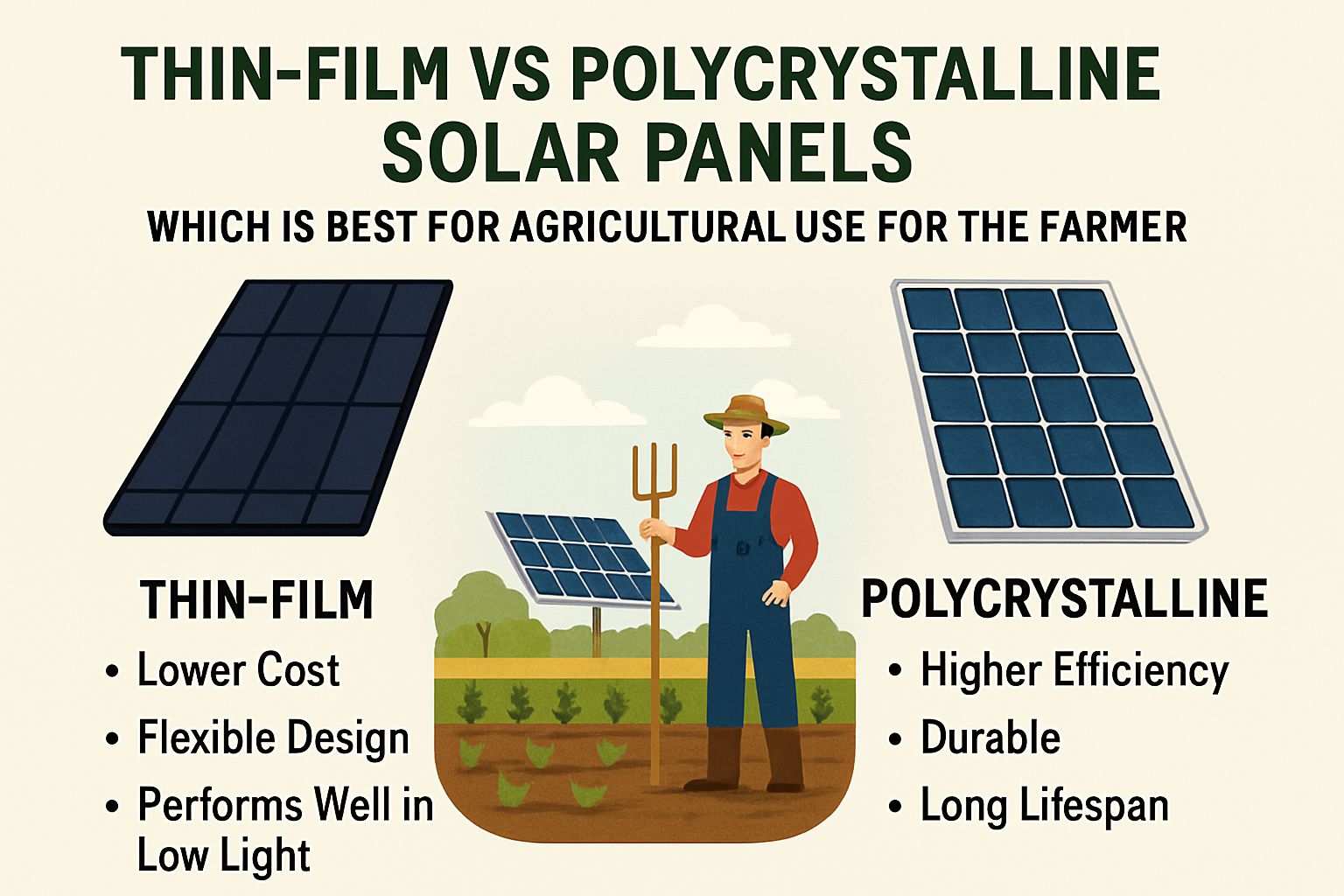
“vs Polycrystalline Solar Panels …” from growingsolarmist.com and used with no modifications.
Article-At-A-Glance:
- Polycrystalline panels deliver 13–17% efficiency, making them the go-to choice for farms with large flat roof surfaces or open ground-mount space that need maximum power output per square meter.
- Thin-film panels operate at 10–13% efficiency but outperform polycrystalline in diffuse light, high heat, and on curved or structurally weak surfaces — conditions common on older farm buildings.
- Growing Solar Mist breaks down exactly how each panel type performs across the most common agricultural energy applications, including a full thin-film vs polycrystalline solar panels comparison built specifically for farmers.
- The cost difference is real but often misunderstood — thin-film costs less per installation but requires significantly more surface area to generate the same output, which can make it more expensive overall on space-limited properties.
- There is one scenario where thin-film clearly wins — and most farmers overlook it entirely. Keep reading to find out what it is.
Article-At-A-Glance: Solar Panels for Agricultural Use
Choosing the wrong solar panel type for your farm is an expensive mistake that’s easy to avoid once you understand the core trade-off between these two technologies.
Thin-film and polycrystalline are the two most common solar panel types used in agriculture today. Both can power a farm effectively, but they work very differently — and the best choice comes down to your land, your roof, your climate, and your energy load. Get that match right, and your solar system pays itself off faster. Get it wrong, and you’re either under-generating or over-spending on installation.
Polycrystalline Wins on Output, Thin-Film Wins on Flexibility — Here’s What That Means for Your Farm
That’s the central tension when it comes to farm solar, and understanding it is what separates a well-designed system from an expensive mistake. Polycrystalline panels give you more power from less surface area, but they demand flat, structurally sound mounting surfaces and perform best in full, direct sunlight. Thin-film panels are lighter, more adaptable, and handle shade and heat better — but you’ll need significantly more roof or ground space to match the same output.
For most farms, polycrystalline is the default starting point. But there are specific farm setups — older buildings, shaded paddocks, greenhouse structures, and agrivoltaic systems — where thin-film is clearly the stronger choice. Understanding where each technology excels is what this comparison is built around.
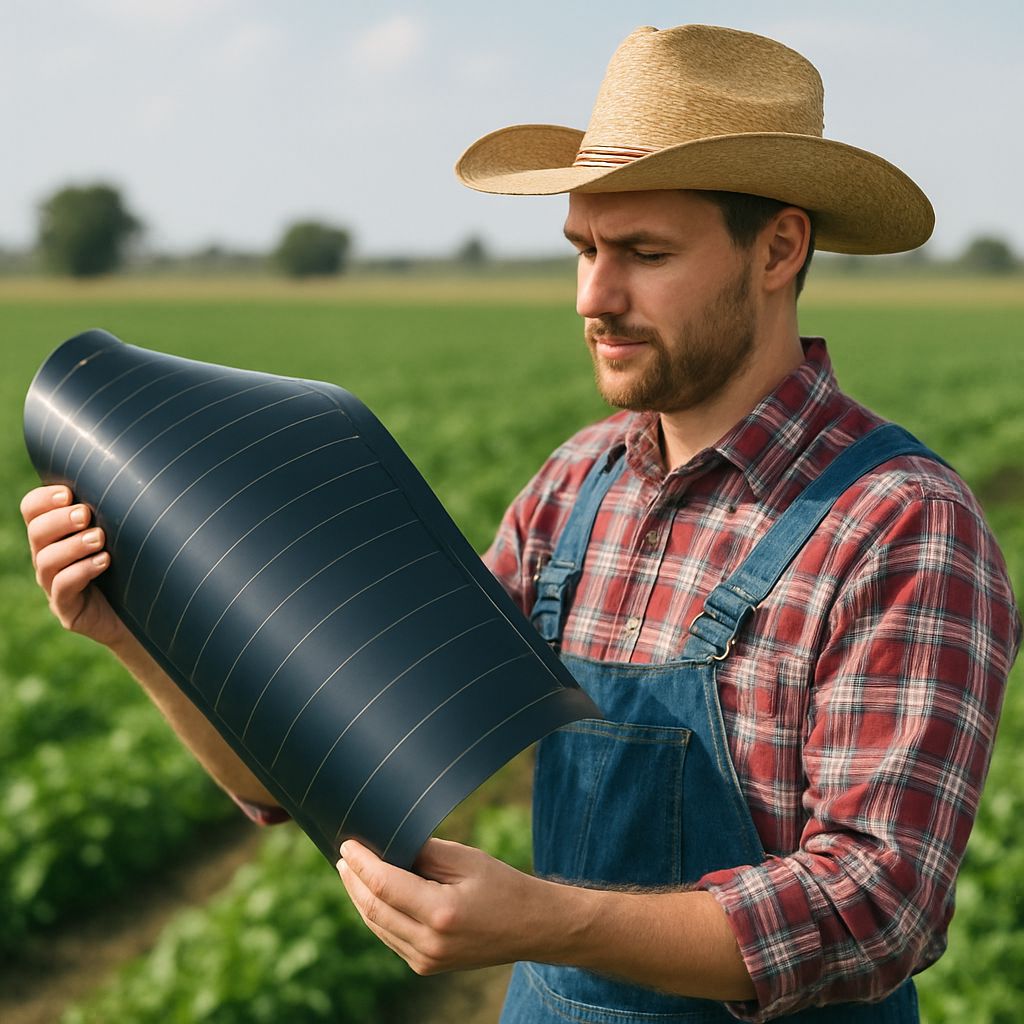
Thin-Film Solar Panels: Farmers Can Use These Flexible and Lightweight Panels
Thin-film panels are made by depositing one or more layers of photovoltaic material — typically cadmium telluride (CdTe), amorphous silicon (a-Si), or copper indium gallium selenide (CIGS) — onto a substrate like glass, plastic, or metal. The result is a panel that’s significantly lighter and more flexible than traditional crystalline silicon panels. That physical flexibility isn’t just a manufacturing detail — it’s the reason thin-film opens up installation options that polycrystalline simply can’t match on a working farm.
Why Thin-Film Panels Work Well on Curved and Weak Roof Structures
Older farm buildings — hay sheds, machinery workshops, curved-roof silos — are rarely built to support the structural load of standard rigid solar panels. A typical polycrystalline panel weighs between 18 and 25 kg, and a full rooftop array can add hundreds of kilograms of dead load to a structure that was never engineered for it. Thin-film panels, by contrast, can weigh as little as 3–4 kg per square meter in flexible laminate form, making them a practical option for buildings where a structural upgrade would otherwise be required before any solar installation could proceed.
Beyond weight, thin-film panels can conform to curved or irregular surfaces. Corrugated iron roofing, curved barn ceilings, and sloped structures that would force awkward racking solutions with rigid panels become straightforward installations with flexible thin-film laminates. This directly reduces labour and mounting hardware costs in scenarios where the roof geometry works against conventional panel design.
The Real Cost of Thin-Film: Cheaper to Install, But More Space Required
Thin-film panels cost less per watt to manufacture and are generally cheaper on a per-panel basis, but that lower upfront number can be misleading. Because efficiency sits between 10–13%, you need roughly 40–60% more surface area to generate the same total output as a polycrystalline array. On a farm with unlimited roof space or open ground, that trade-off can work in your favour. On a property with limited usable area, the space penalty quickly erodes the cost advantage.
Thin-Film Panels Thrive Where Traditional Panels Struggle
In diffuse light conditions — overcast skies, early morning, and late afternoon — thin-film panels maintain a higher proportion of their rated output compared to polycrystalline panels. This is particularly relevant for farms in temperate or coastal climates where clear sunny days are the exception rather than the rule. A thin-film array in cloudy coastal farmland can outperform a similarly rated polycrystalline system on total annual energy generation, simply because it loses less output during the low-light hours that dominate those environments.
Heat performance is another area where thin-film has a measurable edge. All solar panels lose efficiency as temperature rises, a factor measured by the temperature coefficient. Thin-film panels typically carry a lower temperature coefficient than polycrystalline, meaning they shed less output on hot summer days — exactly when farm energy demand from irrigation pumps and cooling systems tends to peak.
Polycrystalline Panels: For Farmers with Large Installations but on a Budget
Polycrystalline panels are made from multiple silicon crystals melted together and cast into ingots, then sliced into wafers. The manufacturing process is less energy-intensive than monocrystalline production, which keeps costs lower while still delivering solid efficiency. That combination of reasonable cost and reliable output is why polycrystalline panels dominate large-scale agricultural solar installations globally.
For farmers looking at reducing overall energy costs across high-demand operations, polycrystalline panels deliver a proven return on investment at scale. The efficiency advantage over thin-film means fewer panels, less racking hardware, and a smaller physical footprint — all of which matter when you’re sizing a system to power grain dryers, irrigation pumps, or refrigerated storage.
How Polycrystalline Panels Are Made and Why It Matters for Durability
The multi-crystal silicon structure gives polycrystalline panels a characteristic blue speckled appearance and a robust, well-understood degradation profile. Most manufacturers rate polycrystalline panels with an annual degradation rate of approximately 0.5–0.7% per year, and standard product warranties run 10–12 years with performance warranties covering 25 years at 80% rated output. That long-term stability is a significant factor for farm investment planning, where energy infrastructure decisions are made on decade-long horizons. For more information on polycrystalline solar panels and their benefits for agricultural use, check out this detailed comparison.
Efficiency Range and What It Means for Your Available Roof or Land Space
With efficiency ratings between 13–17%, polycrystalline panels produce significantly more power per square meter than thin-film alternatives. On a large flat barn roof or an open ground-mounted array in a paddock, this efficiency advantage compounds quickly. A 100 kW polycrystalline system will occupy roughly 600–650 square meters of panel surface, while a thin-film system of equivalent output could require 900 square meters or more. For farms where land and roof area are not unlimited, that difference is decisive.
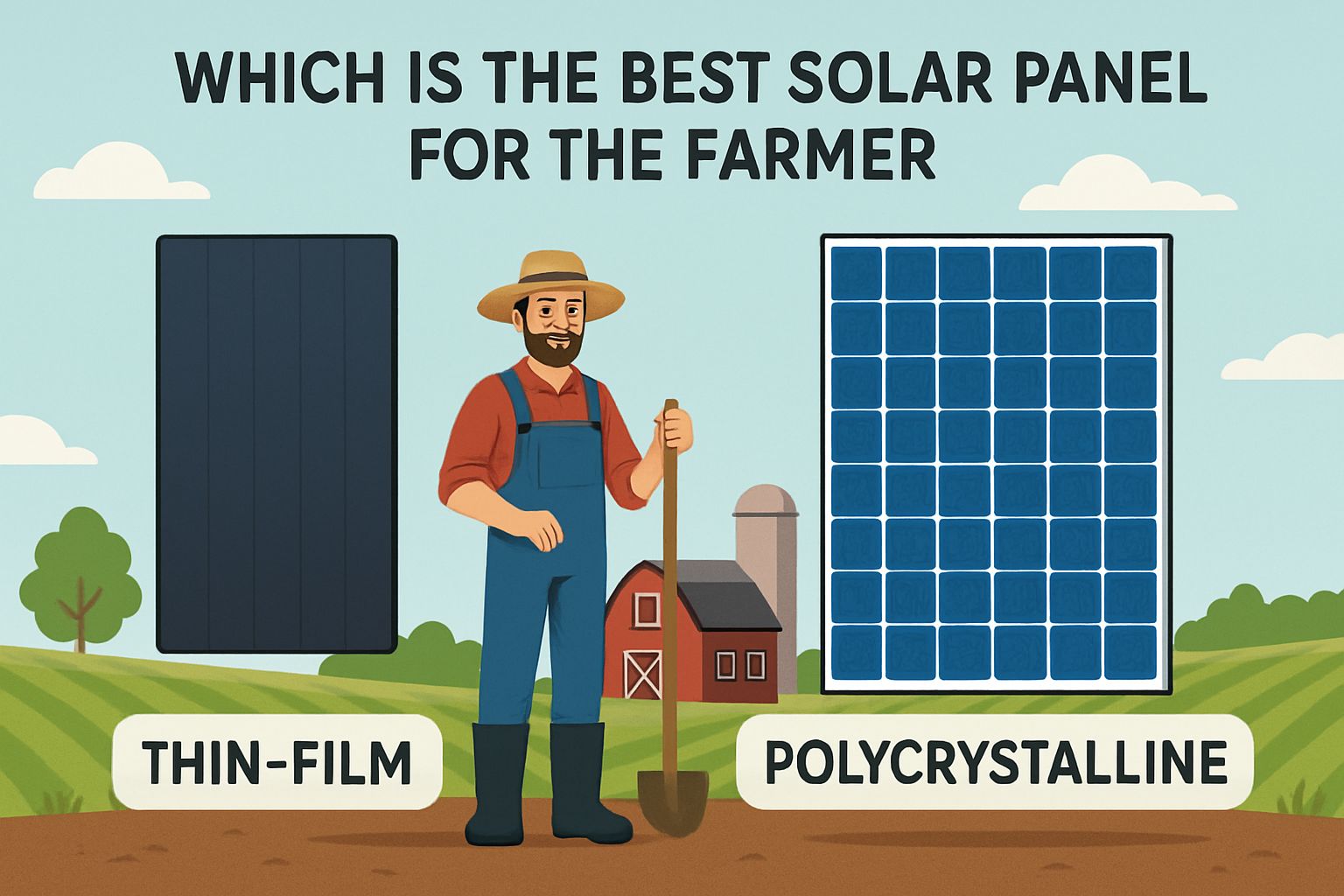
“vs Polycrystalline Solar Panels …” from growingsolarmist.com and used with no modifications.
Head-to-Head: Thin-Film vs Polycrystalline Solar Panels Compared
Side-by-side, the differences between these two panel types come into sharp focus across the metrics that matter most on a working farm. Efficiency, cost, durability, heat tolerance, and physical weight all tell different stories depending on which technology you’re evaluating — and each of those factors carries different weight depending on your specific farm setup.
The table below captures the core comparison points so you can map each factor directly to your own situation before committing to a system design.
|
Feature |
Thin-Film |
Polycrystalline |
|---|---|---|
|
Efficiency |
10–13% |
13–17% |
|
Cost Per Watt |
Lower upfront |
Moderate, better long-term value |
|
Weight |
3–4 kg/m² (flexible) |
18–25 kg per panel |
|
Flexibility |
Can conform to curved surfaces |
Rigid, requires flat mounting |
|
Heat Performance |
Lower temperature coefficient |
Higher temperature coefficient |
|
Shade Tolerance |
Better in diffuse light |
Drops more in partial shade |
|
Lifespan |
10–20 years typical |
25+ years with warranty |
|
Space Required |
40–60% more than polycrystalline |
Compact, high output density |
Efficiency
Efficiency is the single most important number when you’re working with limited roof or ground space. Polycrystalline panels convert 15–17% of incoming sunlight into usable electricity, while thin-film sits at 10–13%. That 4–7 percentage point gap translates directly into how many panels you need and how much mounting hardware, wiring, and labour your installation requires.
On a practical level, if you’re powering a 50 kW irrigation system from a barn roof with 400 square meters of usable space, polycrystalline panels can likely meet that load. Thin-film may fall short on the same roof — or require you to expand onto ground mounts to compensate. Efficiency isn’t just a spec sheet number; it determines whether your available space can actually meet your energy target.
Cost Per Watt and Installation Expense
Thin-film panels typically carry a lower cost per watt at the point of purchase, but total installed cost is a more accurate measure for farm budgeting. Because thin-film requires 40–60% more surface area to match polycrystalline output, the savings on the panels themselves are often offset by additional racking, wiring runs, and labour. Polycrystalline panels have a higher per-panel price but deliver more watts per installation hour, which is why large-scale farm systems almost universally favour them on a cost-per-kilowatt-hour-generated basis over the system’s lifetime.
Lifespan and Warranty Differences
Polycrystalline panels carry a clear advantage here. Standard performance warranties run 25 years at 80% rated output, with annual degradation rates of approximately 0.5–0.7%. Thin-film panels typically degrade faster — particularly amorphous silicon variants — with effective lifespans of 10–20 years depending on the specific technology and manufacturer. For a farm making a capital investment in solar infrastructure, that 5–15 year lifespan gap is a significant factor in the total return on investment calculation. Learn more about thin-film vs polycrystalline solar panels and their suitability for agricultural use.
Heat and Shade Performance on Working Farms
Temperature coefficient is the percentage of output a panel loses for every degree Celsius above 25°C. Thin-film panels typically carry a temperature coefficient of around -0.2% per °C, compared to -0.4% to -0.45% per °C for most polycrystalline panels. On a 40°C summer day — common across inland farming regions — that difference means thin-film panels are generating noticeably more power during the exact hours when irrigation pumps and grain handling equipment are running at full load.
Shade performance follows a similar pattern. Polycrystalline panels use series-wired cells, meaning partial shading of even one cell can reduce output across the entire string. Thin-film panels handle partial shading more gracefully due to their monolithic cell structure. On farms where trees, buildings, or equipment regularly cast moving shadows across part of an array, thin-film’s shade tolerance can recover meaningful amounts of daily generation that would otherwise be lost.
Weight and Structural Load on Farm Buildings
A standard polycrystalline panel weighs between 18–25 kg. A 100 kW rooftop array using polycrystalline panels could add 3,500–5,000 kg of dead load to a roof structure before accounting for racking and fixings. Many older farm sheds, grain stores, and machinery buildings were not designed with that load in mind. Flexible thin-film laminates at 3–4 kg per square meter can reduce total roof load by 70–80% compared to an equivalent rigid panel installation, making them the only viable rooftop option on buildings where a structural assessment rules out conventional panels.
Where Polycrystalline Panels Perform Best on a Farm
Polycrystalline panels perform best on farms with large, flat, unshaded roof surfaces or open ground-mount areas — think modern steel-frame sheds, purpose-built grain storage facilities, or dedicated solar paddocks. Dairy operations running continuous refrigeration, poultry farms with high ventilation loads, and cropping operations with large irrigation pump requirements all benefit from polycrystalline’s high output density. When you have the space and the structural capacity, polycrystalline delivers more kilowatt-hours per dollar invested over the life of the system than thin-film can match.
Space vs Flexibility: The Key Trade-Off Farmers Must Consider
Every farm solar decision eventually comes back to this question: do you have the space and structure to maximise polycrystalline’s efficiency advantage, or do your buildings and land conditions make thin-film’s flexibility worth the output trade-off? Neither panel type is universally better. The right answer is determined entirely by your specific farm’s physical reality — roof condition, available ground area, shading profile, and peak energy demand timing all feed into that calculation.
High-Energy Farm Operations That Need Maximum Output Density
Grain dryers, large centre-pivot irrigation systems, cold storage facilities, and intensive poultry or pig sheds all share one characteristic: they consume large amounts of electricity in concentrated windows of time. For these operations, generating the maximum possible kilowatt-hours from the available installation footprint is the primary design goal. Polycrystalline panels, with their 15–17% efficiency and 25-year performance warranty, are purpose-built for this requirement. A well-designed polycrystalline ground-mount array on 1,000 square meters of flat paddock can deliver 150–170 kW of installed capacity — enough to run substantial irrigation loads during peak daylight hours.
Greenhouse and Agrivoltaic Applications Where Thin-Film Has the Edge
Agrivoltaic systems — where solar panels and crop production share the same land area — are one of the fastest-growing applications of solar in agriculture. In these installations, the amount of light that passes through or around the panels directly affects crop yields underneath. Thin-film panels, particularly semi-transparent CIGS variants, can be engineered to transmit a controlled percentage of sunlight while still generating electricity. This makes them uniquely suited to greenhouse roofs and agrivoltaic canopies where rigid opaque polycrystalline panels would block too much light and suppress crop production.
The practical application extends beyond purpose-built greenhouses. Shade-tolerant crops like leafy greens, herbs, and some berry varieties have demonstrated maintained or improved yields when grown under thin-film agrivoltaic canopies that reduce peak heat stress while still allowing sufficient diffuse light penetration. Researchers have documented successful agrivoltaic trials combining thin-film panel arrays with crops including lettuce, spinach, and silage grass, with dual land-use efficiency gains measured against conventional single-use farmland.
- Semi-transparent CIGS thin-film panels can be tuned to transmit 10–40% of incoming light, allowing crop production underneath
- Greenhouse roof installations benefit from thin-film’s lightweight laminate format, which avoids structural reinforcement costs on existing glasshouse frames
- Shade-tolerant crops including leafy greens, herbs, and some berry varieties are the best candidates for under-panel production
- Agrivoltaic canopy systems using thin-film panels can reduce soil moisture evaporation by up to 30%, lowering irrigation demand in arid farming regions
- Dual land-use efficiency is the core economic argument — the same land generates both electricity revenue and crop yield simultaneously
For farmers exploring agrivoltaic design, the choice between thin-film and polycrystalline is less about cost-per-watt and more about the light transmission requirements of the specific crop system being integrated. Getting that light budget right is what determines whether the crop underneath thrives or struggles — and thin-film’s tuneable transparency is the reason it dominates this application.
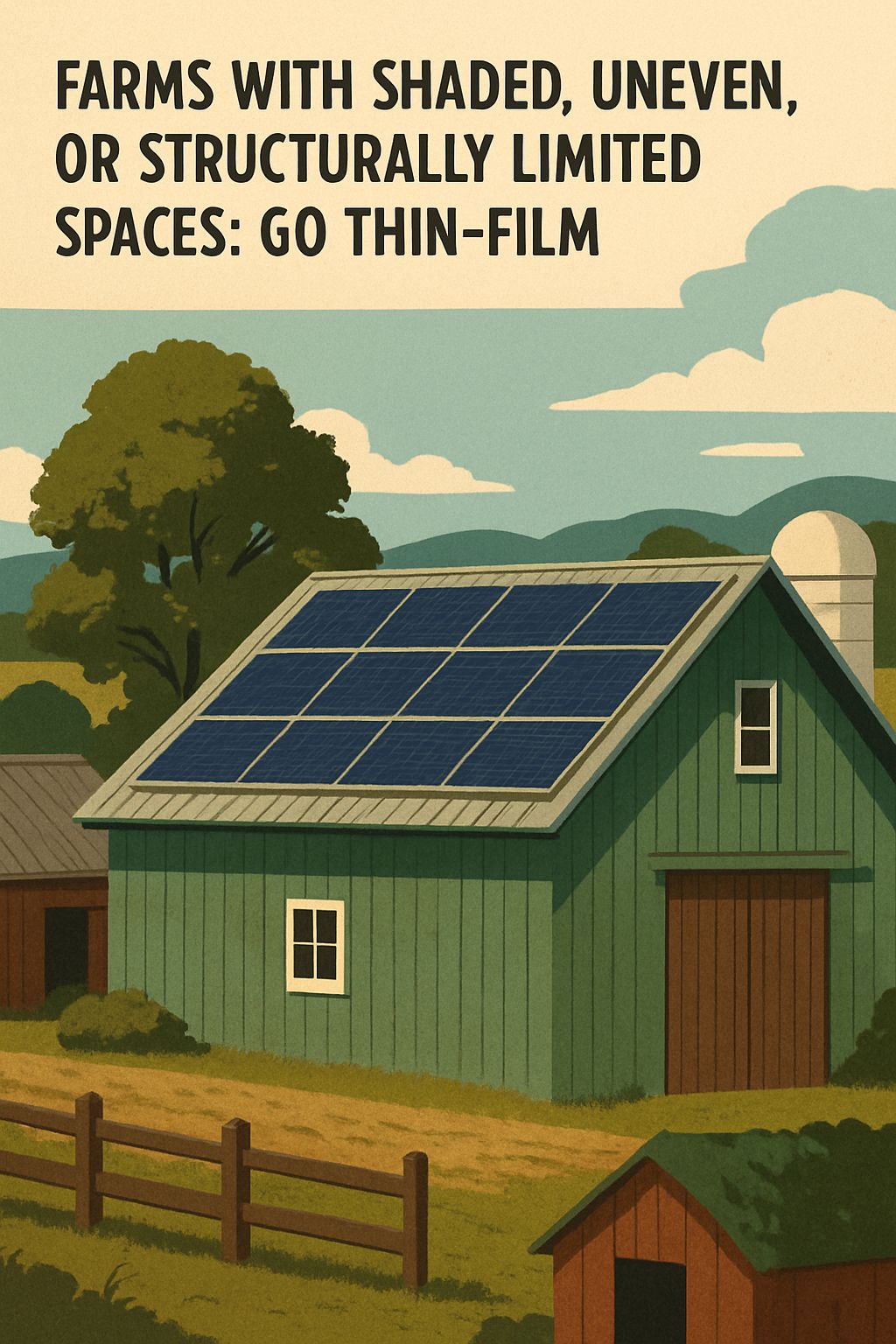
Farms With Shaded, Uneven, or Structurally Limited Spaces: Go Thin-Film
If your farm buildings are older, structurally marginal, or sit in a location where tree lines, hills, or neighbouring structures cast regular shadow across your roof, thin-film is the panel technology designed for exactly that situation. The combination of low weight, shade tolerance, and diffuse-light performance makes thin-film the practical answer when polycrystalline’s efficiency advantage simply cannot be realised due to physical constraints.
- Older corrugated iron sheds that cannot support 18–25 kg panels without structural reinforcement are ideal candidates for flexible thin-film laminates
- North-facing slopes with partial tree shading favour thin-film’s monolithic cell structure, which avoids the string-loss effect that hammers polycrystalline output under moving shade
- Curved silo roofs and round-top machinery shelters are installations where rigid panels physically cannot conform to the surface without custom racking that adds significant cost
- Coastal and high-rainfall farming regions with frequent overcast conditions see thin-film’s diffuse-light advantage translate into meaningfully higher annual generation totals
- Mixed-use farm buildings where roof access is frequent and panel weight creates safety concerns benefit from thin-film’s dramatically lower structural footprint
The structural load issue is one that many farmers only discover after receiving a negative engineering assessment on their existing shed roof. Adding a full polycrystalline array to an older farm building often triggers a requirement for additional purlins, reinforced rafters, or complete re-roofing before installation can proceed — costs that can run into tens of thousands of dollars before a single panel goes up. Thin-film laminates can frequently be bonded directly to existing roof sheeting without any structural modification, which fundamentally changes the economics of the project.
Shade management is the other deciding factor. On a polycrystalline string system, a shadow covering 10% of one panel’s surface can reduce output from the entire string by 30–50% depending on system configuration. Thin-film panels, with their integrated cell layout, contain shade impact to the affected area rather than cascading it across the whole array. For farms where complete shade elimination is not possible — and on most working properties, it isn’t — that contained shade response recovers real kilowatt-hours every single day.
The decision framework is straightforward: if you can provide flat, unshaded, structurally sound surface area in sufficient quantity, polycrystalline is almost certainly your best investment. If any one of those three conditions — flat, unshaded, structurally sound — cannot be met, thin-film becomes the primary option worth costing.
Budget-First Farmers: What the Numbers Actually Say
When budget is the dominant constraint, the comparison between thin-film and polycrystalline requires looking beyond the sticker price on the panels themselves. Thin-film panels carry a lower upfront cost per panel, but generating 50 kW of capacity with 10–13% efficient panels requires significantly more panels, more mounting hardware, more wiring, and more installation labour than achieving the same 50 kW with 15–17% efficient polycrystalline panels. In most large-scale farm installations, polycrystalline delivers a lower total installed cost per kilowatt of capacity — and a better cost-per-kilowatt-hour figure across the system’s 25-year life.
The exception is when thin-film’s installation advantages eliminate costs that would otherwise be unavoidable. If thin-film allows you to avoid a $20,000 structural upgrade on a shed roof, or bypass the need for ground-mount racking by bonding directly to an existing surface, those avoided costs can tip the total project budget firmly in thin-film’s favour. Budget decisions should always be made on total installed cost and lifetime energy value — not panel price alone. For more information on the benefits of these panels, you can read about flexible lightweight thin-film solar panels.
Polycrystalline Is the Default Choice for Most Farms — With One Clear Exception
For the majority of farms — those with modern steel-frame buildings, open flat ground available for mounting, and energy loads that demand maximum output density — polycrystalline solar panels are the logical starting point. The efficiency advantage, the 25-year performance warranty, the well-established degradation profile, and the lower lifetime cost per kilowatt-hour generated make polycrystalline the dominant choice in agricultural solar for good reason. The single clear exception is any installation scenario where the surface is curved, the structure is weight-limited, the shading is unavoidable, or the application is agrivoltaic — in those cases, thin-film is not a compromise, it is the correct engineering choice.
Frequently Asked Questions
Farmers evaluating solar panel types for the first time tend to circle back to the same practical questions once the technical comparison is on the table. The answers below address the most common decision points directly, without the generalised advice that tends to dominate solar marketing material.
Understanding these distinctions before engaging a solar installer puts you in a much stronger position to assess quotes, push back on inappropriate recommendations, and ensure the system design actually matches your farm’s physical reality and energy profile.
These questions are framed around real farm scenarios — because the right answer for a 2,000-hectare cropping operation powering large centre-pivot irrigation is genuinely different from the right answer for a small mixed farm with a 1970s machinery shed and a coastal climate.
What sets thin-film and polycrystalline panels apart?
Thin-film panels are made by depositing photovoltaic material in ultra-thin layers onto a substrate like glass, metal, or plastic. Polycrystalline panels are made from multiple silicon crystals fused together, sliced into wafers, and assembled into rigid panel frames. The manufacturing difference produces two fundamentally different products: thin-film is lightweight, flexible, and performs better in low-light and high-heat conditions; polycrystalline is heavier, rigid, more efficient per square meter, and carries a longer proven lifespan.
For farmers, the practical distinction comes down to where and how you can install them. Polycrystalline panels require structurally sound, predominantly flat surfaces and minimal shading for best performance. Thin-film panels tolerate curved surfaces, lighter structures, partial shade, and diffuse light conditions — trading output density for installation versatility.
How do weather conditions impact thin-film vs polycrystalline panels?
Thin-film panels handle adverse weather conditions more gracefully than polycrystalline across two key dimensions: heat and cloud cover. The lower temperature coefficient of thin-film panels — typically around -0.2% per °C compared to -0.4% to -0.45% per °C for polycrystalline — means they shed significantly less output on hot days. In overcast or diffuse light conditions, thin-film also maintains a higher proportion of its rated output, making it better suited to temperate, coastal, and high-rainfall farming regions where full direct sunlight is not the daily norm.
Which panel type is more cost-efficient in the long term for farmers?
Polycrystalline panels deliver better long-term cost efficiency in most farm installations, primarily because their higher efficiency means fewer panels are needed to generate the same output, and their 25-year performance warranty provides a reliable energy cost baseline over the system’s full operational life. Thin-film’s lower upfront panel cost is generally offset by the larger array footprint required, and the shorter effective lifespan of some thin-film technologies — particularly amorphous silicon — means replacement costs arrive sooner. The exception is installations where thin-film’s physical advantages eliminate otherwise unavoidable structural or racking costs, which can shift the lifetime cost equation in its favour.
Can thin-film panels power high-demand farm equipment like grain dryers?
- Grain dryers typically require 15–75 kW of continuous electrical load depending on capacity and throughput rate
- Thin-film panels at 10–13% efficiency can technically generate sufficient power, but require a substantially larger array footprint than polycrystalline to do so
- Space availability is the limiting factor — generating 50 kW from thin-film panels requires approximately 385–500 square meters of panel surface versus 295–335 square meters for polycrystalline
- Battery storage integration is often required regardless of panel type, since grain dryers typically run during harvest periods that may include night operations
Thin-film panels can absolutely power a grain dryer — the technology is not the limiting factor. The question is whether your property has sufficient suitable surface area to mount the larger array that thin-film’s lower efficiency demands. On properties with unlimited flat ground and the budget for a large ground-mount system, thin-film’s heat performance advantage during summer harvest periods can actually work in its favour, recovering output during the hottest parts of the day when polycrystalline panels are losing efficiency to temperature.
For most grain operations, polycrystalline remains the more practical choice for high-demand loads. The output density advantage means you can meet a 50–75 kW grain dryer load from a single large shed roof rather than requiring additional ground-mount infrastructure. When the grain dryer and irrigation pumps are both running simultaneously during a summer harvest — exactly the scenario where your solar system needs to perform at its peak — polycrystalline’s larger installed capacity from a smaller footprint tends to deliver more reliable coverage of that combined load.
The design decision should be based on a proper load analysis timed against your harvest calendar, your available installation surfaces, and your peak summer generation profile. A system sized purely on annual averages will consistently underperform during the high-demand harvest windows that matter most to your operation’s bottom line.
Are there government incentives that apply to both panel types for farmers?
In most markets where agricultural solar incentives exist, the support mechanisms are technology-neutral — meaning they apply based on installed capacity and energy generation rather than panel type. Australia’s Small-scale Renewable Energy Scheme (SRES) and Large-scale Renewable Energy Target (LRET) both operate on a certificate-based system tied to kilowatt-hours generated, not to whether those kilowatt-hours come from thin-film or polycrystalline panels. The same principle applies to investment tax credits and accelerated depreciation schemes available in other agricultural markets.
The practical implication is that the incentive value of your solar installation is determined by total system output, not panel technology. Because polycrystalline panels generate more kilowatt-hours from the same installation footprint, a polycrystalline system will typically generate more renewable energy certificates or qualify for a higher incentive value than an equivalently sized thin-film installation — simply because it produces more electricity. Thin-film systems that require larger arrays to match polycrystalline output can potentially qualify for equivalent incentive values, but the larger installation cost must be factored against that outcome.
Always verify current incentive programs with your national or state agricultural energy authority before finalising a system design, as program structures, caps, and eligibility criteria change regularly. The best solar installer for a farm project is one who actively incorporates available incentive structures into the system sizing and financial modelling — not one who presents the technology comparison in isolation from the funding landscape that significantly affects your actual payback period.
Growing Solar Mist provides practical, farmer-focused solar guidance to help agricultural operations make smarter energy decisions — explore their full thin-film vs polycrystalline comparison to find the right panel type for your specific farm setup.







Leave a Reply