
Article-at-a-Glance
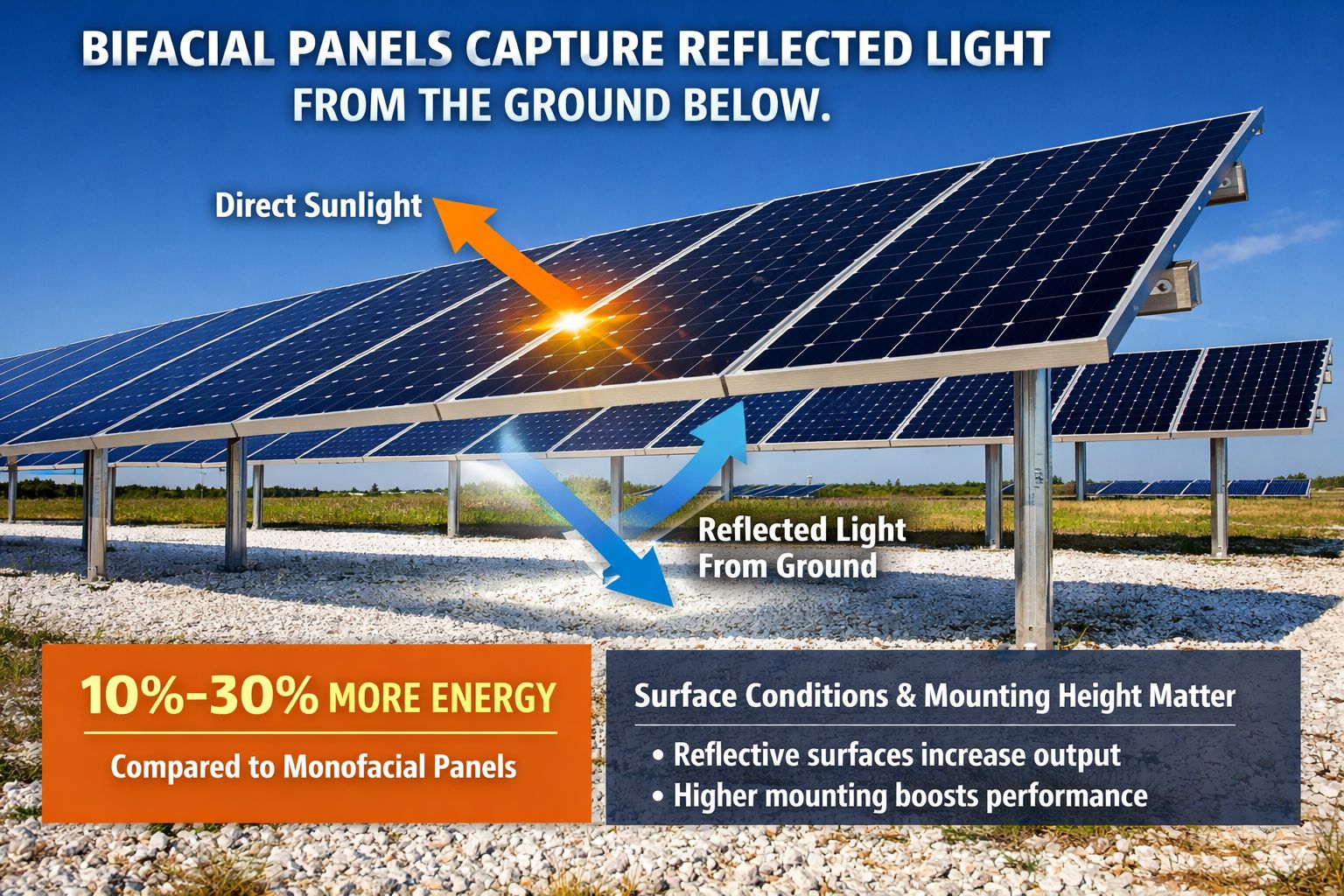
- Bifacial panels capture reflected light from the ground beneath them, producing 10% to 30% more energy than monofacial panels depending on surface conditions and mounting height.
- Ground surface color and reflectivity, known as albedo, is the single biggest factor determining how much bonus energy a bifacial system generates.
- Monocrystalline silicon with glass-glass construction dominates bifacial panel design, offering conversion efficiencies between 20% and 23%.
- Farms using agrivoltaic setups with elevated bifacial arrays can grow shade-tolerant crops or graze livestock while generating power from the same acreage.
- Mounting height plays a surprisingly large role in performance, with gains climbing significantly once panels are raised from 0.5 meters to 1.5 meters or higher.
Solar technology has quietly split into two camps: panels that only collect light on one side, and panels that collect it on both. That second group, bifacial solar panels, has been gaining ground fast among farmers, utility developers, and homeowners looking to squeeze more power out of the same rooftop or field. The appeal isn’t complicated once you understand the mechanics, but the details around ground surfaces, mounting heights, and panel materials make a real difference in whether bifacial technology pays off for your specific situation. Resources like Growing Solar Mist have been tracking these performance variables closely, particularly as agrivoltaic installations become more common on working farms.
This article breaks down exactly how bifacial panels work, what they’re made of, and where they perform best. You’ll find specific percentage gains tied to different ground surfaces, mounting heights that maximize output, and a rundown of which crops thrive underneath elevated solar arrays. Whether you’re sizing up a farm installation or just curious why bifacial panels cost more upfront, the numbers here come straight from field data and engineering benchmarks rather than guesswork.
What Makes Bifacial Panels Different From Standard Solar Panels
A standard solar panel only has one job: absorb sunlight hitting its front face and convert it into electricity. Everything behind that panel, including whatever light bounces off the ground, goes to waste. Bifacial panels flip that equation by adding a second layer of photovoltaic cells on the rear side, allowing them to harvest reflected and ambient light that would otherwise never get used.
This isn’t a minor tweak. It changes how engineers think about site selection, racking height, and even what kind of ground cover to install beneath an array. The rear-side gain depends on several interacting factors, but the core concept stays simple: more light hitting active cells means more electricity produced per panel.
Dual-Sided Energy Capture Explained
Light reaches the back of a bifacial panel in a few different ways. Some of it reflects directly off the ground surface below. Some comes from ambient sky radiation scattering in all directions, which is why bifacial panels still outperform monofacial ones even on cloudy days. And in elevated installations, light can bounce off nearby surfaces like white gravel paths or reflective roofing before reaching the rear cells.
- Direct reflection off the ground surface beneath the panel
- Diffuse ambient light scattered through the atmosphere, especially relevant in cloudy or overcast climates
- Secondary reflections off nearby structures, pavement, or reflective ground treatments
Each of these light sources adds up, and the combined effect is what engineers call “bifacial gain.” Depending on conditions, that gain can be the difference between a mediocre system and an exceptional one.
10% to 30% More Power Than Monofacial Panels
The headline number most people cite with bifacial technology is a 10% to 30% energy boost over standard monofacial panels. That’s a wide range, and for good reason: bifacial gain isn’t a fixed property of the panel itself. It’s a product of ground reflectivity, mounting height, panel tilt, and even the season.
- Lower latitude installations typically see bifacial gains up to 12%
- Higher latitude installations can see substantially higher gains due to more favorable sun angles creating better reflection geometry
- Raising panel height from 0.5 meters to 1.5 meters above grade can add another 5 to 10 percentage points of gain
In other words, the panel’s rated output on a spec sheet only tells part of the story. Real-world gain depends heavily on how and where the system gets installed.
Why a 100 kW Bifacial Array Can Outperform a 120 kW Monofacial Array
Here’s a practical way to picture the impact. A 100 kW ground-mounted bifacial array operating at a 20% bifacial gain produces output equivalent to a 120 kW standard monofacial array, without adding a single extra panel to the footprint. That’s a meaningful distinction for anyone working with limited land or roof space, since bifacial technology effectively lets you generate more power without expanding your physical installation area.
This matters most for agricultural operations and commercial sites where land use is already a constraint. Instead of needing 20% more panels to hit a target output, a well-placed bifacial system can close that gap using the same number of modules, provided the ground surface and mounting height are optimized to support strong rear-side performance.
What’s Inside a Bifacial Solar Panel
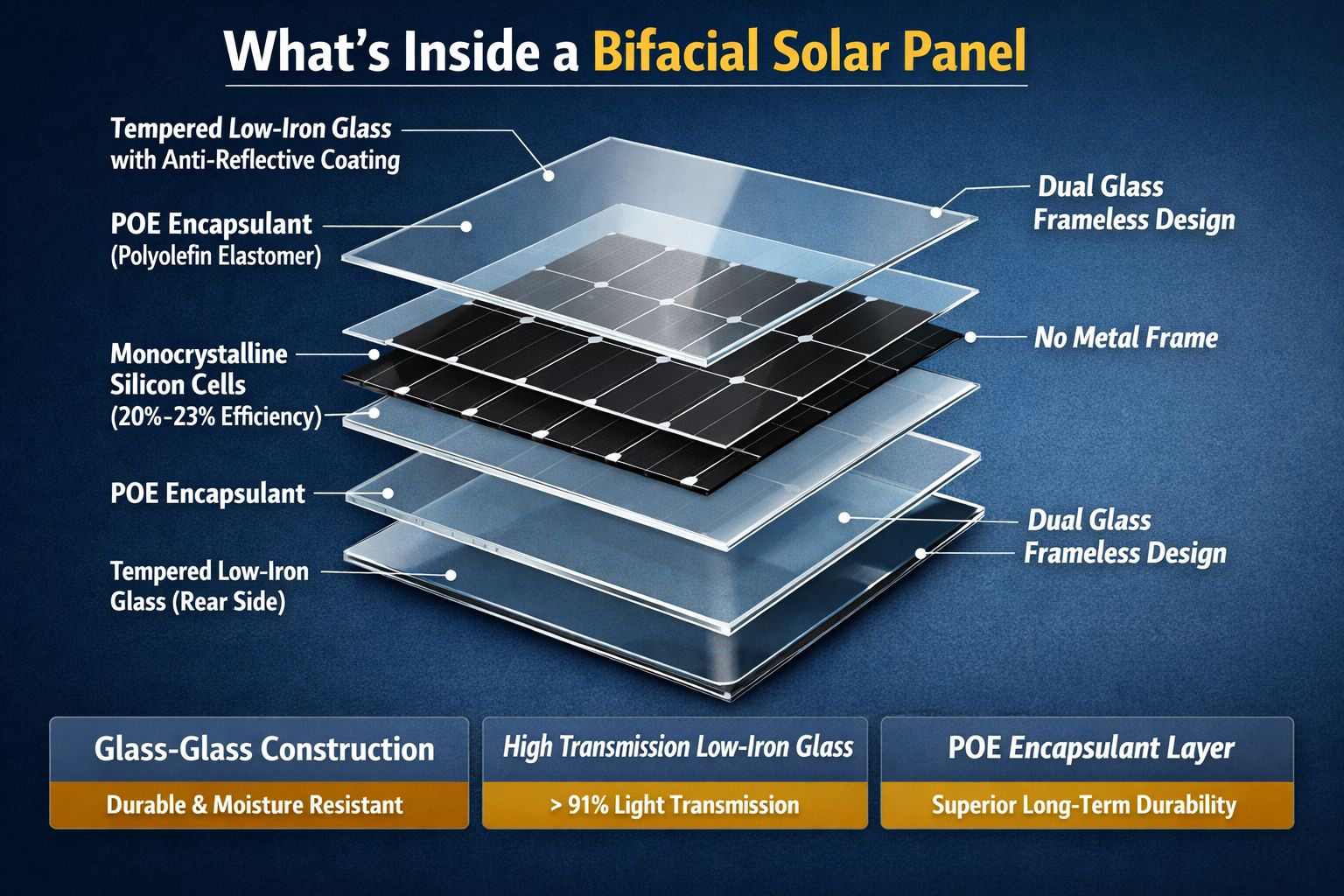
Opening up a bifacial panel reveals construction choices that differ meaningfully from standard monofacial modules. Every material decision, from the type of silicon used to the glass thickness, affects how much rear-side light actually converts into usable electricity.
Monocrystalline Silicon Cells and Efficiency Rates of 20% to 23%
Bifacial panels use monocrystalline silicon almost exclusively, and that’s not a coincidence. Monocrystalline cells deliver conversion efficiency typically between 20% and 23%, outperforming polycrystalline alternatives in nearly every bifacial application. Polycrystalline cells are rarely used in bifacial configurations today because their grain boundaries scatter electrons more aggressively, which hurts efficiency gains on the rear side where light intensity is already weaker than the front.
|
Cell Type |
Typical Efficiency |
Bifacial Suitability |
|---|---|---|
|
Monocrystalline Silicon |
20% to 23% |
Dominant choice for bifacial design |
|
Polycrystalline Silicon |
Lower than monocrystalline |
Rarely used due to grain boundary scattering |
Glass-Glass Construction vs Glass-Backsheet Designs
Most agricultural and ground-mount bifacial installations use glass-glass construction, with tempered glass panels typically ranging from 2mm to 3.2mm per side. This design holds up better against moisture, flexing, and long-term UV exposure compared to glass-transparent backsheet alternatives. Glass-backsheet configurations do exist and offer a lighter, slightly cheaper option, but they trade away some durability and tend to degrade faster under sustained UV exposure.
Low-Iron Glass and Anti-Reflective Coatings
Not all glass is created equal when it comes to letting light through. Low-iron glass transmits over 91% of light, compared to roughly 86% for standard glass, which translates directly into better performance on both the front and rear sides of the panel. Anti-reflective coatings push this even further, cutting surface reflection from around 4% down to less than 1%, meaning more of the incoming light actually reaches the silicon cells instead of bouncing away unused.
Why POE Encapsulants Are Replacing EVA
Between the glass layers and silicon cells sits an encapsulant material, and manufacturers are increasingly shifting from EVA (ethylene vinyl acetate) toward POE (polyolefin elastomer). The reason comes down to durability. POE offers better resistance to potential-induced degradation, a slow efficiency loss that can creep into panels over years of operation, particularly in humid or high-voltage system conditions. For more on material composition, check out bifacial solar panels.
This shift matters more for bifacial panels than standard ones, since any degradation affecting the rear cells cuts directly into the extra energy gain that justified the higher price tag in the first place.
Frameless Designs That Prevent Edge Shadowing
Many bifacial panels skip the traditional metal frame entirely. That’s a deliberate design choice, not a cost-cutting shortcut. Frames create edge shading that blocks reflected light from reaching rear cells near the panel’s border, quietly reducing the bifacial gain the whole system was designed to capture.
- Frameless panels allow light to reach rear cells uninterrupted along the edges
- Dual-glass frameless construction also improves resistance to wind loads and flexing stress
- Removing the frame slightly reduces weight, simplifying some mounting configurations
The tradeoff is that frameless panels require more careful handling during installation, since there’s no metal edge protecting the glass from impact damage.
Ground Albedo Determines Your Energy Bonus
If there’s one variable that determines whether your bifacial investment pays off big or barely moves the needle, it’s what’s sitting on the ground underneath the panels. Albedo, the measure of how much sunlight a surface reflects, swings bifacial gain anywhere from a modest 2% to a dramatic 30%.
White Gravel and Reflective Membranes Deliver 25% to 30% Gain
White gravel and reflective membranes sit at the top of the albedo chart, pushing bifacial gain into the 25% to 30% range. This is why some installers intentionally spread white gravel or crushed limestone beneath ground-mount arrays. It’s a relatively low-cost modification, and it tends to pay for itself through the extra energy harvested over the system’s operational lifespan.
Reflective membranes work similarly on commercial rooftops, where installers sometimes choose white or light-colored roofing materials specifically to boost rear-side output on bifacial systems.
Concrete and Light Pavement Surfaces
Concrete or light-colored pavement lands in the 18% to 25% bifacial gain range, making it a strong middle-tier option. This matters for commercial and industrial installations where parking lots, loading areas, or paved equipment yards sit beneath or near solar arrays.
|
Ground Surface |
Bifacial Gain Range |
|---|---|
|
White gravel / reflective membrane |
25% to 30% |
|
Concrete / light pavement |
18% to 25% |
|
Dry sandy soil |
15% to 20% |
|
Short grass / light ground cover |
12% to 18% |
|
Dark soil / dense vegetation |
10% to 12% |
Dry sandy soil, common across desert installations, achieves a respectable 15% to 20% gain on its own without any added ground treatment, which partly explains why bifacial technology has found such a strong foothold in arid regions.
Snow Cover Can Push Gains to 30%
Snow-covered ground carries an albedo value of 0.65 to 0.90, meaning it reflects up to 90% of incoming sunlight back toward the panel’s rear side, producing an estimated energy gain of up to 25% to 30% during winter months.
That’s a surprising twist for anyone who assumes solar panels only perform well in sunny, snow-free climates. In reality, a snow-covered field can turn into one of the best possible surfaces for bifacial gain, even as overall daylight hours shrink during winter. The high reflectivity more than compensates for shorter days in many northern installations.
This seasonal swing means bifacial systems installed in snowy regions often see their best rear-side performance concentrated in winter months, a pattern that doesn’t apply to standard monofacial panels at all.
Dark Soil and Dense Vegetation Limit Rear-Side Gains
On the opposite end of the spectrum, dark soil and dense vegetation produce the weakest bifacial gains, typically landing between 10% and 12%. Dark surfaces absorb light rather than bounce it back, which starves the rear cells of the reflected illumination they depend on. Farms or installations sitting on rich, dark topsoil or thick crop cover shouldn’t expect dramatic rear-side performance unless they modify the ground surface or raise mounting height to compensate. For more information on bifacial solar panels benefits, consider exploring additional resources.
This doesn’t mean bifacial panels are a bad choice on darker ground. It just means the premium paid for bifacial technology delivers a smaller return in these conditions, and site planners should factor that into cost projections before committing to the higher upfront investment.
How Mounting Height Changes Your Output
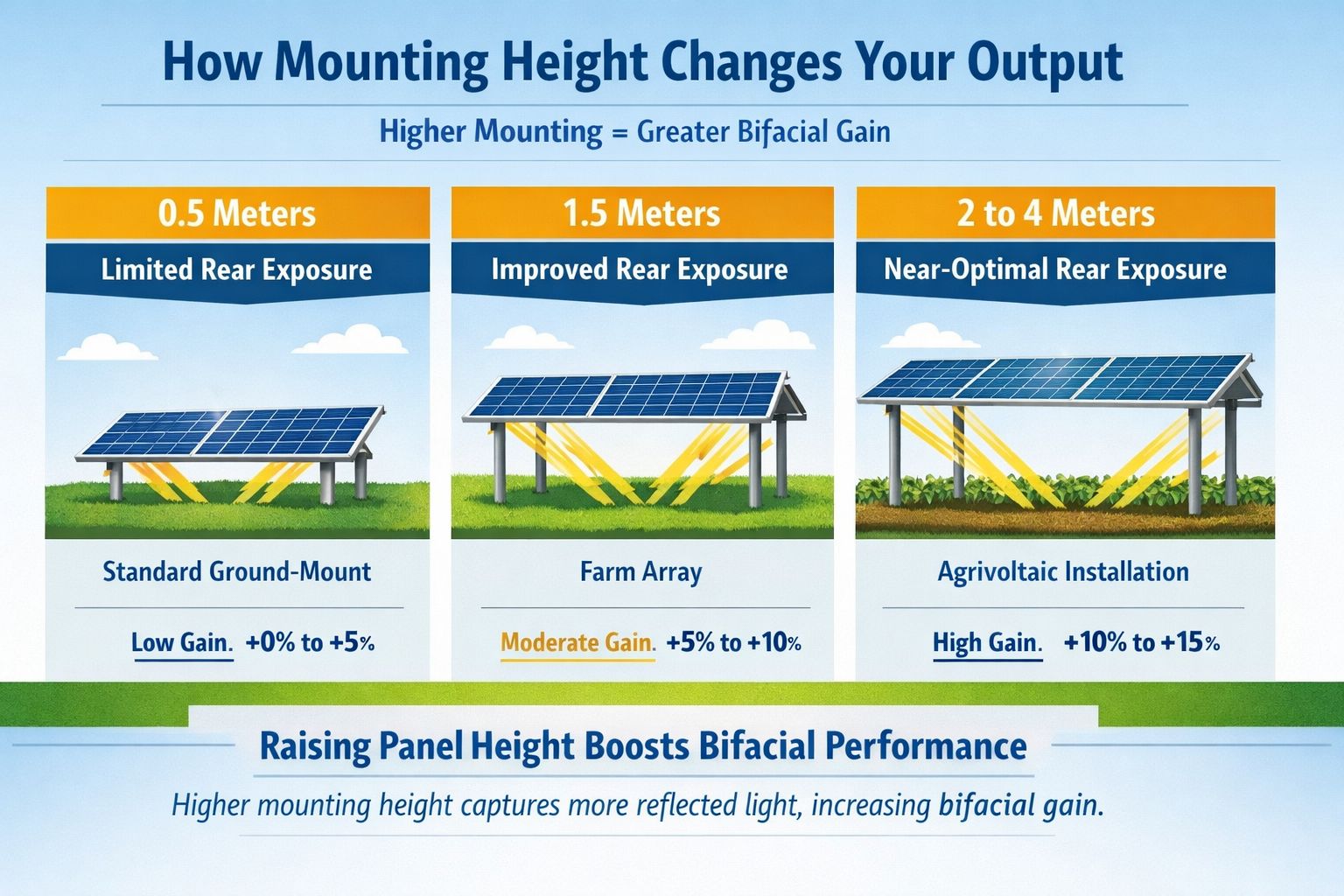
Ground surface sets the ceiling for bifacial gain, but mounting height determines how much of that potential actually gets captured. The higher a panel sits above the ground, the wider the angle of reflected light it can intercept, and the research on this relationship is remarkably consistent across different studies.
|
Mounting Height |
Rear-Side Exposure |
Typical Use Case |
|---|---|---|
|
0.5 meters |
Limited |
Standard ground-mount, minimal optimization |
|
1.5 meters |
Noticeably improved |
Common farm arrays |
|
2 to 4 meters |
Near-optimal |
Agrivoltaic installations |
That height-to-gain relationship isn’t just theoretical. Raising a panel from 0.5 meters to 1.5 meters above grade can add 5 to 10 percentage points of bifacial gain, a jump significant enough to change the economics of an entire project.
For rooftop installations, this same logic applies on a smaller scale. A bifacial system only makes financial sense on a roof if there’s at least a few inches of clearance between the rear glass and the roofing material, since flush-mounted bifacial panels have no room to capture reflected light at all.
Low Mounting at 0.5 Meters Limits Rear Exposure
At just half a meter off the ground, bifacial panels don’t have much room to work with. Reflected light arrives at a steep, narrow angle, and much of it misses the rear cells entirely. This height still delivers some bifacial benefit over a standard monofacial panel, but it’s far from the technology’s full potential.
Mid-Range Mounting at 1.5 Meters for Farm Arrays
A 1.5-meter mounting height has become something of a sweet spot for standard farm arrays that aren’t designed around crop access underneath. At this height, reflected light reaches the rear cells at a much more favorable angle, and the gain improvement over lower mounting is substantial enough to justify the added racking cost in most cases.
Many agricultural operations choose this height specifically because it balances performance gains against the practical limits of standard racking systems, which weren’t originally engineered with bifacial technology in mind.
High Mounting at 2 to 4 Meters for Agrivoltaic Systems
Agrivoltaic installations typically build mounting structures 2 to 4 meters above ground, and that height range happens to land near the sweet spot for maximizing bifacial energy capture. It’s not a coincidence. Farmers need that clearance for tractors, combines, and tall crops, and it turns out the same height requirement also delivers near-optimal rear-side light exposure for the panels above.
Bifacial Panels Last Longer and Degrade Slower
Energy output tells only half the story. The other half is how long a panel keeps producing that output before performance starts to slip, and bifacial panels have a genuine edge here too.
- Dual-glass construction resists wind loads and flexing stress better than standard single-glass monofacial panels
- Lower degradation rates mean bifacial panels retain more of their original output capacity over decades of operation
- Glass-glass designs resist moisture ingress far more effectively than polymer backsheets common in older panel designs
These durability advantages compound over time. A panel that degrades slower and withstands weather stress better doesn’t just produce more energy in year one. It keeps producing more energy relative to a standard panel in year ten, year twenty, and beyond.
For farm operations making a 25-year investment decision, that compounding advantage often matters more than the headline bifacial gain percentage advertised at the point of purchase.
Dual-Glass Construction Resists Wind and Flexing
Bifacial panels built with dual-glass construction handle wind loads noticeably better than standard monofacial panels with a single glass layer and polymer backsheet. The symmetrical structure distributes stress more evenly across the panel face, making it more resilient during high-wind events and reducing the risk of micro-cracking that can quietly reduce output over time.
Lower Degradation Rates Over 25-Plus Years
The degradation rate of bifacial panels runs lower than that of monofacial panels, largely because the dual-glass construction minimizes the environmental factors that typically chip away at cell efficiency year after year. Moisture, UV exposure, and thermal cycling all take a toll on solar panels over their operational lifespan, and bifacial construction happens to defend against several of these stressors simultaneously.
Over a 25-year system life, even a small difference in annual degradation rate adds up to a meaningful gap in cumulative energy production between bifacial and monofacial installations.
Protection Against Moisture and Potential-Induced Degradation
Glass-glass construction in farm settings resists moisture ingress far more effectively than polymer backsheets, providing significantly better long-term stability in humid or wet climates. Combined with POE encapsulants replacing older EVA materials, modern bifacial panels are increasingly well-defended against potential-induced degradation, a slow efficiency loss that can otherwise creep into high-voltage solar systems over time.
Best Crops and Livestock for Bifacial Solar Farms
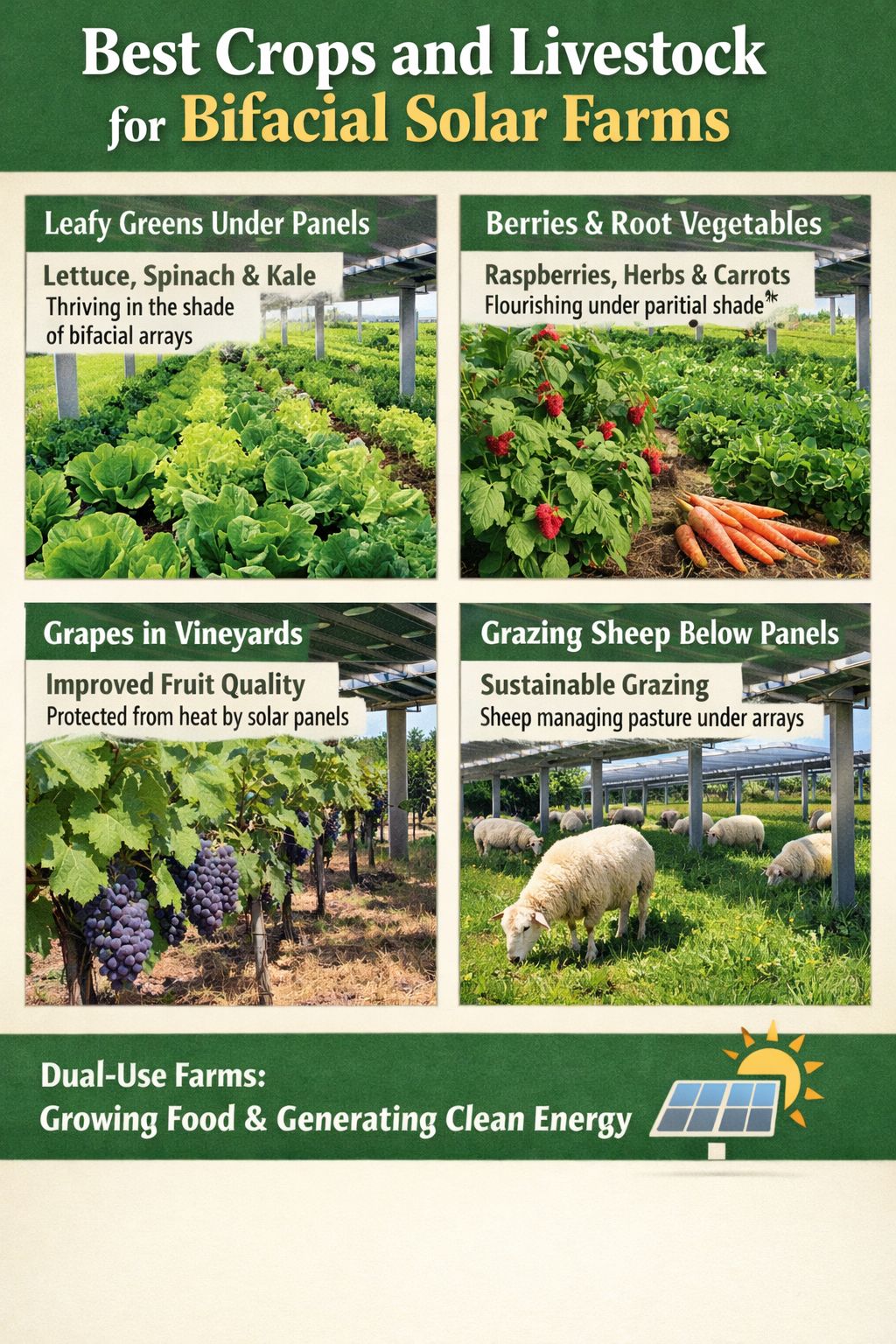
Pairing bifacial panels with agriculture, often called agrivoltaics, has moved well past the experimental stage. Research trials across Europe and Japan have identified a specific set of crops and livestock arrangements that thrive underneath elevated solar arrays, turning what used to be purely energy-producing land into dual-purpose farmland.
Leafy Greens Like Lettuce, Spinach, and Kale
Leafy greens have shown some of the strongest results in agrivoltaic trials. Lettuce, spinach, kale, and similar crops grow largely unaffected, and in some cases improved, under the partial shade cast by elevated bifacial panels. The reduced heat stress and lower evapotranspiration beneath the panels appear to benefit these shade-tolerant greens without sacrificing yield.
Berries, Herbs, and Root Vegetables
Berries, particularly raspberries and currants, perform well under elevated panel arrays, along with herbs like basil and cilantro, lavender, and certain root vegetables. These crops tend to tolerate the dappled, reduced-intensity sunlight that filters through and around a well-spaced panel array, making them reliable choices for farms transitioning part of their acreage to agrivoltaic use.
Grapes and Improved Fruit Quality Under Panels
Grapes grown under elevated panels in European trials demonstrated improved fruit quality, a result tied directly to the temperature moderation that agrivoltaic shading provides during peak summer heat. Vineyards dealing with increasingly intense heat waves have found that agrivoltaic shading helps protect fruit from sunscald and heat stress without compromising ripening.
This finding has drawn particular attention from wine-growing regions facing climate pressures, where temperature control during the growing season directly affects both yield and flavor profile.
Grazing Livestock Beneath Elevated Arrays
Pasture grasses used for livestock grazing maintain acceptable yields even under moderate shading, making sheep grazing beneath elevated bifacial arrays one of the most widely adopted agrivoltaic applications worldwide. The panels provide shade for the animals during hot months, the sheep keep vegetation trimmed without the need for mechanical mowing, and the farm generates electricity from land that would otherwise serve a single purpose.
This arrangement has become something of a model case for agrivoltaic efficiency, demonstrating how farms with grazing sheep beneath elevated arrays can squeeze more value out of every acre than a standard monofacial setup covering the same footprint.
Regional Performance: Where Bifacial Panels Perform Best
Bifacial panels can technically operate in almost any region where conventional solar panels work, but the extra energy generated from the rear side varies enormously depending on climate and geography. Research has shown that bifacial performance depends on a combination of geographic location, ground albedo, system geometry, rear-side irradiance, and self-shading, rather than any single factor acting alone.
Desert Solar Farms in the Middle East and American Southwest
Desert environments offer a near-ideal combination for bifacial technology. Sand and light-colored desert surfaces typically carry albedo values between 0.30 and 0.45, compared to standard dark soil sitting around 0.10 to 0.15. That higher natural reflectivity, paired with the open, unobstructed land common in desert solar farms, explains why bifacial adoption has grown quickly across installations in the Middle East and American Southwest.
Why Open Land and High Albedo Create Optimal Conditions
The common thread across top-performing bifacial sites isn’t a specific climate zone. It’s the combination of open land, unobstructed by surrounding shade, and naturally or artificially high ground albedo. Whether that’s desert sand, winter snow, or deliberately placed white gravel, the physics stays consistent: more reflected light reaching the rear cells means more electricity produced per panel, regardless of what region the installation sits in.
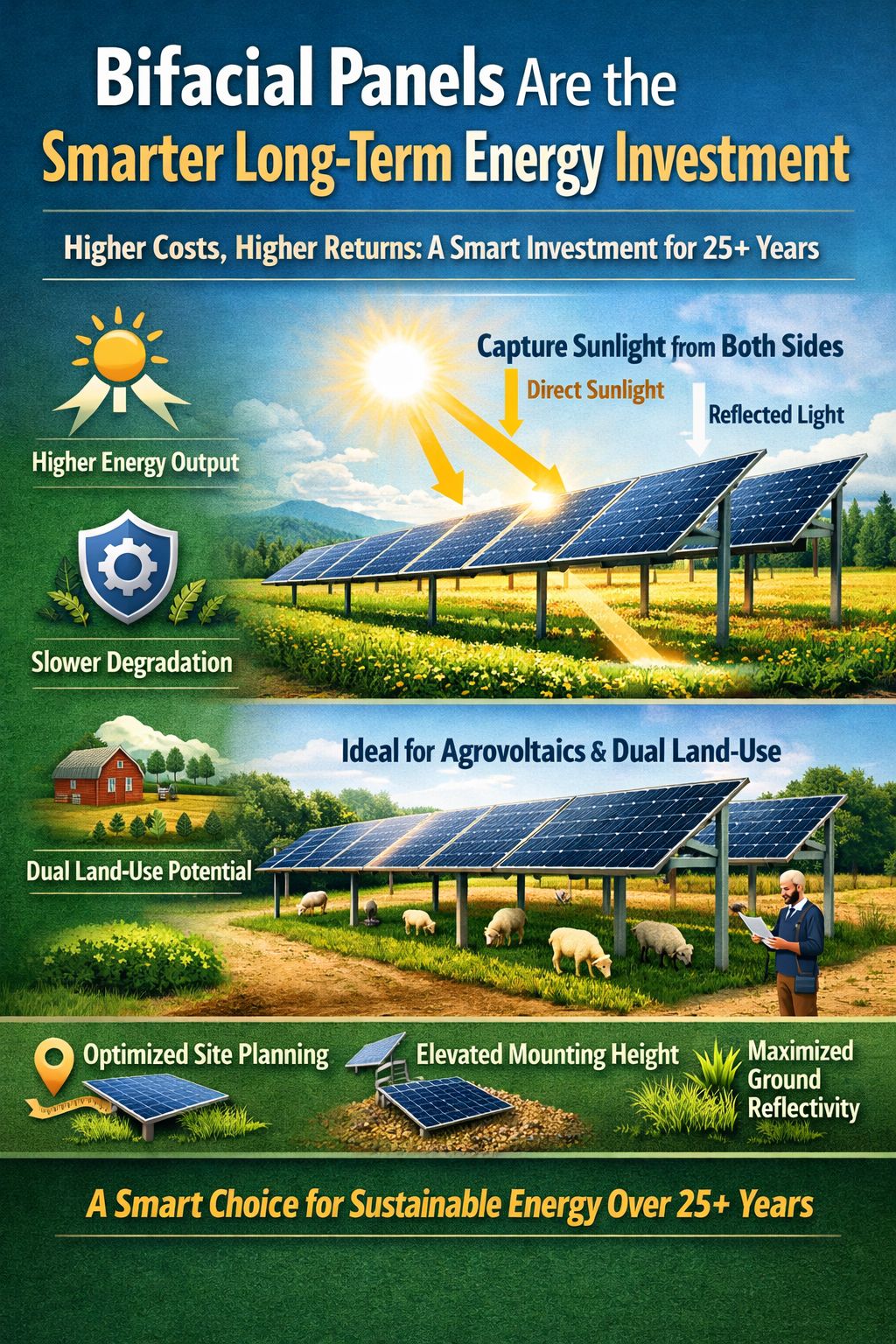
Bifacial Panels Are the Smarter Long-Term Energy Investment
Bifacial panels cost more upfront and require more careful site planning, but the combination of higher energy output, slower degradation, and dual land-use potential for agricultural operations makes them a compelling choice for anyone planning a system meant to last 25 years or more. The technology rewards thoughtful site selection, and farms or landowners willing to optimize ground surface and mounting height stand to gain the most from the investment.
Frequently Asked Questions
How much more energy do bifacial solar panels produce compared to standard panels?
Bifacial solar panels produce 10% to 30% more energy than standard monofacial panels, with the exact gain depending on ground surface reflectivity, mounting height, and geographic location.
What ground surface gives bifacial panels the highest energy gain?
White gravel and reflective membranes give bifacial panels the highest energy gain, typically in the 25% to 30% range, though fresh snow cover can produce similarly strong results during winter months.
What height should bifacial panels be mounted for agrivoltaic farming?
Agrivoltaic farming installations typically mount bifacial panels at 2 to 4 meters above ground, a height that provides both equipment clearance for farm machinery and near-optimal rear-side light exposure.
Which crops grow best underneath bifacial solar panels?
Leafy greens like lettuce and spinach, berries such as raspberries, herbs like basil, and grapes all show strong results growing underneath bifacial solar panels in agrivoltaic trials.
Are bifacial solar panels worth the higher upfront installation cost?
Bifacial solar panels are generally worth the higher upfront cost for large-scale agricultural or commercial installations, since the long-term energy gains, slower degradation, and dual land-use benefits typically outweigh the initial price difference over a 25-year system lifespan.
For farmers and landowners weighing whether bifacial technology fits their next solar project, Growing Solar Mist continues to publish detailed breakdowns of real-world agrivoltaic performance worth reviewing before breaking ground. For further insights, explore the benefits and advantages of bifacial solar panels in farm operations.
How Bifacial Panels Improve Soil and Crop Conditions
Solar panels and farmland used to be an either-or proposition, but elevated bifacial arrays have changed that equation entirely. The partial shade cast by panels mounted several meters above ground does more than just generate electricity; it actively reshapes the growing conditions for whatever crops sit beneath it. Learn more about the benefits of bifacial solar panels and their impact on agriculture.
Research from agrivoltaic pilot projects in Europe and Japan has consistently shown that partial shading from elevated panels can reduce crop water stress during peak summer heat. That single finding has driven a lot of farmer interest in bifacial agrivoltaic systems, since water stress during heat waves is one of the biggest threats to crop yield in a changing climate.
Soil Moisture Retention During Dry Periods
Soil beneath elevated solar panels retained measurably more moisture during dry periods compared to fully exposed control plots in German and French research sites. The shade reduces direct solar heating of the soil surface, slowing the rate at which moisture evaporates between irrigation cycles or rainfall events. Learn more about the benefits of bifacial solar panels for farm operations.
Reduced Evapotranspiration and Water Loss
Partial shading from panels reduces evapotranspiration by lowering soil and plant surface temperatures, which in turn reduces water loss from crops during hot months. Agrivoltaic installations with elevated panels have shown reduced irrigation water requirements while maintaining comparable crop productivity for shade-tolerant species, a combination that matters enormously for farms operating in water-stressed regions.
Microclimate Stability for Heat-Sensitive Crops
The area beneath bifacial panels maintains more stable temperature and humidity levels, buffering crops from extreme heat events that might otherwise stunt growth or damage sensitive plants. Ground cover beneath panels can also be planted with wildflowers and native grasses, supporting pollinator populations that benefit surrounding crops and add yet another layer of value to the land. Learn more about bifacial solar panels benefits for agricultural uses.
Regional Performance: Where Bifacial Panels Perform Best
Bifacial panels can technically work in almost any region where conventional solar panels operate, but extra energy generated from the rear side varies enormously depending on climate and geography. A bifacial system installed on dark, moist farmland in a cloudy region will never match the output of an identical system installed on reflective desert sand under clear skies, even though both panels are built the same way.
Research from the National Laboratory of the Rockies shows that bifacial performance depends strongly on geographic location, albedo, system geometry, rear-side irradiance, and self-shading, not any single factor acting in isolation. That’s an important distinction for anyone comparing bifacial case studies from different parts of the world, since a 30% gain reported in one region doesn’t guarantee similar results somewhere else.
Still, bifacial panels maintain a performance edge over monofacial panels even in cloudy climates, not just in bright, high-irradiance environments. Ambient sky radiation scatters in all directions, and a portion of that scattered light still reaches the rear surface regardless of whether direct sunlight is blocked by cloud cover.
|
Region Type |
Typical Albedo Advantage |
Bifacial Suitability |
|---|---|---|
|
Desert / arid regions |
0.30 to 0.45 (sand) |
Excellent |
|
Snow-prone northern climates |
0.65 to 0.90 (fresh snow) |
Excellent, seasonal |
|
Temperate farmland |
0.10 to 0.20 (soil/grass) |
Moderate |
|
Cloudy coastal regions |
Variable, diffuse-light dependent |
Good, due to ambient scatter |
Desert Solar Farms in the Middle East and American Southwest
Desert environments check nearly every box bifacial technology needs to perform at its best. Sand and light-colored desert surfaces typically carry albedo values between 0.30 and 0.45, compared to standard dark soil sitting around 0.10 to 0.15, giving the rear cells a steady stream of reflected light throughout the day.
That natural reflectivity, combined with the vast open tracts of land common to desert solar installations, explains why bifacial adoption has accelerated so quickly across utility-scale projects in the Middle East and the American Southwest. Few other regions offer this same combination of abundant sunlight, minimal cloud interference, and naturally reflective ground cover.
Why Open Land and High Albedo Create Optimal Conditions
The common thread across every top-performing bifacial installation isn’t a specific climate zone or latitude. It’s the combination of open, unobstructed land and naturally or artificially elevated ground albedo. Whether that reflectivity comes from desert sand, winter snow, or deliberately placed white gravel, the underlying physics stays the same: more reflected light reaching the rear cells means more electricity produced per panel. Learn more about bifacial solar panels benefits.
Bifacial Panels Are the Smarter Long-Term Energy Investment
Bifacial panels cost more upfront and demand more careful planning around mounting height and ground surface, but the long-term combination of higher energy yield, slower degradation, and dual-purpose land use makes them a smart bet for farms, commercial sites, and utility-scale projects willing to optimize their installation from day one. For more information on their advantages, visit Bifacial Solar Panels Benefits.
Frequently Asked Questions
Bifacial solar technology raises a handful of practical questions for anyone weighing it against a standard monofacial setup. Here are straightforward answers to the ones that come up most often.
These answers pull directly from field performance data and engineering benchmarks, not marketing claims, so they should hold up whether you’re planning a backyard installation or a multi-acre agrivoltaic farm.
How much more energy do bifacial solar panels produce compared to standard panels?
Bifacial solar panels produce 10% to 30% more energy than standard monofacial panels, with the exact gain depending on ground surface reflectivity, mounting height, and geographic location.
What ground surface gives bifacial panels the highest energy gain?
White gravel and reflective membranes give bifacial panels their highest energy gain, typically landing in the 25% to 30% range, though fresh snow cover can produce comparable results during winter months. For more information on their advantages, check out the benefits of bifacial solar panels.
What height should bifacial panels be mounted for agrivoltaic farming?
Agrivoltaic farming installations typically mount bifacial panels at 2 to 4 meters above ground, a height range that provides equipment clearance for tractors and combines while also delivering near-optimal rear-side light exposure.
Lower mounting heights around 1.5 meters still offer meaningful bifacial gain and work well for farms that don’t require full machinery access beneath the array. To learn more about the advantages of bifacial solar panels, visit this comprehensive guide on solar panels for farms.
Which crops grow best underneath bifacial solar panels?
Leafy greens like lettuce, spinach, and kale show strong results underneath bifacial solar panels, along with berries such as raspberries and currants, herbs like basil and cilantro, and grapes in European agrivoltaic trials.
Pasture grasses used for livestock grazing also maintain acceptable yields under moderate shading, making sheep grazing one of the most widely adopted agrivoltaic pairings worldwide.
|
Crop Category |
Agrivoltaic Performance |
|---|---|
|
Leafy greens |
Unaffected or improved growth |
|
Berries |
Strong performance under elevated panels |
|
Grapes |
Improved fruit quality from temperature moderation |
|
Pasture grass |
Acceptable yields under moderate shade |
Are bifacial solar panels worth the higher upfront installation cost?
- Higher energy output of 10% to 30% over the system’s lifetime offsets much of the initial price premium
- Lower degradation rates mean bifacial panels retain more output capacity across a 25-year lifespan
- Dual-glass construction reduces long-term maintenance and replacement costs tied to wind and moisture damage
- Agrivoltaic configurations add a second revenue stream through crops or grazing on the same land
For large-scale agricultural or commercial operations, the math tends to favor bifacial panels once the full 25-year lifespan is factored into the equation rather than just the installation invoice.
Smaller residential installations may see a less dramatic return, particularly on rooftops without enough clearance to capture meaningful rear-side light.
The deciding factor usually comes down to site conditions: available land, ground reflectivity, and whether the extra investment in racking and glass-glass construction fits the project’s budget.
Anyone on the fence should run the numbers using their specific ground surface and mounting plans rather than relying on generic industry averages. For more information on choosing the best solar panels for your needs, consider exploring the different types available.
For farmers and landowners exploring whether bifacial panels fit their next project, Growing Solar Mist continues to publish detailed agrivoltaic performance data worth reviewing before breaking ground.







Leave a Reply