

Article-at-a-Glance
- Bifacial panels can generate 10% to 30% more energy than standard panels by capturing reflected light off the ground, making them ideal for open agrivoltaic land.
- Monocrystalline panels hit 17% to 22% efficiency, the highest of any type, making them the top pick when barn or shed roof space is limited.
- Polycrystalline panels cost 15% to 20% less per watt, making them a practical workhorse for large ground-mounted arrays on fallow fields.
- Thin-film panels weigh 50% to 80% less than crystalline options, solving the structural weight problem on older barns and curved Quonset roofs.
- Later in this article, you’ll find a side-by-side comparison table showing exactly which panel type matches your farm’s roof space, land availability, and budget.
Choosing the wrong solar panel for your farm can cost you thousands in lost energy production over 25 years, but the right match depends entirely on what you’re powering and where you’re building.
Farms aren’t like suburban rooftops. You’ve got barns with massive roof surfaces, open fields sitting mostly unused, greenhouses that need light to pass through, and decades-old equipment sheds that can’t support heavy racking systems. Each of these situations calls for a different panel technology, and picking based on price alone often backfires. There’s no single “best” panel for every farm, just the best panel for your farm.
Which Solar Panel Actually Fits Your Farm
Farmers face a decision that homeowners rarely encounter: massive variation in installation environments across a single property. A dairy operation might need panels for the barn roof, the equipment shed, and a fallow back forty acres all at once. Picking one panel type for every application usually means overpaying in one spot and underperforming in another.
The four main panel categories, bifacial, monocrystalline, polycrystalline, and thin-film, each solve a different problem. Bifacial panels excel where you have open ground and reflective surfaces. Monocrystalline panels win when roof space is tight but energy demand is high. Polycrystalline panels make sense when you have acres to spare and want to keep costs down. Thin-film panels solve the weight and flexibility puzzle on older or curved structures. Understanding which problem you’re actually solving determines which panel earns its spot on your farm. For more insights, explore the benefits of agrivoltaics.
1. Bifacial Panels: The Ground-Reflection Powerhouse
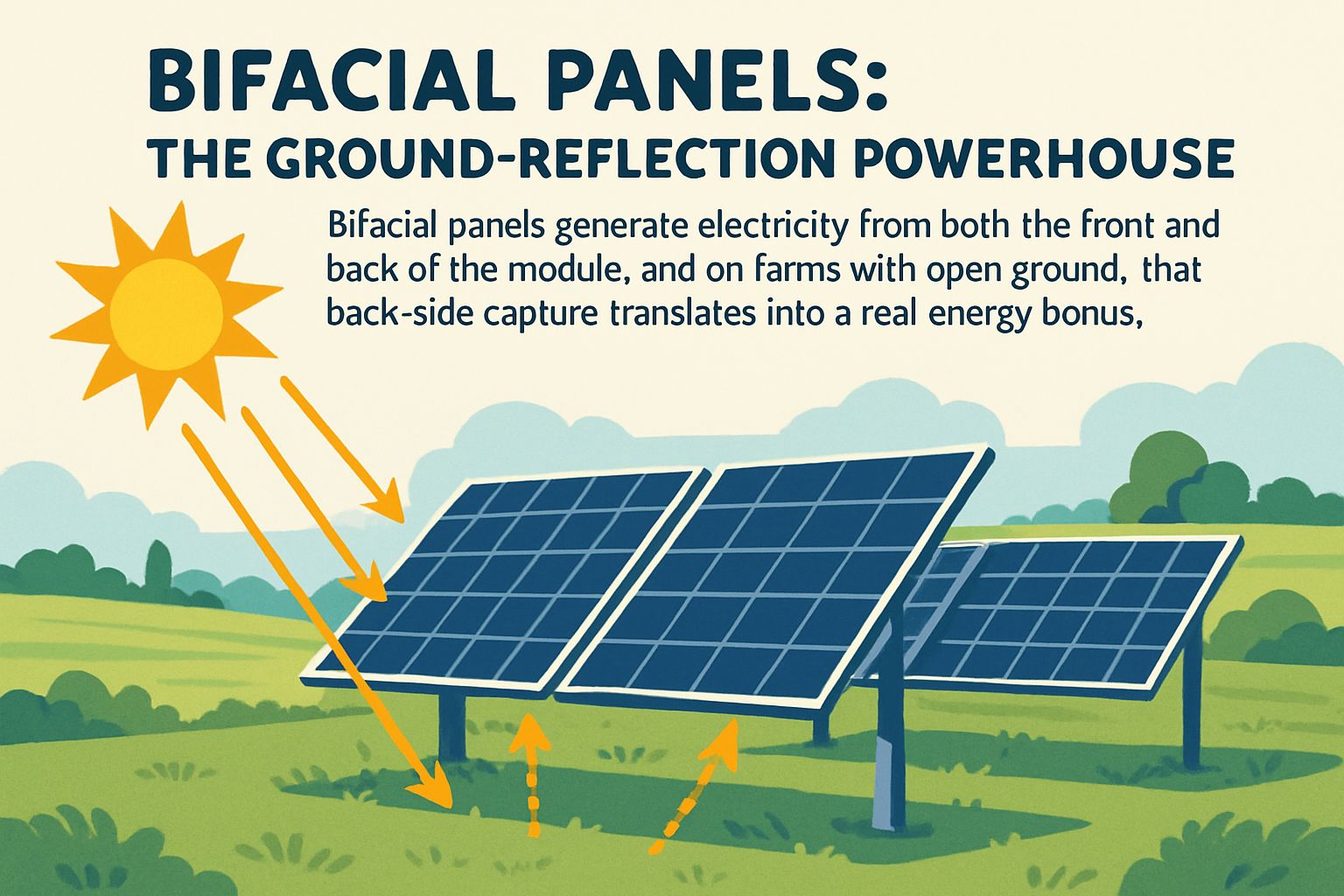
Bifacial panels generate electricity from both the front and back of the module, and on farms with open ground, that back-side capture translates into a real energy bonus.
A 100 kW ground-mounted bifacial array operating at a 20% bifacial gain produces the equivalent output of a 120 kW standard panel array. That’s a fifth more electricity from the same footprint, without adding a single extra panel. For farms running irrigation pumps, grain dryers, or cold storage off a ground-mount system, that gain adds up fast.
How Rear-Side Energy Capture Works
The rear side of a bifacial panel picks up sunlight that bounces off the ground beneath and around it. This reflected light, known as albedo, hits the back of the module and gets converted into additional electricity. The brighter and more reflective the ground surface, the more power that back side pulls in.
This isn’t a marginal effect. Bifacial gain ranges anywhere from 10% to 30% depending on installation conditions, and ground albedo is the single biggest factor driving that range.
Why Ground Cover Changes Your Energy Output
What’s underneath your bifacial array matters almost as much as the panel itself. White gravel and light-colored membrane surfaces reflect the most light, pushing bifacial gain to the 25% to 30% range. Dark soil with dense vegetation sits at the opposite end, delivering only a 10% to 12% boost.
- White gravel or white membrane ground surface: 25% to 30% bifacial gain
- Concrete or light-colored pavement: 18% to 25% bifacial gain
- Dry sandy soil: 15% to 20% bifacial gain
- Short grass or light ground cover: 12% to 18% bifacial gain
- Dark soil or dense vegetation: 10% to 12% bifacial gain
If you’re planning a bifacial installation over cropland with dense green cover, don’t expect the top-end gains you’d see over gravel or pavement. Knowing your ground type ahead of time helps set realistic production expectations.
Best Mounting Height for Maximum Gain
Height off the ground plays a surprisingly large role in how much extra power you get. Raising panel height from 0.5 meters to 1.5 meters above grade can increase bifacial gain by 5 to 10 percentage points. The higher the panel sits, the more reflected light reaches the rear cells before it scatters.
This is why agrivoltaic mounting structures, the elevated systems that let farming continue underneath solar arrays, are typically built 2 to 4 meters above ground. That height isn’t just for tractor and livestock clearance. It also happens to be near the sweet spot for maximizing bifacial energy capture.
Ideal Use: Agrivoltaic and Open Farmland Systems
Bifacial panels are the clear panel of choice for agrivoltaic installations where solar generation and agricultural production share the same land. Whether you’re grazing sheep beneath elevated arrays or growing shade-tolerant crops between rows, bifacial technology squeezes more value out of every acre dedicated to solar.
Open ground-mounted systems on farmland, even without active co-farming underneath, also benefit. Since these installations already sit above bare soil, gravel, or grass, the reflected light is there for the taking.
Cost Premium vs Long-Term Savings
Bifacial panels aren’t free of trade-offs. They typically cost more upfront than standard monofacial panels, but the extra energy harvest over a 25 to 30 year system life usually justifies the premium for ground-mounted farm applications, especially on high-albedo sites with proper mounting height.
For farmers weighing the investment, the math comes down to your specific site conditions: ground surface, available mounting height, and how much open land you’re working with. Get those three factors right, and bifacial technology delivers meaningfully more electricity per dollar spent than a standard panel would on the same plot.

2. Monocrystalline Panels: Maximum Power in Minimum Space
When a farm building’s roof space runs out before your energy needs do, monocrystalline panels solve that math problem better than any other technology on the market.
Why Single-Crystal Silicon Boosts Efficiency
Monocrystalline panels are made from a single continuous silicon crystal, which gives every cell in the panel a uniform molecular structure. That uniformity means electrons move through the material with less resistance, and less resistance translates directly into higher efficiency. It’s why monocrystalline panels hit the 17% to 22% efficiency range, the highest of any silicon-based panel type, with premium products from manufacturers like SunPower (now Maxeon) reaching the upper end of that spectrum.
Efficiency differences might sound like a technical detail, but on a working farm, they change what’s physically possible. Consider a barn roof with 1,000 square feet of usable south-facing surface. Swap a 13% efficient polycrystalline panel for a 17% efficient monocrystalline panel, and you gain roughly 40 kW of additional system capacity from the exact same roof space. That’s the difference between running your milking equipment on solar power or still writing a check to the utility company every month.
Monocrystalline panels also hold up better in low-light conditions and handle partial shading more gracefully than polycrystalline alternatives, especially when paired with module-level power electronics. On a farm where a grain silo or tree line casts a shadow across part of the roof at certain times of day, that shade tolerance keeps your system producing instead of tanking output the moment one panel goes dark. For more insights into how solar panels can benefit agriculture, explore the advantages of agrivoltaics.
Best Farm Buildings for Monocrystalline Installation
Monocrystalline panels perform best in roof-mounted applications on farm structures where space is limited but energy demand runs high. Think about the buildings on your property that draw serious power around the clock or during peak seasons.
- Dairy barns with milking equipment, ventilation fans, and refrigeration running daily
- Poultry houses that rely on climate control and lighting systems around the clock
- Grain processing facilities with augers, dryers, and conveyor motors
- Cold storage buildings that need consistent, reliable power to protect perishable inventory
- Equipment sheds with large, unobstructed roof planes and minimal roof penetrations, making installation straightforward and efficient
Each of these structures shares a common trait: high energy draw paired with finite roof real estate. That combination is exactly where monocrystalline’s higher efficiency per square foot pays off the most.
Handling Partial Shade on Barns and Sheds
Farm buildings rarely sit in a perfectly open field with zero obstructions. Grain silos, windbreaks, neighboring structures, and even seasonal tree growth can throw shadows across sections of a roof at different times of day. Monocrystalline panels tolerate these interruptions better than polycrystalline options, particularly when the system includes module-level power electronics like microinverters or power optimizers.
Without that shade tolerance, a single shaded cell can drag down output for an entire string of panels. For a working farm where every kilowatt-hour matters, that resilience keeps your system running closer to its rated capacity even when conditions aren’t perfect. Learn more about solar panel types that can enhance resilience on your farm.
Upfront Cost vs Long-Term Output
Monocrystalline panels aren’t the cheapest option per watt. They generally run 10% to 20% more than polycrystalline panels of equivalent wattage. But the numbers behind that premium tell a longer story.
Monocrystalline panels degrade slowly, typically losing just 0.3% to 0.5% of their output per year. Manufacturers commonly guarantee at least 92% of original output after 25 years, and many panels still operate at 80% efficiency after 40 years in the field. With an average lifespan of 25 to 40 years and a favorable temperature coefficient around -0.30% per degree Celsius, monocrystalline panels keep producing reliably long after cheaper alternatives have started slipping in performance.
For a farm operation planning to run solar for the next three decades, that slower degradation curve often outweighs the higher sticker price. You’re paying more today to lock in stronger performance for longer, on a roof where you likely won’t get a second chance to add more panels later. Learn more about agrivoltaics benefits and how they can enhance your farm’s sustainability.
3. Polycrystalline Panels: The Budget-Friendly Workhorse
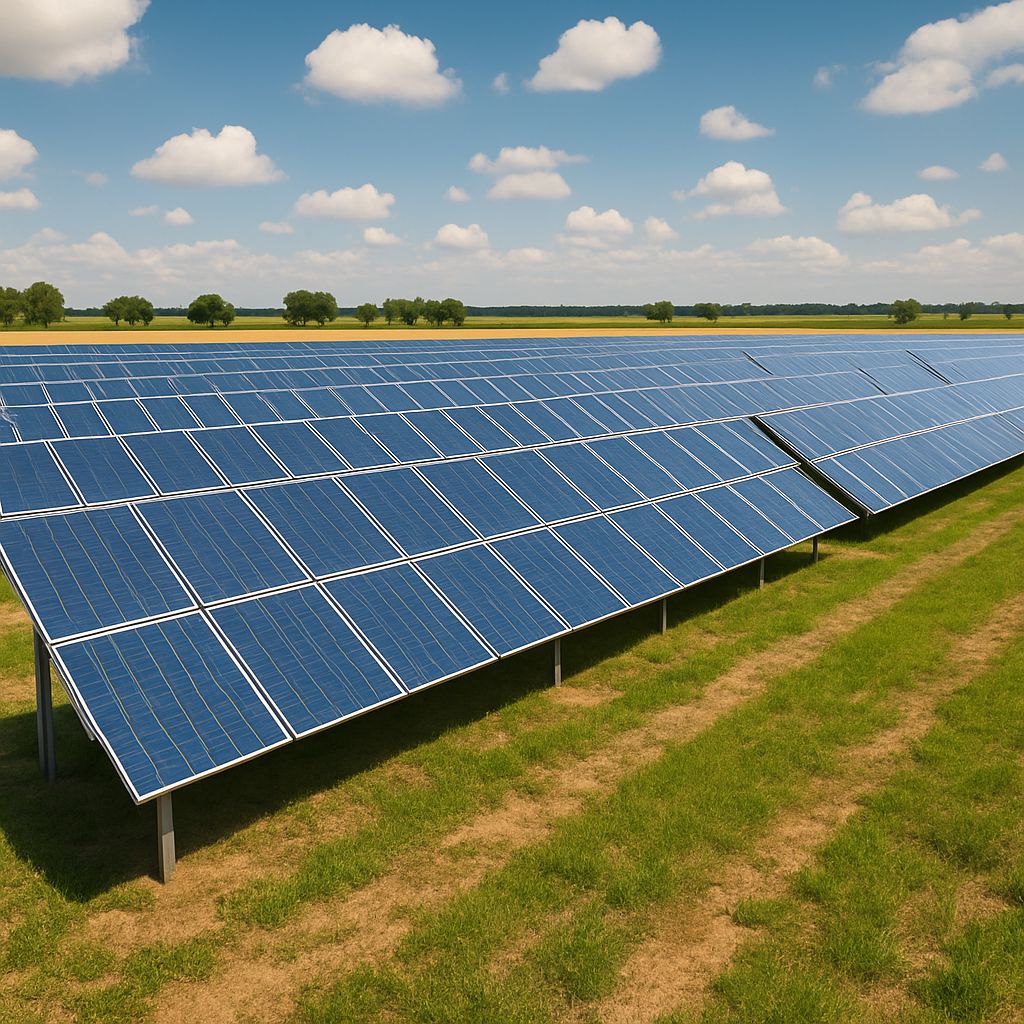
If your farm has acres of unused land rather than a roof space shortage, polycrystalline panels offer a straightforward way to generate serious power without the premium price tag of monocrystalline or bifacial technology.
- Cost 15% to 20% less per watt than monocrystalline options
- Operate in the 13% to 17% efficiency range
- Made by melting multiple silicon fragments together and casting them into blocks
- Recognizable by their characteristic blue, multi-toned appearance with visible crystal grain boundaries
- Require a less resource-intensive manufacturing process than growing single silicon crystals
That lower cost doesn’t come from cutting corners on durability. It comes from a simpler manufacturing process that skips the resource-intensive step of growing a single silicon crystal. For farms where land is available but capital is tight, that cost savings can be the difference between installing solar now or waiting another few years.
The trade-off is efficiency. Polycrystalline panels won’t squeeze as much power out of a given square foot as monocrystalline or bifacial panels. But when land isn’t the limiting factor, that lower efficiency matters a lot less. You simply install more panels across the available space to hit your target output.
This makes polycrystalline the practical workhorse for large ground-mounted arrays on fallow or marginal farmland, land that isn’t earning its keep growing crops or grazing livestock anyway. For more information on how solar panels can be financially beneficial for farmers, check out this article on solar panels financial benefits.
How Multi-Crystal Manufacturing Cuts Costs
Instead of painstakingly growing one flawless silicon crystal the way monocrystalline production requires, polycrystalline manufacturing melts multiple silicon fragments together and casts them into blocks. This process uses less energy, less time, and less waste than the monocrystalline method.
The visible result is that blue, marbled appearance with distinct crystal grain boundaries running through each cell. Cosmetically, it’s less uniform than the sleek black look of monocrystalline panels. Functionally, it means slightly lower electron mobility and, therefore, slightly lower efficiency. But for open field installations where nobody’s judging curb appeal, that trade-off rarely matters.
What does matter is the price. For a 200 kW ground-mounted farm array, the polycrystalline cost differential represents $15,000 to $25,000 in savings on panel procurement alone. That’s real capital freed up for other parts of your operation, whether it’s additional acreage, updated equipment, or simply a healthier cash reserve.
Best Use: Large Ground-Mounted Arrays on Fallow Land
A 200 kW polycrystalline ground array installed across an unproductive paddock corner can generate meaningful farm electricity while saving $15,000 to $25,000 compared to an equivalent monocrystalline installation, without sacrificing the acreage you actually need for crops or grazing.
Fallow fields, unproductive paddock corners, and land adjacent to farm infrastructure make ideal locations for polycrystalline ground-mounted systems. These are spaces that already aren’t contributing to your bottom line through farming, so putting solar panels there doesn’t cost you any agricultural output.
The key is identifying land that’s genuinely underutilized rather than repurposing productive acreage. A rocky corner that’s always been a headache to plant, a strip along a fence line too narrow for equipment turns, or ground near existing farm buildings that never quite worked for crops, these are the spots where polycrystalline arrays make the most economic sense.
Because polycrystalline panels need more surface area to generate the same output as higher-efficiency alternatives, having ample land available is essential. On a small residential lot, that space requirement would be a dealbreaker. On a farm with hundreds of acres, it’s simply not an issue.
Matching Output to Farm Equipment Power Demands
Farms with high daytime energy loads from irrigation pumps, grain augers, or feed mixing equipment are particularly well-suited to large polycrystalline ground arrays. These operations draw substantial power during daylight hours, which lines up perfectly with when solar panels produce the most electricity.
Where the Savings Go: Storage and Monitoring Upgrades
The money saved by choosing polycrystalline over pricier panel types doesn’t have to sit idle. Many farm operations reinvest that difference into battery storage systems, allowing excess daytime production to cover energy needs after sundown, or into monitoring software that tracks system performance and flags maintenance issues before they become costly problems. For more information on how solar panels can provide financial benefits for farmers, consider reading further.
Others put the savings toward expanding the array itself, adding more polycrystalline panels to offset the lower per-panel efficiency with sheer panel count. Either way, the cost advantage of polycrystalline technology gives farm operations flexibility that a premium panel choice simply doesn’t offer.

4. Thin-Film Panels: Lightweight Solutions for Fragile Structures
Not every farm building can handle the weight of traditional solar panels, and that’s exactly the problem thin-film technology was built to solve. For more on the advantages of this technology, explore the benefits of agrivoltaics.
Why Weight Matters for Older Farm Buildings
Standard crystalline silicon panels weigh between 18 and 25 kilograms each. Multiply that across dozens of panels, and you’re adding serious structural load to a roof. For older farm buildings, that extra weight isn’t always safe or even possible without expensive reinforcement work first. However, using solar panels can offer financial benefits for farmers that may offset these costs.
Thin-film panels sidestep that problem entirely. Manufactured by depositing photovoltaic material in ultra-thin layers onto a substrate, these panels weigh as little as 4 to 8 kilograms in flexible formats, with lightweight rigid versions coming in around 10 to 14 kilograms. That’s a weight reduction of 50% to 80% compared to crystalline alternatives, a critical advantage for older farm structures, greenhouses, and curved rooftops that simply weren’t built to support heavy racking systems. For more insights into the benefits of agrivoltaics, explore how these systems can be advantageous for agricultural setups.
CdTe, Amorphous Silicon, and CIGS Explained
Three thin-film technologies show up most often in agricultural settings: Cadmium Telluride (CdTe), amorphous silicon (a-Si), and Copper Indium Gallium Selenide (CIGS). Each brings a slightly different balance of cost, efficiency, and flexibility to the table, and knowing the difference helps you pick the right one for your specific structure.
Greenhouse Integration and Crop Shading Benefits
Greenhouses represent one of the most compelling thin-film applications in agriculture. Semi-transparent thin-film panels can be integrated directly into greenhouse glazing, generating electricity while simultaneously providing partial shading for crops underneath.
That dual function solves two problems with one installation. Instead of choosing between clear glass for maximum light or opaque panels for maximum power, semi-transparent thin-film lets you generate electricity and manage light intensity at the same time.
- Semi-transparent thin-film integrates directly into greenhouse glazing rather than requiring separate mounting structures
- Products like the Sunpreme GxB series are specifically designed for dual-function glazing applications in greenhouse environments
- Partial shading from the panels can benefit shade-sensitive crops that suffer under full, unfiltered sunlight
For growers running greenhouse operations that already juggle light management, irrigation, and climate control, adding electricity generation to the glazing itself is an efficient use of existing infrastructure rather than a separate build. To explore more about this innovative approach, you can read about the agrivoltaics benefits and advantages explained.
It also means you’re not sacrificing growing space to accommodate solar. The panels become part of the structure instead of competing with it.
Curved Roofs and Quonset-Style Buildings
Curved roofing on older Quonset-style equipment storage buildings and hay storage structures represents another strong application for thin-film technology. These arched, corrugated metal buildings are common across farm country, but their curved shape makes traditional rigid panel racking difficult or impossible to install properly.
Flexible CIGS and amorphous silicon panels solve that geometry problem by conforming directly to curved metal roofing without the racking hardware that rigid crystalline panels require. That means no drilling extensive mounting points into aging roof structures and no added weight from bulky frames.
For farms with these older curved structures still in active use for hay or equipment storage, thin-film offers a way to add solar generation without the engineering headaches and added expense that rigid panels would demand on a non-standard roofline.
Efficiency Trade-Offs to Know Before You Buy
Thin-film’s flexibility and light weight come with a real efficiency cost. These panels typically operate in the 10% to 13% range, meaning they require nearly twice the panel count compared to monocrystalline to achieve equivalent system output. On large farms with sufficient open land, the cost and complexity of that additional hardware usually outweighs any savings on the panels themselves, which is why thin-film isn’t the right choice for large, open-ground solar arrays where land availability allows for higher panel counts using more efficient technology.
Thin-film earns its place specifically where weight and flexibility are the limiting factors, not where efficiency per square foot is the priority. Match the technology to the problem it actually solves, and it performs exactly as intended.
Side-by-Side Comparison for Farm Decision-Making
With four distinct panel technologies each suited to different farm scenarios, seeing the numbers side by side makes the decision considerably easier. The table below breaks down the core specs that matter most when you’re planning an agricultural solar installation.
Keep in mind that these are general ranges based on typical products in each category. Specific manufacturers and product lines can push toward the higher or lower end of these figures, so always check the spec sheet for the exact panel you’re considering.
Efficiency, Weight, and Lifespan at a Glance
Here’s how the four panel types stack up on the metrics that matter most for farm applications:
|
Panel Type |
Efficiency Range |
Relative Weight |
Typical Lifespan |
Best Farm Application |
|---|---|---|---|---|
|
Bifacial |
Varies by base cell + 10-30% gain |
Standard to heavy (glass-glass) |
25-30+ years |
Open ground-mount, agrivoltaics |
|
Monocrystalline |
17% to 22% |
18-25 kg per panel |
25-40 years |
Barn and shed roofs, limited space |
|
Polycrystalline |
13% to 17% |
18-25 kg per panel |
25-35 years |
Large ground arrays, fallow land |
|
Thin-Film |
10% to 13% |
4-14 kg per panel |
15-20 years |
Greenhouses, curved roofs, old structures |
Notice how each technology trades something for something else. Bifacial trades a higher upfront cost for extra energy from the same footprint. Monocrystalline trades a price premium for maximum efficiency per square foot. Polycrystalline trades some efficiency for a lower price tag and simpler manufacturing. Thin-film trades efficiency for weight and flexibility.
None of these trade-offs make one panel objectively “better” than the others. They just mean each panel type wins in different circumstances, which is exactly why most large farm operations end up using more than one technology across different parts of the property.
Matching Panel Type to Farm Structure and Land Use
Think through your farm layout building by building and field by field. A dairy barn with a tight roofline and heavy daily power draw points toward monocrystalline. A back forty of unused pasture points toward polycrystalline or bifacial, depending on whether you want to farm underneath the array. A greenhouse or an aging Quonset hut points toward thin-film. Very few farms fit neatly into just one category, and that’s perfectly normal.
Choosing the Right Panel for Your Specific Farm Operation
Start by mapping out your energy needs against your available space, structure by structure. Roof space that’s limited but carries high daily power draw calls for monocrystalline’s efficiency. Open land that isn’t earning its keep through crops or grazing is a natural fit for polycrystalline or bifacial ground-mount systems, with bifacial pulling ahead when you’ve got reflective ground cover and enough clearance for elevated mounting. Fragile roofs, curved structures, and greenhouses point toward thin-film’s lightweight, flexible design. Most working farms end up combining two or more of these technologies across different buildings and fields, and that’s not a compromise, it’s simply matching the right tool to the right job. For more insights on how solar panels can benefit your farm, explore agrivoltaics benefits.
Frequently Asked Questions
What is the most efficient solar panel for a farm?
Monocrystalline panels are the most efficient option, hitting 17% to 22% efficiency thanks to their single-crystal silicon structure. This makes them the top choice when roof space is limited but energy demand is high.
However, “most efficient” doesn’t always mean “best fit.” A farm with abundant open land might get more total value from a lower-efficiency polycrystalline or bifacial ground-mount system simply because space isn’t a constraint.
Can solar panels be installed on old barn roofs?
Yes, but the panel type matters. Standard crystalline panels weighing 18 to 25 kilograms each can be too heavy for aging roof structures without reinforcement work first.
Thin-film panels solve this problem directly. Weighing as little as 4 to 8 kilograms in flexible formats, they reduce structural load by 50% to 80% compared to crystalline alternatives, making them a practical option for older barns that can’t handle traditional racking systems.
Are bifacial panels worth the extra cost for farmland?
In most open-field farm applications, yes. Bifacial panels generate 10% to 30% more energy than standard panels by capturing reflected light off the ground, and that extra output compounds over a 25 to 30 year system lifespan.
The value increases further on sites with high-albedo ground cover like white gravel or light pavement, and with mounting heights of 1.5 meters or more. On dark soil with dense vegetation and low mounting height, the gain shrinks, so it’s worth evaluating your specific site conditions before committing to the premium. For more information on how to maximize the environmental benefits of solar power on your farm, consider the specific conditions and potential gains.
Do thin-film panels work well in greenhouses?
Semi-transparent thin-film panels integrated into greenhouse glazing generate electricity while providing partial shading for crops underneath, solving two problems with a single installation rather than forcing a choice between light and power generation.
Products like the Sunpreme GxB series are specifically built for this dual-function application, making thin-film one of the few solar technologies that actively benefits crop production rather than simply coexisting with it.
For growers already managing light intensity and shade for sensitive crops, thin-film glazing turns an existing structural need into a power source.
How much roof space do polycrystalline panels need compared to monocrystalline?
Polycrystalline panels need noticeably more roof space to match monocrystalline output, since they operate at 13% to 17% efficiency versus monocrystalline’s 17% to 22%. On a roof with limited square footage, that gap can mean the difference between meeting your energy goals and falling short.
For reference, hitting a 10 kW system might require:
- 31 polycrystalline panels at 320 watts each
- 25 monocrystalline panels at 400 watts each
That’s six fewer panels and less roof space needed with monocrystalline, though at a higher cost per watt. On a farm with plenty of open ground rather than roof constraints, that extra space requirement for polycrystalline rarely matters.
Solar panels have become an essential part of modern farming, offering a sustainable way to power operations and reduce costs. Farmers are increasingly turning to solar energy to run their equipment, irrigate crops, and even power their homes. The financial benefits of using solar panels are significant, as they help farmers maximize savings and increase their profits. For more information on how solar panels can benefit farmers financially, you can explore the financial benefits for farmers of adopting solar technology.



Leave a Reply