
Article-At-A-Glance: How Solar Panels Put More Money in Farmers’ Pockets
- Solar panels can cut farm energy bills by 50% to 90%, with full payback periods typically ranging from 5 to 10 years depending on system size and location.
- The USDA REAP grant program covers up to 50% of solar installation costs, and the federal Investment Tax Credit (ITC) adds another 30% reduction — meaning farmers can offset the majority of upfront expenses through government programs alone.
- Agrivoltaic systems — where solar panels and crops share the same land — have shown that farmers can earn up to 25 times more per acre compared to traditional crop production, according to Michigan State University research.
- Farmers who lease land for solar development can earn between $700 and $2,000 per acre annually, creating a reliable income stream that runs parallel to traditional farming.
- Keep reading to find out which financing option — solar loans, PPAs, or REAP grants — delivers the best return for your specific farm size and energy needs.
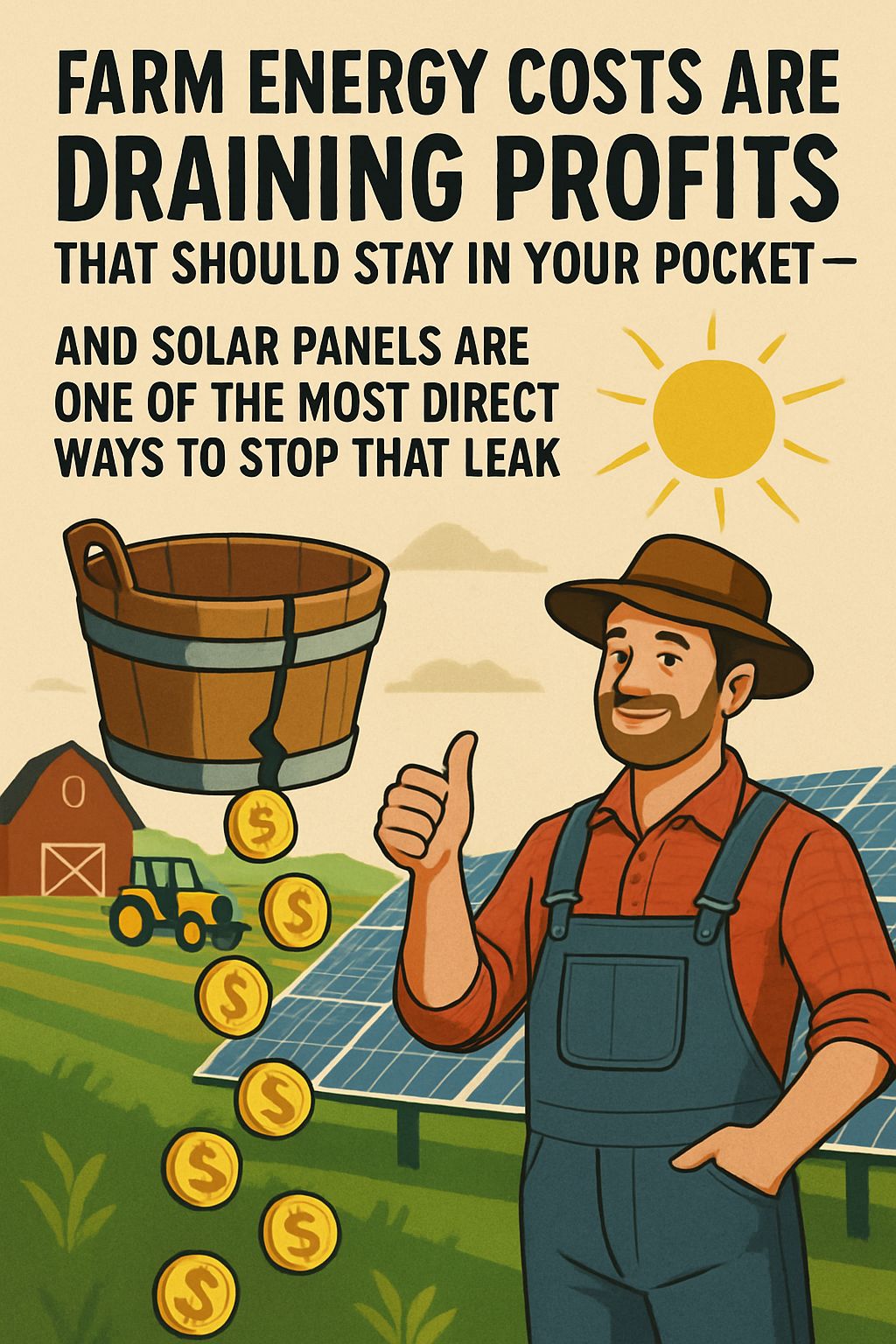
Farm energy costs are draining profits that should stay in your pocket — and solar panels are one of the most direct ways to stop that leak. Solar Panels Financial Benefits for Farmers are well-documented, and the numbers make a compelling case for any agricultural operation looking to cut costs and diversify income. For farmers exploring where to start, resources on agricultural solar financing can provide a useful foundation before committing to an installation.
The economics have shifted dramatically in recent years. Equipment costs have dropped, federal incentives have expanded, and utility rates keep climbing — all of which tilt the equation further in favor of going solar. Whether you operate a small family farm or manage hundreds of acres, the financial levers available through solar energy are worth understanding in detail.
Solar Panels Are Changing Farm Economics Fast
Agriculture is one of the most energy-intensive industries in the country. Irrigation systems, grain dryers, ventilation for livestock barns, refrigeration for produce — all of it adds up to electricity bills that can run tens of thousands of dollars annually. For many operations, energy is the second or third largest operating cost after labor and inputs.
Solar is changing that equation at a structural level. Rather than paying a utility company every month indefinitely, farmers who install solar panels are essentially prepaying for 25 to 30 years of electricity at a fixed rate. Once the system pays for itself — typically within 5 to 10 years — the power it generates is effectively free.
The shift is already underway across American agriculture. From dairy farms in Wisconsin to vegetable operations in California, solar adoption is accelerating because the financial case is no longer marginal — it’s clear.
How Much Farmers Actually Save on Energy Bills
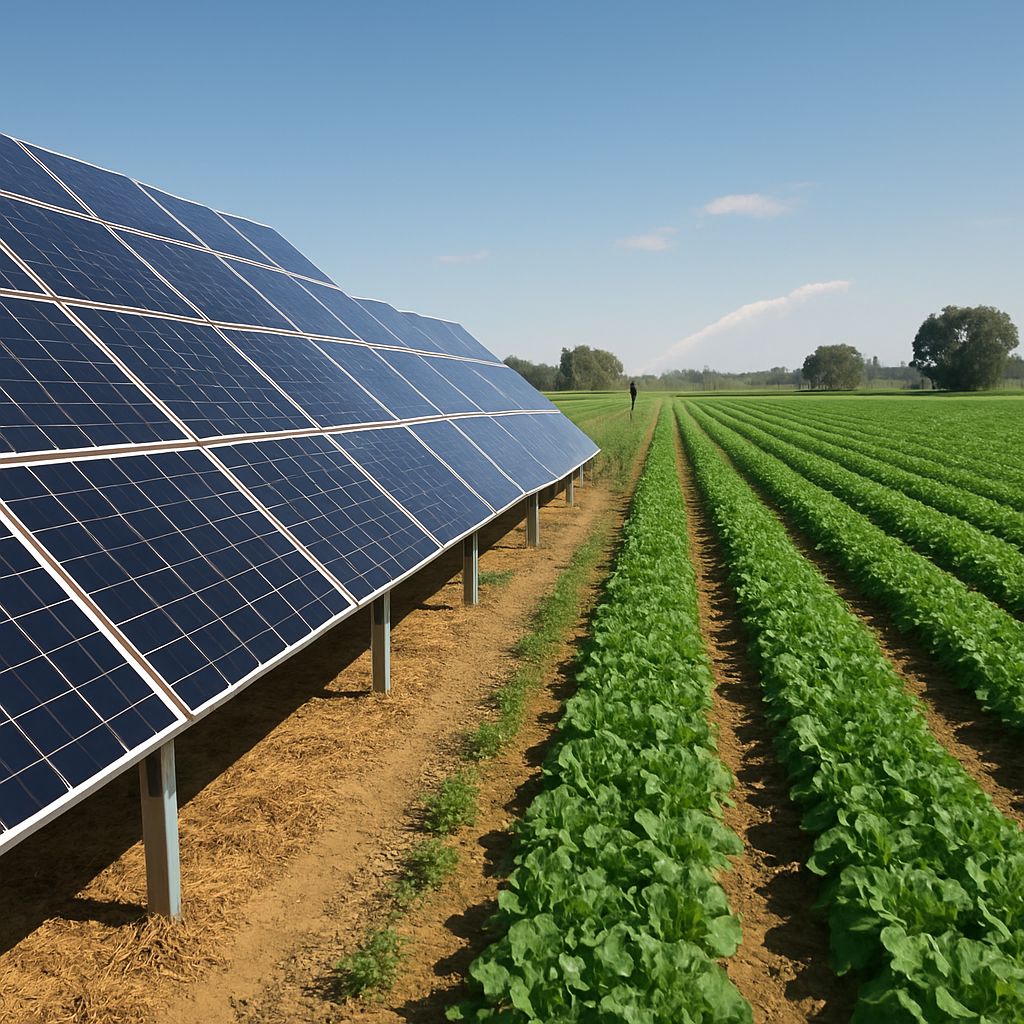
The savings from solar depend on your current energy usage, local utility rates, and how well your system is sized to match your consumption. That said, most agricultural solar installations reduce electricity bills by 50% to 90%. Farms with high daytime energy loads — like irrigation-heavy operations — often achieve the highest offset rates because their energy demand aligns closely with peak solar production hours.
- Irrigation-dependent farms can eliminate most of their pumping costs by running solar-powered systems during daylight hours
- Poultry and livestock operations with continuous ventilation needs see consistent year-round savings
- Grain drying operations that run seasonally can pair solar with battery storage or net metering to bank energy for high-use periods
- Greenhouse farms benefit from solar offsetting lighting and climate control costs simultaneously
- Dairy farms with refrigeration running 24/7 use net metering credits generated during the day to offset overnight grid consumption
Average Energy Cost Reductions After Solar Installation
To put real numbers on the savings, consider a mid-size row crop operation spending $3,000 per month on electricity for irrigation and equipment. A properly sized solar system could reduce that bill to somewhere between $300 and $900 per month — saving $25,000 to $32,000 annually. Over a 25-year panel lifespan, that compounds into substantial retained profit. Learn more about how solar panels can reduce energy costs for farms.
|
Farm Type |
Avg. Monthly Energy Cost (Pre-Solar) |
Estimated Monthly Savings |
Annual Savings Estimate |
|---|---|---|---|
|
Dairy Farm |
$4,500 |
$2,700 – $4,050 |
$32,400 – $48,600 |
|
Grain/Row Crop |
$3,000 |
$1,500 – $2,700 |
$18,000 – $32,400 |
|
Poultry Operation |
$2,200 |
$1,100 – $1,980 |
$13,200 – $23,760 |
|
Small Vegetable Farm |
$800 |
$400 – $720 |
$4,800 – $8,640 |
These figures are estimates based on a 50%–90% bill reduction range, and actual savings will vary by state, utility provider, and system configuration. The key takeaway is that the savings are proportional — even smaller operations see meaningful financial relief.
Diesel Generator Costs vs. Solar Power Savings
For farms that rely on diesel generators — particularly in rural areas without reliable grid access — the savings calculation is even more dramatic. Diesel fuel costs fluctuate with oil markets and have averaged between $3.50 and $5.00 per gallon in recent years. A generator running 8 hours a day to power irrigation can consume hundreds of gallons per month. Solar irrigation pumps eliminate that fuel expense entirely, converting a volatile recurring cost into a one-time capital investment.
How Net Metering Turns Surplus Energy Into Cash
Net metering is the policy that allows farmers to send excess solar electricity back to the grid and receive credit on their utility bill. During peak production hours — typically midday when many farms aren’t running full loads — solar systems often generate more power than the farm is consuming. That surplus flows back to the utility, and the credits roll forward to offset nighttime or low-sun-season consumption. In states with strong net metering policies like California, New Jersey, and Minnesota, this mechanism can effectively zero out electricity bills for well-sized systems. Additionally, farmers can boost their yield by growing mushrooms under solar panels, further maximizing the benefits of solar energy.
Government Incentives That Cut Your Upfront Solar Costs
The upfront cost of a farm solar installation is the most common barrier farmers cite — and it’s the one that government incentive programs are specifically designed to address. When you stack federal, state, and USDA programs together, the effective out-of-pocket cost of going solar drops significantly from the sticker price. Additionally, some farmers are exploring innovative ways to increase crop yield by growing under solar panels, which can further enhance the financial benefits of solar installations.
Understanding which incentives apply to your operation and how to combine them is where the real financial optimization happens. Many farmers leave money on the table simply because they aren’t aware that multiple programs can be used simultaneously.
Federal Investment Tax Credit (ITC) for Farm Solar
The federal Investment Tax Credit currently allows farmers to deduct 30% of their total solar installation cost directly from their federal tax liability. For a $200,000 system, that’s a $60,000 tax credit — not a deduction, but a direct dollar-for-dollar reduction in what you owe the IRS. The ITC applies to both purchased systems and certain financed installations, and it covers equipment, labor, and permitting costs. Farmers operating as sole proprietors, partnerships, LLCs, or corporations can all qualify, provided they have sufficient tax liability to absorb the credit.
USDA REAP Grants: Up to 50% of Installation Costs Covered
The USDA Rural Energy for America Program (REAP) is arguably the most powerful solar incentive specifically designed for agricultural producers. REAP provides grants covering up to 50% of eligible project costs and loan guarantees up to 75%. Grants and loans can be combined within a single application, meaning a farmer could theoretically cover up to 75% of total installation costs through REAP alone — before layering in the ITC. Applications are accepted on a rolling basis, and priority is given to projects in rural areas with strong energy savings potential. For more insights on solar energy benefits, read about how solar panels can reduce energy costs for farms.
State-Level Solar Rebates and Subsidies for Farmers
Beyond federal programs, most states offer their own layer of solar incentives — and some are specifically tailored to agricultural operations. New York’s NY-Sun program provides additional per-watt incentives for farms. California’s SGIP (Self-Generation Incentive Program) supports battery storage paired with solar. Minnesota offers agricultural-specific solar carve-outs within its renewable energy standards. The Database of State Incentives for Renewables & Efficiency (DSIRE) at dsireusa.org is the most reliable place to look up what’s available in your state, updated in real time as programs change.
State incentives vary widely in value — some are modest rebates of a few hundred dollars per kilowatt, while others provide meaningful per-project grants. The best approach is to inventory available state programs before finalizing your financing plan, since some rebates require pre-approval before installation begins. For farmers interested in maximizing their crop yield, it’s worth exploring how to grow beets and radishes under solar panels for increased growth.
Accelerated Depreciation Benefits Under MACRS
The Modified Accelerated Cost Recovery System (MACRS) allows farmers to depreciate solar equipment over just 5 years for federal tax purposes, rather than the 20+ year useful life of the panels themselves. When combined with the ITC, this accelerated depreciation schedule can substantially reduce taxable farm income in the early years of a solar system’s life. For farms with significant tax liability, MACRS depreciation effectively functions as an additional financial incentive that front-loads the economic benefit of the investment.
Solar Farms as a Direct Income Source
Beyond cutting energy costs, solar gives farmers something genuinely valuable: a new revenue stream that doesn’t depend on weather, crop prices, or market volatility. Whether you’re leasing land to a solar developer or generating and selling your own power, solar can function as a cash-flowing asset running parallel to your existing agricultural operation.
This income diversification matters more than it might seem. Farm income is notoriously cyclical — a bad harvest year or a commodity price drop can erase a season’s work. Solar income, by contrast, is contractual and predictable, providing financial stability that agriculture alone rarely guarantees.
Leasing Land for Solar Panels: What Farmers Earn Per Acre
Land leasing for utility-scale solar development has become one of the most straightforward ways for farmers to monetize underproductive acreage. Solar developers pay landowners an annual lease rate in exchange for the right to install and operate panels — and the farmer keeps ownership of the land throughout the lease term, which typically runs 20 to 40 years.
Lease rates vary significantly depending on location, proximity to transmission infrastructure, local electricity market conditions, and land quality. However, published ranges give a useful benchmark for what farmers can realistically expect to negotiate. For example, some farmers have found innovative ways to increase growth by growing crops under solar panels, which can potentially influence lease negotiations.
- Average solar land lease rates in the US range from $700 to $2,000 per acre per year
- High-demand states like California, New Jersey, and Massachusetts tend to offer rates at the top of the range
- Rates in the Midwest and Southeast typically fall between $800 and $1,400 per acre annually
- Some leases include escalation clauses that increase payments by 1% to 2% per year to keep pace with inflation
- Marginal farmland that produces inconsistent crop yields often generates more income per acre through solar leasing than through active cultivation
Before signing any solar lease, it’s worth having an agricultural attorney review the terms. Key clauses to scrutinize include decommissioning responsibilities, land restoration requirements at lease end, and what happens to the lease if the solar developer sells the project to another company — which is common in the industry.
Selling Excess Power Back to the Grid
Farmers who own their solar systems outright — rather than leasing land to a developer — can sell surplus electricity back to the grid through net metering or direct power purchase agreements with utilities. This turns the farm’s solar infrastructure into an active revenue generator rather than just a cost-reduction tool. For those interested in maximizing their farm’s potential, exploring the best crops that thrive under solar panels can further enhance both productivity and profitability.
The mechanics are straightforward. When your solar system produces more electricity than your farm is consuming in real time, the excess flows back to the grid. Depending on your state’s net metering policy, you receive either a bill credit at the full retail rate or a wholesale rate payment. In states with strong net metering protections, farmers can accumulate substantial credits during low-demand seasons that offset peak-consumption months entirely.
- California, New York, and New Jersey offer full retail-rate net metering credits — the most financially favorable arrangement
- Some states cap the system size eligible for net metering, typically at 1 MW for agricultural operations
- Virtual net metering allows farms with multiple meters or buildings to apply solar credits across all accounts
- Feed-in tariff programs in select states offer fixed per-kilowatt-hour payments for exported solar energy, providing income certainty
Farmers generating significant surplus power should also explore whether their utility offers a commercial solar incentive rate or whether they qualify for a wholesale power purchase agreement directly with the grid operator. In some markets, this delivers better long-term returns than standard net metering arrangements. For those interested in maximizing land use, certain crops thrive under solar panels, offering additional revenue opportunities.
Real Return on Investment: Solar Panel Payback Periods
The payback period is the single most important financial metric for evaluating a farm solar investment — it tells you exactly how long it takes for your energy savings and income to fully recover what you spent on the system. After that point, every dollar the system generates is pure profit.
Typical Payback Timeline for Farm Solar Installations
For most agricultural solar installations in the United States, the payback period falls between 5 and 10 years. That range reflects variation in system size, local electricity rates, available incentives, and how effectively the system is sized to actual farm consumption. Farms in states with high utility rates and strong incentive programs — like California or Massachusetts — often achieve payback in as little as 4 to 6 years. Operations in lower-rate states with fewer incentives might sit closer to the 8 to 10 year end of the range.
The key accelerators that shorten the payback period are the federal ITC (which immediately reduces your effective system cost by 30%), USDA REAP grants (which can cover up to 50% of costs), and high local electricity rates that make each kilowatt-hour of solar production more financially valuable. Stack those together and the math shifts dramatically in your favor. For more insights, you might explore how to boost farmer yield by growing crops under solar panels.
Long-Term Profit After the Payback Period
Solar panels are warrantied for 25 years and typically continue producing at 80% to 90% of original capacity for 30 years or more. Once the payback period is complete, a farm’s solar system continues generating electricity — and eliminating bills — for another 15 to 25 years with minimal maintenance costs. That extended profit window is what makes the ROI for agricultural solar so compelling compared to most capital investments a farm operation can make. An average return on investment for solar farms sits between 10% and 20% annually, with the best-positioned projects outperforming that range.
How System Size Affects Financial Returns
Larger systems benefit from economies of scale — the per-watt installation cost drops as system size increases, which improves the overall return profile. A 500 kW system installed on a large grain operation will typically have a lower cost per kilowatt than a 25 kW rooftop system on a small farm, even though both may achieve similar payback periods due to proportional energy savings.
Small farms shouldn’t let system size discourage adoption. A properly sized 15 kW to 50 kW system for a small operation can still deliver meaningful annual savings of $5,000 to $15,000, and the percentage return on investment is often just as strong as larger installations when incentives are properly applied.
Agrivoltaics: Growing Crops and Generating Power on the Same Land
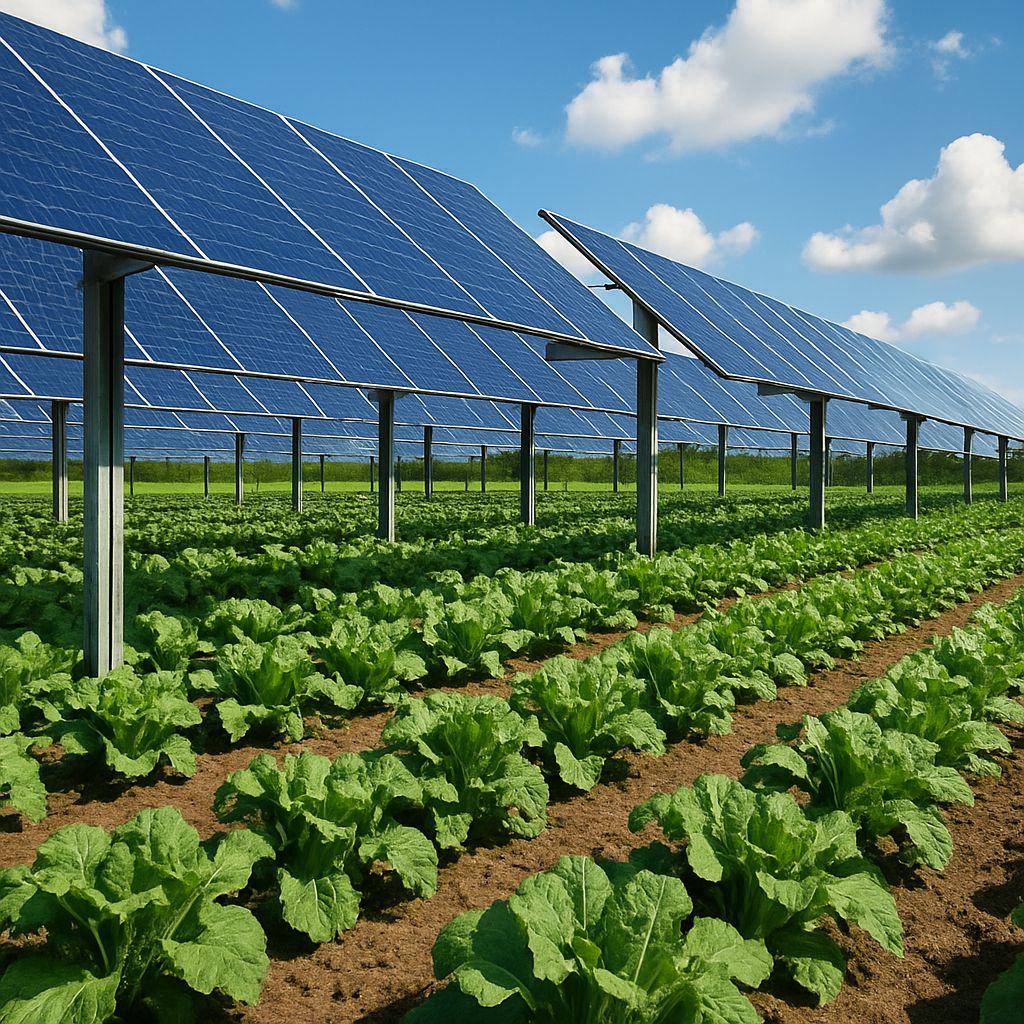
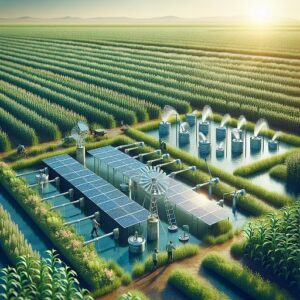
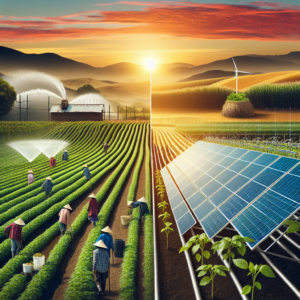
Agrivoltaics — the practice of co-locating solar panels and agricultural production on the same land — is one of the most financially exciting developments in farm solar. Rather than choosing between crop production and solar income, agrivoltaic systems allow farmers to do both simultaneously on the same acreage. Research from Michigan State University has shown that this dual-use approach can generate up to 25 times more income per acre compared to conventional crop farming alone.
Which Crops Benefit Most from Agrivoltaic Systems
Not every crop thrives under solar panels, but many do — particularly those that benefit from partial shade. Leafy greens like lettuce and spinach, herbs, strawberries, and certain root vegetables have demonstrated strong yields in agrivoltaic arrangements. Shade-tolerant crops often show reduced water stress and improved quality metrics when grown beneath panel arrays. Pollinator-friendly ground cover and grazing operations for sheep have also proven highly compatible with solar arrays, with several utility-scale projects now integrating managed grazing directly beneath panel rows.
Water Savings and Reduced Irrigation Costs
One of the less-discussed financial benefits of agrivoltaic systems is water conservation. Solar panels shade the soil beneath them, reducing evaporation rates and soil moisture loss. Research has shown that crops grown in agrivoltaic systems can require up to 50% less irrigation water compared to fully exposed growing conditions. For farms in water-stressed regions or those paying significant costs for irrigation, this reduction translates directly into lower operating expenses — compounding the financial benefit of solar beyond just the electricity savings.
Financing Options That Make Solar Affordable Right Now
The upfront capital requirement of a solar installation is real, but it doesn’t have to be a barrier. A range of financing structures have been developed specifically to match how agricultural businesses operate — with seasonal cash flow, asset-rich but liquidity-constrained balance sheets, and long planning horizons. For those interested in maximizing their land use, some farmers are exploring ways to grow mushrooms under solar panels to boost their yield.
The right financing option depends on your tax situation, cash flow, and how quickly you want to start seeing a return. Here’s a breakdown of the primary paths available to farm operations today.
- Solar purchase loans — Traditional financing through agricultural lenders or solar-specific loan programs, allowing farmers to own the system and capture all incentives including the ITC and MACRS depreciation
- USDA REAP loan guarantees — Backed by the federal government, reducing lender risk and enabling more favorable interest rates for rural agricultural borrowers
- Power Purchase Agreements (PPAs) — A third-party developer installs and owns the system on your property; you buy the power it generates at a fixed rate below your current utility rate, with zero upfront cost
- Solar leases — Similar to PPAs but with fixed monthly payments rather than per-kilowatt-hour pricing; useful for farms that want predictable costs without ownership complexity
- Farm Credit System loans — Institutions like Farm Credit Services of America and AgriFinancial offer renewable energy financing specifically structured around agricultural cash flow cycles
- PACE financing — Property Assessed Clean Energy programs allow farmers in participating states to finance solar through a property tax assessment, with repayment tied to the land rather than personal credit
For farmers who can absorb the ITC and MACRS depreciation benefits — meaning they have sufficient federal tax liability — purchasing the system outright through a loan typically delivers the best long-term financial return. Those without significant tax appetite may find PPAs or leases more immediately beneficial, even though they forfeit the ownership incentives. The right answer is farm-specific, and a conversation with a solar financier who understands agricultural tax structures is worth the time before committing to any one path.
Solar Loans with Low Interest Rates for Agricultural Operations
Solar loans designed for agricultural operations are available through both traditional lenders and specialized clean energy financing institutions. Interest rates for farm solar loans currently range from approximately 4% to 8% depending on creditworthiness, loan term, and lender type. The critical advantage of a loan over a lease or PPA is ownership — when you finance a solar purchase, you claim the 30% federal ITC, the MACRS depreciation schedule, and any state incentives. Those benefits alone can effectively reduce your loan principal by 40% to 60% in the first year when properly applied, dramatically shortening your real payback period. For more information on how certain crops thrive under solar panels, you can explore additional resources.
Power Purchase Agreements (PPAs): Zero Upfront Cost Option
A Power Purchase Agreement lets a solar developer install a system on your farm at no upfront cost. In exchange, you agree to buy the electricity the system generates at a fixed per-kilowatt-hour rate — typically 10% to 30% below your current utility rate — for a contract term of 15 to 25 years. The immediate savings are real even on day one, and you carry zero installation risk or maintenance responsibility since the developer owns the equipment. The trade-off is straightforward: you don’t own the system, so you don’t capture the ITC or depreciation benefits. For farms with limited tax liability or tight capital, a PPA remains one of the most accessible entry points into solar savings.
Farm Credit System Loans for Renewable Energy Projects
The Farm Credit System is a network of agricultural lenders that exists specifically to finance farm operations — and renewable energy projects fall squarely within their mandate. Institutions like Farm Credit Services of America and CoBank offer solar financing structured around agricultural realities: seasonal repayment schedules, deferred payment options during low-revenue periods, and loan officers who understand farm balance sheets. For farmers who want to own their system but need financing terms that accommodate irregular cash flow, the Farm Credit System is often the most practical and farmer-friendly lending option available.
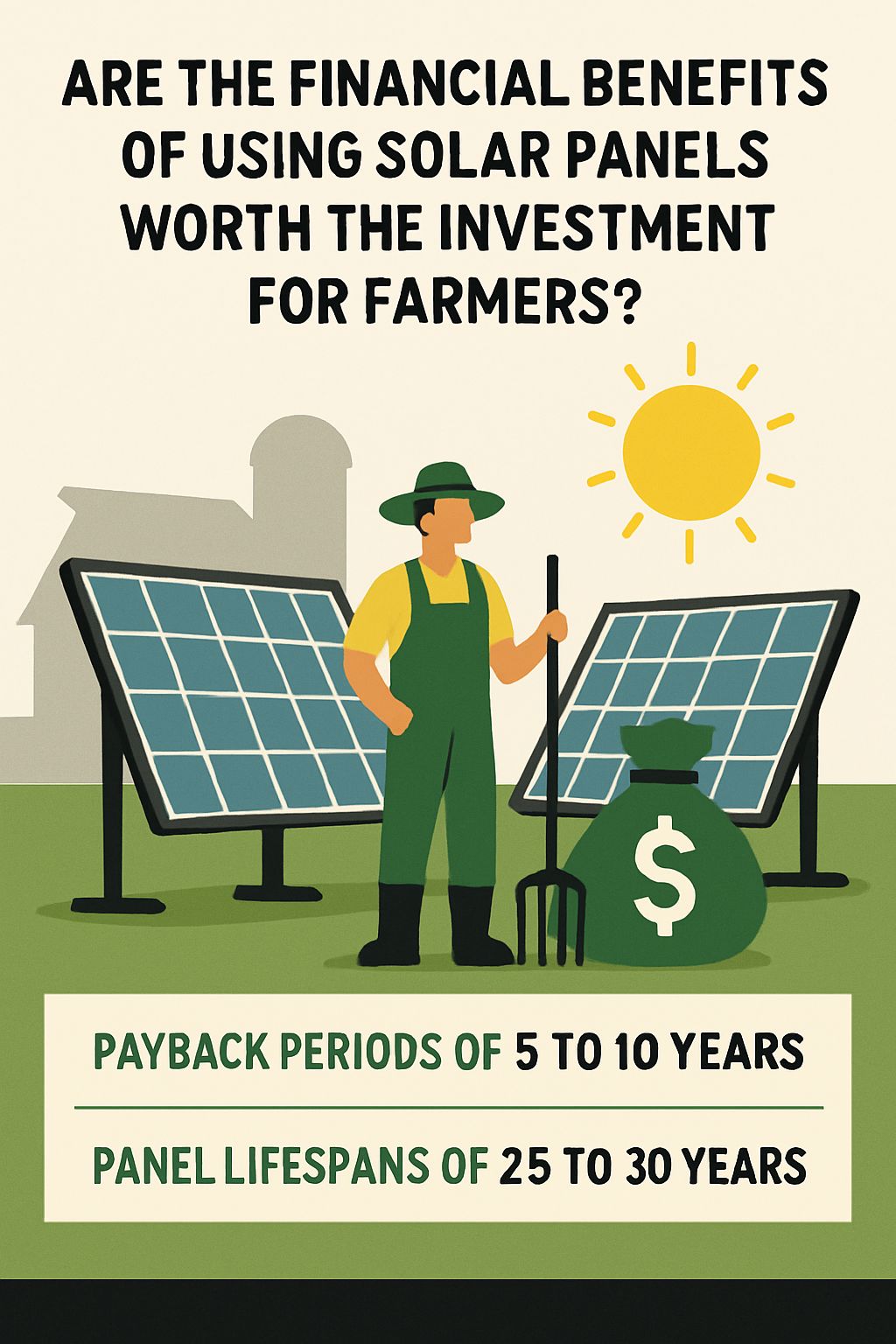
Are the Financial Benefits of Using Solar Panels Worth the Investment for Farmers?
The answer, for most farm operations, is a clear yes — and the data backs that up. With payback periods of 5 to 10 years, panel lifespans of 25 to 30 years, average annual ROI between 10% and 20%, and the ability to stack federal tax credits, USDA grants, and state rebates simultaneously, solar represents one of the strongest capital investments available to agricultural producers today. The combination of reduced operating costs, new income streams through net metering or land leasing, and long-term energy price stability creates a financial profile that few other farm investments can match. For farmers who are still on the fence, the more pressing question isn’t whether solar pays off — it’s how much longer you can afford to wait while energy costs keep climbing.
Frequently Asked Questions
Farmers considering solar often have the same core questions: How long before it pays for itself? Can smaller operations realistically afford it? What programs exist to help cover the cost? The answers are more encouraging than many expect, and understanding the specifics makes it easier to move from consideration to action.
Below are the most common questions farmers ask about the financial side of solar — answered directly with the numbers and details that actually matter for agricultural decision-making.
How Long Does It Take for Farm Solar Panels to Pay for Themselves?
Most farm solar installations reach full payback within 5 to 10 years. Farms in high-electricity-rate states with access to strong incentive programs — particularly the federal ITC and USDA REAP grants — often land closer to the 5-year end of that range. After the payback period is complete, the system continues generating electricity for another 15 to 25 years with minimal maintenance costs, meaning the majority of a solar system’s productive life is spent generating pure financial return. The payback clock starts moving faster when incentives are properly stacked and the system is accurately sized to actual farm energy consumption.
Can Small Farms Afford Solar Panel Installation?
Yes — and small farms have more options than many realize. A 15 kW to 50 kW system sized for a small operation costs significantly less in absolute terms than utility-scale installations, and the same federal incentives apply regardless of system size. The 30% ITC, USDA REAP grants, and accelerated MACRS depreciation are all available to small agricultural producers. Power Purchase Agreements (PPAs) eliminate upfront costs entirely, making solar accessible even for farms with limited capital. PACE financing in participating states removes credit barriers by tying repayment to the property itself rather than personal finances. The financial tools designed to make solar accessible exist specifically because small farm adoption was identified as a policy priority.
What Government Grants Are Available for Farm Solar in the US?
The primary federal grant program for farm solar is the USDA Rural Energy for America Program (REAP), which provides grants covering up to 50% of eligible project costs for agricultural producers and rural small businesses. REAP applications are accepted on a rolling basis throughout the year, and grants can be combined with REAP loan guarantees for even greater coverage. Priority scoring in the REAP program favors projects with strong energy savings potential, smaller project sizes, and applicants in underserved rural areas.
Beyond REAP, the USDA’s Environmental Quality Incentives Program (EQIP) can provide financial assistance for energy-efficient improvements on farms, including components that integrate with solar systems. State-level grant programs vary widely — New York, Illinois, and Massachusetts have historically offered agricultural solar grants through their state energy offices. The DSIRE database at dsireusa.org is the most current and comprehensive resource for identifying what’s available in your specific state, and many programs require pre-approval before installation begins, so checking early in the planning process is essential.
Does Solar Power Work for Farms in Cloudy Regions?
Solar panels generate electricity from daylight, not direct sunlight — which means they produce power even under overcast conditions, just at a reduced output level compared to full sun. Germany, one of the cloudiest industrialized nations in the world, is consistently among the top solar energy producers globally, which demonstrates that solar viability isn’t limited to the Sun Belt. In the United States, states like New York, Michigan, and Washington all have active and financially viable farm solar installations despite receiving significantly less annual sunlight than states like Arizona or Texas.
The financial impact of reduced sunlight is real but manageable. Systems in cloudier regions are typically sized slightly larger to compensate for lower peak production hours, which increases upfront costs modestly. However, net metering policies in many northern states are strong, and the federal ITC and REAP grants apply equally regardless of geography. A qualified solar installer can run a site-specific production estimate using historical solar irradiance data for your exact location — that number is what drives your actual savings projection, and it’s more accurate than broad regional assumptions. For more details on how solar panels can reduce energy costs, you can explore this resource.
Can Farmers Earn Money by Selling Solar Energy Back to the Grid?
Yes — farmers who own their solar systems can sell surplus electricity back to the grid through net metering or direct utility agreements, creating an active income stream from their solar infrastructure. Under net metering, excess production is credited to your utility account at either the full retail rate or a wholesale rate depending on your state’s policy. Those credits offset future bills or, in some states, result in a direct payment if credits exceed consumption over a billing cycle.
The income potential from selling back to the grid depends on system size, local utility rates, and how much surplus your farm generates relative to its own consumption. A well-sized system on a farm with lower seasonal energy demand during peak solar months — for example, a grain operation between planting and harvest — can generate significant exportable surplus during those periods.
Farmers interested in maximizing grid revenue should also explore whether their utility offers a commercial solar tariff or a dedicated agricultural net metering rate, as some utilities provide more favorable terms for farm-scale systems than for standard residential net metering. In certain deregulated energy markets, farmers can also negotiate direct Power Purchase Agreements with energy buyers, bypassing the utility entirely for even better per-kilowatt-hour pricing.


Leave a Reply