

Key Takeaways:
- Most herbs naturally thrive in partial shade — solar panels create the ideal dappled light environment that many culinary herbs evolved to grow in.
- Agrivoltaic herb farming can reduce water use by 20–30% while simultaneously increasing yields for shade-tolerant varieties like mint, parsley, and lemon balm by 10–30% during summer months.
- Panel layout matters more than most farmers realize — row orientation, panel height, and spacing directly determine which zones get enough light for which herbs.
- Not all herbs belong under solar arrays — some sun-loving varieties actually suffer in low-light conditions, and knowing which ones to avoid can save an entire season’s crop.
- Small-scale agrivoltaic herb plots are proving highly profitable — read on to find out what real farmers are reporting from their solar-shaded growing zones.
Solar Panels and Fresh Herbs Are a Natural Fit
Growing fresh herbs under solar panels isn’t a workaround — it’s actually one of the smartest dual-use land strategies available to farmers today.
The concept falls under agrivoltaics, a rapidly growing field that combines solar energy production with active crop cultivation on the same land. What makes herbs particularly exciting in this context is that many of them didn’t evolve in open fields baking under full sun — they evolved beneath tree canopies, in forest edges, and in sheltered clearings. Solar panels, as it turns out, mimic those conditions remarkably well. For growers looking to explore this space, Growing Solar Mist offers practical resources on integrating crop production with solar infrastructure.
The result is a growing system where the energy asset above and the food crop below actually support each other. Panels reduce heat stress on herbs. Herbs, in turn, keep the ground cooler, which marginally improves panel efficiency. It’s a feedback loop that benefits both systems — and it starts with understanding why herbs and shade are already a natural pairing.
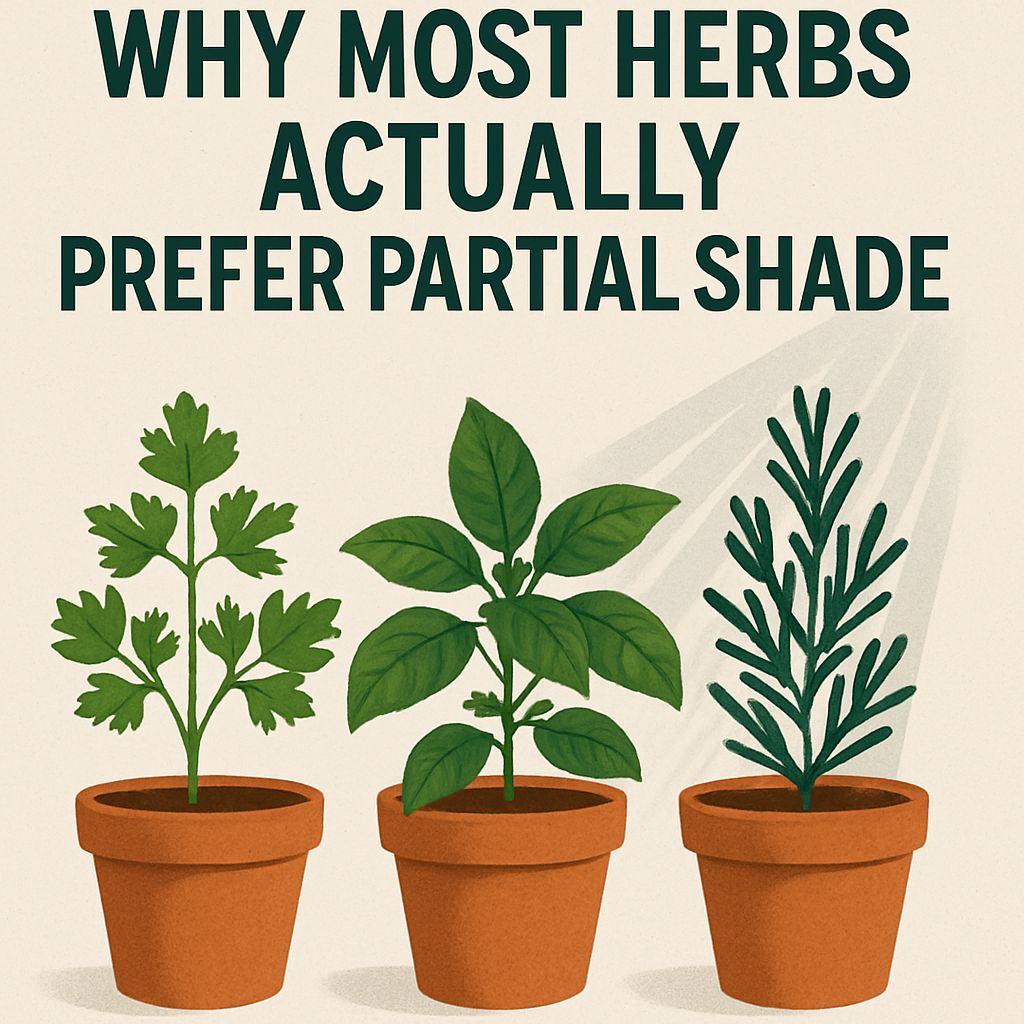
Why Most Herbs Actually Prefer Partial Shade
The assumption that all herbs need full sun is one of the most common mistakes in herb cultivation. While it’s true that some Mediterranean herbs like rosemary and lavender evolved in high-sun, dry environments, a large portion of the most popular culinary herbs — mint, parsley, cilantro, chives, and lemon balm — actually perform better with protection from intense midday sun. Excessive solar radiation doesn’t just cause wilting; it triggers early bolting, toughens leaf texture, and reduces the aromatic oil content that makes fresh herbs valuable in the first place.
Key insight: Many culinary herbs evolved as understory plants beneath forest canopies. The filtered, dappled light produced by elevated solar panels closely replicates that natural growing environment — often producing more tender, more flavorful harvests than open-field cultivation.
Understanding why shade helps comes down to two core mechanisms: light saturation limits and heat stress reduction. Both explain why solar panels aren’t just tolerated by herbs — they’re genuinely beneficial.
The Light Saturation Point Explained
Every plant has a light saturation point — the maximum light intensity at which photosynthesis continues to increase. Beyond that threshold, additional light produces no extra growth and often causes photoinhibition, where the plant’s photosynthetic machinery is actually damaged. For shade-adapted herbs like mint and parsley, that saturation point sits well below full midday sun. Solar panels intercept the excess radiation before it reaches the plant, keeping light levels in the productive range for longer throughout the day.
Heat Stress and How Panels Reduce It
Soil temperature under solar arrays runs measurably cooler than in open fields on hot days. This matters enormously for herbs because root zone temperature directly influences water uptake, nutrient absorption, and overall plant vigor. When soil stays cooler, herbs spend less energy on stress responses and more energy on leaf and stem development — which is exactly the biomass that gets harvested and sold. Panels also block hail, moderate heavy rain impact, and reduce evaporation rates from both soil and plant surfaces. Learn more about how farmers can protect solar panels from environmental damage.
The combined effect is a microclimate that extends the productive growing season at both ends — earlier spring starts and later autumn harvests — without any additional infrastructure investment beyond what the solar array already provides.
Which Herbs Tolerate Low Light vs. Need More Sun
Not every herb responds the same way. Here’s a straightforward breakdown:
|
Herb |
Light Preference |
Solar Panel Suitability |
|---|---|---|
|
Mint |
Partial shade |
✓ Excellent |
|
Parsley |
Partial shade to full sun |
✓ Excellent |
|
Chives |
Partial shade |
✓ Excellent |
|
Cilantro |
Cool, partial shade |
✓ Excellent |
|
Lemon Balm |
Partial shade |
✓ Excellent |
|
Oregano |
Full sun preferred |
△ Moderate |
|
Thyme |
Full sun preferred |
△ Moderate |
|
Rosemary |
Full sun required |
✗ Poor |
|
Lavender |
Full sun required |
✗ Poor |
Best Fresh Herbs to Grow Under Solar Panels
Selecting the right herbs for your solar array isn’t guesswork — it’s matching plant biology to the specific microclimate your panels create. The herbs below consistently outperform open-field counterparts in agrivoltaic systems, and each one brings something distinct to the table in terms of yield volume, market value, and ease of management.
Placement matters within the array itself. The zones directly beneath panel centers receive the deepest shade, while the gaps between rows and the edges of the array receive significantly more light. Mapping which herbs go where — based on their individual light tolerance — is what separates a high-yield solar herb operation from a mediocre one.
Most of the herbs listed below are perennials or fast-cycling annuals, which makes them ideal for the agrivoltaic model. They can be harvested multiple times per season, require relatively low inputs, and respond well to the modified microclimate conditions that solar infrastructure creates.
- Mint — thrives in partial shade, spreads aggressively, high essential oil yield
- Parsley — biennial with excellent shade tolerance, consistent market demand
- Chives — low maintenance, strong regrowth after cutting, handles reduced light well
- Cilantro — shade delays bolting significantly, extends harvest window
- Lemon Balm — exceptional shade adapter, prized for aromatics and herbal tea markets
- Oregano — moderate shade tolerance, best positioned at array edges
- Thyme — workable in partial shade, quality maintained with strategic placement
1. Mint
Mint is the standout performer in agrivoltaic herb systems. It naturally grows along stream banks and forest edges where overhead canopy filters direct sunlight — conditions that solar panels replicate almost precisely. Beneath panels, mint produces more tender leaves with higher essential oil concentration compared to plants grown in full sun, where heat-driven moisture loss toughens the foliage. It also spreads laterally with enthusiasm, meaning a well-managed mint plot can fill available growing space efficiently across multiple harvests per season.
2. Parsley
Parsley is a workhorse crop for solar panel systems. Both flat-leaf and curly varieties handle partial shade without significant yield penalties, and the cooler soil temperatures under panels actually reduce the risk of the summer slowdown that parsley growers in hot climates typically experience. The extended growing window under panels — both earlier in spring and later into fall — allows for more harvests per year than open-field production typically permits. Learn more about crops that thrive under solar panels.
For commercial growers, this extended season translates directly to revenue. Parsley maintains consistent wholesale and retail pricing year-round, making it a reliable anchor crop in any agrivoltaic herb mix.
3. Chives
Chives are among the lowest-maintenance herbs you can grow under solar panels. They tolerate partial shade well, require minimal intervention between harvests, and regenerate quickly after cutting — often producing four to six harvests per growing season under managed conditions. Their shallow root systems also make them ideal candidates for raised beds installed beneath elevated solar arrays.
4. Cilantro
Cilantro’s biggest challenge in open-field production is bolting — the rapid shift to seed production triggered by heat and long daylight hours. Solar panels address both triggers simultaneously. Shade reduces soil and air temperature, while the partial light interruption slows the photoperiod response that initiates bolting. Growers consistently report that cilantro planted under panels produces harvestable leaf material for significantly longer than field-grown plants, often doubling or tripling the usable harvest window in summer months.
5. Lemon Balm
Lemon balm is one of the most shade-adapted herbs in commercial production. A member of the mint family, it actively prefers environments where direct sunlight is filtered rather than constant. Under solar panels, lemon balm develops lush, fragrant foliage that commands premium pricing in herbal tea, aromatherapy, and specialty food markets.
It’s also notably drought-tolerant once established, which aligns well with the reduced irrigation requirements of shaded growing zones beneath panels. For farmers looking to diversify into higher-margin herb categories, lemon balm is one of the most compelling options available in an agrivoltaic setup.
6. Oregano
Oregano sits in the moderate category for solar panel compatibility. It prefers full sun but tolerates partial shade without catastrophic yield loss, making it a viable choice for the lighter-shaded zones at the edges of solar arrays or in wider row-gap areas where more direct light penetrates. For more information on how to optimize your farm’s energy use, explore solar panel power solutions for farms.
The key consideration with oregano in agrivoltaic systems is essential oil concentration. Some research suggests that reduced light intensity can marginally lower aromatic compound production in full-sun herbs like oregano, so placement strategy matters. Positioning oregano where it receives morning sun and afternoon shade — rather than deep midday shade — tends to preserve the flavor profile that culinary and commercial buyers expect.
Harvest timing also plays a role. Cutting oregano just before flowering, when essential oil content peaks regardless of light conditions, helps offset any reduction in aromatic intensity caused by partial shading.
7. Thyme
Thyme is workable in agrivoltaic systems when placement is handled thoughtfully. Like oregano, it’s a Mediterranean herb that evolved in high-sun, low-humidity environments — so deep shade beneath panel centers isn’t ideal. However, positioned along array edges or in wider inter-row gaps where dappled light is consistent throughout the day, thyme produces acceptable yields with good aromatic quality. The key advantage panels offer thyme is temperature moderation during peak summer heat, which reduces the woody stem development that accelerates when plants are heat-stressed in open fields. Learn more about crops that thrive under solar panels.

How Panel Layout Directly Impacts Herb Yield
The solar array itself is not a uniform environment — it’s a mosaic of light intensities, moisture zones, and temperature gradients that shift throughout the day and across seasons. How your panels are arranged determines what grows well and where. Getting this right is the difference between a productive dual-use system and a setup where half your herb crop underperforms because it ended up in the wrong light zone.
Panel Height and Spacing for Maximum Light Diffusion
Panel height above the growing surface is one of the most significant variables in agrivoltaic herb production. Arrays mounted at 2.5 to 4 meters above ground allow sufficient light penetration to the understory while still providing meaningful shade during peak sun hours. Lower mounting heights create deeper, more consistent shade that suits mint, lemon balm, and parsley well, but may be too restrictive for oregano and thyme. Higher mounting creates a more diffuse light environment across a broader area, giving growers more flexibility in herb placement.
Row spacing between panel strings directly controls the width of the light corridors herbs can access. Wider spacing — commonly 4 to 6 meters between rows — creates alternating bands of fuller light and panel shade, which experienced agrivoltaic growers use intentionally to position different herb varieties in the zone that matches their light requirements. Narrower spacing reduces these light corridors and pushes the entire understory toward deeper shade, limiting viable herb options to the most shade-tolerant varieties.
East-West vs. North-South Row Orientation
Row orientation determines how shadow patterns move across the growing surface throughout the day. North-South oriented rows cast shadows that sweep east to west as the sun tracks across the sky, meaning most planting zones beneath the array receive a rotating mix of direct and filtered light throughout the day. This dynamic light environment suits a wider range of herbs because no single zone stays in deep shade all day.
East-West oriented rows cast more consistent, stationary shadows on the north-facing side of each panel row, creating a persistent shade zone that stays cool and dark for most of the day. This orientation is highly favorable for deep shade herbs like mint and lemon balm but creates challenging conditions for moderate-sun herbs like oregano and thyme. Understanding your array’s orientation before you plan your herb layout will save you from mismatched plantings that never reach their yield potential. For farmers interested in maximizing their setup, exploring the benefits of solar panels can provide additional insights.
Bifacial Panels and Reflected Light Benefits
Bifacial solar panels — which capture light from both the front and rear surfaces — introduce an additional dynamic that’s genuinely useful for herb growers. When these panels are installed over light-colored ground cover or reflective mulch, they bounce ambient light upward from the ground surface back through the panel array. This scattered, diffuse light reaches plants growing in otherwise shaded zones and supplements their light intake without introducing the direct radiation intensity that causes heat stress. For herbs in the moderate shade category, this reflected light can meaningfully improve growth rates without compromising the cooling benefits the array provides.
Soil and Water Management Under Solar Arrays
One of the most immediate changes growers notice when they begin farming beneath solar panels is how differently the soil behaves compared to open-field plots. The altered moisture dynamics, temperature regulation, and rainfall interception created by the array above fundamentally change how you need to approach irrigation systems, soil amendment, and drainage management.
Getting soil management right under solar panels isn’t just about keeping herbs alive — it’s about leveraging the unique conditions the array creates to actively improve growing outcomes. The panels do a significant amount of work for you if you understand what they’re changing and respond accordingly.
The two most critical factors to manage are soil moisture distribution and irrigation scheduling. Both behave differently under a solar array than in open-field conditions, and both require specific adjustments to maximize herb yield.
How Panels Alter Soil Moisture Levels
The Drip Line Effect: Solar panels intercept rainfall and channel it to the edges of the array in concentrated drip lines — similar to roof eaves. The soil directly beneath panel centers receives significantly less rainfall than open fields, while the zones at panel edges can receive concentrated runoff. Without active irrigation management, this creates a patchwork of dry and oversaturated zones that directly disrupts herb root health.
This moisture redistribution effect is one of the most underestimated challenges in agrivoltaic herb farming. Growers who transition from open-field production often assume their existing rainfall assumptions still apply — but beneath a solar array, effective precipitation reaching the soil surface can be reduced by 20 to 40% depending on panel density and array configuration. In practice, this means herbs in the drier central zones under panels may show moisture stress even during weeks of regular rainfall.
On the positive side, evaporation rates from shaded soil are substantially lower than from sun-exposed ground. The net effect in many climates is that total soil moisture retention under the array is comparable to or better than open fields, but the distribution of that moisture is highly uneven. Active irrigation — rather than rainfall reliance — is the correct management response.
Soil temperature stability is another benefit worth noting. Shaded soil under panels shows smaller temperature swings between day and night, which promotes more consistent microbial activity, better nutrient cycling, and more stable root zone conditions for herbs like parsley, mint, and chives that perform best in even-tempered soil environments.
Irrigation Adjustments for Shaded Growing Zones
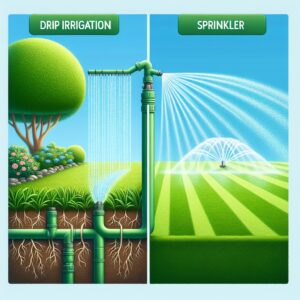
Drip irrigation is the recommended approach for herb production beneath solar arrays. Surface drip lines or subsurface emitters placed at the base of each herb row deliver moisture directly to the root zone, bypassing the uneven rainfall distribution caused by the panels above. This method also reduces foliar moisture — a critical consideration since humid leaf surfaces in the relatively still air beneath solar arrays can accelerate fungal disease development in dense herb plantings.
Irrigation scheduling beneath panels requires recalibration from open-field baselines. Because evapotranspiration rates are lower in shaded, cooler soil, the same herbs typically require 15 to 30% less water than identical plantings in full sun. Overwatering is a genuine risk for growers who don’t adjust their schedules when they transition crops beneath a solar array. Waterlogged soil in shaded zones encourages root rot in herbs like thyme and oregano that require good drainage to thrive.
Soil moisture sensors installed at root depth in multiple zones across the array are the most reliable way to calibrate irrigation timing. Given that different zones within the same array can have meaningfully different moisture levels due to the drip line effect, zone-by-zone monitoring produces significantly better results than a single timer-based irrigation schedule applied uniformly across the entire plot. For more information on optimizing irrigation, explore our solar irrigation systems guide.
|
Irrigation Factor |
Open Field Baseline |
Under Solar Array |
|---|---|---|
|
Water requirement |
100% standard rate |
70–85% of standard rate |
|
Evaporation rate |
High in summer |
Reduced by panel shade |
|
Rainfall effectiveness |
Even distribution |
Uneven; drip line effect |
|
Recommended method |
Sprinkler or drip |
Drip irrigation only |
|
Monitoring approach |
Schedule-based |
Sensor-based, zone-by-zone |
Practical Tips to Maximize Herb Yield Per Square Foot
Agrivoltaic herb farming rewards precision. The growers getting the strongest yields per square foot beneath their arrays aren’t doing anything dramatically different — they’re making a series of small, well-informed decisions about variety selection, bed design, soil management, and harvest timing that compound into measurably better results across the season.
1. Match Herb Varieties to Your Panel Shade Density
Before planting anything, map the shade density across your array at different times of day using a simple light meter or smartphone lux meter app. Identify your deep shade zones (directly beneath panel centers), your moderate shade zones (mid-row gaps), and your light-exposure zones (array edges and wider inter-row corridors). Then match your herb selection to each zone: mint and lemon balm in deep shade, parsley and chives in moderate shade, oregano and thyme at the sunnier edges. This single step does more for yield optimization than almost any other intervention.
2. Use Raised Beds to Improve Drainage and Root Health
Raised beds installed beneath solar arrays solve several problems at once. They improve drainage in zones where panel drip lines concentrate runoff, prevent soil compaction from maintenance foot traffic around the array, and allow growers to customize soil composition for specific herb varieties in different zones. A raised bed filled with a well-draining loam and compost mix gives mint and parsley a significantly better root environment than compacted native soil that may have been disturbed during panel installation.
Bed height of 20 to 30 centimeters is sufficient for most culinary herbs. This depth accommodates root systems comfortably, retains enough moisture for consistent growth, and drains freely enough to prevent the waterlogging that shaded soil is susceptible to when irrigation or rainfall is heavy. Wooden or galvanized steel bed frames both work well in the array environment, though galvanized steel tends to handle the humidity cycling beneath panels with greater longevity.
3. Apply Mulch to Retain Moisture in Drier Panel Zones
The dry zones that develop beneath panel centers — where rainfall is most intercepted — benefit significantly from a 5 to 8 centimeter layer of organic mulch applied around herb root zones. Straw, wood chips, and shredded leaf mulch all reduce evaporation from exposed soil surfaces, moderate soil temperature, and suppress weed competition in areas where reduced light doesn’t fully prevent weed germination.
Mulch also gradually breaks down and contributes organic matter to the soil profile beneath the array — an ongoing benefit that improves soil structure and microbial activity over multiple growing seasons. In agrivoltaic systems where growers are cultivating the same plots year after year, this incremental soil improvement compounds into meaningfully better growing conditions over time.
Avoid thick mulch applications directly against herb stems, particularly for woody-stemmed varieties like thyme and oregano. Mulch pressed against stems in the humid, lower-airflow environment beneath panels creates ideal conditions for collar rot. Keep a clear 5 centimeter gap between mulch and stem bases to maintain adequate airflow at the soil surface.
4. Rotate Herb Placement Seasonally Based on Sun Tracking
Solar angle changes significantly between summer and winter, which means the shadow patterns cast by your array shift across the seasons. A zone that sits in moderate shade during July may receive considerably more direct light in October as the sun drops lower in the sky and shadows lengthen. Growers who map their array’s shadow behavior across seasons — rather than just at peak summer — can rotate herb placements to take advantage of these shifting light conditions, moving sun-tolerant varieties like oregano and thyme into zones that open up to more light in shoulder seasons.
5. Harvest Frequently to Encourage Bushier, Denser Growth
The single most effective cultural practice for increasing herb yield per square foot beneath solar panels is consistent, frequent harvesting. When you cut herbs regularly — removing no more than one-third of the plant’s total growth at each harvest — you signal the plant to produce lateral branching rather than vertical stem elongation. The result is a denser, bushier plant that produces significantly more harvestable leaf material per square foot over the course of a season than a plant left to grow unchecked. In the sheltered, moderate-light environment beneath a solar array, this effect is particularly pronounced because plants aren’t diverting energy into stress responses. For more on this topic, explore how farming under solar panels can enhance plant growth.
For mint, chives, and lemon balm, harvesting every 3 to 4 weeks during the active growing season keeps plants in a continuous vegetative state that maximizes leaf production. Parsley responds well to outer-stem harvesting, where older stems are removed first, encouraging the center crown to keep pushing new growth. Cilantro under panels — already benefiting from delayed bolting — should be harvested as soon as leaves reach usable size to maintain the productive vegetative phase as long as possible before the plant eventually flowers.

Yield Results Farmers Are Seeing With Agrivoltaic Herb Farming
The data coming out of agrivoltaic herb operations — from small-scale market garden setups to larger commercial arrays — consistently tells the same story: shade-tolerant herbs grown beneath solar panels outperform their open-field counterparts in key metrics during the warmest months of the year, while also delivering meaningful resource savings that improve the overall economics of herb production. For more insights on the advantages, explore the benefits of solar panels for farmers.
Leafy Herb Yield Increases of 10–30% in Summer Months
- Mint and lemon balm show the strongest yield gains, consistently performing at the upper end of the 10–30% improvement range compared to open-field plots during summer
- Parsley yield improvements are particularly notable in hot climates where open-field summer production is typically compromised by heat stress and bolting pressure
- Cilantro harvest windows extend significantly under panels — in some documented cases doubling the number of days between planting and bolting compared to full-sun plantings in the same region
- Chives demonstrate consistent multi-harvest productivity throughout summer months, with regrowth rates maintained at levels comparable to spring production rather than declining as they typically do in open-field summer heat
- Leafy greens grown alongside herbs in the same agrivoltaic systems demonstrate yield increases in the 10–30% range, validating the broader performance trajectory observed across shade-tolerant crops
What drives these numbers isn’t any single factor — it’s the compounding effect of multiple simultaneous improvements the solar array creates. Cooler soil temperatures, reduced evapotranspiration, protection from hail and heavy rain, and moderated light intensity all contribute to a growing environment that is simply less stressful for shade-adapted herbs than an open field during peak summer conditions.
The most significant yield gains are consistently observed during the June through August window in temperate climates — precisely the period when open-field herb production is most challenged by heat and drought stress. This timing is strategically valuable for commercial herb growers because summer is often the period of highest fresh herb demand in culinary and farmers’ market channels, meaning higher yields arrive exactly when market prices and buyer demand are strongest.
It’s also worth noting that yield quantity is only part of the picture. Growers consistently report that herbs harvested from solar array understories demonstrate superior leaf texture, color, and aromatic quality compared to heat-stressed open-field equivalents. For premium culinary herb markets — restaurants, specialty grocers, and direct-to-consumer operations — this quality differential can command price premiums that amplify the revenue impact of yield improvements beyond what raw tonnage numbers suggest.
Water Use Reductions of 15–30% Across Herb Plots
Reduced irrigation demand is one of the most economically significant benefits of agrivoltaic herb production, and the figures are consistent across different climates and array configurations. Herb plots beneath solar panels typically require 15 to 30% less water than equivalent open-field plantings to achieve the same or better yields. The mechanism is straightforward: panel shade reduces soil surface temperature and slows evaporation, while also reducing the transpiration demand on plants that are no longer managing full sun heat load.
For commercial herb operations in water-constrained regions — increasingly common as climate patterns shift — this reduction isn’t just a cost saving, it’s a resilience strategy. Operations that can maintain full herb production through summer dry periods while neighboring open-field growers are rationing irrigation have a meaningful competitive advantage in both yield volume and market reliability. The water savings compound in importance as irrigation costs and water access restrictions increase across agricultural regions globally.
Herbs That Struggle Under Solar Panels and What to Do Instead
Rosemary, lavender, and basil are the three herbs most likely to disappoint growers who place them in deep shade beneath solar arrays without careful planning. Rosemary and lavender evolved in full Mediterranean sun and genuinely require high light intensity for both growth and essential oil production — partial shade doesn’t just reduce their yield, it fundamentally compromises the aromatic quality that makes them commercially valuable. Basil is more nuanced: it tolerates partial shade better than rosemary or lavender, but in deep shade beneath panel centers, it grows slowly, produces smaller leaves, and becomes more susceptible to fungal issues in the humid, low-airflow understory environment. The practical solution for all three is placement at array edges or in the widest inter-row light corridors where they receive meaningful direct sun for at least five to six hours daily — or, in the case of deep-shade zones, simply not planting them there at all and redirecting those spaces to herbs that genuinely benefit from the conditions panels create. For more insights on how to effectively utilize solar panels on farms, check out this guide on benefits of solar panels for farmers.
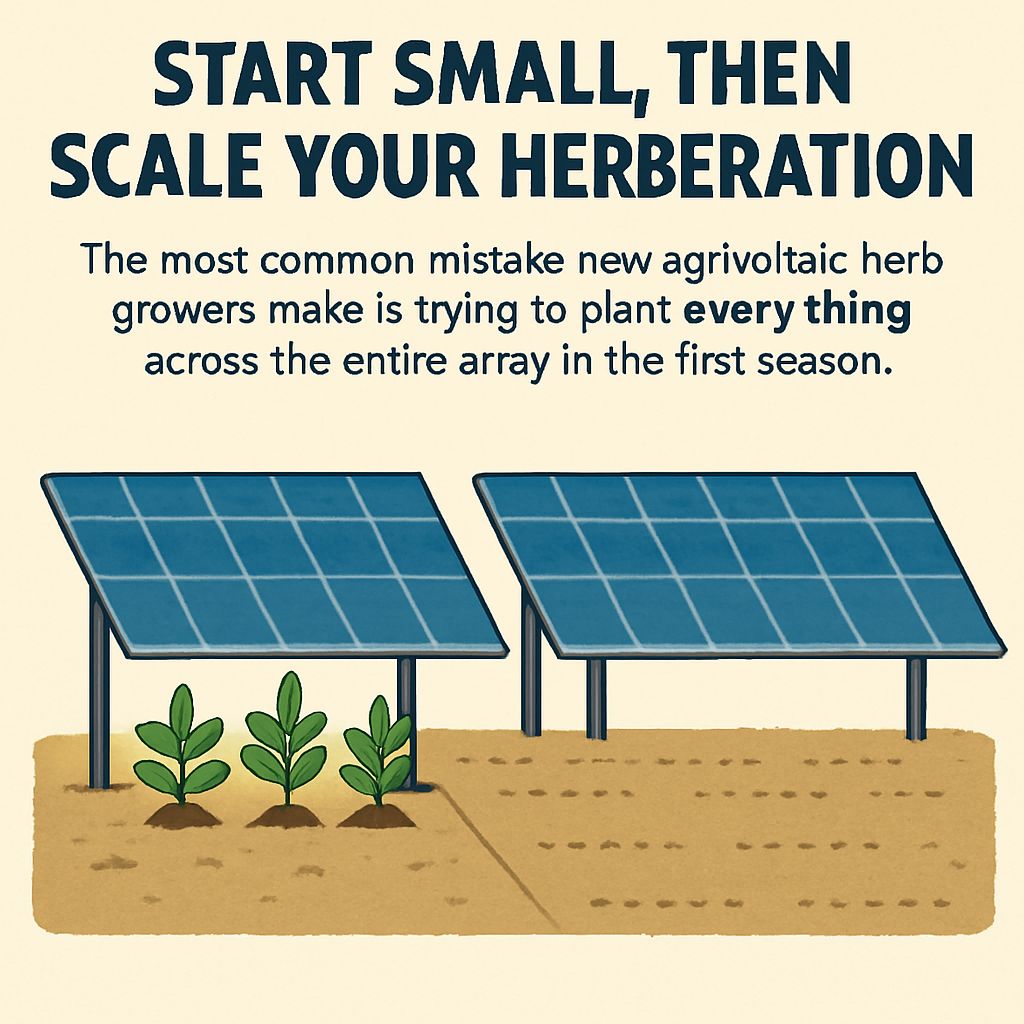
Start Small, Then Scale Your Herb Operation
The most common mistake new agrivoltaic herb growers make is trying to plant everything across the entire array in the first season. The light environment beneath your specific array — with its particular panel height, row spacing, orientation, and local sun angle — is unique to your site. Starting with a trial plot that covers two or three panel rows allows you to observe actual light distribution, soil moisture behavior, and herb performance before committing your full growing space and input budget to a configuration that may need adjustment.
In a trial-scale first season, focus on two or three high-confidence varieties — mint, parsley, and chives are reliable starters — planted across the different shade zones of your test rows. Track yield volume, harvest frequency, water usage, and any pest or disease issues across each zone. What you learn in that single season will give you the site-specific data needed to design a full-scale planting plan with far higher confidence than any generalized agrivoltaic guide can provide. Scale into the full array in season two with that knowledge in hand, and you’ll avoid the costly mismatches that come from planting blind.
Frequently Asked Questions
Agrivoltaic herb farming generates a consistent set of questions from growers who are new to the concept. Here are the most common ones, answered directly:
- Can I grow basil under solar panels?
- How much shade do solar panels actually cast on crops below?
- Do I need special solar panel equipment to grow herbs underneath?
- How far apart should solar panel rows be for herb farming?
- Is agrivoltaic herb farming profitable for small-scale farmers?
These questions come up repeatedly because they address the core practical concerns growers face when transitioning existing solar infrastructure into a productive dual-use system — or when designing a new agrivoltaic setup from scratch.
The answers vary depending on your specific array configuration, local climate, and target herb varieties. However, the principles below apply broadly across the wide range of agrivoltaic herb setups that are actively in production today, from small market garden installations to commercial-scale operations.
Use these answers as a starting framework, then refine your approach based on the site-specific observations you make during your first growing season beneath your particular array.
Can I grow basil under solar panels?
Basil can be grown under solar panels, but it requires careful placement. Unlike mint or parsley, basil is a full-sun herb that performs best with six or more hours of direct or bright filtered light daily. In deep shade beneath panel centers, basil tends to grow slowly, produce smaller and less flavorful leaves, and become prone to fungal issues due to reduced airflow and higher humidity. It is not an ideal candidate for the darkest zones of an agrivoltaic system.
The best approach for basil in a solar array is positioning it in the lightest available zones — array edges, south-facing inter-row gaps (in the northern hemisphere), or wherever your site mapping shows the highest average daily light intensity. Some growers in hot climates report that basil placed in moderate partial shade under panels actually performs comparably to open-field plants because the temperature moderation offsets the light reduction. In cooler climates, however, the light reduction tends to dominate and basil performance suffers more noticeably. Test a small basil planting in your sunniest array zone before committing significant space to it.
How much shade do solar panels actually cast on crops below?
The shade cast by solar panels varies significantly based on panel density, tilt angle, mounting height, and time of day — but as a general benchmark, standard fixed-tilt residential and commercial arrays reduce light reaching the ground surface by 30 to 70% depending on position beneath the array and season. Directly beneath panel centers, shade is deepest. In the inter-row gaps and at array edges, light levels are considerably higher. Shade also shifts throughout the day as the sun tracks across the sky, meaning most zones beneath a north-south oriented array experience a rotating pattern of shade and filtered light rather than constant darkness. For more insights, explore the benefits of solar panels for farmers.
Do I need special solar panel equipment to grow herbs underneath?
No specialized panel equipment is required to begin growing herbs beneath an existing solar array. Standard fixed-tilt panels at typical commercial or agricultural mounting heights create a suitable understory growing environment for shade-tolerant herbs without any modification to the solar infrastructure itself. Where growers do invest in upgrades, the most impactful options are elevated mounting systems (raising panels to 3–4 meters to allow more light penetration and easier access for harvesting equipment) and bifacial panels that capture reflected light from the ground surface. Both improve the growing environment beneath the array, but neither is a prerequisite for starting a productive agrivoltaic herb operation with existing infrastructure.
How far apart should solar panel rows be for herb farming?
Row spacing in an agrivoltaic herb system is one of the most important design variables you can control. The goal is to create inter-row corridors wide enough to provide meaningful light access to the herbs growing between panel strings, while still maintaining sufficient panel density for energy production goals. Most agrivoltaic systems optimized for crop production use row spacing of 4 to 6 meters between panel strings, which creates usable light corridors for a broad range of herb varieties.
Narrower spacing — below 3 meters — pushes the entire understory into conditions suitable only for the most shade-tolerant herbs. Wider spacing above 6 meters creates excellent growing conditions for a full range of herbs, including moderate-sun varieties like oregano and thyme, but reduces total solar energy output per unit of land area. The right balance depends on whether your primary revenue driver is energy production or herb sales, and this determination should inform array design before installation if you’re planning a new agrivoltaic system.
Row Spacing Guide for Agrivoltaic Herb Farming:
2–3 meters: Deep shade dominant — suitable for mint, lemon balm only
3–4 meters: Moderate shade — suitable for mint, parsley, chives, cilantro
4–6 meters: Mixed light corridors — suitable for full herb range including oregano and thyme at edges
6+ meters: High light access — full herb range viable across most zones, reduced energy density
If you are working with an existing fixed-installation array where row spacing is already set, focus your energy on understanding the actual light distribution your current spacing creates rather than redesigning the infrastructure. Map your light zones using a lux meter across different times of day and seasons, then match your herb selection to the conditions you actually have rather than the ones you might prefer.
For new installations where agrivoltaic herb production is a primary goal from the outset, engaging a solar installer experienced in dual-use agricultural systems is strongly recommended. The additional upfront planning to optimize row spacing, mounting height, and panel orientation for both energy yield and crop production will pay dividends across the full productive life of the array — typically 25 to 30 years for modern solar infrastructure.
Is agrivoltaic herb farming profitable for small-scale farmers?
Yes — and in many cases, agrivoltaic herb production generates stronger returns per square foot than either solar energy alone or open-field herb farming alone. The dual revenue stream is the core economic advantage: the land simultaneously produces electricity income and high-value crop income from the same footprint, without either use significantly compromising the other when the system is well-designed.
Fresh culinary herbs are among the highest-value crops per unit of weight in agricultural commerce. Mint, parsley, lemon balm, and chives consistently command strong wholesale and retail pricing, and the quality improvements documented in agrivoltaic herb systems — more tender leaves, better aromatics, extended harvest windows — position solar-grown herbs well for premium market channels including restaurants, specialty retailers, and farmers’ markets.
Small-scale operations benefit particularly from the reduced input costs agrivoltaic systems deliver: 15 to 30% less water, reduced heat stress losses, extended growing seasons, and lower crop failure risk during extreme weather events all translate to improved margin on each harvest cycle. For a market gardener or small farm already operating beneath a solar array — or considering installing one — the incremental cost of setting up raised herb beds and drip irrigation beneath existing panels is modest relative to the ongoing revenue potential. Learn more about how agrivoltaics is reshaping farming.



Leave a Reply