
Key Takeaways:
- Solar panels naturally create shade, humidity, and shelter — the exact conditions mushrooms need to fruit and thrive — making agrivoltaic mushroom farming a near-perfect fit.
- Wine cap, oyster, shiitake, and lion’s mane are the top-performing mushroom varieties for growing under solar arrays, each with specific substrate and moisture needs.
- Agrivoltaic systems can increase land-use efficiency by up to 70%, and adding specialty mushrooms creates a high-value secondary income stream with minimal infrastructure cost.
- Soil moisture retention under solar panels is significantly higher than open fields, reducing irrigation needs and creating stable conditions for mycelium development year-round.
- Keep reading to find out exactly how to set up your grow, which species earn the most at market, and what yields real farmers are actually seeing from this system.
Most farmers sitting on a solar installation have no idea they’re already halfway to running a profitable mushroom operation.
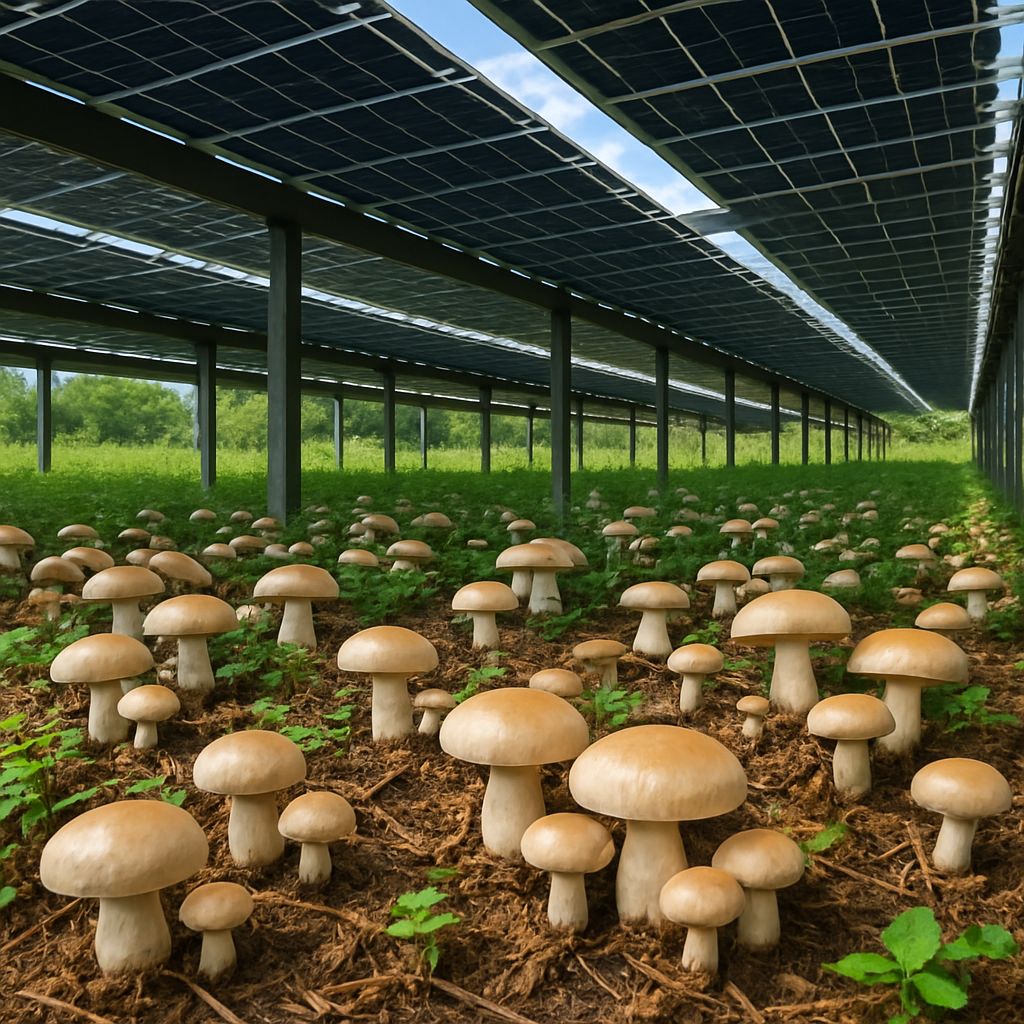
Growing Solar Mist, a resource focused on the intersection of solar energy and sustainable agriculture, points out that the microclimate beneath solar panels isn’t just tolerable for shade-loving crops — it’s genuinely advantageous. The shaded, protected space that most landowners treat as dead real estate is, in fungal terms, prime growing territory. If you’re already generating electricity up top, you might as well generate income down below.
Solar Panels Already Create the Perfect Mushroom Environment
Mushrooms don’t need what most crops need. They don’t chase sunlight. They don’t need plowed rows or fertilized soil in the traditional sense. What they do need is consistent moisture, protection from harsh direct sun, stable temperatures, and a substrate rich in organic matter. Solar panels, almost accidentally, deliver all four.
The space beneath a solar array behaves more like a forest understory than an open field. Panels block intense midday radiation, trap humidity close to the ground, and shield the soil from rain impact and wind desiccation. That’s not a side effect — that’s a growing environment.
Shade, Humidity, and Shelter: What Mushrooms Need
Fungi are not photosynthetic. They don’t convert light into energy — they break down organic matter instead. This means the partial or near-total shade beneath a solar array isn’t a limitation. For species like oyster mushrooms and wine caps, it’s ideal. Direct sun dries out fruiting bodies and can halt development entirely, so the diffused light filtering through or around panels is much closer to what these species experience in their natural woodland habitats. To learn more about how solar panels can benefit crop growth, check out this article on solar panels on farms.
|
Mushroom Variety |
Ideal Light Level |
Humidity Need |
Substrate |
|---|---|---|---|
|
Wine Cap (Stropharia rugosoannulata) |
Low to indirect |
60–80% |
Wood chips, straw |
|
Oyster (Pleurotus ostreatus) |
Low to indirect |
80–95% |
Straw, sawdust |
|
Shiitake (Lentinula edodes) |
Indirect/diffused |
70–90% |
Hardwood logs or sawdust |
|
Lion’s Mane (Hericium erinaceus) |
Low indirect |
85–95% |
Hardwood sawdust |
Shelter matters just as much as shade. Mushrooms are delicate at the fruiting stage — a heavy rainstorm can physically damage caps and introduce contamination. The overhead coverage from solar panels acts like a passive roof, protecting fruiting bodies without blocking airflow.
How Solar Panel Microclimates Differ From Open Fields
Research published in Agricultural and Forest Meteorology confirmed that the microclimate beneath solar panels measurably reduces air temperature, lowers atmospheric water demand, and retains significantly more soil moisture than adjacent open-field plots. For mushroom cultivation, that translates to fewer manual waterings, more stable fruiting cycles, and less thermal stress on developing mycelium. Open fields simply can’t replicate this passively — you’d need shade cloth, irrigation infrastructure, and windbreaks to come close.
Why This Works Better Than a Dedicated Mushroom Shed
A purpose-built mushroom growing shed requires capital investment, climate control equipment, and ongoing energy costs to maintain humidity and temperature. The space under solar panels delivers comparable environmental conditions at zero additional infrastructure cost. You’re essentially using a structure that’s already paid for — or paying for itself through electricity generation — as your growing environment. The dual-use nature of the land is the efficiency gain, and it’s a substantial one.
The Science Behind Agrivoltaic Mushroom Growth
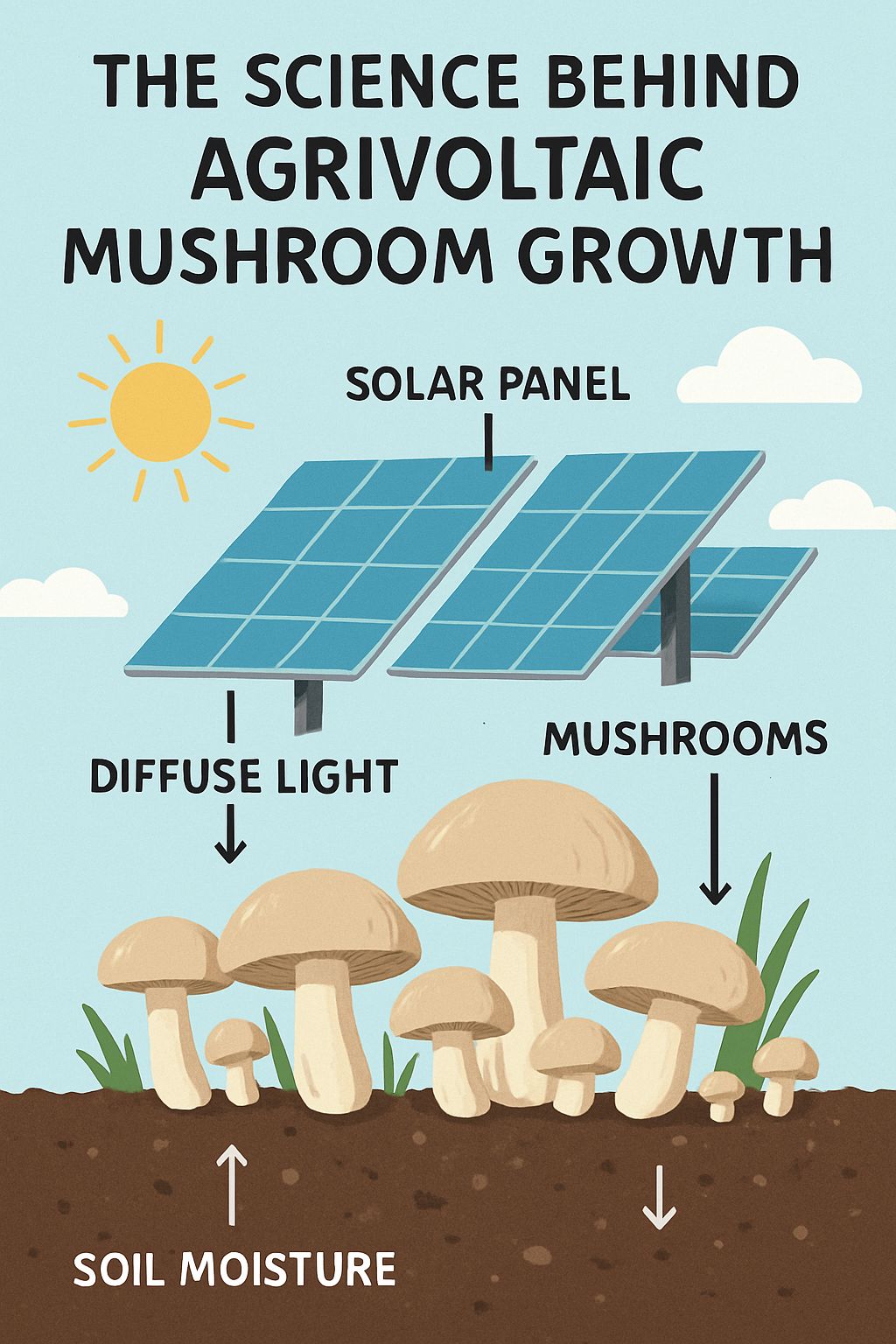
Agrivoltaics — the practice of co-locating solar energy production and crop cultivation on the same land — has been studied extensively for leafy greens, root vegetables, and berries. The fungal application is newer in formal research, but the underlying environmental data makes the case clearly. The conditions solar arrays create align almost exactly with what mycologists engineer artificially in commercial grow rooms.
How Diffused Light Under Panels Triggers Faster Fruiting
Mushrooms use light as an environmental cue, not an energy source. Diffused or indirect light signals to the mycelium that it has reached the surface — triggering the transition from vegetative growth to fruiting. The scattered light that filters through and around solar panels provides exactly this stimulus without the drying effect of direct sun exposure. In controlled studies, species like Pleurotus ostreatus (oyster mushrooms) have shown strong fruiting responses to indirect light levels in the range of 500 to 1,000 lux, which falls well within what a solar installation transmits to the ground below.
Soil Moisture Retention Rates Under Solar Arrays
One of the most significant agrivoltaic benefits is water conservation. Solar panels intercept rainfall and redirect it, but more importantly, they dramatically reduce evapotranspiration at ground level. Studies on agrivoltaic systems have documented 20–30% reductions in crop water consumption compared to open-field equivalents. For mushroom cultivation, where maintaining substrate moisture in the 60–95% relative humidity range is non-negotiable, this passive moisture retention is a genuine operational advantage — it reduces the frequency and volume of manual irrigation required to sustain productive fruiting cycles.
Temperature Regulation and Its Effect on Mycelium Development
Mycelium — the root-like fungal network that eventually produces mushrooms — is temperature-sensitive. Most culinary species colonize substrate most efficiently between 55°F and 75°F (13–24°C). Extreme heat above 85°F can stall colonization or kill mycelium outright. Solar panels moderate ground-level temperature fluctuations by blocking peak solar radiation during the hottest part of the day. This buffering effect keeps the substrate within the productive temperature band for longer periods, extending both the active growing season and the number of productive fruiting cycles per year.
Best Mushroom Varieties to Grow Under Solar Panels
Not every mushroom species is suited for an outdoor agrivoltaic setup. The best candidates are species that naturally grow in woodland or forest-edge environments, tolerate variable outdoor conditions, and produce reliably on low-cost substrates like wood chips, straw, or hardwood logs. The four varieties below consistently outperform others in this context — both agronomically and economically. If you’re interested in how solar panels can enhance farming practices, explore the benefits of solar panels for farmers.
1. Oyster Mushrooms
Oyster mushrooms are the most forgiving and fastest-producing variety you can grow under solar panels. They colonize substrate quickly, fruit aggressively, and tolerate the kind of minor environmental fluctuations that come with outdoor cultivation. A single inoculated straw log can produce multiple flushes over a growing season, making them an ideal starting point if you’re new to agrivoltaic mushroom farming.
- Colonization temperature: 65–75°F (18–24°C)
- Fruiting temperature: 55–65°F (13–18°C)
- Preferred substrate: wheat straw, sawdust, or coffee grounds
- Time to first harvest: 2–4 weeks after inoculation
- Yield per log: 1–3 lbs per flush, 3–5 flushes per season
The overhead protection from solar panels is particularly valuable for oyster mushrooms, which are prone to drying out at the pin stage — the earliest phase of fruiting body formation. Once pins dry out, they abort and you lose the flush entirely. The humidity retention under a solar array dramatically reduces this risk without any additional intervention.
From a market standpoint, oyster mushrooms command strong prices at farmers markets and through restaurant wholesale channels. Blue, pink, and golden oyster varieties can fetch $10–$18 per pound at retail, and chefs actively seek locally grown supply. The combination of low setup cost, fast turnaround, and premium pricing makes oyster mushrooms the most accessible entry point into solar panel mushroom cultivation.
2. Shiitake Mushrooms
Shiitake is the most commercially significant edible mushroom in the world after the button mushroom, and it’s a natural fit for the conditions under a solar array. Shiitake grown on hardwood logs — oak, sugar maple, or ironwood — produces dense, meaty caps with significantly better flavor and shelf life than commercially grown sawdust-block shiitake. The log method is slower, but the quality premium at market justifies the timeline.
Shiitake logs need a period of shade and consistent moisture to fully colonize before they’ll fruit — a process called “run” that typically takes 6–12 months depending on log diameter and ambient temperature. Once colonized, logs are induced to fruit through a cold-water soak or natural seasonal temperature drop. Under solar panels, where temperature buffering keeps the logs from drying out during colonization, run times can be more consistent and colonization more complete.
- Colonization time: 6–12 months on hardwood logs
- Fruiting trigger: cold-water soak (50–55°F for 12–24 hours) or natural cold snap
- Productive lifespan per log: 3–5 years
- Ideal log species: oak, sugar maple, hornbeam
- Retail price range: $10–$20 per pound
The long productive lifespan of shiitake logs makes them particularly valuable in a solar array setup. Stack inoculated logs in a totem or lean-to configuration under the panels, and a single installation can yield harvests for multiple years with minimal ongoing labor.
3. Lion’s Mane Mushrooms
Lion’s mane (Hericium erinaceus) is the highest-value culinary mushroom on this list, regularly retailing between $20–$30 per pound at specialty grocers and farmers markets. It requires the highest humidity of the four varieties — consistently above 85% — which makes the moist microclimate under solar panels especially useful. Lion’s mane is more temperature-sensitive than oyster or wine cap, so it performs best in the moderate shoulder seasons of spring and fall, or in climates where summer temperatures stay below 75°F. Position lion’s mane bags or blocks in the most sheltered, least wind-exposed section of your array for best results.
4. Wine Cap Mushrooms
Wine cap mushrooms (Stropharia rugosoannulata) are the most practical variety for large-scale outdoor solar installations because they grow directly in wood chip beds on the ground — no logs, no bags, no sterilization equipment required. You simply layer inoculated spawn into a wood chip substrate between the solar panel rows and let the mycelium colonize the bed over several weeks. Wine caps are extraordinarily vigorous in the right conditions, capable of producing mushrooms with caps reaching 6–12 inches in diameter.
Beyond yield, wine cap mycelium actively improves soil health by breaking down wood chips into rich humus. This is a meaningful long-term benefit for any farmer planning to rotate other crops through the space beneath their solar array. The fungal network also interacts with plant root systems, supporting nutrient exchange in a way that benefits companion plantings grown alongside them. For more information on how farmers can benefit, check out the advantages of solar panels for farmers.
How to Set Up a Mushroom Grow Under Solar Panels
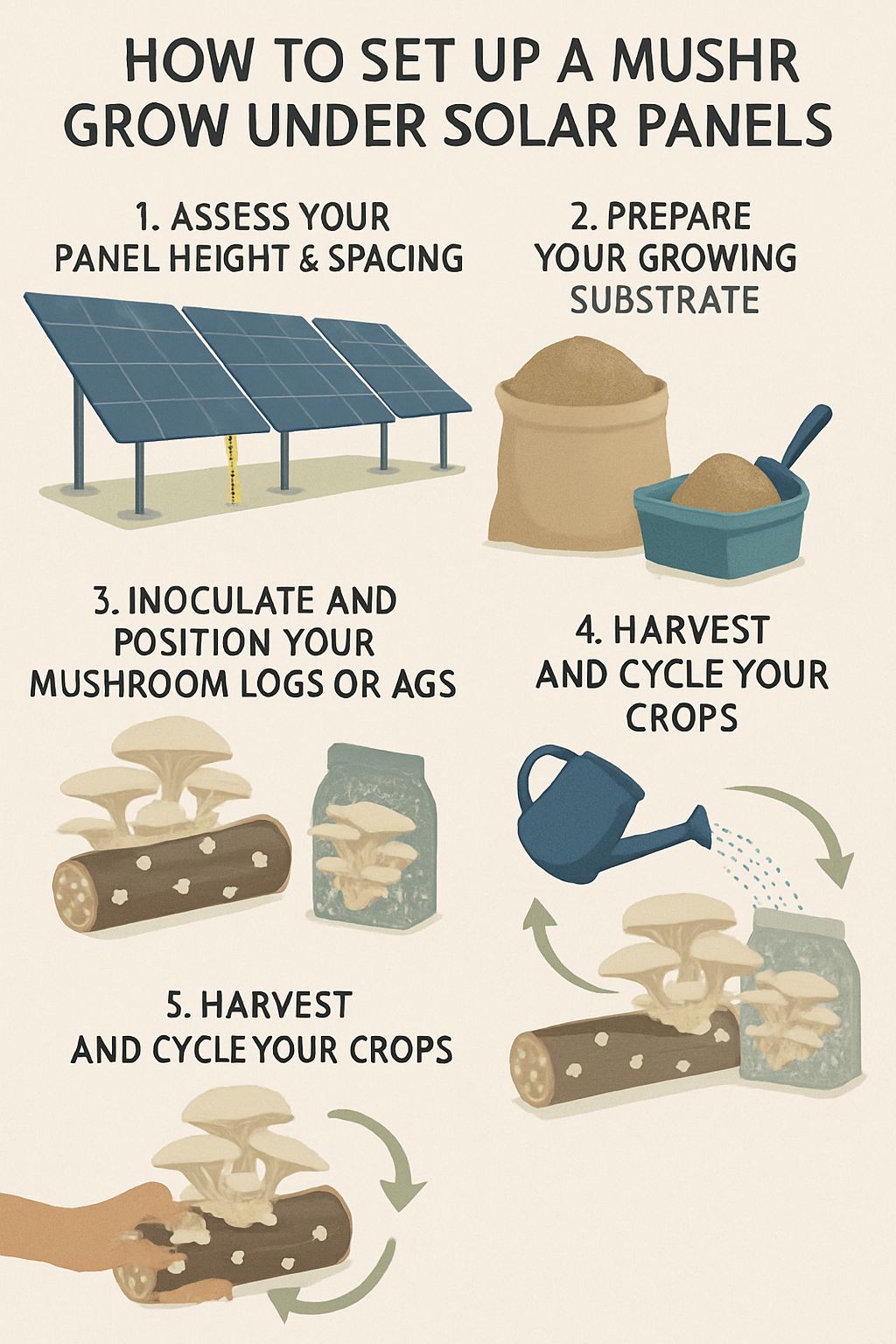
Setup is more straightforward than most farmers expect. You don’t need grow rooms, environmental controls, or specialized equipment for most of the varieties covered here. What you do need is a systematic approach to spacing, substrate preparation, and moisture management. Work through these steps in order before your first inoculation.
Step 1: Assess Your Panel Height and Spacing
Before selecting your mushroom variety or substrate, map your array’s physical layout. Panel height determines how much airflow and ambient humidity the space retains — arrays mounted at 6 feet or higher allow for comfortable access and better air circulation, which is important for preventing contamination. Row spacing dictates how much ground area you’re working with and how much light filters through. South-facing fixed-tilt arrays typically leave more consistent shade than single-axis trackers, which shift throughout the day. Note the orientation, measure your row widths, and identify the areas with the most stable shade coverage — that’s where your grow beds or log stacks will go.
Step 2: Prepare Your Growing Substrate
Substrate preparation is where most beginners either cut corners or overcomplicate things. For wine cap beds, you need fresh hardwood wood chips — not bark mulch, not treated wood, not softwood chips high in resins that inhibit fungal growth. Layer the chips 4–6 inches deep directly on the ground between panel rows. For oyster mushrooms grown on straw, pasteurize the straw by soaking it in hot water (160–170°F) for one hour, then drain and cool before inoculating.
Shiitake and lion’s mane require hardwood substrate — either fresh-cut logs for shiitake or sterilized hardwood sawdust blocks for lion’s mane. Log selection matters: use logs cut in late winter when sugar content is high and bark is intact, ideally 3–6 inches in diameter and 3–4 feet long. Avoid logs that have been sitting for more than a few weeks, as competing fungi will have already begun colonizing them.
Substrate moisture at inoculation should be in the 60–65% field capacity range — meaning a handful squeezed firmly should release just a few drops of water. Too wet and you risk anaerobic bacterial contamination. Too dry and mycelium colonization stalls. Get this step right and the rest of the process is far more forgiving.
Step 3: Inoculate and Position Your Mushroom Logs or Bags
For log inoculation, use a 5/16-inch drill bit to bore holes in a diamond pattern across the log’s surface, spaced roughly 4–6 inches apart in each direction. Press plug spawn — dowels pre-colonized with shiitake mycelium — into each hole and seal with cheese wax or beeswax to prevent moisture loss and contamination. For straw or sawdust bags, layer spawn evenly throughout the substrate at a rate of 10–20% spawn to substrate by weight, then seal the bags with a filter patch or polyfill plug to allow gas exchange.
Position inoculated logs in a lean-to or totem stack configuration in the shadiest section of your array, directly on or just above the soil surface. Contact with the ground promotes moisture wicking and, in the case of wine caps and some oyster varieties, allows the mycelium to spread into the surrounding wood chip bed — extending your productive area organically over time.
Step 4: Manage Moisture and Airflow
Once inoculated, your primary job is moisture maintenance. The solar array will do much of the heavy lifting by retaining ambient humidity, but during dry spells you’ll need to supplement with hand watering or a drip line running between rows. Aim to keep substrate surface moisture consistent — if the top inch of a wood chip bed feels dry to the touch, it’s time to water. Avoid overhead sprinklers that saturate fruiting bodies directly, which promotes bacterial blotch and shortens shelf life. Airflow is equally important: good lateral airflow under the panels prevents CO₂ buildup from the respiring mycelium, which at elevated levels suppresses fruiting and causes elongated, malformed mushrooms.
Step 5: Harvest and Cycle Your Crops
Harvest oyster and lion’s mane mushrooms just before the caps begin to flatten and curl upward at the edges — at this stage, spore drop hasn’t begun and flavor is at its peak. Twist and pull cleanly from the substrate rather than cutting, which leaves a cleaner wound and reduces contamination risk. Shiitake caps should be harvested when the veil beneath the cap is still partially intact. After each flush, remove any remaining stub material, mist the substrate, and allow 7–14 days of rest before the next fruiting cycle begins. Wine cap beds can be top-dressed with fresh wood chips between harvests to extend productivity through the season and into subsequent years.
Yield and Income Gains Farmers Are Seeing
The numbers coming out of early agrivoltaic mushroom operations are compelling. A single 100-square-foot wine cap bed established under a solar array can yield 50–150 pounds of mushrooms across a growing season, depending on substrate quality and moisture management. At farmers market retail prices of $8–$12 per pound for wine caps, that’s a potential gross return of $400–$1,800 from a strip of land that was previously generating zero agricultural income. Scale that across a full solar installation with multiple panel rows, and the additional revenue becomes genuinely significant.
What makes this particularly attractive from a farm management standpoint is the low marginal cost of adding mushrooms to an existing solar setup. You’re not building new infrastructure. You’re not irrigating a new field. The panels are already there, the shade is already there, and the microclimate is already functioning. Spawn costs for a 100-square-foot wine cap bed run roughly $30–$60, and wood chip substrate is either free from local arborists or extremely low cost. The input-to-output ratio is difficult to match with almost any other secondary crop.
Land-Use Efficiency Gains from Dual Cropping
Agrivoltaic systems already demonstrate land-use efficiency gains of up to 70% compared to separate solar and agricultural installations — a metric known as the Land Equivalent Ratio (LER). Adding mushrooms into the equation pushes that figure even further because fungi occupy vertical and ground-level space that conventional row crops can’t efficiently use beneath panel rows. A log stack leaned against a panel support post uses space that would otherwise sit completely idle. A wood chip bed running the length of a panel row doubles the productive output of that strip without competing with the electricity generation happening above it.
This matters most for farmers operating on limited acreage where every square foot needs to justify itself economically. Agrivoltaic mushroom cultivation essentially creates a third revenue layer — electricity above, mushrooms below — without requiring additional land acquisition or significant capital outlay. For small and mid-scale operations, that kind of land-use optimization can meaningfully change the farm’s financial profile.
Premium Pricing for Specialty Mushrooms at Local Markets
Specialty mushrooms grown under solar panels carry a story that sells at market. Shoppers and chefs respond to the agrivoltaic angle — the idea that the same installation powering a farm is also growing their food beneath it. Lion’s mane, shiitake, and oyster mushrooms grown this way can be marketed as solar-grown, locally produced, and pesticide-free, which supports premium pricing. Independent surveys of farmers market pricing across the U.S. consistently show specialty mushrooms retailing between $10 and $30 per pound depending on variety — figures that dwarf commodity crop returns per square foot by a wide margin.
Mushrooms Under Solar Panels Are a Low-Risk, High-Reward Bet for Farmers
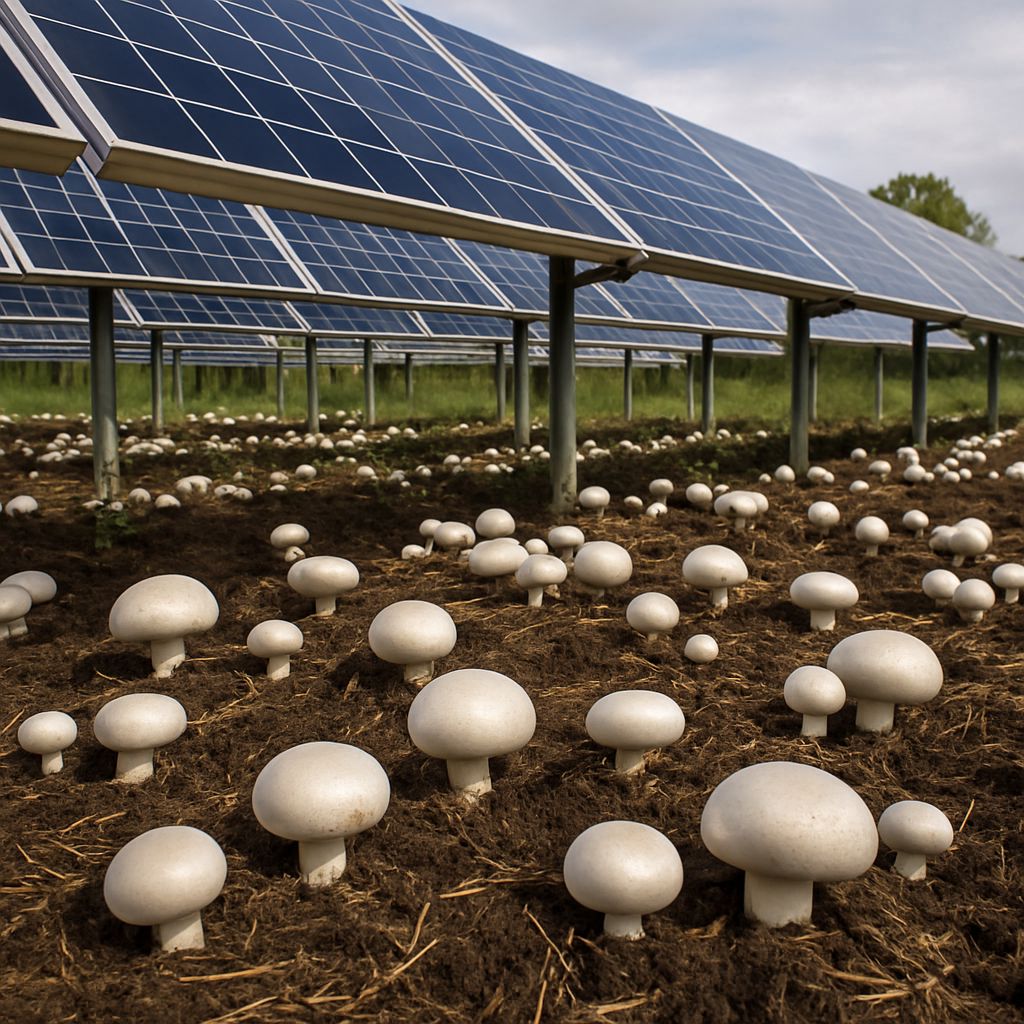
The case is straightforward: the infrastructure is already in place, the microclimate is already functioning, the input costs are minimal, and the market demand for specialty mushrooms is strong and growing. You’re not gambling on a new crop in an untested environment — you’re placing a highly educated bet in a space that nature has essentially pre-configured for fungal growth. Whether you start with a single wine cap bed between two panel rows or build out a full agrivoltaic mushroom operation across an entire array, the risk floor is low and the upside is real. The space under your solar panels isn’t dead land. It’s a growing environment waiting to be used.
Frequently Asked Questions
Below are the most common questions farmers and growers ask when first considering mushroom cultivation under solar panels. Each answer is grounded in practical growing experience and the environmental realities of agrivoltaic systems.
Do mushrooms need any direct sunlight to grow under solar panels?
No — mushrooms do not need direct sunlight to grow. Unlike plants, fungi are not photosynthetic and do not use light as an energy source. They do use indirect or diffused light as an environmental cue to trigger fruiting, and the scattered light that filters through and around solar panels provides exactly the right stimulus. In fact, the absence of direct sun is an advantage, as intense solar radiation dries out fruiting bodies and can abort developing pins before they mature. The light environment beneath a solar array is closer to a forest understory than an open field — which is precisely where most culinary mushroom species evolved to grow.
What is the best substrate to use for growing mushrooms under solar panels?
The best substrate depends on your chosen species, but hardwood wood chips are the most practical and widely applicable option for outdoor solar array cultivation. Wine caps colonize wood chip beds directly on the ground with no additional processing required. Oyster mushrooms perform well on pasteurized wheat straw packed into bags or formed into outdoor logs. Shiitake requires fresh hardwood logs — oak and sugar maple are the preferred species — while lion’s mane produces best on sterilized hardwood sawdust blocks. Avoid softwood substrates like pine or cedar, as the resins they contain are antifungal and will inhibit colonization across all four varieties covered here.
How many mushroom logs can fit under a standard solar array?
A standard residential or small commercial solar array covering roughly 1,000 square feet of ground area can comfortably accommodate 50–100 shiitake logs in a lean-to or totem stacking configuration, depending on panel row spacing and post placement. Logs stacked in totems — standing vertically and leaned against a support — take up roughly 1–2 square feet of ground space per totem of 3–4 logs, maximizing density without impeding access to the panels for maintenance.
Larger utility-scale solar installations with multiple acres of panel rows have proportionally more usable space beneath them, and in those contexts wine cap wood chip beds are often more practical than logs due to the scale of substrate management involved. A good planning benchmark is to allocate 20–30% of your total under-panel ground area to mushroom cultivation initially, assess productivity over a full season, and expand from there based on what the market and your management capacity can support.
Can I grow mushrooms under solar panels year-round?
In most North American and European climates, productive outdoor mushroom cultivation under solar panels runs from early spring through late fall — roughly March through November depending on your location. During winter months, mycelium goes dormant rather than dying, and colonized logs or beds will resume fruiting activity once temperatures rise above 45–50°F in spring. In warmer climates — USDA Zones 8 through 10 — year-round production is achievable with the right species selection. Oyster mushrooms have cold-tolerant strains that can fruit at temperatures approaching 40°F, extending the productive season significantly in moderate climates. The temperature buffering effect of solar panels also means the ground beneath an array warms up earlier in spring and retains heat longer into fall than adjacent open ground, providing a natural season extension without any additional infrastructure. For farmers interested in harnessing solar energy, there are various solar panel power solutions available to support agricultural activities.
Will growing mushrooms under solar panels affect the energy output of my panels?
No — mushroom cultivation at ground level has no measurable impact on solar panel energy output. Panels generate electricity from light hitting the photovoltaic surface, which occurs well above the growing zone. Mushrooms don’t grow tall enough to shade panels under any normal circumstances, and even the moisture and humidity generated by active mycelium at ground level dissipates before reaching panel height in any adequately ventilated array.
The only theoretical interaction worth noting is that denser, taller substrate beds — such as deep wood chip mounds — could potentially reflect slightly less light upward toward bifacial solar panels that capture albedo from the ground. However, this effect is negligible in practice and would not represent a meaningful reduction in energy production for any standard monofacial panel installation.
In fact, some agrivoltaic researchers have noted that the evapotranspiration from actively managed growing systems beneath panels can slightly cool panel operating temperatures — and cooler panels operate more efficiently. Standard silicon photovoltaic panels lose approximately 0.3–0.5% of efficiency per degree Celsius above 25°C, so even modest passive cooling from the growing environment beneath can marginally improve output rather than reduce it.



Leave a Reply