

Key Takeaways: Solar Panels for Farm Operations
- Solar panels can cut farm energy bills by 50–100%, depending on system size, local sunlight, and energy consumption patterns.
- The USDA REAP grant covers up to 50% of solar installation costs for eligible agricultural operations — a funding opportunity many farmers overlook.
- All Energy Solar specializes in designing and installing farm-specific solar systems that account for roof load, panel tilt, and daily agricultural energy demand.
- Ground-mounted and roof-mounted systems each have unique trade-offs for farm operations — and choosing the wrong one can cost you productive land or structural integrity.
- Most farm solar systems pay for themselves in 6–10 years, with panels lasting 25–30 years — meaning decades of near-free electricity after breakeven.
Energy costs are quietly draining farm profits every single season, and solar panels may be the most practical fix most farmers haven’t fully explored yet.
As electricity prices continue to climb, agricultural operations are feeling the squeeze harder than almost any other industry. Farms run energy-intensive equipment around the clock — irrigation pumps, ventilation systems, refrigeration units, grain dryers — and those loads add up fast. For many operations, electricity is now one of the top three operating expenses. All Energy Solar works directly with farmers across the country to design systems built around the specific demands of agricultural energy use, not just a one-size-fits-all panel count.
Farmers Are Losing Money on Energy Bills Every Season
The average U.S. farm spends thousands of dollars annually on electricity alone — and that number grows every year as utility rates rise. Unlike fuel or fertilizer costs, energy bills offer almost no flexibility. You can’t negotiate with your utility provider the way you can shop around for seed prices.
What makes this particularly painful is the seasonal spike. During planting and harvest, energy demand surges right when farmers are already stretched financially. Running grain dryers, irrigation systems, and cold storage simultaneously during peak season can push monthly bills into the tens of thousands for mid-to-large operations. Solar directly addresses this problem by generating the most electricity during the same long, sunny days that drive peak farm energy demand.
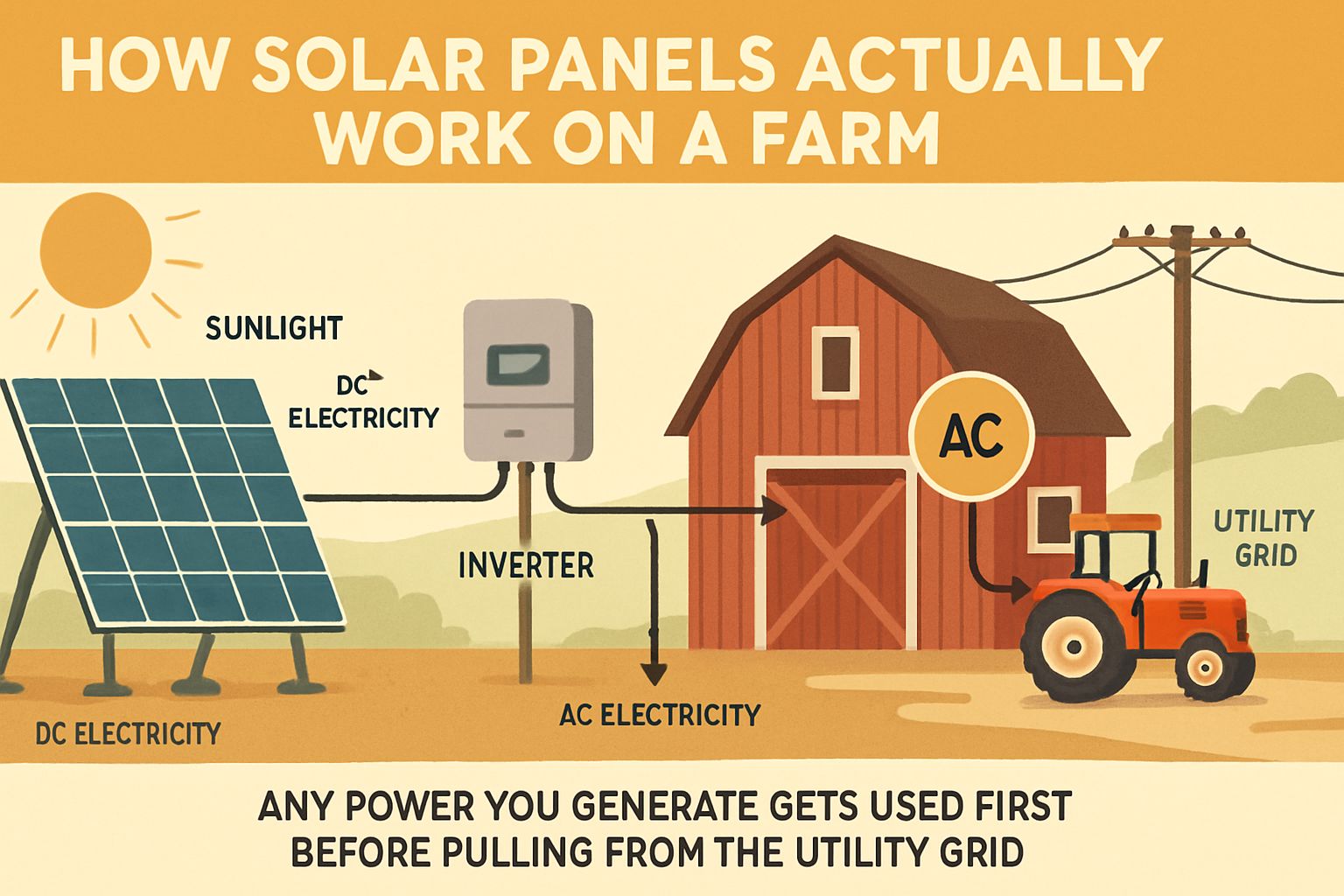
How Solar Panels Actually Work on a Farm
Solar panels work by converting sunlight into direct current (DC) electricity through photovoltaic (PV) cells. An inverter then converts that DC electricity into alternating current (AC), which is what your farm equipment actually runs on. The system connects directly to your existing electrical infrastructure, and any power you generate gets used first before pulling from the utility grid.
Farm solar systems are typically sized based on 12-month energy consumption data. An installer will review your utility bills, identify peak usage periods, and design a system that offsets the largest portion of your load. For most farms, that means systems ranging from 50 kilowatts (kW) to several megawatts (MW) depending on operation size. Learn more about how farm solar can cut energy costs.
Quick Example: A dairy farm running milking equipment, refrigeration, and water heating 24/7 might consume 30,000–60,000 kWh per month. A properly sized solar array of 200–400 kW could offset 80–100% of that load during peak production months.
How Farms Generate Their Own Power During Peak Daylight Hours
Solar panels produce electricity whenever sunlight hits the cells — no moving parts, no fuel required. Production peaks between 10 a.m. and 3 p.m., which conveniently aligns with the heaviest daytime farm operations. During these hours, your panels can power equipment directly in real time, reducing or eliminating what you pull from the grid entirely.
The amount of electricity generated depends on three key variables: panel wattage, the number of panels installed, and your location’s peak sun hours. For reference, most of the U.S. agricultural belt receives between 4 and 6 peak sun hours per day — enough to make solar economically viable across nearly all major farming regions.
What Happens to Excess Energy Your Farm Produces
When your panels produce more electricity than your farm is using at that moment, the excess flows back to the utility grid. Through a policy called net metering, your utility provider credits your account for that surplus power. Those credits then offset the electricity you pull from the grid at night or during low-production periods, essentially using the grid as a giant battery.
Not every state has the same net metering rules, so it’s worth verifying your local policy before designing your system. Some states offer full retail rate credits, while others offer wholesale rates. Either way, net metering dramatically improves the financial return on a farm solar investment.
Ground-Mounted vs. Roof-Mounted Solar Systems for Farm Buildings
The choice between ground-mounted and roof-mounted solar comes down to your available structures, land constraints, and energy goals. Roof-mounted systems use existing barn or facility rooftops, preserving open land for crops and livestock. However, older barns may require structural reinforcement before they can safely support panels. Ground-mounted arrays offer more flexibility in panel orientation and tilt for maximum sun exposure, but they do consume land that might otherwise be productive.
The Real Cost of Going Solar on a Farm
|
System Size |
Estimated Installation Cost |
After 30% ITC |
After REAP Grant (up to 50%) |
|---|---|---|---|
|
50 kW |
$75,000 – $100,000 |
$52,500 – $70,000 |
$26,250 – $35,000 |
|
100 kW |
$130,000 – $175,000 |
$91,000 – $122,500 |
$45,500 – $61,250 |
|
250 kW |
$300,000 – $400,000 |
$210,000 – $280,000 |
$105,000 – $140,000 |
|
500 kW |
$550,000 – $750,000 |
$385,000 – $525,000 |
$192,500 – $262,500 |
The upfront cost of a farm solar system is real — but it rarely tells the full financial story. Once you layer in available incentives, the net investment drops significantly, often by more than half before factoring in long-term energy savings. Farmers can also explore the benefits of solar panels for powering grain dryers and cold storage, further enhancing cost efficiency.
Most agricultural solar installations fall between $2.50 and $3.50 per watt installed, depending on system complexity, mounting type, and regional labor costs. A 100 kW system — suitable for a mid-sized operation — typically runs $130,000 to $175,000 before incentives. That’s a serious number, but the combination of federal tax credits, USDA grants, and utility savings changes the math dramatically.
Average Installation Costs for Agricultural Solar Systems
Agricultural solar costs vary based on system size, equipment quality, and site-specific factors like trenching requirements for ground mounts or roof reinforcement for barn installations. Utility-scale systems above 500 kW often benefit from volume pricing on panels and inverters, bringing the per-watt cost down closer to $1.80–$2.20. Smaller farm systems in the 50–150 kW range typically cost more per watt but are still highly viable once incentives are applied.
Federal Investment Tax Credit (ITC) and What It Covers
The Federal Investment Tax Credit (ITC) allows farms to deduct 30% of the total solar installation cost directly from their federal tax liability. This applies to both the equipment and labor costs associated with the installation. For a $150,000 system, that’s a $45,000 reduction in what you owe — dollar for dollar, not just a deduction from taxable income. To understand more about the components involved, you can explore the key elements for farm operations using solar panels.
- Applies to new solar installations on agricultural properties
- Covers both equipment costs and installation labor
- Can be carried forward if your tax liability is less than the credit amount
- Currently set at 30% through 2032 under the Inflation Reduction Act
- Works in combination with the USDA REAP grant for maximum savings
To claim the ITC, your farm must own the solar system outright — leased systems do not qualify. This makes purchasing or financing through a loan the preferred route for farmers who want to maximize their return on investment.
USDA REAP Grants Cover Up to 50% of Solar Project Costs
The USDA Rural Energy for America Program (REAP) is one of the most powerful — and underused — funding tools available to American farmers. REAP provides grants covering up to 25% of eligible project costs, and when combined with loan guarantees, total assistance can reach 50% of the total installation cost. For a $200,000 solar project, that’s up to $100,000 in direct funding before you’ve calculated a single dollar in energy savings.
To qualify, your operation must be an agricultural producer with at least 50% of gross income coming from agricultural activities, and the project must be located in a rural area. Applications are accepted on a rolling basis, but competitive funding windows open periodically throughout the year. Working with an installer experienced in REAP applications — like All Energy Solar — significantly improves your approval odds, since the paperwork and technical documentation requirements are substantial.
How Long Before a Farm Solar System Pays for Itself
The payback period for a farm solar system typically falls between 6 and 10 years, depending on system size, local electricity rates, available incentives, and how much of the generated power your farm actually consumes on-site. After that breakeven point, you’re generating electricity at essentially zero marginal cost for the remaining life of the system — which is 25 to 30 years for most commercial-grade panels.
Farms with high daytime energy consumption — dairy operations, poultry houses, greenhouse growers — tend to see the fastest payback because they’re using solar power directly as it’s generated, rather than exporting it to the grid at lower credit rates. For more insights on how solar panels can benefit farms, read about solar panel power solutions for farms. The more you consume on-site, the better your return.
Here’s a straightforward way to estimate your own payback period: take your net system cost after all incentives, then divide it by your annual electricity savings. If your post-incentive cost is $70,000 and you save $10,000 per year in energy bills, your payback period is 7 years. After that, 18 or more years of near-free electricity follow.
- Average payback period: 6–10 years for most agricultural systems
- Panel lifespan: 25–30 years with minimal degradation (typically 0.5% per year)
- Post-payback savings: Potentially $200,000–$500,000+ over the system’s lifetime depending on operation size
- Energy price inflation hedge: Locks in predictable energy costs as utility rates continue rising
- Accelerated depreciation: MACRS 5-year depreciation schedule available for business-owned farm solar systems
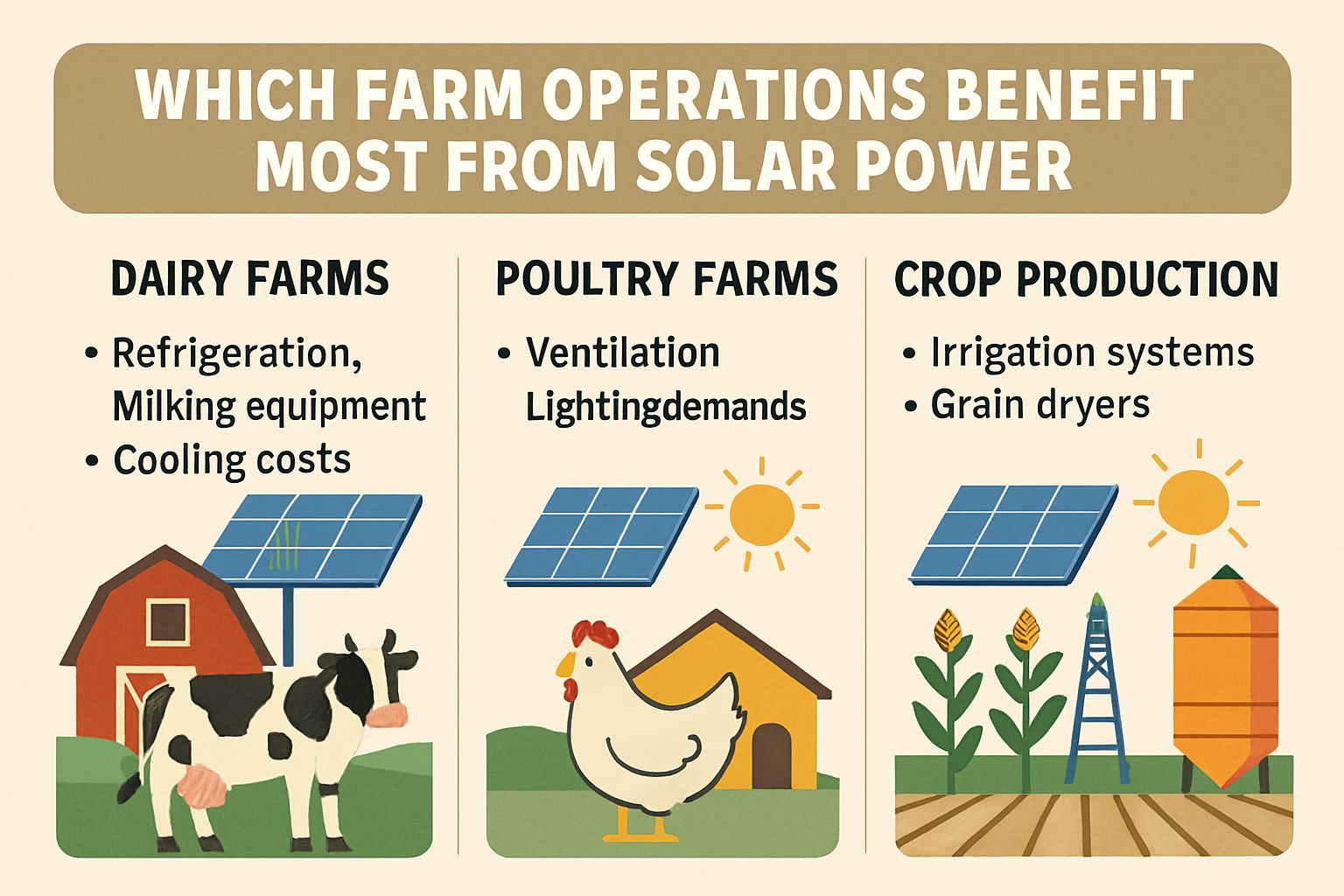
Which Farm Operations Benefit Most from Solar Power
While almost any farm can benefit from solar, certain agricultural operations see returns that are dramatically faster than others. The common thread is high, consistent, daytime energy consumption. The more electricity your operation uses during daylight hours, the more directly your panels offset that cost in real time — which is where the strongest financial case for solar is built. For more insights on the benefits of solar panels for farmers, explore our detailed guide.
Livestock operations, in particular, run energy-intensive systems continuously. Climate control, water heating, refrigeration, and automated feeding systems don’t stop at sundown, but their daytime loads alone are often enough to justify a full solar installation. Crop-based operations benefit heavily during planting and harvest seasons when irrigation and drying equipment run near constantly.
Dairy Farms: Refrigeration, Milking Equipment, and Cooling Costs
Dairy farms are among the highest energy consumers in agriculture. Bulk milk tanks require continuous refrigeration to maintain temperatures below 40°F, milking equipment runs multiple times daily, and water heating demands are constant. According to data from agricultural energy studies, dairy operations can consume 1,000–3,000 kWh per cow per year. A 200-cow operation could be running 200,000–600,000 kWh annually — a load that a well-sized solar array can significantly offset, driving down one of the farm’s biggest variable costs.
Poultry Farms: Ventilation and Lighting Demands
Poultry houses depend on precise environmental control to maintain flock health and production rates. Ventilation fans run continuously to regulate temperature and air quality, while lighting systems are programmed to control laying cycles in egg-production operations. These systems run around the clock, but the daytime load alone — especially during summer months when cooling demands peak — makes solar an exceptionally strong fit. Many poultry producers report electricity as their single largest operating cost after feed, making solar one of the most impactful financial decisions available to them.
Crop Production: Irrigation Systems and Grain Dryers
For crop farmers, the energy crunch hits hardest during two windows: irrigation season and harvest. Center-pivot irrigation systems can draw 50–150 kW of power per unit while running, and grain dryers — which remove moisture from harvested corn, soybeans, and wheat — are among the most energy-intensive pieces of equipment on any farm. A single grain dryer running at full capacity during harvest can consume 500,000 BTUs per hour. Solar arrays paired with on-site battery storage or grid net metering can absorb a significant portion of these seasonal spikes, smoothing out the energy costs that compress already-thin crop margins.
The Downsides of Farm Solar You Should Know Before Committing
Solar is a strong investment for most farms — but it’s not without real trade-offs. Going in with a clear understanding of the limitations will help you design a smarter system and avoid costly surprises after installation. The challenges are manageable, but they deserve honest consideration before you sign any contracts.
The two most significant concerns for agricultural operations are land use and the impact of weather variability on system output. Neither of these makes solar a bad decision, but both influence how you size your system, where you place it, and how you plan for periods of reduced production. To understand more about solar’s impact on agricultural land, you can read this article on solar’s impact on your farm’s land.
Important Note on Weather and Output: Solar panels do not stop producing electricity on cloudy days — they simply produce less. A high-quality panel operating under heavy cloud cover typically generates 10–25% of its rated capacity. For most farms, grid connection and net metering credits built up during sunny periods effectively cover these gaps without any disruption to farm operations.
Weather variability is a real factor in solar system performance, particularly for farms in northern states or regions with significant seasonal cloud cover. A farm in Minnesota will see meaningfully different annual production than a comparable system in Kansas or Georgia. This is why proper system sizing — accounting for your specific location’s solar resource data — is critical. Oversizing slightly is often the right move for farms in lower-sunlight regions to ensure consistent offset throughout the year. For more insights, explore solar panel power solutions for farms.
Maintenance requirements are often overstated as a concern, but they’re not zero. Panels should be inspected annually and kept clear of debris, bird droppings, and snow accumulation that can reduce output. Inverters — which convert DC to AC electricity — typically have a lifespan of 10–15 years and will need replacement during the panel’s operational life. Budget for inverter replacement as part of your long-term system economics.
Ground-Mounted Arrays Consume Productive Farmland
A 100 kW ground-mounted solar array requires roughly 0.5 to 1 acre of land, depending on panel spacing and row configuration. For farms where every acre counts toward revenue, this is a meaningful trade-off. The good news is that creative system design can minimize the impact. Roof-mounted systems on barns, equipment sheds, and processing buildings eliminate the land-use issue entirely. Agrivoltaic installations — where solar panels are elevated or spaced to allow crop growth or livestock grazing underneath — are also gaining traction as a way to generate energy without sacrificing agricultural productivity. Research from the University of Arizona found that certain shade-tolerant crops can actually benefit from the partial shade created by elevated solar arrays, with reduced water evaporation extending irrigation efficiency.
Solar Panels Can Affect Shade, Soil Temperature, and Water Runoff
Ground-mounted solar arrays do alter the microenvironment beneath and around them. Panels create shaded zones that lower soil temperatures, which can reduce evaporation and retain moisture longer — a benefit in drought-prone regions, but potentially a concern in areas where soil warming is important for early-season crop germination. Water runoff patterns also shift, since rain that would normally distribute evenly across a field now concentrates at panel edges. Proper site grading and drainage planning during installation can address this directly, and an experienced agricultural solar installer will account for these factors in the system design.
Solar Panels Are a Smart Long-Term Bet for Most Farmers
When you strip away the complexity, the core argument for farm solar is straightforward: energy is one of the few major input costs that solar can permanently reduce. Seed prices, fertilizer costs, and labor rates will keep climbing — but a paid-off solar system produces electricity at near-zero marginal cost for decades. That’s a financial advantage that compounds year after year, long after the panels have paid for themselves.
The combination of the 30% Federal ITC, USDA REAP grants covering up to 50% of project costs, MACRS accelerated depreciation, and net metering credits creates a financial environment where solar is genuinely difficult to argue against for most agricultural operations. The risk profile has also improved dramatically — modern commercial panels carry 25-year performance warranties guaranteeing output stays above 80% of rated capacity, and tier-one panel manufacturers have decades of operational data backing those claims. For farmers looking to explore more about solar solutions, understanding the benefits of solar panels can be a great starting point.
- Energy independence: Reduces reliance on utility rate increases that are largely outside your control
- Predictable operating costs: Locks in known energy expenses for the life of the system
- Multiple income streams: Net metering credits and potential participation in renewable energy certificate (REC) markets
- Sustainability credentials: Increasingly relevant for agricultural supply chains and food brands prioritizing low-carbon sourcing
- Asset value: Owned solar systems add to farm asset value and can be included in estate or succession planning
The farms that benefit most from solar aren’t just the largest operations — they’re the ones with consistent, high daytime energy loads and the discipline to evaluate the numbers honestly. A 50 kW system on a mid-sized poultry farm can generate the same percentage return on investment as a 500 kW system on a large dairy operation, if the load profile and incentive stack align correctly.
The bottom line is this: energy costs aren’t going down, utility infrastructure isn’t getting more reliable, and the incentive window for maximum solar returns — particularly the 30% ITC through 2032 — won’t last forever. For farmers who’ve been watching solar from the sidelines, the case for acting sooner rather than later has rarely been stronger.
Frequently Asked Questions
Farmers considering solar often have the same core questions — and the answers are more straightforward than the industry sometimes makes them appear. Here are the most common questions agricultural solar buyers ask, answered directly. For more details on the benefits of solar panels for farmers, you can explore additional resources.
Understanding these fundamentals before you talk to an installer puts you in a much stronger position to evaluate proposals, ask the right questions, and make a decision that actually fits your operation — not just the one that fits the installer’s sales pitch.
Can a solar system power an entire farm operation on its own?
Yes — but with an important qualifier. A solar system sized correctly for your farm’s energy consumption can offset 80–100% of your annual electricity use when combined with grid net metering. True off-grid operation, meaning complete independence from the utility grid, requires substantial battery storage and is significantly more expensive. For most farms, a grid-tied system with net metering delivers the best financial outcome: you use solar power when the sun shines, draw from the grid when needed, and bank credits from surplus production to offset nighttime and winter usage.
Do solar panels still work during cloudy or winter months on a farm?
Solar panels continue generating electricity in cloudy and winter conditions — just at reduced output. On overcast days, panels typically produce 10–25% of their rated capacity. In winter months, shorter days mean fewer production hours, but cold temperatures actually improve panel efficiency slightly compared to hot summer days. Net metering handles the gap: credits earned during high-production spring and summer months carry forward to offset higher grid usage in winter. Farms in northern states like Minnesota, Wisconsin, and Michigan successfully operate solar systems year-round with strong financial returns.
Does installing solar panels increase a farm’s property value?
Owned solar systems — those purchased outright or financed through a loan — generally increase property value because they represent a long-term income-generating or cost-reducing asset. The increase in value depends on system size, remaining panel life, and local real estate market familiarity with agricultural solar. Leased systems are more complicated, since the lease obligation transfers to a new owner and can actually complicate a farm sale.
Several factors influence how much value solar adds to a farm property specifically:
- System age and remaining warranty coverage
- Current local electricity rates (higher rates = higher value of production)
- Whether the system is fully paid off or still carries loan obligations
- State-specific solar property tax exemptions, which prevent assessment increases in many states
- Active net metering agreements that transfer to a new owner
Many states also offer solar property tax exemptions that prevent the added value of a solar system from increasing your annual property tax assessment — a meaningful benefit that preserves the full financial advantage of the installation.
What maintenance do solar panels require on a farm?
Commercial-grade solar panels are remarkably low-maintenance by agricultural equipment standards. Annual inspections to check panel connections, mounting hardware, and inverter performance are standard practice. Panels should be cleared of heavy snow accumulation, dust buildup in dry climates, and debris from nearby vegetation that could cause shading. Most farms can handle basic visual checks themselves, with a professional inspection once per year as part of a service agreement.
The one component that requires planned replacement is the inverter. String inverters — the most common type in agricultural systems — have an operational lifespan of 10–15 years, meaning most farm solar systems will need at least one inverter replacement over their operational life. Microinverters, which attach individually to each panel, have longer warranties (typically 25 years) but come at a higher upfront cost. Budget approximately $8,000–$20,000 for inverter replacement on a mid-sized farm system when planning your long-term system economics.
Can farmers sell excess solar energy back to the grid?
Yes — this is exactly what net metering enables. When your solar panels produce more electricity than your farm is using at a given moment, the surplus flows back to the utility grid and your meter runs backward. Your utility company credits your account for that exported power, which you then draw against during periods when your panels aren’t producing enough to meet demand.
The value of those credits varies by state and utility. Some utilities credit exported power at the full retail electricity rate — meaning you’re effectively selling power at the same price you’d otherwise buy it. Others credit at a lower wholesale or avoided-cost rate. A handful of states have moved toward less favorable net metering structures in recent years, which is why understanding your specific utility’s current policy is an essential step before system design begins.
In states with strong net metering policies, excess summer production can generate enough credits to cover nearly all winter electricity costs — effectively making solar a 12-month financial solution rather than just a warm-weather one. Some farmers in deregulated energy markets also participate in Renewable Energy Certificate (REC) markets, earning additional revenue for the clean energy attributes of their solar production separate from the physical electricity itself.
Solar panels have become an increasingly popular choice for farmers looking to power their farm operations sustainably. These panels harness the sun’s energy, converting it into electricity that can be used to run various farm equipment and systems. One of the significant benefits of using solar panels is the reduction in energy costs, which can be a substantial expense for farmers. Additionally, solar panels contribute to a cleaner environment by reducing the reliance on fossil fuels. For farmers interested in learning more about the advantages of solar panels, exploring these benefits can provide valuable insights into sustainable farming practices.


Leave a Reply