
Article At a Glance: Solar Panels for Farming Use
- Solar panels can reduce farm energy costs by 50% or more, making them one of the highest-ROI investments available to modern farmers.
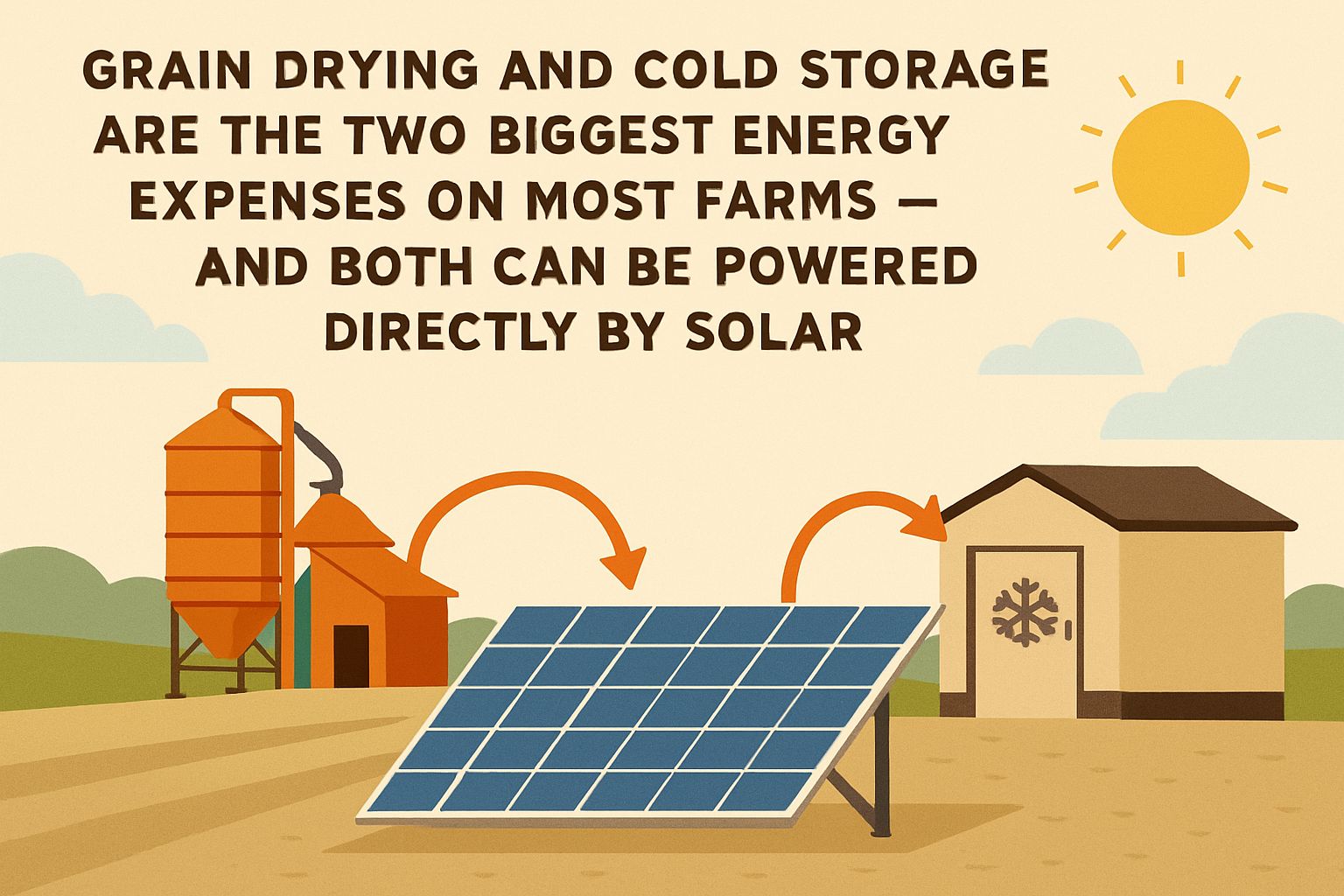
- Grain drying and cold storage are the two biggest energy expenses on most farms — and both can be powered directly by solar.
- A well-sized solar grain drying system can add 20–40% more heat to the drying process, supplementing the natural heat already in ambient air.
- Federal tax credits, USDA grants, and net metering programs can significantly cut the upfront cost of going solar on a farm.
- Keep reading to find out which solar setup works best for your farm size — and how long it realistically takes to pay for itself.
Energy costs are quietly eating into farm profits every single season — and solar panels are one of the most practical ways to fight back.
For farmers running grain dryers, cold storage units, irrigation pumps, or livestock facilities, electricity bills can represent one of the largest operational expenses of the year. Solar energy directly targets that cost. Renewable energy solutions designed for agricultural use are now more accessible than ever, with financing options, federal incentives, and proven technology making the transition far less daunting than it was even a decade ago.
Farmers Are Losing Money on Energy Bills — Solar Changes That
Walk into any grain operation during harvest season and the energy meters are running hard. High-capacity dryers, refrigeration units, lighting, and water pumps all draw continuously from the grid. For many farms, that adds up to tens of thousands of dollars per year in electricity alone — costs that compound season after season with no cap in sight.
Why Grain Drying and Cold Storage Are the Biggest Energy Drains on a Farm
Grain drying is one of the most energy-intensive processes in post-harvest agriculture. High-moisture grain harvested in wet seasons requires significant heat and airflow to bring moisture content down to safe storage levels, typically below 14%. Running a high-temperature dryer continuously during peak harvest can consume electricity at a rate that rivals small industrial operations.
Cold storage compounds the problem. Perishable crops — fruits, vegetables, dairy — require stable refrigerated environments around the clock. Unlike grain drying, which is seasonal, cold storage demands energy 365 days a year. Together, these two systems often account for the majority of a farm’s annual electricity consumption.
How Solar Panels Directly Offset These High-Cost Operations
Solar panels generate electricity that feeds directly into the systems drawing the most power on your farm. In low-temperature grain drying setups, solar collectors provide supplemental heat that reduces how hard — and how long — your dryer needs to run. In cold storage applications, solar-generated electricity powers compressors and fans, dramatically cutting grid dependency.
Farms that have made the switch report electricity bill reductions of 50% or more. The impact is most dramatic for operations with high daytime energy loads, since solar output peaks during the same daylight hours when drying and refrigeration systems are working hardest.
How Solar-Powered Grain Dryers Work
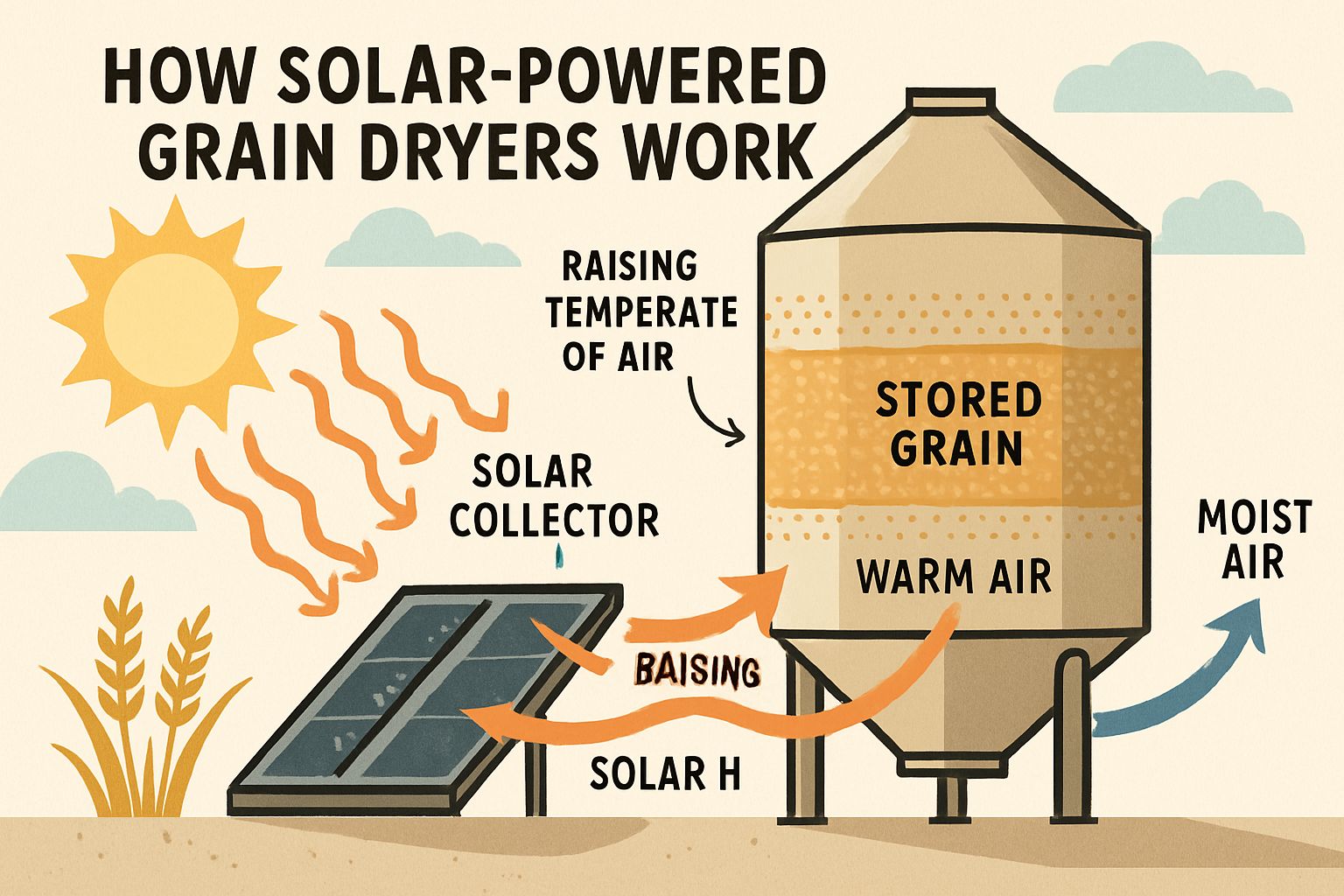
Solar grain drying is not a complicated concept — it uses the sun’s heat to raise the temperature of air before it passes through stored grain, speeding up moisture removal. But the engineering behind an effective system requires understanding how solar heat interacts with natural air conditions at your specific location and time of year.
The Difference Between Solar Dryers and Traditional Sun Drying
Traditional open-air sun drying leaves grain exposed to the elements — insects, rain, dust, and uneven drying are constant problems. Solar dryers, by contrast, use enclosed collectors to capture and concentrate heat, directing warm, clean air through the grain in a controlled environment. The result is faster, more hygienic drying with significantly lower post-harvest losses.
The practical difference shows up in quality, not just speed. Grain dried in an enclosed solar system retains better color, lower contamination risk, and more consistent moisture levels throughout the batch — factors that directly affect market price.
How Solar Heat Supplements Natural Air in Low-Temperature Drying
Here is where the physics gets interesting. In a full-bin low-temperature drying system, 50–70% of the heat used to dry grain already exists in the surrounding ambient air. The fan pushing that air through the grain also contributes another 10–15% in heat gain. A well-designed solar collector only needs to add the remaining 20–40% — which means a relatively modest solar installation can have a major impact on drying capacity.
This is why low-temperature drying systems are particularly well-suited to solar integration. The system does not demand intense, consistent heat — it needs a moderate, reliable temperature boost of just 5–10°F above ambient. Solar collectors are highly effective at delivering exactly that range, even in partly cloudy conditions.
Why Intermittent Sunlight Is Not a Problem for Grain Drying
One of the most common misconceptions about solar grain drying is that cloudy days make the system unreliable. In practice, the intermittent nature of solar collection is far less of an issue for grain drying than it is for other applications like home heating or livestock shelter warming.
Grain drying is a gradual process that unfolds over days or weeks, not hours. When solar input drops on an overcast day, the drying process simply slows slightly — the grain does not spoil or reverse. The fan continues to move air, and ambient heat still does the majority of the work. Solar heat is collected during daylight hours and put to use immediately, with no complex storage system required.
How to Size a Solar Collector for Grain Drying
Sizing depends on several variables: your farm’s latitude, the time of year you are drying, the volume of grain being dried, and your target moisture reduction. At 40 degrees north latitude — roughly central Illinois — solar availability shifts significantly between September and November, which is peak drying season for corn.
Key sizing factors for a solar grain drying collector:
- Farm latitude (affects sun angle and daily solar hours)
- Collector tilt angle (optimized for your latitude and drying season)
- Grain volume and initial moisture content
- Target final moisture level (typically 13–14% for corn)
- Airflow rate of your existing fan system (CFM per bushel)
A general rule of thumb is that collector area should be matched to fan capacity — undersizing the collector wastes fan energy, while oversizing adds unnecessary capital cost. Working with an agricultural energy specialist to model your specific setup will give you the most accurate sizing before you invest.
Solar Cold Storage Protects Perishable Crops
For fruit growers, vegetable producers, and dairy farmers, the cold chain is everything. A power outage or spiking energy cost does not just inconvenience operations — it can destroy an entire harvest’s value in hours. Solar-powered cold storage removes both of those risks by generating electricity on-site, independent of grid reliability.
A properly designed solar cold storage system runs entirely on panels and battery backup, maintaining stable internal temperatures even through night hours or brief cloudy periods. The compressors and fans that keep temperatures consistent draw power from solar-charged batteries during off-peak sun hours, creating a seamless 24-hour cycle that requires minimal grid input.
The financial case is compelling beyond just energy savings. When perishable produce can be stored longer at the farm level, farmers gain negotiating power — they are no longer forced to sell immediately at whatever price is available at harvest. That leverage can translate directly into higher revenue per unit, often far exceeding the cost of the solar installation itself over time.
Which Crops Benefit Most from Solar-Powered Cold Storage
Not all crops benefit equally from refrigerated storage, but the ones that do represent some of the highest-value produce on any farm. Fruits like mangoes, berries, apples, and grapes are highly sensitive to temperature fluctuations and can lose significant market value within days of harvest without proper cooling. Leafy vegetables, tomatoes, and root crops also sit high on the list — each degree of temperature control translates directly into extended shelf life and better sale prices. For more information on how solar energy can benefit agriculture, you can read about solar energy for agriculture.
How FPOs and Co-operatives Are Rolling Out Village-Level Solar Cold Storage
Farmer Producer Organizations and agricultural co-operatives have recognized that individual farmers often cannot afford a dedicated solar cold storage unit — but a shared facility serving an entire village or cluster of farms is a completely different economic equation. Pooling resources through an FPO structure allows groups of smallholders to collectively fund, install, and manage a solar-powered cold storage unit that none of them could justify individually.
These village-level installations typically serve 20 to 50 farming families and are sized to handle the peak harvest volumes of the surrounding area. The shared model also simplifies maintenance, since a single trained technician can service the system for the whole group. Several state agricultural departments and international development organizations are actively co-funding these projects, recognizing that village solar cold storage is one of the highest-impact interventions available for reducing post-harvest losses at scale.
The Real Financial Benefits of Farm Solar
The financial argument for farm solar has never been stronger. Between falling panel prices, improved battery storage technology, and an expanding menu of government incentives, the math now works for operations of almost every size — from small family farms to large commercial grain producers.
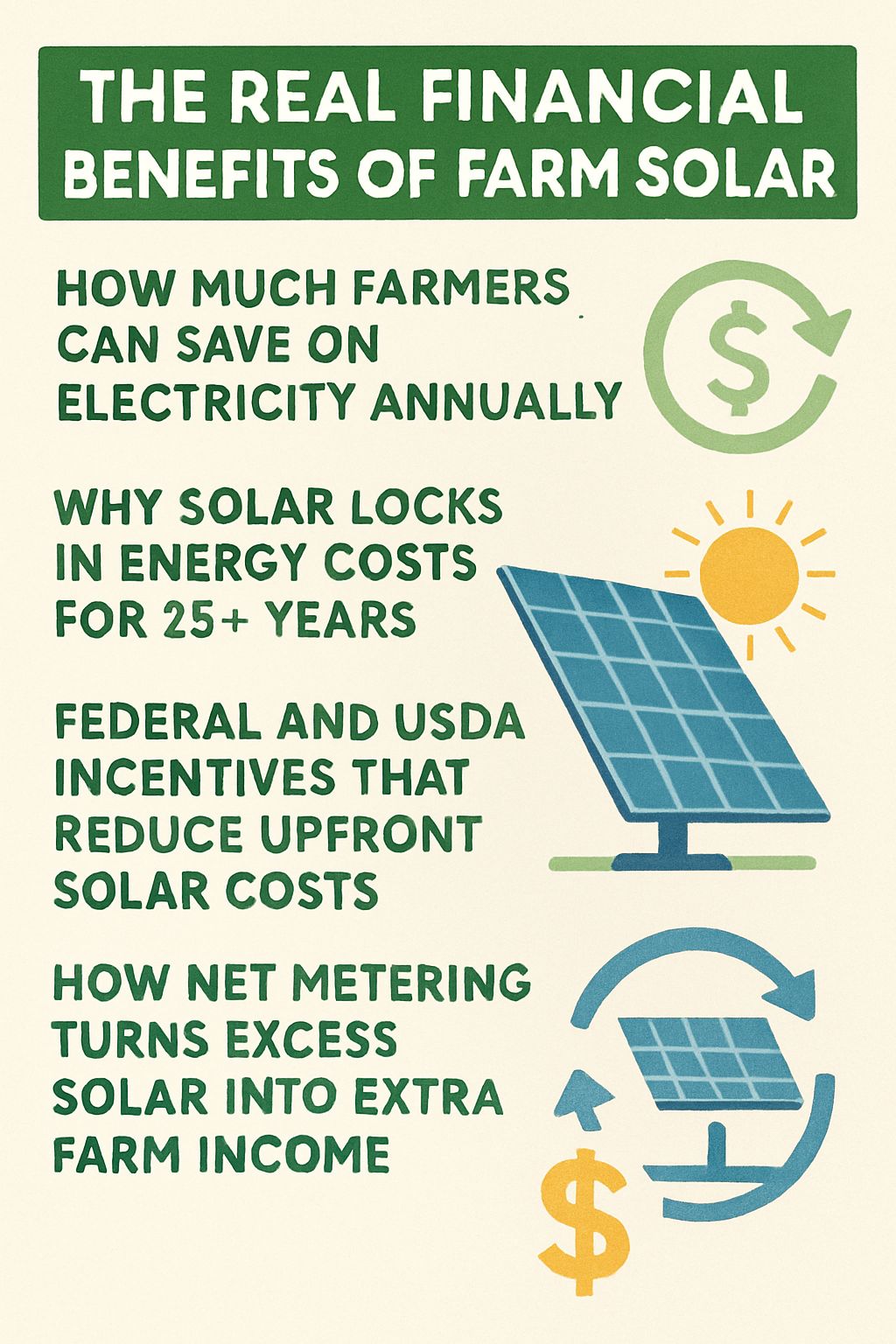
How Much Farmers Can Save on Electricity Annually
Savings depend heavily on farm size, energy consumption patterns, and local utility rates — but the numbers reported by farms that have made the switch are consistently significant. Many operations running irrigation pumps, grain dryers, and cold storage simultaneously report electricity cost reductions of 50% or more after going solar. For larger commercial farms with annual electricity bills in the $40,000–$80,000 range, that translates to savings of $20,000 to $40,000 every single year. Learn more about how smart controllers and sensors can further enhance solar power efficiency on farms.
Smaller farms see proportionally similar results. A mid-sized vegetable operation paying $800 per month in electricity could realistically cut that bill to $300–$400 per month with a properly sized rooftop or ground-mount system. Over a 25-year panel lifespan, those monthly savings stack into a substantial return on the original investment — often delivering a total payback of two to three times the installation cost.
Why Solar Locks in Energy Costs for 25+ Years
One of the most underappreciated advantages of farm solar is price certainty. Grid electricity rates have historically risen year over year, and farms have no control over those increases. A solar installation, by contrast, produces electricity at a fixed effective cost from day one — the panels generate the same output regardless of what happens to utility rates. Over a 25-year panel lifespan, locking in your energy cost today provides a powerful hedge against the rate increases that will inevitably keep coming.
Federal and USDA Incentives That Reduce Upfront Solar Costs
The upfront cost of a farm solar installation is the single biggest barrier for most operators — and that is exactly where federal and USDA programs make a decisive difference. The federal Investment Tax Credit (ITC) currently allows eligible agricultural businesses to deduct a significant percentage of solar installation costs directly from their federal tax liability. The USDA’s Rural Energy for America Program (REAP) provides grants covering up to 25% of total project costs, plus loan guarantees for the remaining portion — a combination that can dramatically reduce the net out-of-pocket investment required to get a system running.
How Net Metering Turns Excess Solar into Extra Farm Income
On sunny days when solar generation exceeds on-farm consumption — which happens regularly during lower-activity periods between planting and harvest — net metering allows farmers to send that surplus electricity back to the grid in exchange for credits on future utility bills. In states with favorable net metering policies, this effectively turns your solar array into a secondary revenue stream, offsetting winter energy costs with credits earned during peak summer production months.
Where to Install Solar Panels on a Farm
Farm properties typically offer installation flexibility that urban and suburban solar customers can only dream about. Between large roof surfaces on barns and outbuildings, open ground in field margins, and fallow land that generates no income, most farms have multiple viable locations for solar panels — each with its own set of trade-offs worth understanding before committing to a layout.
Roof-Mounted Systems on Barns and Agricultural Buildings
Barn rooftops are the most common starting point for farm solar, and for good reason. Installing panels on an existing structure uses space that is already accounted for in your farm’s footprint, requires no additional land, and keeps the panels close to the buildings drawing the most electricity. South-facing barn roofs with minimal shading are ideal candidates — a large dairy barn or grain storage facility can easily accommodate a system large enough to power the entire operation.
Structural assessment is a critical first step before installation. Older barns may require reinforcement to handle the added load of panel racking and the panels themselves. Working with an installer experienced specifically in agricultural buildings — not just residential rooftop systems — ensures that the structural evaluation is done correctly and that the mounting system is compatible with metal, wood, or corrugated roofing materials commonly found on farm buildings.
Ground-Mount Options for Fallow or Underused Land
When roof space is limited or structurally unsuitable, ground-mount systems on fallow or low-productivity land are an excellent alternative. Fixed ground-mount arrays can be installed along field boundaries, in corners of irregularly shaped fields, or on land with soil conditions that make row cropping uneconomical. For farms interested in maximizing output, tracking ground-mount systems — which follow the sun’s arc across the sky — can increase energy generation by 20–25% compared to fixed arrays, though they carry a higher upfront cost.
Ground-Mount Options for Fallow or Underused Land
When roof space is limited or structurally unsuitable, ground-mount systems on fallow or low-productivity land are an excellent alternative. Fixed ground-mount arrays can be installed along field boundaries, in corners of irregularly shaped fields, or on land with soil conditions that make row cropping uneconomical.
For farms interested in maximizing output, tracking ground-mount systems — which follow the sun’s arc across the sky — can increase energy generation by 20–25% compared to fixed arrays, though they carry a higher upfront cost. The decision between fixed and tracking systems usually comes down to available land area and the farm’s overall energy demand profile.
- Fixed ground-mount arrays work well on flat, open land with good south-facing exposure
- Single-axis trackers follow the sun east to west, boosting daily output by 20–25%
- Dual-axis trackers adjust for both daily and seasonal sun angles, offering maximum output in high-demand operations
- Agrivoltaic layouts place panels above crop rows, allowing simultaneous land use for both energy generation and low-light-tolerant crops
- Field boundary installations avoid removing productive acreage from rotation entirely
One increasingly popular approach is agrivoltaics — a dual-use system where solar panels are elevated above crop rows, allowing farming to continue underneath. Research has shown that certain crops, including leafy greens and some berries, actually benefit from the partial shading these systems provide in hot climates, while the panels above generate clean electricity for the operation. It is a model that squeezes genuine value from every square foot of your land.
The High Upfront Cost of Solar Is the Biggest Barrier — Here Is How to Manage It
The capital intensiveness of solar installation is a real obstacle — there is no point pretending otherwise. A mid-sized farm solar system can run anywhere from $30,000 to well over $150,000 depending on capacity and installation complexity. But the tools available today to manage that upfront cost have changed the equation significantly. USDA REAP grants cover up to 25% of total project costs outright, while the federal ITC reduces tax liability on the remaining investment. Third-party financing, solar leases, and Power Purchase Agreements (PPAs) allow farms to go solar with little to no upfront cash, paying for the system through the energy savings it generates from day one. For most farms, the question is no longer whether solar pencils out — it is which financing structure fits best.
Solar Makes Sense for Farms Running Grain Dryers and Cold Storage
If your farm is running grain dryers and cold storage systems, solar is not a futuristic concept — it is a practical, proven cost-reduction tool available right now. The combination of high daytime energy loads, long operating seasons, available roof and land area, and strong federal incentive programs makes agricultural operations one of the strongest use cases for solar installation anywhere in the economy. The farms making the move today are locking in energy cost certainty for the next 25 years while their neighbors continue writing larger checks to the utility company every harvest season. To maximize the efficiency of your solar setup, consider exploring dual-axis vs single solar tracker systems for your farm.
Frequently Asked Questions
Here are answers to the most common questions farmers ask before making the move to solar energy.
Can solar panels fully power a grain dryer on a large farm?
In a low-temperature, full-bin drying setup, a well-sized solar collector system can contribute meaningfully to the majority of heat input needed — supplementing the 50–70% of heat already present in ambient air. For high-temperature continuous-flow dryers that demand intense, consistent energy, solar works best as a hybrid solution paired with grid power or battery storage rather than a complete standalone replacement. The right answer depends on your dryer type, grain volume, and local solar resource.
How long does it take for a farm solar system to pay for itself?
Payback periods for farm solar installations typically range from 5 to 10 years, depending on system size, local electricity rates, financing structure, and which incentives are applied. Operations that qualify for USDA REAP grants and the federal ITC consistently land toward the shorter end of that range.
After payback, the system continues generating electricity at effectively zero fuel cost for another 15 to 20 years — the financial equivalent of running your dryers and cold storage for free. That long tail of savings is where the real wealth-building happens for farm operations that go solar early. For those interested in enhancing their solar setup, exploring dual-axis solar trackers can offer additional benefits for agricultural efficiency.
Several factors will determine exactly where your farm falls on the payback timeline:
- Current annual electricity spend (higher bills = faster payback)
- Available federal and state incentives at time of installation
- Whether net metering credits are available in your utility territory
- Financing method — cash purchase delivers faster payback than lease structures
- System sizing accuracy — a properly sized system avoids both under-production and unnecessary capital cost
- Local solar irradiance — farms in high-sun regions naturally generate more electricity per panel
What government grants are available for agricultural solar installations?
The USDA Rural Energy for America Program (REAP) is the most significant federal grant program specifically targeting farm solar installations, providing grants of up to 25% of eligible project costs alongside loan guarantees for up to 75% of the remaining amount. Beyond REAP, the federal Investment Tax Credit (ITC) applies to agricultural solar installations, and many states operate their own agricultural energy efficiency grant programs layered on top of federal funding. Contacting your local USDA Rural Development office is the fastest way to identify every program available in your specific state and county.
Can solar-powered cold storage maintain a stable temperature year-round?
Yes — a properly designed solar cold storage system with adequate battery backup maintains stable internal temperatures continuously, including through nights and overcast periods. The key is correct system sizing: battery bank capacity must be matched to the compressor’s overnight draw, and the panel array must be large enough to recharge batteries fully during shorter winter daylight hours. Systems designed with these parameters in mind have demonstrated reliable year-round performance across a wide range of climates.
Is solar grain drying suitable for small-scale or subsistence farmers?
Solar grain drying is one of the most accessible renewable energy applications for small-scale farmers precisely because it does not require a large, expensive system to deliver meaningful results. Simple flat-plate solar collectors can be built from low-cost local materials and integrated with a basic fan and storage bin to create an effective low-temperature drying setup. The modest temperature rise required — just 5–10°F above ambient — means even a small collector area makes a measurable difference in drying speed and grain quality.
For subsistence farmers in tropical and subtropical regions, enclosed solar dryers also solve a critical post-harvest problem that open sun drying cannot: protecting grain from insects, rain, and fungal contamination during the drying process. That protection alone can prevent losses that would otherwise consume a significant portion of the harvest before it ever reaches market or the family table.


Leave a Reply