

“Farmers Solar Panel Backup Solutions …” from growingsolarmist.com and used with no modifications.
Key Takeaways
- The right backup battery can mean the difference between a failed harvest and an uninterrupted season — choosing wrong costs more than just money.
- Lithium Iron Phosphate (LiFePO4) batteries are the top choice for most modern farm solar setups, offering 2,000–5,000+ charge cycles versus 500–1,200 for lead-acid alternatives.
- Lead-acid batteries still make sense for small farms and tight budgets, especially when proper maintenance routines are already in place.
- Flow batteries are a game-changer for large-scale operations — but most farmers don’t know when they actually make financial sense (we break it down inside).
- Growing Solar Mist covers the full spectrum of solar-powered farming solutions, from battery selection to irrigation system design for every scale of operation.
Pick the wrong battery for your solar irrigation system and you could be hauling water by hand during a drought.
Solar energy has transformed how farms operate, but panels alone aren’t enough. When the sun goes down or clouds roll in, your irrigation pumps, cold storage units, and livestock systems still need power. That’s where your backup battery becomes the backbone of the entire setup. The wrong choice doesn’t just underperform — it fails at the exact moment you need it most.
For farmers exploring reliable solar energy solutions, Growing Solar Mist offers practical, farm-specific guidance on batteries, irrigation systems, and solar panel setups built for real agricultural demands. Understanding your battery options before you buy can save thousands over the life of your system.
The four primary battery technologies used in farm solar systems are lead-acid, lithium-ion (specifically LiFePO4), flow batteries, and saltwater batteries. Each fits a different combination of farm size, budget, climate, and energy demand. There’s no universal answer — but there is a right answer for your operation.
|
Battery Type |
Cost per kWh |
Cycle Life |
Maintenance |
Best For |
|---|---|---|---|---|
|
Flooded Lead-Acid |
$100–$150 |
500–1,000 |
High |
Budget-conscious small farms |
|
AGM (Sealed Lead-Acid) |
$200–$250 |
600–1,200 |
Low |
Small-mid farms, low maintenance |
|
LiFePO4 (Lithium Iron Phosphate) |
$400–$700 |
2,000–5,000+ |
Very Low |
Mid-to-large farms, long-term use |
|
Flow Battery |
$300–$500 |
10,000+ |
Moderate |
Large farms, high-demand systems |
|
Saltwater Battery |
$300–$500 |
3,000+ |
Low |
Eco-focused operations |
Your Farm Needs a Backup Battery — Here’s What to Know First
Solar panels generate power only when the sun is shining — which is rarely when your farm’s energy demand peaks. Irrigation systems often run at dawn and dusk. Cold storage runs overnight. Livestock climate systems run continuously. Without a battery bank storing that solar energy, you’re either dependent on the grid or running dry at the worst possible time.
Battery storage also acts as a financial buffer. Time-of-use electricity pricing means grid power costs significantly more during peak hours. A well-sized battery bank lets you draw stored solar energy during those windows instead of paying premium rates. Farms that have made the switch report meaningful reductions in monthly utility costs, especially during summer irrigation season.
Before selecting a battery, three factors determine everything: your peak energy demand, your budget, and your installation environment. A remote 40-acre operation in Arizona with no grid connection has entirely different needs than a 5-acre family farm in Ohio with grid access as a fallback. Get these three factors clear before comparing any specs.
“Deep‑Cycle Flooded Lead‑Acid Battery …” from growingsolarmist.com and used with no modifications.
Lead-Acid Batteries: The Budget-Friendly Starting Point
Lead-acid batteries have powered off-grid systems for over a century, and they remain the most cost-accessible entry point for farmers adding battery backup to a solar system. They’re well-understood, widely available, and the maintenance requirements — while real — are straightforward for anyone already comfortable managing farm equipment.
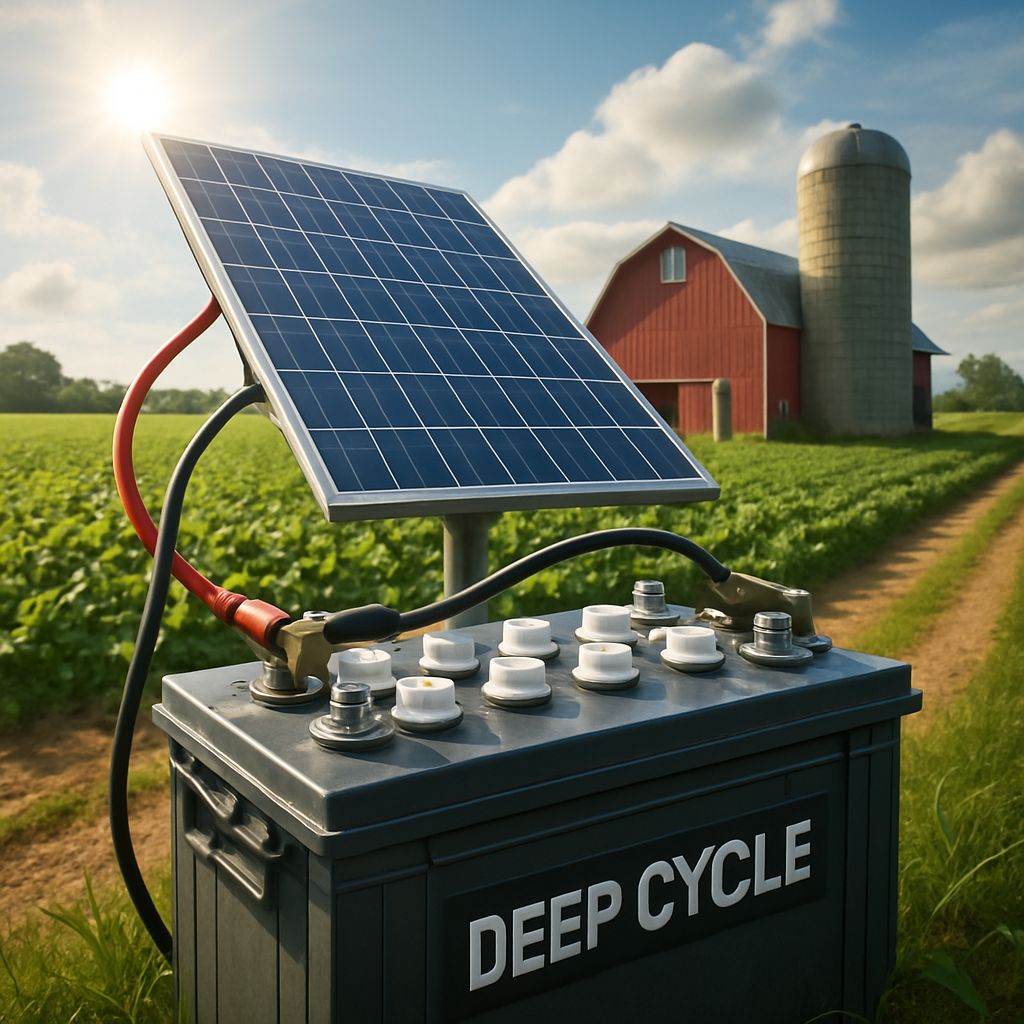
Flooded Lead-Acid: Low Cost, High Maintenance
Flooded lead-acid (FLA) batteries are the most affordable option on the market, typically running $100–$150 per kWh. They work by submerging lead plates in a liquid electrolyte solution, which must be topped up with distilled water regularly to prevent sulfation and plate damage. When properly maintained, they deliver 500–1,000 charge cycles and can last 5–7 years on a farm solar system.
The tradeoff is real: they off-gas hydrogen during charging, require ventilated enclosures, and need monthly water checks. For farmers with technical discipline and a tight capital budget, they’re a solid choice — especially for systems that won’t be scaled significantly over time.
Sealed AGM and Gel Batteries: Less Upkeep, Slightly Higher Cost
Absorbed Glass Mat (AGM) batteries are a significant step up from flooded models. The electrolyte is absorbed into fiberglass mats between the lead plates, eliminating the need for water topping and reducing off-gassing substantially. AGM batteries typically cost $200–$250 per kWh — roughly a 40–60% premium over flooded lead-acid — but most farmers find the maintenance savings justify the gap. For more information on why farms are turning to battery storage, you can read this article on battery storage for backup power.
Gel batteries follow a similar principle but use a silica-based gel electrolyte instead. They handle deep discharges slightly better than AGM but are more sensitive to high charge rates, which makes charge controller compatibility an important consideration. Both sealed types are better suited for indoor enclosures like pump houses or outbuildings where venting would otherwise be a concern.
Where Lead-Acid Makes Sense on a Farm
For small systems irrigating fewer than 5 acres with modest water requirements, flooded or AGM lead-acid batteries often provide the best balance of cost and initial performance. Their lower upfront cost frees up budget for higher-quality solar panels and pump equipment — which typically deliver more tangible return on investment than premium batteries at the small scale. Seasonal systems that only run a few months annually are also good candidates, since the higher cost of lithium may not be recouped before the system is mothballed for winter.
Lithium Iron Phosphate (LiFePO4): The Most Popular Farm Battery
LiFePO4 has become the default recommendation for mid-to-large farm solar installations — and for good reason. It delivers a combination of cycle life, depth of discharge, weight, and low maintenance that no lead-acid chemistry can match. The upfront cost is 2–3 times higher than flooded lead-acid, but the lifetime value calculation almost always tips in lithium’s favor for farms running systems year-round.
Why LiFePO4 Outperforms Other Lithium Chemistries for Agriculture
Not all lithium batteries are the same. Standard lithium-ion (like the chemistry in consumer electronics) is sensitive to heat, prone to thermal runaway, and degrades faster under the deep, irregular discharge cycles common in farm applications. LiFePO4 — lithium iron phosphate — uses a fundamentally more stable chemistry. It doesn’t produce the same thermal runaway risk, tolerates wider temperature swings, and handles partial states of charge far better than standard lithium-ion.
Lifespan and Cycle Count Compared to Lead-Acid
A quality LiFePO4 battery delivers 2,000–5,000+ charge cycles at 80–100% depth of discharge. Compare that to flooded lead-acid, which is typically rated for 50% depth of discharge to preserve lifespan, effectively halving the usable capacity you’re paying for. Over a 10-year period on a working farm, a LiFePO4 system will typically outlast two to three lead-acid bank replacements — making the total cost of ownership comparable or lower despite the higher initial price.
Heat Tolerance and Outdoor Installation Considerations
Farm environments are harsh. Battery enclosures in pump houses, equipment sheds, and field stations regularly see temperature swings from below freezing in winter to above 100°F in summer. LiFePO4 performs well across a wider operating range than lead-acid, though all lithium batteries benefit from insulated enclosures in extreme climates. Charging LiFePO4 below 32°F without a battery management system (BMS) that includes low-temperature cutoff can cause permanent lithium plating damage — a detail many installers overlook when setting up farm systems in northern states.
Flow Batteries: Built for Large-Scale Farm Operations
Flow batteries occupy a completely different category from anything else on this list. They’re not common on small farms, and for good reason — the economics don’t justify it. But for large operations with high, consistent daily energy demands, flow batteries offer capabilities that lithium and lead-acid simply can’t match.
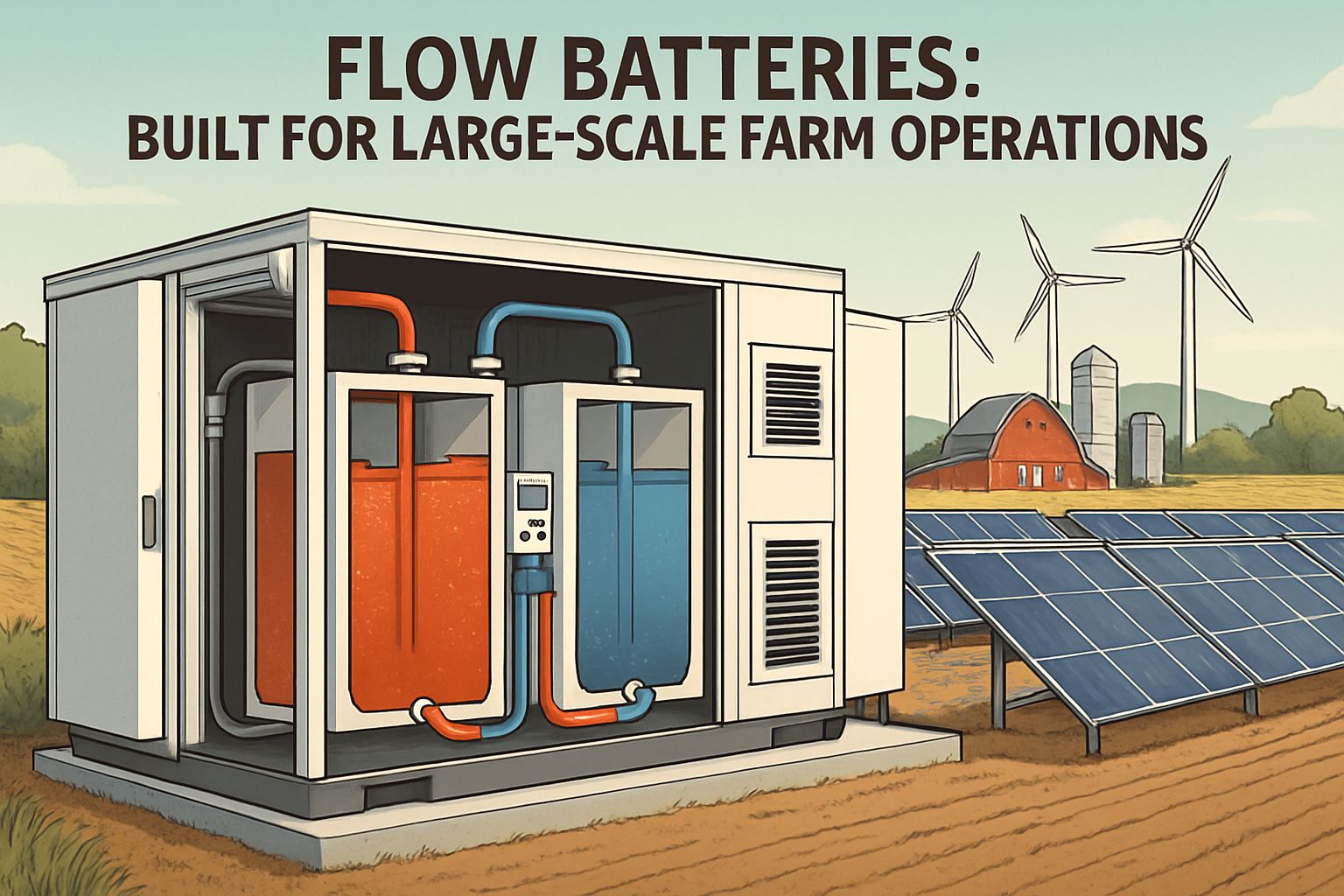
The fundamental difference is how energy is stored. Rather than storing charge in solid electrode materials like lead plates or lithium cells, flow batteries store energy in liquid electrolyte solutions held in external tanks. This architecture makes them almost infinitely scalable — you add capacity by adding tank volume, not by buying new battery modules.
How Flow Batteries Store and Deliver Energy
During charging, electrical energy drives a chemical reaction in the electrolyte solutions — typically vanadium-based in commercial systems. During discharge, the reaction reverses, releasing stored energy back as electricity. The electrolyte is pumped through a central cell stack where the energy conversion happens. Because the energy storage (the tanks) is physically separate from the power conversion (the cell stack), flow batteries don’t degrade the same way solid-state batteries do. Properly maintained vanadium flow batteries can achieve 10,000+ cycles with minimal capacity loss.
Scalability for Multi-Field Irrigation and High-Demand Systems
Where flow batteries make real financial sense is in operations running multiple high-draw systems simultaneously — large center-pivot irrigation networks, multi-barn livestock operations, or farms with on-site cold storage facilities for perishable crops. The ability to scale storage capacity independently of power output means you can design a system around exactly the energy demand you have today and expand it in modular increments as the operation grows, without replacing the core hardware.
Off-Grid vs. Hybrid vs. Grid-Tied Battery Systems
How your battery system connects to the grid — or doesn’t — shapes everything from system sizing to how you respond during outages. Understanding the three main configurations helps you avoid over-investing in storage you don’t need or under-sizing a system that leaves critical loads unprotected.
Each setup has a specific financial and operational profile. Off-grid systems offer complete independence but demand the most battery capacity. Hybrid systems balance cost and flexibility. Grid-tied systems with battery backup are increasingly popular as utility rates climb and grid reliability becomes less predictable in rural areas.
Off-Grid Systems: Full Energy Independence for Remote Farms
Off-grid systems are the only option for farms located beyond the reach of utility lines — and there are more of these than most people assume. In a fully off-grid setup, your battery bank must cover 100% of your energy needs during low solar production periods, which means sizing for multiple days of autonomy. Most off-grid farm systems are designed for 2–4 days of backup capacity without any solar input, factoring in seasonal variation in sunlight hours. LiFePO4 and flow batteries are the strongest performers here due to their deep discharge tolerance and long cycle life.
Hybrid Systems: Flexibility Between Solar, Battery, and Grid Power
Hybrid systems are the sweet spot for most farms that have grid access but want energy independence and cost control. A hybrid inverter manages the relationship between your solar panels, battery bank, and the utility grid simultaneously — drawing from solar first, then batteries, then the grid only when both are depleted. This setup lets you store solar energy during the day, use it during evening peak demand hours, and fall back on grid power only as a last resort.
The financial advantage of a hybrid system is significant. By avoiding grid draw during peak pricing windows, farms can dramatically reduce demand charges on commercial electricity accounts. Adding even a modest 10–20 kWh battery bank to an existing solar array can shift the majority of evening energy loads off grid-sourced power entirely, depending on your operation’s consumption profile.
“Lithium-Ion Batteries Backup for Solar …” from growingsolarmist.com and used with no modifications.
Key Farm Applications That Depend on Backup Battery Power
Battery backup isn’t a luxury for farms — it’s operational insurance. The applications below aren’t just about convenience; for most farms, an unplanned power outage affecting any one of these systems can translate directly into crop losses, livestock health emergencies, or significant equipment damage.
Prioritizing which loads your battery system must cover helps you size the system correctly from the start. Not every load needs backup — but the critical ones need to be identified and sized for before you commit to a battery configuration.
Irrigation Pumps and Water Supply Continuity
Irrigation pumps are typically the highest single draw on a farm solar system. A standard 1 HP submersible pump pulls roughly 750 watts continuously, and larger center-pivot systems can demand 10–50 kW or more. When sizing battery backup for irrigation, calculate your pump’s wattage, your daily runtime in hours, and multiply by at least 1.25 to account for inefficiencies. A pump running 6 hours per night at 1.5 kW needs a minimum of 11.25 kWh of usable battery storage per day — before accounting for any other loads.
Cold Storage and Refrigeration for Perishable Crops
Cold storage failure is one of the most financially devastating outcomes of a power outage for farms growing fruits, vegetables, dairy, or meat products. A single-room walk-in cooler running at 35°F typically draws 1–2 kW continuously, and the thermal mass of stored product means temperature begins rising within 2–4 hours of power loss in warm weather.
Cold Storage Battery Sizing Reference:
Walk-in Cooler (10×10 ft) — Continuous draw: ~1.2 kW — 24-hour storage needed: ~28.8 kWh
Walk-in Freezer (10×10 ft) — Continuous draw: ~2.0 kW — 24-hour storage needed: ~48 kWh
Dairy Bulk Tank (500 gal) — Continuous draw: ~2.5–3.5 kW — 24-hour storage needed: ~60–84 kWh
Note: Add 25% buffer for compressor startup surge and temperature recovery loads.
These numbers make clear why cold storage backup demands a serious battery investment. Most farms running perishable storage alongside irrigation will need a minimum 50–100 kWh battery bank to cover both loads through a single overnight period — which puts LiFePO4 systems in the 48V configuration or flow batteries firmly in the picture.
The good news is that cold storage loads are highly predictable and consistent. Unlike irrigation, which runs in defined windows, refrigeration runs 24/7 — which actually makes solar-plus-battery system sizing more straightforward. Your solar array charges the battery during the day while the cooler draws from it at night, creating a clean daily cycle that LiFePO4 batteries are well-suited to handle.
For farms with significant cold storage needs, it’s worth investing in a temperature-monitoring system with battery-backed alerts. Even the best battery system can experience a fault — and knowing within minutes rather than hours can be the difference between saving and losing an entire harvest batch.
Livestock Climate Control and Automated Feeding Systems
Poultry and swine operations are particularly vulnerable to power loss. Ventilation failure in a poultry barn during summer heat can cause significant mortality within hours. Automated feeders, waterers, and climate control systems in livestock facilities are non-negotiable backup candidates. These loads are generally lower wattage than cold storage but run continuously and cannot tolerate interruption — making reliable battery backup essential rather than optional for any serious livestock operation.
Greenhouse Climate Control
Greenhouse operations depend on precise temperature management, CO₂ enrichment systems, supplemental lighting, and automated vent controls — all of which draw continuous power. A mid-sized commercial greenhouse (5,000–10,000 sq ft) can draw 3–8 kW continuously depending on season and climate zone. Battery backup for greenhouse operations is best paired with a hybrid system that prioritizes solar and batteries during daylight hours while maintaining grid as a reliable fallback during overnight cold snaps when heating demand spikes unpredictably. Learn more about HJT solar panels powering farming operations to enhance energy efficiency.
Security Systems, Electric Fences and Lighting
Electric fencing, perimeter lighting, and farm security cameras are relatively low-draw but mission-critical loads that are easy and cost-effective to back up. A standard electric fence energizer draws as little as 1–5 watts continuously. Security camera systems with DVR recording typically draw 50–150 watts total. These loads can often be covered by a small dedicated battery bank separate from the main farm system — a practical approach for farms that want to protect high-value livestock areas without needing to size the entire farm battery system around security loads. For more information on why farms are turning to battery storage, visit Hubble Energy.
How to Choose the Right Battery for Your Farm
The single biggest mistake farmers make when selecting a battery is starting with the product instead of starting with the load. Battery manufacturers and installers will quote you on system size — but only you know which loads are truly critical, which can be interrupted without consequence, and what your actual daily energy consumption looks like across seasons.
Work through the following decision points in order before comparing any product specifications or price points.
Match Battery Capacity to Your Peak Energy Demand
Add up the wattage of every load you need the battery to support, multiply by the number of hours each runs daily, and sum the total. That gives you your daily kWh requirement. Then determine your desired days of autonomy — how many days the system should run without solar input. Multiply daily kWh by days of autonomy, then divide by your battery’s usable depth of discharge (0.5 for lead-acid, 0.8–0.95 for LiFePO4) to get your minimum required battery bank size. Always add a 20–25% buffer for real-world inefficiencies and load growth.
Factor in Climate, Location, and Installation Environment
If your battery enclosure will experience temperatures below freezing, LiFePO4 with a built-in battery management system featuring low-temperature charging cutoff is non-negotiable. In extreme heat environments above 95°F, all battery types benefit from insulated, ventilated enclosures — but flooded lead-acid becomes especially vulnerable to accelerated water loss and plate damage. Humidity is also a factor in coastal or high-humidity farming regions: sealed AGM and LiFePO4 batteries handle moisture exposure significantly better than flooded lead-acid banks with exposed terminal connections.
Budget: Upfront Cost vs. Long-Term Savings
|
Battery Type |
Upfront Cost (20 kWh system) |
Expected Lifespan |
Replacement Cycles (10 yr) |
10-Year Total Cost |
|---|---|---|---|---|
|
Flooded Lead-Acid |
$2,000–$3,000 |
5–7 years |
1–2 replacements |
$4,000–$9,000 |
|
AGM (Sealed Lead-Acid) |
$4,000–$5,000 |
6–8 years |
1 replacement |
$8,000–$10,000 |
|
LiFePO4 |
$8,000–$14,000 |
10–15 years |
0 replacements |
$8,000–$14,000 |
|
Flow Battery |
$12,000–$20,000 |
20+ years |
0 replacements |
$12,000–$20,000 |
The table above makes the long-term math clear: lead-acid’s low upfront cost erodes quickly once you factor in replacement cycles, maintenance labor, and the opportunity cost of system downtime during battery bank swaps. For farms planning to run the same solar system for 10 or more years, LiFePO4 is almost always the more economical choice over the full period — even when capital is tight at the point of initial investment.
Financing options are worth exploring for LiFePO4 systems. USDA Rural Energy for America Program (REAP) grants and loans cover up to 50% of eligible renewable energy system costs, including battery storage — a resource many farmers overlook when comparing upfront price tags. State-level agricultural energy programs offer additional incentives in many regions, which can dramatically change the upfront cost comparison.
If budget genuinely constrains you to lead-acid at the start, design your system with future lithium retrofit in mind. Choose an inverter and charge controller compatible with both battery chemistries, and leave physical space in your battery enclosure for higher-density lithium modules. This approach lets you start with the most affordable option without locking yourself out of an upgrade path later.
When to Scale Up: Signs Your System Has Outgrown Its Battery
Your battery system will tell you when it’s struggling — if you know what to watch for. The clearest sign is voltage sag during peak demand periods: if your inverter is frequently switching to grid or generator backup during morning and evening load peaks despite adequate solar production, your battery bank is undersized for your actual consumption. Other red flags include batteries that reach full charge before noon consistently (meaning your solar array has outgrown your storage capacity), or batteries that hit low-voltage cutoff before sunrise after a full day of charging.
Track your system’s state of charge at the same time each morning for two weeks. If you’re regularly starting the day below 40% on a lead-acid system or below 20% on LiFePO4, you’re running a deficit that will compound into premature battery degradation. At that point, the question isn’t whether to scale up — it’s whether to expand the existing bank or replace it with a higher-capacity system in a more appropriate chemistry.
“Solar Battery Storage Cost in 2026 …” from advancesolar.com and used with no modifications.
Real-World Battery Costs and ROI for Farmers
Raw product cost is only one piece of the financial picture. Installation labor, inverter compatibility, ongoing maintenance, and replacement frequency all factor into the true cost of ownership over a 10- to 15-year system lifetime. Farmers who evaluate batteries only on sticker price consistently end up paying more in the long run.
- Flooded Lead-Acid (20 kWh bank): $2,000–$3,000 upfront, plus $200–$400/year in maintenance time and materials, with 1–2 full replacements over 10 years
- AGM Sealed Lead-Acid (20 kWh bank): $4,000–$5,000 upfront, near-zero maintenance cost, typically one replacement over 10 years
- LiFePO4 (20 kWh bank): $8,000–$14,000 upfront, minimal maintenance, no replacement needed within a 10-year window under normal farm cycling
- Vanadium Flow Battery (20 kWh equivalent): $12,000–$20,000 upfront, moderate annual pump and electrolyte maintenance, 20+ year operational life with virtually no capacity degradation
- USDA REAP Grant Offset: Up to 50% of eligible system costs reimbursed — dramatically changes the real out-of-pocket comparison across all battery types
When you factor REAP grant eligibility into the equation, a $14,000 LiFePO4 system becomes a $7,000 out-of-pocket investment — directly comparable to or cheaper than a flooded lead-acid system that will need replacing twice in the same period. The ROI conversation shifts entirely once incentive programs are included in the analysis.
Beyond avoiding replacement costs, the ROI on battery storage for farms also comes from avoided grid demand charges, reduced generator fuel consumption, and — critically — avoided crop or livestock losses during outages. A single cold storage failure representing a lost harvest batch can easily exceed the total cost of a properly sized LiFePO4 battery system. This makes the insurance value of battery backup one of the most compelling arguments for investing in quality storage from day one. For more insights, consider exploring the comparison of solar technologies for farmers.
Initial Investment Breakdown
For a mid-sized farm running a 20 kWh daily load with a requirement for 2 days of autonomy, a properly sized LiFePO4 system in a 48V configuration will typically require 50–55 kWh of installed battery capacity (accounting for 80–90% usable depth of discharge). At current market pricing of $400–$700 per kWh installed, that puts the total system cost between $20,000 and $38,500 before incentives — a wide range driven primarily by brand, BMS quality, and installer labor costs in your region. Pairing with a quality hybrid inverter such as the Victron Quattro 48/10000 or SMA Sunny Island adds $3,000–$6,000 to the total but provides the monitoring and management capabilities that protect your battery investment long-term.
Lifetime Value Comparison
- LiFePO4 at 3,000 cycles (80% DoD): Delivers approximately 8.2 years of daily cycling before reaching 80% rated capacity — with most quality cells continuing to function well below that threshold for years afterward
- Flooded Lead-Acid at 700 cycles (50% DoD): Reaches end-of-life in under 2 years under daily cycling — making it suitable only for seasonal or infrequent-use farm systems
- AGM at 900 cycles (50% DoD): Approximately 2.5 years under daily cycling — better than flooded but still requires multiple replacements over a 10-year system life
- Vanadium Flow at 10,000+ cycles: 27+ years of daily cycling at full depth of discharge — the clear winner on pure longevity for large-scale farm operations
These cycle-life numbers assume daily full cycling, which represents the most demanding use case. Farms that cycle their batteries less aggressively — drawing down to 50% most nights rather than 80–90% — will see significantly extended real-world lifespans across all battery types. For more insights on solar technologies, check out this solar technologies comparison for farmers.
One factor that gets overlooked in ROI discussions is labor cost for battery maintenance and replacement. Replacing a 20 kWh flooded lead-acid bank requires disconnecting, safely disposing of, and reinstalling several hundred pounds of lead-acid modules — a process that typically costs $500–$1,500 in installer labor on top of the replacement hardware. Over 10 years, two replacement cycles add $1,000–$3,000 in labor alone to the flooded lead-acid total cost of ownership.
Grid outage frequency in your region is another ROI variable worth researching before finalizing your system design. Farms in areas prone to severe weather, aging grid infrastructure, or wildfire-related Public Safety Power Shutoffs (PSPS) — common in parts of California, Texas, and the Pacific Northwest — derive outsized value from battery backup because outage events are more frequent and longer in duration. A battery system that pays for itself in 8 years under normal conditions might deliver payback in 4–5 years in a high-outage-risk region when avoided loss events are factored in.
One final consideration: battery technology pricing continues to fall. LiFePO4 cell costs have dropped significantly over the past five years and are projected to continue declining. Farmers who delayed purchase decisions waiting for prices to fall further have often found that the energy savings and loss-prevention value they missed during the waiting period exceeded the marginal savings from buying later. If your system is ready to be built and the numbers make sense today, the opportunity cost of waiting is real.
Lead-Acid vs. Lithium vs. Flow: Side-by-Side Comparison for Farmers
The table below consolidates the key decision metrics for the three primary battery technologies used in farm solar systems. Use it as a practical reference when comparing quotes or discussing options with an installer. For a broader understanding of solar technologies, you might also want to explore our solar technologies comparison for farmers.
|
Metric |
Flooded Lead-Acid |
AGM Lead-Acid |
LiFePO4 Lithium |
Vanadium Flow |
|---|---|---|---|---|
|
Cost per kWh (installed) |
$100–$150 |
$200–$250 |
$400–$700 |
$300–$500 |
|
Usable Depth of Discharge |
50% |
50–60% |
80–95% |
100% |
|
Cycle Life |
500–1,000 |
600–1,200 |
2,000–5,000+ |
10,000+ |
|
Typical Lifespan (farm use) |
3–5 years |
4–7 years |
10–15 years |
20–25 years |
|
Maintenance Requirement |
High (monthly) |
Low |
Very Low |
Moderate (annual) |
|
Cold Weather Performance |
Moderate |
Moderate |
Good (with BMS) |
Good |
|
Scalability |
Limited |
Limited |
Moderate |
Excellent |
|
Best Farm Size |
Small (<5 acres) |
Small–Medium |
Medium–Large |
Large commercial |
|
Thermal Runaway Risk |
Low |
Low |
Very Low |
None |
Looking at this side by side, one thing becomes immediately clear: there is no single “best” battery — there’s only the best battery for a specific combination of farm size, budget, climate, and operational profile. A 3-acre berry farm in Vermont with seasonal irrigation has almost nothing in common with a 200-acre commercial vegetable operation in California, and their optimal battery choices reflect that difference entirely.
The usable depth of discharge row deserves particular attention. A 20 kWh flooded lead-acid bank delivers only 10 kWh of usable storage before risking sulfation damage. A 20 kWh LiFePO4 bank delivers 16–19 kWh of usable storage. To get equivalent usable capacity, you’d need to install nearly double the lead-acid capacity — which changes the cost comparison significantly at the system level, even before factoring in replacement cycles.
Scalability is the decisive factor for growing farm operations. If you’re planning to expand irrigated acreage, add cold storage, or bring additional outbuildings onto your solar system within the next 5 years, choose a battery technology and inverter platform that supports capacity expansion without requiring a full system replacement. LiFePO4 systems based on modular 48V rack-mount batteries — such as the BYD Battery-Box Premium HVS or Pylontech US5000 — are specifically designed for this kind of incremental scaling and are widely compatible with major hybrid inverter brands.
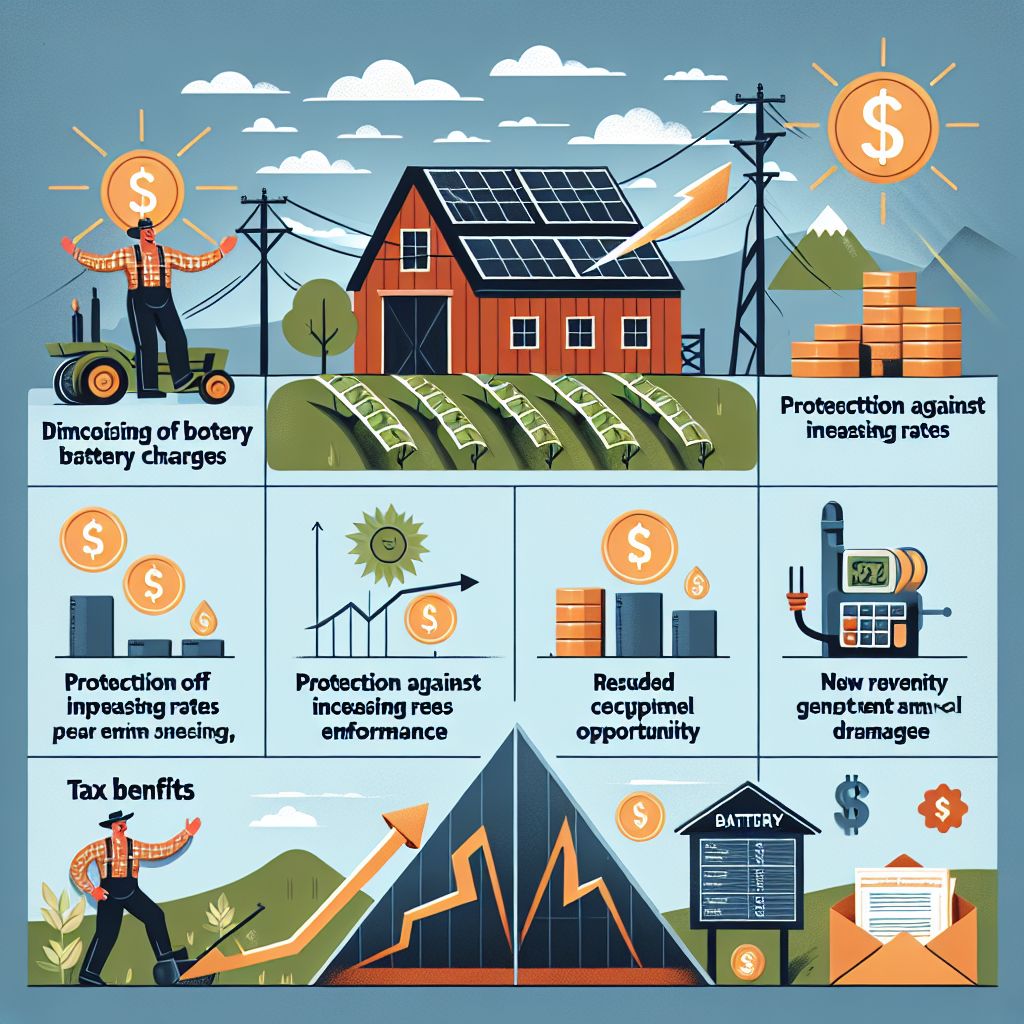
“Solar Panel Battery Technology for …” from growingsolarmist.com and used with no modifications.
The Right Battery Pays for Itself — Here Is How to Make It Work
- Size for your critical loads first, not your total farm consumption — identify which systems cannot be interrupted and design the battery bank around those loads specifically
- Invest in a quality battery management system (BMS) regardless of which chemistry you choose — it protects the cells from overcharge, overdischarge, and thermal events that shorten lifespan
- Match your charge controller to your battery chemistry — using a PWM controller with LiFePO4 batteries or a charge profile designed for lead-acid will degrade lithium cells prematurely
- Apply for USDA REAP funding before purchasing — the grant covers up to 25% and the loan component up to 75% of eligible costs, and applications can be submitted before system installation
- Plan for battery expansion from day one — even if you install a smaller bank initially, choose components that support future capacity additions without requiring hardware replacement
The farms that get the best return on battery investment are the ones that treat it as an engineered system rather than a product purchase. A battery bank installed without proper load analysis, charge controller matching, and environmental protection will underperform regardless of how much it cost. The technical details matter as much as the product selection.
Monitoring is the ongoing discipline that protects your investment after installation. Modern battery management systems from brands like Victron Energy, SMA, and Schneider Electric provide real-time state-of-charge data, cycle count tracking, temperature monitoring, and fault alerts accessible from a smartphone. Reviewing this data weekly during the first season after installation lets you catch emerging issues — unusual capacity loss, abnormal temperature readings, irregular charge cycles — before they compound into costly failures.
The bottom line is straightforward: the right battery for your farm is the one that reliably covers your critical loads, fits your operational budget over a 10-year horizon, survives your climate, and can grow with your operation. Lead-acid gets you started. Lithium carries you forward. Flow takes you to scale. Start with honest load math, factor in the full lifetime cost, apply for every available incentive, and build a system designed to last — not just to launch.
Frequently Asked Questions
The questions below cover the most common decision points farmers face when adding battery backup to a solar system. These answers reflect real-world installation considerations across different farm types, climates, and budget levels. For more information on why farms are turning to battery storage, you can read this article by Hubble Energy.
If your specific situation isn’t covered here, the most important step you can take is a professional load audit before purchasing any battery hardware. An accurate picture of your actual daily energy consumption is worth more than any product comparison.
How Many Solar Batteries Does a Farm Typically Need?
The number of batteries depends entirely on your energy demand and desired autonomy period — there’s no universal answer. A small 3-acre market garden with a single irrigation pump and no cold storage might run effectively on a 10–15 kWh battery bank (roughly 2–4 standard 48V LiFePO4 modules). A mid-sized diversified farm with irrigation, cold storage, and livestock systems typically needs 50–100 kWh of installed capacity to cover 24–48 hours of autonomy.
For planning purposes, calculate your total daily load in kWh, multiply by your desired days of autonomy, then divide by your battery’s usable depth of discharge to get the minimum installed capacity you need. Add 20–25% as a buffer. That number divided by your chosen battery module’s kWh rating gives you the number of units required.
Can I Add a Backup Battery to an Existing Solar Panel System?
Yes — but compatibility is the critical factor. If your existing solar system uses a standard string inverter (the most common type in grid-tied residential and small commercial installs), you’ll likely need to add a separate AC-coupled battery inverter, such as the Victron MultiPlus or SMA Sunny Boy Storage, alongside a compatible battery bank. Some string inverters are “storage-ready” and can be upgraded with a paired battery unit, but many cannot directly interface with battery storage at all.
If your system uses a hybrid inverter already, adding batteries is typically straightforward — connect the battery bank to the DC bus following the manufacturer’s specifications and update the inverter’s charge parameters to match your new battery chemistry. Always verify that your existing charge controller’s voltage range and charge profile are compatible with the battery chemistry you’re adding before making any connections. Mismatched charge profiles are the number-one cause of premature battery failure in retrofit installations. For a detailed comparison of solar technologies, including hybrid inverters, visit this solar technologies comparison.
How Long Do Farm Solar Backup Batteries Last Before Replacement?
Battery lifespan varies significantly by chemistry, usage pattern, and environmental conditions. The most honest answer is that cycle count — not calendar time — is the primary driver of battery aging. A battery used lightly in a seasonal operation will outlast the same battery in a year-round daily-cycling application by several years, regardless of the calendar date on the warranty.
Temperature is the second most important lifespan factor. Every 15°F above 77°F (25°C) that a lead-acid battery operates at regularly cuts its cycle life approximately in half. LiFePO4 is considerably more heat-tolerant but still degrades faster in consistently elevated temperature environments. Keeping batteries in insulated, ventilated enclosures that moderate extreme temperature swings is one of the highest-return maintenance investments you can make.
Expected Battery Lifespan by Type (Farm Solar Use)
Flooded Lead-Acid: 3–5 years (daily cycling) / 5–7 years (seasonal use)
AGM Sealed Lead-Acid: 4–7 years (daily cycling) / 7–10 years (seasonal use)
LiFePO4 (Lithium Iron Phosphate): 10–15 years (daily cycling) / 15+ years (seasonal use)
Vanadium Flow Battery: 20–25 years with annual electrolyte and pump maintenance
Saltwater Battery: 8–12 years (daily cycling)All figures assume proper charge controller matching, appropriate depth of discharge management, and installation in a temperature-moderated environment.
Warranty terms are a useful secondary indicator of manufacturer confidence in battery longevity. Quality LiFePO4 batteries from established brands — such as the BYD Battery-Box Premium, Pylontech FORCE H2, or Blue Ion LX — typically carry 10-year warranties with guaranteed minimum capacity retention thresholds of 70–80% at end of warranty period. Lead-acid batteries rarely carry warranties longer than 1–3 years, which itself reflects the difference in expected service life. For more on solar technologies, explore our comparison of solar technologies for farmers.
The practical indicator that a battery bank needs replacement is a measured capacity below 70–80% of its rated original capacity under standard test conditions. Most modern BMS platforms track this automatically and will generate a health alert when the threshold is crossed. Without a BMS, the field indicator is batteries that reach low-voltage cutoff earlier in the evening than they did when new — a sign that usable capacity has degraded to the point where the system can no longer meet its intended load coverage window.
Are Lithium Batteries Safe to Install in Farm Outbuildings?
LiFePO4 batteries specifically are among the safest lithium chemistries available and are genuinely well-suited for farm outbuilding installation. Unlike standard lithium-ion (NMC or NCA chemistry), LiFePO4 does not produce thermal runaway under abuse conditions such as overcharge, physical damage, or short circuit — the scenarios most relevant to farm environments where equipment vibration, rodents, and temperature extremes are real hazards. This is a primary reason LiFePO4 has become the dominant choice for stationary farm storage applications.
That said, best practices for outbuilding installation are non-negotiable: install batteries on non-combustible mounting surfaces (concrete, steel racking), ensure the enclosure has adequate ventilation for heat dissipation, keep batteries away from fuel storage and combustible materials, and use appropriately rated DC disconnect switches and fusing on all battery connections. A thermal monitoring alarm connected to your farm’s security alert system adds an additional layer of protection with minimal cost. Follow the National Electrical Code (NEC) Article 706 guidelines for energy storage systems, and check local jurisdiction requirements — some counties require permits for battery storage installations above a certain capacity threshold.
What Size Battery Do I Need to Power an Irrigation Pump Overnight?
Start with your pump’s actual power draw — not its horsepower rating, but its measured watt draw under load. A 1 HP pump is nominally 746 watts, but real-world draw with a standard single-phase induction motor and pump losses typically runs 900–1,100 watts continuously. Measure with a clamp meter if possible; nameplate ratings frequently understate actual consumption.
- Step 1: Measure or confirm your pump’s running wattage (e.g., 1,000W for a 1 HP system)
- Step 2: Multiply by nightly runtime in hours (e.g., 1,000W × 8 hours = 8,000 Wh = 8 kWh)
- Step 3: Divide by your battery’s usable depth of discharge (8 kWh ÷ 0.85 for LiFePO4 = 9.4 kWh minimum installed capacity)
- Step 4: Add 25% buffer for startup surge, inverter inefficiency, and load variability (9.4 kWh × 1.25 = 11.75 kWh)
- Step 5: Account for startup surge — most induction motors draw 3–6× running wattage at startup, which your inverter must handle; verify inverter surge capacity before finalizing selection
For a single 1 HP irrigation pump running 8 hours overnight, you need a minimum of approximately 12 kWh of installed battery capacity — which translates to roughly three Pylontech US5000 48V modules (each rated 4.8 kWh) or equivalent. Pair with a hybrid inverter rated for at least 3,000W continuous and 6,000W surge to handle motor startup reliably.
Larger pump systems scale proportionally. A 5 HP pump drawing 4,500W running 6 hours per night requires 31.8 kWh of installed LiFePO4 capacity using the same calculation method — putting you in the range of seven 48V rack-mount modules or a single larger lithium cabinet system. At this scale, the economics of LiFePO4 versus lead-acid become even more decisively in lithium’s favor due to the high daily cycling demand.
If you’re running multiple pumps across different irrigation zones on a timer-based schedule, stagger start times by at least 30 seconds to prevent simultaneous motor startups from hitting your inverter with compounded surge loads. This simple scheduling adjustment can prevent inverter overload trips and extend the life of both the inverter and the battery bank by reducing peak current stress on the system.
Always revisit your battery sizing calculation after any significant change to your irrigation setup — adding a new pump, extending runtime windows, or switching to higher-flow nozzles can shift your energy demand enough to push an initially adequate system into chronic under-performance. Treat battery sizing as a living document, not a one-time calculation.
Growing Solar Mist specializes in practical solar solutions for farming operations — from battery selection and irrigation system design to full off-grid and hybrid solar builds tailored to real agricultural demands.




Leave a Reply