
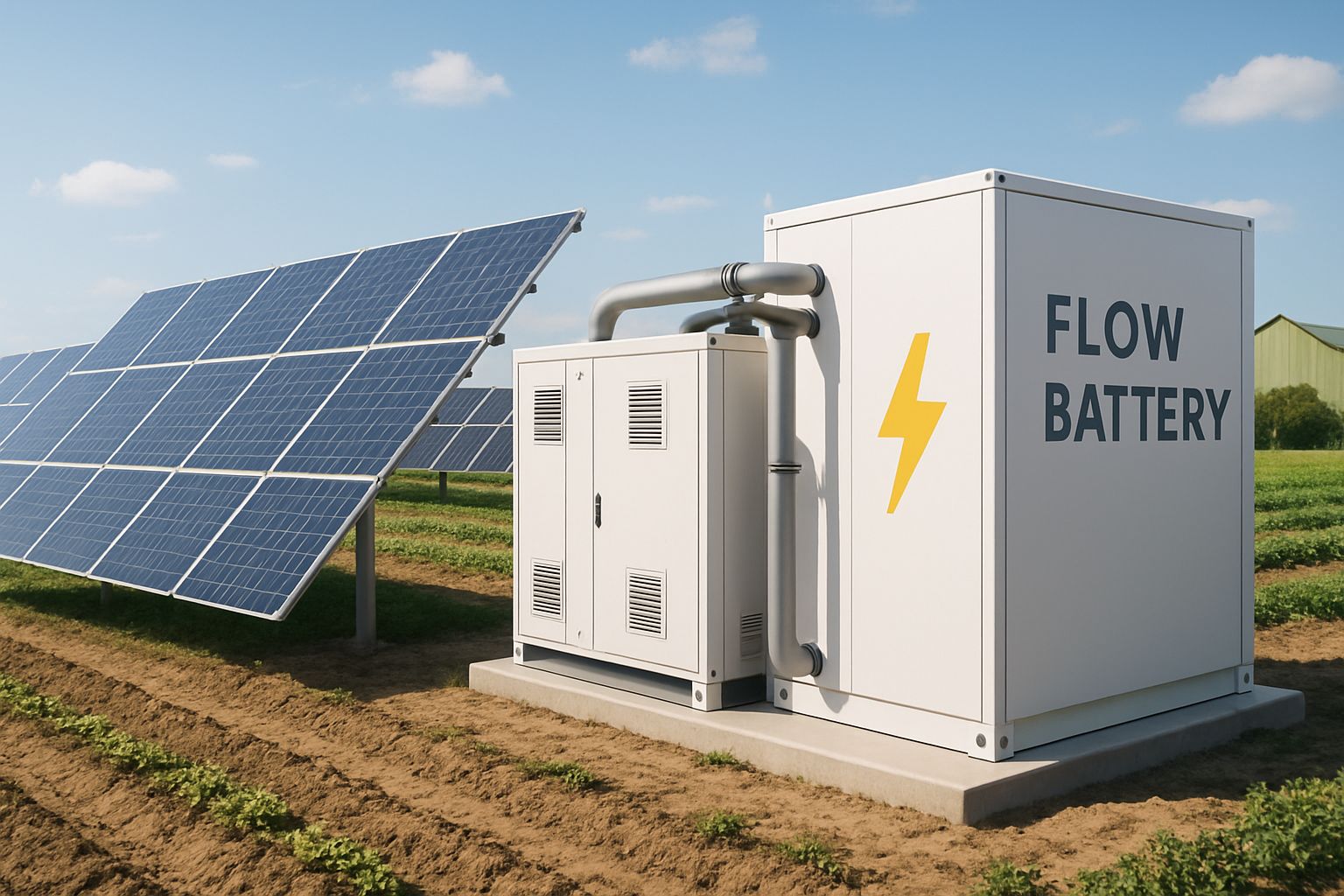
Article-at-a-Glance
- Flow batteries paired with solar panels give farms 24/7 power reliability — eliminating dangerous dependency on daylight hours or grid connectivity for critical operations like irrigation, cold storage, and ventilation.
- Unlike lithium-ion batteries, flow batteries last 15–20+ years with minimal capacity degradation, making them a far more cost-effective long-term investment for agricultural operations.
- Flow Battery Solutions has been helping agricultural operations nationwide implement continuous power systems that transform intermittent solar into dependable farm energy.
- Sizing your flow battery system correctly is the difference between full energy independence and costly gaps — and there’s a straightforward method farmers can use to calculate exactly what they need.
- Non-flammable electrolytes and deep-cycle durability make flow batteries uniquely suited to the high-demand, safety-sensitive environment of working farms.
Solar panels on a farm without battery backup are like a barn with no roof — fine when the weather cooperates, but completely exposed when conditions turn against you.
Flow Battery Solutions has been working with agricultural operations across the country to implement continuous power systems that close the gap between intermittent solar generation and the non-stop energy demands of modern farming. The problem isn’t solar power itself — it’s the storage strategy behind it.
Solar Power Alone Leaves Farms Vulnerable
A solar array without energy storage only delivers power when the sun is shining. For a residential home, that’s an inconvenience. For a working farm, it’s a liability. Irrigation pumps, ventilation fans, milking equipment, cold storage units, and incubators don’t pause for clouds or sunsets — and every unplanned outage carries real financial consequences.
Traditional solar setups generate peak power mid-morning to mid-afternoon, but farm energy demand doesn’t follow that curve. Early morning livestock routines, overnight cold storage maintenance, and pre-dawn irrigation scheduling all fall outside the solar generation window. Without a robust storage solution, farmers either stay tethered to the grid or run expensive diesel generators as backup — neither of which delivers true energy independence.

Why Farm Power Demands Never Stop
Modern agriculture is an energy-intensive operation around the clock. A mid-sized dairy farm, for example, runs milking equipment two to three times per day including early morning and evening sessions. Poultry operations maintain continuous ventilation and temperature control 24 hours a day. Greenhouse growers rely on heating systems, grow lights, and automated irrigation that operate on programmed cycles regardless of solar output.
The energy reality of a working farm: Most farms need reliable power during the hours of highest risk — early morning, late evening, and overnight — which are exactly the windows when solar generation is zero.
What makes farm power demands uniquely challenging is the combination of high load requirements and zero tolerance for interruption. A two-hour power gap that inconveniences a home office can mean spoiled perishables, stressed livestock, failed crops, or equipment damage on a working farm. Energy storage isn’t a luxury for agricultural operations — it’s core infrastructure.
Irrigation Systems That Run Day and Night
Consistent irrigation is one of the most critical and energy-intensive tasks in crop production. Agronomically optimal irrigation timing often falls outside solar generation hours — early morning watering reduces evaporation, and overnight drip irrigation conserves moisture in the soil. Without battery storage, farmers are forced to schedule irrigation around power availability rather than crop requirements, which directly impacts yield quality and water efficiency.
Cold Storage and Climate Control Requirements
Cold storage for produce, dairy, and meat products requires continuous power with zero tolerance for temperature fluctuation. A single overnight outage can render an entire harvest unsellable. Climate-controlled livestock facilities — particularly for poultry and swine — require uninterrupted ventilation and heating systems that operate around the clock, making reliable overnight power storage non-negotiable for these operations.
The Real Cost of Power Interruptions on Livestock Operations
Power interruptions on livestock farms aren’t just inconvenient — they’re costly in measurable ways. Dairy cows under heat stress produce significantly less milk. Poultry operations can lose entire flocks during summer heat events if ventilation systems fail. Automated feeding systems that go offline disrupt feeding schedules in ways that affect growth rates and animal health metrics for days after the outage. The financial exposure from a single major power disruption frequently exceeds the annual cost of a properly sized battery backup system.
What Flow Batteries Actually Are
A flow battery is an electrochemical energy storage system that stores energy in liquid electrolyte solutions held in external tanks rather than in solid electrode materials. This fundamental design difference — liquid storage versus solid storage — is what gives flow batteries their distinctive advantages in longevity, scalability, and safety over conventional battery chemistries like lithium-ion.
The most common agricultural-grade flow battery technology uses vanadium redox chemistry, where vanadium ions dissolved in a sulfuric acid solution are pumped through an electrochemical cell stack to charge and discharge energy. Because the energy capacity is determined by tank size rather than the cell stack itself, flow batteries can be scaled up simply by increasing electrolyte volume — making them uniquely adaptable to the varying energy demands of different farm operations. For a comparison of other solar technologies for farmers, you can explore additional resources.
How Liquid Electrolytes Store and Release Energy
During charging, solar energy drives a chemical reaction that changes the oxidation state of the vanadium ions in the electrolyte. When the farm draws power, the process reverses — the electrolyte flows back through the cell stack, the chemical reaction releases electrons, and electricity is delivered to the farm’s circuits. Because the electrolyte itself doesn’t degrade the way solid electrode materials do in lithium-ion batteries, flow batteries can be fully charged and discharged daily for 15–20+ years without significant capacity loss. This deep-cycle durability is precisely what makes them so well-matched to the repetitive daily energy demands of agricultural operations.
Flow Batteries vs. Lithium-Ion: Key Differences for Farmers
Lithium-ion batteries dominate consumer energy storage, but the farm environment exposes their limitations quickly. Lithium-ion cells degrade with deep discharge cycles, typically losing meaningful capacity within 5–10 years. They carry flammability risks that make installation near livestock buildings and dry hay storage a genuine safety concern. Their storage capacity is fixed at the time of manufacture — scaling up means buying entirely new units.
|
Feature |
Flow Batteries |
Lithium-Ion Batteries |
|---|---|---|
|
Lifespan |
15–20+ years |
5–10 years |
|
Deep Discharge Tolerance |
100% daily, no degradation |
Degrades with deep cycling |
|
Fire Risk |
Non-flammable electrolytes |
Flammable, thermal runaway risk |
|
Scalability |
Expand by adding electrolyte |
Fixed at manufacture |
|
Best Fit |
Large farms, long-duration storage |
Residential, short-duration use |
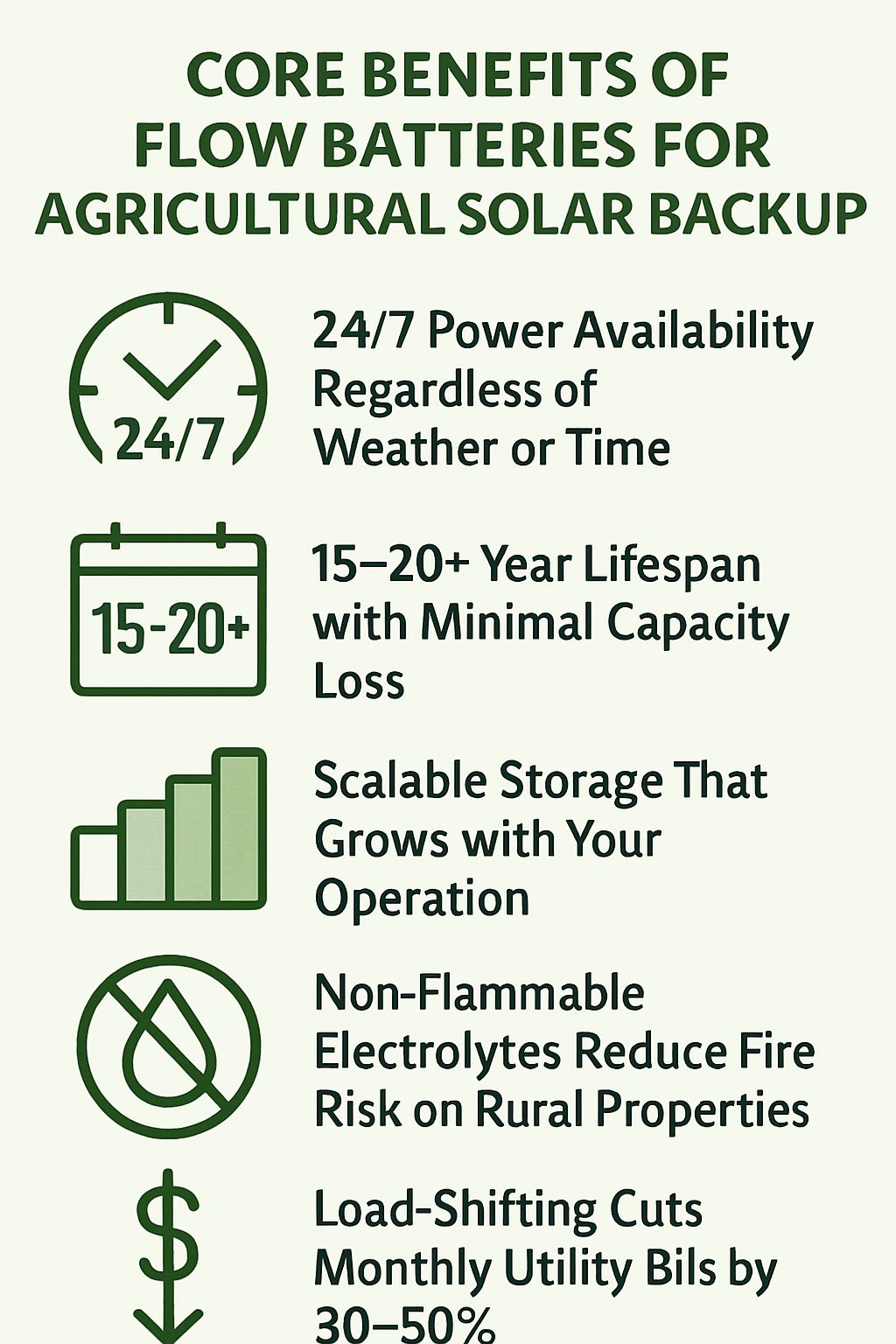
Core Benefits of Flow Batteries for Agricultural Solar Backup
Flow batteries don’t just solve the solar storage problem — they solve it in a way that’s specifically aligned with how farms actually operate. The combination of deep-cycle durability, long lifespan, and scalable capacity addresses the exact pain points that make conventional battery storage a poor fit for agricultural applications. For a deeper understanding of solar technologies suitable for farmers, consider this comparison of solar technologies.
Where lithium-ion systems force farmers into compromises — limiting discharge depth to preserve battery life, replacing units every decade, or accepting fixed capacity that can’t grow with the operation — flow batteries eliminate those constraints entirely. The result is a storage platform that works as hard as the farm itself, day after day, season after season.
The five core advantages below aren’t theoretical. They’re the practical reasons why large-scale agricultural operations are increasingly choosing flow battery systems as the backbone of their solar energy strategy.
1. 24/7 Power Availability Regardless of Weather or Time
Flow battery systems store surplus solar energy generated during peak daylight hours and discharge it on demand — overnight, during overcast weather, or during peak morning farm routines when solar output is minimal. This transforms solar from a weather-dependent resource into a fully dispatchable power source. Critical farm systems including irrigation pumps, ventilation fans, milking equipment, and cold storage units receive continuous, stable power without grid dependency or diesel generator backup.
2. 15–20+ Year Lifespan with Minimal Capacity Loss
The lifespan advantage of flow batteries over lithium-ion alternatives is substantial in agricultural economics. A lithium-ion system installed today will likely require full replacement within 8–10 years. A vanadium redox flow battery installed on the same timeline will still be operating at near-original capacity two decades later — with the same daily deep-discharge cycles throughout.
This durability stems from the fundamental chemistry: because energy is stored in liquid electrolyte rather than solid electrodes, the degradation mechanism that limits lithium-ion lifespan simply doesn’t apply. The electrolyte itself can even be reconditioned and reused, further extending system life and reducing long-term operating costs.
Lifecycle economics in practice: Over a 20-year period, a farm might replace a lithium-ion system twice while a flow battery system installed at the same time is still running on its original electrolyte — dramatically changing the total cost of ownership calculation.
3. Scalable Storage That Grows with Your Operation
Farm operations aren’t static. A vegetable grower who adds a greenhouse, a dairy operation that expands its herd, or a poultry farm that adds a second building all face growing energy demands over time. Flow battery systems are uniquely positioned for agricultural growth because capacity expansion requires adding electrolyte volume and additional tanks — not purchasing an entirely new system.
This modularity means the initial investment doesn’t become obsolete as the farm grows. The cell stack, inverter, and control systems remain in place while storage capacity scales to match operational demand — a fundamentally different economic model than fixed-capacity battery technologies.
4. Non-Flammable Electrolytes Reduce Fire Risk on Rural Properties
Fire risk is a serious and often underweighted consideration in farm battery storage decisions. Rural properties frequently combine high-value assets — dry hay storage, timber structures, livestock, and equipment — in close proximity. Lithium-ion batteries carry a documented thermal runaway risk: under certain fault conditions, they can ignite and sustain fires that are extremely difficult to extinguish.
Safety profile comparison: Vanadium redox flow batteries use water-based electrolyte solutions that are non-flammable by nature. There is no thermal runaway mechanism, no combustible cell chemistry, and no pressurized gas release under fault conditions — making them significantly safer for installation in agricultural environments.
This safety advantage has direct implications for insurance costs, installation placement flexibility, and peace of mind when the system is located near livestock buildings or stored crops. Farms that have historically avoided battery storage near high-value structures due to fire concerns will find flow battery installations far more compatible with standard agricultural safety protocols.
Installation near grain bins, hay storage, or livestock housing — which would be inadvisable with lithium-ion technology — becomes a viable option with flow battery chemistry. This placement flexibility can meaningfully reduce installation complexity and wiring costs on larger properties where the battery system needs to be located close to the loads it serves.
5. Load-Shifting Cuts Monthly Utility Bills by 30–50%
For farms that remain partially grid-connected, flow battery systems enable a powerful cost-reduction strategy called load shifting. By storing solar energy during low-demand daylight hours and deploying it during peak-rate evening and morning periods, farms avoid the highest utility tariff windows entirely. Agricultural operations with grid connectivity and time-of-use electricity pricing have documented monthly utility cost reductions in the range of 30–50% after implementing solar-plus-flow-battery systems — with the exact savings depending on local utility rate structures and farm energy consumption patterns.
How to Size a Flow Battery System for Your Farm
Getting the sizing right is the most important technical decision in a flow battery implementation. An undersized system leaves critical loads exposed during low solar generation periods. An oversized system represents capital that could be deployed elsewhere on the operation. The goal is matching storage capacity precisely to your farm’s actual energy consumption profile — including seasonal variation and future growth.
Sizing a flow battery system for agricultural use involves three interconnected calculations: total daily energy consumption, critical load identification, and autonomy duration — meaning how many hours or days of backup power the system needs to provide without solar input. Most agricultural implementations target one to three days of full critical-load autonomy as the baseline design parameter.
The process doesn’t require an engineering degree, but it does require accurate data about your farm’s current energy use. Before engaging with any system installer, farmers should gather the following baseline information:
- Monthly utility bills for the past 12 months showing kilowatt-hour consumption
- A list of all electrically powered equipment with wattage ratings and average daily operating hours
- Identification of critical loads that cannot tolerate any power interruption versus flexible loads that can be shed during low-storage periods
- Peak demand periods — times of day or seasons when energy consumption is highest
- Any planned operational expansions that will increase energy demand within the next 5–10 years
Calculating Your Farm’s Daily Energy Consumption
Daily energy consumption is calculated by multiplying the wattage of each piece of equipment by its average daily operating hours, then summing all loads across the operation. A 5-horsepower irrigation pump running 6 hours per day consumes approximately 22.4 kWh. A ventilation system for a 500-bird poultry house running continuously might draw 8–12 kWh per day. Cold storage for 10,000 lbs of produce could add another 15–25 kWh depending on ambient temperature and insulation quality. These figures add up quickly, and accurate load assessment is the foundation of a correctly sized system. For more information on powering agricultural operations, consider exploring HJT solar panels.
Seasonal variation matters significantly in agricultural energy planning. Irrigation loads peak in summer. Heating loads peak in winter. Harvest season may add temporary high-draw equipment like grain dryers or processing machinery. A properly sized flow battery system accounts for peak seasonal demand — not just average annual consumption — to ensure the farm has adequate storage capacity during its most energy-intensive periods.
Matching Storage Capacity to Critical Load Requirements
Not all farm loads carry equal priority. The sizing strategy that delivers the best combination of cost efficiency and operational protection focuses storage capacity on critical loads first — the systems where a power outage causes immediate, measurable harm. Livestock ventilation, refrigeration, milking equipment, and automated irrigation controllers typically sit at the top of the critical load hierarchy. Secondary systems like workshop lighting, grain handling equipment, and administrative power can be managed on a load-shedding basis during extended low-solar periods without significant operational impact.
Planning for Seasonal Energy Demand Fluctuations
Seasonal planning is where many farm energy systems fall short. A storage system sized for average annual demand will be chronically undersupplied during peak season and oversupplied during slower periods. For flow battery systems, the correct approach is to size storage capacity to your highest seasonal demand — typically summer irrigation combined with cold storage, or winter heating loads for livestock facilities — and treat off-peak periods as opportunities to build reserve capacity rather than reasons to reduce system size.
The good news is that flow batteries handle seasonal demand swings better than any competing technology. Because capacity scales with electrolyte volume, a farm that anticipates significant seasonal variation can design the system with expansion capacity built into the tank infrastructure from day one, then add electrolyte volume as demand grows. This forward-planning approach avoids the expensive and disruptive process of retrofitting an undersized system mid-operation. For a deeper understanding of solar technologies comparison for farmers, check out this resource.
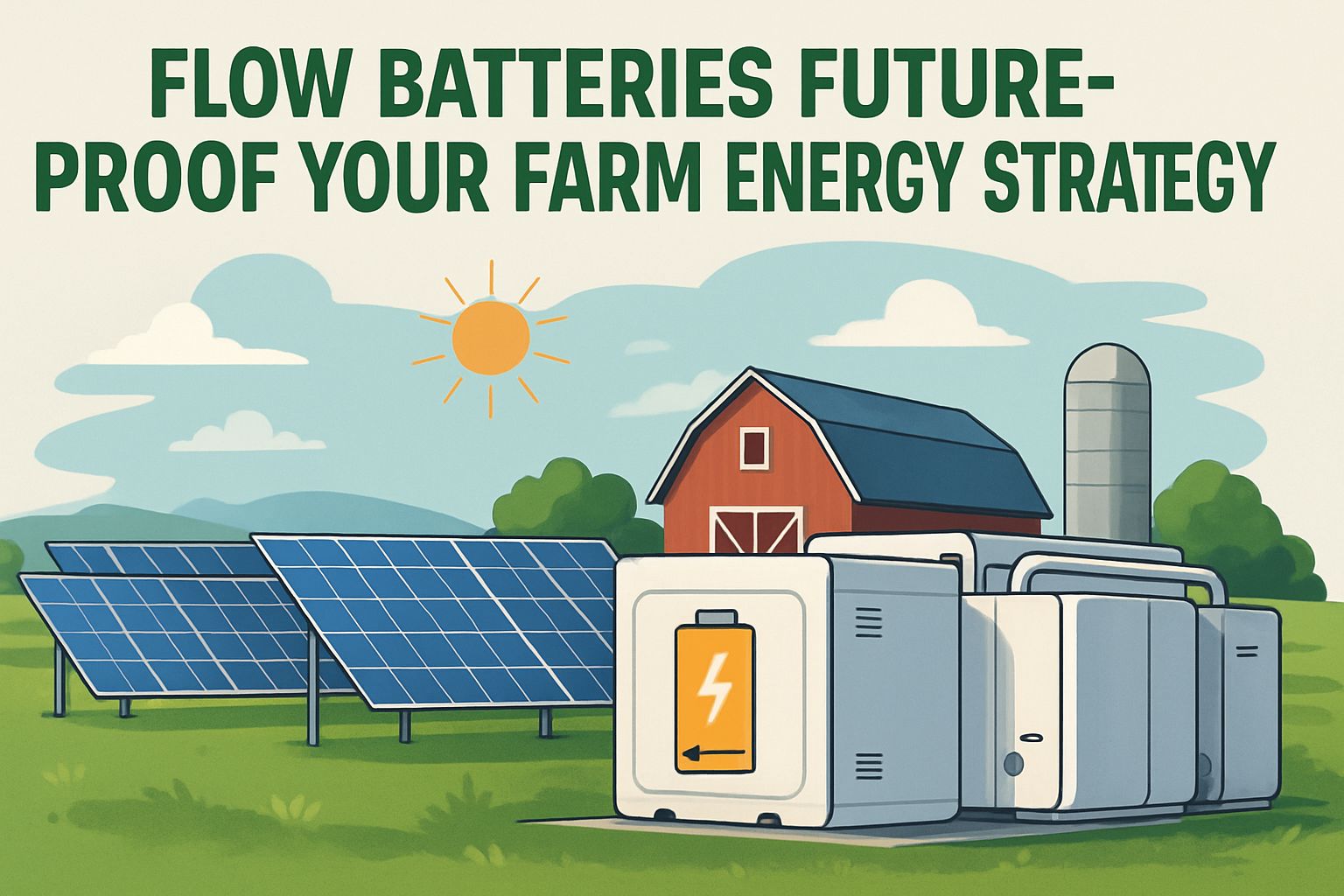
Flow Batteries Future-Proof Your Farm Energy Strategy
Energy costs for agricultural operations have increased consistently over the past decade, and that trend shows no sign of reversing. Grid reliability in rural areas continues to be a vulnerability — transmission infrastructure serving farming communities often receives lower maintenance priority than urban grids, leaving rural operations exposed to longer and more frequent outages. Flow battery systems paired with solar generation directly address both of these pressures simultaneously, locking in energy costs and eliminating grid dependency for critical loads in a single infrastructure investment.
The scalability of flow battery technology means the system you install today can serve the farm you’re building toward tomorrow. Unlike fixed-capacity technologies that require full replacement to accommodate growth, flow battery systems expand incrementally alongside the operation — adding storage volume as new buildings come online, as herd sizes increase, or as new irrigation infrastructure is added. For farmers thinking in 20-year horizons rather than 3-year equipment cycles, that adaptability represents a fundamentally different and more valuable kind of energy asset.
Frequently Asked Questions
Quick Reference: Flow Batteries for Farm Solar Systems
• Lifespan: 15–20+ years with minimal capacity degradation
• Daily discharge: 100% depth of discharge, every day, without damage
• Fire risk: Non-flammable water-based electrolytes — no thermal runaway
• Scalability: Expand storage by adding electrolyte volume, not new units
• Monthly savings: 30–50% utility cost reduction documented in grid-connected agricultural implementations
• Retrofittable: Yes — flow battery storage can be integrated with existing solar installations
Farmers evaluating flow battery systems for the first time tend to arrive with the same core questions. The technology is well-established in industrial energy storage, but its application in agriculture is newer territory — and getting clear answers to these practical questions is the right starting point before any capital commitment.
The questions below address the most common decision points: lifespan, overnight capacity, safety near livestock, how flow batteries differ from standard solar batteries, and what realistic monthly savings look like in agricultural contexts. These aren’t theoretical answers — they reflect what agricultural flow battery implementations actually deliver in real operational conditions.
If your specific operational question isn’t covered below, the variables that matter most are your farm’s daily energy consumption profile, your critical load list, and your local utility rate structure. Those three data points drive almost every meaningful sizing and economics decision in a flow battery implementation.
How Long Do Flow Batteries Last on a Farm Solar System?
Flow batteries typically last 15–20+ years in agricultural applications, significantly outperforming the 5–10 year lifespan of lithium-ion alternatives under the same daily cycling conditions. The vanadium electrolyte doesn’t degrade the way solid electrode materials do — it can even be reconditioned and reused if needed — which means the system you install today will likely still be operating at near-original capacity well past the point where a lithium-ion system would have required full replacement. For farmers making capital infrastructure decisions, that lifespan difference fundamentally changes the total cost of ownership calculation in favor of flow battery technology.
Can Flow Batteries Power an Entire Farm Overnight?
Yes — when correctly sized for the operation’s critical load requirements. A flow battery system designed with one to three days of autonomy capacity will comfortably carry all critical farm systems through the overnight period on a single day’s solar generation, with reserve capacity remaining for cloudy stretches. The key word is correctly sized: a system designed for a residential load won’t meet agricultural demands, which is why accurate load assessment before system specification is essential. Large operations with high overnight energy demands — dairy facilities, climate-controlled poultry houses, produce cold storage — require proportionally larger electrolyte tank capacity, but the technology scales to meet those requirements without the chemistry limitations that cap lithium-ion system performance.
Are Flow Batteries Safe to Install Near Livestock Buildings?
Flow batteries are among the safest energy storage technologies available for installation in agricultural environments. The vanadium electrolyte solution is water-based and non-flammable — there is no thermal runaway risk, no combustible cell chemistry, and no pressurized gas release under fault conditions. This safety profile makes flow battery installations appropriate for placement near livestock housing, dry hay storage, grain bins, and timber farm structures where lithium-ion battery installation would present unacceptable fire risk. Standard installation practices include secondary containment for electrolyte tanks as a precautionary measure, but the fundamental fire safety profile is dramatically better than competing battery chemistries.
What Is the Difference Between Flow Batteries and Regular Solar Batteries?
Standard solar batteries — the type commonly installed in residential and small commercial solar systems — are typically lithium-ion units where energy is stored in solid electrode materials inside sealed cells. They’re compact, relatively affordable at small scale, and well-suited to homes with modest overnight storage needs. Their limitations in agricultural contexts are significant: fixed capacity, degradation from deep daily cycling, flammability risk, and a lifespan that typically requires replacement within a decade. For those in agriculture, exploring different solar technologies comparison can provide insights into more suitable options.
Flow batteries store energy in liquid electrolyte held in external tanks, with energy conversion happening in a separate cell stack. This separation of energy storage from energy conversion is what enables the deep-cycle durability, scalability, and non-flammable safety profile that makes flow batteries the superior technology for farm-scale solar storage. The tradeoff is that flow battery systems require more physical space and a higher initial capital investment — factors that make them less practical for residential applications but well-justified for agricultural operations with large, continuous energy demands and long investment horizons.
How Much Can a Farm Save Monthly by Adding Flow Battery Storage to Solar?
Agricultural operations with grid connectivity and time-of-use electricity pricing have documented monthly utility cost reductions in the range of 30–50% after implementing solar-plus-flow-battery systems. The primary savings mechanism is load shifting — storing solar energy during low-rate daytime periods and deploying it during high-rate morning and evening peak windows, effectively avoiding the most expensive electricity the utility sells.
Beyond load shifting, farms that achieve full critical-load independence from the grid eliminate exposure to rate increases, demand charges, and infrastructure upgrade fees that utilities frequently impose on high-consumption agricultural accounts. The long-term savings from avoided rate escalation can be as significant as the near-term load-shifting savings, particularly for farms in regions where agricultural electricity rates have been rising steadily.
The exact monthly savings figure depends on three farm-specific variables: current utility rate structure and whether time-of-use pricing applies, total daily energy consumption and how much of it can be shifted to stored solar, and the size of the flow battery system relative to the operation’s total load. A detailed energy audit using 12 months of utility bills is the most reliable starting point for projecting site-specific savings before committing to a system specification.



Leave a Reply