
Article-at-a-Glance
- Monocrystalline solar panels convert sunlight into electricity more efficiently than any other silicon-based panel type, hitting 17% to 22% efficiency thanks to their single-crystal structure.
- Farms with high daily power draws—dairy barns, poultry houses, grain facilities—benefit most from the extra wattage these panels squeeze out of limited roof space.
- These panels degrade slowly, often losing just 0.3% to 0.5% of output per year, which means they can still produce usable power four decades after installation.
- Working with a knowledgeable installer like SunWatts Solar can help farmers calculate exactly how much capacity they’d gain by upgrading to monocrystalline technology.
- There’s a real cost tradeoff between monocrystalline and polycrystalline panels worth understanding before you sign a contract—more on that calculation below.
If you’re trying to squeeze every available watt out of a barn roof or grain shed, monocrystalline solar panels are the technology built for that job.
Farms run differently than houses. Milking equipment doesn’t care that it’s cloudy. Poultry fans and climate controls run around the clock regardless of the season. When your power demands are constant and your roof space is finite, the type of solar panel you choose stops being a minor decision and starts being a math problem with real financial consequences. Monocrystalline panels, made from a single continuous silicon crystal, consistently come out on top of that math for working farms.
Why Monocrystalline Panels Are Built Different
Not all solar panels start from the same raw material arrangement, and that difference shows up directly in performance. Monocrystalline panels get their name from the Latin root “mono,” meaning one—because each cell is cut from a single, uninterrupted silicon crystal rather than a mix of fragments. That structural purity is the entire reason these panels outperform their polycrystalline cousins.
The Single-Crystal Silicon Structure
Inside a monocrystalline cell, silicon atoms line up in a continuous, unbroken lattice. Electrons move through this uniform structure with almost nothing to slow them down. Polycrystalline cells, by contrast, are made from multiple silicon fragments melted together, creating grain boundaries where electrons bump into resistance. That resistance translates directly into lost energy—energy a farm operation could otherwise be using.
99.999% Pure Silicon Through the Siemens Process
Before silicon ever becomes a solar cell, it has to be purified to an almost unbelievable degree. Manufacturers use something called the Siemens process to strip raw silicon of impurities until it reaches over 99.999% purity. That level of refinement matters because even trace contaminants can create tiny defects that interrupt electron flow, shaving off efficiency points the farm will never get back.
The Czochralski Method: From Molten Silicon to Solid Ingot
Once the silicon is purified, it’s melted down and formed into a solid cylindrical ingot using the Czochralski method. A small seed crystal gets dipped into the molten silicon and slowly pulled upward while rotating, allowing the silicon to solidify around it in a single, continuous crystal structure. The result is a cylindrical ingot typically 200mm to 300mm in diameter, several meters long, and genetically uniform from top to bottom. This single-crystal consistency is what makes monocrystalline panels perform so predictably, even on a working farm exposed to dust, temperature swings, and years of weather.
How Monocrystalline Panels Are Made, Step by Step
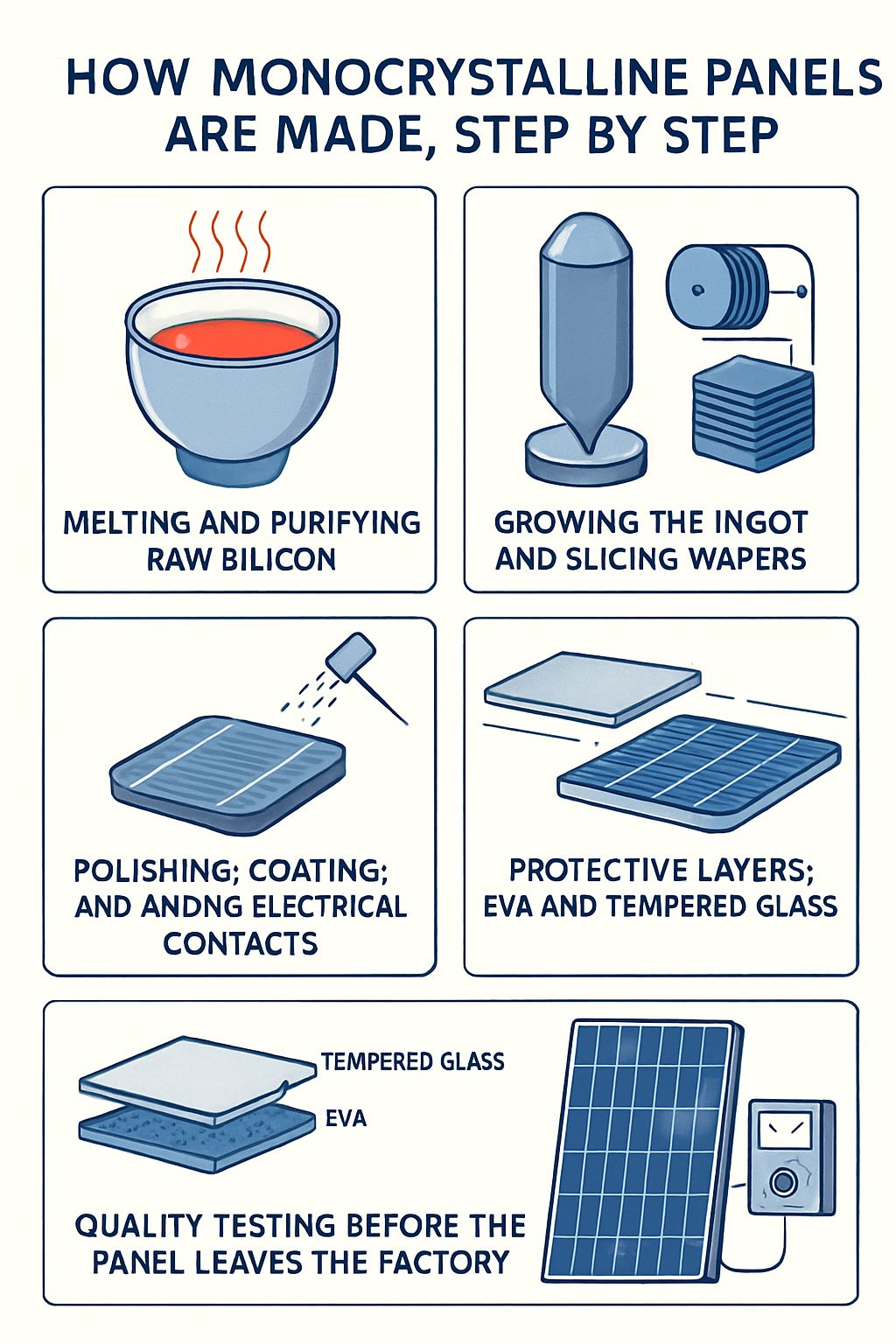
Understanding the manufacturing process isn’t just trivia—it explains why monocrystalline panels cost more upfront and why that cost buys real durability. Every stage of production is built around maintaining the integrity of that single crystal structure, from the moment raw silicon enters the furnace to the final quality check before a panel ships out.
Here’s what actually happens on the production line:
1. Melting and Purifying Raw Silicon
- High-purity silicon gets melted in a crucible at extremely high temperatures.
- Temperature and rotation speed are controlled with precision during the entire ingot-growing process.
- Any inconsistency at this stage creates defects that carry through the rest of production.
This is the step where most of the quality difference between manufacturers gets baked in. A tightly controlled melt produces a cleaner ingot, and a cleaner ingot produces cells with fewer internal flaws.
2. Growing the Ingot and Slicing Wafers
Once the cylindrical ingot cools, it gets sliced into thin wafers—thin enough that a single ingot yields hundreds of them. Each wafer is then polished and cleaned to remove surface impurities left over from the cutting process. This step determines how much usable surface area each future cell will have for capturing sunlight.
3. Polishing, Coating, and Adding Electrical Contacts
After polishing, wafers receive an anti-reflective coating designed to improve light absorption rather than letting sunlight bounce off the surface. Electrical contacts, made from high-grade silver paste, are then applied to facilitate the flow of electrons once the cell starts generating current. Without this coating and contact work, a huge percentage of captured sunlight would simply go to waste.
4. Protective Layers: EVA and Tempered Glass
Raw solar cells are fragile on their own, which is why manufacturers encase them in protective layers before they ever reach a farm roof. Ethylene-vinyl acetate (EVA) seals the cells against moisture, while tempered glass shields them from hail, debris, and general wear. A sturdy aluminum frame wraps the whole assembly, giving it the structural rigidity needed to survive mounting, wind load, and decades of thermal expansion and contraction.
5. Quality Testing Before the Panel Leaves the Factory
Every wafer gets tested before it becomes part of a finished panel. Manufacturers measure efficiency, durability, and overall performance under controlled conditions to make sure each unit meets strict quality standards. This testing step is part of why monocrystalline panels tend to carry stronger warranties than other panel types—manufacturers have more confidence in a product they’ve verified at the cell level before it’s even assembled.
The entire process is more resource-intensive than polycrystalline manufacturing, which explains the price gap between the two technologies. But for farms running equipment day and night, that extra manufacturing investment often pays for itself in the form of higher output per square foot.
Efficiency Numbers Every Farmer Should Know
Efficiency is the number that actually matters when you’re staring at a barn roof wondering how many panels will fit—and how much power they’ll generate once they’re up there.
17% to 22% Efficiency Range Explained
Monocrystalline panels typically operate in the 17% to 22% efficiency range, the highest of any silicon-based panel type on the market. Premium products from manufacturers like SunPower and Maxeon land at the upper end of that spectrum. Some newer monocrystalline models are now pushing past 22% efficiency, with industry projections suggesting standard test condition efficiencies could exceed 22% broadly by 2025.
Why 300 Watts Beats 250 Watts on the Same Size Panel
Here’s where the numbers get concrete. A monocrystalline panel can produce roughly 300 watts of power, while a polycrystalline panel of the exact same physical size typically produces around 250 watts. That 50-watt difference might not sound dramatic on paper, but multiply it across a 40-panel barn roof installation, and you’re looking at a meaningful gap in total system capacity—without adding a single extra panel or square foot of roof space.
PERC Technology and Bifacial Gains
Newer monocrystalline panels are pushing efficiency even further with PERC technology, short for Passivated Emitter and Rear Contact. PERC adds a layer to the cell that captures more light and reduces electron loss, boosting efficiency by up to 1.5%. Bifacial panels take it a step further by absorbing sunlight on both the front and back sides of the panel, which can increase total energy output by up to 30% under ideal conditions—a feature particularly useful on ground-mount farm installations where reflected light off the ground or snow can be captured from underneath.
Performance Where It Matters: Shade, Clouds, and Heat
A spec sheet efficiency number only tells half the story. What actually matters on a working farm is how a panel performs when conditions aren’t perfect—when a grain silo throws shade across half the array at 4pm, or when three cloudy days in a row roll through during harvest season.
Handling Partial Shade Better Than Polycrystalline
Farms are full of shade sources that residential rooftops rarely deal with: grain silos, windbreaks, barns casting shadows on each other, and tree lines that grow taller every year. Monocrystalline panels tolerate partial shading more gracefully than polycrystalline alternatives, largely because their uniform crystal structure doesn’t create the same cascading power loss when one section of a cell gets blocked. Pair that resilience with module-level power electronics—microinverters or power optimizers—and a shaded panel won’t drag down the output of the entire string, keeping the system running closer to its rated capacity even when conditions aren’t ideal.
Low-Light and Cloudy Day Output
Overcast skies don’t shut a monocrystalline system down. These panels continue producing electricity on cloudy days and in low-light conditions, which matters a lot for farms that can’t afford unpredictable power dips during a multi-day weather system. It’s not peak performance, but it’s reliable performance—and reliability is usually worth more to a working farm than a theoretical maximum output number.
Low Temperature Coefficient Keeps Panels Working in Summer Heat
Solar panels actually lose efficiency as they get hotter, which surprises a lot of people who assume more sun always equals more power. Monocrystalline panels have a favorable temperature coefficient around -0.30% per degree Celsius, meaning they lose less output per degree of heat than many competing technologies. On a July afternoon with a metal barn roof radiating heat back up into the panels, that smaller temperature penalty adds up to real wattage saved over the course of a season.
Built to Last: Durability on the Farm
Farmers don’t replace equipment on a whim—everything gets evaluated by how long it’ll last and how much it’ll cost to maintain. Monocrystalline panels were built with that mindset in mind, even if the manufacturers weren’t specifically thinking about dairy barns when they designed them.
Slow Degradation Rate of 0.3% to 0.5% Per Year
Every solar panel loses a small percentage of its output capacity each year—that’s just physics. Monocrystalline panels degrade slowly, typically losing only 0.3% to 0.5% of output annually. That’s a slow enough decline that a panel installed today will still be doing meaningful work two decades from now, which matters a lot when you’re financing a system against years of expected energy savings.
25-Year Warranties and 40-Year Field Performance
Manufacturers commonly guarantee at least 92% of original output after 25 years, and warranties of 25 years or more have become standard across the industry. In practice, many panels installed decades ago are still operating at roughly 80% efficiency after 40 years in the field. The average lifespan runs 25 to 40 years total, which means a system installed on a barn roof today could realistically still be generating power when the next generation takes over the farm.
Standing Up to Snow, Wind, and Coastal Humidity
Farm structures take a beating from weather that residential rooftops rarely see—heavy snow loads, sustained wind, and in coastal regions, salt air that corrodes metal over time. Monocrystalline panels are built to perform well under these extreme conditions, including intense heat, heavy snowfall, and strong winds. They’re also resistant to corrosion, which matters significantly for farms near coastlines or in high-humidity regions where lesser materials would degrade within a few seasons.
Put those three durability factors together—slow degradation, strong warranties, and weather resistance—and you get a panel that’s genuinely built for the demands of agricultural use rather than just adapted to it.
Monocrystalline vs. Polycrystalline: Which Wins for Farms?
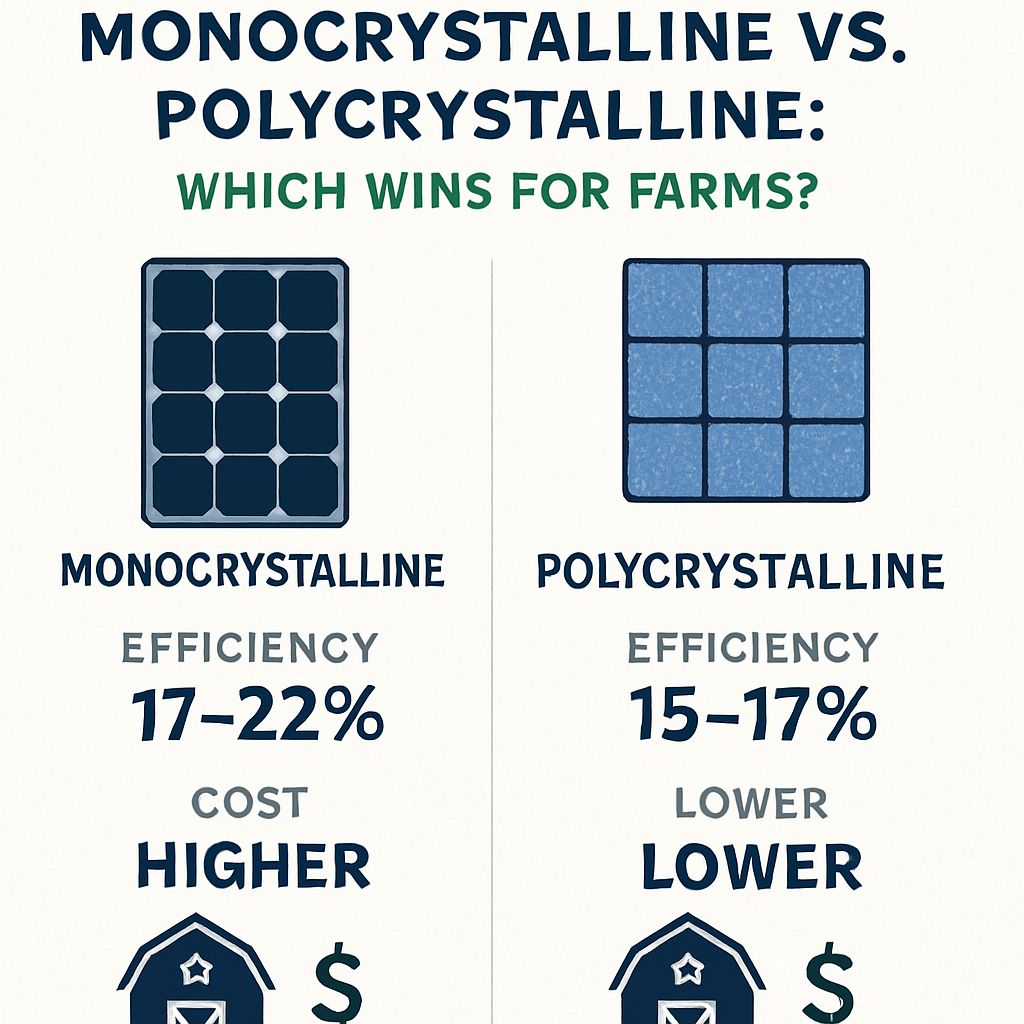
This is the comparison every farmer eventually has to make, and the honest answer is: it depends on your roof space and your budget. But the numbers make the tradeoff pretty clear once you lay them side by side.
Polycrystalline panels run 15% to 20% less per watt than monocrystalline panels, which sounds like an easy win until you factor in the efficiency gap. On a 200 kW ground array, that polycrystalline cost differential represents $15,000 to $25,000 in savings on panel procurement alone. That’s real money. But it comes at the cost of needing more physical space and getting lower output per panel over the system’s lifetime.
Efficiency and Cost Per Watt Compared
Monocrystalline panels typically run 10% to 20% more expensive than polycrystalline panels of equivalent wattage. In exchange, you get efficiency in the 17% to 22% range compared to polycrystalline’s 13% to 17%. For farms with abundant, unobstructed land—think open fields for ground-mount arrays—polycrystalline’s lower cost per watt can make sense since space isn’t the limiting factor. For farms working with finite roof space on barns and equipment sheds, monocrystalline’s higher output per square foot usually wins the math.
Visual Differences: Black Sleek vs. Blue Marbled
Beyond the numbers, there’s a visual difference worth mentioning. Monocrystalline panels have a distinctive black appearance that many farm owners find more aesthetically pleasing than the bluish, marbled hue of polycrystalline panels. That might not matter for a grain shed tucked behind the main buildings, but it can matter if your solar installation is visible from the road or near a farmhouse where curb appeal factors into the decision.
Space Requirements for the Same Energy Output
This is where the comparison gets concrete for farm planning. Because monocrystalline panels produce more power per square foot, they require less total roof or ground space to hit the same energy target as polycrystalline panels. For a farm with a modest-sized barn roof and a large energy appetite—say, a dairy operation running refrigeration and milking equipment nonstop—that space efficiency can be the deciding factor, regardless of the extra upfront cost.
Monocrystalline vs. Thin-Film: Weight vs. Power
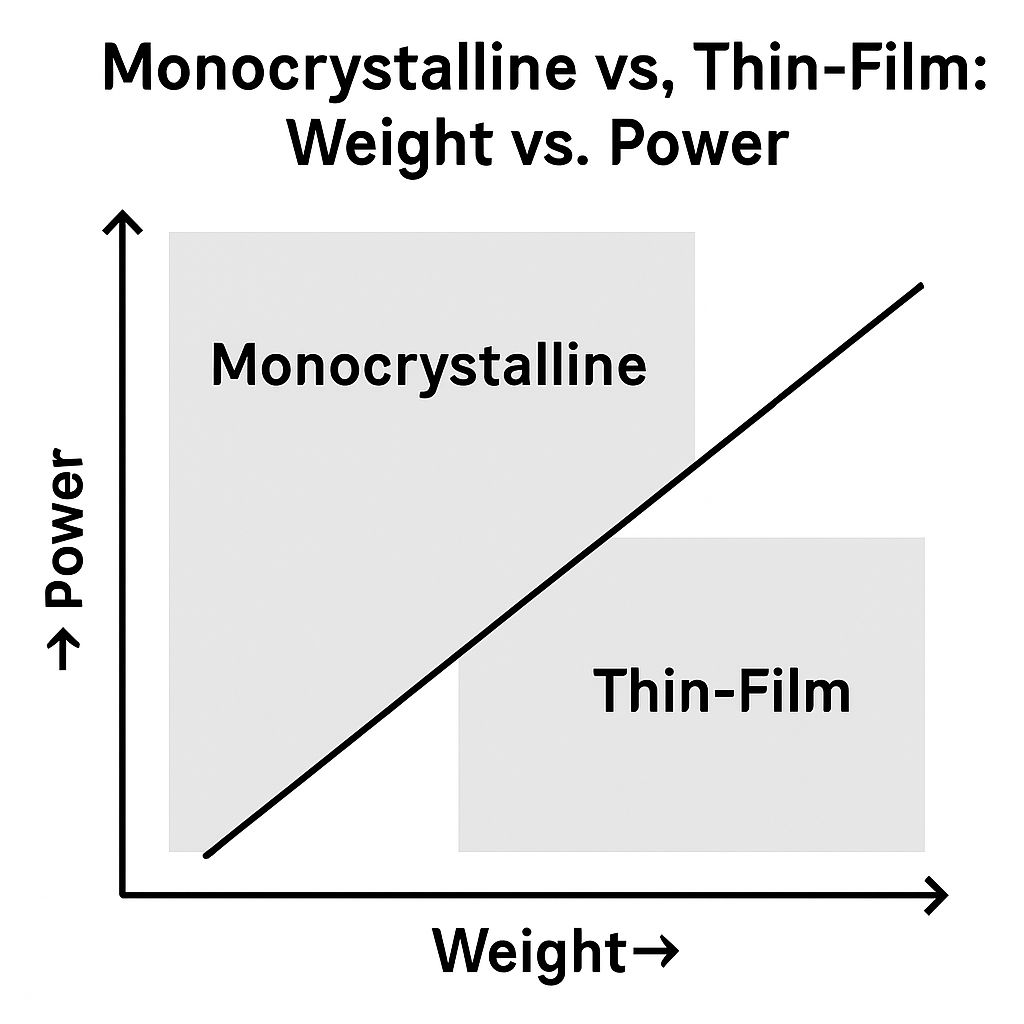
Thin-film solar panels come up in farm conversations mostly because of their light weight, which sounds appealing for older structures with questionable roof load ratings. But weight isn’t the only factor that matters, and thin-film’s efficiency tradeoff is steep enough that it rarely makes sense for farms with real power demands.
Efficiency Gap Between the Two Technologies
Thin-film panels typically run in the 10% to 12% efficiency range, well below monocrystalline’s 17% to 22%. That gap means you’d need nearly double the surface area of thin-film panels to generate the same power output as a monocrystalline system. For a farm trying to power equipment with constant, significant load, that efficiency gap translates directly into needing a much larger installation footprint to meet the same energy goals.
Why Thin-Film’s Lighter Weight Doesn’t Always Win
Thin-film’s main selling point—its light weight—matters most for structures that genuinely can’t support heavier racking systems. But most farm buildings constructed with standard trusses and modern engineering can handle the weight of monocrystalline panel arrays without structural modification. Unless you’re working with a genuinely fragile older structure where load limits are a documented concern, thin-film’s weight advantage usually isn’t worth sacrificing more than a third of your potential energy output. A structural assessment from a qualified engineer will tell you definitively which category your building falls into before you make that call.
|
Panel Type |
Efficiency Range |
Relative Cost per Watt |
Best Farm Fit |
|---|---|---|---|
|
Monocrystalline |
17% – 22% |
Highest |
Limited roof space, high daily power demand |
|
Polycrystalline |
13% – 17% |
15-20% lower than mono |
Open land, ground-mount arrays, budget-conscious projects |
|
Thin-Film |
10% – 12% |
Lowest material cost, but largest footprint needed |
Structurally weak roofs unable to support heavier racking |
Best Farm Applications for Monocrystalline Panels
Not every farm building needs the same solar solution, but certain operations benefit so clearly from monocrystalline’s advantages that the decision practically makes itself.
Dairy Barns Running Milking Equipment and Refrigeration
Dairy operations don’t get a day off. Milking equipment, ventilation fans, and refrigeration systems run on a constant cycle regardless of weather or season, which makes consistent, high-density power generation essential. Monocrystalline’s strong low-light performance and high output per square foot make it a natural fit for dairy barn roofs, where equipment demands rarely dip below a steady baseline.
Poultry Houses Needing Climate Control
Poultry operations rely on climate control and lighting systems running around the clock to keep birds healthy and productive. A monocrystalline system sized correctly for a poultry house roof can offset a significant chunk of that constant electrical draw, and the technology’s resistance to partial shading helps when poultry barns are clustered close together and casting shadows on each other throughout the day.
Grain Processing Facilities with High Motor Loads
Grain facilities run some of the heaviest electrical loads on any farm, between augers, dryers, and conveyor motors all pulling power simultaneously during harvest season. These facilities benefit from a few specific advantages monocrystalline panels bring to the table:
- Higher wattage per panel reduces the total number of panels needed to meet peak motor loads.
- Strong performance in partial shade helps when grain bins and silos cast shadows across portions of the roof throughout the day.
- Low degradation rates ensure the system still meets demand years down the line as motor loads increase with facility expansion.
- Durability against dust and debris common in grain handling environments protects the long-term investment.
Grain operations also tend to have large, flat roof surfaces on processing buildings, which plays directly into monocrystalline’s strength of maximizing output per square foot. When harvest season hits and every motor is running at once, having a system sized for peak demand rather than average demand prevents costly reliance on grid power during the busiest weeks of the year.
The upfront cost premium for monocrystalline panels tends to matter less for grain facilities specifically, since the electrical savings during peak season can be substantial enough to shorten the payback period considerably compared to a residential installation.
Cold Storage Buildings for Perishable Inventory
Cold storage is unforgiving. A power interruption doesn’t just cost money—it can destroy an entire season’s worth of perishable inventory. Monocrystalline’s reliable output, even during cloudy stretches and partial shade events, makes it a dependable choice for powering cold storage compressors that simply cannot afford downtime. Combining a monocrystalline array with battery backup or a grid-tied system adds another layer of protection against the kind of power loss that keeps cold storage operators up at night.
The consistency matters as much as the raw output here. A cold storage facility doesn’t need peak performance for a few hours a day—it needs steady, dependable power generation that holds up through every weather pattern a growing season throws at it.
Because cold storage buildings often have large, uninterrupted roof surfaces similar to grain facilities, they’re also well suited to maximizing the space-efficiency advantage monocrystalline panels offer over polycrystalline alternatives.
Equipment Sheds with Large Roof Planes
Equipment sheds often get overlooked in farm solar planning, but their large, unobstructed roof planes and minimal roof penetrations make them nearly ideal candidates for monocrystalline installations. Without the shading complications common on other farm buildings, these roofs can host arrays that perform close to their theoretical maximum output, making the higher upfront investment in monocrystalline technology pay off even faster than on more shade-affected structures.
Solving the Weight Problem on Older Farm Structures
Older farm buildings sometimes raise a legitimate concern: can the existing structure handle the added weight of a solar array? It’s a fair question, especially for barns and sheds built decades ago under different engineering standards than what’s used today.
The good news is that most farm structures, even older ones, were built with enough structural margin to handle a properly engineered solar installation. The real risk isn’t usually the panels themselves—it’s skipping the assessment step and assuming a roof can handle a load it was never designed for.
Why Lighter Racking Matters for Quonset Roofs
Quonset-style buildings present a unique challenge because their curved metal roofs distribute weight differently than a standard gable or flat roof. Lighter mounting racks and careful attachment point planning become more important here than on conventional structures, since the curved surface limits where loads can be safely concentrated. A qualified installer familiar with Quonset-specific mounting systems can design around this limitation without sacrificing the efficiency benefits of a monocrystalline array.
This is one area where working with an experienced solar provider pays off immediately. Mounting hardware designed specifically for curved agricultural roofs exists precisely because standard residential racking wasn’t built with Quonset barns in mind.
Getting a Professional Structural Assessment
Before committing to any farm solar installation, a structural engineer should evaluate the roof’s load capacity, truss spacing, and overall condition. This assessment typically takes a few hours and costs far less than discovering a problem after panels are already mounted. Farmers who skip this step risk either an unsafe installation or a costly retrofit down the road—neither outcome worth the money saved by avoiding an inspection upfront.
Real Numbers: Space Efficiency Gains on Farm Roofs
Numbers tend to convince farmers faster than marketing language, so here’s what the space efficiency advantage actually looks like when applied to a real barn roof.
Swapping Polycrystalline for Monocrystalline on a 1,000 Sq Ft Barn Roof
Swapping a 13% efficient polycrystalline panel for a 17% efficient monocrystalline panel on the same 1,000 square feet of barn roof gains roughly 40 kW of additional system capacity. That’s not a theoretical number—it’s the direct result of higher wattage density per panel, multiplied across the same physical footprint. For a dairy barn or grain facility where roof space is fixed and energy demand keeps climbing, that 40 kW difference can be the gap between a system that covers daily operations and one that falls short during peak demand periods.
Bifacial Ground-Mount Arrays and the 20% Power Boost
Farms with open land for ground-mount installations can push efficiency even further with bifacial monocrystalline panels. These panels capture sunlight reflected off the ground—especially effective over snow, light-colored gravel, or reflective ground cover—on top of their standard front-facing output. In ideal conditions, bifacial technology can increase total energy output by up to 30%, though real-world farm installations typically see gains closer to 20% once ground reflectivity and panel tilt angle are factored in. For larger ground-mount systems, that extra output can meaningfully shorten the payback period on the initial investment.
The Environmental Payoff for Your Farm
Beyond the financial math, there’s an environmental case for monocrystalline solar that matters to a growing number of farm operations—particularly those selling into markets where sustainability credentials carry real value.
Energy Payback Time of 2 to 3 Years
Every solar panel requires energy to manufacture, which raises a fair question: how long until a panel generates more energy than it took to produce? For monocrystalline panels, that energy payback time typically runs 2 to 3 years. Given an average lifespan of 25 to 40 years, that means a panel spends the overwhelming majority of its working life producing clean energy well beyond what it cost to manufacture.
That payback window matters more than it might seem at first glance, because it directly answers the “is this actually green” question that skeptical farmers sometimes raise. A few key environmental benefits stack up once that payback period passes:
- Decades of clean energy production with zero emissions during operation
- Reduced reliance on fossil fuel-generated grid electricity for farm operations
- Lower raw material consumption per watt compared to less efficient panel types
- Panels built to last 25+ years, meaning fewer replacements and less manufacturing waste over time
For farms marketing themselves around sustainable or environmentally conscious practices, that payback math provides a credible, verifiable claim rather than a vague sustainability gesture.
Lower Raw Material Use Per Watt Produced
Because monocrystalline panels generate more power per unit of material than polycrystalline or thin-film alternatives, less raw silicon, glass, and metal gets consumed to produce the same amount of energy capacity. This efficiency advantage compounds across a large farm installation, where the material savings from choosing monocrystalline over less efficient alternatives can be substantial when scaled across dozens or hundreds of panels.
Recycling Programs for End-of-Life Panels
When monocrystalline panels do eventually reach the end of their functional lifespan—often 25 to 40 years down the road—recycling programs are becoming more widely available to recover valuable materials like silicon and metals. This emerging infrastructure means the environmental case for monocrystalline solar doesn’t end when a panel stops producing power efficiently; the materials themselves can go on to serve another purpose rather than ending up in a landfill.
Are Monocrystalline Panels the Best Choice for Farmers?
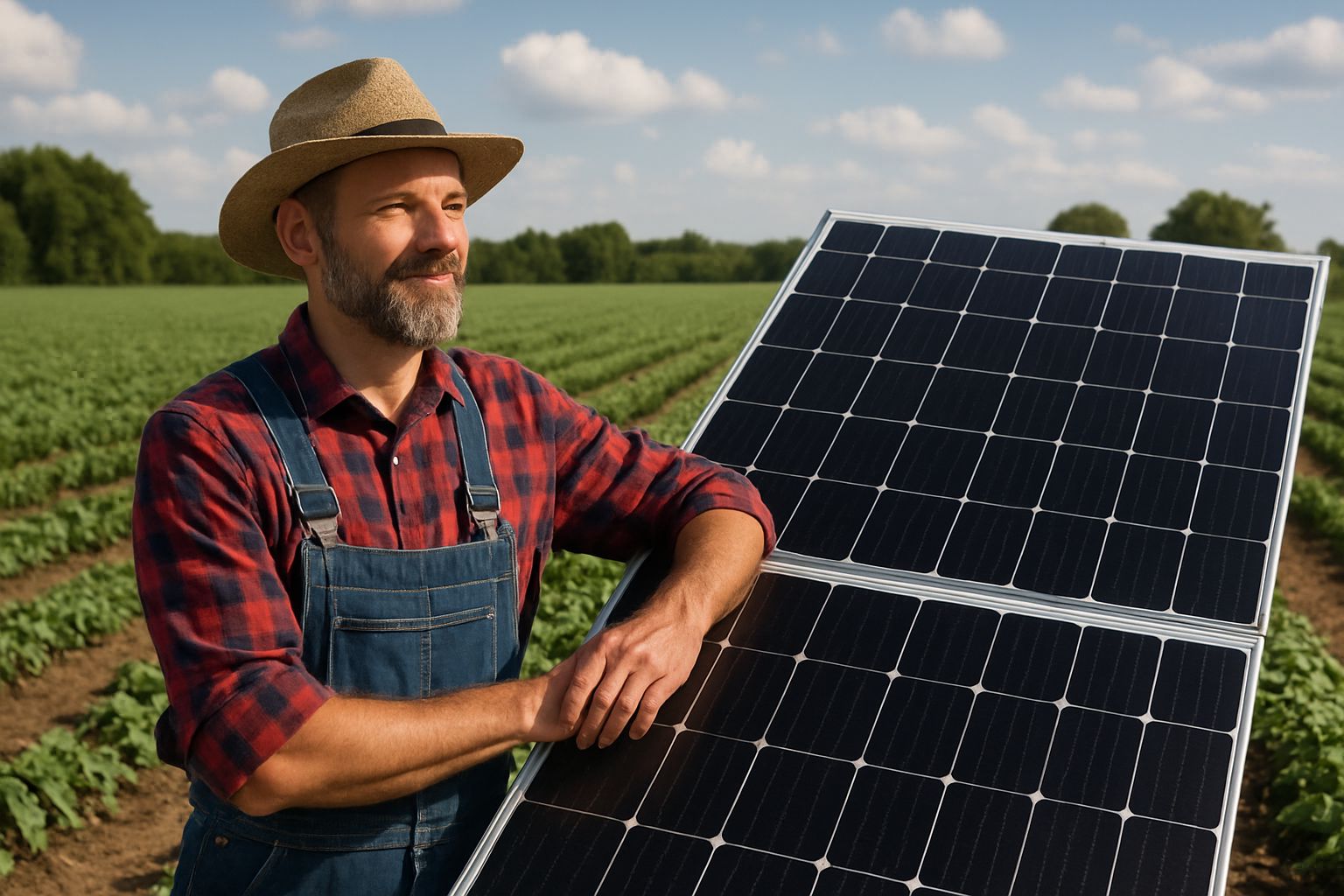
For most working farms, the answer comes down to roof space versus budget flexibility. If your operation is working with limited roof real estate on barns, sheds, or processing facilities, monocrystalline’s higher efficiency and superior space-to-power ratio make it the more practical long-term choice despite the higher upfront cost. Farms with abundant open land for ground-mount systems have more flexibility to consider polycrystalline as a budget-conscious alternative, though even then, bifacial monocrystalline panels often justify their premium through the additional output gained from reflected light capture. The combination of slow degradation, strong warranties, and resilience in partial shade conditions makes monocrystalline technology a sound long-term investment for nearly any farm operation running consistent daily power demands.
Frequently Asked Questions
How many monocrystalline panels does a typical farm need?
It depends entirely on your energy consumption and available roof or ground space. A dairy barn running milking equipment and refrigeration will need a different system size than a grain facility running seasonal motor loads. Getting an energy audit of your specific operation—reviewing past utility bills and equipment power draw—is the only reliable way to calculate the right system size before purchasing panels.
Can monocrystalline panels handle the weight limits of an old barn roof?
In most cases, yes, since standard monocrystalline panels with aluminum framing aren’t dramatically heavier than other panel types. The real concern is the overall structural condition of the roof itself, not the panel technology. A professional structural assessment will confirm whether your specific building can support the array safely, regardless of which panel brand or type you’re considering.
Do monocrystalline panels work well in cold, snowy climates?
Yes. Monocrystalline panels are built to withstand heavy snowfall and perform reliably in cold conditions, and their favorable temperature coefficient actually means they operate more efficiently in cooler weather than in extreme heat. Snow reflecting light onto bifacial panels can even provide a modest output boost during winter months, assuming the array is tilted to shed snow buildup efficiently.
How long before a farm sees a return on investment?
Return on investment timelines vary based on system size, local electricity rates, and available incentives, but most farm installations see payback periods ranging from several years to around a decade depending on these factors. Given that monocrystalline panels typically last 25 to 40 years, the system continues generating savings well beyond the initial payback period, often for two to three decades afterward.
Are monocrystalline panels worth the extra cost over polycrystalline for a small farm?
For small farms with limited roof space, the extra 10% to 20% upfront cost of monocrystalline panels is usually justified by the higher output per square foot, since fewer panels are needed to meet the same energy target. Small operations with ample open land might find polycrystalline’s lower cost per watt more appealing, particularly if space constraints aren’t a factor. The right answer depends on weighing your available installation space against your budget and long-term energy goals.
Making the switch to monocrystalline solar is one of the most straightforward ways a farm can lock in decades of reliable, lower-cost power.







Leave a Reply