

Key Takeaways
- Agricultural solar panels allow farmers to generate clean energy while continuing to grow crops on the same land, maximizing farm profitability.
- Solar installations can reduce water usage by up to 30% through partial shading, helping farms build resilience against drought conditions.
- Farmers utilizing agrivoltaic systems have reported increased yield for certain shade-tolerant crops while simultaneously creating a new revenue stream.
- Government incentives including the Rural Energy for America Program (REAP) can cover up to 25% of installation costs, dramatically improving ROI timelines.
- SunHarvest Solar has been helping farmers transition to solar energy since 2012, with specialized agricultural installations that maintain or improve crop production.
Farmers across America are discovering a powerful climate adaptation strategy that simultaneously addresses energy costs and crop resilience. The integration of solar panels into agricultural operations—known as agrivoltaics—is revolutionizing how we think about land use efficiency while building farm resilience against increasingly unpredictable weather patterns. SunHarvest Solar has been at the forefront of this agricultural revolution, helping farmers design systems that complement rather than compete with crop production.
Solar Panels Are Changing Farming Forever
The traditional view of solar farms as vast arrays of panels covering otherwise productive land is being replaced by a more integrated approach. Modern agricultural solar installations are designed to share space with crops, creating dual-income streams from the same acreage. This integration represents one of the most significant innovations in farming since the advent of mechanized agriculture, allowing farmers to become energy producers while maintaining their primary food production role.
Dual Benefits: Harvest Energy While Growing Crops
Agrivoltaic systems create a symbiotic relationship between energy and food production. The panels provide partial shade that can benefit certain crops while generating clean electricity. Research from the University of Arizona shows that many vegetable crops grown under solar panels require significantly less water while maintaining comparable yields. Some shade-tolerant plants even demonstrate improved growth patterns when shielded from the harshest midday sun. This dual harvest approach effectively increases land use efficiency by up to 70% compared to separate solar and crop production.
Weather Protection Against Climate Extremes
As climate change intensifies weather extremes, solar panels provide a buffer against harsh conditions. The panels create microclimates underneath that protect crops from excessive heat, reducing leaf surface temperatures by up to 15°F during heatwaves. During heavy rainfall events, they moderate the impact of precipitation, reducing soil erosion and plant damage. This protective effect has proven particularly valuable in regions experiencing increasingly erratic weather patterns, where traditional growing methods face mounting challenges from climate volatility.
Reduced Water Usage During Droughts
Water conservation represents one of the most compelling benefits of agricultural solar systems during our changing climate. The partial shade created by appropriately spaced panels reduces evaporation from soil and evapotranspiration from plants. Studies from the National Renewable Energy Laboratory demonstrate water savings between 14-29% depending on crop type and panel configuration. As water becomes increasingly precious in many agricultural regions, this reduction in irrigation requirements can mean the difference between a successful harvest and crop failure during extended drought conditions.

How Agricultural Solar Panels Build Farm Resilience
Beyond the obvious environmental benefits, agricultural solar installations fundamentally strengthen farm operations against both market and climate uncertainties. This enhanced resilience manifests through multiple interconnected advantages that create a more stable and sustainable agricultural business model. By diversifying income streams and reducing operational costs, solar-equipped farms are better positioned to weather both literal and financial storms.
Energy Independence During Grid Failures
When paired with battery storage systems, agricultural solar installations provide critical energy security during grid disruptions. This independence has proven invaluable during extreme weather events when traditional power infrastructure fails. Irrigation systems, climate control in livestock facilities, and refrigeration for perishable harvests can continue uninterrupted, preventing catastrophic losses. Many farmers report that this energy security alone justifies their solar investment, particularly in regions prone to weather-related outages or where utility infrastructure is aging and unreliable.
Stable Income When Crops Fail
Agricultural solar systems create a crucial financial safety net during years when crop yields suffer from extreme weather events. While drought, flooding, or pest outbreaks can devastate traditional farm income, energy production remains relatively stable. This diversification has saved numerous operations during challenging growing seasons. The consistent revenue from power generation—whether through net metering or power purchase agreements—provides essential cash flow to cover operational expenses and debt service even when primary agricultural production falls short of expectations.
Reduced Irrigation Costs
Solar-powered pumping systems dramatically reduce the costs associated with irrigation, which typically represents one of the largest energy expenses on farms. By eliminating fuel costs for diesel pumps or high utility bills from grid-connected electric pumps, these systems improve both the financial and environmental sustainability of water management. Modern solar irrigation systems incorporate smart controls that optimize water delivery based on soil moisture readings, further enhancing efficiency. The combination of reduced energy costs and improved water management creates a compounding benefit that significantly improves farm economics.
Protection From Extreme Heat and Hail
The physical structure of solar arrays provides tangible protection against increasingly common extreme weather events. Properly designed systems create partial shade that shields crops from excessive solar radiation during heatwaves, reducing heat stress and associated yield losses. Additionally, panels offer a physical barrier against hail damage—a growing concern as climate change intensifies storm systems. This protective function is especially valuable for high-value fruits and vegetables where quality and appearance directly impact market value. Some insurance providers now offer premium discounts for crops grown under protective solar arrays, recognizing their risk-mitigating effects.
Agricultural solar panels (agrivoltaics) enhance farm resilience by providing economic, environmental, and operational benefits to farming operations. Below is a detailed table illustrating how these systems help build farm resilience across key impact areas.
|
Impact Area |
How Solar Panels Build Resilience |
|---|---|
|
Crop Protection |
Provide shade to reduce heat stress, protect from late frosts and hail, moderate soil temperature, and support growth of heat-sensitive crops. 1, 2, 3 |
|
Water Conservation |
Reduce evaporation and retain soil moisture, decreasing irrigation needs and helping in drought conditions. 2, 3, 4 |
|
Livestock Welfare |
Create shaded and cooler grazing areas, reducing heat stress for animals and improving productivity. 2, 5 |
|
Economic Stability |
Diversify farmer income by allowing simultaneous crop/livestock production and energy generation, providing steady and reliable revenue streams. 2, 5 |
|
Energy Independence |
Enable farms to produce their own sustainable energy, lowering operational costs and reducing reliance on grid/fossil fuels. 5, 6, 7, |
|
Environmental Stewardship |
Reduce farm carbon footprint, combat climate change, and support sustainable agriculture by lowering greenhouse gas emissions. 5, 6, 7 |
|
Land Productivity |
Optimize land use by supporting dual-cropping (plants/livestock and solar energy), helping overcome land-use conflicts. 1, 3 |
|
Extreme Weather Adaptation |
Panels shield crops from intense sunlight, drought, storms, and can be adapted for protection during adverse weather events. 1, 2, 3 |
|
Long-Term Sustainability |
Solar installations last for decades (often 25+ years), providing reliable resilience to energy price changes and climate variability. 5, 6 |
Agricultural solar panels build farm resilience by contributing to productivity, climate-smart adaptation, financial stability, and environmental conservation.
Agrivoltaics: The Smart Way to Combine Crops and Energy
The science of agrivoltaics—deliberately designing systems where crops and solar panels coexist beneficially—has advanced significantly in recent years. This approach represents a fundamental shift from simply placing panels in fields to creating integrated systems where energy and food production complement each other. The key lies in understanding how different crops respond to varied light conditions and designing solar installations that optimize this relationship.
This integrated approach requires collaboration between agronomists, solar engineers, and farmers to maximize both energy and crop production. Initial research focused primarily on preventing yield losses, but newer studies demonstrate that certain configurations can actually improve agricultural outputs for specific crops while maintaining excellent energy generation. The result is a truly symbiotic system where the whole exceeds the sum of its parts.
Which Crops Thrive Under Solar Panels
Not all crops respond identically to the altered light conditions beneath solar arrays. Leafy greens like lettuce, spinach, and kale have demonstrated remarkable success in agrivoltaic systems, often showing yield increases of 20-30% compared to full-sun conditions. Many berries, including blueberries and raspberries, also perform exceptionally well, benefiting from reduced heat stress and more stable soil moisture. Root vegetables such as carrots, beets, and potatoes show comparable yields to conventional growing methods while requiring significantly less irrigation. Conversely, sun-loving crops like corn and wheat typically experience modest yield reductions but may still provide acceptable harvests when panel spacing and height are optimized.
Optimal Panel Height and Spacing for Different Plants
The physical configuration of solar arrays significantly impacts both energy generation and crop performance. For low-growing crops like lettuce and many herbs, panels can be mounted 8-10 feet above ground level with typical spacing. Taller crops such as peppers, tomatoes, and berry bushes benefit from increased panel heights of 12-15 feet and wider spacing that allows more diffuse light. Innovative tracking systems that adjust panel angles throughout the day can create dynamic light patterns that benefit both energy production and plant growth cycles. The most advanced designs incorporate semi-transparent photovoltaic panels that filter light in ways that specifically benefit photosynthesis while still generating substantial electricity.
Real-World Yield Comparisons
Field trials across diverse growing regions have provided compelling evidence for agrivoltaics’ viability. A three-year study in the Pacific Northwest demonstrated that potato yields under optimized solar arrays maintained 90-95% of conventional production while reducing irrigation requirements by 25%. Similar research in the Southwest showed tomato production actually increased by 5-10% under panels during summer months when conventional fields suffered heat stress. These real-world results challenge the assumption that agricultural productivity must be sacrificed for energy production. The data consistently shows that thoughtfully designed systems can maintain or even enhance agricultural output while adding substantial energy generation to farm operations.

Financial Benefits That Make Solar Worth It
The economic case for agricultural solar installations has never been stronger. While the initial investment requires careful consideration, the combination of declining installation costs and escalating energy prices has dramatically improved the financial equation. Forward-thinking farmers are increasingly viewing solar not as a cost but as a strategic investment that pays dividends through multiple revenue streams and cost reductions.
The most successful agricultural solar adopters take a holistic view of the financial benefits, looking beyond simple electricity savings to consider comprehensive return on investment. This broader perspective often reveals compelling economics that traditional ROI calculations might miss.
1. Lower Energy Bills
The most immediate benefit comes from reduced utility bills, which can represent substantial savings for energy-intensive operations. Dairy farms, which require significant electricity for milk cooling, ventilation, and automated feeding systems, often see payback periods shortened to 5-7 years through these savings alone. Irrigation-dependent operations in regions with high electricity rates have reported 60-80% reductions in energy costs. These savings provide reliable cash flow improvements that become increasingly valuable as utility rates continue their upward trajectory in most agricultural regions.
2. New Revenue From Selling Power
Many agricultural operations don’t consume all the electricity they generate, especially during peak production seasons. Net metering programs allow farmers to sell excess power back to the grid, creating a new revenue stream from previously untapped resources. Some larger installations qualify for power purchase agreements (PPAs) with utilities, guaranteeing stable income for 15-25 years regardless of agricultural market fluctuations. This predictable revenue provides valuable financial stability that can help secure additional financing for farm improvements or expansion.
3. Government Incentives and Tax Credits
The economics of agricultural solar are significantly enhanced by various government incentives designed to accelerate renewable energy adoption. The federal Investment Tax Credit currently covers 30% of installation costs, while USDA’s Rural Energy for America Program (REAP) offers grants covering up to an additional 25% for qualified agricultural producers. Many states provide additional tax incentives, expedited depreciation schedules, or performance-based incentives that further improve returns. These programs can combine to offset 50-75% of initial capital costs, dramatically improving project economics.
4. Improved Crop Value in Some Cases
Intriguingly, some farmers report premium pricing for crops grown under agrivoltaic systems. The controlled light conditions and reduced environmental stress can improve quality metrics for certain specialty crops. Wine grapes grown under optimized solar arrays in California have shown improved sugar-acid balances that command premium prices. Several leafy green producers have secured higher-value contracts with organic retailers specifically for their solar-grown produce, marketing the dual environmental benefits of renewable energy and water conservation. This quality premium represents an often-overlooked financial benefit that can significantly improve overall project returns.
5. Long-Term ROI Calculations
When all financial benefits are properly accounted for, agricultural solar installations typically achieve payback periods of 5-10 years depending on system size, available incentives, and local utility rates. After this payback period, the systems generally provide 15-20 additional years of productive operation with minimal maintenance costs. Modern financial analysis shows internal rates of return between 10-18% for well-designed agricultural solar projects, outperforming many traditional farm investments. This compelling long-term economics explains why agricultural solar adoption continues to accelerate despite initial capital requirements.
Common Setup Options for Your Farm
Agricultural solar installations come in several configurations, each designed to address specific farm needs and conditions. The optimal setup depends on available space, existing infrastructure, primary agricultural activities, and energy requirements. Working with experienced agricultural solar designers ensures your system complements rather than competes with farm operations.
Full Field Coverage Systems
Traditional ground-mounted systems with full field coverage work well for dedicated solar fields or permanently fallow land. These installations typically generate the most power per acre but require land to be primarily dedicated to energy production. Some innovative designs incorporate pollinator habitat beneath and between panels, creating environmental benefits beyond renewable energy. These systems generally offer the lowest cost per watt due to standardized installation practices and economies of scale, making them financially attractive when land availability isn’t a limiting factor.
Raised Panel Designs for Equipment Access
Elevated mounting systems allow standard farm equipment to operate underneath the panels, enabling continued agricultural production. These systems typically position panels 10-15 feet above ground level with sufficient spacing for tractors and implements to maneuver between support posts. Though installation costs run 15-25% higher than conventional ground-mounted systems, the ability to maintain full agricultural production often justifies this premium. These designs work particularly well for mechanically harvested row crops and orchard operations where equipment access is essential.
Solar-Powered Irrigation Solutions
Dedicated solar arrays specifically sized to power irrigation pumps represent one of the most straightforward applications of agricultural solar technology. These systems eliminate ongoing energy costs for water delivery while providing reliable irrigation even in remote locations without grid access. Modern solar irrigation includes smart controls that optimize pumping based on available sunlight, soil moisture sensors, and weather forecasts. The latest designs incorporate battery storage to extend pumping hours beyond daylight, ensuring consistent water delivery during critical growth stages without requiring oversized solar arrays.
Barn and Structure Installations
Roof-mounted systems on existing agricultural buildings often provide the simplest and most cost-effective entry point into solar energy. These installations utilize otherwise unused space without impacting land availability for crops or livestock. Large dairy barns, equipment sheds, and processing facilities frequently offer extensive south-facing roof areas ideal for solar installation. Modern structural engineering allows many older agricultural buildings to be reinforced cost-effectively when existing roof capacity is insufficient. These systems typically qualify for expedited permitting processes since they don’t require additional land use considerations.

Real Farmers Seeing Real Results
The theoretical benefits of agricultural solar are compelling, but nothing speaks more convincingly than the experiences of farmers who have successfully integrated these systems into their operations. These real-world case studies demonstrate how diverse agricultural enterprises have leveraged solar technology to build climate resilience while improving their bottom line.
Sheep Grazing Success in Oregon
The Willamette Valley Solar Grazing Cooperative represents an innovative model combining solar energy with livestock production. Their 150-acre solar installation was specifically designed to accommodate rotational sheep grazing between and beneath panel arrays. The solar developer pays the cooperative for vegetation management services, creating a new revenue stream beyond wool and lamb production. The sheep effectively maintain vegetation height without damaging infrastructure, eliminating mowing costs for the solar operator.
Project lead Sarah Jenkins reports that lamb growth rates under the panels actually exceeded those in conventional pastures during summer months, as the animals benefited from shade during peak heat hours. Soil testing over three years has shown improved carbon sequestration and nutrient cycling in the solar grazing fields compared to nearby conventional pastures, demonstrating that properly managed solar grazing creates environmental benefits beyond renewable energy production.
Small Farm Energy Independence in Minnesota
Riverbend Organic Farm installed a 35kW agrivoltaic system specifically designed to complement their diversified vegetable operation while achieving energy independence. The elevated panel design allows continued cultivation of salad greens, herbs, and root vegetables in the partial shade beneath panels. Owner Michael Thornton reports that during the 2021 heat wave, crops under panels maintained marketable quality while identical plantings in full sun suffered significant losses, clearly demonstrating the climate resilience benefits of their system.
Start Your Solar Farming Journey Today
Transitioning to solar-powered agriculture requires careful planning and consideration of your specific farm needs and conditions. The most successful implementations begin with thorough assessment and research before moving to equipment selection and installation. This methodical approach ensures your system will complement existing operations while maximizing both energy and agricultural production.
Beginning your solar journey doesn’t require immediate major investments. Many farmers start with smaller pilot projects that allow them to gain experience with the technology while demonstrating viability for their specific operation. These initial installations can be expanded modularly as confidence grows and financial returns are validated through direct experience. For more insights on integrating solar power with agriculture, explore agrivoltaics in the Northwest.
First Steps to Assess Your Land’s Potential
Before contacting installers, conduct a preliminary assessment of your property’s solar potential and energy needs. Review your electricity consumption history over multiple years to understand seasonal patterns and identify opportunities for load reduction through efficiency improvements. Examine your property for south-facing slopes or underutilized areas that might accommodate solar arrays without compromising productive agricultural land.
Consider how solar might complement your specific crops or livestock. Shade-tolerant vegetables, berries, or grazing operations often pair exceptionally well with solar installations. Map out areas where panels might provide beneficial shade or wind protection for sensitive crops or animals.
Solar Site Assessment Checklist
• Annual electricity consumption (kWh/year)
• Available space (acres or square feet)
• Distance to nearest electrical interconnection
• Soil type and drainage conditions
• Shading from trees or structures
• Local zoning and permitting requirements
• Current agricultural use and production value
• Preferred crops for agrivoltaic integration
Most agricultural extension offices now offer preliminary solar assessments to help farmers evaluate potential before committing to detailed engineering studies. These services typically include basic financial modeling based on your specific energy usage patterns and available incentives, providing a valuable reality check before proceeding with more detailed planning.
Finding the Right Installer and Equipment
Selecting a qualified installer with specific agricultural experience is perhaps the most critical decision in your solar journey. Agricultural installations differ significantly from residential or commercial projects, requiring specialized knowledge of farm operations, equipment clearances, and compatibility with irrigation systems. Request detailed references from other farms similar to yours and personally visit these installations to see real-world performance and integration with agricultural activities.
Equipment selection should prioritize durability in agricultural environments where dust, moisture, and temperature extremes can challenge solar components. Premium panels with stronger frames and sealed junction boxes often prove more economical long-term despite higher initial costs. Mounting systems should accommodate potential future changes in crop selection or equipment needs, with modular designs that allow configuration adjustments as your operation evolves.
- Look for installers with at least 5+ years of specific agricultural solar experience
- Request agricultural-specific references and visit completed installations
- Prioritize systems designed for harsh environmental conditions
- Consider future expansion capability in initial design
- Verify warranty coverage specifically includes agricultural applications
- Ensure monitoring systems are compatible with farm internet connectivity
The most reputable agricultural solar providers offer comprehensive services beyond installation, including assistance with interconnection agreements, incentive applications, and ongoing performance monitoring. These partners view themselves as long-term contributors to your farm’s success rather than simply equipment vendors, providing valuable support throughout your solar journey.
Avoiding Common First-Timer Mistakes
New adopters of agricultural solar technology frequently encounter preventable challenges that experienced system owners have already navigated. Learning from these common missteps can save significant time, money, and frustration as you implement your own solar strategy. The most successful projects build flexibility into their design, allowing adaptation as both solar technology and agricultural practices continue evolving.
Common Agricultural Solar Pitfalls
• Undersizing electrical interconnection capacity for future expansion
• Insufficient panel height for equipment clearance
• Inadequate water management around ground-mounted systems
• Failing to secure necessary agricultural exemptions for property taxes
• Overlooking seasonal shading from deciduous trees or structures
• Incompatibility between monitoring systems and farm internet connectivity
Perhaps the most critical mistake is viewing solar solely as an energy project rather than an integrated agricultural system. The most successful implementations carefully consider how solar infrastructure interacts with seasonal field operations, irrigation systems, and livestock movements. Detailed mapping of these interactions during the design phase prevents costly modifications after installation. For more insights, explore climate resilience in agriculture.
Successful agricultural solar adopters also recognize the importance of community engagement throughout the development process. Early communication with neighbors, local officials, and agricultural organizations helps identify and address potential concerns while building valuable support for your project. This proactive approach often streamlines permitting processes and can uncover unexpected collaboration opportunities with neighboring operations.
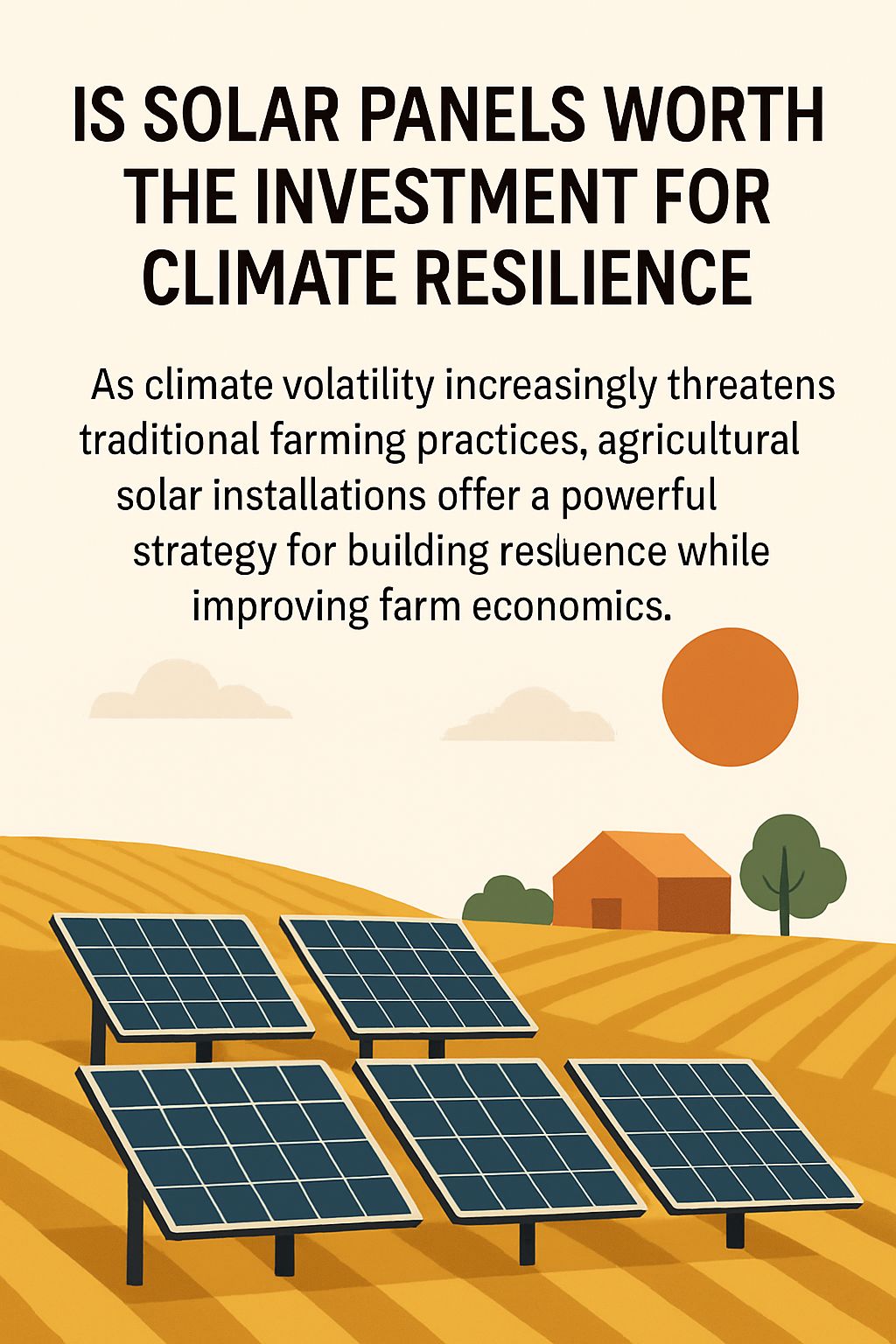
Conclusion: Is Solar Panels Worth the Investment for Climate Resilience
As climate volatility increasingly threatens traditional farming practices, agricultural solar installations offer a powerful strategy for building resilience while improving farm economics. The dual benefits of energy independence and modified growing environments create multiple layers of protection against both climate and market uncertainties. When properly designed and implemented, these systems represent not just adaptation to changing conditions but a proactive path toward more sustainable and profitable agricultural operations. For farmers looking to secure their operation’s future against increasing climate challenges while creating new revenue streams, agricultural solar installations deserve serious consideration as a cornerstone strategy for the coming decades.
Frequently Asked Questions
As agricultural solar installations become more common, farmers considering this technology typically share similar questions and concerns. The following responses address the most common inquiries based on current research and real-world implementation experience.
How much does an agricultural solar system typically cost?
Typical Agricultural Solar Installation Costs (2023)
• Small systems (10-30kW): $2.20-2.80 per watt installed
• Medium systems (30-100kW): $1.90-2.40 per watt installed
• Large systems (100kW+): $1.60-2.10 per watt installed
• Agrivoltaic premium: +15-25% for elevated mounting
• Battery storage addition: $800-1,200 per kWh capacity
Note: Costs before applying federal tax credits, USDA grants, and state incentives
Agricultural solar system costs have declined significantly over the past decade, making these installations increasingly accessible to farms of all sizes. The per-watt installation cost varies based on system size, mounting approach, and site conditions. Standard ground-mounted systems for a typical 60kW installation currently average $2.00-2.30 per watt before incentives, with economies of scale reducing costs for larger systems.
Specialized agrivoltaic systems with elevated mounting structures to accommodate continued farming underneath typically command a 15-25% premium over standard installations. This additional cost often proves worthwhile through maintained agricultural production, effectively paying for itself through continued crop revenue from the same land area.
After applying federal tax credits (currently 30%), USDA REAP grants (up to 25%), and state-specific incentives, many farmers reduce their effective out-of-pocket costs by 50-70%. This dramatic reduction in net investment, combined with ongoing energy savings and potential new revenue streams, creates compelling economics even for operations with tight capital constraints.
Financing options specifically designed for agricultural solar projects have expanded significantly, with specialized agricultural lenders now offering terms that align repayment schedules with projected energy savings. These financial innovations make solar accessible even to operations unable to commit to large upfront capital expenditures.
Will solar panels damage my soil or affect crop nutrition?
Comprehensive soil studies from established agrivoltaic systems show no negative impacts on soil health or crop nutrition when properly designed and managed. In many cases, researchers have documented improved soil conditions beneath panels, including increased moisture retention, reduced temperature extremes, and enhanced microbial activity. Water running off panels tends to create localized irrigation patterns that must be managed through appropriate ground cover and potentially supplemental drainage in high-precipitation regions. Proper installation includes protective measures during construction to prevent soil compaction and erosion.
Long-term studies from the National Renewable Energy Laboratory have found no evidence of metal leaching from properly maintained solar equipment into agricultural soils. Modern solar panels are engineered with sealed systems that effectively contain all potentially harmful materials throughout their operational lifetime. The partial shading patterns created by panels can actually improve nutrient cycling in some agricultural systems by moderating soil temperatures and reducing moisture stress, creating more favorable conditions for beneficial soil microorganisms.
Can I still use my farm equipment with solar panels installed?
Modern agricultural solar installations can be specifically designed to accommodate continued equipment access and operation. Elevated mounting systems with clearances of 12-15 feet allow passage of most standard tractors, harvesters, and implements. Panel rows can be spaced to match existing equipment widths, minimizing adaptation requirements. Some innovative designs incorporate tracking systems that temporarily adjust panel angles to maximize clearance during critical field operations, then return to optimal energy-producing positions afterward. Working with designers experienced in agricultural operations ensures your system will complement rather than hinder equipment movement and functionality.
For livestock operations, panel mounting includes reinforced components and raised electrical connections specifically designed to withstand contact with animals. Fencing configurations and gate placements can be integrated into the overall system design to maintain efficient rotational grazing or animal movement patterns while protecting critical infrastructure. These agricultural-specific design considerations often represent a small percentage of total project cost while dramatically improving compatibility with existing farm operations.
What happens to my solar system during severe weather?
Agricultural solar installations are engineered to withstand extreme weather conditions common in farming regions. Modern systems are designed to survive wind speeds of 120+ mph, heavy snow loads, and significant hail impact. Most panels now include automatic safety shutdowns during grid outages, eliminating electrocution risks during storm damage assessment or repairs. The distributed nature of solar arrays means that damage to individual panels rarely compromises the entire system, allowing continued partial operation even after significant weather events. Many agricultural insurance providers now offer specific riders covering solar equipment, recognizing their integral role in farm operations and providing protection against catastrophic damage.
How long before my solar investment pays for itself?
Payback periods for agricultural solar installations typically range from 5-10 years depending on system configuration, available incentives, and local utility rates. Operations with high energy consumption for irrigation, refrigeration, or climate control often see the shortest payback periods due to immediate and substantial reduction in utility costs. Systems that qualify for premium net metering rates or feed-in tariffs may achieve payback in as little as 4-6 years in favorable jurisdictions.
The most accurate payback calculations consider multiple value streams beyond simple electricity savings, including potential crop yield benefits, carbon credit opportunities, and depreciation advantages. Many agricultural financial advisors now incorporate these comprehensive analyses when evaluating solar investments, recognizing that traditional simple payback calculations often undervalue the total economic benefit.
After the initial payback period, solar systems typically provide 15-20 additional years of productive operation with minimal maintenance costs. This extended production period represents pure profit that significantly enhances the overall return on investment and explains why many farmers view solar as one of their most financially sound long-term investments.
As energy costs continue rising while solar technology becomes more efficient and affordable, agricultural solar installations increasingly represent not just environmental stewardship but sound business strategy for forward-thinking farm operations. Your farm can simultaneously address climate challenges and financial sustainability through thoughtfully implemented solar technology.

Leave a Reply