
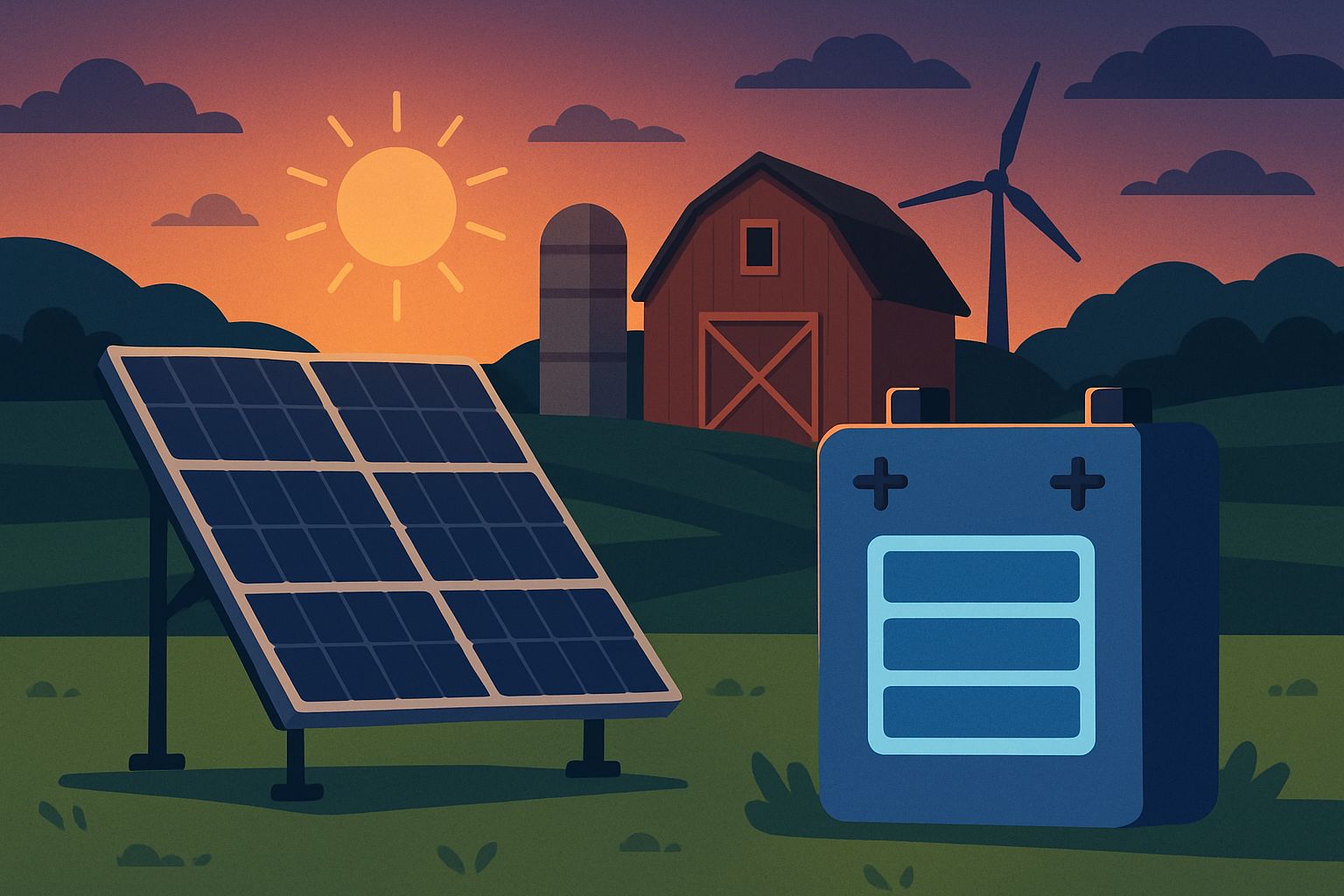
Key Takeaways
- Off-grid solar power systems can reduce farm operating costs by up to 70% compared to traditional grid connections while providing reliable energy independence.
- Properly sized battery storage is essential for maintaining farm operations during nighttime hours, with lithium-ion, lead-acid, and flow batteries offering different benefits depending on farm needs.
- Strategic panel placement and weather-proofing techniques can help maximize solar energy production even during winter months and adverse weather conditions.
- Growing Solar Mist provides specialized solar solutions that address the unique energy demands of agricultural operations, from irrigation to livestock climate control.
- Modern monitoring systems allow farmers to track energy production and consumption in real-time, enabling better decision-making and system optimization.
Imagine never worrying about power outages during critical harvest times or watching helplessly as electricity bills soar during peak growing seasons. For today’s farmers, energy independence isn’t just about sustainability—it’s about survival.
The agricultural sector faces unique energy challenges that conventional power solutions struggle to address. From remote locations with limited grid access to seasonal operations requiring flexible energy solutions, farms need power systems that work as hard as farmers do. Off-grid solar power systems offer a compelling solution by harnessing abundant sunlight to power everything from irrigation pumps to cold storage facilities, even during nighttime hours and challenging weather conditions.
The Hidden Energy Crisis Facing Modern Farms
Modern farming operations are energy-intensive enterprises. Irrigation systems, climate control for livestock housing, processing equipment, and refrigeration units all demand consistent, reliable power. Many farms, particularly those in rural or remote areas, face significant challenges when relying on traditional power infrastructure. As Growing Solar Mist research indicates, these energy demands can account for up to 30% of operating costs for some agricultural businesses, creating a substantial financial burden that affects profitability and long-term sustainability.
The energy crisis in agriculture becomes particularly acute during peak growing seasons when power demand is highest and outages can be most devastating. A single day without electricity during critical operations can result in thousands of dollars in lost crops or compromised livestock conditions. This vulnerability creates an unsustainable risk for farm businesses already operating on tight margins.
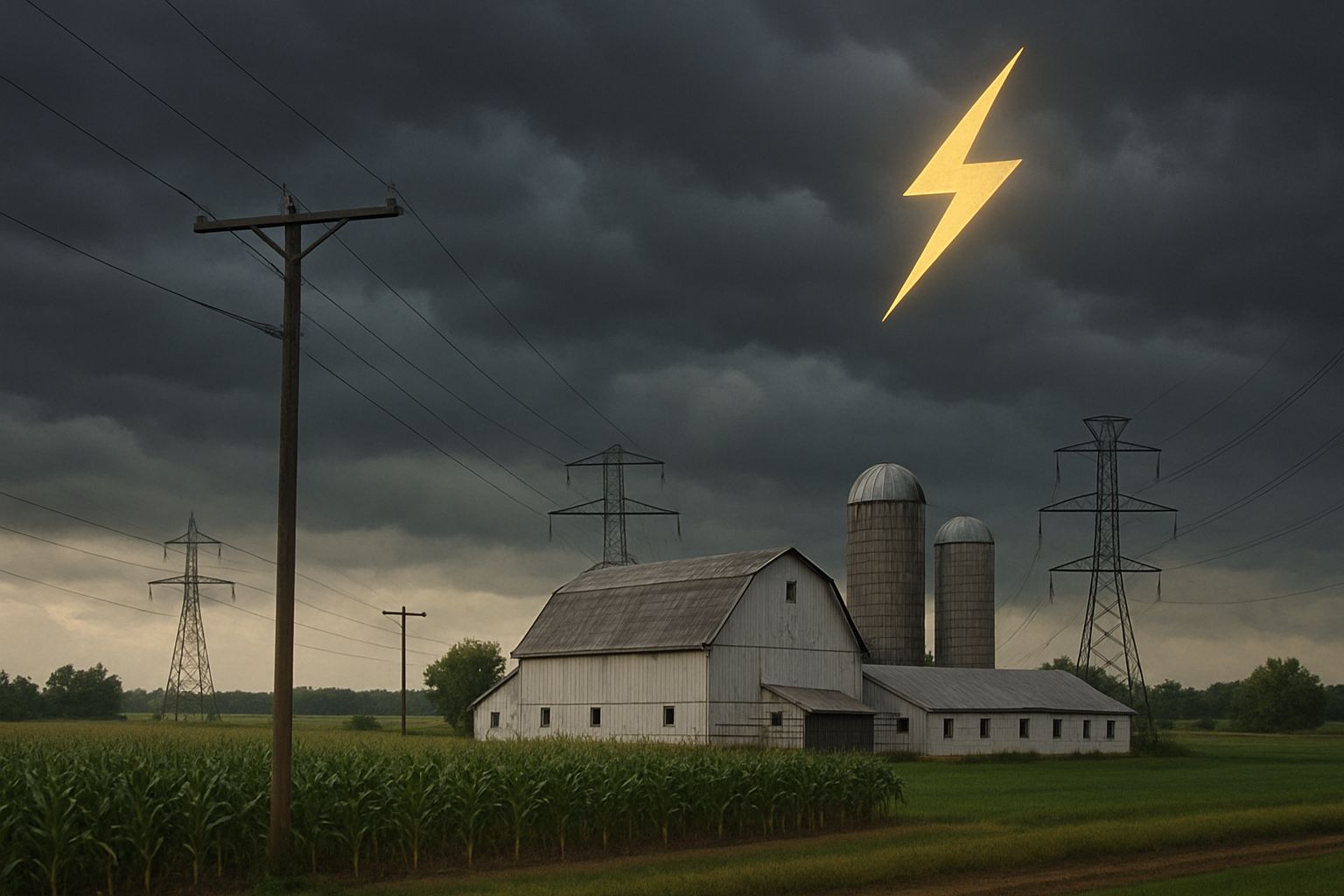
Why Traditional Power Solutions Fail Farmers
The conventional power grid was not designed with farm operations in mind. Grid infrastructure often prioritizes population centers, leaving rural areas with less reliable service and fewer upgrade options. For farms, this translates to inconsistent power quality, unexpected outages, and limited capacity for expansion—all critical limitations for agricultural operations that depend on reliable energy.
Unpredictable Costs During Peak Agricultural Seasons
Traditional energy sources subject farmers to wildly fluctuating costs that can wreak havoc on carefully planned operating budgets. During peak growing seasons, when irrigation and climate control systems run continuously, energy costs can spike dramatically. These seasonal cost variations make financial planning exceptionally difficult and can erode profitability during crucial production periods. Many farmers report energy bill increases of 200-300% during peak seasons, creating significant cash flow challenges precisely when capital is most needed for other operational expenses.
Critical Power Outages During Harvest Time
Perhaps nothing strikes fear into a farmer’s heart quite like a power outage during harvest operations. When the grid fails during critical periods, the consequences can be devastating. Harvested crops requiring immediate processing or refrigeration may spoil, automated milking systems can fail, and climate control systems for livestock housing can shut down. The financial and animal welfare implications of these outages can be severe, turning what should be the most productive time of year into a crisis management scenario. To mitigate these risks, many farmers are exploring solar power benefits to improve operations efficiency.
Environmental Impact of Diesel Generators
Many farms have turned to diesel generators as backup power solutions, but this approach comes with significant drawbacks. Beyond the obvious fuel costs, diesel generators produce substantial emissions that contribute to air pollution and climate change. The environmental footprint of diesel power generation contradicts many farmers’ desires to operate more sustainably and can damage a farm’s relationship with surrounding communities and environmentally conscious consumers. Additionally, diesel generators require regular maintenance and fuel storage, adding yet another set of tasks to an already demanding farm management schedule. For a more sustainable alternative, farmers can explore solar power benefits to improve operations and efficiency.
Core Components of an Off-Grid Solar Farm System
An effective off-grid solar power system for agricultural applications consists of four essential components working in harmony. Solar panels capture energy, batteries store it for later use, charge controllers prevent battery damage, and inverters convert DC power to AC power for standard farm equipment. This integrated approach creates a reliable power ecosystem that can operate independently of traditional grid infrastructure, providing farmers with unprecedented energy autonomy.
Solar Panel Selection for Agricultural Applications
Selecting the right solar panels for your farm requires careful consideration of several factors. Monocrystalline panels offer the highest efficiency (20-22%) and work well in limited space situations, while polycrystalline panels provide a more cost-effective option with slightly lower efficiency (15-17%). For farms with extensive available land, thin-film panels can be an excellent choice despite their lower efficiency, as they perform better in high-temperature conditions and partial shading situations common in agricultural settings.
The mounting system is equally important as the panels themselves. Fixed ground mounts are the most common for agricultural installations due to their durability and lower maintenance requirements. Tracking systems, which follow the sun throughout the day, can increase energy production by 25-45% but come with higher initial costs and more maintenance requirements. Your choice should balance maximum energy production with practical considerations like field access for equipment and livestock. For a comprehensive understanding of these systems, you might find this ultimate guide to off-grid solar systems helpful.
Battery Storage Systems: Sizing for Overnight Power
The heart of any off-grid system is its battery storage capacity. For farms, proper sizing is critical to ensure operations continue seamlessly through the night and during cloudy periods. A comprehensive energy audit identifying both average and peak power requirements forms the foundation of proper battery system design. Most agricultural operations benefit from systems sized to provide 2-3 days of autonomy, meaning they can run essential systems without any new solar input for that duration.
When calculating battery capacity needs, consider seasonal variations in energy consumption. Irrigation demands peak during growing seasons, while heating requirements for livestock barns increase during winter months. Your battery system should be sized for your highest demand period while incorporating a 20-30% buffer to account for inefficiencies and unexpected needs. Working with an agricultural energy specialist can help translate your farm’s specific operations into precise battery capacity requirements.
Charge Controllers and Inverters: Making Solar Power Usable
Charge controllers serve as the energy traffic managers of your solar system, regulating the voltage and current flowing from your panels to your batteries. MPPT (Maximum Power Point Tracking) controllers are strongly recommended for farm applications, as they can increase charging efficiency by 20-30% compared to simpler PWM (Pulse Width Modulation) models. This increased efficiency translates directly into more stored energy available for nighttime operations.
Inverters transform the DC power stored in batteries into AC power compatible with standard farm equipment. For agricultural operations, pure sine wave inverters are essential despite their higher cost, as they provide the clean power necessary for sensitive equipment like pumps, motors, and refrigeration systems. Many farms benefit from multiple inverters strategically placed near different operation centers rather than a single centralized unit, reducing power loss over long distances and providing redundancy if one unit fails. For those interested in optimizing their farm’s energy efficiency, exploring solar power benefits for farmers can be a valuable resource.
System Monitoring Tools: Staying Ahead of Problems
Modern solar systems include sophisticated monitoring capabilities that provide real-time insights into system performance. These tools track energy production, battery state of charge, and consumption patterns, allowing farmers to identify potential issues before they become critical failures. Remote monitoring options enable checking system status from anywhere via smartphone apps, particularly valuable during busy seasons when farmers may not have time for manual system checks.
Intelligent monitoring systems can also help optimize farm operations by identifying energy usage patterns. This data allows farmers to schedule high-consumption activities during peak solar production periods, maximizing the direct use of solar power and minimizing battery cycling. Some advanced systems can even automate this process, automatically starting irrigation pumps or cooling systems when excess solar production is available.
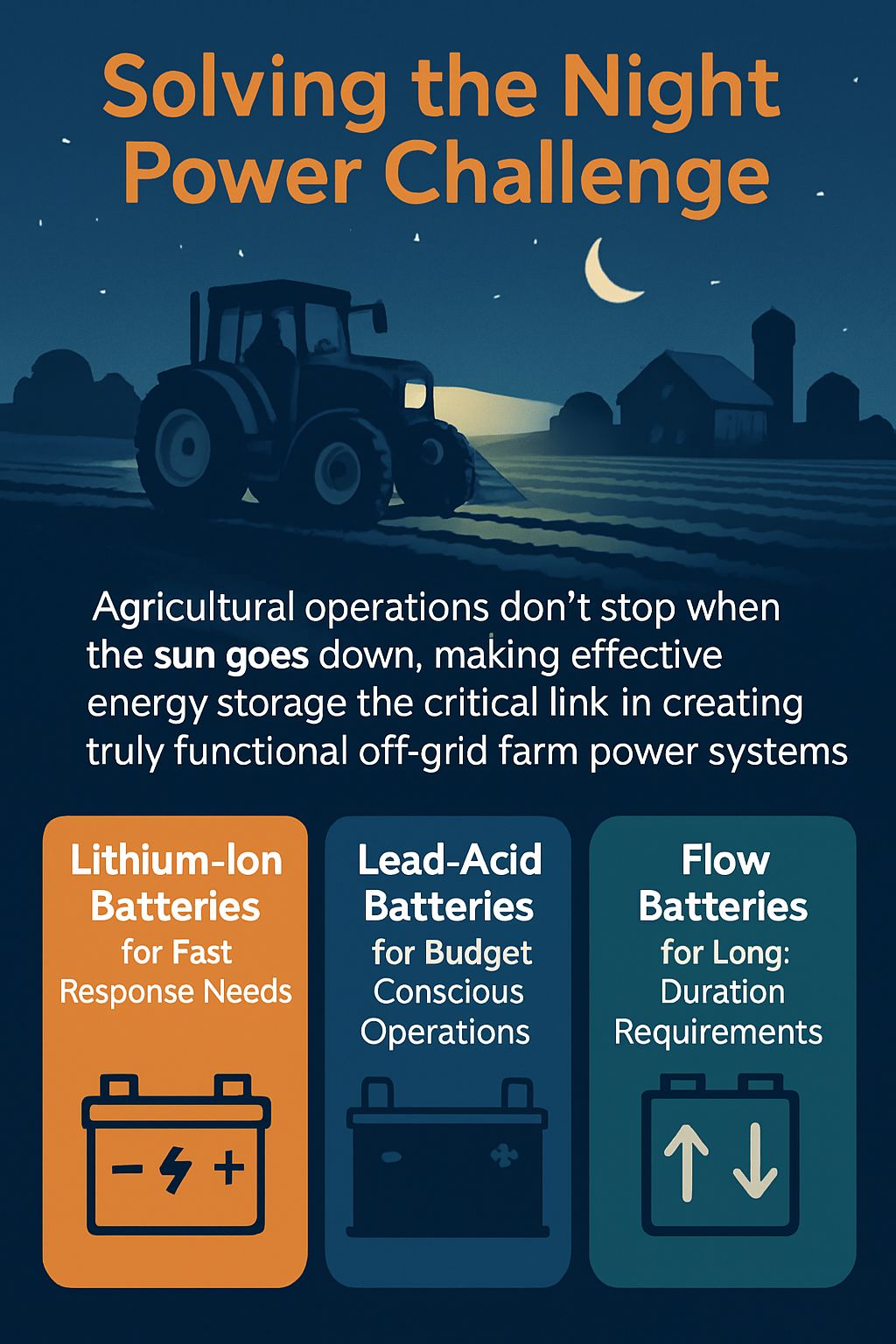
Solving the Night Power Challenge
Agricultural operations don’t stop when the sun goes down, making effective energy storage the critical link in creating truly functional off-grid farm power systems. Different battery technologies offer distinct advantages for various agricultural applications, and intelligent load management strategies can maximize the value of stored energy during nighttime hours.
Battery Types and Their Farm Applications
1. Lithium-Ion for Fast Response Needs
Lithium-ion batteries have revolutionized agricultural solar applications with their exceptional efficiency and performance characteristics. With discharge depths of 80-100% and cycle lives exceeding 4,000 cycles, these systems can provide reliable power for 10+ years under typical farm usage patterns. Their rapid charge/discharge capabilities make them ideal for handling the sudden power demands common in agricultural operations, such as motor startups for grain augers or sudden pumping requirements.
The compact footprint of lithium systems—requiring 50-70% less space than equivalent lead-acid setups—makes them particularly valuable for farms with limited installation space. While the higher initial investment (typically $800-1,200/kWh) presents a hurdle, many farmers find the longer lifespan, minimal maintenance requirements, and superior performance justify the upfront cost, especially for critical systems that cannot tolerate power interruptions.
2. Lead-Acid for Budget Conscious Operations
Traditional lead-acid batteries remain popular in agricultural applications where initial cost constraints are a primary concern. At $150-300/kWh, these systems provide an accessible entry point for farmers beginning their renewable energy journey. Their proven technology and widespread availability mean replacement parts and service expertise can be found even in remote agricultural regions.
The limitations of lead-acid batteries—including shorter cycle lives (500-1,000 cycles), reduced efficiency in cold temperatures, and higher maintenance requirements—make them better suited for supplementary rather than primary power systems. Many farms successfully implement these batteries for specific applications like workshop power or security lighting while using more advanced battery technologies for critical operations. Regular maintenance including water level checks and terminal cleaning is essential for maximizing the 3-7 year lifespan typical of these systems in agricultural settings.
3. Flow Batteries for Long-Duration Requirements
Flow batteries represent the cutting edge of agricultural energy storage, offering unmatched longevity and scalability for larger farm operations. These systems, which store energy in liquid electrolyte solutions, can provide 20+ years of service with minimal degradation, making them ideal for permanent agricultural installations. Their ability to decouple power and energy ratings allows precise customization to match a farm’s specific needs – whether that’s high power output for brief periods or sustained lower output over extended timeframes.
The ability to cycle deeply without degradation makes flow batteries particularly valuable for seasonal agricultural operations that might fully discharge their storage systems during intensive periods. While the current cost ($500-600/kWh) and larger physical footprint represent challenges, farms with predictable long-term energy needs often find the total lifetime cost competitive with other technologies when amortized over the system’s extended lifespan.
Smart Load Management During Dark Hours
Strategic energy usage is as important as storage capacity for successful nighttime operations. Modern farm energy management systems can prioritize equipment operation based on criticality, ensuring essential systems like livestock ventilation receive power priority over deferrable tasks. Automated load shedding can temporarily disconnect non-essential equipment during periods of low battery charge, extending runtime for critical operations until solar production resumes.
Many agricultural operations benefit from scheduling energy-intensive tasks during daylight hours when possible, reducing nighttime battery draw. For example, irrigation pumps can operate during peak solar production, filling storage tanks that then use gravity flow for overnight watering. Cold storage facilities can “pre-cool” during daylight hours, requiring less energy to maintain temperatures overnight. These operational adjustments can significantly extend battery life while reducing the required storage capacity and system cost.
Weather-Proof Solar Strategies for Farm Operations
Reliable year-round operation demands thoughtful system design that accounts for seasonal weather variations. Solar power systems for farms must be engineered to perform through all conditions, from summer heat waves to winter storms, ensuring uninterrupted agricultural operations regardless of weather challenges. Learn how to cut your farm’s electricity costs with solar power to enhance efficiency and sustainability.
Panel Placement to Maximize Winter Sunlight
Optimal panel positioning becomes critical for maintaining energy production during winter months when daylight hours decrease. In northern latitudes, increasing panel tilt angles to 45-60 degrees during winter can improve solar capture by up to 25% compared to standard summer angles. Some agricultural installations employ adjustable mounting systems that allow seasonal tilt adjustments, maximizing production year-round while maintaining structural integrity against wind loads.
Strategic placement relative to surrounding farm structures and vegetation prevents winter shadows from reducing panel output. While summer shade patterns may be negligible, the lower winter sun angle creates longer shadows that can significantly impact production. Conducting a comprehensive solar path analysis across seasons ensures panels remain unshaded during critical production hours, particularly important for farms in northern regions where winter solar resources are already limited.
Snow and Ice Management Techniques
Snow accumulation presents a particular challenge for agricultural solar installations in colder climates. Steep panel mounting angles (40+ degrees) enable passive snow shedding as the dark panel surfaces warm slightly during daylight hours. For larger ground-mount systems, adequate spacing between panel rows prevents snow from one row shadowing the next after sliding off. Some innovative farm installations incorporate mechanical solutions like timed vibration systems that gently shake panels to dislodge accumulated snow.
Ice buildup requires different management strategies than snow. Anti-icing coatings applied to panel surfaces can reduce adhesion and facilitate faster clearing once temperatures rise. For critical farm power applications, some system designs incorporate minimal heating elements that activate only when sensors detect both freezing conditions and zero power production, using a small portion of stored energy to clear panels and restore generation capacity. These systems typically consume less than 5% of daily production to eliminate conditions that would otherwise result in zero output.
Backup Power Integration for Extended Cloudy Periods
Even well-designed solar systems must contend with extended periods of limited production. For farms where operational continuity is essential, hybrid systems integrating renewable-powered generators provide crucial backup capacity. Modern biodiesel generators can be configured to automatically start when battery storage reaches critical levels, running at optimal efficiency to recharge batteries before shutting down. Unlike traditional backup generators, these systems operate preventatively rather than reactively, maintaining battery charge rather than responding to complete power loss.
Micro-wind turbines increasingly complement agricultural solar installations, particularly in regions where winter months bring both reduced sunlight and increased wind resources. These complementary generation profiles—solar producing more in summer, wind producing more in winter—create a more balanced year-round energy supply. Some innovative farm operations even incorporate small-scale biogas generators fueled by agricultural waste, creating truly integrated energy systems that maximize farm resource utilization while ensuring power reliability regardless of weather conditions. For more on how solar power can enhance farm operations, explore the benefits of solar power for farmers.
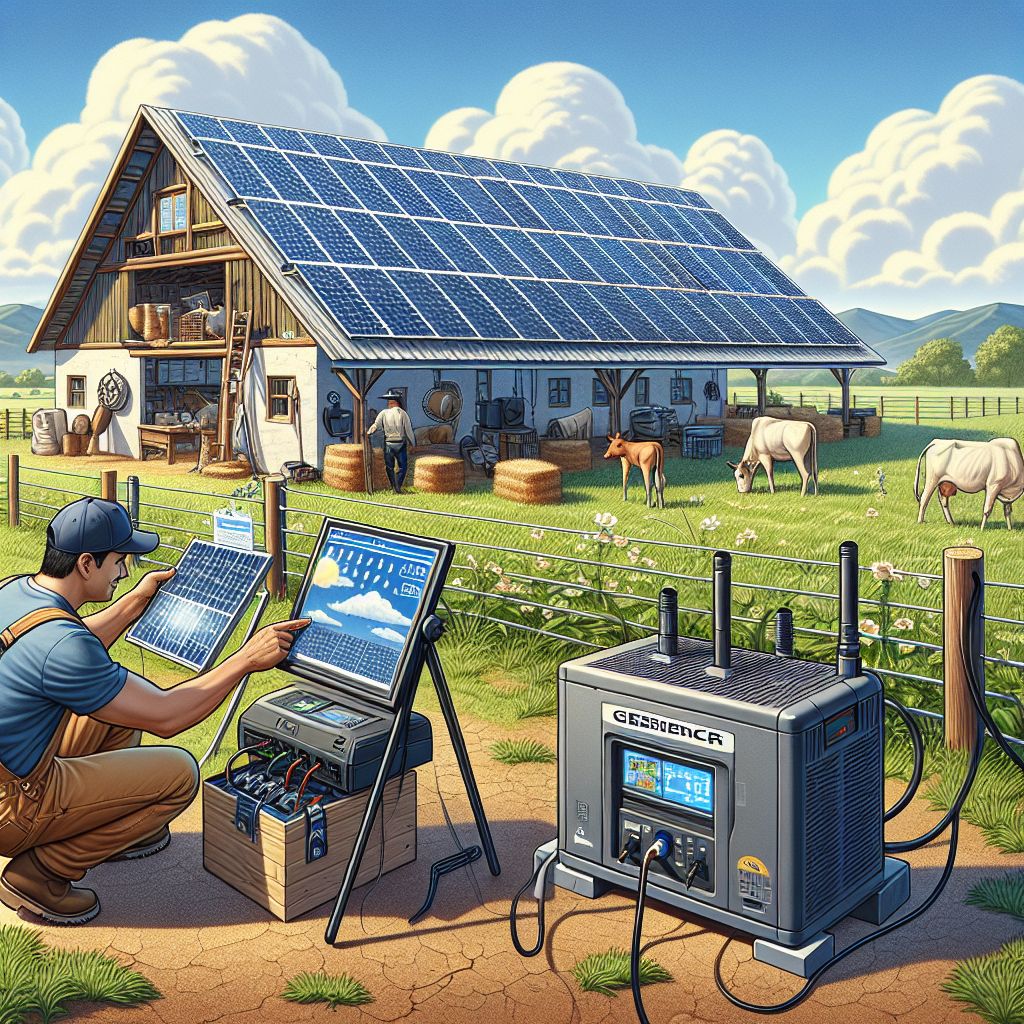
“Off-Grid Farming with Solar Power: Can …” from growingsolarmist.com and used with no modifications.
Real-World Performance Data from Agricultural Solar Systems
Real-world data from operating agricultural solar systems provides valuable insights beyond theoretical calculations. Analysis of production data from dozens of farm installations reveals that actual performance closely tracks projected outputs when systems are properly designed for agricultural conditions. The critical factors distinguishing high-performing farm systems include oversized array capacity (typically 120-130% of calculated requirements), sufficient battery storage for operational continuity, and intelligent energy management systems that optimize usage patterns. For farmers looking to cut electricity costs with solar power, these insights are invaluable.
Seasonal Energy Production Patterns
Production data from farm installations across different climate zones demonstrates predictable seasonal patterns that inform system sizing requirements. Most agricultural installations experience production peaks during late spring and early summer, with output typically 30-40% higher than annual averages during these periods. Winter production generally drops to 40-60% of peak output, with the specific reduction depending on latitude and local weather patterns. Understanding these cyclical patterns allows farmers to align high-energy operations with natural production cycles where possible, reducing battery cycling and extending system life.
Battery Discharge Rates During Night Operations
Battery performance analysis reveals that most agricultural operations experience predictable nighttime consumption patterns. Livestock operations typically see relatively consistent overnight power draw for ventilation, heating or cooling, and automated feeding systems. Crop operations often experience more variable patterns based on seasonal processing needs and cold storage requirements. Data from monitored systems indicates that most farms benefit from configuring 50-60% of battery capacity for regular nightly use, reserving the remainder for extended cloudy periods and emergency backup.
System Performance During Extreme Weather Events
Case studies of farm solar systems during extreme weather events demonstrate their resilience when properly designed. During the Midwest polar vortex events of recent years, farms with winterized solar systems maintained 30-50% of normal production despite challenging conditions, with properly sized battery systems bridging the production gaps. Similarly, agricultural installations in hurricane-prone regions have shown exceptional durability when engineered to withstand high wind loads, often returning to production faster than grid power can be restored to the area. This resilience represents a significant advantage for agricultural operations where power interruptions can have severe consequences for livestock welfare or crop preservation. For more information on solar systems, check out this ultimate guide to off-grid solar systems.
Cost Analysis: Breaking Down the Numbers
Financial analysis remains a primary consideration for farm solar investments. Complete off-grid systems for agricultural applications typically range from $25,000-$100,000+ depending on capacity requirements and system complexity. This represents a significant capital investment, but one that delivers returns through multiple financial mechanisms including eliminated utility bills, protection from future energy price increases, and significant tax advantages specifically available to agricultural businesses.
Initial Investment vs. Long-Term Savings
Comprehensive financial modeling for agricultural solar installations demonstrates compelling long-term economics despite substantial upfront costs. Farms typically experience complete payback periods of 5-9 years depending on energy usage patterns, local electricity rates, and available incentives. After this payback threshold, systems continue generating essentially free energy for 15-25+ additional years, with only minimal maintenance costs. When calculated on a levelized cost of energy basis (total lifetime system cost divided by total energy production), most farm solar systems deliver energy at $0.06-0.10/kWh – often less than half the retail rates charged by utilities.
Available Agricultural Solar Incentives
Agricultural operations enjoy access to numerous financial incentives that can significantly improve project economics. The federal Investment Tax Credit currently provides a 26% credit against installed system costs, with specific agricultural applications potentially qualifying for accelerated depreciation schedules that further enhance tax benefits. Many states offer additional incentives including grants, low-interest loans, and performance-based incentives that provide ongoing payments for generated energy. Agricultural operations should also investigate USDA Rural Energy for America Program (REAP) grants, which can cover up to 25% of renewable energy project costs for qualified agricultural producers.
Typical Payback Periods for Different Farm Types
Payback analysis reveals interesting variations across different agricultural operations. Dairy farms typically experience the fastest returns (5-7 years) due to their consistent year-round energy demands and high power requirements for milk cooling and processing. Poultry operations follow closely behind, with climate control systems representing ideal loads for solar power. Row crop operations generally see longer payback periods (7-9 years) due to more seasonal energy usage patterns, though irrigation-intensive farms can achieve faster returns. In all cases, operations that can shift flexible energy usage to daylight hours experience significantly improved economic returns compared to those requiring extensive battery storage.
Farm-Specific Solar Applications
Irrigation Systems Powered by the Sun
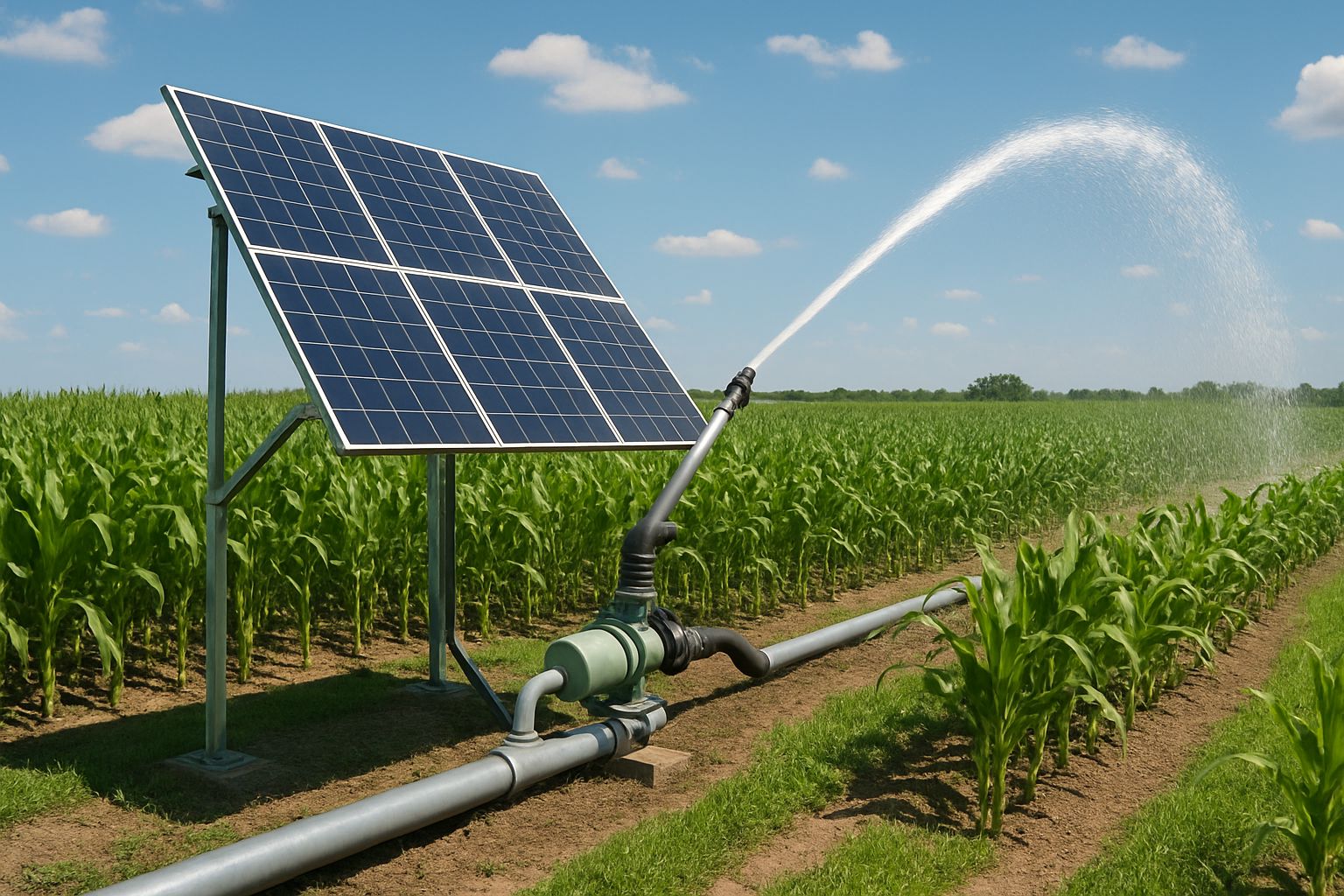
Solar-powered irrigation represents one of the most natural applications for agricultural solar, directly converting sunshine into the water delivery essential for crop production. Direct-coupled solar pumping systems can operate without batteries by pumping water during daylight hours into elevated storage tanks or reservoirs, which then provide gravity-fed irrigation during overnight periods. This approach eliminates battery costs while providing 24-hour water availability. For farms requiring precise irrigation scheduling regardless of time of day, battery-coupled systems provide complete flexibility with programmable controllers that maintain optimal soil moisture levels around the clock.
Livestock Operations and Climate Control
Climate control for livestock housing presents unique challenges and opportunities for solar implementation. Poultry houses, dairy barns, and hog facilities require consistent ventilation, heating, and cooling to maintain animal health and productivity. Solar systems for these applications must be sized for worst-case scenarios – providing sufficient cooling during summer heat waves and adequate heating during winter cold snaps. Thermal storage systems are increasingly incorporated alongside electrical storage, using excess daytime solar production to heat or cool thermal mass (often water tanks) that can then release this energy overnight, reducing battery requirements for temperature management.
Cold Storage Solutions for Harvest Preservation
Preserving harvested crops through refrigeration represents one of the most energy-intensive farm operations and a perfect application for solar power with appropriate storage. Modern solar refrigeration systems for farms employ phase-change materials and advanced insulation to maintain stable temperatures with minimal energy input. These systems often leverage the natural alignment between peak cooling needs and peak solar production during summer harvest periods. For critical cold storage applications, redundant battery systems provide backup security, ensuring temperature integrity even during extended cloudy periods.
Vacuum cooling technology powered by solar energy has emerged as a game-changer for leafy green producers, reducing cooling energy requirements by up to 60% compared to conventional refrigeration. These systems rapidly remove field heat from freshly harvested produce, extending shelf life while consuming less energy. For meat and dairy processing, solar-powered flash cooling systems provide the rapid temperature reduction needed for food safety while operating entirely off-grid.
The economic benefits of solar-powered cold storage extend beyond energy savings. By enabling on-farm preservation, these systems allow producers to extend marketing periods, access higher-value market opportunities, and reduce spoilage losses. Many small and medium-sized producers report that solar-powered cold storage facilities have enabled them to transition from commodity markets to direct-to-consumer sales channels, significantly improving profit margins.
- Lowered operating costs through eliminated electricity bills
- Enhanced product quality through consistent cooling regardless of grid conditions
- Extended marketing seasons through reliable long-term storage
- Improved food safety compliance with uninterrupted cold chains
- Reduced carbon footprint appealing to environmentally conscious consumers
Farmers considering solar-powered preservation systems should evaluate their harvest patterns, storage duration requirements, and target markets when sizing systems. Most successful implementations start with comprehensive energy monitoring of existing cooling operations, identifying both average and peak demands before designing renewable alternatives. This data-driven approach ensures systems meet actual operational needs rather than relying on generalized calculations that might result in inadequate or unnecessarily expensive installations.
Installation and Maintenance Best Practices
Proper installation and maintenance fundamentally determine the long-term success of agricultural solar systems. Unlike residential installations, farm systems must withstand harsh environmental conditions including exposure to dust, ammonia from livestock operations, and agricultural chemicals. System components should be rated for agricultural environments, with sealed enclosures for electronics and proper ventilation to prevent condensation damage. For more insights on how solar power can enhance farm operations, check out this article on solar power benefits for farmers.
Mounting systems require particular attention in agricultural settings where both surface and aerial equipment movement necessitates careful placement and adequate clearances. Ground-mount systems should maintain sufficient height for vegetation management underneath panels, while roof-mounted arrays must account for the shorter lifespan typical of agricultural buildings compared to residential structures. Proper wire management prevents damage from rodents common in farm environments, typically requiring metal conduit rather than the plastic options used in residential installations. For more insights, explore the benefits of solar power for farmers.
Working with Qualified Agricultural Solar Installers
Agricultural solar installations present unique requirements beyond those of residential or commercial projects, making installer selection particularly important. Qualified agricultural solar specialists understand farm-specific considerations including appropriate equipment placement relative to livestock areas, dust management for electronics in grain handling operations, and proper system sizing for seasonal operational variations. When evaluating potential installers, farmers should specifically request examples of previous agricultural projects, particularly those matching their specific type of operation (dairy, poultry, row crops, etc.). Reputable installers will provide detailed production projections based on farm-specific data rather than generic estimates, and will clearly explain system limitations during extended low-production periods. For those looking to cut electricity costs with solar power, understanding these nuances is crucial.
Seasonal Maintenance Schedule
Effective maintenance for farm solar systems follows the natural rhythms of agricultural operations. Spring maintenance should focus on cleaning panels of winter debris and checking for any freeze damage to mounts or wiring before peak summer production season. Summer inspections prioritize ventilation systems for electronics, ensuring components don’t overheat during maximum production periods. Fall maintenance prepares systems for winter challenges, including checking battery capacity before lower-production months and ensuring water drainage systems are clear. Winter monitoring focuses primarily on snow management and ensuring battery systems maintain appropriate temperature ranges. Most agricultural operations benefit from automated monitoring systems that provide alerts for performance issues, allowing immediate response to problems before they affect farm operations.
Troubleshooting Common System Issues
Even well-designed systems occasionally experience challenges that require troubleshooting. The most common issues in agricultural installations include battery performance problems (often related to temperature extremes), inverter faults during motor startups (particularly with well pumps and grain handling equipment), and production losses from soiling (dust, pollen, and bird droppings). Developing basic diagnostic capabilities can prevent costly service calls for simple issues. Many problems can be identified through monitoring system data, with production patterns often providing clear indicators of specific issues – whether that’s a gradual decline suggesting panel soiling or sudden drops indicating electrical faults. Creating a relationship with a service provider that offers remote diagnostic capabilities provides an excellent balance between self-sufficiency and professional support.
Conclusion: Is Off-Grid Solar Power Worth the Upfront Investment for the Farmer.
When all factors are considered, off-grid solar power represents a transformative investment for most agricultural operations. Beyond the quantifiable economic returns through eliminated utility bills and tax benefits, these systems provide critical operational resilience against increasingly unstable grid infrastructure and volatile energy markets. The ability to maintain essential farm functions during regional power outages can prevent catastrophic losses that might otherwise overwhelm the cost savings from years of operation. For remote operations where grid extension costs are prohibitive, solar often represents the only economically viable option for reliable power. As battery costs continue their dramatic decline and panel efficiencies increase, the economic case becomes increasingly compelling each year.
Future-Proofing Your Farm with Expandable Solar
Forward-thinking agricultural operations design solar systems with future expansion in mind. Modular approaches allow incremental capacity additions as farm operations grow or energy needs evolve. Initial infrastructure (mounting systems, conduit runs, and interconnection equipment) can be sized for eventual expansion, reducing the marginal cost of future additions. This approach allows farms to spread capital investments across multiple years while maintaining the flexibility to adapt to changing operational requirements or take advantage of improving technology. Many farmers report that after experiencing the benefits of their initial solar installations, they accelerate plans for system expansion beyond their original timelines.
As agriculture continues evolving toward increasingly electrified equipment and automated operations, on-farm renewable energy production will likely transition from advantageous to essential. Early adopters not only gain immediate benefits but position their operations for continued success as energy becomes an increasingly important component of agricultural competitiveness. Growing Solar Mist continues supporting farmers through this transition with specialized agricultural solar solutions designed specifically for the unique demands of modern farming operations.
Frequently Asked Questions
Agricultural solar systems generate numerous questions from farmers considering these investments. The following answers address the most common inquiries based on real-world implementation experience across diverse farm operations. These practical insights help farmers develop realistic expectations and make informed decisions about integrating solar power into their specific agricultural contexts.
How many solar panels do I need to power my entire farm?
System sizing depends entirely on your specific energy requirements, which vary dramatically across different types of agricultural operations. As a general starting point, most farms require between 25-40 kW of solar capacity per $1,000 of monthly electricity expense. Dairy operations typically need 40-60 kW systems for medium-sized operations, while poultry houses often require 25-35 kW per house depending on climate control requirements. The most accurate approach involves analyzing 12-24 months of actual electricity usage data, identifying both average and peak demands, then designing a system that addresses your specific operational patterns. Professional energy audits can identify efficiency improvements that might reduce your required system size and cost.
Can an off-grid solar system handle heavy equipment like grain dryers?
Powering high-draw equipment like grain dryers presents specific challenges but remains entirely feasible with properly designed systems. The key consideration is whether the equipment runs occasionally or continuously. For intermittent high-draw applications like grain dryers that operate seasonally, many farms find that oversizing their solar arrays and incorporating load management systems provides the most cost-effective solution. These systems can accumulate stored energy during low-usage periods, then deploy this reserve when needed for intensive operations.
For continuous high-load operations, hybrid systems incorporating both solar and other generation sources often prove most practical. Many large farms successfully implement systems where solar handles baseline operations while cleaner generator technologies (often biodiesel or propane) supplement during peak demand periods. Modern control systems seamlessly integrate these multiple sources, automatically optimizing the generation mix based on available solar resources and operational demands. To learn more about how solar power can improve farm operations, check out the solar power benefits for farmers.
What happens to excess energy my solar farm produces?
In true off-grid systems, excess energy management requires careful planning to avoid waste. During high production periods, smart systems can automatically shift flexible loads to utilize available energy – pumping water to storage tanks, pre-cooling refrigerated spaces, or charging equipment batteries. Some farms incorporate productive uses for occasional excess energy, such as hydrogen production for equipment fuel or water purification systems that operate when surplus power is available. For grid-connected farms utilizing solar primarily for economic and backup benefits, net metering programs (where available) allow selling excess production to utilities, effectively using the grid as a battery and further improving project economics.
How do I protect solar equipment from severe weather?
Agricultural solar installations can be engineered to withstand extreme weather when properly designed. For high wind areas, reinforced mounting systems with deeper foundations and additional attachment points increase structural integrity without significantly affecting costs. Hail resistance comes primarily from quality panel selection, with most premium panels rated to withstand 1-inch hailstones at terminal velocity. For severe hail regions, protective measures like temporary hail mesh (similar to that used for fruit trees) can provide additional security during forecast events. Lightning protection represents a critical consideration for exposed farm installations, requiring comprehensive grounding systems and surge protection devices at multiple points. Working with installers experienced in agricultural settings ensures these environmental factors are properly addressed during system design rather than as afterthoughts.
Are there specific solar financing options for agricultural businesses?
Agricultural operations enjoy several financing advantages not available to other businesses. USDA programs specifically target renewable energy for farms, including REAP grants covering up to 25% of project costs and guaranteed loan programs with favorable terms. Many agricultural lenders now offer specific renewable energy loan products with terms aligned to the expected system lifespan (15-25 years), significantly reducing annual payments compared to traditional equipment loans. Power Purchase Agreements (PPAs), where third parties own and maintain the system while the farm purchases the produced electricity at predetermined rates, eliminate upfront costs entirely. For operations concerned about maintenance responsibilities, lease options with service inclusion provide fixed-cost alternatives to direct ownership. The optimal financing approach depends on your farm’s tax situation, cash flow considerations, and preferences regarding system ownership and maintenance responsibilities.
Perhaps the most significant advantage of agricultural solar investments is their predictability in an industry characterized by uncertainty. While crop prices fluctuate and input costs rise unpredictably, a properly designed solar system delivers consistent financial benefits for decades. This predictability creates a stabilizing influence on overall farm economics, reducing vulnerability to factors beyond the farmer’s control.
The transition to renewable energy represents more than just a financial decision for agricultural operations. It embodies a commitment to resource stewardship and operational resilience that aligns with the fundamental values of farming. As climate challenges intensify and energy markets become increasingly volatile, on-farm energy production provides both practical benefits and peace of mind.
Solar power systems tailored to agricultural applications deliver immediate operational advantages while positioning farms for long-term success in an evolving agricultural landscape. When designed with farm-specific considerations in mind, these systems transform energy from an unpredictable expense into a managed resource that supports rather than constrains agricultural operations.
Ready to explore how solar power can transform your farm’s energy independence and sustainability? Growing Solar Mist provides specialized renewable energy solutions engineered specifically for agricultural operations.







Leave a Reply