
Key Takeaways
- Solar-powered sprinkler systems can reduce irrigation costs by up to 80% compared to grid-powered systems while providing sustainable energy for farm operations.
- Different sprinkler system types (center pivot, linear move, traveling gun, fixed set, and micro-sprinklers) serve various field sizes, shapes, and crop requirements.
- Modern solar irrigation systems can operate effectively even during cloudy periods with proper battery storage solutions.
- ROI on solar sprinkler systems typically ranges from 3-7 years, depending on system size, existing infrastructure, and available incentives.
- Growing Solar Mist offers custom solar irrigation solutions that can be integrated with existing sprinkler systems or installed as complete packages.
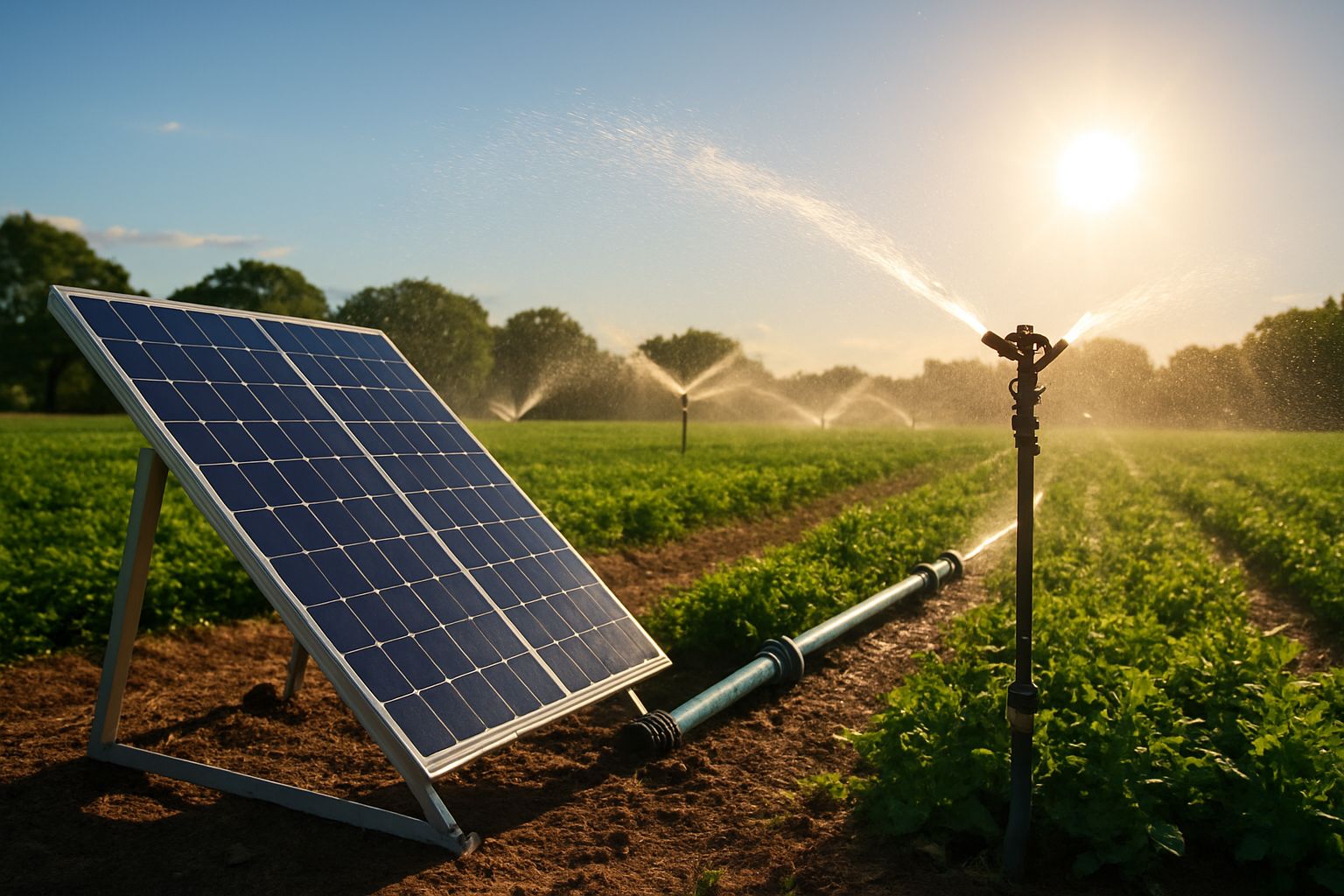
Water meets sun in a technological partnership that’s transforming modern farming. Solar-powered sprinkler irrigation combines renewable energy with efficient water delivery, creating a sustainable solution for today’s agricultural challenges.
The rising costs of electricity and diesel have pushed many farmers to seek alternatives for powering their irrigation systems. Solar power offers a compelling solution with decreasing panel costs, increased efficiency, and attractive government incentives making it more accessible than ever. Growing Solar Mist specializes in helping farmers transition to these sustainable systems, offering expertise in matching solar capacity to your specific irrigation needs while maximizing available tax credits and grants.
Understanding how these systems work together—and which configuration best suits your farm—requires examining both the irrigation components and the solar technology that powers them. Let’s explore the options available and how they might benefit your specific agricultural operation.
Why Solar-Powered Sprinkler Systems Are Transforming Farm Irrigation
The marriage between solar power and sprinkler irrigation creates a perfect synergy for modern agriculture. These systems shine brightest during summer months when irrigation needs peak—exactly when solar energy production reaches its maximum potential. This natural alignment eliminates the traditional reliance on the grid during high-demand periods when utility rates often surge.
Beyond the obvious environmental benefits, solar-powered irrigation offers remarkable financial advantages. Farmers typically see operational cost reductions of 40-80% compared to conventional power sources, with systems that can last 25+ years with minimal maintenance. The elimination of fuel transportation and storage concerns provides additional operational simplicity and safety benefits that many overlook when calculating return on investment.
Perhaps most significantly, these systems provide energy independence that protects against power outages and price volatility. In remote locations where grid connection costs can exceed $30,000 per mile, solar-powered irrigation systems often represent not just the greener choice but the only economically viable option. This independence transforms irrigation from a variable expense to a predictable, controlled aspect of farm operations.
What are the Different types of Sprinkler Irrigation Systems Farmers Use
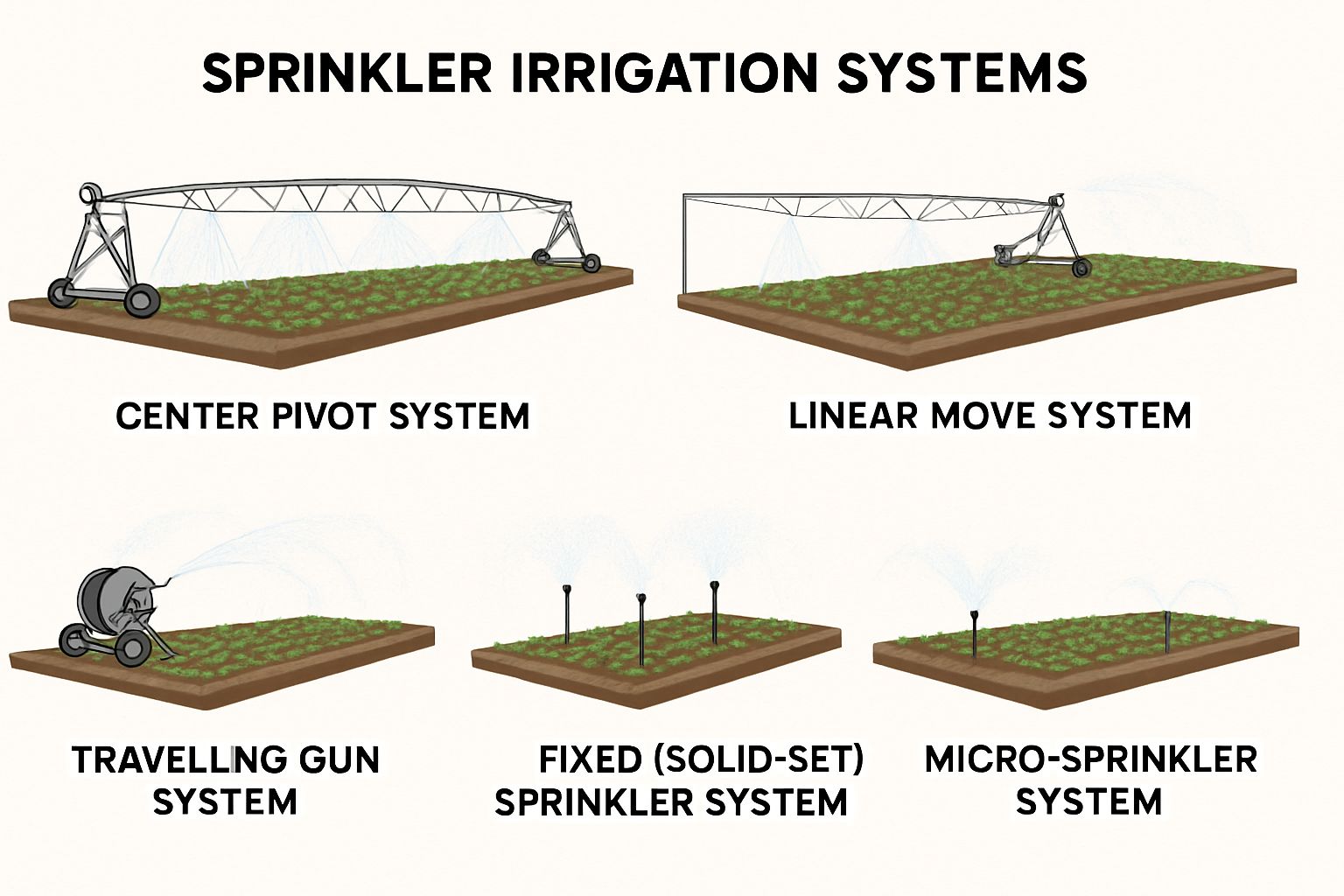
Sprinkler irrigation encompasses several distinct system types, each designed to address specific agricultural needs based on field dimensions, topography, crop requirements, and operational considerations. Understanding these differences is crucial for selecting the most efficient system for your particular situation.
From massive center pivots irrigating hundreds of acres to precise micro-sprinklers delivering targeted moisture to high-value crops, each system offers unique advantages. The ideal choice depends on factors including field size and shape, water availability, soil characteristics, and crop water requirements. For those interested in exploring different types of irrigation systems, here’s a detailed guide on solar-powered irrigation systems. What works perfectly for row crops on flat terrain may be entirely unsuitable for orchards on rolling hills.
Let’s examine the major categories to help identify which might serve your farm most effectively when powered by solar energy.
Center Pivot Systems: The Workhorse of Large-Scale Farming
Center pivot systems stand as agriculture’s irrigation giants, capable of efficiently watering circular fields ranging from 40 to 500+ acres with remarkable uniformity. These iconic rotating structures, anchored at a central pivot point, slowly traverse the field on wheeled towers while distributing water through sprinklers mounted along their length. Their popularity stems from their exceptional combination of labor efficiency and water distribution uniformity—many modern systems achieve efficiency rates exceeding 85% under optimal conditions. For farmers interested in sustainable practices, exploring solar panel investments can further enhance the efficiency and eco-friendliness of these irrigation systems.
- Coverage capacity ranges from quarter-section (40 acres) to full-section (125+ acres) with a single system
- Water application efficiency typically between 75-90%, significantly higher than flood irrigation
- Automated operation reduces labor requirements by up to 90% compared to manual irrigation methods
- Solar compatibility excellent due to predictable energy consumption patterns and central power distribution
- Adaptable to various terrain with elevation compensation technology for sloping fields
When paired with solar power, center pivots present an ideal match for sustainability-minded large-scale operations. The consistent power requirements align well with properly sized solar arrays, and the long operational life of both components ensures excellent long-term return on investment. The central power source simplifies solar integration compared to distributed irrigation systems.
How Center Pivots Transform Circular Fields
Center pivot systems create their distinctive circular irrigation patterns by rotating around a fixed central point where water and power enter the system. This design fundamentally reshapes farming practices, influencing everything from planting patterns to harvesting logistics. The circular configuration maximizes irrigation coverage within a square field, though corner systems can be added to reach those traditionally missed areas.
Modern center pivots incorporate sophisticated technology including GPS guidance, variable rate irrigation capabilities, and remote monitoring systems that allow precise water application based on specific field conditions. These smart systems can adjust water application rates as they move through different soil zones or crop varieties, maximizing efficiency while minimizing waste. When powered by solar, this technology reaches its full potential for sustainable agriculture.
Cost vs. Coverage: What to Expect
Initial investment for center pivot systems represents a significant capital expenditure, typically ranging from $50,000 to $150,000 depending on length, technology features, and terrain adaptations required. When incorporating solar power, additional investment of $25,000-$75,000 may be required for sufficient energy generation capacity, though various incentives can substantially reduce this figure. Despite these upfront costs, the exceptional longevity of both components—with proper maintenance, pivots often operate 20+ years and solar panels 25+ years—creates compelling long-term economics.
Cost vs. Coverage: What to Expect
Initial investment for center pivot systems represents a significant capital expenditure, typically ranging from $50,000 to $150,000 depending on length, technology features, and terrain adaptations required. When incorporating solar power, additional investment of $25,000-$75,000 may be required for sufficient energy generation capacity, though various incentives can substantially reduce this figure. Despite these upfront costs, the exceptional longevity of both components—with proper maintenance, pivots often operate 20+ years and solar panels 25+ years—creates compelling long-term economics.
The cost-benefit analysis improves dramatically when considering operational savings. Traditional electric or diesel-powered pivots typically cost $3,000-$7,000 annually to operate, depending on energy prices and irrigation requirements. Solar-powered alternatives eliminate most of these recurring costs, often achieving complete payback within 5-7 years while providing decades of nearly free operation thereafter. For farms in areas with high or volatile energy prices, this payback period can shrink to as little as 3-4 years.
Ideal Crops and Field Conditions
Center pivots excel with field crops including corn, soybeans, wheat, alfalfa, cotton, and potatoes, particularly on relatively flat terrain with slopes under 15%. These systems perform optimally on medium to heavy soils that can handle their typical application rates of 0.25-0.5 inches per hour without runoff concerns. The ability to apply water uniformly across large areas makes them particularly valuable for crops with consistent water requirements throughout the growing season.

Linear Move Systems for Rectangular Fields
Linear move systems, also known as lateral move irrigators, offer an alternative configuration designed specifically for rectangular fields. Unlike center pivots that rotate around a fixed point, these systems travel in straight lines across the field, typically guided by above-ground cables, buried wires, or GPS navigation. This linear movement pattern allows them to achieve nearly 100% field coverage without the corner losses associated with center pivots.
The mechanical structure resembles center pivots, using a series of connected spans supported by wheeled towers, but both ends move simultaneously rather than pivoting around a fixed point. Water supply typically comes from an open ditch parallel to the system’s movement path or from a flexible hose connected to a pressurized mainline. Solar power integration requires careful planning due to the mobile nature of the power distribution requirements.
Operation and Water Distribution Patterns
Linear systems move uniformly across fields, creating rectangular irrigation patterns that maximize water distribution efficiency in non-circular fields. Most systems travel at speeds between 1-10 feet per minute, adjustable based on desired application rates and soil infiltration capabilities. This controlled movement allows precision application ranging from light, frequent irrigation to deeper, less frequent watering cycles depending on crop requirements and soil conditions. For more insights on irrigation systems, explore selecting an irrigation system.
Water distribution uniformity represents one of the linear system’s greatest strengths, typically achieving 85-95% uniformity coefficients under proper operation. This exceptional uniformity contributes to optimized crop growth, reduced water waste, and more efficient nutrient utilization throughout the field. When powered by properly sized solar arrays with battery storage, these systems maintain their precision even during cloudy periods or extended operation.
Labor Requirements Compared to Other Systems
Linear move systems require moderately more management than center pivots, primarily due to the need for end-of-field alignment adjustments and water supply management. However, they still offer tremendous labor savings compared to hand-move pipe systems or surface irrigation methods. Modern automation features including remote operation, programmable controllers, and auto-reverse capabilities have further reduced labor demands, making solar-powered linear systems increasingly attractive for medium to large-scale operations seeking to optimize both water and workforce resources.
Traveling Gun Systems: Portable Power for Medium-Sized Farms
Traveling gun sprinkler systems offer exceptional flexibility for medium-sized operations, utilizing a large-volume sprinkler mounted on a wheeled cart that moves slowly across the field. These systems typically irrigate in lanes ranging from 100-350 feet wide and up to a quarter-mile long, making them ideal for irregular field shapes where pivot systems would be impractical. Their portability allows farmers to irrigate multiple scattered fields with a single system, maximizing equipment utilization throughout the growing season. For more information on different solar-powered irrigation systems, explore our detailed guide.
The mobile nature of traveling guns aligns well with portable solar solutions that can be transported alongside the irrigation equipment. While these systems require higher operating pressures than other sprinkler options, advances in solar pump technology have made renewable powering increasingly viable, particularly when combined with efficient pressure regulation and energy storage systems. For farms with diverse field configurations and crops with varying irrigation schedules, this combination offers remarkable operational flexibility.
Setup and Operation Basics
Traveling gun systems operate by slowly retracting a cable or hose that pulls the sprinkler cart across the field. Water is supplied through a flexible, high-pressure hose connected to a stationary supply point, with the retraction mechanism powered either by a small engine, water turbine, or electric motor. Setup involves positioning the traveler at the field’s end, extending the cable/hose across the intended irrigation path, and connecting to the water supply.
Solar integration typically focuses on powering the pumping system rather than the retraction mechanism, which requires relatively little energy compared to water pressurization needs. The intermittent operation pattern of traveling guns—often running for 8-12 hours before requiring repositioning—creates ideal conditions for solar-powered systems with battery storage, allowing energy harvesting during daylight hours to support extended operation into evening periods.
Water Pressure Requirements
Traveling gun systems demand significantly higher operating pressures than other sprinkler options, typically requiring 70-100 PSI at the gun to achieve proper droplet formation and coverage patterns. This high pressure requirement has traditionally limited their compatibility with solar power, as pressure generation represents the most energy-intensive aspect of irrigation. However, innovations including variable frequency drives, efficient pump designs, and pressure-maintaining valves have substantially improved energy efficiency. For more information, explore the possibilities of powering sprinkler irrigation systems with solar panels.
When designing solar power systems for traveling guns, oversizing the array by 15-20% compared to calculated requirements provides crucial buffer capacity during periods of reduced sunlight or increased demand. Battery storage sized to provide 4-6 hours of operation ensures consistent performance during cloud cover or evening irrigation sessions. These design considerations ensure reliable operation while maintaining the flexibility that makes traveling guns attractive to diversified farming operations. For more insights, explore the investment potential of solar panels for farmers.
Best Applications and Limitations
Traveling gun systems excel in situations requiring irrigation flexibility across diverse field shapes, sizes, and crop types. They prove particularly valuable for operations growing high-value specialty crops with staggered planting and harvesting schedules, as a single system can serve multiple fields throughout the season. Their application versatility also makes them ideal for supplemental irrigation during critical growth stages or drought conditions, providing targeted moisture precisely where needed. For more information on different types of irrigation systems, you can explore irrigation system selection.
The primary limitations include lower water application efficiency (typically 65-75% compared to 80-90% for pivot systems), higher labor requirements for repositioning, and greater energy demands due to high operating pressures. These factors must be carefully balanced against the flexibility advantages when considering solar powering options. For farms with sufficient solar capacity and proper system matching, the operational benefits often outweigh these limitations, particularly when factoring in the ability to irrigate otherwise difficult field configurations.
Fixed and Solid-Set Sprinkler Systems
Fixed and solid-set sprinkler systems provide permanent or semi-permanent irrigation solutions ideal for specialty crops, smaller fields, and areas where terrain limitations prevent mechanized systems. These configurations feature a network of pipes and risers permanently installed throughout the field, eliminating the need for movement during the growing season. For high-value crops like orchards, vineyards, and berries, the precision and reliability of fixed systems often justify their higher initial installation costs. To further enhance efficiency, farmers can explore solar panel investments to power these irrigation systems sustainably.
The stationary nature of these systems creates perfect alignment with solar power integration, as energy needs remain consistent and predictable. With no moving components requiring power, the entire solar capacity can focus on pump operation. This simplified power delivery system reduces complexity and maintenance requirements while maximizing efficiency.
Permanent vs. Portable Installations
Permanent solid-set systems feature underground mainlines with fixed risers and sprinklers positioned strategically throughout the field. This configuration provides exceptional convenience, as the entire system remains in place year after year with minimal seasonal preparation. The upfront installation cost runs significantly higher ($1,500-3,000 per acre) but delivers lower long-term labor requirements and greater durability, with well-maintained systems often lasting 15-20 years.
Portable solid-set alternatives utilize above-ground aluminum or PVC pipe that workers position at season start and may relocate between fields as needed. While requiring more labor for setup and takedown, these systems offer greater flexibility at approximately half the installation cost of permanent configurations. For diversified farms with rotating crop patterns or multiple small fields, this portability creates valuable operational flexibility while still providing excellent solar compatibility.
Ideal Uses for Orchards and Specialty Crops
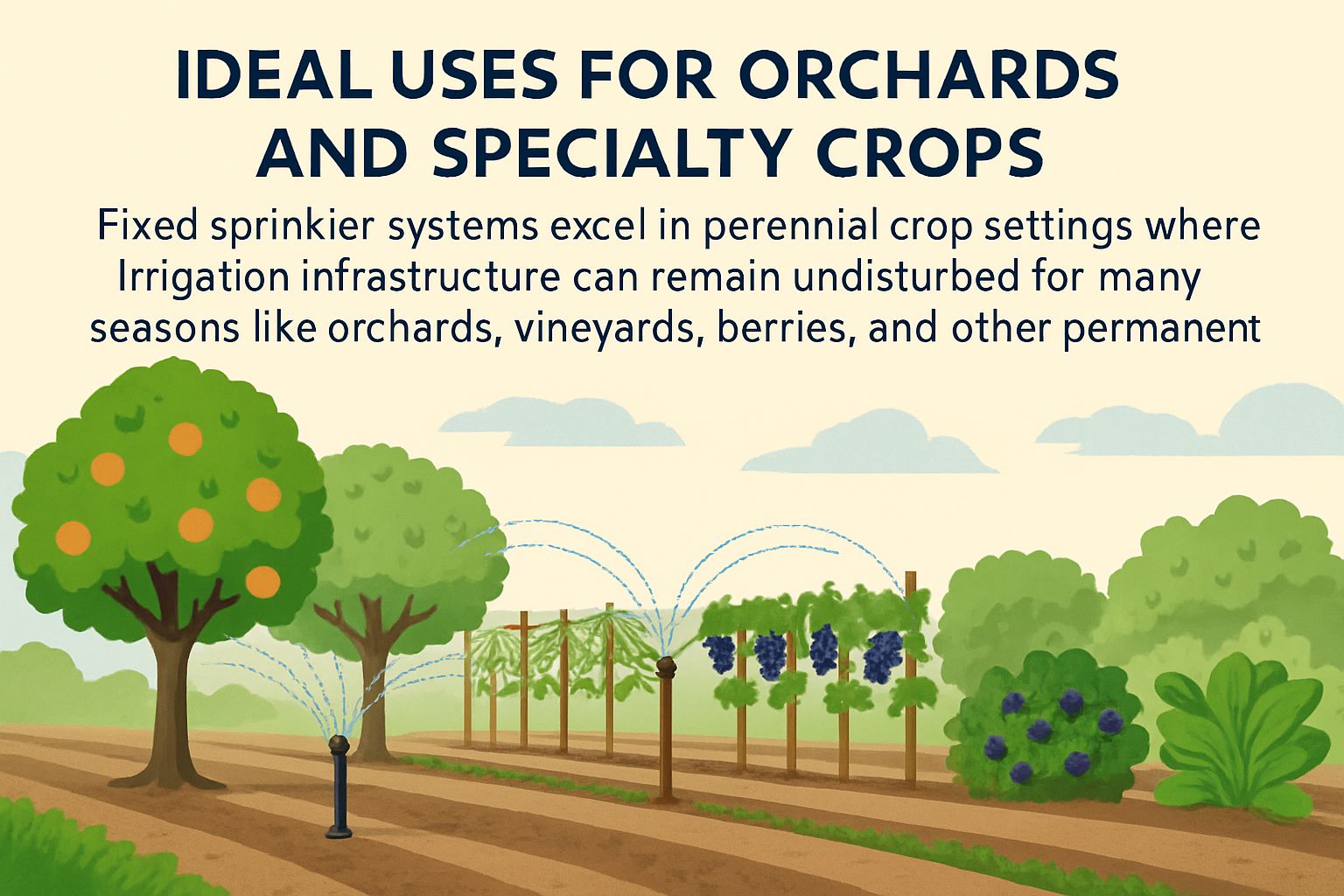
Fixed sprinkler systems excel in perennial crop settings where irrigation infrastructure can remain undisturbed for many seasons. Orchards, vineyards, berries, and other permanent plantings benefit from the precise placement of sprinklers that can be customized to the specific spacing and water requirements of each crop variety. The ability to design application patterns that maximize uniformity while minimizing trunk wetting or foliar disease risk creates significant advantages for high-value specialty crops.
For frost protection applications, solid-set systems provide unmatched capabilities, as they can be activated immediately when temperature thresholds are reached. This protective function alone often justifies the investment for crops susceptible to spring frost damage. When paired with properly sized solar arrays and battery storage, these systems ensure frost protection remains available even during utility outages—a crucial advantage during critical weather events.
Maintenance Considerations
Fixed sprinkler systems typically require more comprehensive winterization procedures than mechanized alternatives, particularly in regions with freezing temperatures. Thorough drainage, compressed air blowout of lines, and protection of above-ground components demand careful attention to prevent costly freeze damage. However, routine seasonal maintenance generally requires less time and expertise than the mechanical servicing needed for pivot or linear systems.
The primary maintenance challenge involves individual sprinkler head inspection and replacement, as system performance depends on consistent operation across all outlets. Regular inspection for clogging, wear, or misalignment ensures uniform water distribution and prevents localized stress. The distributed nature of these systems necessitates methodical inspection protocols to maintain efficiency, though modern pressure monitoring technology can now alert operators to potential issues before crop stress occurs.
Micro-Sprinkler Systems for Precision Application
Micro-sprinkler systems represent the pinnacle of water-efficient sprinkler technology, delivering precisely controlled, low-volume irrigation directly to the plant root zone. Operating at lower pressures (15-30 PSI) than conventional sprinklers, these systems require significantly less energy—making them ideal candidates for solar power applications. Their precise application patterns minimize water loss from evaporation, wind drift, and overspray while maximizing absorption efficiency.
The energy efficiency of micro-sprinklers creates perfect synergy with solar power systems, often reducing pump size requirements by 30-50% compared to conventional sprinklers. This reduction translates directly to smaller solar arrays and lower system costs while maintaining irrigation capacity. For operations prioritizing both water and energy conservation, this combination offers compelling advantages. To explore more about this, visit our guide on solar-powered sprinkler irrigation systems.
Water Conservation Benefits
Micro-sprinkler systems typically achieve application efficiencies of 80-95%, substantially outperforming conventional overhead irrigation in water utilization. By delivering water directly to the root zone at rates matched to soil infiltration capabilities, these systems virtually eliminate runoff while minimizing evaporation losses. This precision can reduce water consumption by 30-50% compared to traditional methods—a crucial advantage in regions facing water restrictions or high irrigation costs.
Beyond quantity reductions, micro-sprinklers improve water quality protection by minimizing leaching of nutrients and agricultural chemicals beyond the root zone. The controlled application rates prevent deep percolation that can transport soluble materials to groundwater, creating environmental benefits that increasingly factor into regulatory compliance and sustainability certification programs. When powered by solar energy, these systems represent truly sustainable irrigation technology with minimal resource footprint.
Crop-Specific Advantages
For tree crops, berries, and vegetables, micro-sprinklers provide significant advantages through targeted moisture delivery that maintains ideal soil conditions without excessive canopy wetting. This focused application reduces disease pressure, improves fruit quality, and allows irrigation during harvesting operations without interfering with field activities. The flexibility to adjust individual emitter flow rates creates opportunities for precision management based on specific plant requirements or soil variations within fields.
In greenhouse and nursery applications, micro-sprinklers paired with solar power create self-contained irrigation systems requiring no external utility connections. This independence enables production in remote locations while ensuring consistent, automatic irrigation even during power outages. The controlled application pattern also reduces humidity levels compared to overhead irrigation, creating healthier growing environments for sensitive crops.

Water Quality Considerations for Sprinkler Systems
Water quality fundamentally impacts the performance, maintenance requirements, and longevity of sprinkler irrigation systems. Minerals, particulates, organic material, and chemical characteristics all influence system selection and operation. Understanding these impacts helps prevent costly equipment failures while ensuring optimal irrigation effectiveness.
For solar-powered systems, water quality takes on additional importance as maintenance access may be limited in remote installations. Proactive filtration and treatment become essential components of system design rather than optional additions. Investing in appropriate water quality management typically returns dividends through extended equipment life, reduced maintenance, and more consistent performance.
Dealing with Hard Water and Mineral Buildup
High mineral content water, particularly with elevated calcium, magnesium, or iron levels, can create significant challenges for sprinkler systems through scale formation in pipes, emitter clogging, and efficiency reduction. These minerals gradually accumulate within the system, restricting flow and eventually requiring chemical cleaning or component replacement. For solar applications, these restrictions increase pressure requirements and energy consumption, potentially exceeding system capacity during peak demand.
Preventive strategies include water treatment systems ranging from simple injection of acid or sequestering agents to more sophisticated water conditioning equipment. Regular system flushing, particularly at season end, removes accumulated materials before they solidify during dormant periods. For systems with known hard water challenges, component selection should prioritize clog-resistant designs even when they carry premium pricing—the long-term operational benefits typically justify the additional investment.
Filtration Requirements
Effective filtration represents the foundation of reliable sprinkler system operation, particularly for micro-sprinkler applications with small emission orifices. Filtration requirements vary based on water source and sprinkler type, with surface water generally requiring more extensive treatment than well water. Most systems benefit from multi-stage filtration that combines coarse debris removal with finer particulate filtering appropriate to the smallest system orifice.
Self-cleaning filters provide significant advantages for solar-powered systems by reducing maintenance requirements and preventing pressure increases associated with filter clogging. While carrying higher initial costs, these automated systems ensure consistent performance with minimal oversight—crucial for remote installations. Proper sizing remains essential, as undersized filters create frequent cleaning cycles and potential irrigation interruption.
Picking the Correct Solar Panels to Pair up with the Irrigation System You Have
Selecting the appropriate solar technology for your irrigation needs requires balancing multiple factors including energy requirements, available space, budget constraints, and environmental conditions. The ideal configuration varies significantly based on your specific sprinkler system type, pumping requirements, and operational patterns. Proper matching ensures sufficient power generation while maximizing return on investment. For more information on powering your irrigation system, check out this guide on powering a sprinkler irrigation system with solar panels.
Begin by calculating your irrigation system’s precise energy requirements, measuring both peak demand (kilowatts) and total consumption (kilowatt-hours) during typical operation. This assessment should account for seasonal variations and any planned system expansions. With these figures established, you can evaluate panel options that deliver appropriate capacity within your space and budget constraints.
Here is a comparison table of the four best solar panel types for agricultural use — focusing on features, efficiency, and suitability for farms.
|
Solar Panel Type |
Efficiency Range |
Cost per Watt (Approx.) |
Key Advantages for Agriculture |
Limitations |
Best Farm Applications |
|---|---|---|---|---|---|
|
Monocrystalline Panels |
17–22% 1 |
$0.90–$1.50 2 |
High efficiency, compact design, long lifespan, performs well in all climates |
Higher upfront cost |
Space-limited farms, rooftops, and irrigation systems 1 |
|
Polycrystalline Panels |
13–17% 3 |
$0.70–$1.00 3 |
Lower cost, durable, long lifespan, strong in direct sunlight |
Requires more space, less efficient in cloudy conditions | |
|
Thin-Film Panels |
10–13% 5 |
$0.50–$0.90 2 |
Lightweight, flexible, better low-light/shaded performance |
Lower efficiency, shorter lifespan |
Greenhouses, barns, shaded or irregular terrain 5 |
|
Bifacial Panels |
increase energy production by 5-30% compared to traditional single-sided panels. 6 |
$1.00–$1.60 6 |
Captures light from both sides, high energy yield, great for reflective surfaces like grass or soil |
Higher cost, more complex installation |
Agrivoltaics (dual-use with crops), open-field installations 6 |
1. Monocrystalline Panels: High-Efficiency Option for Limited Space
Monocrystalline solar panels offer the highest efficiency rates (17-22%) and space utilization, making them ideal for installations with limited mounting area or higher energy demands. These premium panels utilize single-crystal silicon that enables superior electron flow and energy conversion, typically generating 10-15% more power per square foot than polycrystalline alternatives. For irrigation systems requiring substantial energy—particularly center pivots and large pumping stations—this density advantage often justifies the 15-25% price premium over other technologies.
2. Polycrystalline Panels: Budget-Friendly for Large Farm Installations
Polycrystalline panels balance efficiency (13-17%) with significantly lower production costs, creating excellent value for agricultural applications where space constraints are minimal. These panels utilize silicon fragments melted together, producing the distinctive blue, multifaceted appearance and good performance at approximately 20-30% lower cost than monocrystalline options. For large-scale irrigation installations where mounting area isn’t limited, the greater cost-efficiency often delivers better overall return despite requiring about 15-20% more surface area for equivalent output.
Farmer Case Study: Walker Family Farms
After calculating their 40HP irrigation pump consumed approximately 30kWh daily during peak season, the Walker family installed a 20kW polycrystalline system covering 1,500 square feet of ground-mounted array. The system cost $42,000 before incentives, compared to $51,000 for an equivalent monocrystalline setup. With federal tax credits reducing net cost to $31,000, the system achieved complete payback in 5.2 years and has operated maintenance-free for over a decade, saving approximately $8,500 annually in electricity costs.
When evaluating polycrystalline options for irrigation, prioritize panels with enhanced performance in high-temperature environments, as agricultural installations frequently operate during the hottest weather periods. Look for panels with temperature coefficients of -0.35%/°C or better to minimize production losses during peak summer conditions. This specification proves particularly important for southern regions where panel temperatures regularly exceed 140°F during irrigation season.
Most irrigation installations utilize ground-mounted configurations that simplify maintenance access while allowing optimized panel orientation. These mounting systems add approximately $0.20-0.40 per watt to system costs but provide superior cooling and accessibility compared to roof installations. For polycrystalline systems in particular, the improved airflow from ground mounting can offset much of the efficiency differential with monocrystalline alternatives.
Budget-conscious farms should also explore the emerging market for high-quality used or refurbished polycrystalline panels, which often provide 80-90% of original output at 40-60% of new panel pricing. While requiring careful inspection and output verification, these alternatives can create compelling economics for irrigation projects, often reducing payback periods below three years for suitable applications.
3. Thin-Film Panels: Flexible Solution for Greenhouse Integration
Thin-film solar technology offers unique advantages for specialized agricultural applications despite lower efficiency rates (10-13%). These lightweight, flexible panels can integrate into structures like greenhouse roofing or shade cloth systems, providing dual functionality without requiring dedicated mounting space. Though requiring approximately twice the surface area of crystalline panels for equivalent output, their ability to utilize non-traditional mounting surfaces and perform better under partial shading creates niche applications in agricultural settings, particularly for low-pressure irrigation systems like drip or micro-sprinklers.
4. Bifacial Panels: Maximize Energy Harvest with Dual-Sided Production
Bifacial panels represent the newest mainstream solar technology, capturing light on both front and rear surfaces to increase energy production by 5-30% compared to traditional single-sided panels. This design proves particularly valuable for agricultural applications where ground reflection from light-colored soil, snow cover, or reflective ground covers can significantly boost energy harvest. Though commanding a 10-15% price premium over standard monocrystalline panels, the production advantage often delivers superior economics for irrigation applications that operate during peak growing seasons when day length and light conditions maximize bifacial advantages.
For large-scale irrigation with predictable seasonal operation patterns, bifacial technology paired with single-axis tracking systems creates the optimal combination of production density and cost-effectiveness. This configuration typically increases annual energy yield by 25-35% compared to fixed installations, often reducing required panel capacity and system footprint by similar percentages. Though adding complexity and approximately 15-20% to initial system costs, tracking configurations typically achieve payback within 3-5 years while extending the daily operating window for irrigation equipment.
Making the Switch: Is it a Good Investment for a Farmer to Use a Solar-Powered Sprinkler Systems
The economic case for solar-powered sprinkler irrigation continues strengthening as panel prices decline, energy costs rise, and incentive programs expand. Most properly designed agricultural solar systems now achieve full financial payback within 4-8 years while providing operational benefits for 25+ years. This compelling return, combined with protection from future energy price volatility, makes solar irrigation increasingly attractive even for operations with limited capital resources.
|
System Size |
Approximate Cost |
Typical Payback Period |
25-Year ROI |
|---|---|---|---|
|
Small (5-10kW) |
$15,000-$30,000 |
5-7 years |
300-450% |
|
Medium (11-30kW) |
$33,000-$85,000 |
4-6 years |
400-550% |
|
Large (31-75kW) |
$88,000-$190,000 |
3-5 years |
500-650% |
|
Commercial (76kW+) |
$195,000+ |
3-4 years |
600-750% |
Beyond pure economics, solar-powered irrigation provides significant operational advantages including immunity from power outages, elimination of fuel delivery logistics for remote fields, and reduced maintenance compared to engine-driven alternatives. These benefits prove particularly valuable during critical irrigation periods when system reliability directly impacts crop yield and quality. The ability to operate independently during grid failures or energy shortages provides insurance value that, while difficult to quantify, represents meaningful risk reduction for weather-sensitive operations.
When evaluating potential solar transitions, consider starting with a partial system that addresses your most consistent irrigation requirements while leaving flexibility for future expansion. This approach minimizes initial capital requirements while providing immediate operational benefits and experience with the technology. Many farmers find that beginning with 30-50% of total irrigation demand proves optimal, allowing system familiarity before larger investments while immediately reducing operating costs.
Frequently Asked Questions
The transition to solar-powered irrigation naturally raises questions about system performance, economics, and practical implementation. Addressing these common concerns provides clarity for farmers considering this technology for their operations. The answers below reflect real-world experience rather than theoretical projections, based on data from hundreds of agricultural installations across diverse growing regions.
Most implementation challenges relate to system sizing rather than technology limitations. Proper matching between irrigation requirements and solar capacity proves essential for successful operation, highlighting the importance of working with agricultural specialists rather than general solar installers who may lack understanding of seasonal irrigation patterns and agricultural priorities.
How much water can I save with sprinkler irrigation compared to flood irrigation?
Converting from traditional flood irrigation to well-designed sprinkler systems typically reduces water consumption by 30-60% while improving distribution uniformity and crop response. Center pivot and linear systems generally achieve 40-50% water savings, while micro-sprinkler configurations can reach 60-70% reductions for appropriate crops. These efficiency gains directly reduce pumping requirements and solar capacity needs, creating multiple layers of resource conservation and cost reduction.
How long do solar panels for irrigation systems typically last?
Quality solar panels maintain at least 80% of their original production capacity for 25-30 years, with many systems continuing to perform at 70-75% efficiency for 35+ years. Most manufacturers guarantee 80-83% production at the 25-year mark, with degradation curves showing most significant decline in the first few years followed by very gradual reduction thereafter. The solid-state nature of solar technology, with no moving parts in the panels themselves, contributes to this exceptional longevity and reliability—particularly important for agricultural applications where equipment durability directly impacts operational continuity.
Can sprinkler systems work with all soil types?
While sprinkler irrigation can function on most soils, system selection should align with specific soil characteristics to maximize efficiency and prevent problems. Sandy soils benefit from frequent, lighter applications delivered by systems with flexible scheduling capabilities, while clay soils require slower application rates to prevent runoff and compaction. Soil infiltration rates should dictate sprinkler selection, application intensity, and irrigation scheduling to achieve optimal performance. For farmers interested in sustainable energy solutions, exploring solar panel investments could complement their irrigation strategies.
For challenging soils with very low infiltration rates, micro-sprinklers offer significant advantages by delivering water at rates as low as 0.05 inches per hour—well below the infiltration capacity of even heavy clay soils. On extremely sandy soils with high infiltration but poor retention, irrigation scheduling becomes particularly crucial, with systems that can deliver multiple short cycles often proving most effective at maintaining consistent moisture within the root zone.
Modern sprinkler technologies including variable rate irrigation and pulsing nozzles have substantially expanded the range of soils that can be effectively irrigated, allowing customized application patterns within single fields to address soil variations. These technologies pair particularly well with solar power systems that can adjust operating parameters based on real-time soil moisture data and weather conditions.
How do I calculate the return on investment for a new solar sprinkler system?
Calculating ROI requires comparing total system costs (after incentives) against annual operational savings and production benefits. Begin by determining current irrigation energy costs, including electricity, fuel, and maintenance for existing systems. Next, obtain detailed quotes for appropriately sized solar alternatives that include installation, electrical integration, and monitoring systems. Subtract available incentives including federal tax credits (currently 30%), USDA REAP grants (up to 50% of system costs for qualifying farms), and state/utility rebates from the gross system price to determine net investment.
Divide this net investment by annual operational savings to calculate simple payback period in years. For more sophisticated analysis, incorporate the time value of money using discounted cash flow calculations with appropriate interest rates. Most agricultural operations use 5-7% discount rates for these calculations, reflecting typical capital costs. The resulting net present value (NPV) and internal rate of return (IRR) provide comprehensive evaluation of solar irrigation investments compared to alternatives.
ROI Calculation Example:
A 25kW solar system powers a 20HP pump operating 1,000 hours annually
System cost: $75,000
Federal tax credit (30%): -$22,500
State rebate: -$5,000
Net investment: $47,500Annual electricity savings: $8,500
Maintenance reduction: $750
Total annual savings: $9,250Simple payback: 5.1 years ($47,500 ÷ $9,250)
25-year ROI: 388% (($47,500 × 4.88) ÷ $47,500)
For comprehensive evaluation, also consider increased crop quality, yield improvements from more consistent irrigation, and operational benefits including reduced downtime and extended irrigation hours during peak seasons. While more difficult to quantify precisely, these factors often add 10-20% to the direct energy savings value, further enhancing solar irrigation economics.
Can existing irrigation systems be retrofitted with solar power?
Most existing sprinkler systems can be successfully retrofitted with solar power without requiring replacement of functional irrigation components. The retrofit process typically focuses on the power supply to pumping equipment, either by direct solar connection with appropriate controls or through grid-tied systems that offset electricity consumption. Direct-drive solar retrofits work particularly well for systems with consistent daytime operation patterns and flexible scheduling options, while grid-tied approaches prove advantageous when irrigation timing requires night operation or cannot be adjusted to match solar production patterns.
The retrofit process typically begins with energy audit and load analysis to determine system requirements, followed by solar design matched to available space and budget constraints. Equipment modifications may include pump controller replacement to accommodate variable power input, installation of soft starters to manage inrush current, or addition of battery storage for operations requiring consistent pressure regardless of solar conditions. These modifications typically add 10-25% to basic solar installation costs but ensure compatible operation with existing irrigation infrastructure.
For optimal retrofit results, consider combining solar installation with irrigation efficiency improvements including pressure regulation, sprinkler package updates, and leak repairs. These complementary modifications often reduce energy requirements by 15-30%, allowing smaller solar installations while improving overall system performance. Growing Solar Mist specializes in these integrated approaches that maximize return on investment while extending equipment life and improving operational reliability.
Solar-powered sprinkler irrigation systems have become increasingly popular among farmers due to their sustainability and cost-effectiveness. These systems harness solar energy to power the irrigation process, reducing reliance on traditional energy sources and lowering operational costs. There are various types of solar-powered irrigation systems available, each designed to meet specific agricultural needs. For more information on the different types of solar-powered irrigation systems, farmers can explore options that best suit their requirements and environmental conditions.

Leave a Reply