

Article-At-A-Glance
- Solar panels can reduce farm operating costs by 30-100% while providing tax benefits and energy independence
- USDA’s Rural Energy for America Program (REAP) offers grants covering up to 25% of installation costs
- Modern agricultural solar systems typically achieve ROI within 5-10 years while lasting 25+ years
- Dual-use farming allows crops to grow beneath panels, maximizing land productivity
- Paradise Solar Energy helps farmers navigate funding options and design systems optimized for agricultural operations
For farmers facing volatile crop prices and rising energy costs, solar power offers a pathway to financial stability. Farm operations consume significant electricity for irrigation, climate control, and equipment—making energy one of the largest controllable expenses. Converting this unavoidable cost into an investment opportunity is why thousands of agricultural producers are turning to solar energy.
Solar panels provide farmers with predictable energy costs in an industry where little else is predictable. Weather patterns change, market prices fluctuate, but solar production remains remarkably consistent year after year. This reliability creates a financial foundation that helps operations weather the inevitable ups and downs of agricultural markets.
Paradise Solar Energy specializes in designing systems that address the unique needs of agricultural operations, helping farmers transform energy from an expense into an asset. Our team understands both renewable energy technology and agricultural operations, ensuring solutions that enhance rather than complicate farm management.
Why Solar Panels Make Financial Sense for Farmers
The economics of solar power for agriculture have never been more favorable. Installation costs have dropped over 70% in the past decade while efficiency continues to improve. Meanwhile, conventional electricity rates continue their steady climb, widening the gap between traditional energy costs and solar-generated power. For operations with high daytime electricity usage like dairy farms, poultry houses, and irrigated crops, the financial case is particularly compelling.
Agricultural operations benefit from solar power in ways urban installations cannot match. Farms typically have ample space for optimally positioned arrays, whether on underutilized land, equipment shed rooftops, or even floating on irrigation ponds. This flexibility allows for ideal system sizing rather than being constrained by limited space.
The tax benefits for farmers installing solar extend beyond the federal Investment Tax Credit. Accelerated depreciation schedules, property tax exemptions in many states, and business energy incentives create a powerful financial package that can offset a significant portion of installation costs.
“After installing our 75kW system, our dairy operation’s electricity bill dropped from $2,500 monthly to under $300. The system paid for itself in just over six years, and we’re now entering our ninth year of essentially free power generation.” – James Carpenter, Sunrise Dairy Farm
Steady Energy Cost Savings vs. Rising Utility Bills
The most immediate benefit farmers experience after installing solar is the dramatic reduction in monthly utility bills. Agricultural operations typically see 30-100% reductions in electricity costs, depending on system size and energy consumption patterns. This cost stability is particularly valuable for operations with seasonal production cycles, as it helps smooth out cash flow throughout the year.
Government Incentives Slash Installation Costs
The USDA’s Rural Energy for America Program (REAP) offers grants covering up to 25% of solar installation costs for agricultural producers. Combined with the federal Investment Tax Credit currently at 30%, these incentives can reduce initial costs by over half. Many states offer additional incentives specifically for agricultural solar installations, creating a powerful financial package.
Applying for these programs requires navigating complex paperwork and meeting specific deadlines. The application windows for REAP funding open twice yearly, with the next deadline approaching on March 31st. Successful applications require detailed energy audits, financial projections, and technical specifications that demonstrate both financial need and project viability.
While the application process can seem daunting, the financial rewards make it worthwhile. A 100kW system that might cost $200,000 before incentives could potentially receive $50,000 in REAP grants and $60,000 in tax credits, reducing the farmer’s out-of-pocket cost to $90,000. With annual electricity savings of $15,000-20,000, the payback period shrinks dramatically.
Beyond federal programs, most states offer additional incentives that can further improve project economics. These range from property tax exemptions to performance-based incentives that pay for each kilowatt-hour produced. Some utilities also offer agricultural-specific solar rebates to encourage renewable adoption in rural areas.
- USDA REAP grants: Up to 25% of project costs
- Federal Investment Tax Credit: 30% of installation costs
- Accelerated depreciation: Allows writing off the system value over 5-7 years
- State-specific incentives: Vary by location but often include rebates and tax exemptions
- Utility rebates: Available in many service territories
Diversified Income Through Energy Production
For many farmers, solar panels represent more than just savings—they create a new revenue stream. Through net metering agreements, excess power generated during peak production periods earns credits that offset consumption during other times. In some states, farmers can participate in community solar programs, selling subscriptions to their solar production to neighbors who cannot install their own systems.
This energy income provides crucial diversification that helps buffer against agricultural market volatility. Unlike crop insurance that only pays during disasters, solar production generates revenue regardless of growing conditions. During drought years when irrigation costs typically spike, the value of solar energy increases proportionally.
Some forward-thinking farmers have begun integrating solar into their brand identity, marketing their products as “solar-grown” to environmentally conscious consumers. This premium positioning can increase product value while strengthening customer loyalty. The stability of energy income allows for more confident planning and investment in other aspects of the agricultural operation. For more information on solar panel types for farms, you can explore different options that suit agricultural needs.
The following table summarizes why solar panels make financial sense for agricultural operations, with each reason supported by recent sources:
|
Reason |
Description |
Citation |
|---|---|---|
|
Lower Energy Costs |
Generates electricity onsite, cuts reliance on the grid, and saves on monthly power bills. | |
|
Stable Long-Term Energy Prices |
Shields farmers from rising and unpredictable energy costs, aiding accurate budgeting. | |
|
Energy Independence |
Enables farms to operate regardless of grid outages, ensuring uninterrupted farm operations. | |
|
Additional Revenue Streams |
Surplus power can be sold via net metering, earning extra income and lowering payback period. | |
|
Government Incentives |
Tax credits and grants can cover a significant portion of installation costs. |
3 |
|
Improved Farm Efficiency |
Solar power can be used for water pumps, ventilation, and other farm systems, enhancing output. | |
|
Environmental Benefits |
Reduces carbon footprint and reliance on fossil fuels, supporting sustainable farming. | |
|
Dual Land Use & Crop Benefits |
Solar installations with crops (agrivoltaics) can improve yields and land utilization. | |
|
Boosts Property Value |
Solar-equipped farms may increase in value due to energy savings and asset productivity. |
6 |
|
Diverse Revenue in Uncertain Years |
Provides farmers with financial cushioning during poor crop yields by generating energy income. |
Solar panels, therefore, help farmers save money, create new income opportunities, stabilize operating costs, and future-proof their businesses while meeting sustainability goals.
How Much Land Do Solar Panels Really Need?
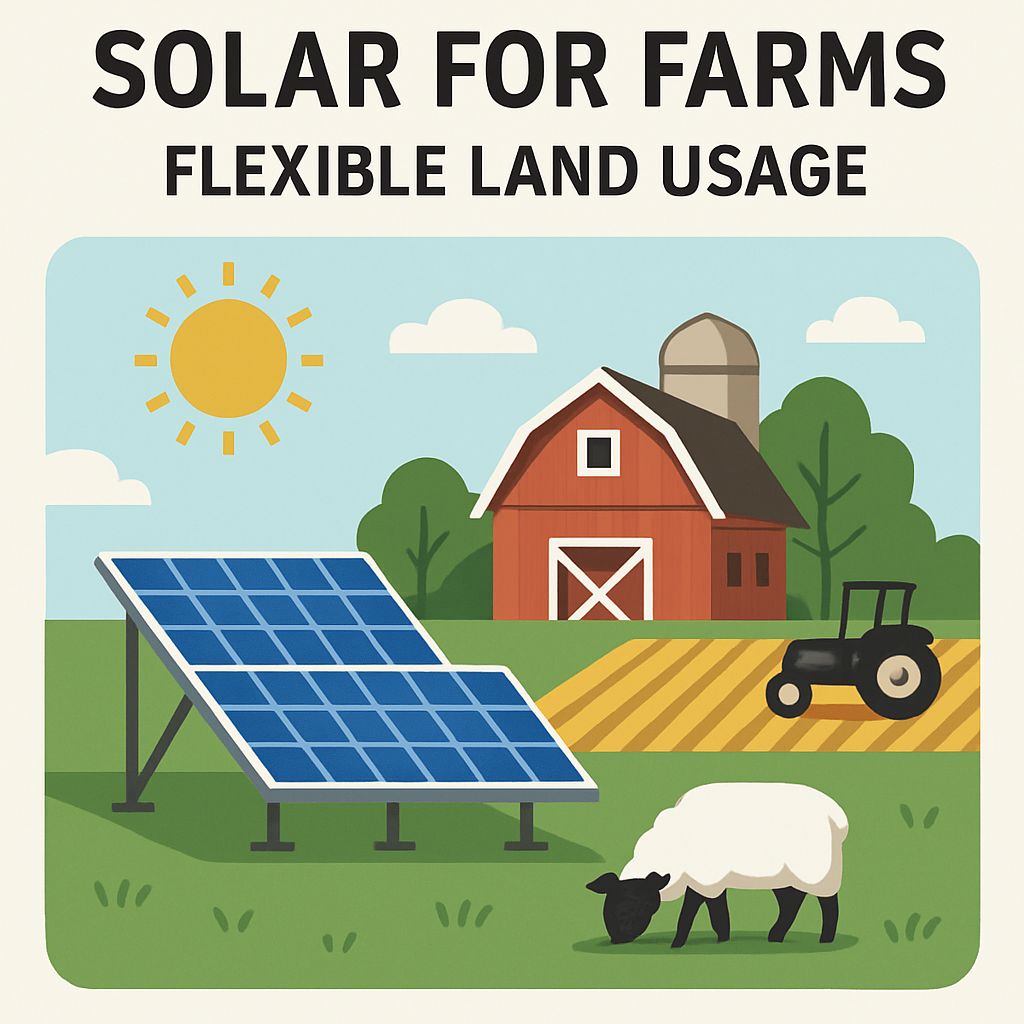
One of the primary concerns for farmers considering solar is land usage. The good news is that modern solar installations are remarkably flexible in their deployment options. A typical 100kW system—enough to power many medium-sized farm operations—requires approximately 5,000-7,000 square feet of space. This represents less than a quarter of an acre, a small fraction of most agricultural properties.
Space Requirements for Farm-Scale Systems
The space needed for solar installations scales linearly with system capacity. Commercial agricultural systems typically range from 10kW for small operations to 1MW or larger for extensive farming enterprises. A 10kW system requires roughly 600-800 square feet, while a 500kW system needs about 2.5-3 acres. System design and panel efficiency play significant roles in determining the final footprint, with high-efficiency panels requiring less space for the same energy output.
Modern tracking systems that follow the sun throughout the day can increase energy production by 20-30% compared to fixed installations, potentially reducing land requirements. However, these systems require greater spacing between rows to prevent self-shading, which can partially offset their space efficiency benefits. The decision between fixed and tracking systems depends on available space, budget considerations, and specific energy production goals.
When calculating space requirements, it’s also important to consider access paths for maintenance, electrical equipment placement, and any setback requirements from property lines. A comprehensive site plan should account for these factors to avoid surprises during installation.
Strategic Placement Options: Rooftops vs. Field Installation
Many farms have substantial roof space on barns, equipment sheds, and other structures that can host solar arrays without sacrificing any ground space. Roof mounting eliminates concerns about land use competition while potentially reducing installation costs since ground preparation and mounting structures are simplified. Most agricultural buildings constructed in the past 20 years can support the additional weight of solar panels with minimal reinforcement.
For ground-mounted systems, strategic placement can minimize impact on productive land. Areas unsuitable for cultivation—such as rocky outcroppings, drainage swales, or buffer zones along property lines—can become productive energy-generating spaces. Some farmers opt to place solar arrays on pasture land, maintaining grazing underneath with appropriate panel height and spacing.
Innovative approaches include solar carports over equipment parking areas and elevated systems above farm ponds. These dual-use applications maximize space utility while providing additional benefits like equipment weather protection or reduced water evaporation.
Dual-Use Farming: Growing Crops Under Solar Panels
A growing trend in agricultural solar is agrivoltaics—the practice of growing crops beneath partially shaded solar arrays. Research from multiple universities has demonstrated that certain crops, particularly leafy greens, berries, and some vine crops, can thrive in the dappled light conditions created by appropriately spaced panels. These systems use specially designed mounting structures that raise panels higher off the ground and create strategic light patterns.
In regions with intense summer heat or drought conditions, the partial shade from solar panels can actually improve yields for certain crops by reducing plant stress and water evaporation. Studies have shown water requirement reductions of up to 30% for some crops grown under solar arrays compared to open-field cultivation. This approach transforms the land use question from an either/or choice to a both/and opportunity.
Crunching the Numbers: ROI Timeline for Agricultural Solar
The financial performance of agricultural solar systems has improved dramatically over the past decade. Most farm installations now achieve full return on investment within 5-10 years, while generating power for 25-30+ years. This creates a lengthy period of essentially free energy production after the payback threshold is crossed.
Initial Investment Breakdown
Agricultural solar installations typically cost between $1.50-$2.25 per watt before incentives, with larger systems achieving better economies of scale. For a 100kW system, this translates to approximately $150,000-$225,000 in initial costs. After applying REAP grants, tax credits, and other incentives, the net farmer investment often drops to $0.70-$1.00 per watt—or $70,000-$100,000 for our example 100kW system.
Beyond the panels themselves, farmers should budget for potential electrical upgrades, mounting structures, and monitoring systems. Fortunately, most modern farm electrical services are already robust enough to accommodate solar connections without major upgrades. System design can significantly impact both initial costs and long-term performance, making experienced agricultural solar designers worth their premium.
Financing options specifically designed for agricultural solar projects can minimize or eliminate upfront cash requirements. Many rural lenders offer solar-specific loans with terms structured around the expected energy savings, allowing the system to essentially pay for itself through reduced utility bills.
Monthly Savings Calculation Method
To calculate potential monthly savings, farmers should analyze 12-24 months of utility bills to establish baseline electricity costs. A properly sized solar system in most U.S. agricultural regions will produce 1,300-1,600 kilowatt-hours annually per kilowatt of installed capacity. Multiplying this production by your current electricity rate provides a good estimate of annual savings.
For example, a 100kW system in the Midwest might generate approximately 140,000 kWh annually. At an electricity rate of $0.12/kWh, this represents $16,800 in annual savings. Additional value comes from avoiding future rate increases, which historically average 2-3% annually. By year 10, when rates may have climbed to $0.15/kWh, the same production would be worth $21,000 annually.
Payback Period: 5-10 Year Reality Check
The payback period—the time required for energy savings to equal the net investment—varies based on several factors. System cost, available incentives, electricity rates, and solar production all influence this calculation. Farms with high daytime energy usage for irrigation, refrigeration, or processing typically see faster payback periods since they directly offset high-cost power rather than exporting to the grid. For more information on how solar power benefits farmers, explore this comprehensive guide.
Most agricultural operations achieve payback within 5-7 years when all incentives are applied, though this can stretch to 8-10 years in regions with lower electricity costs or less favorable solar conditions. This timeline is significantly shorter than the 25-30 year system lifespan, creating a lengthy period of free energy production. Compared to other farm capital investments, solar typically delivers more predictable returns with less operational involvement.
Long-Term Profit Potential Over 25+ Years
The extended productive lifespan of solar systems creates remarkable long-term value. A 100kW system costing $85,000 after incentives might save $15,000-$20,000 annually in electricity costs. Over a 25-year lifespan, this represents $375,000-$500,000 in energy savings from an $85,000 investment—a 4-6x return. This calculation becomes even more favorable when accounting for electricity rate increases over time.
Modern solar panels maintain at least 80% of their original production capacity even after 25 years, with many continuing to produce significant energy for 30+ years. This longevity stands in stark contrast to other farm equipment investments that typically depreciate rapidly and require replacement after 7-15 years. The minimal moving parts in fixed solar systems contribute to their exceptional reliability and low maintenance requirements.
Federal and State Solar Incentives for Farmers
The financial landscape for agricultural solar has never been more favorable, with multiple incentive programs specifically designed to support farmers transitioning to renewable energy. These programs stack together to dramatically reduce upfront costs and accelerate the return on investment timeline.
USDA REAP Grants and Loans
The Rural Energy for America Program (REAP) represents one of the most valuable incentives available to agricultural producers. This USDA program offers grants covering up to 25% of eligible project costs and loan guarantees for up to 75% of project costs. REAP funding is specifically earmarked for rural small businesses and agricultural producers, making farmers ideal candidates. The application process requires energy audits, financial projections, and technical specifications, but the potential funding justifies the effort required.
REAP applications are accepted during specific windows twice annually, with competitive scoring based on technology, project readiness, and financial viability. Successful applications typically demonstrate both clear financial benefits and energy production capabilities. While the paperwork can be substantial, many solar installers with agricultural experience offer assistance navigating the application process.
Federal Investment Tax Credits
The federal Investment Tax Credit (ITC) currently provides a 30% tax credit for qualified solar installations, representing a dollar-for-dollar reduction in federal income tax liability. Unlike deductions that merely reduce taxable income, this credit directly reduces tax owed. For farmers with significant tax liabilities, this credit can offset a substantial portion of system costs. The ITC is scheduled to remain at 30% through 2032 before beginning a gradual reduction, making the current period particularly advantageous for solar installation.
Depreciation benefits further enhance the tax advantages of solar investments. Agricultural solar installations qualify for bonus depreciation or Modified Accelerated Cost Recovery System (MACRS) treatment, allowing farmers to write off the system value over a 5-7 year period rather than the 25+ year physical lifespan. This acceleration creates significant early-year tax benefits that improve project economics.
State-Specific Agricultural Solar Programs
Beyond federal incentives, most states offer additional programs specifically designed for agricultural producers. These vary widely by location but can include production-based incentives, rebates, grants, low-interest loans, and property tax exemptions. Some states have developed specialized agricultural energy programs that provide technical assistance alongside financial incentives, helping farmers optimize system design for their specific operations.
States with particularly strong agricultural solar incentives include California, New York, Massachusetts, Minnesota, and Oregon, though valuable programs exist in nearly every state. Many state programs are administered through departments of agriculture rather than energy offices, so farmers should investigate multiple agencies when researching available support. Some programs combine energy and water conservation requirements, creating opportunities for comprehensive sustainability improvements. For more insights on optimizing solar energy for agriculture, explore the efficiency and performance factors that impact farmers.
Net Metering and Power Purchase Agreements
The economics of agricultural solar are significantly influenced by how excess production is valued. Net metering policies, which credit farmers for excess electricity sent to the grid at retail rates, create the most favorable economics. These programs effectively use the grid as a battery, allowing farmers to build credits during sunny periods that offset consumption during nighttime or cloudy conditions.
In regions without net metering, farmers may benefit from entering Power Purchase Agreements (PPAs) with utilities or third-party energy buyers. These agreements provide guaranteed rates for excess production, creating predictable revenue streams. Some innovative PPAs include escalator clauses that increase payment rates over time, hedging against inflation and future utility rate increases. For more insights on agricultural solar panel efficiency, consider exploring additional resources.
Solar Panel Installation Process for Farms
The installation process for agricultural solar systems follows a predictable timeline, though each farm presents unique considerations. From initial assessment to commissioning typically requires 3-6 months, with the actual construction phase usually completed within 2-4 weeks for average farm systems.
Site Assessment Factors
A thorough site assessment examines multiple factors including solar exposure, existing electrical infrastructure, structural capacity of buildings (for roof mounting), soil conditions (for ground mounting), and proximity to interconnection points. This evaluation identifies optimal locations for panels based on exposure, accessibility, and minimal interference with farm operations. Modern assessment tools include solar pathfinder devices, drone surveys, and sophisticated modeling software that predicts annual production with remarkable accuracy.
Electrical evaluation is equally important, assessing the farm’s current service capacity, panel configuration, and interconnection requirements. Many farms have multiple electrical services for different operational areas, creating opportunities for strategic system placement to maximize value. Understanding load patterns throughout the day and year helps optimize system sizing to match consumption patterns.
- Solar exposure analysis to identify optimal placement
- Structural assessment of potential mounting locations
- Electrical infrastructure evaluation
- Access and maintenance requirements review
- Permitting and utility interconnection research
Best Installation Timing Around Harvest Seasons
Timing solar installation to avoid peak farming seasons minimizes operational disruption. For crop farmers, the ideal installation windows typically fall after harvest and before spring planting. Livestock operations may have more flexibility but should still consider seasonal workload patterns. Careful planning with installers can ensure that construction activities don’t interfere with critical agricultural timelines. For those interested in optimizing solar panel efficiency, this guide on solar panel efficiency can provide valuable insights.
The permitting and interconnection process often represents the longest timeline component, requiring 2-3 months in many jurisdictions. Starting this process well in advance of desired installation dates ensures all paperwork is complete when optimal construction windows arrive. Experienced agricultural solar installers will coordinate the entire timeline, managing permitting, equipment procurement, and construction scheduling.
Maintenance Requirements and System Longevity
One of solar’s greatest advantages for busy farmers is its minimal maintenance requirements. Modern systems have few or no moving parts, dramatically reducing maintenance compared to other farm equipment.
Annual Upkeep Costs vs. Traditional Farm Equipment
Annual maintenance costs for solar systems typically run 0.5-1% of the initial system cost, far lower than traditional farm equipment. This translates to approximately $750-$1,500 annually for a $150,000 system, covering panel cleaning, electrical inspections, and occasional inverter maintenance. Many systems include monitoring capabilities that automatically alert owners to performance issues, eliminating the need for regular manual inspections.
Panel cleaning represents the most regular maintenance task, with frequency determined by local conditions. Dusty regions or areas near fields that undergo frequent tilling may require 2-4 cleanings annually, while other locations may need only annual attention. Many farmers incorporate panel cleaning into existing equipment maintenance routines, using similar tools to those used for greenhouse cleaning or equipment washing.
Compared to irrigation equipment, tractors, or HVAC systems that require frequent maintenance and replacement every 7-15 years, solar represents a remarkably low-maintenance investment. The inverters that convert DC power to AC typically require replacement once during the system’s 25+ year lifespan, representing the largest predictable maintenance expense. For more information on how solar panels work, check out this detailed explanation of solar panel functionality.
Weather Resistance in Agricultural Settings
Modern solar equipment is engineered to withstand harsh agricultural environments. Panels are tested to resist impact from one-inch hailstones, withstand high wind loads, and endure temperature extremes from -40°F to 185°F. The aluminum and glass construction resists corrosion, even in environments with chemical sprays or high humidity. This durability makes solar particularly well-suited to farm installations where equipment must endure challenging conditions.
Most agricultural solar systems are designed with wind loads of 120+ mph, exceeding requirements for all but the most extreme hurricane zones. Ground-mount systems can be engineered with reinforced foundations for areas with particularly high wind concerns. Snow loads are addressed through panel angle optimization and structural reinforcement, allowing systems to operate reliably even in northern climates.
Real Farm Success Stories: Solar ROI in Action
Abstract financial projections become concrete when examining real-world examples of farms that have successfully integrated solar energy.
Dairy Operation Energy Savings
Riverview Dairy in Minnesota installed a 154kW system to offset the substantial electricity demands of their milking parlor, refrigeration systems, and ventilation equipment. Their $310,000 system qualified for a $77,500 REAP grant and $93,000 in tax credits, reducing net cost to $139,500. The system generates approximately 198,000 kWh annually, saving over $23,000 in electricity costs. With additional state production incentives, the system achieved complete payback in just 5.2 years and is projected to save over $800,000 during its lifetime.
“The predictability of our energy costs since installing solar has been just as valuable as the savings themselves. When planning annual budgets, we now have one major expense category that’s essentially fixed for the next 25 years.” – Thomas Wilson, Riverview Dairy
Crop Farm Cost Reductions
Peterson Family Farms in California’s Central Valley installed a 300kW system primarily to power irrigation pumps during the growing season. Their installation cost $600,000 before incentives, but qualified for substantial support including a $150,000 REAP grant, $180,000 in federal tax credits, and $75,000 in state rebates. Their net investment of $195,000 pays for itself through approximately $60,000 in annual electricity savings. The system reached payback in just 3.3 years and provides critical protection against California’s escalating agricultural electricity rates.
By scheduling irrigation during peak solar production hours, the farm maximizes the value of their generated electricity. This operational adjustment not only improves financial performance but also reduces strain on the electrical grid during peak demand periods. The farm reports that the predictable energy costs have allowed them to maintain profitability despite water cost increases and commodity price fluctuations.
Solar Panel Ownership Models for Farmers
Agricultural producers have multiple ownership structures available for solar installations, each offering different combinations of investment requirements, risk profiles, and financial benefits. The optimal approach depends on the farm’s cash position, tax situation, and long-term energy goals.
Direct Purchase vs. Lease Options
Direct ownership provides the greatest long-term financial benefits, giving farmers complete control and all the energy savings for the system’s life. This approach maximizes tax incentives and grants, as the farmer can directly claim the 30% federal tax credit, accelerated depreciation benefits, and USDA grant funding. For those interested in exploring solar panel types for farms, ownership typically delivers the best lifetime returns and adds clean energy assets to the farm’s balance sheet.
Leasing and power purchase agreements (PPAs) offer alternatives with minimal or zero upfront costs. These arrangements typically involve third-party ownership, with the farmer either leasing the system for a monthly fee or purchasing the power produced at predetermined rates. While reducing initial cash requirements, these arrangements typically deliver lower lifetime savings than direct ownership since the third party captures a portion of the incentives and benefits. For farms with limited tax liability or capital constraints, these options still deliver immediate energy savings while conserving capital for other farm investments.
Community Solar Participation
Some farmers are finding value in larger-scale community solar projects, either hosting arrays on their land or participating as subscribers. Host farmers typically receive lease payments for the land used, creating steady income from marginal acreage without requiring capital investment. These arrangements often span 20-25 years with predictable escalating payments, providing valuable income diversification. For those interested in the technical aspects, understanding the solar panels power generation process can be beneficial.
For farmers with suitable land but limited capital or tax appetite, community solar hosting represents an attractive passive income opportunity. Typical lease rates range from $800-$1,200 per acre annually, with minimal impact on farm operations once construction is complete. The best arrangements include soil management and eventual decommissioning provisions that protect the land’s agricultural viability for future generations.
Future-Proofing Your Farm with Renewable Energy
Beyond immediate financial returns, solar investments position farms advantageously for coming decades as agriculture continues evolving in response to climate pressures and economic forces. Energy independence represents a strategic advantage in an era of increasing utility costs and grid reliability challenges.
Protection Against Rising Energy Costs
Historical data shows electricity rates rising 2-3% annually on average, outpacing general inflation in most years. This trend is expected to accelerate as utilities invest in grid modernization and face increasing regulatory pressures. By securing decades of energy at today’s effective rates, solar installations shield farm operations from this steady erosion of profitability.
Energy price volatility represents another challenge for farm planning, with some regions experiencing dramatic seasonal or peak-demand pricing fluctuations. Solar generation often aligns well with these high-cost periods, particularly for irrigation and cooling loads that peak during sunny summer months. This alignment maximizes the effective value of each kilowatt-hour generated.
As carbon pricing and renewable portfolio standards become more common, utilities will increasingly pass compliance costs to consumers. Farms with their own generation capacity will be partially insulated from these regulatory-driven increases, maintaining competitive advantage against operations fully exposed to utility rates.
Enhanced Farm Property Values
Solar installations typically increase farm property values by approximately 3-4% according to recent appraisal studies. This appreciation stems from both the income-producing capability of the system and the reduced operating costs for future owners. Unlike many farm improvements that depreciate immediately, solar infrastructure retains both functional and financial value for decades.
For farms contemplating generational transfer or potential sale, documented energy savings create tangible value that can be factored into succession planning or asking prices. Some agricultural lenders have begun offering more favorable terms for properties with renewable energy installations, recognizing their contribution to operational stability and risk reduction.
Sustainable Legacy for Next Generation Farmers
As younger generations return to or enter farming, they increasingly prioritize sustainability alongside profitability. Solar installations represent visible commitments to environmental stewardship while delivering practical financial benefits. For multi-generational operations, these investments demonstrate forward-thinking management that balances immediate needs with long-term vision.
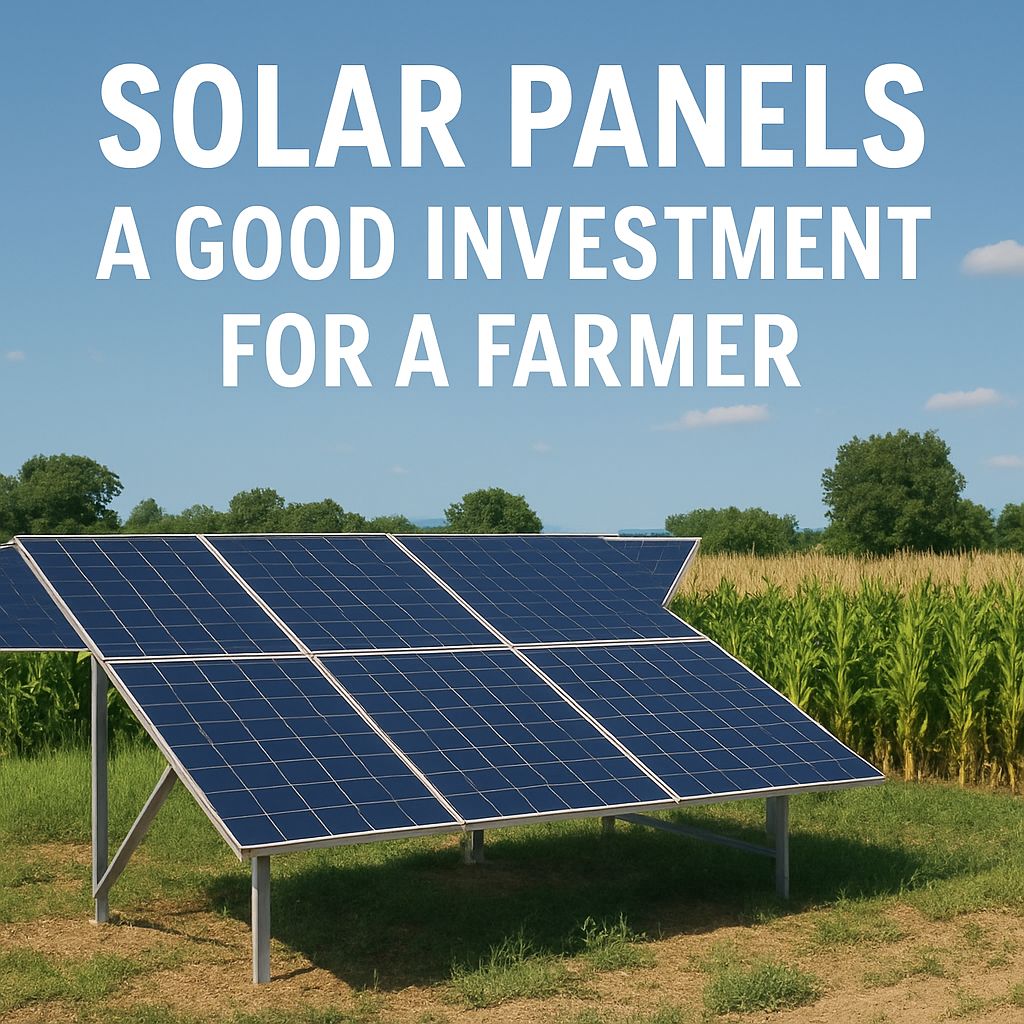
Conclusion: Are Solar Panels a Good Investment for a Farmer
For most agricultural operations, solar panels represent not just a good investment but an exceptional one. Few other farm capital improvements offer the combination of immediate cost reduction, long-term financial returns, tax advantages, and operational benefits. With payback periods typically ranging from 5-10 years and productive lifespans exceeding 25 years, the financial case is compelling even before considering protection against future energy cost increases.
The best agricultural solar investments are those tailored specifically to the farm’s unique energy usage patterns, physical layout, and business structure. Working with specialists experienced in agricultural installations ensures that systems complement rather than complicate farm operations. Paradise Solar Energy helps farmers navigate both the technical aspects of system design and the financial complexity of grants, tax incentives, and utility programs to maximize return on investment.
Frequently Asked Questions
As farmers consider solar investments, several common questions arise about practical aspects of installation and operation. These answers address the most frequent concerns raised during agricultural solar consultations.
How do solar panels perform during harsh weather conditions on farms?
- Modern panels withstand 1-inch hail impacts with minimal damage
- Wind resistance typically rated for 120+ mph in properly installed systems
- Snow shedding occurs naturally on panels installed at 20°+ angles
- Lightning protection systems prevent damage during electrical storms
- Production decreases during heavy cloud cover but systems are designed with weather patterns factored into annual projections
Agricultural environments present weather challenges that solar equipment manufacturers have specifically addressed in modern designs. Panel mounting systems have evolved to resist farm-specific challenges like equipment vibration, dust accumulation, and wildlife interference.
Monitoring systems provide real-time performance data, allowing farmers to quickly identify any weather-related issues. Most systems include remote shut-down capabilities for emergency situations like flooding or fire risk. Many agricultural insurance policies can be extended to cover solar equipment with minimal premium increases. For more information on solar panel options, explore the best solar panel types for farms.
Farmers in extreme weather regions should consult with agricultural solar specialists who understand local conditions. System designs can be modified with reinforced mounting, additional clearance for snow accumulation, or specialized hail-resistant panels in vulnerable regions.
Despite occasional extreme weather events, the 25+ year performance of modern solar systems demonstrates their resilience across diverse agricultural settings. The distributed nature of panel arrays means that even partial damage typically affects only a small percentage of production capacity.
Will installing solar panels affect my crop insurance or farm subsidies?
Solar installations typically have no impact on crop insurance eligibility or farm program payments when properly planned. USDA guidance specifically addresses renewable energy installations, confirming that appropriately sized systems for on-farm use don’t affect program eligibility. For larger systems that sell substantial power to utilities, impacts depend on the specific programs and land use arrangements.
- Maintain detailed documentation of the land’s continued agricultural use
- Consult with FSA office before installation if programs are crucial to operation
- Consider dual-use strategies that maintain agricultural production beneath panels
- Request written confirmation of continued eligibility from relevant agencies
- Review insurance policies to ensure solar equipment receives appropriate coverage
When solar panels occupy less than 5% of a farm’s acreage, program impacts are rarely significant. Dual-use installations that maintain agricultural production beneath the panels generally preserve the land’s agricultural status for program purposes.
For farms heavily dependent on federal programs, consultation with both renewable energy experts and USDA representatives ensures appropriate system design and documentation. The growing recognition of renewable energy’s role in agricultural sustainability has led to increasingly favorable policy interpretations.
Can I power irrigation systems with solar energy?
Irrigation represents one of the most suitable farm loads for solar power due to the natural alignment between sunny conditions and water needs. Direct-coupled solar irrigation systems can operate pumps during daylight hours without batteries, while grid-connected systems allow pumping anytime with solar offsetting costs. For a deeper understanding of how these systems work, explore the solar panels power generation process.
|
Irrigation Type |
Solar Compatibility |
System Requirements |
ROI Timeline |
|---|---|---|---|
|
Center Pivot |
Excellent |
25-50kW per 120 acres |
5-8 years |
|
Drip/Micro |
Excellent |
10-20kW per 120 acres |
4-6 years |
|
Flood Irrigation |
Good |
15-30kW per 120 acres |
6-9 years |
|
Traveling Gun |
Moderate |
20-40kW per system |
7-10 years |
Variable frequency drives (VFDs) paired with solar arrays optimize irrigation efficiency by matching pump operation to available power. This approach can reduce water usage by 15-30% while extending equipment life through gentler operation. The combination of energy savings and water conservation often qualifies these systems for enhanced incentives from both energy and conservation programs.
Battery storage integration allows irrigation scheduling flexibility while still utilizing solar generation. While adding cost, these systems provide valuable resilience during grid outages and enable irrigation during optimal agronomic windows regardless of solar production timing.
USDA’s EQIP (Environmental Quality Incentives Program) often provides additional funding for solar irrigation systems that demonstrate water conservation benefits. When combined with REAP grants and tax incentives, these stacked benefits can reduce farmer costs by 60-75% for qualifying systems.
Do solar panels work well in areas with seasonal sunlight variations?
Solar systems perform effectively even in regions with significant seasonal variations when properly designed. Northern latitude farms typically experience 30-40% production differences between summer and winter months, but annual production totals remain highly predictable. System designers account for these variations using historical solar radiation data, ensuring realistic financial projections. The economics remain favorable because many agricultural operations have complementary seasonal energy demands, with highest consumption occurring during peak production seasons for irrigation, cooling, and harvest processing.
What happens to my excess solar energy when production exceeds farm needs?
In most states, net metering policies credit farmers for excess energy sent to the grid, typically at retail rates or slightly reduced values. These credits offset consumption during nighttime or lower-production periods. The ideal system sizing balances annual production against consumption to maximize financial returns while minimizing uncredited excess. For more insights on optimizing solar panel use in agriculture, check out best solar panel types for farms.
Some utilities offer time-of-use rate structures that provide higher compensation for electricity produced during peak demand periods. These programs can significantly enhance solar economics for farms that can align their consumption with off-peak hours while generating during high-value periods.
For farms consistently generating substantial excess energy, battery storage systems can capture production for later use. While adding significant cost, these systems provide valuable resilience during outages and may qualify for additional incentives focused on grid stability and emergency preparedness.
Contact Paradise Solar Energy today for a free assessment of your farm’s solar potential and discover how solar panel types for farms can transform your agricultural operation’s profitability for decades to come.b







Leave a Reply