
Key Takeaways
- Solar panel systems can reduce farm energy costs by up to 75%, with payback periods averaging 5-7 years depending on system size and local incentives
- Agricultural operations are uniquely positioned to benefit from solar with their abundant land space and high energy demands for irrigation, processing, and climate control
- Modern solar systems can power everything from irrigation pumps and cold storage to electric fencing and farm residences
- Agrivoltaics—the practice of using land for both solar energy production and agriculture—can increase land productivity by up to 70%
- Federal tax credits currently cover 30% of installation costs, while many states offer additional agricultural-specific solar incentives
Farmers across America are discovering a new crop that doesn’t require water, fertilizer, or pesticides—sunlight. Converting this abundant resource into electricity through solar panels is transforming agricultural operations while dramatically cutting overhead costs. By integrating renewable energy into their operations, forward-thinking farmers are securing their financial futures while reducing their environmental impact.
Agricultural operations typically require substantial energy inputs for irrigation, climate control, processing, and storage. The U.S. Department of Energy reports that many farms can offset 75% or more of their electricity needs through strategically designed solar installations. For many operations, solar power isn’t just an environmental choice—it’s becoming an economic necessity in the face of rising utility costs.
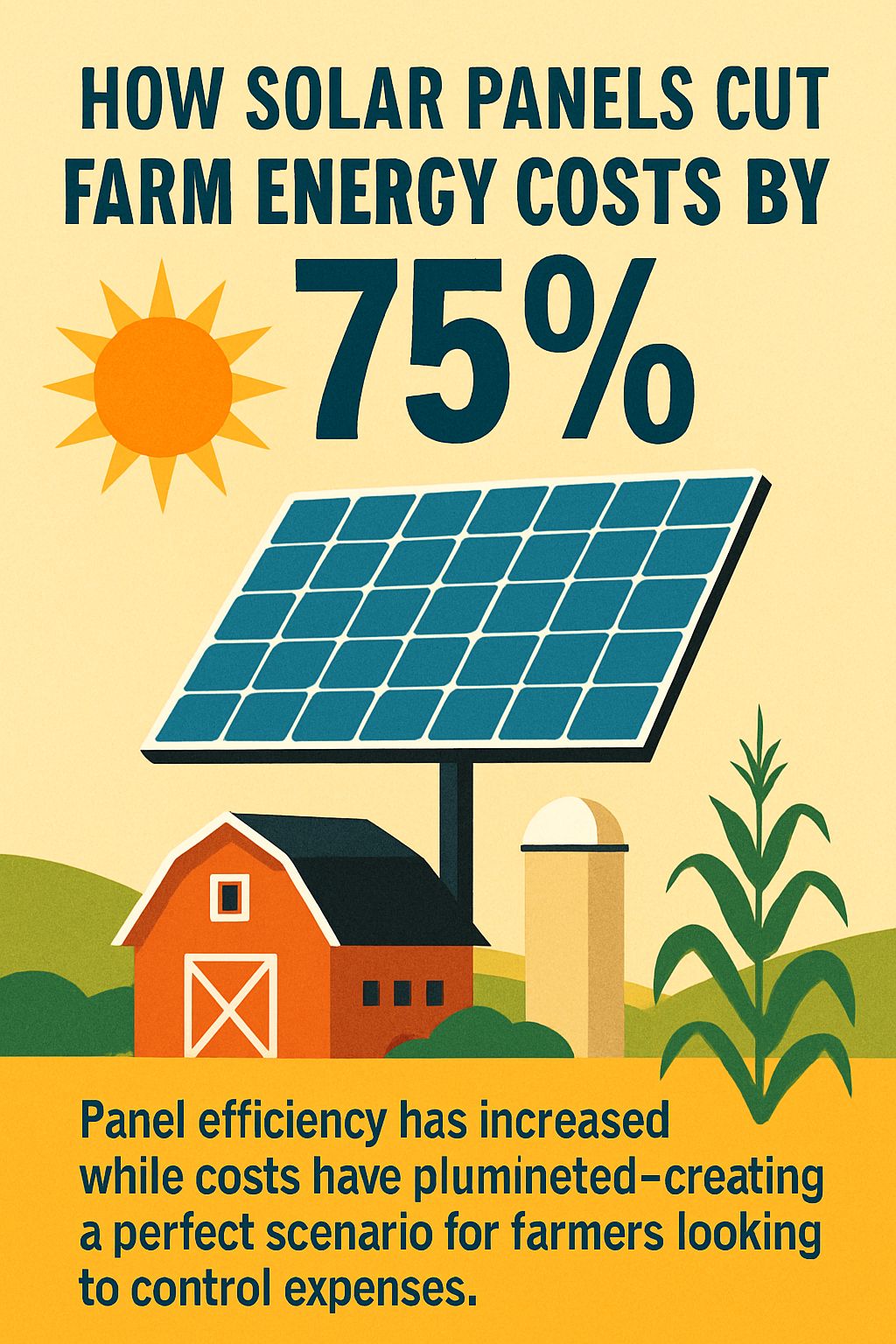
How Solar Panels Cut Farm Energy Costs by 75%
The economics of solar for agricultural operations have shifted dramatically in the past decade. Panel efficiency has increased while costs have plummeted—creating a perfect scenario for farmers looking to control expenses. A typical 25-30kW system can offset most energy needs for small to medium farms, with current installation costs ranging from $2-3 per watt before incentives. With federal tax credits covering 30% of installation costs and accelerated depreciation benefits, most agricultural solar installations reach payback within 5-7 years while providing 25+ years of reduced energy costs.
The Science Behind Solar Power Generation
Solar panels generate electricity through the photovoltaic effect—the process by which certain materials create an electric current when exposed to sunlight. The panels contain silicon cells that capture photons from sunlight and release electrons, generating direct current (DC) electricity. This DC power is then converted to alternating current (AC) through inverters, making it compatible with standard farm electrical systems. Modern panels typically convert 20-22% of sunlight into usable electricity, though high-efficiency models can reach nearly 25% conversion rates. Each panel in an agricultural installation can produce approximately 400-450 watts under ideal conditions, with large farm systems often combining hundreds of panels into arrays capable of generating substantial power.
Immediate Benefits for Agricultural Operations
Installing solar power on your farm delivers immediate operational advantages beyond simple cost reduction. Energy independence protects operations from utility rate hikes and power outages that can damage sensitive systems or interrupt critical processes. Solar installations also stabilize long-term energy costs, allowing for more accurate financial planning and budgeting. For operations with climate-controlled storage or processing facilities, solar power provides consistent, reliable energy without the emissions associated with diesel generators. Many farmers report that their solar investments have enhanced property values while strengthening relationships with sustainability-focused customers and distribution partners.
The Complete Solar Power Generation Process for Farms
Understanding how solar power works in an agricultural setting helps farmers maximize their investment and plan appropriate system sizing. The complete process involves five key stages that transform sunlight into usable electricity for various farm operations. From initial sunlight capture to potential energy sales back to the grid, each component plays a crucial role in system efficiency.
Modern agricultural solar systems are designed to withstand harsh farming environments including dust, extreme temperatures, and occasional impacts from equipment or wildlife. Most components carry robust warranties—typically 25 years for panels and 10-15 years for inverters and battery systems—ensuring long-term reliability for farm operations that depend on consistent power. For more information on how solar panels can benefit farm operations, visit solar panels benefits for farmers.
1. Sunlight Capture Through Photovoltaic Cells
The solar generation process begins when photons from sunlight strike the silicon-based photovoltaic cells within each panel. These cells contain silicon semiconductors treated with phosphorus and boron to create positive and negative charges—forming an electric field similar to a battery. When sunlight hits this field, electrons are knocked loose and flow in one direction, creating direct current electricity. A typical farm installation might include 60-72 cell panels optimized for maximum sunlight absorption throughout the day.
Panel placement critically affects energy production on agricultural properties. South-facing installations (in the Northern Hemisphere) typically generate the most electricity, though east-west configurations can provide more consistent power throughout the day. Ground-mounted systems are most common for farm installations as they allow for optimal positioning and don’t require structural roof modifications. Advanced tracking systems that follow the sun’s movement can increase energy production by 25-35% compared to fixed installations, though they require additional maintenance and investment. Learn more about how solar panels improve farm resilience.
2. DC to AC Conversion via Inverters
Once solar panels capture sunlight and generate DC electricity, this power must be converted to alternating current (AC) before it can be used in standard farm equipment and buildings. This critical conversion happens through inverters, which serve as the brains of your solar power system. Modern farm installations typically use either string inverters for entire array sections or microinverters attached to individual panels. Microinverters tend to cost more initially but optimize performance for each panel independently, reducing the impact of partial shading from trees, structures, or passing clouds.
Quality inverters include monitoring capabilities that allow farmers to track system performance from their smartphones or computers. These monitoring systems provide real-time data on energy production, helping identify potential maintenance issues before they become costly problems. Most agricultural installations include surge protection and grounding features specifically designed to withstand lightning strikes and power fluctuations common in rural areas. For farmers looking to further enhance their operations, exploring solar panels benefits for farm livestock can provide additional insights.
3. Integration with Farm Electrical Systems
The converted AC electricity flows through your farm’s electrical panel, where it powers equipment, buildings, and processes. A properly designed system includes automatic transfer switches that seamlessly transition between solar power, battery storage, and grid electricity as needed. This integration ensures continuous operation of critical systems like irrigation, ventilation, and refrigeration regardless of weather conditions or time of day.
Depending on your operation’s needs, certain high-draw equipment may be programmed to run during peak solar production hours to maximize direct solar usage. Smart controllers can automatically schedule pumps, compressors, and processing equipment to operate when solar generation is highest, reducing dependence on stored or purchased electricity.
4. Battery Storage for Nighttime and Cloudy Days
Battery storage systems capture excess daytime solar production for use during evening hours or cloudy periods. Today’s agricultural battery systems typically use lithium iron phosphate (LiFePO4) chemistry, offering 10+ year lifespans and safer operation than older lead-acid batteries. A properly sized battery bank can power critical farm systems overnight and provide backup during grid outages, ensuring irrigation cycles continue, livestock ventilation systems remain operational, and refrigerated products stay at proper temperatures.
For many farms, battery storage provides the additional benefit of peak shaving—using stored energy during high-demand periods when utility rates are highest. This strategy can significantly reduce demand charges, which often account for 30-40% of commercial agricultural electric bills. Based on typical farm energy profiles, battery systems sized at 30-50% of daily energy usage generally provide the optimal balance of cost and functionality.
5. Grid Connection for Excess Energy Sales
Most agricultural solar installations maintain a connection to the utility grid, allowing farms to sell excess production back to the utility through net metering programs. This arrangement effectively turns your electric meter backward when you produce more than you consume, creating credits against future electricity purchases. In states with favorable net metering policies, farmers can offset winter energy costs with summer solar production, maximizing the financial return on their solar investment.
Grid-tied systems also provide backup power security without requiring oversized battery banks. During extended cloudy periods when solar production is reduced, the grid connection ensures continuous power availability. Sophisticated grid-tie inverters automatically disconnect during utility outages to prevent backfeeding, protecting utility workers while allowing your system to continue powering critical farm functions through battery backup.
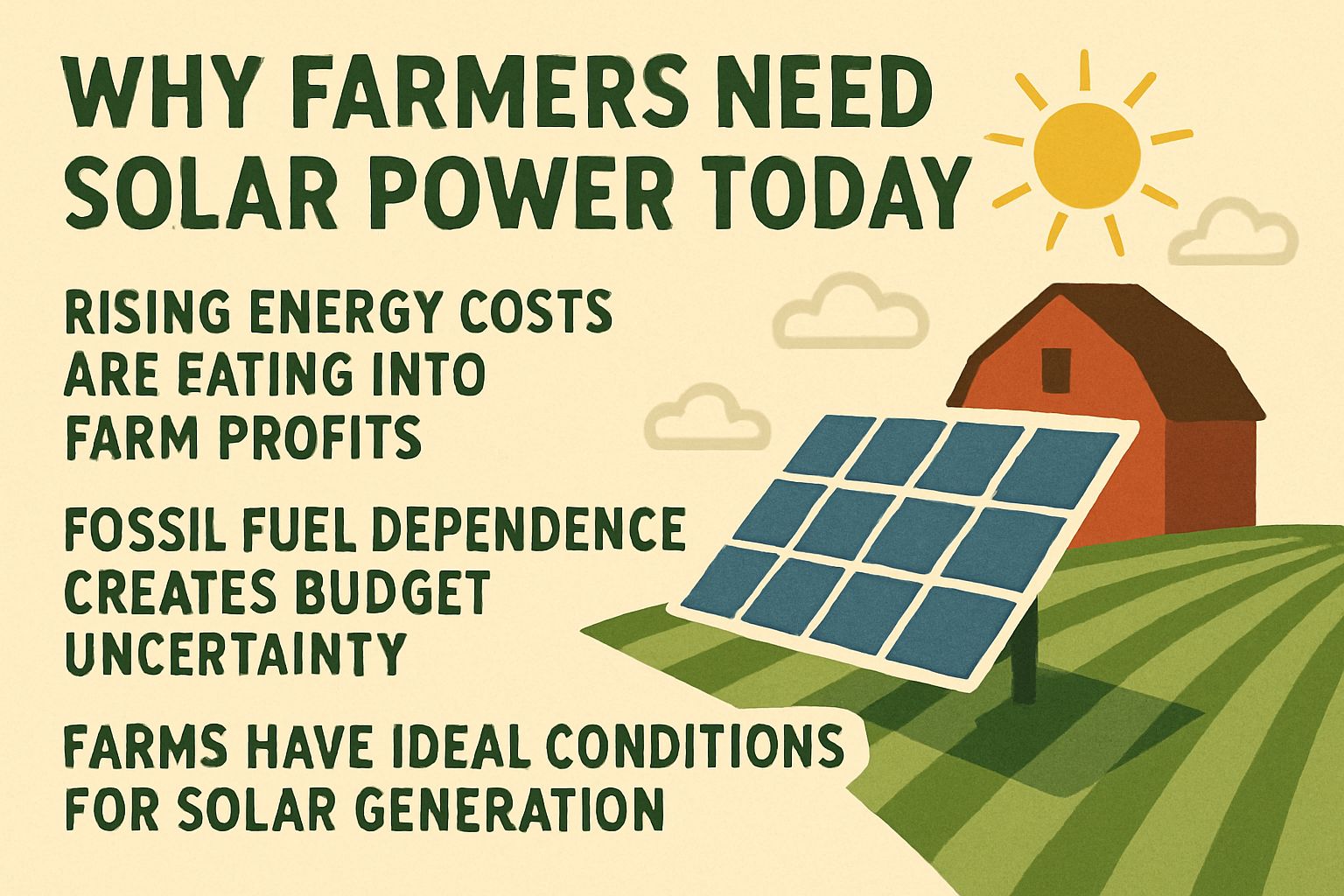
Why Farmers Need Solar Power Today
The agricultural sector faces unique energy challenges that make solar power particularly valuable. From remote locations with limited grid access to operations requiring consistent power for animal welfare, farms benefit from energy independence in ways many other businesses don’t. Solar power addresses these specific agricultural needs while providing financial and operational advantages that strengthen farm resilience and sustainability.
Rising Energy Costs Are Eating into Farm Profits
Agriculture is exceptionally vulnerable to energy price volatility. Irrigation alone can account for 20-30% of a farm’s operational costs, while climate control for livestock or product storage drives energy expenses even higher. USDA economic research indicates that electricity costs for agricultural operations have risen approximately 4-6% annually over the past decade—significantly outpacing inflation. For many farmers, these rising costs directly impact already-thin profit margins. Solar power provides cost certainty, allowing operations to lock in electricity prices for 25+ years through fixed installation costs rather than facing continual utility rate increases.
Fossil Fuel Dependence Creates Budget Uncertainty
Many farms rely heavily on diesel generators for remote power needs, creating significant exposure to fuel price fluctuations and supply chain disruptions. During recent fuel price spikes, farms reported 30-40% increases in operational costs directly tied to diesel prices. Converting these systems to solar-powered alternatives eliminates this volatility while reducing maintenance requirements and downtime. Solar-powered pumps, for instance, typically require maintenance only every 5-7 years compared to annual or semi-annual servicing for diesel equipment.
Farms Have Ideal Conditions for Solar Generation
Agricultural properties typically offer optimal conditions for solar production: abundant open space, minimal shading, and clear solar access. These natural advantages often result in 15-20% higher solar production efficiency compared to suburban or urban installations. Additionally, farms frequently have suitable outbuilding roof space or marginally productive land areas that can be repurposed for solar arrays without impacting primary agricultural activities. The distributed nature of farm operations also creates opportunities for strategic panel placement near high-energy-use locations like pumping stations or processing facilities, reducing transmission losses and infrastructure costs. For more information on how solar panels can provide energy cost reduction for farms, visit our detailed guide.
Types of Solar Panel Systems for Agricultural Operations
Agricultural operations have unique energy demands that can be met through various solar system configurations. Each setup offers specific advantages depending on your farm’s location, energy requirements, and budget constraints. From fully grid-connected systems to completely independent power sources, the right configuration can dramatically impact both performance and return on investment.
Grid-Tied Systems: Selling Excess Power Back
Grid-tied systems remain the most common installation for agricultural operations, particularly those with reliable utility access. These systems connect directly to the utility grid, allowing farms to draw supplemental power during high-demand periods and sell excess generation during peak production. Most states offer net metering programs that credit farmers for this excess electricity at retail or near-retail rates. The elimination of battery storage requirements in these systems typically reduces initial installation costs by 20-30%, making them attractive for operations with consistent grid reliability.
Off-Grid Systems: Complete Energy Independence
For remote agricultural operations or areas with unreliable utility service, off-grid systems provide complete energy autonomy. These installations include substantial battery storage capacity to maintain power during nighttime and low-production periods. While initial costs run 40-60% higher than comparable grid-tied systems due to battery requirements, they eliminate utility bills entirely and avoid expensive utility extension costs that can exceed $25,000 per mile in rural areas. Modern off-grid systems typically incorporate backup generators that automatically engage during extended low-production periods, ensuring critical farm operations remain functional regardless of weather conditions. Learn more about how solar panels benefit farmers by providing reliable power solutions.
Hybrid Systems: The Best of Both Worlds
Hybrid systems combine grid connection with battery storage, offering both energy independence and grid benefits. These installations can operate in either grid-interactive or off-grid mode as needed, providing backup power during outages while still allowing net metering benefits. For livestock operations, processing facilities, or cold storage applications where power interruptions could cause significant losses, hybrid systems provide essential resilience. The ability to strategically shift between battery usage and grid power also enables peak-shaving—using stored energy during high-rate periods to minimize demand charges that often comprise 30-40% of agricultural electric bills.
Mobile Solar Solutions for Remote Fields
Innovative portable solar solutions are revolutionizing power access for remote agricultural applications. Trailer-mounted solar generators with battery storage can deliver 5-15 kWh daily to power irrigation pumps, electric fencing, monitoring equipment, or temporary worker facilities without the expense of permanent infrastructure. These mobile units can be relocated seasonally to support different fields or operations, maximizing utility across your property. Rental options have emerged in many agricultural regions, allowing farmers to deploy solar power precisely when and where it’s needed without capital investment. For more information on how solar panels can reduce energy costs, explore additional resources.
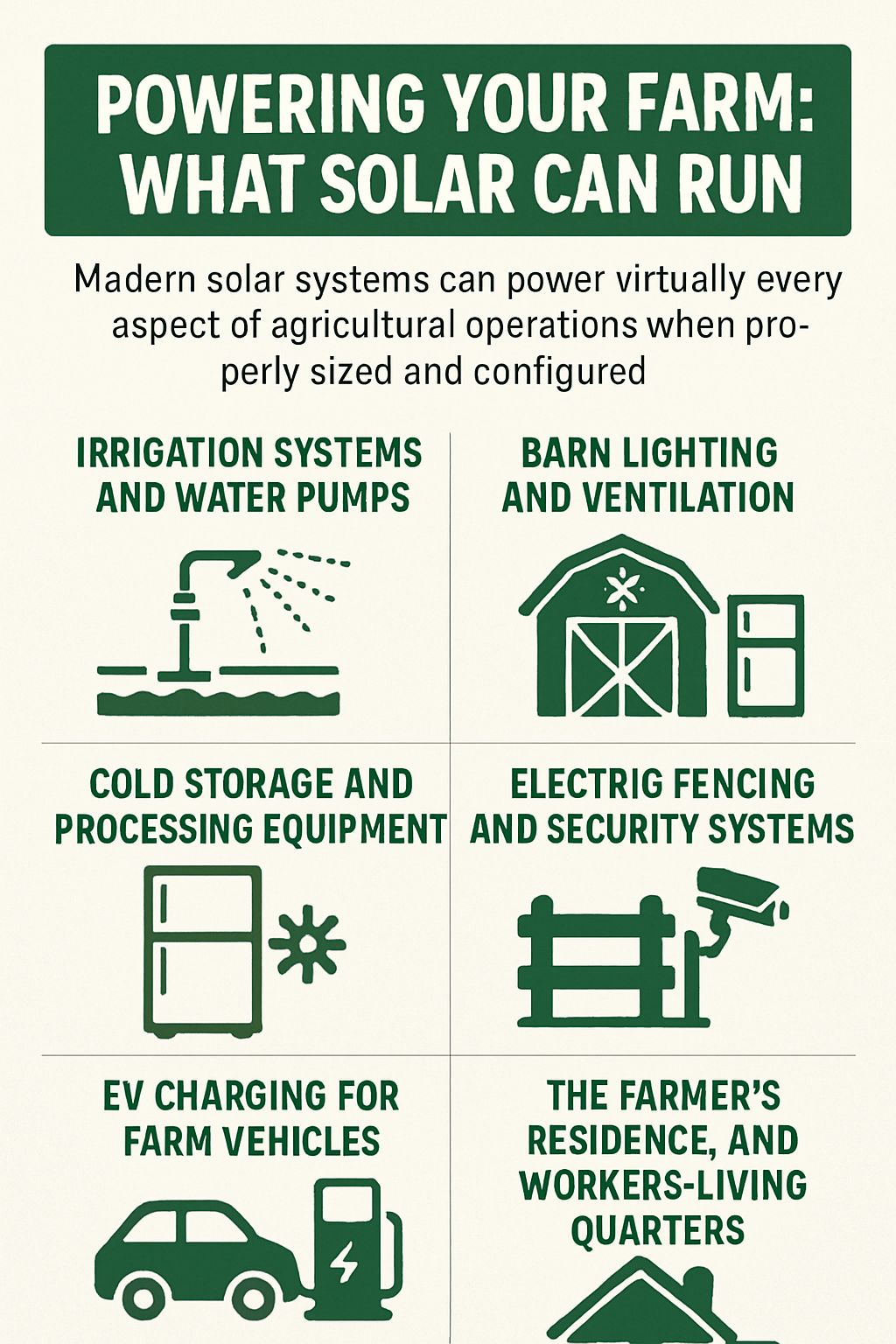
Powering Your Farm: What Solar Can Run
Modern solar systems can power virtually every aspect of agricultural operations when properly sized and configured. From basic lighting to sophisticated processing equipment, understanding what applications work best with solar power helps prioritize system design for maximum return on investment.
Irrigation Systems and Water Pumps
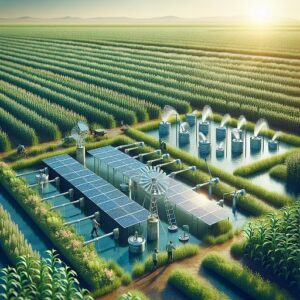
Solar-powered pumping systems represent one of the most economical applications for agricultural solar, often paying for themselves within 3-5 years through eliminated fuel or electricity costs. Direct solar-to-pump systems using DC motors can operate without batteries or inverters during daylight hours, significantly reducing system complexity and cost. For operations requiring consistent water delivery, solar pumps connected to elevated storage tanks can pump during peak sunlight hours while gravity feeds irrigation systems as needed. Modern variable frequency drives adjust pump speed based on available sunlight, maximizing water delivery efficiency throughout the day.
Barn Lighting and Ventilation
Livestock facilities require consistent lighting and ventilation to maintain animal health and productivity. Solar systems paired with LED lighting reduce energy consumption by up to 75% compared to traditional lighting while providing better illumination quality. Ventilation systems with solar-powered controllers can automatically adjust airflow based on temperature, humidity, and air quality parameters. For operations with extended lighting requirements, programmable controllers can prioritize critical systems during limited power availability periods, ensuring animal welfare while optimizing energy usage.
Cold Storage and Processing Equipment
Temperature-controlled storage facilities represent significant energy expenses for many agricultural operations. Solar cooling systems using high-efficiency compressors can maintain critical temperatures while dramatically reducing operating costs. For operations with predictable processing schedules, solar production can be synchronized with equipment usage to maximize direct power consumption. Thermal storage systems—using ice created during peak solar production—can provide cooling during non-production hours without requiring extensive battery capacity, offering an economical alternative for cold-storage applications.
Electric Fencing and Security Systems
Remote pasture management becomes significantly more efficient with solar-powered fencing and monitoring systems. Small dedicated solar panels with integrated batteries can power electric fence chargers for months without maintenance, eliminating frequent battery replacements. Solar-powered security systems with cellular or radio transmission capabilities provide real-time monitoring of distant facilities, water levels, gate positions, or animal movements. These systems typically require minimal power and can operate reliably with small 20-50 watt panels even in partially cloudy conditions, making them an excellent option for farm livestock management.
EV Charging for Farm Vehicles
As agricultural equipment manufacturers introduce more electric utility vehicles, tractors, and small equipment, on-site charging infrastructure becomes increasingly valuable. Solar-powered charging stations can replenish electric utility vehicles during daylight hours, offsetting what would otherwise become a significant new electrical load. For operations with multiple electric vehicles, smart charging systems can prioritize and schedule charging based on current solar production and vehicle usage patterns. Several manufacturers now offer solar-compatible charging equipment specifically designed for agricultural environments with enhanced durability and weather resistance.
The Farmer’s Residence and Workers Living Quarters
Incorporating residential buildings into agricultural solar systems often improves overall economics through increased system utilization. Farm homes typically use most electricity during morning and evening hours when farm operations may have lower demands, creating complementary usage patterns that maximize direct consumption of solar production. For operations with worker housing, solar power can significantly reduce utility costs while providing improved lighting and comfort. Some agricultural solar incentive programs specifically address combined residential-agricultural installations, offering enhanced benefits for integrated approaches.
Agrivoltaics: Combining Crops and Solar Production
Innovative farmers are discovering that solar panels and agriculture can coexist on the same land through agrivoltaics—the practice of producing both solar electricity and crops in a single space. Rather than choosing between energy and food production, this emerging approach offers multiple revenue streams from the same acreage while providing unique agricultural benefits.
Shade-Tolerant Crops That Thrive Under Panels
Research from the National Renewable Energy Laboratory demonstrates that certain crops actually perform better in the partial shade created by elevated solar panels. Leafy greens like spinach, kale, and lettuce grown under solar arrays have shown yield increases of 20-30% in hot climates due to reduced heat stress and improved soil moisture retention. Other shade-tolerant crops showing positive results include broccoli, chard, certain berries, ginger, turmeric, and many herbs. Panel elevation and spacing can be customized to provide optimal light conditions for specific crop varieties, with typical installations raising panels 8-12 feet above ground level to accommodate farm equipment access. Learn how farmers increase crop yield with solar panels.
Crop Performance Under Solar Arrays (NREL Research Results)
Spinach: +28% yield increase compared to full sun
Lettuces: +21% yield increase compared to full sun
Peppers: +12% yield increase in hot climates
Tomatoes: -8% yield reduction but improved fruit quality
Potatoes: -11% yield reduction
Most grains: Not recommended (require full sun)
Livestock Grazing Benefits in Solar Fields
Sheep grazing represents the most successful livestock integration with solar installations, providing natural vegetation management while generating additional farm income. Studies from American Solar Grazing Association show maintenance cost reductions of 20-30% when sheep graze solar arrays compared to mechanical vegetation control. The shade panels provide improves animal welfare through reduced heat stress during summer months, with sheep showing preference for shaded areas during peak temperature periods. Properly designed solar installations include specialized fencing, appropriate panel heights (minimum 24-30 inches clearance), and animal-safe wiring protection to prevent damage from curious livestock.
Water Conservation Advantages
Agrivoltaic systems demonstrate significant water conservation benefits, with research showing 15-30% reduced irrigation requirements for crops grown beneath panels. This efficiency comes from lower evaporation rates due to partial shading and the capture of rainfall runoff from panels that can be directed to crops. In arid regions, these water savings can substantially improve sustainability and reduce irrigation costs. Some sophisticated installations incorporate rainwater harvesting systems that capture, filter, and store panel runoff for scheduled irrigation, further enhancing water efficiency and reducing dependence on wells or municipal water sources.

Cost Analysis: What Farmers Need to Know
Making informed financial decisions about agricultural solar requires understanding both initial investments and long-term operational impacts. While upfront costs remain significant, various incentives and financing options make solar increasingly accessible for operations of all sizes.
Initial Investment vs. Long-Term Savings
Agricultural solar installations typically cost between $2.00-$2.80 per watt before incentives, with economies of scale reducing per-watt costs for larger systems. For a typical 30kW system suitable for a small to medium farm, initial investment ranges from $60,000-$84,000 before applying tax credits and other incentives. Operating costs remain minimal, with annual maintenance expenses typically running just 0.5-1% of system cost. Over a 25-year system lifespan, total ownership costs (including initial investment and all maintenance) typically average 7-9 cents per kilowatt-hour—significantly below commercial electricity rates in most regions and with greater price stability than utility power. Learn more about farm energy cost reduction with solar panels.
Agricultural Solar Incentives and Tax Credits
The federal Investment Tax Credit currently offers a 30% credit against the total installed cost of agricultural solar systems, dramatically improving project economics. Accelerated depreciation benefits allow qualifying agricultural businesses to depreciate the entire system cost (after applying the 30% tax credit) within the first year in many cases. Many states offer additional incentives specifically for agricultural solar installations, including grants, rebates, property tax exemptions, and specialized loan programs. The USDA’s Rural Energy for America Program (REAP) provides grants covering up to 25% of project costs and loan guarantees for the remainder, making financing significantly more accessible for rural agricultural operations.
- Federal Investment Tax Credit: 30% of system cost
- Accelerated Depreciation: 100% first-year bonus depreciation available
- USDA REAP Grants: Up to 25% of project costs
- State-Specific Incentives: Vary by location but often include production-based incentives, sales tax exemptions, and specialized agricultural grants
- Utility Programs: Many rural electric cooperatives offer additional incentives for agricultural solar installations
Typical Payback Period for Farm Installations
Most agricultural solar installations achieve payback within 5-8 years depending on local electricity rates, available incentives, and system design. Operations with high daytime energy usage typically see faster returns, as direct consumption of solar electricity provides better economics than net metering in most regions. Specialized agricultural applications like solar irrigation often achieve payback in as little as 3-5 years due to eliminated fuel costs and reduced maintenance expenses. After reaching payback, systems typically provide 15-20+ additional years of heavily discounted electricity, significantly improving farm profitability and cash flow during that period.
Financing Options Specifically for Farmers
Specialized agricultural solar financing has expanded dramatically, with lenders now offering farm-friendly terms that align with agricultural cash flow cycles and recognize the value solar adds to operations. The USDA Farm Service Agency’s Farm Storage Facility Loan Program can now be used for solar systems that power eligible equipment, offering terms up to 12 years at favorable interest rates. Many agricultural lenders offer solar loans structured around harvest schedules, with payment timing coordinated with typical farm income periods. Third-party ownership models including leases and Power Purchase Agreements (PPAs) allow farmers to install solar with minimal upfront cost, paying only for the electricity produced at rates typically 15-25% below utility prices.
Step-by-Step Installation Process
Installing solar on your farm involves several critical stages to ensure optimal performance and return on investment. Understanding this process helps set realistic timelines and ensures you’re adequately prepared for each phase of implementation. To learn more about how solar panels can benefit your farm operations, consider exploring additional resources.
Most agricultural installations require 3-6 months from initial consultation to fully operational system, with much of this time dedicated to permitting, utility approvals, and incentive applications rather than actual construction. The physical installation typically requires just 1-3 weeks depending on system size and complexity. Learn more about how solar panels benefit farmers in their operations.
Working with contractors experienced specifically with agricultural installations ensures systems are designed to withstand farm environments including dust, equipment traffic, livestock interaction, and specialized power requirements.
- Initial consultation and site assessment (1-2 weeks)
- Proposal development and system design (2-4 weeks)
- Contract signing and incentive application (1-2 weeks)
- Permitting and utility approvals (4-12 weeks)
- Equipment ordering and delivery (2-6 weeks)
- Physical installation (1-3 weeks)
- System testing and commissioning (1 week)
- Final inspections and interconnection (1-3 weeks)
1. Energy Audit and Site Assessment
The installation process begins with a comprehensive energy audit analyzing your farm’s electricity usage patterns, peak demands, and seasonal variations. This assessment includes evaluating 12-24 months of utility bills to identify consumption trends and rate structures affecting system economics. Site evaluation identifies optimal panel locations considering solar access, distance to electrical interconnection points, soil conditions for ground mounts, and structural capacity for roof installations. This phase should also include preliminary discussions with your utility regarding interconnection requirements and any potential grid capacity limitations.
Site Assessment Checklist for Agricultural Solar
• Annual electricity consumption (total kWh)
• Peak demand patterns (when and how much)
• Available installation space (roof or ground)
• Shading analysis (trees, buildings, equipment)
• Distance to interconnection points
• Soil conditions (for ground mounts)
• Structural analysis (for roof mounts)
• Flood plain and drainage considerations
• Equipment access requirements
• Future expansion plans
Consider future farm plans during this phase, including potential electrification of currently fossil-fueled equipment, expansion of irrigated acreage, or addition of processing facilities that might increase electrical demand. Properly accounting for growth ensures your system won’t be undersized within a few years of installation.
2. System Sizing and Design
Based on your energy audit and available installation space, your solar contractor will design a system that balances energy production goals with budget considerations. This design phase includes selecting specific equipment (panels, inverters, mounting systems) appropriate for agricultural environments, determining optimal array positioning for maximum annual production, and engineering appropriate structural supports. For ground-mounted systems on farms, designs typically incorporate elevated arrays (7-12 feet minimum clearance) to allow equipment access underneath and minimize impact on operations. Special consideration should be given to wind and snow loading in agricultural installations, as open farm settings often experience more extreme weather conditions than residential areas.
3. Permitting and Utility Approvals
Agricultural solar installations require various permits and approvals before construction can begin. These typically include electrical permits, structural permits for roof mounts, land use or zoning approvals for ground mounts, and utility interconnection agreements. The permitting process varies significantly by location but generally takes 4-12 weeks for agricultural systems. Your contractor should handle this process, including submission of detailed electrical diagrams, structural calculations, equipment specifications, and site plans. Utility interconnection applications require particular attention, as rural electrical systems may have capacity limitations or require grid upgrades for larger installations—factors that can significantly impact project timeline and costs if not identified early.
4. Installation and Testing
The physical installation begins with site preparation—establishing equipment access routes, preparing ground mount foundations, or making necessary roof repairs before mounting hardware installation. For ground-mounted agricultural systems, foundation types vary based on soil conditions, with options including driven piers, concrete footings, or ballasted systems for temporary installations. Panel installation typically follows a systematic approach, with mounting hardware secured first, followed by panel placement, and finally electrical connections. Throughout installation, regular quality control inspections should verify proper grounding, watertight connections, and correct wire management to prevent future issues from harsh agricultural environments including dust, moisture, and wildlife.
5. Connecting to Farm Operations
The final installation phase connects your solar array to your farm’s electrical systems through appropriately sized disconnects, breakers, and monitoring equipment. This critical stage includes programming system parameters, testing protective equipment functions, and commissioning monitoring platforms that will track performance. For systems with battery backup, this phase includes setting charge/discharge parameters and testing automatic transfer capabilities during simulated grid outages. Most agricultural installations include a formal owner training session covering system operation, monitoring interface usage, shutdown procedures for maintenance or emergencies, and warranty documentation for all components.
After installation, expect a final inspection from local building authorities and utility representatives before receiving permission to operate (PTO) from your utility company. This final approval typically arrives 1-3 weeks after physical installation completion and represents the official start of your solar production period.

Getting the Most from Your Farm’s Solar System
Maximizing return on your solar investment requires thoughtful management throughout the system’s 25+ year lifespan. Simple monitoring and maintenance procedures can significantly improve performance, extending system life and increasing energy production. Establishing routine care protocols ensures continuous optimal operation while minimizing unexpected downtime or production losses.
Simple Maintenance Requirements
Agricultural solar systems require minimal maintenance compared to most farm equipment, typically needing only 2-4 hours of attention per year. Panel cleaning represents the most frequent maintenance task, with frequency depending on local conditions—dusty regions may require quarterly cleaning while areas with regular rainfall might need just annual attention. Vegetation management around ground-mounted arrays prevents shading and potential fire hazards, with many farmers utilizing sheep grazing as a natural maintenance solution. Annual electrical inspections should check for loose connections, weather damage to wiring, and proper functioning of disconnect switches and ground fault protection. Inverters typically require the most attention, with annual inspection of cooling fans, filters, and communication systems recommended to prevent premature failure.
Seasonal Adjustments for Maximum Efficiency
Fixed-tilt ground mount systems can benefit from seasonal angle adjustments, typically performed twice yearly to optimize for summer and winter sun positions. This simple adjustment can increase annual energy production by 8-12% compared to static positioning, though it requires additional labor and appropriate adjustment mechanisms. For irrigation-focused systems, coordinating pump schedules with peak solar production hours maximizes direct power usage without battery storage. Operations with seasonal processing (harvest, drying, cooling) can often adjust work schedules to align with solar production peaks, improving economics through increased self-consumption of generated electricity.
Monitoring Systems to Track Performance
Modern agricultural solar installations include sophisticated monitoring platforms accessible via smartphone or computer, providing real-time production data and historical performance analytics. These systems immediately alert owners to production anomalies that might indicate equipment failures, shading issues, or connection problems requiring attention. Advanced monitoring platforms integrate weather forecasting to provide next-day production estimates, helping plan energy-intensive activities around expected solar availability. For systems with battery storage, intelligent monitoring can optimize charging/discharging cycles based on weather forecasts, planned usage, and utility rate structures to maximize financial returns while maintaining appropriate backup reserves.
Establishing performance benchmarks during your first year of operation provides valuable comparison points for future evaluation. Documented production expectations for each month allow quick identification of potential issues when actual generation falls below predicted values. Most monitoring systems can automatically generate monthly performance reports, simplifying record-keeping for tax purposes, warranty claims, and incentive program compliance.
Frequently Asked Questions
As you consider solar power for your agricultural operation, you likely have questions about performance, economics, and implementation. Here are answers to the most common questions farmers ask when evaluating solar power options for their operations.
Will solar panels work during cloudy weather on my farm?
Solar panels continue producing electricity during cloudy weather, though at reduced capacity—typically generating 10-25% of their rated output depending on cloud density. Modern high-efficiency panels perform better in diffuse light conditions than older technologies, improving cloudy-day production. Agricultural systems are designed using local weather data that accounts for typical cloud patterns throughout the year, ensuring annual production estimates remain realistic. For operations requiring consistent power regardless of weather, battery storage or hybrid systems with grid backup provide reliable electricity even during extended cloudy periods.
How long do agricultural solar panel systems typically last?
Agricultural solar installations typically carry 25-year manufacturer warranties guaranteeing at least 80% of original production capacity at that point, though actual lifespans frequently exceed 30-35 years with proper maintenance. Panel degradation rates average just 0.5% annually, meaning a quality system should still produce 87.5% of its original output after 25 years. Inverters generally have shorter lifespans, with string inverters typically warranted for 10-12 years and microinverters for 25 years, making inverter replacement the most common major maintenance expense during system life. Mounting hardware, particularly aluminum and stainless steel components designed for agricultural environments, typically lasts the entire system lifetime with minimal maintenance requirements.
Can I install solar panels myself to save money?
While DIY installation is technically possible for experienced individuals with electrical and construction knowledge, agricultural systems present significant safety and performance risks if improperly installed. Professional installation ensures proper system design, code compliance, maximum efficiency, and crucially—warranty protection for your investment. Many manufacturers void equipment warranties for self-installed systems, creating substantial financial risk. Additionally, most agricultural incentive programs and tax credits require professional installation with appropriate certifications and permits. The savings from professional design expertise—including proper system sizing, equipment selection, and performance optimization—typically outweigh any labor costs saved through self-installation. For more information on how solar power works, you can visit this comprehensive guide.
If budget constraints are significant, consider a phased professional installation approach starting with your highest-value applications (typically irrigation or major processing loads) and expanding the system over time as finances allow.
What happens to excess energy my farm produces?
Excess electricity from grid-connected agricultural solar systems typically flows back to the utility grid, with your account receiving credits through net metering programs available in most states. These credits offset future electricity purchases during night hours or low-production periods. Net metering policies vary significantly by state and utility, with some providing retail-rate credits while others use avoided-cost rates (typically lower than retail). Some agricultural operations strategically oversize their solar systems to generate additional revenue through net metering, effectively farming sunshine alongside traditional crops. For systems without favorable net metering, battery storage can capture excess production for later use, though this adds significant cost compared to grid export.
Will solar panels damage my farmland or reduce growing space?
When properly designed, agricultural solar installations minimize impact on valuable farmland while providing new revenue opportunities. Ground-mounted systems typically require 7-10 acres per megawatt of capacity, though elevated designs allow continued grazing or cultivation beneath panels. Many farmers strategically locate solar arrays on marginal or less-productive land, hillsides unsuitable for equipment, or areas with poor soil quality or drainage issues. Agrivoltaic designs specifically optimize dual land use, with research showing total land productivity (combining agricultural yield and energy production value) can increase by 60-70% compared to single-use approaches. Removable mounting systems with minimal soil disturbance preserve long-term land quality, allowing future agricultural use if needed.
Solar power isn’t just an environmental choice for modern farmers—it’s increasingly becoming an economic necessity for agricultural operations facing rising energy costs and tightening margins. By harnessing abundant sunshine, farms can achieve greater operational resilience, predictable energy costs, and improved sustainability that increasingly matters to consumers and distribution partners.
From powering irrigation systems that keep crops thriving during dry periods to maintaining climate control in livestock facilities, solar energy delivers reliable power that grows alongside your operation. The combination of falling equipment costs, generous incentive programs, and agricultural-specific financing options has created an unprecedented opportunity for farms of all sizes to benefit from renewable energy.
SolarFarm Alliance provides comprehensive solar solutions designed specifically for agricultural operations, with specialized expertise in irrigation systems, livestock facilities, and agrivoltaic installations. Visit SolarFarmAlliance.com to schedule a free solar assessment for your farm.

Leave a Reply