
Key Takeaways
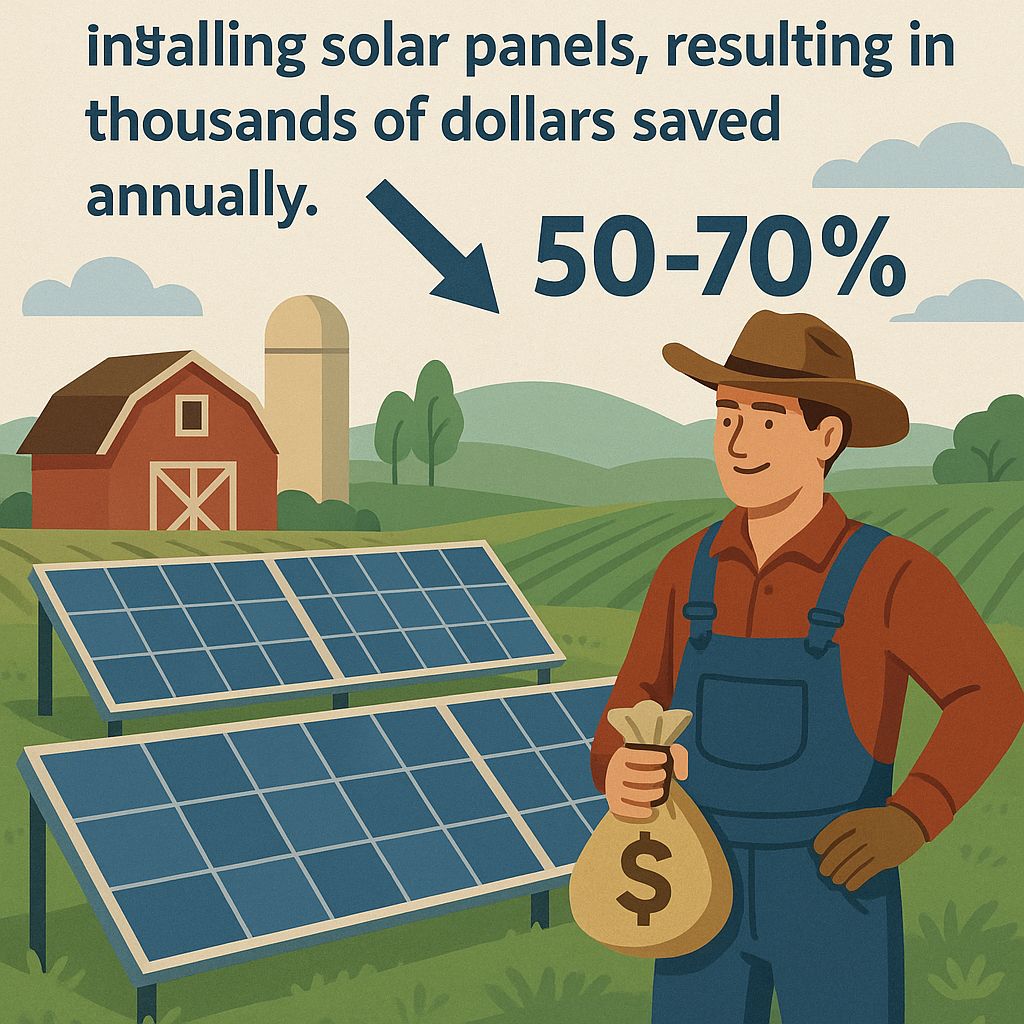
- Farms can slash electricity costs by 50-70% after installing solar panels, resulting in thousands of dollars saved annually.
- Initial investment costs can be offset through USDA REAP grants, tax credits, and other agricultural incentives specifically designed for farmers.
- Solar systems require minimal maintenance while providing 25-30 years of reliable energy production and protection against rising utility rates.
- Case studies show farms reducing monthly electricity bills from $2,000 to as low as $600, with annual savings exceeding $16,000 in some cases.
- Beyond cost savings, solar installations can create new revenue streams through net metering programs that pay farmers for excess electricity.
Farm Solar Panels: Slash Your Energy Bills by 50-70%
Farmers, does this sounds familiar. You pull off a successful harvest, battle inflation on feed and equipment, and just when you think you’ve secured a solid margin, the utility bill arrives. Suddenly, the cost of running your irrigation pumps, grain dryers, and cooling systems feels like the single largest variable drain on your farm’s profitability.
For modern agriculture, energy is no longer a fixed cost—it’s a runaway liability.
But what if you could not only stabilize that cost but virtually eliminate it? We’re not talking about marginal savings; we’re talking about a revolutionary shift in your operation’s economics. Imagine slashing your annual energy expenditure by a guaranteed 50%, with many farms seeing cuts reaching a staggering 70%.
This isn’t just greenwashing or a passing trend. Farm solar panels (agrivoltaics and ground-mount systems) are now a critical piece of infrastructure that transforms a massive overhead cost into a powerful asset. In this definitive guide, we’ll dive deep into the specific calculations, deployment strategies, and crucial grants that allow farmers across the country to lock in low operating costs and future-proof their land
The Real Cost of Energy on Your Farm
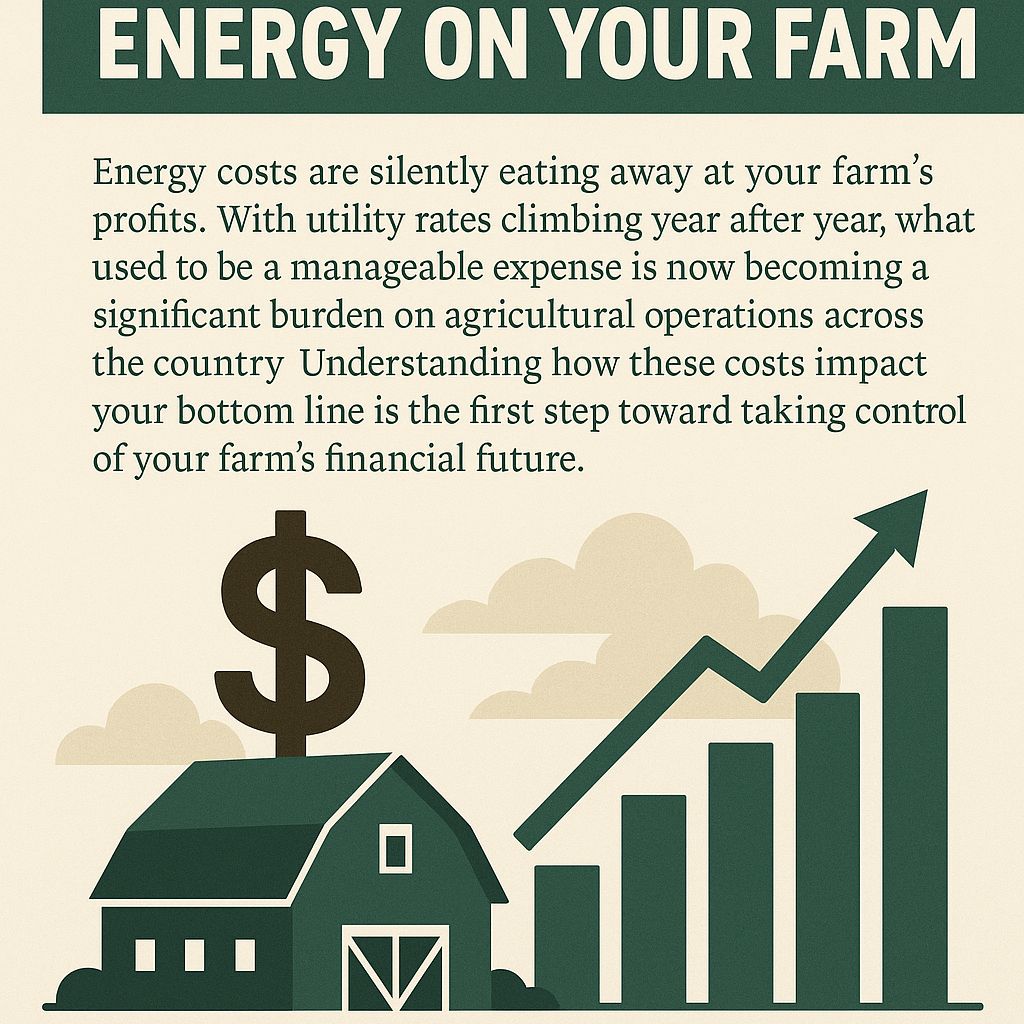
Energy costs are silently eating away at your farm’s profits. With utility rates climbing year after year, what used to be a manageable expense is now becoming a significant burden on agricultural operations across the country. Understanding how these costs impact your bottom line is the first step toward taking control of your farm’s financial future.
How Rising Electricity Prices Hurt Your Bottom Line
The impact of rising electricity prices on farm profitability cannot be overstated. While you’ve been focused on optimizing crop yields and managing labor costs, your monthly utility bills have likely been climbing steadily at 2-3% annually. For farms with substantial electricity needs—such as dairy operations with milk cooling systems or irrigated crop production—these increases compound dramatically over time. A farm spending $20,000 annually on electricity today could face costs exceeding $32,000 in just ten years if prices continue their upward trajectory.
- Irrigation systems can account for 30-50% of a farm’s total energy consumption
- Dairy operations typically spend $35-45 per cow annually on electricity
- Cold storage facilities can consume 15-25% of a farm’s energy budget
- Ventilation and climate control systems in livestock buildings create consistent year-round energy demands
Hidden Energy Expenses in Everyday Farm Operations
Many farming operations have hidden energy costs that aren’t immediately obvious when reviewing monthly bills. Water pumping, grain drying, and ventilation systems operate continuously throughout growing seasons, creating substantial electricity demands that fluctuate with production cycles. Equipment that runs 24/7, such as refrigeration units for dairy products or climate control systems for livestock, creates a constant drain on resources that compounds over time.
Even seasonal operations face significant energy challenges. Grain dryers can consume massive amounts of electricity during harvest periods, creating billing spikes that affect cash flow precisely when you need capital for other operational expenses. These varying consumption patterns make traditional energy costs both unpredictable and difficult to manage effectively. For a more sustainable approach, consider exploring off-grid solar panel solutions to mitigate these energy challenges.
Environmental Impact of Traditional Farm Energy Sources
Beyond the financial burden, conventional energy sources used on farms carry significant environmental costs. Diesel generators, propane heaters, and grid electricity derived from fossil fuels contribute to carbon emissions that impact both global climate patterns and local air quality. As consumers and regulators increasingly focus on sustainable agriculture, the environmental footprint of your energy choices has direct implications for market access and compliance requirements.
Forward-thinking farmers are recognizing that renewable energy isn’t just about cost savings—it’s becoming a necessary adaptation to changing market expectations and regulatory frameworks. By addressing both the financial and environmental aspects of energy consumption, solar power offers a comprehensive solution to multiple challenges facing modern agricultural operations.
Solar panels can dramatically lower the real cost of energy on a farm by providing significant savings, improving sustainability, and boosting overall resilience. Below is a table comparing traditional farm energy costs with the benefits solar panels provide:
|
Aspect |
Traditional Energy Costs |
With Solar Panels on Farm |
|---|---|---|
|
Electricity Bills |
Often one of the highest annual expenses; rates continuously rise due to inflation and grid dependence. 1, 2 |
Can be reduced by 50–70%, sometimes up to 100% if solar covers full needs. 2, 3, 4 |
|
Price Stability |
Highly variable due to market fluctuations, fuel price volatility, and grid fees. 1, 5 |
Fixed or predictable costs after installation; protected from market swings. 1, 5 |
|
Carbon Footprint |
High, especially if grid power is fossil-fuel based. 5 |
Zero operational emissions; dramatically lowers farm’s environmental impact. 5, 6 |
|
Energy Independence |
High; self-generation means reliable operation and less reliance on utility suppliers. 2, 5 | |
|
Incentives & Grants |
Substantial: tax credits, grants, and depreciation incentives can cover up to 30–50% of install costs. 1, 2, 7 | |
|
Maintenance Costs |
Regular, can be unpredictable, machinery dependent on fuel. 1 |
Minimal; panels require occasional cleaning and inspection; warranties often included. 2 |
|
Additional Benefits |
None; costs and environmental impact stay constant or increase. 5 |
Extra shade for livestock, reduced water evaporation, improved soil and biodiversity, rainwater harvesting opportunities. 7, 8 |
Solar panels not only save money for farmers but also make agricultural operations more sustainable, resilient to shocks, and environmentally friendly—making them a powerful tool for today’s and tomorrow’s farms (1, 2, 5).
Solar Power: A Smart Investment for Farmers
Converting sunlight into electricity isn’t just for urban rooftops or massive utility projects—it’s a practical solution tailored for agricultural settings. Solar power systems have evolved significantly in recent years, with specialized configurations designed specifically for farm applications. From dairy operations to crop production facilities, these systems can be customized to match your specific energy profile while maximizing available incentives for agricultural installations.
How Solar Panels Work on Agricultural Properties
Solar panels generate electricity through the photovoltaic effect, converting sunlight directly into usable power without moving parts or complex maintenance requirements. When sunlight strikes the silicon cells within each panel, it creates an electric current that’s captured and converted to usable AC power through inverters. This electricity then flows directly into your farm’s existing electrical system, offsetting the power you would otherwise purchase from the utility grid. The beauty of this system is its simplicity—once installed, modern solar arrays operate automatically, requiring minimal oversight while consistently producing clean energy whenever the sun shines.
Types of Solar Systems for Different Farm Needs
Different agricultural operations require customized solar solutions to maximize efficiency and return on investment. Grid-tied systems are the most common choice for farms with reliable utility connections, allowing you to draw power from the grid when needed and send excess electricity back when your panels produce more than you consume. These systems offer the best balance of cost and performance for most operations without requiring battery storage.
For remote locations or operations requiring uninterrupted power, hybrid systems combine grid connections with battery storage to provide backup during outages or peak demand periods. Though more expensive initially, these systems offer enhanced energy security and can qualify for additional incentives in many states. The most independent option—off-grid systems—completely disconnects from utility providers but requires substantial battery capacity and careful sizing to ensure sufficient power during low production periods.
Matching Solar Capacity to Your Farm’s Energy Requirements
The key to maximizing your solar investment is properly sizing the system to match your specific energy consumption patterns. A comprehensive analysis of at least 12 months of utility bills reveals your baseline consumption and seasonal variations, ensuring your system addresses both average and peak requirements. For farms with significant seasonal operations like grain drying or irrigation, designing for peak capacity can significantly reduce the highest-cost electricity charges that often occur during demand billing cycles. To further optimize your setup, consider exploring best farm batteries for solar panels to ensure efficient energy storage and usage.
Modern solar design software can calculate the optimal system size based on your location’s solar exposure, roof orientation, and energy consumption data. This precision approach prevents both undersizing—which fails to capture maximum savings—and oversizing, which can lead to diminished returns on panels producing more electricity than you can use or sell back to the grid.
The Numbers Don’t Lie: Farm Solar Savings
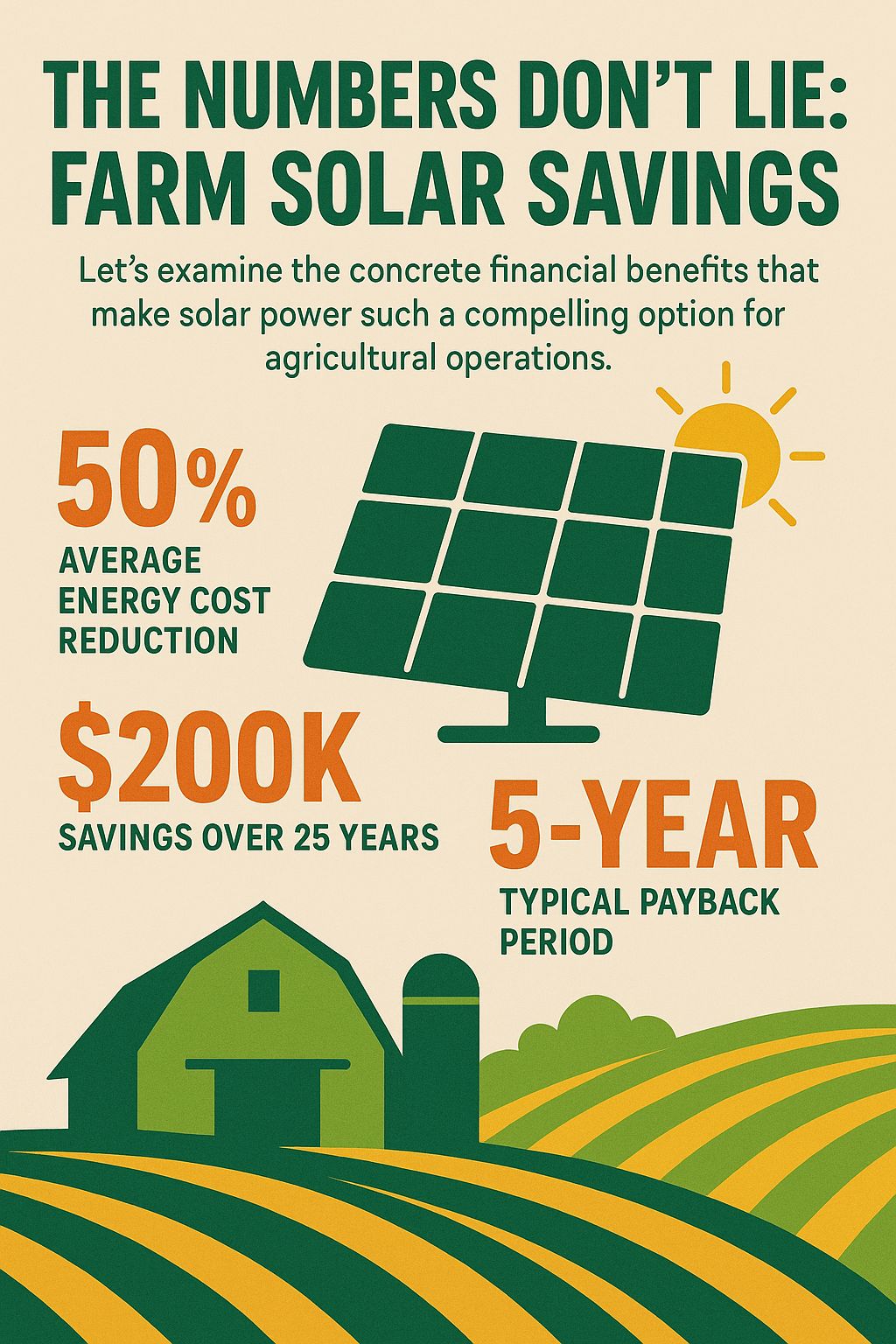
Let’s examine the concrete financial benefits that make solar power such a compelling option for agricultural operations. The numbers reveal why thousands of farmers are making this transition—not as an environmental gesture, but as a strategic business decision with measurable impacts on operational costs and long-term profitability.
Average Monthly Savings on Utility Bills
The immediate impact of solar installation is visible in your very first post-installation electric bill. Farms typically see reductions of 50-70% in monthly electricity costs, with many operations cutting their bills by thousands of dollars each month. This savings begins immediately after system commissioning and continues with minimal degradation throughout the system’s multi-decade lifespan. For a medium-sized operation previously spending $2,000 monthly on electricity, this translates to $1,000-$1,400 in reduced expenses every single month.
These savings are particularly impactful for energy-intensive farming operations. Dairy farms with substantial refrigeration needs, irrigated crop operations with multiple pump stations, and controlled-environment facilities like greenhouses or poultry barns see the most dramatic reductions due to their consistent electricity demands. For many operations, these monthly savings alone justify the transition to solar power without even considering the additional benefits and incentives available.
Payback Period: When Your System Pays for Itself
While the initial investment in solar technology is significant, the payback period for agricultural installations is increasingly attractive. Most farm solar systems reach the break-even point in 5-8 years when accounting for all available incentives and tax benefits. This payback timeline has shortened dramatically over the past decade as equipment costs have fallen while efficiency has improved. After consulting with 8M Solar, many farms discover their effective payback period is even shorter than initially projected due to specialized agricultural incentives not available to residential installations.
The payback calculation becomes even more favorable when considering the opportunity cost of continuing to pay escalating utility rates. Every dollar not spent on electricity becomes working capital that can be reinvested into other aspects of your operation—from equipment upgrades to expansion opportunities. This redirection of funds from operational expenses to capital improvements creates a compounding financial benefit that extends well beyond the direct electricity savings.
Long-Term ROI Over a 25-30 Year Solar Panel Lifespan
Modern agricultural solar installations are engineered to produce clean energy for 25-30 years with minimal degradation, creating decades of positive returns after the initial payback period. When calculated over this operational lifetime, most farm solar systems deliver returns of 15-25% annually—far outperforming many traditional farm investments while requiring minimal oversight or management. For a system with a 6-year payback period and 25-year lifespan, that means 19 years of essentially free electricity production with returns flowing directly to your bottom line.
Protection Against Future Electricity Price Hikes
Perhaps the most valuable aspect of solar investment is the protection it provides against future utility rate increases. While grid electricity prices have consistently risen 2-3% annually and often spike during energy crises, your solar production costs remain fixed after installation. This cost certainty creates predictable operational expenses that improve financial planning and insulate your farm business from energy market volatility for decades to come.
Beyond Energy Bills: Additional Financial Benefits
The direct savings on monthly utility bills represent only the beginning of solar’s financial advantages for agricultural operations. A comprehensive approach to solar investment reveals multiple additional revenue streams and financial incentives that dramatically enhance the overall return profile for farm installations.
Net Metering: Getting Paid for Excess Energy
Net metering programs allow farms to receive credit or payment for excess electricity fed back into the grid when production exceeds consumption. During peak daylight hours, your solar array often generates more power than your operation can use immediately, creating a valuable commodity you can sell back to utility companies. This arrangement effectively turns your meter backward, banking credits that offset consumption during nighttime hours or cloudy periods.
For seasonal agricultural operations, net metering offers particular advantages. Crop production facilities might consume less electricity during winter months while still generating substantial solar output, creating credit balances that offset heavy usage during growing seasons. Similarly, operations with predictable usage patterns can strategically size their systems to maximize these credits during peak production periods.
In many states, agricultural producers receive preferential net metering rates compared to residential customers due to their more predictable production profiles and larger system capacities. These enhanced rates further improve the economics of farm solar installations while creating a secondary income stream from what was previously just an expense category.
Tax Credits and Deductions Available to Farmers
The federal Investment Tax Credit (ITC) remains one of the most significant financial incentives for agricultural solar adoption, allowing farm businesses to deduct 30% of the total system cost directly from their federal tax liability. Unlike deductions that merely reduce taxable income, this credit provides a dollar-for-dollar reduction in taxes owed, effectively reducing your net system cost by nearly one-third. For qualifying agricultural operations, this credit can be carried forward for up to 20 years if your tax liability in the installation year is insufficient to capture the full benefit immediately.
USDA REAP Grants and Low-Interest Loans
The USDA’s Rural Energy for America Program (REAP) offers grants covering up to 25% of total system costs for qualifying agricultural producers in addition to the federal tax credit. These grants, specifically designed for rural businesses and agricultural operations, can dramatically reduce initial capital requirements while accelerating payback timelines. The combination of REAP grants and tax credits can reduce effective system costs by more than 50% in many cases.
For farms preferring to finance their solar installations, REAP also offers guaranteed loan programs with favorable terms specifically for renewable energy projects. These loans typically feature lower interest rates, longer amortization periods, and more flexible qualification criteria than conventional commercial financing options. The program’s agricultural focus means loan officers understand the unique cash flow patterns and seasonal considerations of farm businesses.
Depreciation Benefits for Your Solar Investment
Beyond grants and tax credits, solar systems qualify for accelerated depreciation through the Modified Accelerated Cost Recovery System (MACRS), allowing farms to deduct the remaining system cost over just five years instead of the 25+ year actual lifespan. This front-loaded tax benefit significantly improves cash flow during the critical early years of your solar investment when you’re still recouping initial costs. For farm operations in higher tax brackets, this depreciation benefit alone can reduce effective system costs by an additional 15-20% beyond other incentives.
Many states offer additional tax incentives specifically for agricultural renewable energy projects, including property tax exemptions that prevent your solar investment from increasing your farm’s assessed value. These state-level benefits vary widely but can create substantial additional savings that further enhance your return on investment and accelerate your payback timeline. To understand more about the potential challenges, you can read about the dark side of solar panels for farm power operations.
Real Farms, Real Savings: Success Stories
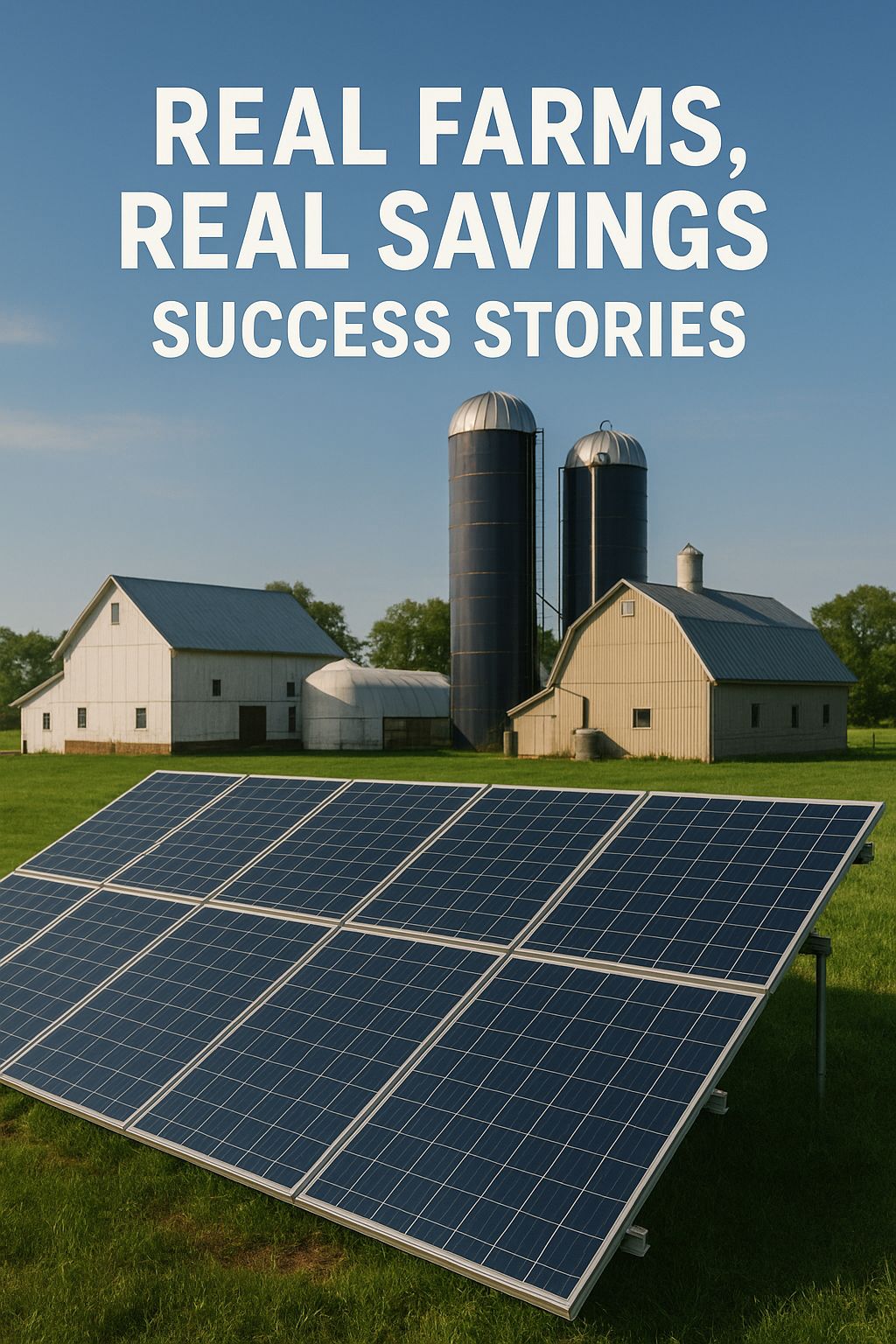
The financial benefits of solar power aren’t theoretical—they’re being realized daily on farms across the country. These case studies demonstrate how agricultural operations similar to yours have transformed their energy expenses into assets through strategic solar investments.
Dairy Farm Case Study: From $2,000 to $600 Monthly Electric Bills
A 200-cow dairy operation in Wisconsin installed a 75kW solar system that reduced their monthly electricity expenses from $2,000 to approximately $600—a 70% reduction that saves $16,800 annually. With substantial energy demands for milk cooling, vacuum pumps, and ventilation, this farm was particularly vulnerable to rising electricity costs. Their system qualified for both federal tax credits and a state-specific agricultural renewable energy grant, reducing the effective installation cost by 55%. With these incentives, their payback period shortened to just 4.5 years, after which they’ll enjoy essentially free electricity for the remaining 20+ years of system life. For more information on how solar power savings impact farmers, explore this detailed analysis.
The dairy owners report that beyond direct savings, their solar installation has created valuable marketing opportunities with milk processors and consumers increasingly concerned with sustainable production practices. This marketing advantage has translated into premium pricing opportunities that further enhance the system’s financial benefits.
Crop Production Facility: Saving $16,800 Annually
A mid-sized grain and vegetable operation in California installed a 100kW ground-mounted solar array to power irrigation pumps, cold storage facilities, and processing equipment. Their system now provides 65% of their total electricity needs, generating annual savings exceeding $16,800. By timing their installation to coincide with an equipment upgrade, they were able to integrate the solar project into existing capital improvement plans, minimizing disruption to operations while maximizing available tax benefits. For more insights, explore the bright side of using the sun to power your farm with solar panels.
This operation utilized USDA REAP funding to cover 25% of the project costs as a direct grant, combined with the 30% federal tax credit and accelerated depreciation. Their effective out-of-pocket expense was less than half the total system cost, creating an exceptional return profile with full payback projected within 5.2 years. The farm owner notes that the predictable energy costs have improved their ability to project operational expenses and pricing models for their produce contracts.
Small Family Farm: 65% Reduction in Energy Costs
A 40-acre diversified family farm in North Carolina installed a 15kW rooftop solar system on their main barn, reducing their annual electricity costs by 65%. While smaller than commercial-scale installations, their system qualified for the same incentive programs, including the federal tax credit and accelerated depreciation. By working with 8M Solar, they were able to identify additional state-level incentives specifically available to small agricultural producers, further enhancing their project economics.
The farm reports that their solar system has become an unexpected agritourism draw, with visitors expressing interest in their renewable energy investments during farm tours and direct sales activities. This educational component has strengthened community connections and improved direct-to-consumer sales of their farm products, creating indirect revenue benefits beyond the direct energy savings.
Planning Your Farm Solar Project
Transitioning to solar power requires careful planning to ensure your investment delivers maximum returns. A methodical approach to system design, financing, and installation creates the foundation for decades of reliable performance and financial benefits.
Step 1: Energy Audit to Determine Your Needs
Before sizing your solar system, conduct a comprehensive energy audit to identify consumption patterns and potential efficiency improvements. Analyzing at least 12 months of utility bills reveals seasonal variations and peak demand periods that inform optimal system sizing. This audit often identifies simple efficiency upgrades that can reduce your overall energy requirements and allow for a smaller, more cost-effective solar installation.
Professional energy auditors specializing in agricultural operations can identify consumption patterns unique to farm settings that might be overlooked in standard assessments. These specialized audits typically cost $500-1,500 but often identify immediate savings opportunities that pay for the service multiple times over before your solar system is even installed.
Step 2: Finding Qualified Agricultural Solar Installers
Agricultural solar installations have unique requirements that differ significantly from residential or commercial projects. Work with installers experienced in farm applications who understand agricultural electrical loads, seasonal operation patterns, and available rural incentive programs. Qualified installers should provide detailed production estimates based on your location’s solar exposure and your specific energy consumption profile, with clear explanations of how these projections translate to financial returns.
Request case studies or references from similar agricultural installations, preferably with systems that have been operational for at least 2-3 years so actual performance can be compared against initial projections. Experienced agricultural solar providers like 8M Solar can often identify optimization opportunities specific to farm operations that generic installers might miss, significantly enhancing your system’s long-term performance and financial returns.
Step 3: Securing Financing and Incentives
Develop a comprehensive financing strategy that maximizes available incentives while aligning with your farm’s cash flow and tax situation. For operations with sufficient tax liability, combining the federal Investment Tax Credit with accelerated depreciation often provides the most favorable economics. Agricultural operations with limited immediate tax capacity might benefit more from grant-based programs like REAP that provide direct funding rather than tax benefits.
Beyond traditional financing, many agricultural lenders now offer specialized solar loan products with terms specifically designed for renewable energy projects. These loans typically feature longer amortization periods that match your system’s energy production curve, ensuring positive cash flow from the first year. Some innovative financing models allow farms to install solar with no upfront cost through power purchase agreements (PPAs) where a third party owns the system while you purchase the electricity at a predetermined rate lower than utility prices.
Step 4: Installation Timeline and What to Expect
Agricultural solar installations typically require 2-4 months from contract signing to system activation, with the actual on-site construction phase usually lasting 1-3 weeks depending on system size and complexity. This timeline allows for permitting, utility interconnection applications, and equipment procurement before any physical work begins on your property. Most installers can schedule construction around critical farming operations to minimize disruption during planting, harvest, or other sensitive periods.
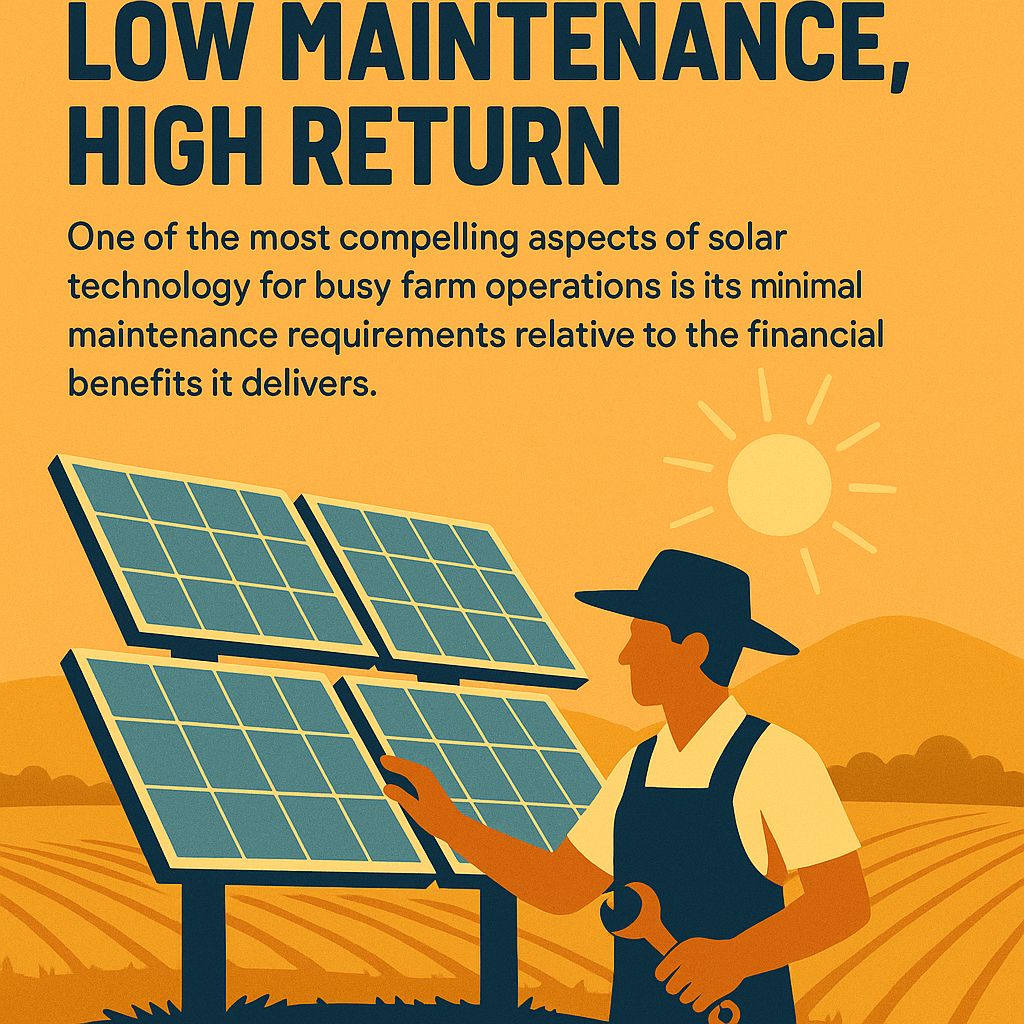
Low Maintenance, High Return
One of the most compelling aspects of solar technology for busy farm operations is its minimal maintenance requirements relative to the financial benefits it delivers. Unlike tractors, irrigation systems, or other farm equipment that demand regular attention, solar arrays operate silently in the background with very little ongoing care required to maintain peak performance.
Minimal Upkeep Requirements for Solar Systems
Modern solar installations require remarkably little maintenance over their multi-decade operational life. With no moving parts in the panels themselves, routine maintenance primarily consists of occasional cleaning to remove dust buildup that might reduce efficiency. In many agricultural regions with regular rainfall, natural precipitation often provides sufficient cleaning without manual intervention. Most system components are designed to operate for 25+ years without replacement, creating an exceptionally low maintenance burden compared to other farm systems.
Weather Resistance and Durability in Farm Environments
Agricultural solar installations are engineered to withstand harsh farming environments including extreme temperatures, dust, and severe weather events. Modern panels are tested to withstand one-inch hail impacts at terminal velocity and wind loads exceeding 140 mph in properly designed mounting systems. This durability is particularly valuable in agricultural settings where equipment is constantly exposed to environmental stresses. For more insights on how solar power impacts farming, visit Growing Solar Mist.
Most quality solar panels carry 25-year performance warranties that guarantee at least 80% of original output even after a quarter-century of continuous operation. This exceptional longevity creates tremendous value for farm operations, as the system continues generating substantial savings long after the initial investment has been recovered.
Performance Monitoring to Maximize Savings
- Real-time production monitoring through mobile apps allows instant verification that your system is performing as expected
- Automated alert systems notify you immediately if production drops unexpectedly, allowing rapid diagnosis of any potential issues
- Performance data integration with farm management software helps correlate energy production with operational activities
- Annual performance reviews identify any efficiency trends requiring attention before they significantly impact your savings
These monitoring capabilities transform solar from a passive investment into an actively managed farm asset that consistently delivers optimal returns. Many agricultural installations include enhanced monitoring systems that track not just energy production but also consumption patterns across different farm operations, providing valuable insights for overall energy management beyond the solar system itself. For further insights, explore the common efficiency killers on a farm’s solar panels.
The combination of durability, minimal maintenance requirements, and comprehensive monitoring creates exceptional peace of mind for farm operators already managing countless other systems and equipment. Your solar array silently generates savings day after day, requiring almost none of the attention demanded by traditional farm equipment while delivering consistent financial benefits throughout its multi-decade lifespan.
For operations with limited maintenance capacity or those seeking to reduce overall workload, solar represents one of the most hands-off investments available in modern agriculture. This operational simplicity creates particular value for family farms transitioning between generations or operations looking to redirect labor toward higher-value activities than equipment maintenance.
Solar Panel Placement Options for Maximum Farm Efficiency
Strategic placement of solar arrays on your agricultural property can dramatically impact both energy production and land use efficiency. Beyond simply generating electricity, thoughtfully designed solar installations can complement existing farm operations and create multiple benefits from the same land area.
Roof Mounted vs. Ground Mounted Systems
Roof mounted systems utilize existing structures like barns, equipment sheds, and livestock buildings without consuming additional land area. These installations typically cost less than ground mounts due to reduced structural requirements and simplified electrical connections to buildings already consuming substantial energy. For operations with large, structurally sound roof areas oriented within 45 degrees of true south, roof mounting often provides the most economical installation approach while preserving all productive land for agricultural use.
Ground mounted systems offer superior optimization for sun exposure, panel angle, and maintenance access when suitable roof space is limited or poorly oriented. While consuming some land area, these installations can be strategically placed on marginal or less productive portions of your property. Modern ground mount designs minimize land disturbance and allow for easy removal if land needs change in the future, preserving long-term flexibility for your operation. For more insights, explore how solar power savings impact farmer bottom line costs.
Many farms implement hybrid approaches combining both mounting strategies to maximize total capacity while minimizing productive land use. This diversified approach also creates system redundancy, as roof and ground installations often experience different environmental conditions and maintenance challenges.
Dual-Use Solar: Agrivoltaics for Land Optimization
Innovative agrivoltaic systems enable continued agricultural production beneath and between solar panels, creating dual-income streams from the same land area. These systems typically elevate panels 8-12 feet above ground level with wider spacing than traditional arrays, allowing sufficient light penetration for many crops while creating partially shaded microclimates that benefit certain plants and grazing animals. Research demonstrates that some crops—particularly leafy greens, berries, and shade-tolerant vegetables—can achieve comparable or even improved yields in these controlled light environments while simultaneously generating substantial electricity revenue.
Strategic Positioning to Avoid Crop Shadows
Thoughtful array placement prevents unwanted shading on high-value cropland while maximizing energy production from your available property. Conducting a comprehensive solar site assessment identifies optimal locations that balance energy potential with existing agricultural activities. Many farms utilize field borders, drainage areas, or north-facing slopes that receive full sun but have lower crop productivity potential for solar installations, preserving prime growing areas while still capturing renewable energy benefits.
Cut Costs and Grow Your Farm Business with Solar Power
Solar energy represents a powerful tool for modern farm financial management, transforming unpredictable, ever-increasing electricity expenses into fixed, declining costs that improve both immediate cash flow and long-term profitability. By leveraging available incentives, optimizing system design for agricultural applications, and integrating renewable energy into your broader farm management strategy, you’re positioning your operation for decades of enhanced financial performance while building resilience against future energy challenges. 8M Solar specializes in helping farm operations navigate this transition with agricultural-specific expertise that maximizes both energy production and financial returns from your renewable energy investment.
Frequently Asked Questions (FAQ)
The following questions address the most common concerns farmers have when considering solar investments. These practical answers help clarify the real-world implications of adding renewable energy to your agricultural operation.
Understanding these fundamentals helps you approach solar as a strategic business decision rather than simply an environmental choice or technical upgrade. The financial and operational benefits extend far beyond basic electricity savings when properly integrated into your overall farm management approach. For more insights, consider exploring how solar power savings impact farmer bottom line costs.
How much can a farm typically save each year with solar panels?
Most farms save between 50-70% on their annual electricity costs after installing appropriately sized solar systems. For a farm previously spending $20,000 annually on electricity, this translates to $10,000-$14,000 in first-year savings, with this amount likely increasing over time as utility rates rise while your solar production costs remain fixed. Actual savings vary based on your location’s solar exposure, local utility rates, consumption patterns, and system design, but most agricultural installations deliver payback periods between 5-8 years through direct electricity savings alone.
Beyond direct utility savings, many farms realize additional financial benefits through net metering credits, demand charge reductions, and protection against seasonal rate fluctuations that can dramatically improve overall project economics. These combined benefits often create total returns exceeding 20% annually over the system’s operational life—far outperforming many traditional farm investments.
What size solar system does my farm need?
System sizing depends primarily on your electricity consumption patterns, available installation space, and financial objectives. Most agricultural operations achieve optimal economic returns by sizing systems to offset 70-90% of annual electricity usage rather than aiming for 100% offset. This approach maximizes available incentives while avoiding potential complications with utility interconnection agreements that sometimes arise with larger systems. A comprehensive energy audit and solar assessment will identify your optimal system size based on actual consumption data and site-specific factors.
Do solar panels work well in cloudy or cold agricultural regions?
Modern solar technology performs effectively even in regions with seasonal cloud cover or cold temperatures. While sunny southern locations produce more annual electricity per installed watt, northern farms often realize comparable financial returns due to higher electricity rates and specialized panel designs optimized for diffuse light conditions. Counterintuitively, solar panels actually operate more efficiently in cooler temperatures, as excessive heat can reduce performance. Many of the most profitable farm solar installations are in the upper Midwest and Northeast rather than the traditionally sunny Southwest, demonstrating the technology’s adaptability to diverse agricultural regions.
How do I know if my farm qualifies for solar incentives?
Most agricultural operations qualify for multiple solar incentives, though eligibility requirements vary by program. The federal Investment Tax Credit is available to all taxpaying entities including farms, while USDA REAP grants specifically target rural businesses including agricultural producers. State-level incentives vary widely but often include specialized programs for farm operations that aren’t available to other business types.
The most reliable approach is consulting with an agricultural solar specialist who maintains current knowledge of available incentives across federal, state, and local programs. These experts can quickly assess your operation’s eligibility for specific programs based on factors including:
- Farm size, revenue, and organizational structure (sole proprietorship, LLC, corporation)
- Geographic location and utility service territory
- Specific agricultural activities (livestock, crops, processing, etc.)
- Prior participation in government agricultural or energy programs
With constantly evolving incentive programs, working with specialists who focus specifically on agricultural renewable energy ensures you capture all available benefits for your unique operation. Even farms that previously investigated solar and found it financially marginal often discover that updated incentives or improved technology now create compelling returns.
Can I install solar panels myself to save on costs?
While technically possible, DIY installation sacrifices numerous financial advantages available through professional agricultural solar providers. Professional installations qualify for manufacturer warranties, insurance coverage, and often preferential incentive rates unavailable to self-installed systems. Most importantly, agricultural-specific incentives like REAP grants typically require credentialed installers with specific certifications for project eligibility.
Beyond these financial considerations, professional agricultural solar installers navigate complex utility interconnection requirements, structural engineering standards, and electrical code compliance issues that frequently challenge DIY installations. The potential savings from self-installation are typically far outweighed by reduced incentive eligibility, warranty coverage, and system performance over its multi-decade operational life.


Leave a Reply