
Key Takeaways
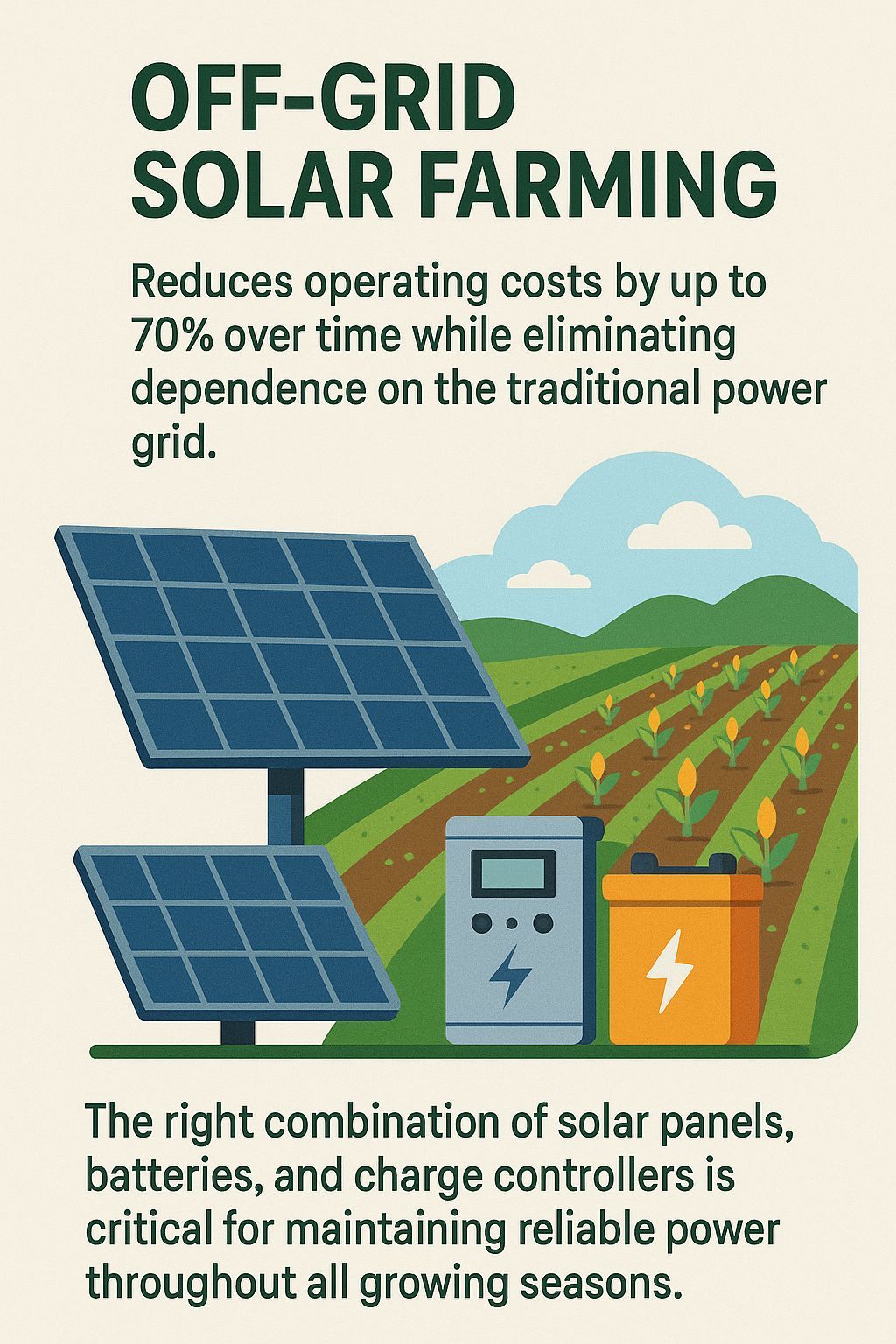
- Off-grid solar farming reduces operating costs by up to 70% over time while eliminating dependence on the traditional power grid
- The right combination of solar panels, batteries, and charge controllers is critical for maintaining reliable power throughout all growing seasons
- Sizing your system correctly based on comprehensive energy needs analysis prevents costly system failures during peak demand periods
- Solar-powered irrigation systems can increase water efficiency by 30-40% while operating with zero fuel costs
- According to GrowingSolarMist.com, farms that transition to off-grid solar systems typically see return on investment within 5-7 years depending on system size and available incentives
Breaking free from the utility grid isn’t just for homesteaders anymore. For modern farmers, off-grid solar represents the path to energy independence, sustainability, and long-term profitability.
Transform Your Farm with Solar: The Off-Grid Revolution
The agricultural landscape is changing rapidly as climate concerns, rising energy costs, and grid reliability issues push farmers toward sustainable alternatives. Off-grid solar systems have emerged as a powerful solution that addresses these challenges while creating new opportunities for farm efficiency and resilience. GrowingSolarMist.com has been at the forefront of helping farmers understand how solar technologies can transform agricultural operations into energy-independent enterprises that thrive regardless of what happens to traditional energy infrastructure.
What is Off-Grid Farming
Off-grid farming refers to agricultural operations that function independently from municipal utility services, particularly electricity from the power grid. Instead of relying on utility companies, off-grid farms generate their own power through renewable sources—primarily solar energy. This approach provides complete energy autonomy, allowing farmers to operate in remote locations where grid connections are unavailable or prohibitively expensive. More importantly, it shields agricultural businesses from power outages, rate hikes, and energy supply disruptions that could devastate crops or livestock operations dependent on consistent power.
Why Solar Power is Perfect for Off-Grid Farms
Farms possess natural advantages that make them ideal candidates for solar power. Most agricultural operations have ample unused space—whether on rooftops, open fields, or even floating on irrigation ponds—that can accommodate solar arrays without compromising productive land. Unlike residential installations that might face space constraints, farms can scale their solar capacity to meet their exact needs. For more information on optimizing solar systems, check out this solar panel efficiency guide.
The seasonal nature of farming also aligns remarkably well with solar energy production. In most regions, peak solar production occurs during summer months when many farms need maximum power for irrigation, cooling systems, and processing equipment. Additionally, the distributed nature of farm buildings and operations allows for strategic placement of solar assets across the property, creating multiple generation points that enhance system reliability.
Cost Savings vs. Initial Investment Reality
Let’s address the elephant in the barn: off-grid solar systems require significant upfront investment. A complete system capable of powering a midsize farm operation typically costs between $25,000 and $100,000 depending on energy requirements, component quality, and installation complexity. However, this initial investment must be weighed against the lifetime cost of purchasing electricity or diesel fuel.
When properly sized and maintained, an off-grid solar system will generate free electricity for 25+ years after the initial investment is recovered, typically within 5-7 years. Many farmers report 60-80% reductions in overall energy expenditures after transitioning to solar. Additional financial benefits include protection from utility rate increases (which historically rise 2-3% annually), potential income from carbon credits, and significant tax advantages through depreciation and renewable energy incentives.
“My diesel generator used to cost me $7,200 annually in fuel alone, not counting maintenance. Since installing our solar system three years ago, our total energy costs have dropped to under $1,000 per year for occasional maintenance. The system will completely pay for itself by year five.” – James Moretti, Organic Vegetable Farmer, California
Essential Components of an Off-Grid Solar Farm System
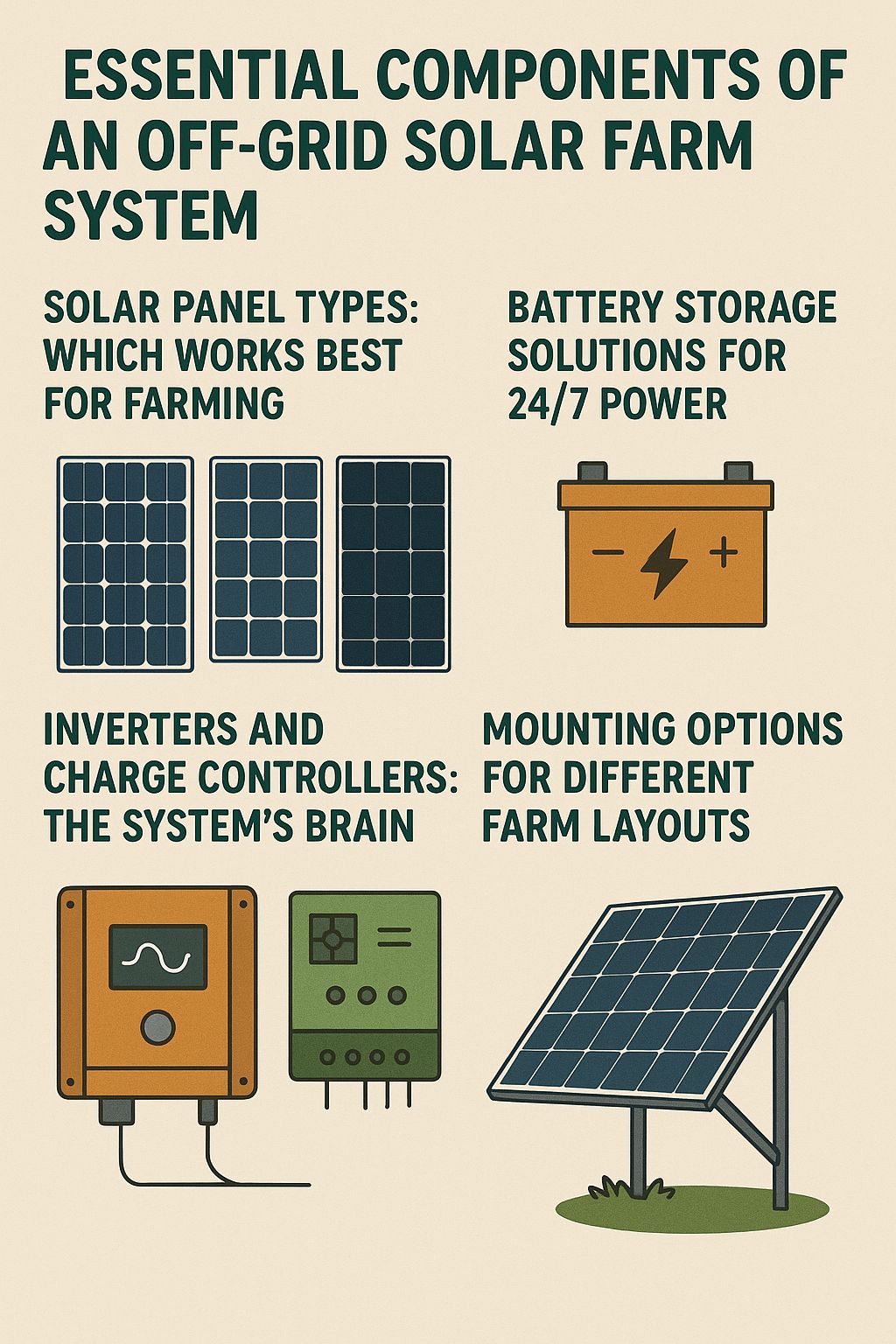
Solar Panel Types: Which Works Best for Farming
The foundation of any off-grid solar system is the panel array, and choosing the right type dramatically affects performance and longevity. For agricultural applications, monocrystalline panels typically offer the best combination of efficiency, durability, and space utilization. These panels convert 17-22% of available sunlight into electricity, compared to 13-17% for polycrystalline alternatives. While monocrystalline panels cost 15-20% more initially, their superior performance in partial shading and high-temperature conditions makes them ideal for farm environments.
Monocrystalline panels typically offer the highest efficiency ratings (17-22%) and smallest footprint for solar irrigation applications, making them ideal for installations with limited space. Though commanding a price premium of approximately 15-20% over polycrystalline alternatives, their superior performance in high-temperature conditions and better low-light electricity generation often justify the additional investment for agricultural applications requiring consistent power output. For drip systems requiring steady pressure maintenance, this performance consistency is particularly valuable.
Polycrystalline panels provide a cost-effective alternative with slightly lower efficiency ratings (13-17%) but substantial durability for farm environments. The larger footprint requirement becomes less significant in agricultural settings where space constraints are minimal compared to residential installations. For micro-sprinkler systems that can tolerate slight pressure variations without significantly impacting performance, polycrystalline panels often represent the most economical solution with favorable payback periods.
Thin-film panels represent a fundamentally different approach to solar technology. Instead of using crystalline silicon wafers, thin-film panels deposit semiconductor materials like amorphous silicon, cadmium telluride, or copper indium gallium selenide onto backing substrates. The result is an incredibly thin, lightweight, and sometimes flexible panel that opens up installation possibilities on non-traditional surfaces. Though less efficient (typically 10-13%) than crystalline options, thin-film technology excels in high-temperature environments and can be integrated into building materials like roofing shingles.
PERC (Passivated Emitter and Rear Cell) panels are a newer technology that enhances the efficiency of traditional monocrystalline and polycrystalline panels by adding a layer that reflects unused sunlight back into the cell. This innovation can significantly boost energy output, especially in low-light conditions.
Choosing the right type of solar panel for your system is crucial. Consider the specific needs of your operations, the available space, and your budget. This below table will help you choose the right one:
|
Type of Solar Panel |
Advantages |
Disadvantages |
|---|---|---|
|
Monocrystalline Solar Panels | ||
|
– Performance drops slightly in extreme heat. 1 | ||
|
– Performs well in low-light conditions (cloudy days, mornings). 1, 2 | ||
|
Polycrystalline Solar Panels |
– Cost-effective option, suitable for large-scale installations. 1, 3 |
– Lower efficiency (13-17%) compared to monocrystalline panels. 1, 3 |
|
– Durable and handles heat well. 3 |
– Requires more space for the same energy output as monocrystalline panels. 3 | |
|
– Affordable initial investment, often offset by government incentives. 3 | ||
|
Thin-Film Solar Panels |
– Lightweight, flexible, and easy to install on unconventional surfaces (e.g., curved roofs)1, 5, 7 |
– Lowest efficiency (10-13%) among the options, requiring more space for equivalent output. 5, 7 |
|
– Performs well in high temperatures and low-light conditions, ideal for diverse climates. 5, 7 |
– Shorter lifespan (10-20 years) compared to crystalline panels. 5, 7 | |
|
– Cost-effective with lower production and installation costs. 5, 7 |
– Bulkier installations needed for larger-scale energy production. 5 | |
|
PERC Solar Panels |
– Enhanced efficiency (Up to 22% or higher) due to passivation layer, capturing more sunlight. 4 |
– Higher cost than traditional Monocrystalline panels, but prices are becoming comparable. 4 |
|
– Performs well in low-light and high-temperature conditions, ideal for varied climates. 2, 4 |
– Technology may be less familiar, requiring specialized installation expertise. 4 | |
|
– Maximizes energy output in limited space, suitable for farms with restricted installation areas. 4 |
This table provides a comparison of solar panel options for farmers, highlighting their suitability based on efficiency, cost, durability, and space requirements. Farmers should consider their specific energy needs, budget, and available installation area when making a decision.
Battery Storage Solutions for 24/7 Power
Without reliable battery storage, your off-grid solar farm becomes useless after sunset. Modern battery technologies have revolutionized energy storage options for agricultural applications. Lithium iron phosphate (LiFePO4) batteries have emerged as the preferred choice for serious off-grid systems, offering 3,000-7,000 cycle lifespans—translating to 10+ years of daily use. Though costing 2-3 times more than traditional lead-acid batteries initially, their longer lifespan, deeper discharge capability (up to 80% vs. 50%), and minimal maintenance requirements make them more economical over time.
For larger operations, consider battery bank redundancy by creating multiple smaller battery arrays rather than a single large bank. This approach prevents total system failure if one component malfunctions and allows for staged replacement of batteries as they age. When sizing your battery bank, plan for at least 3-5 days of autonomy—the ability to run essential systems without solar input during cloudy periods. Most farm operations require a minimum of 20-30 kWh of storage capacity, with larger operations often needing 50-100 kWh or more.
Inverters and Charge Controllers: The System’s Brain
The inverter and charge controller represent the intelligence of your off-grid solar system. These components determine how efficiently your panels generate power and how effectively that power is distributed to your farm operations. For agricultural applications, pure sine wave inverters are non-negotiable, as they produce the clean power necessary for sensitive equipment like water pumps, refrigeration systems, and electronics. Select inverters with surge capacity at least 3 times your continuous load to handle motor startup demands from equipment like water pumps and compressors.
Maximum Power Point Tracking (MPPT) charge controllers optimize energy harvest by continuously adjusting the electrical operating point of your solar panels. These controllers typically extract 15-30% more energy than simpler PWM controllers, making them essential for maximizing return on investment. For reliability in harsh farm environments, choose controllers with conformal coating to resist dust and moisture, and look for models with data logging capabilities that help identify system performance issues before they cause failures.
Mounting Options for Different Farm Layouts
How and where you mount your solar panels significantly impacts their performance and durability. Ground-mounted systems offer the greatest flexibility for most farms, allowing optimal positioning for maximum sun exposure. Fixed ground mounts typically cost $0.20-$0.50 per watt in addition to panel costs but provide the best combination of accessibility for maintenance and storm resistance. For farms with limited ground space, pole mounts elevate panels above crops or livestock areas, creating dual-use spaces that maintain productive land while generating power.
Tracking systems that follow the sun’s path can increase energy production by 25-45% compared to fixed mounts, though they add approximately $0.75-$1.00 per watt to system costs and introduce moving parts that require maintenance. For most agricultural applications, the simplicity and reliability of fixed ground mounts oriented to maximize seasonal production during periods of highest farm energy usage provides the best return on investment. Building-mounted systems offer protection from ground-level hazards but may compromise ideal orientation and increase installation complexity. Learn more about solar tracking systems and their impact on energy efficiency.
Sizing Your Solar System for Off-Grid Solar Operations
Calculate Your Farm’s Energy Needs
Accurate system sizing begins with a comprehensive energy audit. Document every piece of electrical equipment on your farm, its wattage, and daily hours of operation. Pay special attention to motor-driven equipment like pumps and compressors, which can draw 3-5 times their rated wattage during startup. Create separate calculations for critical loads (irrigation, ventilation, refrigeration) versus convenience loads that could be temporarily suspended during low energy periods.
Most small to medium farms require systems in the 10-25 kW range, while larger operations with substantial processing equipment may need 50+ kW systems. Remember that undersizing your system leads to frustration and potential crop losses, while oversizing unnecessarily increases your initial investment. A properly sized system should meet 100% of critical loads and at least 80% of total farm energy needs during normal operation, with sufficient battery storage to maintain critical systems through extended low-production periods.
Accounting for Seasonal Changes in Energy Production
Solar production varies dramatically throughout the year, with winter months typically generating 30-70% less energy than summer depending on your latitude. This seasonal variability demands careful planning to match your farm’s energy cycles with production capacity. For northern latitude farms, panels should be tilted more steeply (latitude plus 15 degrees) to maximize winter production when solar resources are scarce. To better understand how solar can power your farm throughout the year, explore off-grid solar solutions for farms.
Develop an annual energy calendar mapping your farm’s monthly electricity requirements against expected solar production. If your peak farm activities align with peak solar production, you may need less battery storage than operations with high winter energy demands. Consider implementing seasonal operating strategies—scheduling energy-intensive activities like grain drying or processing during high-production months and shifting to lower-power activities during winter. For more insights on optimizing solar efficiency, explore solar tracking systems that can enhance your farm’s solar output.
Planning for Growth: Scalable System Design
The most successful off-grid farm systems incorporate scalability from the beginning. Design your initial system with expansion in mind by selecting charge controllers and inverters that can accommodate additional capacity, installing appropriately sized wiring, and creating mounting infrastructure that allows for panel additions. Many farmers find success in phased implementation, starting with critical systems and expanding as budget allows and experience grows.
Modular system architecture provides both expandability and redundancy. Rather than a single large inverter, consider multiple smaller units that can operate independently. This approach allows you to maintain partial operations during maintenance or component failures and facilitates incremental system expansion without replacing existing equipment. Prepare for technological evolution by designing battery enclosures and mounting systems that can accommodate different component dimensions as you upgrade over time. For more on enhancing solar systems, explore solar tracking systems that increase solar panel efficiency.
Solar-Powered Farm Equipment That Saves Money
Beyond providing general electricity, solar power can directly operate specialized equipment designed for renewable energy sources. These purpose-built systems often achieve greater efficiency than converting conventional equipment to solar power, providing both immediate operational benefits and long-term cost savings. Each piece of solar-direct equipment eliminates another fossil fuel dependency while reducing maintenance requirements and operating costs.
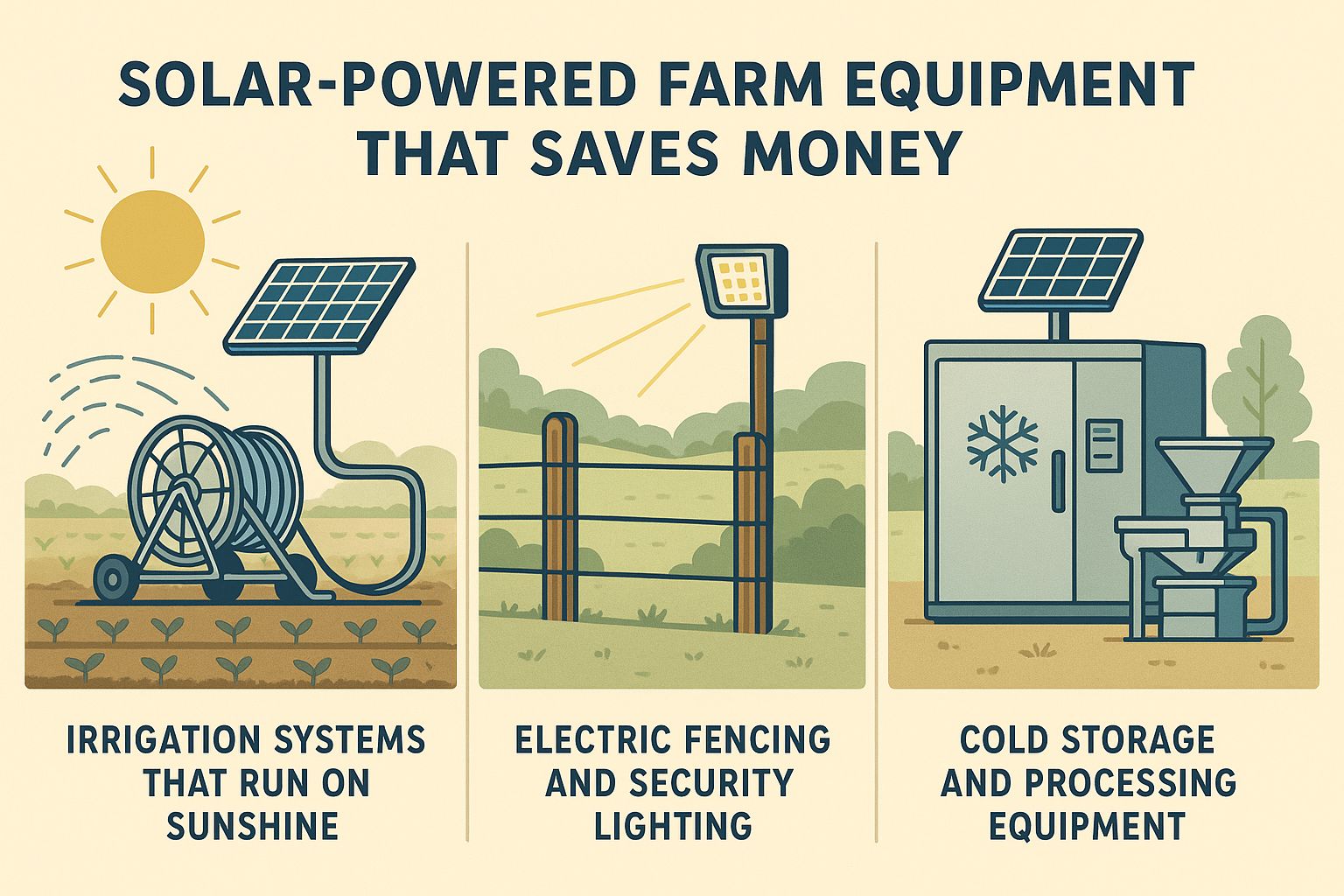
Irrigation Systems That Run on Sunshine
Solar-powered irrigation represents one of the most impactful applications of renewable energy in agriculture. Direct-coupled solar pumping systems operate without batteries by pumping water only when the sun shines, using elevated tanks or ponds for gravity-fed distribution when needed. These systems eliminate fuel costs entirely while providing greatest water output during the hottest, sunniest periods when crops typically need maximum irrigation.
Variable frequency drive (VFD) pumps adjust their speed based on available solar power, allowing operation even during partially cloudy conditions. Modern solar irrigation controllers can integrate soil moisture sensors and weather data to optimize watering schedules, reducing water usage by 30-40% compared to timer-based systems. For farms with consistent water needs, hybrid pump systems incorporate battery storage to extend pumping hours beyond daylight, ensuring reliable water supply with minimal grid dependency.
Electric Fencing and Security Lighting
Electric fencing powered by dedicated solar chargers provides reliable livestock containment without trenching power lines across your property. Modern solar fence chargers deliver 5,000-10,000 volts with minimal power consumption, typically requiring only a 10-30 watt panel and small battery for continuous operation. These self-contained units maintain charge during cloudy periods and include diagnostic displays that alert you to fence problems before containment is compromised.
Security lighting represents another low-hanging fruit for solar conversion. Solar-powered LED fixtures with motion sensors and dawn-to-dusk controllers provide targeted illumination exactly where needed without running electrical lines to remote areas. These fixtures typically include built-in batteries sized to provide 3-5 nights of operation during cloudy periods, ensuring continuous security without requiring connection to your main power system. Strategic placement of solar security lights around livestock areas, equipment storage, and processing facilities deters trespassers and predators while improving nighttime work safety.
Cold Storage and Processing Equipment
Preserving harvested crops requires reliable cooling, traditionally one of the most energy-intensive farm operations. DC-powered refrigeration systems designed specifically for solar applications consume 30-50% less electricity than conventional AC units by eliminating the conversion losses from DC solar power to AC and back to DC within the compressor. These specialized units can run directly from solar panels during daylight hours, then switch to battery power at night, maintaining critical temperature control with minimal energy input.
For smaller operations, phase-change thermal storage systems that “freeze” specialized materials during peak solar production can release cold gradually over 24-48 hours, effectively storing cooling power rather than electricity. This approach significantly reduces battery requirements for refrigeration systems. For processing equipment like grain dryers, dehullers, and small mills, timing operations to coincide with peak solar production can reduce or eliminate battery storage requirements, allowing direct power flow from panels to equipment when the sun is strongest.
Maintaining Your Farm’s Off-Grid Solar System
Seasonal Maintenance Checklist
A systematic maintenance program protects your solar investment and prevents costly downtime during critical farming periods. Each season requires specific attention to different system components. Spring maintenance should focus on inspecting panels for winter damage, cleaning accumulated dirt that reduces efficiency, and checking mounting hardware that may have loosened during freeze-thaw cycles. Summer brings peak production but also heat stress on components—inspect battery enclosures for proper ventilation and verify that charge controllers aren’t operating near their temperature limits.
Fall maintenance prepares your system for lower production months by thoroughly cleaning panels to maximize capture of less intense winter sunlight, testing battery capacity before the high-demand winter months, and ensuring all connections are weathertight before winter precipitation. Winter monitoring should include snow removal from panels when accumulation exceeds 2-3 inches, verifying that battery enclosures maintain temperatures above 40°F for optimal performance, and monitoring system performance data to catch reduced output that might indicate problems requiring attention.
- Monthly: Check system monitoring data for production anomalies; inspect visible connections for corrosion
- Quarterly: Clean panels thoroughly; check battery fluid levels (for flooded lead-acid types); test backup generator
- Biannually: Thermal imaging of electrical connections to identify hot spots; full battery capacity testing
- Annually: Professional inspection of mounting hardware; calibration of charge controllers and inverters
Troubleshooting Common Issues
Even well-maintained solar systems occasionally develop problems. A systematic troubleshooting approach helps identify issues before they escalate to system failures. If your system shows reduced output, first check for physical issues like panel shading from growing vegetation, accumulated dirt or bird droppings, or snow cover. Next, verify electrical connections between panels and throughout the system, looking for corrosion, loose connections, or rodent damage to wiring. For unexplained battery drain, use a clamp meter to identify phantom loads drawing power when equipment should be off.
System performance data provides the most valuable troubleshooting insights. Most modern charge controllers and inverters record daily energy harvest, battery state of charge, and load consumption. Sudden changes in these metrics without corresponding weather changes often indicate developing problems. Establish baseline performance expectations for each month based on your first year of operation, then compare actual performance against these benchmarks to spot degradation before it becomes critical.
When to Call a Professional
While many maintenance tasks can be handled by the farm owner, certain situations warrant professional intervention. Call a solar professional immediately if you notice arcing, burning smells, or unusual noises from any system component. These symptoms indicate potentially dangerous electrical faults. Similarly, professional help is needed if batteries consistently fail to reach full charge despite adequate sunlight, show excessive temperature during charging, or display significant voltage differences between cells.
Annual professional inspections provide preventative value far exceeding their cost. Certified solar technicians can perform specialized diagnostics like IV curve traces that identify underperforming panels, infrared scanning that reveals connection issues invisible to the naked eye, and battery load testing that predicts failure before it occurs. Most system warranties require documented professional maintenance to remain valid, making regular professional service both a technical and financial necessity.
Real Farmers, Real Results: Success Stories
Small Vegetable Farm: 100% Solar Powered
When Maria Alvarez inherited her family’s 5-acre vegetable farm in New Mexico, unreliable grid power was constantly compromising her irrigation schedule and cold storage. After installing a 12kW solar system with 40kWh of lithium battery storage, her operation achieved complete energy independence. The system powers precision drip irrigation, walk-in coolers for harvested crops, and all farm buildings with zero utility costs. Most importantly, the system eliminated crop losses from power outages during critical summer growing periods when grid failures were most common. Learn more about off-grid farming powered by solar panels.
Maria’s system included 36 high-efficiency 335-watt panels, a 15kW hybrid inverter, and a sophisticated energy management system that prioritizes critical farm loads. The $42,000 investment qualified for a 26% federal tax credit and USDA REAP grant covering 25% of costs, reducing her out-of-pocket expense to approximately $20,000. With previous utility bills averaging $350 monthly and generator fuel costs eliminated, the system achieved payback in under 5 years. The farm now produces certified organic vegetables with zero carbon footprint from energy use, allowing premium pricing that further improves profitability.
Livestock Operation: How Solar Improved Profitability
Fourth-generation cattle rancher Thomas Wilson struggled with the high costs and logistical challenges of operating water pumps across 2,000 acres of grazing land. Diesel generators required constant refueling and maintenance, while utility line extensions would have cost over $15,000 per mile. By installing distributed solar water pumping systems at each of six watering stations, he eliminated fuel costs entirely while improving cattle health through reliable water access.
Each pumping station includes a 1.2kW solar array directly powering a submersible pump that fills elevated storage tanks during daylight hours. The gravity-fed water distribution ensures consistent water availability even when the sun isn’t shining. The system’s simplicity eliminated most maintenance requirements—with no batteries or complex electronics, reliability has been nearly 100% over five years of operation.
Beyond direct cost savings of approximately $8,200 annually in fuel and maintenance, the improved water distribution allowed Thomas to utilize previously undergrazing portions of his land. This optimization increased carrying capacity by 15% without purchasing additional property. The elimination of noisy generators also reduced stress on livestock, contributing to weight gain improvements averaging 5-7% across the herd. For more information on enhancing farm efficiency, explore the benefits of solar pump inverters.
The solar pumping systems’ $32,000 total investment reached payback in just four years through operational savings and improved production value. Thomas has since expanded to solar-powered electric fencing, allowing rotational grazing patterns that further improve land utilization and cattle health.
- Complete elimination of fuel costs for water pumping operations
- Reduced cattle travel distance to water sources by 40%
- 15% increase in effective grazing land utilization
- Maintenance requirements reduced from weekly to quarterly checks
- System functionality maintained through extreme weather events that previously disabled generators
Tax Incentives and Grants for Solar Farming
The financial case for off-grid solar farming improves dramatically when you leverage available incentive programs. Federal, state, and utility programs can reduce initial system costs by 30-60%, significantly accelerating payback periods and improving return on investment. Understanding and applying for these programs requires planning but delivers substantial benefits that can make the difference between marginal and exceptional project economics.
Federal Tax Credits That Cut Your Costs
The federal Investment Tax Credit (ITC) remains the most significant financial incentive for agricultural solar installations. This program currently provides a 30% tax credit against the total installed cost of qualifying solar systems with no upper limit on project size. Unlike a deduction that only reduces taxable income, this credit directly reduces your tax liability dollar-for-dollar. For a typical $50,000 farm solar system, this translates to $15,000 in federal tax savings, effectively reducing your net investment to $35,000. The 30% credit rate is confirmed through 2032, after which it will step down to 26% in 2033 and 22% in 2034 before expiring for residential installations (but remaining at 10% for commercial systems) in 2035. Learn more about maintaining solar panel efficiency for your farm.
State-Specific Agricultural Solar Incentives
While federal incentives provide a solid foundation, state-level programs often deliver even greater financial benefits. California’s Net Energy Metering Aggregation (NEMA) program allows farmers to offset electricity used across multiple meters from a single solar array, maximizing utility savings. New York’s NY-Sun program provides direct cash incentives of $0.35-$0.50 per watt for agricultural solar installations, reducing upfront costs significantly.
Massachusetts offers the SMART program, providing performance-based incentives paid monthly over 10 years, with additional adders for agricultural installations that incorporate dual-use concepts like grazing or crop production beneath elevated panels. Oregon’s Renewable Energy Development Grants cover up to 35% of system costs for agricultural producers, with maximum grants of $250,000 for larger operations.
Many states offer property tax exemptions ensuring that adding solar systems won’t increase your farm’s property tax assessment. This often-overlooked benefit provides thousands in tax savings over system lifetime. Additionally, at least 25 states offer sales tax exemptions on solar equipment purchases, immediately reducing system costs by 4-7% depending on local tax rates. For more information on how solar power is transforming rural living, check out rural solar power innovations.
Specialized agricultural solar incentives in states like Minnesota, Vermont, and Iowa provide additional funding specifically for farm operations transitioning to renewable energy. These programs recognize the unique needs and benefits of agricultural solar applications, often providing higher incentive rates than general commercial solar programs.
The combination of federal tax credits, state incentives, accelerated depreciation, and utility programs can reduce the effective cost of agricultural solar systems by 50-75% in many regions. A $100,000 system might have net costs of just $25,000-$50,000 after applying all available incentives, dramatically improving financial returns.
USDA Grants for Renewable Energy
The USDA’s Rural Energy for America Program (REAP) offers both grants and loan guarantees specifically designed for agricultural producers implementing renewable energy systems. REAP grants cover up to 25% of total eligible project costs, with maximum grant awards of $500,000 for renewable energy systems. The program’s guaranteed loan component can finance up to 75% of project costs with terms up to 30 years, often securing more favorable interest rates than conventional financing. Applications typically open twice annually, with simplified applications available for projects under $80,000 and more detailed requirements for larger installations.
Your Path to Energy Independence Starts Now
Off-grid solar represents not just a practical solution to rising energy costs but a fundamental shift toward agricultural resilience and sustainability. By generating your own clean power, you gain control over one of farming’s most essential and historically volatile inputs. The technology has matured, costs have declined dramatically, and the knowledge base for successful implementation continues to expand. Your farm’s energy independence journey begins with assessment, advances through careful planning and implementation, and culminates in decades of reliable, affordable power that insulates your operation from the uncertainties of conventional energy markets.
As you explore your farm’s solar potential, consider reaching out to GrowingSolarMist.com for personalized guidance on system design, component selection, and navigating the incentive landscape that can transform your operation’s energy future.
Frequently Asked Questions
The transition to solar farming raises many practical questions for agricultural producers considering this technology. Below are answers to the most common concerns based on real-world experience from hundreds of successful farm installations.
These answers reflect current technology capabilities and economic realities, helping you develop realistic expectations for your own solar farming journey.
How long do solar panels last on a farm?
Modern agricultural-grade solar panels typically carry 25-year power production warranties guaranteeing at least 80-85% of original output after this period. However, real-world experience shows panels regularly exceeding these specifications, with many systems still producing at 90% capacity after 25 years. The physical durability of current panels easily withstands decades of exposure to farm environments when properly mounted and maintained.
Farm installations benefit from advances in panel construction specifically addressing agricultural challenges. Tempered glass coverings resist impact from hail and debris, while reinforced frames handle snow loads and high winds typical in open farm settings. Most panel failures occur in the first year from manufacturing defects (covered by warranty) or within the first five years from extreme weather events like tornados or hurricane-force winds that would damage any farm structure.
The economic lifespan of solar panels typically extends 30-40 years, far outlasting most other farm investments. While production gradually decreases approximately 0.5% annually, this degradation is predictable and can be incorporated into system sizing calculations. For long-term planning purposes, many farmers choose to slightly oversize initial installations to accommodate this gradual capacity reduction, ensuring sufficient production throughout the system’s multi-decade lifespan.
Can I run heavy farm equipment on solar power?
Direct operation of high-horsepower equipment like tractors, combines, and heavy processing machinery typically exceeds the practical capacity of on-farm solar systems. However, strategic approaches can still reduce fossil fuel dependency for these applications. Battery-electric equipment under 40HP (including utility tractors, ATVs, and small loaders) can be powered through properly sized solar systems. For larger equipment, solar can support maintenance facilities, battery charging systems, and supplementary systems while liquid fuels handle primary propulsion. As agricultural equipment manufacturers continue developing electric alternatives to traditional machinery, the feasibility of solar-powered heavy equipment improves yearly.
What happens when there’s no sun for several days?
Properly designed off-grid systems include battery storage sized to maintain critical operations through typical periods of low solar production in your region. Most agricultural systems aim for 3-5 days of autonomy—the ability to operate essential systems without solar input. This design parameter ensures irrigation pumps, ventilation systems, and refrigeration continue functioning through extended cloudy periods. For more information on how solar panels can power off-grid farming, check out this guide on off-grid farming.
For regions with frequent or extended low-solar periods, hybrid systems incorporating backup generators provide additional security. Modern solar systems can automatically start generators when battery reserves reach predetermined thresholds, run them at optimal efficiency to recharge batteries, then shut down when sufficient charge is restored. This approach minimizes generator runtime and fuel consumption while ensuring continuous power availability regardless of weather conditions.
Is it worth investing in solar if I have a small farm?
Small farms often benefit disproportionately from solar investments because they can achieve complete energy independence with modest system sizes. A 5-10 acre operation typically requires just 5-15kW of solar capacity and 15-30kWh of battery storage to power essential functions—a system costing $20,000-$40,000 before incentives. These smaller systems often qualify for simplified permitting processes, can frequently be owner-installed with professional guidance, and may access specialized funding programs targeting small agricultural producers. The economic case strengthens further when considering that small farms typically pay higher retail electricity rates without access to the volume discounts available to larger operations. For more insights on improving solar efficiency, check out these solar panel efficiency tips.
How do I protect my solar system from extreme weather?
Weather resilience begins with system design and component selection. Choose mounting systems rated for your region’s maximum wind speeds (typically 120-150mph for most agricultural areas), with additional reinforcement in hurricane-prone regions. Panel attachment methods should include locking mechanisms that prevent wind uplift during severe storms. For flood-prone areas, elevate all electrical components at least 3 feet above the highest recorded flood level and use waterproof enclosures for battery systems and electronics.
Lightning protection represents a critical but often overlooked aspect of system protection. Comprehensive lightning protection includes proper grounding of all system components, surge protection devices at both the array and building entry points, and isolation of communications wiring from power conductors. In hail-prone regions, select panels with class 4 hail ratings that withstand 1-inch hail at terminal velocity, and consider seasonally adjustable mounting systems that can be positioned vertically during peak hail seasons to minimize impact surface area.
Finally, insurance specifically covering renewable energy systems provides financial protection against catastrophic events beyond physical mitigation strategies. Many agricultural insurance providers now offer riders or specialized policies for solar assets that cover not only equipment damage but also lost production during repair periods. These policies typically add 0.5-1% of system cost annually but provide essential protection for your investment. For more information on maximizing the efficiency of your solar installations, consider exploring how to increase solar panel efficiency for farm irrigation systems.

Leave a Reply